 免费领取教师福利
若您为此资料的原创作者,认为该资料内容侵犯了您的知识产权,请扫码添加我们的相关工作人员,我们尽可能的保护您的合法权益。

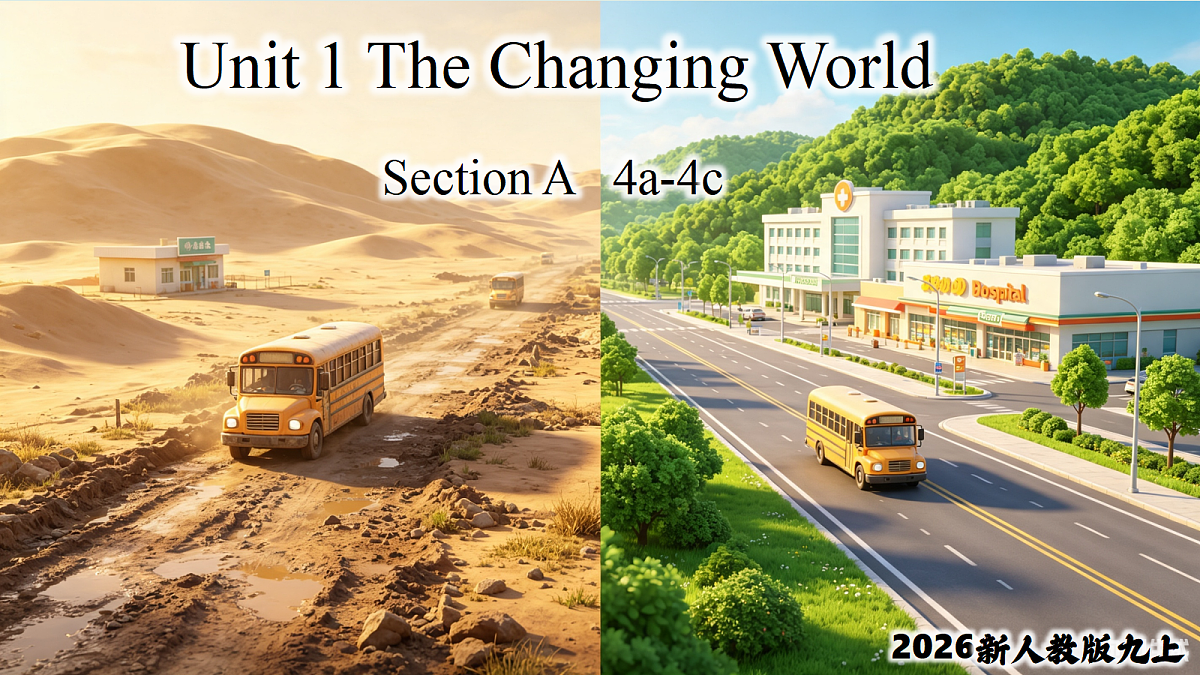
这是一份Unit 1 The Changing World Section A 4a-4c 课件新人教版九年级上册,共25页。
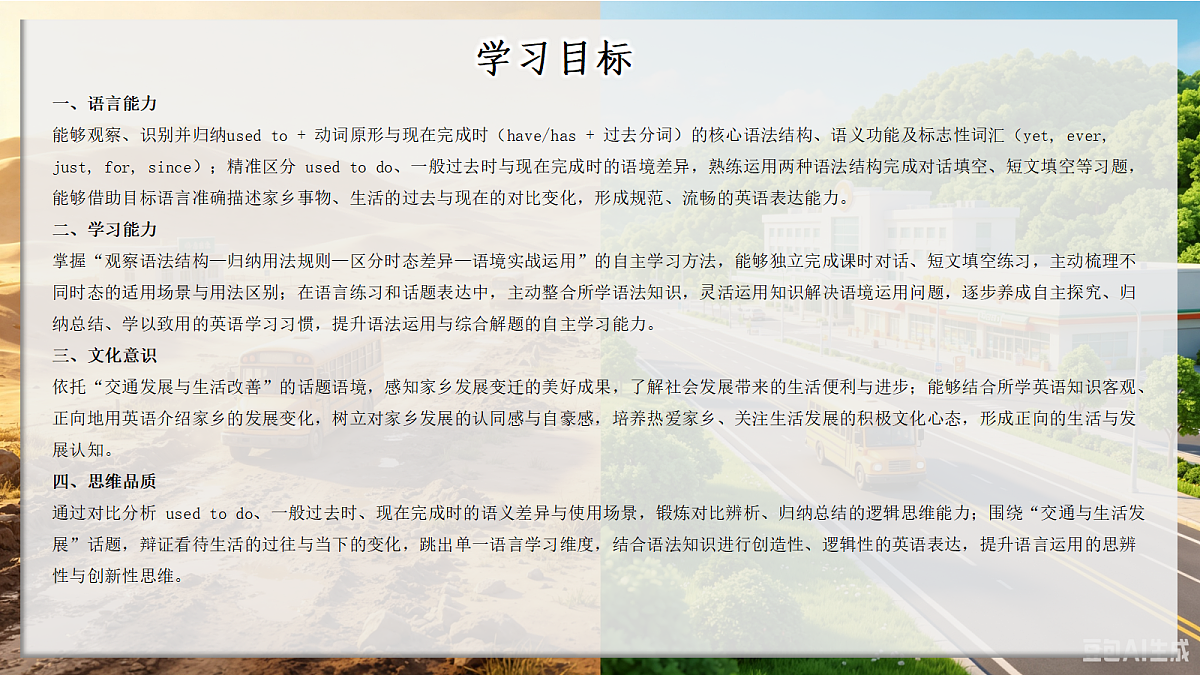
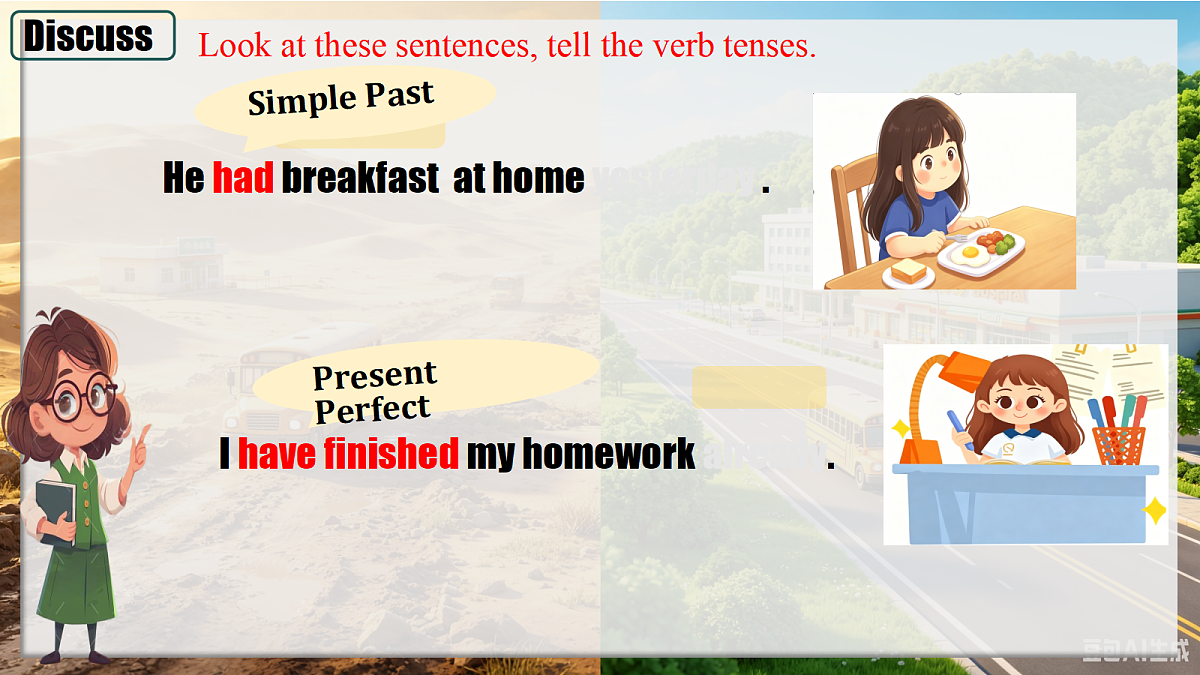
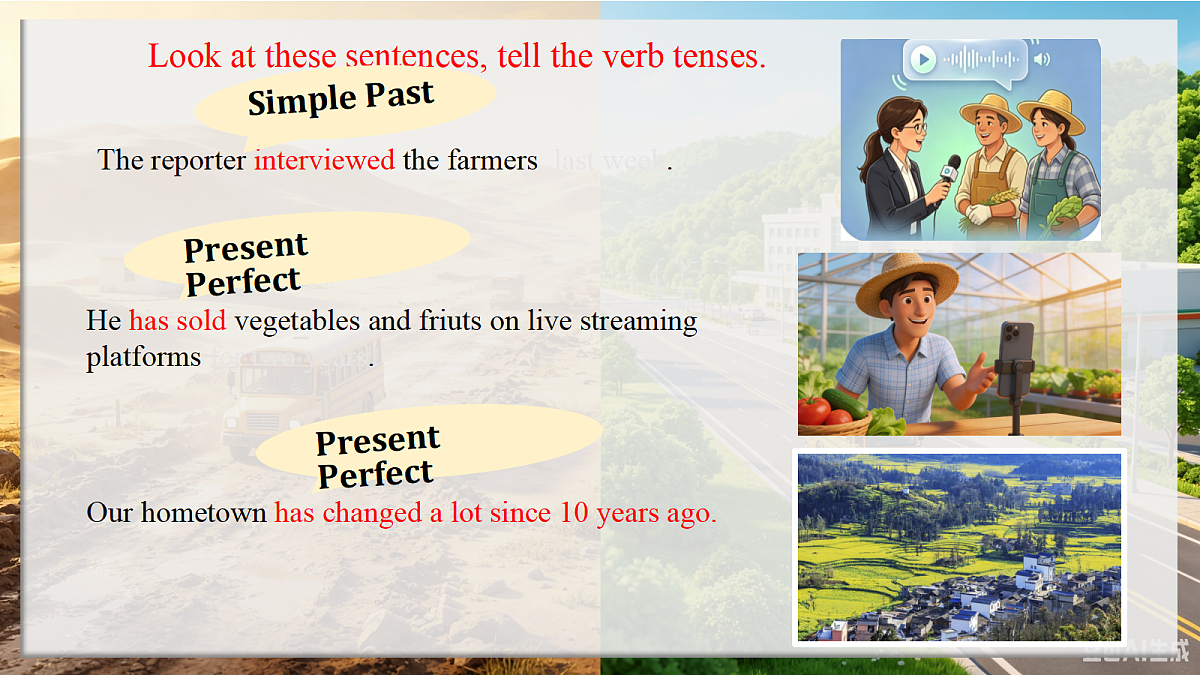
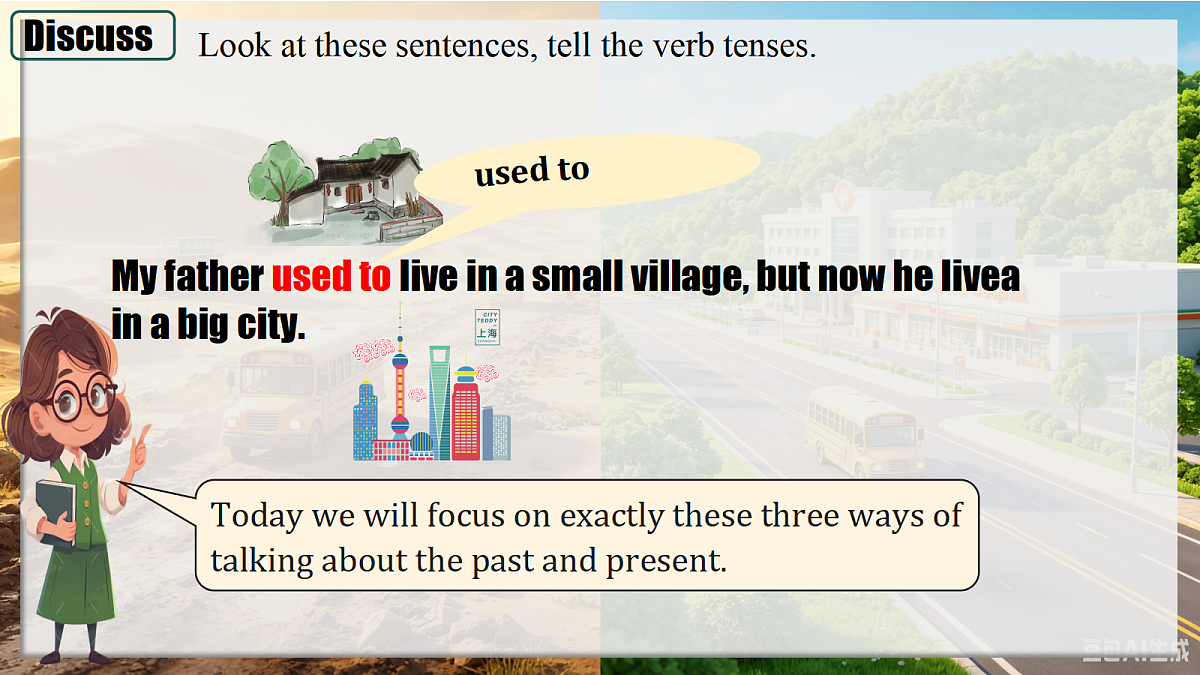
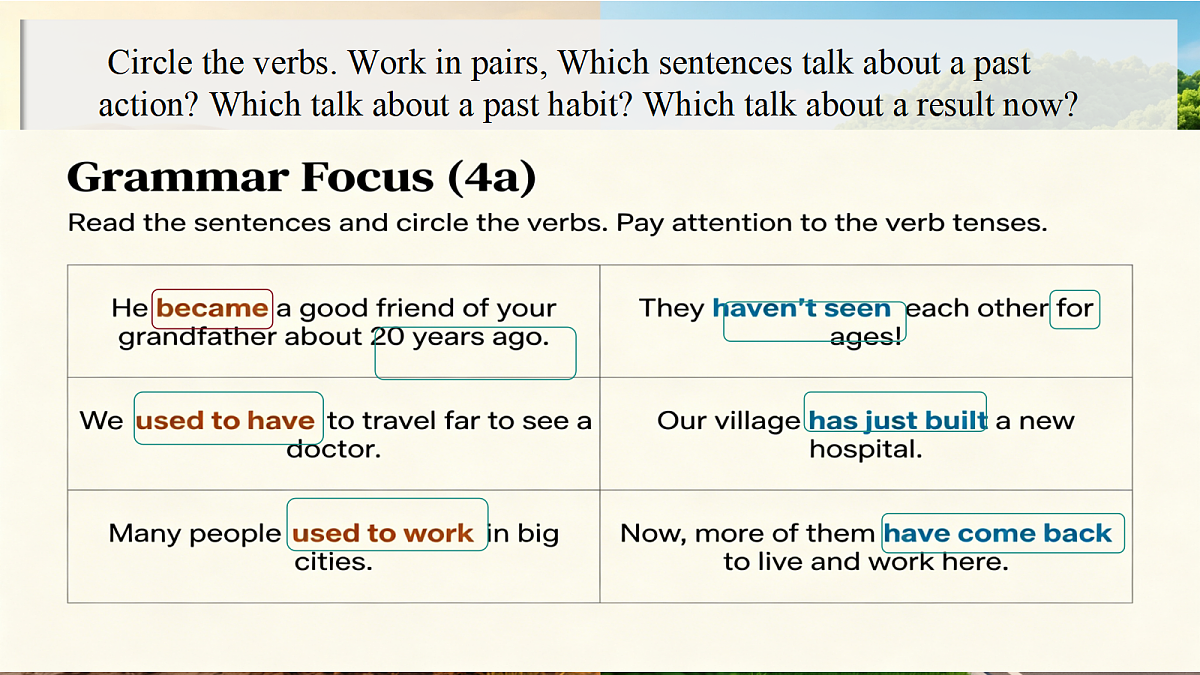
Unit 1 The Changing WorldSection A 4a-4c2026新人教版九上学习目标一、语言能力能够观察、识别并归纳used to + 动词原形与现在完成时(have/has + 过去分词)的核心语法结构、语义功能及标志性词汇(yet, ever, just, for, since);精准区分 used to do、一般过去时与现在完成时的语境差异,熟练运用两种语法结构完成对话填空、短文填空等习题,能够借助目标语言准确描述家乡事物、生活的过去与现在的对比变化,形成规范、流畅的英语表达能力。二、学习能力掌握“观察语法结构—归纳用法规则—区分时态差异—语境实战运用”的自主学习方法,能够独立完成课时对话、短文填空练习,主动梳理不同时态的适用场景与用法区别;在语言练习和话题表达中,主动整合所学语法知识,灵活运用知识解决语境运用问题,逐步养成自主探究、归纳总结、学以致用的英语学习习惯,提升语法运用与综合解题的自主学习能力。三、文化意识依托“交通发展与生活改善”的话题语境,感知家乡发展变迁的美好成果,了解社会发展带来的生活便利与进步;能够结合所学英语知识客观、正向地用英语介绍家乡的发展变化,树立对家乡发展的认同感与自豪感,培养热爱家乡、关注生活发展的积极文化心态,形成正向的生活与发展认知。四、思维品质通过对比分析 used to do、一般过去时、现在完成时的语义差异与使用场景,锻炼对比辨析、归纳总结的逻辑思维能力;围绕“交通与生活发展”话题,辩证看待生活的过往与当下的变化,跳出单一语言学习维度,结合语法知识进行创造性、逻辑性的英语表达,提升语言运用的思辨性与创新性思维。Lead-inDiscuss Look at these sentences, tell the verb tenses.He had breakfast at home yesterday .I have finished my homework already.Simple Past Present PerfectHe has sold vegetables and friuts on live streaming platforms for two years.The reporter interviewed the farmers last week.Our hometown has changed a lot since 10 years ago. Look at these sentences, tell the verb tenses.Present PerfectSimple Past Present PerfectDiscuss Look at these sentences, tell the verb tenses.Today we will focus on exactly these three ways of talking about the past and present.used toPresentation Circle the verbs. Work in pairs, Which sentences talk about a past action? Which talk about a past habit? Which talk about a result now?Grammar Focus: Simple Past Tense结构: 主语 + 动词过去式 (V-ed) + ...时间标志词 :yesterday, in +过去年代, last week, 一段时间+ago含义:描述过去发生的具体事件(动作已结束,与现在无关)The man was very busy last week. Grammar Focus: Present Perfect Tense结构:主语 + have/has +其它。时间标志词 already, yet, just, so far, for+一段时间, since+... 含义:过去发生的动作,对现在造成影响 / 结果 表示:从过去持续到现在的动作 / 状态She has kept this book for two weeks.Grammar Practice 1. The local government ______ massive improvements to the infrastructure since 2018.A. makes B. madeC. has madeD.will make2. Technological achievements ______ a deep influence on how we communicate yesterday.A. have hadB. hadC. hasD. havingCB3. The town built a new high-speed railway three years ago. (Change to Present Perfect using ‘since’) The town ____ ____ a new high-speed railway ______ three years ago.has builtsince4. They have experienced great achievements in environmental protection for a decade. (Change to Simple Past using ‘in 2014’) They _________ great achievements in environmental protection ____ ____.achieved in 2014Grammar Focus: used to结构: 主语 +used to +动词原形 含义:表示过去的某种经常性、习惯性的动作或行为.并意味着这种动作 目前已经不存在时间标志词 : used to,but now,强调 “今昔对比” He used to like coffee, but now he likes drinking tea .Grammar Focus: used to 句子结构否定句:主语+didn’t use to do sth./主语+usedn’t to do sth. 肯定句 :主语+used to do sth.一般疑问句 : Did+主语+ use to do sth.?/Used+主语+ to do sth.?He didn’t use to like coffee. /He usedn’t to like coffee._ Did he use to like coffee?/Used he to like coffee?_ Yes, he did./No,he didn’t.She used to have curly hair.used to do表示过去习惯性的动作或经常性的状态,现在已经不存在。She is used to getting up early.be/get used to doing习惯于做某事(可用于现在、过去、将来等多种时态)The knife is used to cut fruit.be used to do被用来做某事(是被动语态, 用于多种时态)Grammar主语 + have / has + done1.主语+be(were,was)2.主语 + 动词过去式一般过去时现在完成时1.主语 + be (am, is, are)2.主语 + 动词原形/单三一般现在时【主语 + used to+动词原形】过去习惯/状态(现在已改变)SummaryTIMEA: ______ you ______ (be) to the new library yet?B: No, I ______________ (not know) there was a new library. When did it ______ (open)?A: It ____________ (open) last Friday. I _____________ (go) there with my grandpa on Saturday night.B: ______ you ______ (like) it?A: Of course! It’s the most high-tech library I __________ ever __________ (visit).B: Oh, what ______ you ______ (see) there?A: There are sections with books about science and Chinese culture, as well as a huge section with children’s books. I also ______ (read) some digital books on the computer. My grandpa _____________ (listen) to some audio books because he can’t see well.B: Cool! I ________________ (bring) my little brother there tomorrow.Have beendidn’t know open opened went Do like have visited did see read listened will bring 对过去不知道某事的陈述关于科学和中国文化的书籍有声读物have been to… 去过某地(现在已经回来)询问现在的感受read 的过去式还是 readIn the past, it ______ (be) difficult to travel in Guizhou. In many places, there used to ______ (be) no bridges to cross over mountains and rivers, and most roads were just dirt tracks. This ______ (make) it difficult for locals to bring products to the market or to develop industry.Now great changes ____________ (take) place. The government ___________ (build) thousands of kilometres of highways, railways, and wide roads. It has also built many high bridges over mountains and rivers. A journey that used to _________(take) a day now takes only a few hours. As a result, the lives of local people __________________ (improve). They are much richer and happier than they once ________ (be).was be made have taken has built take have improved were make it + adj. + to do sth.使做某事…强调对现在的影响wasbemadehave takenhas builttakehave improvedweren.泥土n.小路adj.宽阔的4cwho has helped make life better? Parents? Teachers? Workers? hard work of many people and the support of the government.1.In Guizhou, My parents have worked hard to give me a good education.The workers have built a new park for us.2.In our hometown,ThinkingThinkingNew roads may destroy old forests. Changes can bring problems too.Not All Changes Are GoodWe should balance development with health.What should we do?Fast food restaurants – convenient but unhealthy. We should ...Thinking1.My grandfather ______ drink coffee every morning, but now he prefers tea.A. used to B. is used to C. gets used to 2.He ______ be shy, but now he enjoys giving speeches in public, ______ he?A. used to;didn’t B. used to; doesn’t C. is used to; isn’t3.— Did your sister ______ stay up late to study? — No, she ______. But now she ______ working until midnight.A. used to; didn’t; is used to B. use to; didn’t; gets used toC. used to; wasn’t; is used to 4.—Tina, when did you come to Guangyuan? —Oh, many years ago. I ________ here since I was five.A.have goneB.have beenC.wasD.am4.—Peter, did you play table tennis with your friends after school yesterday?—No, I didn’t. We ________ vegetables in our school garden.A.waterB.have wateredC.wateredD.are going to waterExerciseABABCHomeworkNeed to do:完成课本4b、4c的错题订正,在对话和短文中正确运用“I used to...”, “Have you ever...?”描述变化。02. 能力拓展采访你的同学或伙伴描述他们社区至少2个变化,然后用英语完成采访描述。Choose to do:
 新教材
新教材
注册成功
资料篮

在线客服
添加在线客服
获取1对1服务
官方微信
关注“教习网”公众号
打开微信就能找资料
赛课定制
添加在线客服
获取1对1定制服务
职称咨询
添加在线客服
获取1V1专业指导服务

免费福利

.png)
.png)
.png)
