 免费领取教师福利
若您为此资料的原创作者,认为该资料内容侵犯了您的知识产权,请扫码添加我们的相关工作人员,我们尽可能的保护您的合法权益。




这是一份Unit 2 Inspiring People (课件)2025-2026学年人教版九年级英语上册,共79页。
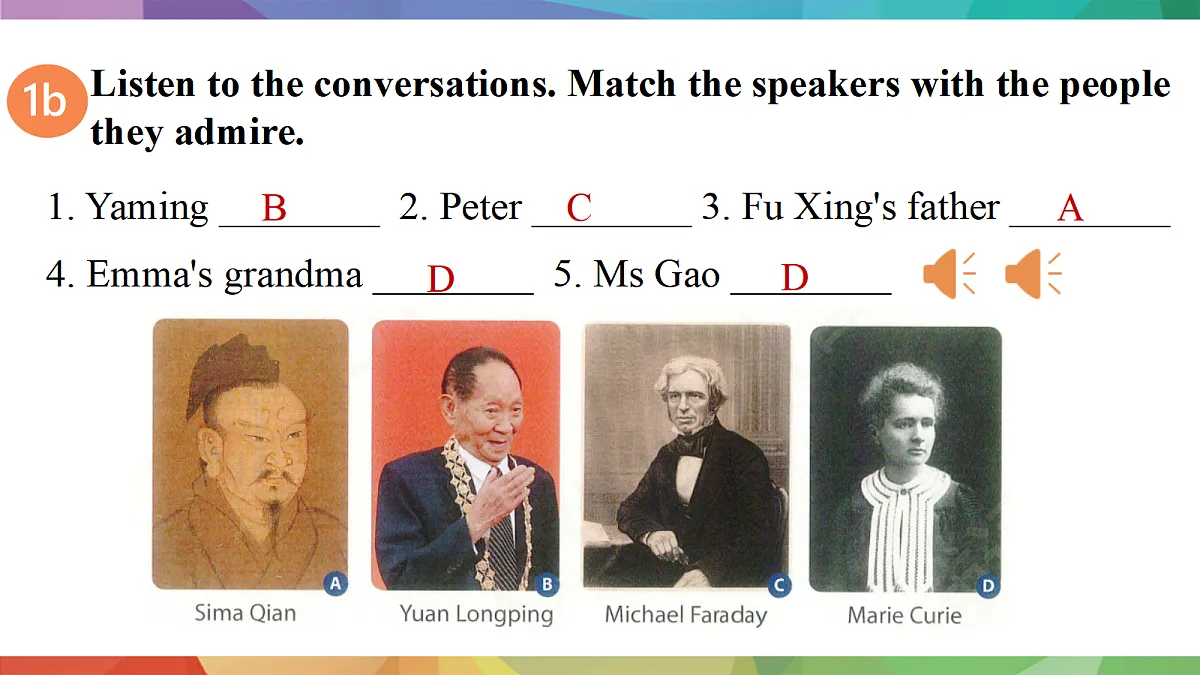
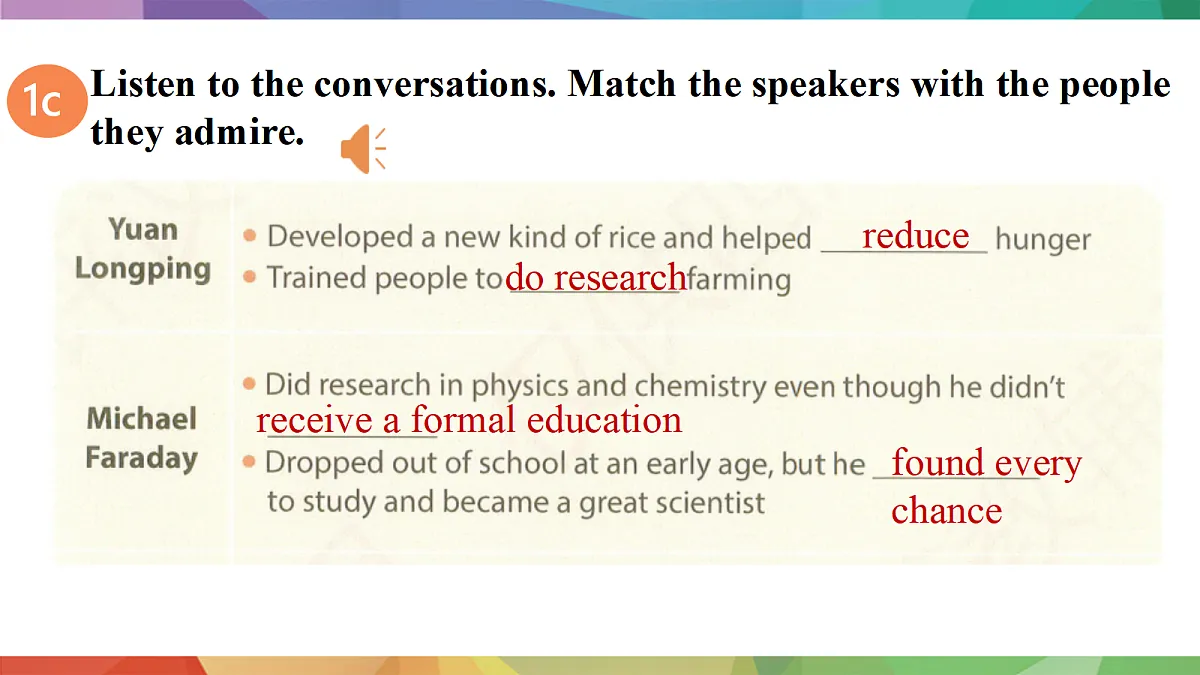
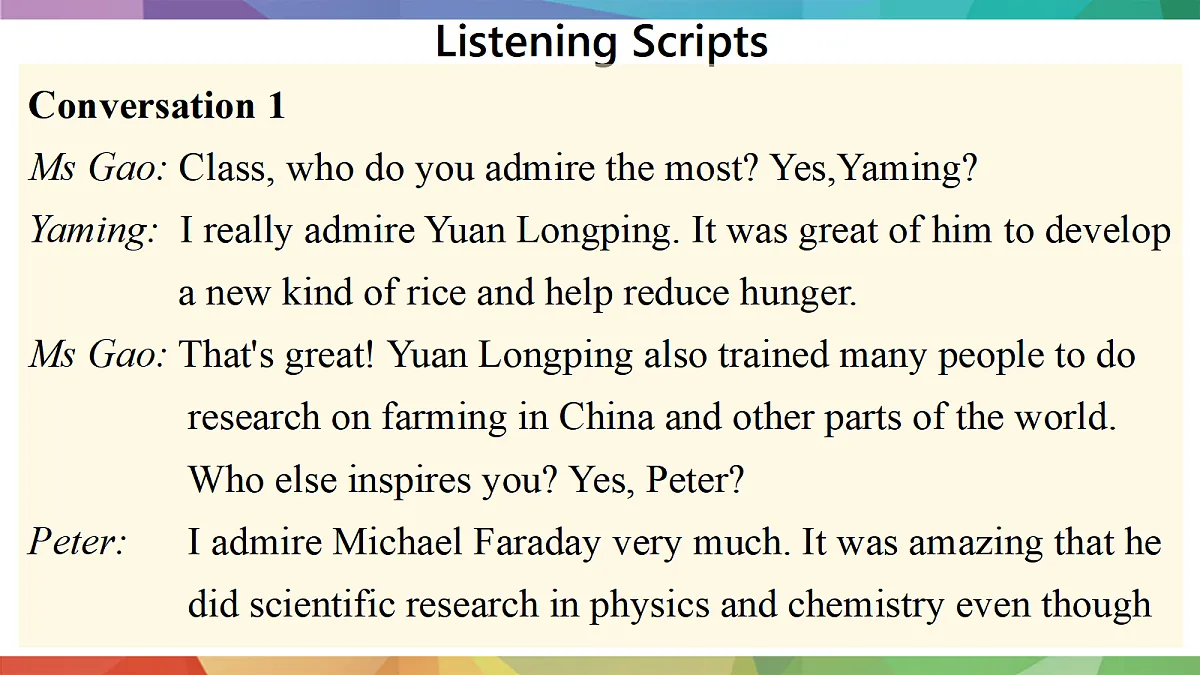
Unit 2 Inspiring PeopleSection A Who do we admire?(1a-1d)Learning ObjectivesIn this lesson you will:identify some famous people and their professions.2. listen for specific details to match speakers with the people they admire and complete the notes.3. talk about a person they admire and explain the reason using the target language.Look and Share1. Who do you see in this picture?2.Do you know any of these people andtheir stories?3. What do these people have in common?writer____ historian____ professor ____ teacher____researcher____ scientist____ chemist____ physicist___Match the people with their professions. More than one option is possible.Listen to the conversations. Match the speakers with the people they admire.1. Yaming ________ 2. Peter ________ 3. Fu Xing's father ________4. Emma's grandma ________ 5. Ms Gao ________BCADDListen to the conversations. Match the speakers with the people they admire.reducedo researchreceive a formal educationfound every chanceauthorplay a big part physicsWon twoListening ScriptsConversation 1Ms Gao: Class, who do you admire the most? Yes,Yaming?Yaming: I really admire Yuan Longping. It was great of him to develop a new kind of rice and help reduce hunger.Ms Gao: That's great! Yuan Longping also trained many people to do research on farming in China and other parts of the world. Who else inspires you? Yes, Peter?Peter: I admire Michael Faraday very much. It was amazing that he did scientific research in physics and chemistry even though he didn't receive a formal education.Ms Gao: Yes, Michael Faraday dropped out of school at an early age, but he found every chance to study and became a great scientist. Thanks!Conversation 2Ms Gao:Who do your parents or grandparents admire? Do you know, Fu Xing?Fu Xing: Yes, Ms Gao. My father loves history. He admires SimaQian.Ms Gao: Ah yes, the author of the book Shiji (Records of the Historian). He also played a big part in reviewing the Chinese calendar at that time.Fu Xing: Oh, I didn't know that. But I know he was the kind of person who never gave up.Ms Gao: Right. It's always important to keep going in life. What about you, Emma?Emma: My grandma told me about Marie Curie, a great scientist. She made many important discoveries in physics and chemistry.Ms Gao: Yes. I admire Madame Curie too! It was difficult for women to do that kind of work back in those days. And she won two Nobel Prizes!What do you think about the people mentioned above? Talk about who you admire and why.Unit 2 Inspiring PeopleSection A Who do we admire?(2a-2d)Learning ObjectivesIn this lesson you will: identify key figures and match them with their achievements and fields of work. listen for specific details to match family members with the people they admire, and complete fact-based notes.discuss why certain figures are inspiring using target language and sentence patterns.Match the people with their achievements.1.____was an important engineer in the 19th century.2.___made important discoveries in physics.3.___volunteered as a nurse to help the wounded soldiers.4.___created a test to see if a computer could really think like a person.BACDListen to the conversation. Who does each family member admire?1. Dad admires___. 2. Mum admires___. 3. Steve admires___.BCADListen again and circle the coloured words you hear to complete the notes.Listening ScriptsGina: Dad, do you have a second? We need to do a survey of family members about their most admired people. Can you help me, please? Dad: Sure. Go ahead.Gina: OK, Dad. Who do you admire the most?Dad: For me, it has to be Isambard Brunel, a famous English engineer. He built the first British railways and many other important things such as bridges, ships, and tunnels. All these helped the UK develop into a modern nation.Gina: Oh, I see. How about you, Mum?Mum: Well, I am really inspired by Florence Nightingale. She created modern nursing. It was wonderful of her to help us understand the need for cleaner hospitals to stop the spread of diseases.Gina: That's nice. What about you, Steve?Steve: Isaac Newton, of course. It was so important that he developed modern physics! I also admire Alan Turing. You know the famous Turing test? It's so cool!Gina: Yes, I agree. He was a pioneer of computer science. Thanks, Steve.Match the people with their fields of work. Then discuss why these people are inspiring.railwaysea travelphysicsmedicinemedicinerailwayphysicssea travelUnit 2 Inspiring PeopleSection A Who do we admire?(3a-3c)Learning ObjectivesIn this lesson you will:get the detailed information about the inspiring people mentioned in the dialogue.grasp the key expressions and sentence patterns to talk about inspiring people.learn about inspiring figures from different fields and appreciate their positive qualities.Read the conversation and complete the chart.Adam: Hi, everyone. Who is the person you admire the most?Yaming: My favourite person is I.M. Pei.Adam: Did he design the glass pyramid at the Louvre Museum?Yaming: Yes. It was very creative of him to design it. The Suzhou Museum is also one of his amazing designs. He created a beautiful balance between the East and the West.Adam: Wow, you really know a lot about him!Yaming: I read books and reports about him. I want to be a creative person like him.Adam: What about you, Chen Jie? Who inspires you?Chen Jie: Wang Yaping, of course, China's first woman to walk in space. She is full of courage and wisdom. She was also the first woman to teach a live class from space. What about you, Adam? Who do you look up to?Adam: Me? My biggest inspiration is not a famous person. It's my father. It's really very nice of him to support and encourage my exchange study here.designedSuzhou Museumcreated a beautiful balancewalk in spaceteach a live class from spacecourageand wisdomAdam’sencouraged his exchange studyListen to the conversation. Pay attention to the questions the speakers used. Then role-play the conversation.Work in groups. Discuss who you admire and why. Use the words and expressions to help you.creative brave amazing inspiring full of courage full of wisdom great curiosity dream big never give up ...Group WorkUnit 2 Inspiring PeopleSection A Who do we admire?(4a-4c)In this lesson you will:master the two core sentence patterns: It is + adj. + (for/of) sb. + to do sth. and It is + adj. + that..., and use them correctly.finish sentence transformation and cloze exercises skillfully to apply the grammar flexibly.use the target patterns to describe inspiring people and their deeds, connecting grammar learning with the theme "the power of role models".Learning ObjectivesRead the sentences. Complete each sentence with a person you know of.It was great of ... to develop a new kind of rice and help reduce hunger.It is always important (for ...) to keep going in life.It was amazing that ... did research in physics and chemistry even though ...It was difficult for ... to do that kind of work back in those days.It's really very nice of ... to support and encourage ...Grammar Rules句型结构:It is/was + adj.+ of sb. + to do sth.描述人的品质(例如:kind, silly, clever, generous...)It was brave of him to save the child.(他救了那个孩子,真勇敢。)It was generous of him to donate so much money.(他捐了这么多钱,真是慷慨。)It’s wise of her to follow the doctor’s advice.(她听从医生的建议,真是明智。)e.g. 可改写为:sb. + be + adj. + to do sth.常见的表示品质类的形容词有:silly(愚蠢的), stupid(笨的), foolish(傻的), careless(粗心的), rude(粗鲁的), mean(刻薄的), selfish(自私的), wicked(邪恶的)...kind(善良的), nice(好的), good(好的), generous(慷慨的), thoughtful(体贴的), considerate(考虑周到的), polite(有礼貌的), clever(聪明的), wise(明智的), brave(勇敢的)...褒义: 贬义:句型结构:It is/was + adj.+ for sb. + to do sth.描述后面的不定式动作(例如:important, necessary, easy ...)It is important for us to learn English well.(对我们来说,学好英语很重要。)It’s difficult for me to solve this problem.(对我来说,解决这个问题很困难。)It is necessary for you to finish the work on time.(对你来说,按时完成工作是必要的。)e.g. 句型结构:It is/was + adj.+ that 从句.这是一个主语从句,it为形式主语,真正的主语是后面的that 从句。adj.表达对后面从句所陈述的时间的评价。It is true that he is from China. (他来自中国,这件事是真的。)It was surprising that they won the game. (他们赢了比赛,这件事令人惊讶。)It is obvious that he is lying.(很明显,他在撒谎。)e.g. 表示“确定性”或“真实性” : true (真实的),clear(清楚的), obvious(明显的),certain(肯定的),sure (确定的), likely(可能的)表示“重要性”、“必要性”或”紧迫性”: important(重要的),necessary(必要的),essential(必不可少的),vital(至关重要的),urgent(紧急的)表示“惊讶”、“奇怪”或"情感”: surprising (令人惊讶的), amazing (令人惊奇的),strange(奇怪的), funny(好笑的),unfortunate(不幸的),interesting (有趣的),wonderful (太好了)常见的形容词有:Rewrite each sentence using the words in brackets.1. We listen to our teacher's advice. (helpful / necessary / important)→ It is helpful / necessary / important for us to listen to our teacher's advice.2. Tall trees can grow from tiny seeds. (amazing / interesting / wonderful)→It is__________________________________________________3. Confucius said that we should treat our elders with respect. (wise)→It was wise of __________________________________________amazing / interesting / wonderful that tall trees can grow from tiny seeds. Confucius to say that we should treat our elders with respect.4. Professor Gui's childhood dream of becoming a space scientist came true through his efforts and hard work. (inspiring)→It was inspiring that_____________________________________________________________________________________________5. Victor Hugo stood up for the common people he cared about. (brave)→ It was brave of__________________________________________Professor Gui's childhood dream of becoming a space scientist came true through his efforts and hard work. Victor Hugo to stand up for the common people he cared about. Complete the passage with the correct sentence parts. In what ways do you find Zhang Qian inspiring? Give your reasons.A. It is important for us B. It was really brave and admirableC. It is always inspiring D. It seemed impossible for him________to read about great people and learn their stories. Recently, I read about Zhang Qian, the pioneer of the famous Silk Road. In order to help defeat his enemies, Emperor Wu of the Han Dynasty sent Zhang Qian to find the Yuezhi people. Unfortunately, Zhang Qian was caught by the enemy.________to finish his task or to return home. However, around 10 years later, he got a chance to run away,DCand he finally succeeded in finding the Yuezhi people.________that he never forgot his task, and his travel also brought back valuable information about the Western Regions. Later, he was sent to these places again to build relationships. Stories like this give us power and inspiration.________to understand the past and find ways to do more for a better future.BAUnit 2 Inspiring PeopleSection B What makes people admirable?(1a-1f)& Vocabulary in UseLearning ObjectivesIn this lesson you will: understand the main ideas and key details of the text. use context clues to guess the meaning of key words and phrases and use them in their own sentences. learn about the importance of seed science and what makes Zhong Yang an inspiring figure. talk about what they can learn from Zhong Yang.Look at the title of the text. What do you think a seed scientist does? Do you think it is an interesting job?The Inspiring Seed ScientistRead the text quickly. Who was the seed scientist? What did he do?The seed scientist is Zhong Yang. Zhong Yang collected many important seeds for China’s banks. Read again and match each paragraph with its topic.Paragraph 1Paragraph 2Paragraph 3Paragraph 4Paragraph 5A. Training local students to do important workB. Introduction to Zhong Yang and seed banksC. What he left behindD. Becoming interested in seedsE. Starting to work and collect seeds in XizangFill in the blanks with the information from the text. Then put the events into the timeline and tell the story of Zhong Yang in your own words.A. Zhong Yang was born.B. He ________________ at the age of 15.C. He began ________________ to train local students.D. He died in ________________.E. He studied ________________ and later ________________.F. He travelled around Xizang to ________________.G. ZhongYang ___________________ plants.entered universitya programme a car accident radio engineering became interested in plantscollect seeds spent his whole life researchingABEFCDExplain the meanings of these sentences in your own words. Pay attention to the underlined words.1. It was very difficult for him to bravethe cold weather and great heights.2. His love for his job and research liveson in his students.Discuss the questions.1. Why did Zhong Yang want more people to do seed collection and research?From the article, we know that seed banks need many different kinds of seeds to protect important plants from disappearing forever. The work of seed collection and research is very hard, and it involves a huge amount of work. Also, he knew that important scientific work could be done better with more people involved. He wanted to train local students to become scientists so that the research could continue, and more seeds and plant information could be collected for China and the world.2. What made Zhong Yang admirable? What can we learn from him?What made him admirable: He dedicated his whole life to researching plants and seeds, collecting many important seeds for China’s seed banks to protect plant diversity. He overcame great difficulties (cold weather, high altitudes, illness) to collect seeds in Xizang, showing strong perseverance and dedication. He trained local students to continue the work, passing on his spirit and knowledge, which means his legacy lives on beyond his own life.What we can learn from him: We should have a strong love and curiosity for our chosen field, and stick to our goals even when facing hardships. We should be willing to make contributions to society and the world, not just for personal gain. We should value passing on knowledge and spirit to younger generations, so that good work can continue for a long time....Circle the correct words to complete the sentences. Then write down more words ending with -ist,-er, and -ian.Vocabulary in Use1. When my sister grows up, she wants to become a science / scientistbecause she likes to find out how the universe works.2. The history / historian wrote a book about the successful development of socialism in China.3. My favourite school subject is chemistry / chemist. I love mixing things together and learning why they change.4. Some biology / biologist students at the university are studying how life on earth began.5. Teng Fei likes physics / physicist very much, and he wants to be a scientific researcher / research in the future. -ist-er -ianartistpianistdentistjournalist...teacherwritersingerdancerdriverfarmerengineer...musicianpoliticianlibrariantechnician...Complete the sentences with the correct forms of the words in the box.1. I heard about the latest discoveries about black holes on the ________.2. Curiosity and________lead us to explore the secrets of the universe.3. I would love to have lunch with you next week. Let me check my ________to see if I am free.4. You'd better wear a mask when you go out. The disease is ________ , and the number of patients is going up.5. Marie Curie's ________ daughter, Irène, was also very interested in science and won a Nobel Prize in Chemistry.radiowisdomcalendarsopreadingelderComplete the passage with the correct forms of the words in the box. Try to introduce Amelia Earhart in your own words.Amelia Earhart was always a brave child, full of_________. Her parents supported and _________ her to be herself. After taking her first flight in a plane, she knew that she wanted to become a _________ more than anything else in the world. Later, she worked hard to pay for her own flying lessons. In 1922, she flew higher than any woman had done before. Earhart is bestcourageencouragedpilotknown for being a flight_________as the first woman to fly onher own across the Atlantic Ocean in 1932.She became famousaround the world. Many people_________ Earhart and find her an inspiring person because of her efforts to work hard and her ability to make her dreams _________.pioneerlook up tocome trueUnit 2 Inspiring PeopleSection B What makes people admirable?(3a-3d)Learning ObjectivesIn this lesson you will: get the key details about Mozi from the online post. learn how to organize information about an inspiring person. use the structured chart to write their own online post about an inspiring person.Read an online post. Who does the writer admire? Why?The writer admires Mozi. Because Mozi was a great thinker who spent his life working for peace. He believed in universal love—everyone should treat others with equal kindness, and countries should not fight. His ideas of peace and love still inspire people today.Complete the chart using the information from the post.thinkerWarring Statespeaceshould avoid attacking oneanother.live onhear the message of peace and loveComplete the chart using the information from the post.Use your notes to write a post about the person you find inspiring.Sample WritingTo me, one of the most inspiring people in modern history is Tu Youyou, a great Chinese medical scientist. Born in 1930, she has dedicated her life to fighting deadly diseases around the world.Tu Youyou lived and worked in China at a time when malaria was killing millions of people every year. She knew she had to find a solution, so she spent years researching traditional Chinese medicine to discover a cure.Her biggest achievement was discovering artemisinin, a medicine that treats malaria. She did thousands of experiments, and even tested the medicine on herself to make sure it was safe. She believed that everyone deserved access to life-saving treatment, no matter where they lived.Though Tu Youyou is in her 90s, her spirit of perseverance and selflessness lives on. I think she is still a great inspiration to scientists and people everywhere. Now, more than ever, the world needs her courage and dedication to fight global health challenges and build a healthier future for all.Lesson 7 ProjectUnit 2 Inspiring PeopleLearning ObjectivesIn this lesson you will:1.do some research on some inspiring people and summarize the qualities they have in common.2.create a poster of one inspiring people that you choose.Make a wall of inspirationBrainstorm inspiring people you know of. Then do some research on each one and write down a simple introduction. Here are some examples.He ZehuiA brilliant physicist known as China's Madame CurieDedicated her life to science and teaching young researchersMao YishengA famous engineer known as“the father of modern bridges in China”Shared his knowledge by teaching at universities and writing booksGalileoAn Italian mathematician, philosopher, and astronomerDiscovered that Earth moves around the sunHuang WenxiuA young village leader who worked to fight poverty in the countrysideBelieved that serving the people was the most important for a party memberDiscuss what these inspiring people have in common. List the qualities you all agree on.Work in your groups to choose a person you admire and make a poster.Present your poster to the class. Put it on the wall of inspiration in your class or school hallway.Reflecting1. What inspiring people have you learnt about? Why are they inspiring?2. What are some words and expressions to describe inspiring people?3. Can you talk about who you admire and explain why?4. In what ways have the stories in this unit inspired you? How can you inspire people around you?Reading PlusUnit 2 Inspiring PeopleLearning ObjectivesIn this lesson you will:1. learn about Edward Jenner’s story and how he helped stop smallpox.2. talk about what qualities Jenner had and what they can learn from him.Edward Jenner and the Battle Against SmallpoxSmallpox used to be one of the worst global diseases. It killed millions of people in history. However, we do not hear much about it anymore. Why? Because it is no longer around in nature. This happened mainly because of the work of Edward Jenner (1749-1823), an English doctor and scientist.Jenner did not have an easy childhood. His parents died when he was young, and his elder brother raised him. It was difficult for him to do well in school, but he had a passion for nature. At 13, he became an apprentice to a doctor for eight years. An apprentice is a young person who learns a job by working for someone else. It was hard for doctors to be well-respected at that time because modern medicine had not fully developed. When he was 21, he studied at a hospital in London.After he finished his studies, Jenner went back to his home in the countryside because he liked it more. There, he became a family doctor and people started to hear about his good work. In his free time, he continued to do research and study nature.It was while working as a doctor that Jenner discovered that milkmaids—women who milk cows—rarely got smallpox. They often got cowpox, a disease like smallpox, but these milkmaids did not get very sick and they did not die. He wondered: Domilkmaids get protected from smallpox just because they often get cowpox?To test this, Jenner came up with the idea of first giving some people cowpox, then giving them smallpox. These people did not get the smallpox! After many other tests, he realized that cowpox could actually be used to protect people from getting smallpox.Jenner invented a new word to describe what he had created:“vaccine". The word comes from the Latin word for “cow". It was wonderful that, because of Jenner's work, smallpox is not around anymore andpeople no longer die from it. His pioneering research has been used to create vaccines for other diseases.A. He became one of the best doctors in the world.B. He developed a new way to do science.C. He found a way to protect people from a disease.Read the text. What was Edward Jenner's major achievement?1______ A. born in England in 1749______ B. became a family doctor______ C. developed a vaccine for smallpox______ D. became a doctor's apprentice______ E. went to London to study there______ F. moved back to the countrysideNumber the events in Edward Jenner's life in the order they happened.2123456They rarely got smallpox, but often got cowpox and did not get very sick.31. What was Jenner interested in when he was young?________________________________________________2. Why did Jenner go back to the countryside?________________________________________________3. What did Jenner notice about milkmaids?________________________________________________4. Where did the word“vaccine”come from?________________________________________________From the Latin word for "cow".Nature.Because he liked the countryside more.Write short answers to the questions.
 新教材
新教材
注册成功
资料篮

在线客服
添加在线客服
获取1对1服务
官方微信
关注“教习网”公众号
打开微信就能找资料
赛课定制
添加在线客服
获取1对1定制服务
职称咨询
添加在线客服
获取1V1专业指导服务

免费福利

.png)
.png)
.png)
