免费领取教师福利


若您为此资料的原创作者,认为该资料内容侵犯了您的知识产权,请扫码添加我们的相关工作人员,我们尽可能的保护您的合法权益。

这是一份人教版(2024)七年级下册(2024)Unit 4 Eat Well教案设计,共14页。
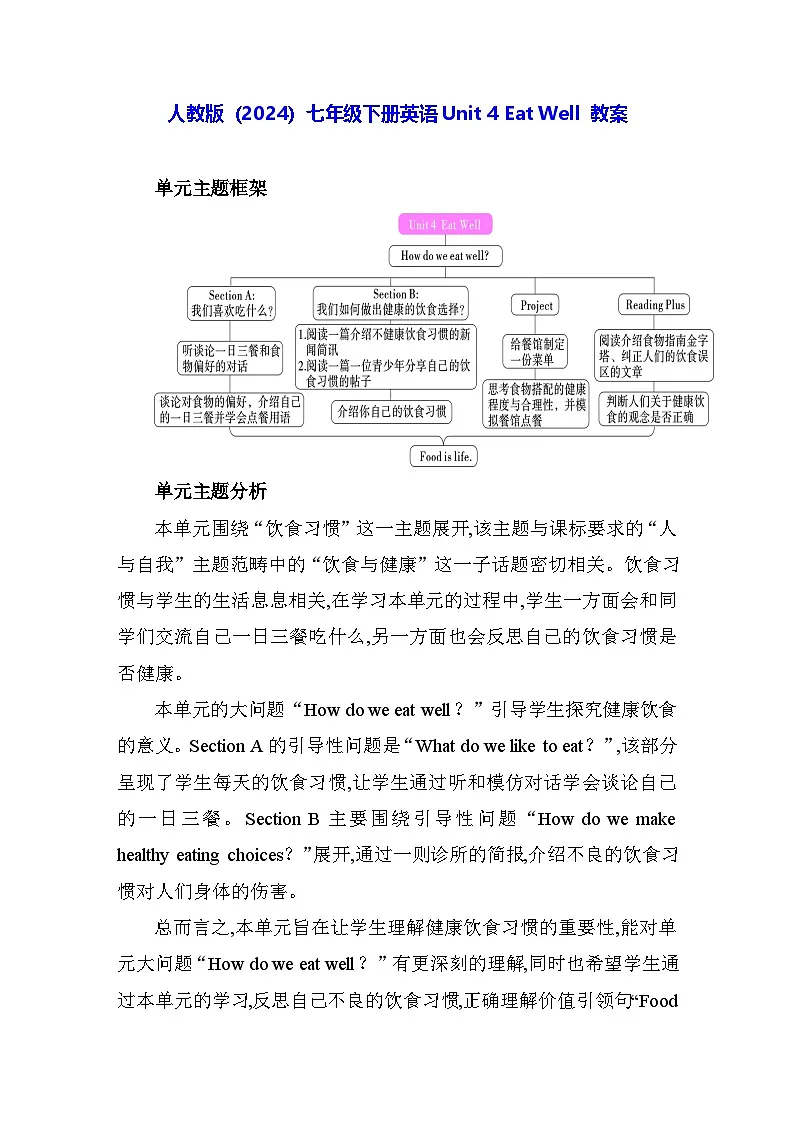
单元主题框架
单元主题分析
本单元围绕“饮食习惯”这一主题展开,该主题与课标要求的“人与自我”主题范畴中的“饮食与健康”这一子话题密切相关。饮食习惯与学生的生活息息相关,在学习本单元的过程中,学生一方面会和同学们交流自己一日三餐吃什么,另一方面也会反思自己的饮食习惯是否健康。
本单元的大问题“Hw d we eat well?”引导学生探究健康饮食的意义。Sectin A的引导性问题是“What d we like t eat?”,该部分呈现了学生每天的饮食习惯,让学生通过听和模仿对话学会谈论自己的一日三餐。Sectin B主要围绕引导性问题“Hw d we make healthy eating chices?”展开,通过一则诊所的简报,介绍不良的饮食习惯对人们身体的伤害。
总而言之,本单元旨在让学生理解健康饮食习惯的重要性,能对单元大问题“Hw d we eat well?”有更深刻的理解,同时也希望学生通过本单元的学习,反思自己不良的饮食习惯,正确理解价值引领句“Fd is life.”,养成健康良好的饮食习惯。
单元教学目标
通过本单元学习,学生能够:
1.谈论自己及他人每餐吃什么食物。
2用英语说出自己一日三餐的食物。
3.询问别人的食物喜好,并提供选择。
4.辨别字母及字母组合a,,u,w在单词中的不同发音,并注意选择疑问句中单词的语调。
5.掌握可数名词和不可数名词的用法。
6.了解健康饮食的重要意义,帮助学生培养良好的饮食习惯。
单元教学重难点
重点:
1.能够用英语说出自己一日三餐的食物。
2.询问别人的食物喜好,并提供选择。
3.将字母及字母组合a,,u,w的发音规律准确运用到认读单词中。
4.掌握选择疑问句的句型和语调。
5.掌握可数名词和不可数名词的用法。
难点:
1.学会字母及字母组合a,,u,w的发音。
2.掌握可数名词和不可数名词的用法。
第一课时 Sectin A(1a-1d)& Prnunciatin
学习目标
In this lessn,students will:
1.understand the cnversatin abut fd chices between Jane and Li Meng;
2.talk abut what they eat fr breakfast,lunch and dinner;
3.prnunce letter and letter cmbinatins a,,u,w crrectly.
教学建议
Step 1 Leadin
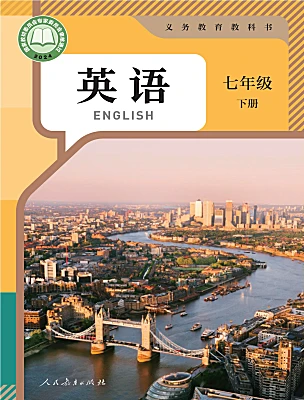
1.Shw the title and pht n Page 25 and ask students t think abut the questin:
◆Lk at the title and the pht.What d yu think this unit is abut?
2.Ask students t lk at the pht mre carefully and answer the questins:
◆Can yu name any f the fds r dishes in the pht?
◆Which dish wuld yu like t eat the mst?
◆What is yur favurite fd?D yu ften eat it?
3.Ask students t read the Big Questin and the leading questins in Sectin A and Sectin B.Make sure students knw the main tpic f this unit.
呈现单元标题和单元主题图,鼓励学生大胆预测本单元可能谈论的话题,并通过讨论吸引学生的兴趣。
Step 2 Listening&Speaking (1a—1d)
Prelistening
Page 26,1a
1.Shw sme pictures f fds and review the English names f these fds.
2.Ask students t write the name f the fds n the blank line under the pictures.Then ask them t answer the questin:Which fd(s) d yu like?
回顾和复习常见食物的英文名称。谈论自己喜欢的食物,引起学生对话题的兴趣。
Whilelistening
Page 26,1b
1.Ask students t read the wrds in 1b and guess which answer may be chsen.
2.Ask students t listen t the first cnversatin.Then tick what Li Meng and Jane wuld like fr lunch.
3.Check the answers with the class.
Page 26,1c
1.Ask students t read the wrds in 1c and make sure they understand the meanings.Lead students t understand the sentence patterns “What d yu have fr B/L/D?” and “I have... fr B/L/D.”
e.g.T:In the mrning,I have tw eggs.S I can als say I have tw eggs fr breakfast.Then,what d yu have fr breakfast?
2.Ask students t listen t the secnd cnversatin.What des Jane have fr breakfast(B),lunch(L) and dinner(D)?
3.Check the answers,and then ask students t crrect the false sentences.
理解听力对话内容、获取细节信息,并在听力中学习和理解目标语言。
Pstlistening
Page 2,1d
1.Let students wrk in pairs,and then ask their classmates abut their meals fllwing the example in 1d.
2.Invite sme grups t share their cnversatins.
分组操练本节课的目标语言。
Summary
Ask students t summarise the sentences that can be used t describe what they eat fr meals:
—What d yu usually have fr breakfast/lunch/dinner?
—I usually breakfast/lunch/dinner.
总结本节课需要掌握的句型。
Step 3 Prnunciatin (1—2)
Page 27,1
1.Ask students t listen t the recrding and repeat the prnunciatin.
2.Ask students t pay attentin t the different prnunciatin f letters and letter cmbinatins.
3.Let students add mre wrds t each grup.
通过边听边跟读练习发音,并通过观察总结发音规则。
Page 27,2
1.Shw the cnversatin in Prnunciatin 2 t students and ask them t read.
2.Ask students t listen t the recrding and repeat the prnunciatin.Then let students ntice the intnatin.
3.Explain the intnatin in alternative questins.
◆选择疑问句提供两种或两种以上情况,问对方选择哪一种,选择项用r连接。选择疑问句不能用Yes或N来回答。朗读时r前面部分用升调,后面部分用降调。
通过边听边读感受选择疑问句中的语调规则。
Extensin Activity
1.Prepare a different cnversatin with alternative questins fr students.
2.Ask students t read the cnversatin.
3.Invite sme students t rleplay the cnversatin t the whle class.
Step 4 Hmewrk
1.Make a survey abut yur family member's meals and then share with yur classmates next class.
2.Finish the exercises
教学反思
第二课时 Sectin A(2a-2e)
学习目标
In this lessn,students will:
1.understand the cnversatin between Tm's family and the waiter;
2.practise the intnatin in the alternative questins in the cnversatin;
3.learn hw t rder at a restaurant.
教学建议
Step 1 Leadin
Shw a vide f rdering at a restaurant t students.Then ask students t answer the questins:
◆What are they ding?
◆What wuld they like t eat?
利用视频引起学生对本课话题的兴趣。
Step 2 Listening&Speaking (2a—2e)
Prelistening
Shw students the pht in 2a and ask them the questins:
◆What are these dishes?
◆Can yu guess what the cnversatin is abut?/Can yu predict what infrmatin yu will hear in the cnversatin?
引导学生观察图片,通过背景信息对交际内容做出预测。
Whilelistening
Page 27,2a
1.Ask students t listen t the cnversatin and circle the clured wrds they hear.
2.Check the answers with students and then cmpare the differences f the clured wrds.
Page 28,2b
1.Ask students t read the cnversatin and cmplete the table in 2b.
2.Check the answers with students.
Page 28,2c
1.Ask students t listen t the cnversatin again and pay attentin t the intnatin in the alternative questins.
2.Invite tw r three pairs f students t rleplay the cnversatin.
Page 28,2d
1.Shw the wrds in 2d t students and then make sure they understand the meanings by ding graphic matching games.
2.Give a tpic fr discussin:What fd and drink wuld yu and yur partner like t rder at a restaurant?
3.Discuss and finish the table.
理解听力对话内容、获取细节信息,并在听力中学习和理解目标语言。
Pstlistening
Page 28,2e
1.Ask students t wrk in pairs and then rleplay a cnversatin between a custmer and a waiter r a waitress at a restaurant.
2.Shw the sentence patterns in 2e t students.They can use the infrmatin frm 1a-2d.
3.Invite tw r three pairs f students t rleplay the cnversatin.
对目标语言进行迁移运用。
Summary
Ask students t summarise the sentence patterns that can be used t rder at a restaurant.
◆I'd like...
◆D yu have...?
◆...,please.
总结本节课的重要句型。
Step 3 Hmewrk
1.Make a cnversatin f rdering fd at a restaurant.
2.Finish the exercises
教学反思
第三课时 Grammar Fcus(3a-3d)
学习目标
In this lessn,students will:
1.master the usage f cuntable and uncuntable nuns;
2.learn t ask thers fr their fd preferences and ffer chices.
教学建议
Step 1 Leadin
Ask students t find a partner and rleplay a cnversatin between a custmer and a waiter r a waitress at a restaurant.
复习听说课中的点餐对话,自然过渡到语法课内容。
Step 2 Grammar Teaching (3a-3d)
Page 29,3a
1.Ask students t read the sentences in 3a,and ask them t circle all the nuns abut fd and drinks.
2.Then ask them t answer the questin:Are they cuntable r uncuntable in the cntext?
3.Check the answers with the class.
4.Explain the usage f cuntable and uncuntable nuns.
可数名词和不可数名词
◆名词按其所表示的事物的性质可分为可数名词和不可数名词。可数名词有单数和复数两种形式,如 an apple—tw apples,a bag—sme bags等。不可数名词一般只有一种形式,没有复数形式,如milk、bread、rice等。还有一些词既可以充当可数名词,也可以充当不可数名词,如fruit、fish、chicken等。
Page 29,3b
1.Shw the cnversatins in 3b t students.Then tell them the cnversatins are humrus.
2.Ask students t cmplete the cnversatins with the crrect frms f the nuns in brackets.
3.Check the answers with the students.
Page 29,3c
1.Ask students t cmplete the passage with the crrect frms f the nuns in brackets.
2.Check the answers with the students.
Page 29,3d
1.Ask students t imagine that their friends are at their hmes.They need t ffer them fd and drinks.
2.Shw the sentence patterns in 3d t students.
3.Invite tw r three pairs f students t rleplay the cnversatins in class.
结合本单元主题,综合运用语法知识。
Step 3 Hmewrk
1.Remember the wrds and phrases in this lessn.
2.Finish the exercises
教学反思
第四课时 Sectin B(1a-2c)
学习目标
In this lessn,students will:
1.understand and master the vcabulary and expressins related t healthy eating;
2.talk abut and write abut their wn eating habits;
3.make gd fd chices and build healthy eating habits.
教学建议
Step 1 Leadin
Page 30,1a
1.Ask students t wrk in pairs and then list what they want t eat tmrrw.
2.Ask students t discuss if their chices are healthy.Then give their reasns.
通过让学生说出自己的饮食偏好,讨论自己的饮食是否健康,引出关于饮食习惯的话题。
Step 2 Reading Cmprehensin (1b-1d)
Prereading
1.Give a vide f dctrs discussing healthy eating.
2.Shw the picture and the title in 1b t students and then ask them t predict what the passage talks abut.
首先通过视频获取与文章相关的信息,再通过让学生根据图片和标题预测文章内容,激发学生的兴趣,培养学生的预测能力。
Whilereading
Page 30,1b
1.Ask students t read the article quickly.Then answer the questin:Hw many pr eating habits are mentined?
2.Check the answers with the class.Analyse article structure.
Page 31,1c
1.Ask students t cmplete the table with the infrmatin frm the article.
2.Invite three students t share their answers fr each pr eating habit.
3.Check the answers with the class.
Page 31,1d
1.Ask the students t read the article again and answer the questins.This time,they shuld pay attentin t detailed infrmatin.
◆What fds have lts f salt and fat?
◆What fds have lts f sugar?
◆What des “Yu are what yu eat” mean?
◆D yu think the pr eating habits in the article are cmmn amng yung peple?Why r why nt?
2.Ask sme students t share their answers with the class.
3.Check and talk abut the answers with the class.
通过完成阅读任务,提高学生理解文本和抓取关键信息的能力。
Pstreading (2a—2c)
Writing(以读促写)
Page 31,2a
1.Shw Lisa's pst t students and then ask them t answer the questins.
◆Hw many eating habits des Lisa write abut?
◆What are they?
2.Check the answers with the class.
Page 31,2b
1.Ask students t talk abut their wn eating habits.
2.Shw sme questins t help them.
①What gd habit(s) d yu have?
②What bad habit(s) d yu have?
③What can yu d t imprve yur eating habits?
3.Invite tw r three students t share their wn eating habits.
Page 31,2c
Ask students t write abut their wn eating habits with the infrmatin frm 2b.
这是一个基于阅读语篇的拓展写作练习。学生通过描写自己的饮食习惯,反思自己的饮食习惯是否合理,对目标语言进行充分练习和巩固。
Language Pints
imprve v.改进;改善
◆作及物动词,可接名词或代词作宾语。如:
I need t imprve my English.我需要提高我的英语水平。
◆作不及物动词,常用imprve in表示在某方面有改进。如:
He imprves a lt in health.他的健康状况大大改善。
太以至于不能
这里t为副词,其后跟形容词或副词;t为不定式符号,后接动词原形。
【拓展】此结构可与+否定结构互换。如:
The prblem is t difficult fr me t wrk ut.=The prblem is s difficult that I can't wrk it ut.这个问题太难了以至于我解答不出来。
pr adj.不好的;贫穷的;可怜的
◆意为“不好的”,常用词组:be pr at (ding) sth.不擅长(做)某事。如:
Mike is pr at cking.迈克不擅长烹饪。
◆意为“贫穷的”,反义词为rich。如:
China des a lt t imprve pr peple's lives.中国在改善穷人的生活方面做了很多。
◆意为“可怜的”。如:a pr little girl一个可怜的小女孩
result n.后果;结果
常用词组:the result 的结果;as a result结果。如:
We all want t knw the result f the ftball match.
Step 4 Hmewrk
1.Cllect sme gd eating habits and discuss with classmates next class.
2.Finish the exercises
教学反思
这是一份人教版(2024)七年级下册(2024)Unit 4 Eat Well教案设计,共14页。
这是一份初中英语人教版(2024)七年级下册(2024)Unit 4 Eat Well教案,共18页。教案主要包含了教学目标,教学重难点,教学方法,教学过程,教学反思,Hmewrk等内容,欢迎下载使用。
这是一份初中人教版(2024)Unit 4 Eat Well教案,共54页。教案主要包含了want,learn,What等内容,欢迎下载使用。
 新教材
新教材注册成功
资料篮

在线客服
添加在线客服
获取1对1服务
官方微信
关注“教习网”公众号
打开微信就能找资料
赛课定制
添加在线客服
获取1对1定制服务
职称咨询
添加在线客服
获取1V1专业指导服务

免费福利

.png)
.png)