 免费领取教师福利
若您为此资料的原创作者,认为该资料内容侵犯了您的知识产权,请扫码添加我们的相关工作人员,我们尽可能的保护您的合法权益。

这是一份人教版(2024)八年级上册(2024)Unit 2 Home Sweet Home Section B 1a-1d完整版课件ppt,文件包含Unit2SectionB1a-1dpptx、8s07Unit2SectionB1bmp3、可选视频-回家mp4、环球时报-回家mp4等4份课件配套教学资源,其中PPT共46页, 欢迎下载使用。
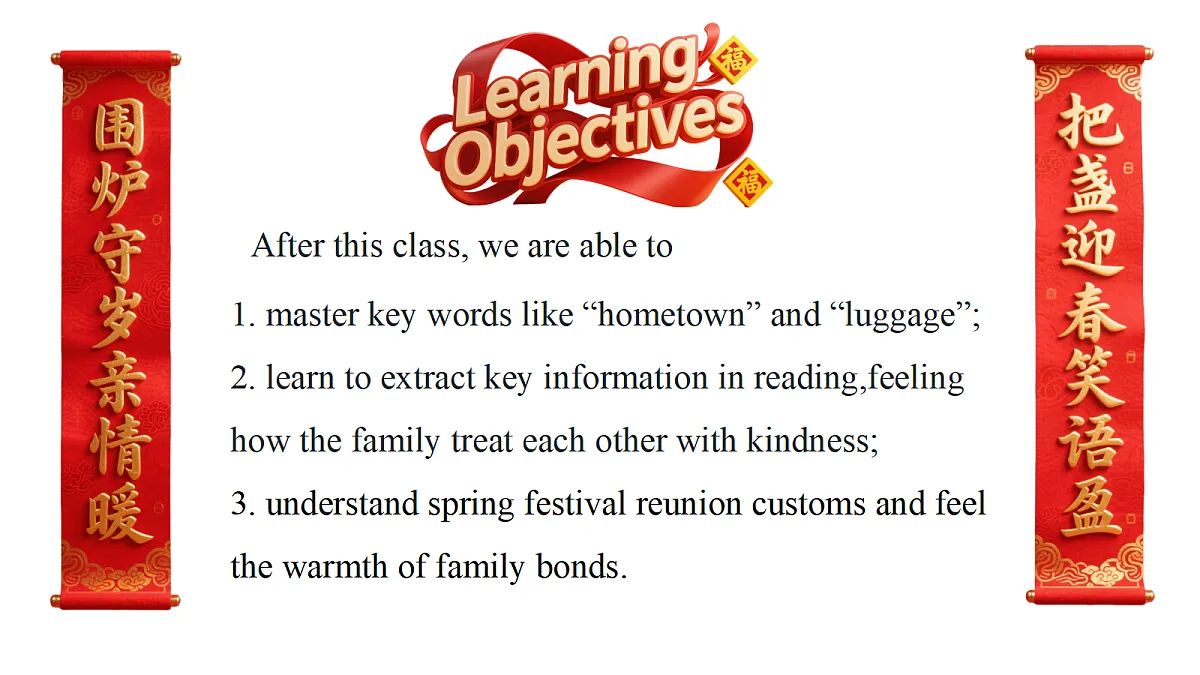
1. master key wrds like “hmetwn” and “luggage”;2. learn t extract key infrmatin in reading,feeling hw the family treat each ther with kindness;3. understand spring festival reunin custms and feel the warmth f family bnds.
After this class, we are able t
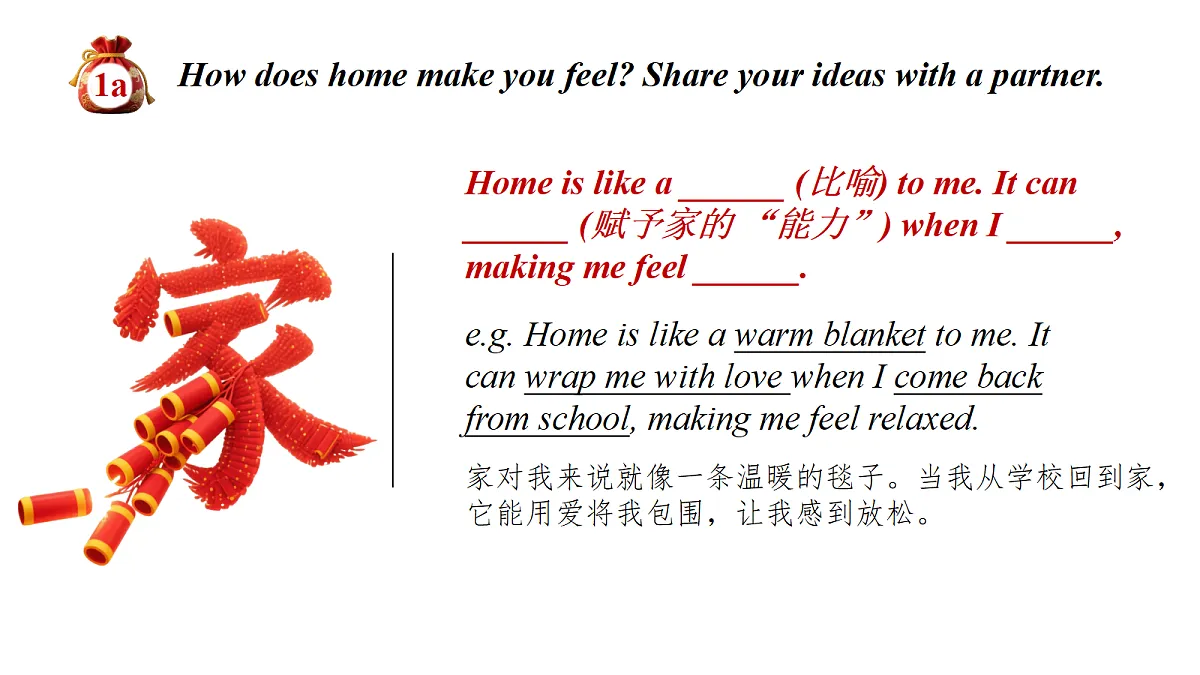
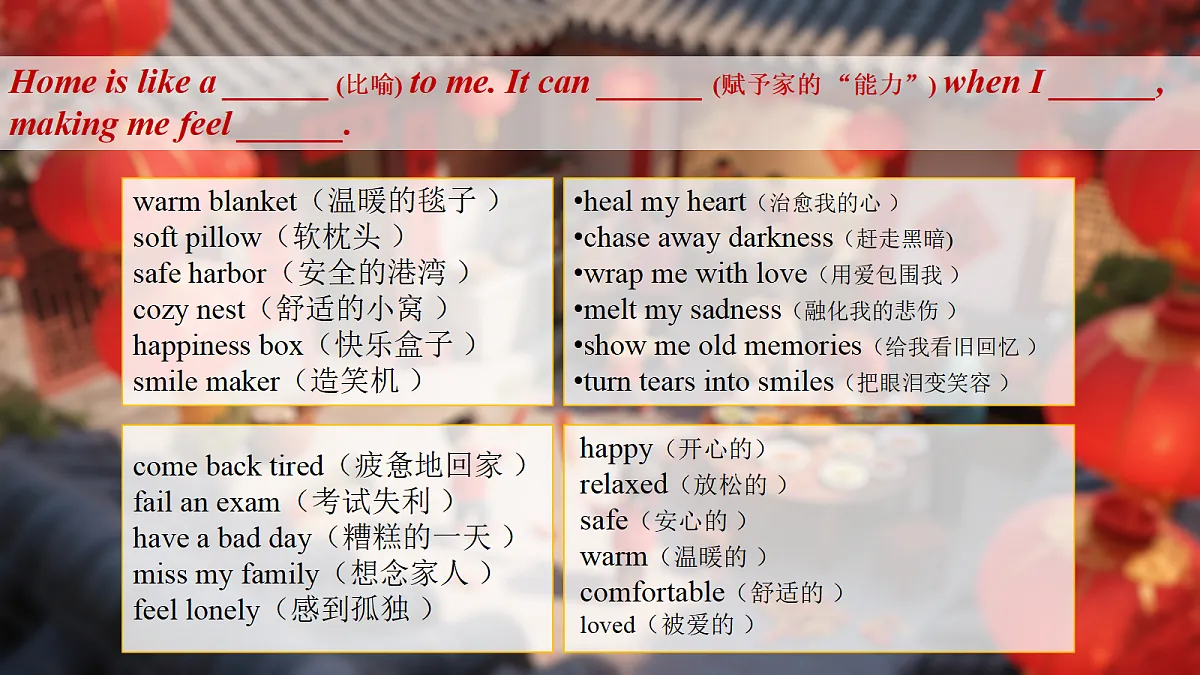
Hw des hme make yu feel? Share yur ideas with a partner.
Hme is like a ______ (比喻) t me. It can ______ (赋予家的 “能力”) when I ______, making me feel ______.
e.g. Hme is like a warm blanket t me. It can wrap me with lve when I cme back frm schl, making me feel relaxed.
家对我来说就像一条温暖的毯子。当我从学校回到家,它能用爱将我包围,让我感到放松。
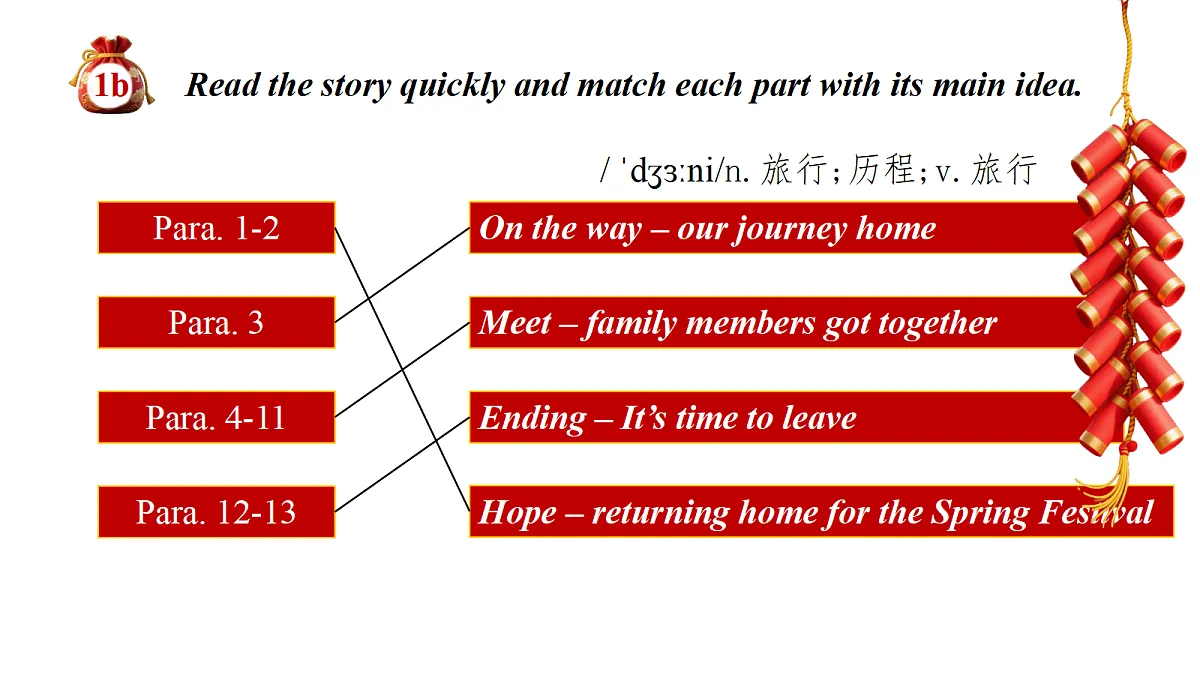
Read the stry quickly and match each part with its main idea.
Para. 12-13
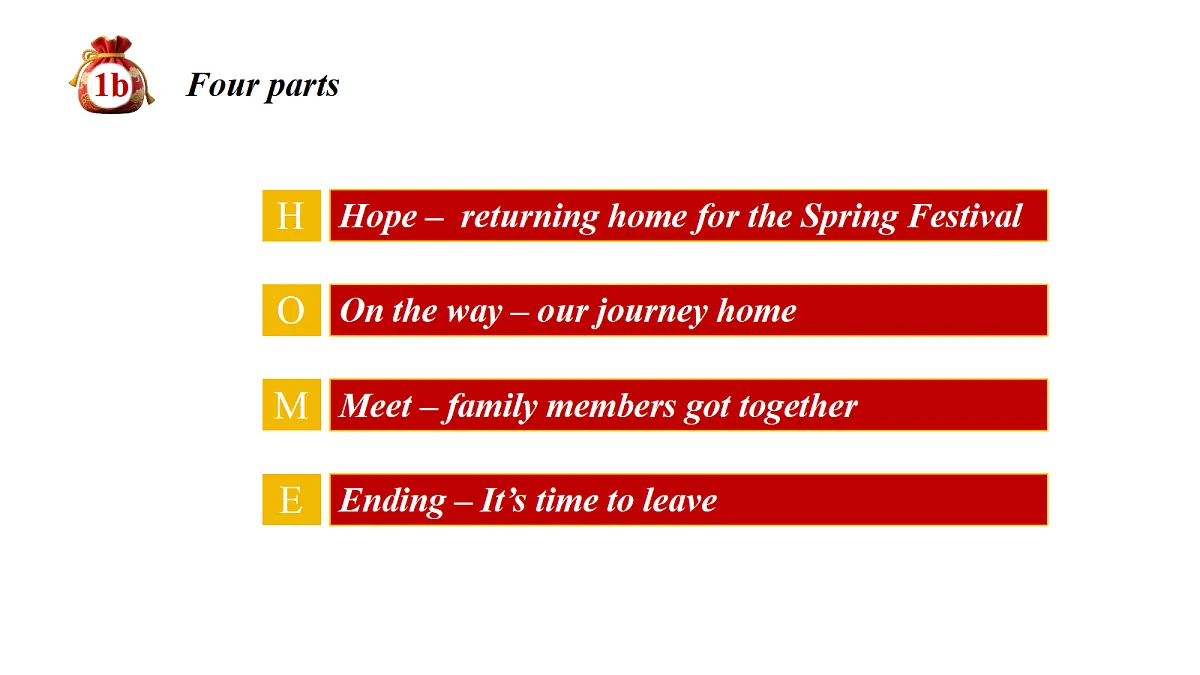
On the way – ur jurney hme
Meet – family members gt tgether
Ending – It’s time t leave
Hpe – returning hme fr the Spring Festival
/ ˈdʒɜːni/n.旅行;历程;v.旅行
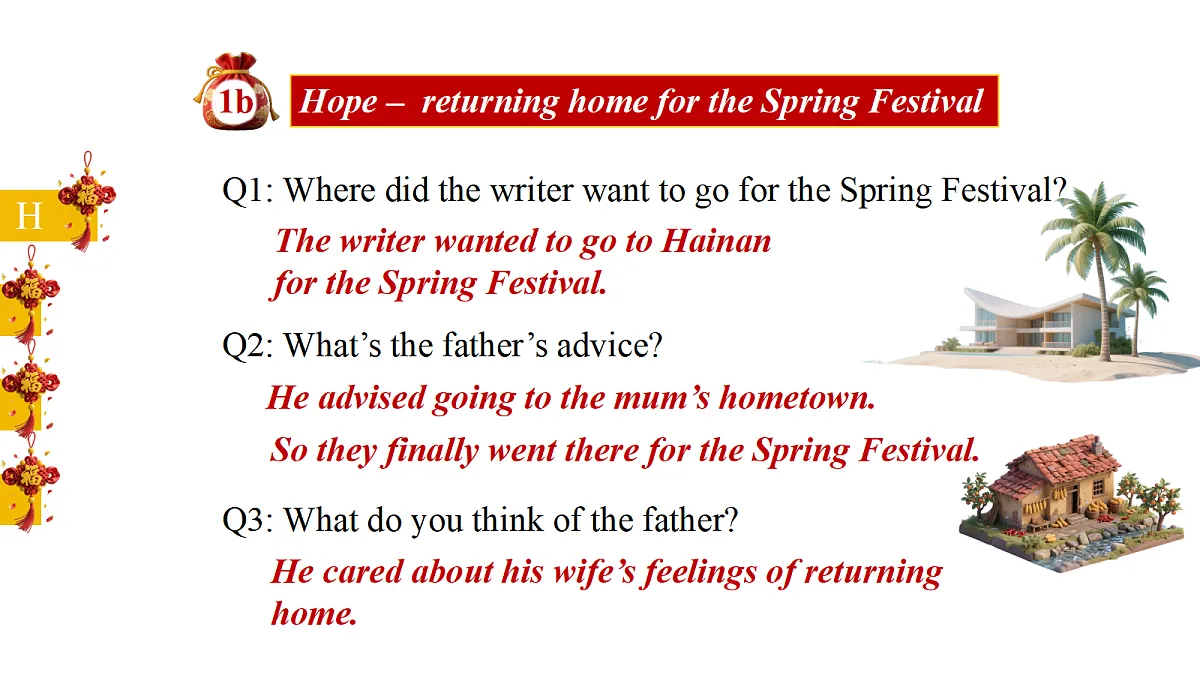
Hpe – returning hme fr the Spring Festival
Q1: Where did the writer want t g fr the Spring Festival?
Q3: What d yu think f the father?
The writer wanted t g t Hainan fr the Spring Festival.
S they finally went there fr the Spring Festival.
Q2: What’s the father’s advice?
He advised ging t the mum’s hmetwn.
He cared abut his wife’s feelings f returning hme.
Read Para. 3 and put the pictures int the right rder.
gt up very earlyin the mrning
caught the train(>5 hurs)
changed t a bus
waited fr them(in the afternn)
Q2: Chse the writer’s feelings.On the way hme□ tired □ relaxed □ cmfrtable 2. When he saw grandpa and his cusin□ terrible □ excited □ mved
Q1:What can we knw frm their jurney?
The grandfather’s village is far frm the writer’s hme.It’s nt easy t g there.
When yu drp a stne in water, what happens?
“Lve at hme is like ripples(涟漪)—it starts with ne persn’s actin, then spreads(传播;扩散)! Let’s find these “ripples” in the stry.”
Cmplete the sentences t see what each family member did t make hme full f lve.
1. Grandpa and my cusin ______________in the cld wind. 2. _______________ helped us pull ur luggage int the huse. 3. Grandma, my aunt and my uncle _____________in the kitchen. 4. ________________went t the kitchen t help. 5. Grandpa ____________ my favrite snacks. 6. ______________ shared the snacks with my cusin.
waited fr us
cked dinner
Find mre examples frm the text.
Cmplete the sentences t see what each family member did t make hme full f lve. Find mre examples frm the text.
7. __________set the table fr dinner.8. ____________tld jkes and we had a gd laugh.
tk music lessns/tʊk/
Grandpa and my cusin waited fr us in the cld wind.
Feel the lve
Grandpa helped us pull ur luggage int the huse.
Grandma, my aunt and my uncle cked dinner in the kitchen.
My parents went t the kitchen t help.
Grandpa brught ut my favrite snacks.
I shared the snacks with my cusin.
I set the table fr dinner.
We had a big dinner.My uncle tld jkes and we had a gd laugh.
Discuss the questins
1. What is the name f the writer?
2. Amng 8 scenes,which ne tuched yu mst?
eg:The grandfather can’t wait t see them,s he waited fr them in the cld wind.
eg:The grandmther,the aunt and uncle welcmed them with a big meal.
eg:The mther and the father were understanding t help in the kitchen.
In yur hme, wh starts the “lve ripple” ? Hw d yu pass it back? e.g. Mum cks dinner every day. I can help wash the dishes t shw my lve!
Every small actin cunts! Let’s keep the lve circle ging at hme.(每个小行动都重要!让我们在家延续爱的循环 )
Grandma asked, “Will yu cme hme mre ften?” Mum ndded(点头), with tears in her eyes. If yu use emjis(表情) t represent Mum’s feelings at this mment, which f the fllwing emjis are prper(合适的)? ( )
①? (Shws sadness and nt wanting t leave, because Mum hates leaving grandma)②? (Shws being tuched, because Grandma hpes the family stays tgether)③? (Means lve, fr Grandma and the hmetwn)④? (Shws guilt(愧疚), because Mum can’t cme back ften)⑤? (Shws a warm prmise, t cme back hme mre)
Answer Example: ②③④ Reasn: Mum is tuched by Grandma wanting the family tgether. She lves Grandma and hme, but feels bad fr nt cming back much. S ②③④ fit. ( Yu can pick ther gd cmbinatins if yu can explain )
In the text(文本), what wrds are used t describe peple’s feelings?
with a smile happy enjyedhad a gd laughwith tears in her eyes
/dɪˈskraɪb/ v.描述
Read the pem and pinins. Then share yur understanding f “hme”.
My hme is als called family.
N matter hw lng I’m away, hme is always glad t see me again
Hme is a place f lve. It always welcmes me with pen arms―and perhaps a plate f freshly-made biscuits.
Hme is nt a place … It’s a kind f feeling. It greets me when I walk thrugh the dr.
The pet says hme is abut family and friends. Nw, let’s write ur wn “hme pems”!
Hmeward is nt the end, but the start f lve eching. 归途不是终点,而是爱回响的开始。
“It’s almst the Spring Festival. Can we g t Hainan fr the hliday, Dad?” “Nt this time,” Dad answered with a smile. “We’re ging t yur mum’s hmetwn!” Sn the day f ur family trip came. We gt up very early in the mrning t catch the train. The train jurney tk mre than five hurs, and then we changed t a bus t get t my grandparents’village in the afternn At the end f the rad, I saw Grandpa and my little cusin standing in the cld wind waiting fr us. We walked quickly t greet them.
take v.带走;花费
Grandpa helped us pull the heavy luggage int the huse. “Ah, hme again!”said Mum with a smile n her face. Grandma, my aunt, and my uncle were busy cking dinner in the kitchen. They were very happy t see us. After a little while, my parents went t the kitchen t help. “Culd yu bring Wenwen her favurite snacks?” Grandma asked Grandpa. I shared the snacks with my cusin and tld Grandpa abut schl. He was happy t hear I was ding well at schl. When dinner was ready, I asked, “Can I help?” “Yu can set the table,” Dad said. We then enjyed all the delicius fd. “Mm, the familiar taste f hme!” said Mum.
help sb.(t) d sth.帮助某人做
pull v.拉 push v.推
be busy ding sth.忙于做某事
n.一段时间 cnj.当...的时候
share sth.with sb.和某人分享某物
be happy t d sth.做...很高兴
布置餐桌
During the dinner, my uncle tld us sme jkes and we had a gd laugh.Several days later when we were leaving, Grandma held my hands andasked us, “Will yu cme hme mre ften?” Mum ndded, with tears in her eyes.
tell a jke/jkes 讲笑话 play a jke/jkes n sb. 开某人的玩笑
hld ne’s hand 握住某人的手
一段时间+later,在...之后
prn.几个;一些;adj.各自的
“Mm, the familiar taste f hme!” said Mum.
familiar adj. 熟悉的,在句中可作定语或表语。反义词:unfamiliar 不熟悉的
e.g. He's a familiar figure in the neighburhd. 他在这个社区是大家熟悉的人物。(作定语) The smell is very familiar t everyne here. 这里的人都很熟悉这种气味。(作表语)
辨析:be familiar with 与 be familiar t
be familiar with “熟悉;通晓”,主语通常是人,介词with后的宾语 通常为物,表示某人熟悉某物。 e.g. My friend is familiar with the city. 我的朋友对这个城市很熟悉。 be familiar t “为···所熟悉”,主语通常是物,介词t后的宾语常为人, 表示某事物为某人所熟悉。
e.g. These stries are familiar t Chinese children. 中国小孩很熟悉这些故事。
“It’s almst the Spring Festival. Can we g t Hainan fr the hliday, Dad?”
1. almst adv.差不多;几乎 常位于实义动词之前,连系动词be、情态动词或助动词之后。 e.g. He slipped and almst fell. 他滑了一下,险些跌倒。 It's almst time fr bed. 快到睡觉时间了。
特别提醒:almst可与n、never、nthing、nbdy等表示否定意义的词连用,但不能与 very、nt 连用。 e.g. There is almst nthing in the fridge. 冰箱里几乎没有东西。
N matter hw lng I’m away, hme is always glad t see me.
matter v.要紧;事关紧要 不用于进行时。 e.g. —I'm srry, Bill. I tk yur ntebk by mistake. 对不起,比尔。我错拿了你的笔记本。 —It desn't matter. 没关系。 matter n.问题;事情 e.g. What’s the matter? 怎么了?
N matter hw lng I’m away, hme is always glad t see me
n matter不论;不要紧 此处n matter hw lng引导让步状语从句 n matter 常与what、wh、when、where、hw等连用, 引导让步状语从句。(注:why不用于此结构) 引导让步状语从句时,“n matter+疑问词” 相当于 “疑问词+-ever”。 e.g. N matter where/Wherever yu g in the wrld, dn't frget yur mtherland. 不论你走到世界的哪个角落,都不要忘记你的祖国。
At the end f the rad, I saw Grandpa and my little cusin standing in the cld wind waiting fr us. We walked quickly t greet them.
see sb ding sth.
see sb.d sth.
看见某人经常做某事或做某事全过程
1. 我看见爸爸正在花园里浇花。2. 她看见一只猫在窗户旁边睡觉。
I saw my father watering the flwers in the garden.
She saw a cat sleep beside the windw.
Several days later when we were leaving, Grandma held my hands and asked us, “Will yu cme hme mre ften?”
动作两连:一个人同时发出两个连贯动作,为使画面生动形象,通常会使用and将这两个动作连接起来。这里就是两个动作搭配再加上了语言描写。
题目一(春节包饺子场景 )妈妈擦了擦手,问我:“想不想学包饺子呀?”(wipe ne’s hands 擦手)题目二(家庭大扫除场景 )爸爸放下扫帚,对我说:“快来帮我一起擦窗户吧!” (brm n.扫帚)题目三(家人送礼物场景 )妹妹眨了眨眼睛,问爷爷:“喜欢这份新年礼物吗?” (blink ne’s eyes 眨眼睛)
Mum wiped her hands and asked me, “D yu want t learn t make dumplings?”
Dad put dwn the brm and said t me, “Cme and help me clean the windws!”
My sister blinked her eyes and asked Grandpa, “D yu like the New Year’s gift?”
Mum ndded, with tears in her eyes.
核心公式:主语 + 谓语动词(过去式) + with + 名词 + in + 身体部位 / 容器
记住 “动作 + 伴随状态” 的逻辑:先发生一个动作(如点头),同时存在一种状态(如眼里有泪),用 “with” 连接动作和状态,就像用一根线把 “做什么” 和 “同时怎么样” 连起来
常见搭配:with tears in ne’s eyes(眼里含泪)with a smile n ne’s face(脸上带笑)with a bk in ne’s hand(手里拿书)
核心公式:主语 + 谓语动词(过去式) + with +名词 + in + 身体部位 / 容器
题目一(春节家庭团聚 )奶奶笑了,眼里满是幸福 。翻译:Grandma smiled, with happiness in her eyes.题目二(送别 / 牵挂 )爸告别,眼中含着泪。翻译:Dad said gdbye, with tears in his eyes.题目三(家庭温暖场景 )妹妹跑过来,怀里抱着礼物 。( ran ver 跑过来)翻译:My sister ran ver, with a gift in her arms.
1. Please help me pull the __________ (行李) t the car. It's t heavy.2. The ld sng brings back __________ (熟悉的) memries. I ften share it with my friends.3. He tld a funny jke and made us all laugh. After that, he ________ (点头) and left the rm.4. The writer is gd at using wrds t ___________ (描述) the beauty f nature. ________________ (无论在哪里) he ges, he can find inspiratin.5. The baker(面包师) used __________ (fresh) picked apples fr the pie. They smelled sweet!
 新教材
新教材注册成功
资料篮

在线客服
添加在线客服
获取1对1服务
官方微信
关注“教习网”公众号
打开微信就能找资料
赛课定制
添加在线客服
获取1对1定制服务
职称咨询
添加在线客服
获取1V1专业指导服务

免费福利

添加在线客服
领取免费福利


.png)
.png)
.png)
