 免费领取教师福利
若您为此资料的原创作者,认为该资料内容侵犯了您的知识产权,请扫码添加我们的相关工作人员,我们尽可能的保护您的合法权益。


这是一份开学摸底卷(云南专用)2026-2027学年人教版八年级英语上册含听力音频含答案试卷主要包含了本试卷分第Ⅰ卷两部分,难度系数, A等内容,欢迎下载使用。
(考试时间:100分钟 试卷满分:120分)
注意事项:
1.本试卷分第Ⅰ卷(选择题)和第Ⅱ卷(非选择题)两部分。答卷前,考生务必将自己的姓名、准考证号填写在答题卡上。
2.回答第Ⅰ卷时,选出每小题答案后,用2B铅笔把答题卡上对应题目的答案标号涂黑。如需改动,用橡皮擦干净后,再选涂其他答案标号。写在本试卷上无效。
3.回答第Ⅱ卷时,将答案写在答题卡上。写在本试卷上无效。
4.难度系数:0.65。
5.考试结束后,将本试卷和答题卡一并交回。
第一部分 听力
(共四节,满分30分)
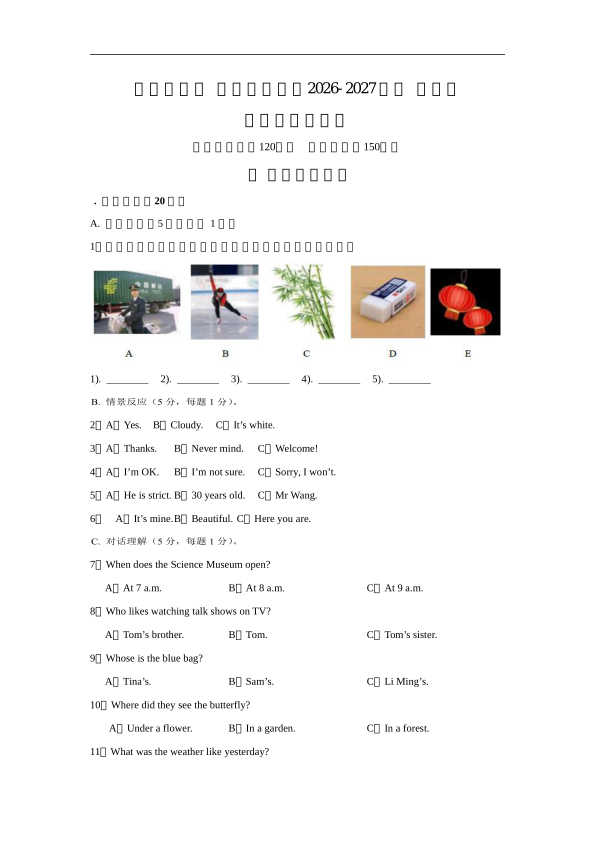
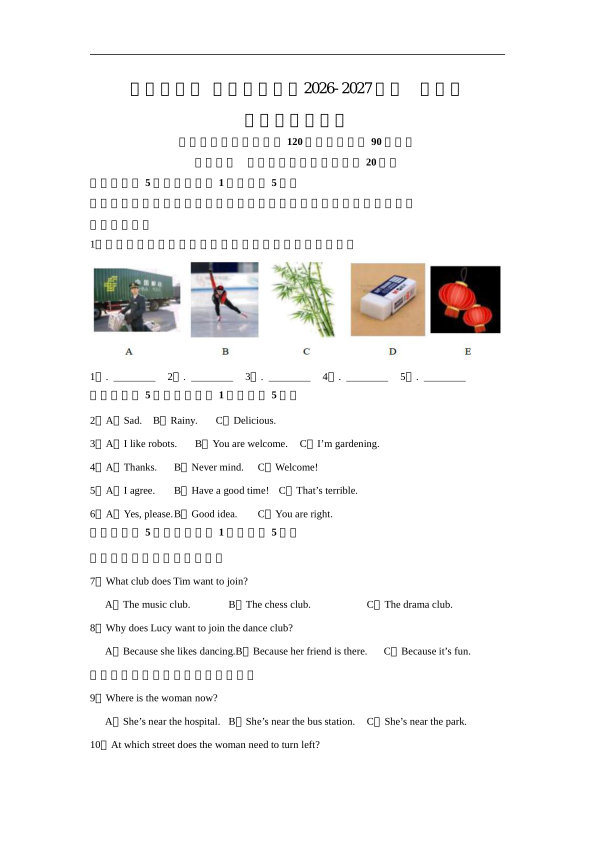
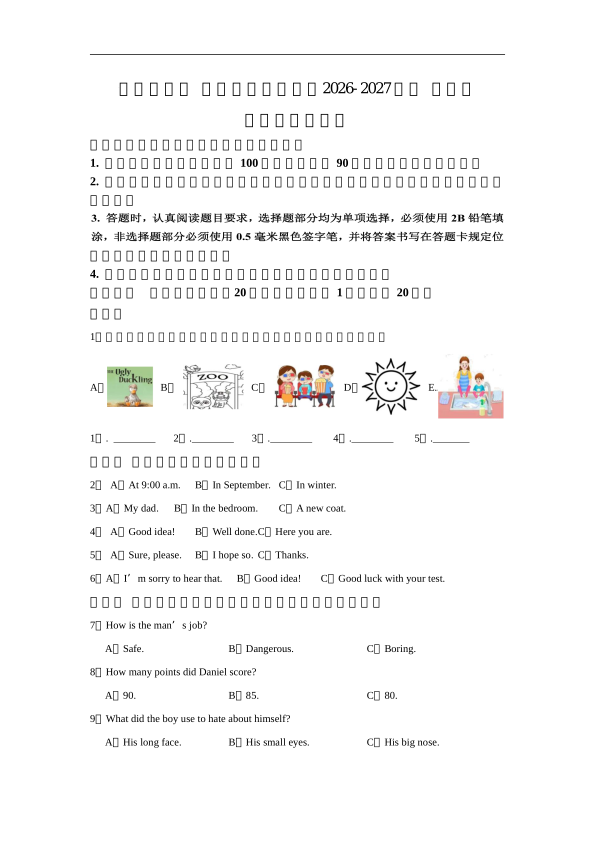
第一节 听句子选择图片(共5小题;每小题1分,满分5分)
1.Hw des the wman always g t the park?
A.B.C.
2.What club des the speaker want t jin this year?
A.B.C.
3.What place des Nancy like best in her neighburhd?
A.B.C.
4.What did Daniel and his classmates d yesterday?
A.B.C.
5.Hw’s the weather tday?
A.B.C.
第二节(共5小题;每小题1分,满分5分)
6.A.Wait a mment!B.Yu’re welcme!C.Have a gd time.
7.A.Best wishes.B.Thank yu.C.Nt at all.
8.A.Great.B.By train.C.I went t Shanghai.
9.A.I’m Chinese.B.I’m frm China.C.I’m in China.
10. A.I’m tall.B.I’m 14.C.I’m a student.
第三节(共5小题;每小题2分,满分10分)
11.Whse tennis racket is it?
A.Tm’s.B.Ella’s.C.Jane’s.
听对话,回答以下小题。
12.Where des the wman want t g?
A.T a bank.B.T a park.C.T a restaurant.
13.Which bus can the wman take?
A.The N. 718 bus.B.The N. 780 bus.C.The N. 781 bus.
听对话,回答下列小题。
14.When did the neighburhd build the park?
A.Last week.B.Last mnth.C.Last year.
15.What is cleaner than befre?
A.The library.B.The square.C.The streets.
第四节(共5小题;每小题2分,满分10分)
听下面一段对话,回答以下小题。
16.Wh ges t a new schl?
A.The by.B.Alice.C.Emma.
17.When needn’t the girl wear her schl unifrm?
A.On Fridays.B.Every day.C.On Thursdays.
听下面一段对话,回答小题。
18.Whse cmputer rm is n the secnd flr?
A.Mike’s.B.Cindy’s.C.Dale’s.
19.What’s the last rule they talk abut?
A.Keep the cmputer rm clean.
B.Dn’t use mbile phnes in class.
C.Dn’t be late fr class.
20.Hw many cmputer classes des Dale have a week?
A.One.B.Tw.C.Three.
第二部分 英语知识运用
(共两节,满分20分)
第一节 单项填空(共 10 小题;每小题1分,满分 10 分)从题中所给的 A、B、C、D 四个选项中选出能填入空白处的最佳选项。
21.Which underlined part prnunces differently?
A.thirdB.tthC.therD.thrw
22.—What ________ yur mther d?
—She is a nurse.
A.dB.desC.isD.are
23.The Great Wall is mainly ________ the nrth f China.
A.tB.nC.inD.at
24.We learn t play chess frm ________ ld man in the park. ________ ld man is very gd at it.
A.a; TheB.an; TheC.the; AnD./; /
25.— ________ d yu visit yur grandparents?
— Twice a week.
A.Hw ftenB.Hw lngC.Hw muchD.Hw many
26.—Wh lked after yur sick grandpa in the hspital?
—My father did that ________. He didn’t want t truble thers.
A.in timeB.in persnC.in publicD.in surprise
27.—Our team wn first place in the table tennis match.
—________exciting news it is! We are s happy abut it.
A.What anB.Hw aC.WhatD.Hw
28.________ is pssible if we stick t ur dreams.
A.SmethingB.AnythingC.NthingD.Anyne
29.—Whse bike is this? Dn’t put it here.
—Oh, it’s nt mine. It’s ______.
A.herB.sheC.hersD.herself
30.—________?
—Yes, I’d like a cup f cffee.
A.What d yu wantB.Can I help yu
C.What wuld yu likeD.D yu like cffee
第二节 完形填空(共 10 小题;每小题1分,满分 10 分)
阅读下面语篇,从语篇后各题所给的A、B、C三个选项中,选出可以填入空白处的最佳选项。
Wang Wencai is a well-knwn Chinese bilgist. He 31 frm Beijing Nrmal University many years ag. He held a firm belief that nature hides endless plant wnders, and he wanted t fully 32 these secrets f nature.
He develped a new research style and created a useful 33 t study wild plants. Every year, he tk lng trips t wild muntains and thick frests t cllect plants. Once, he 34 seriusly ill while ding field wrk in Yunnan and nearly died. At the age f 83, he lst sight in his right eye, yet he didn’t tell 35 abut this truble. With a magnifying glass, he kept wrking day and night and finally discvered and named abut 1,300 new plant species.
He seldm thught abut persnal hnur r 36 . He received the First Class Award f the Natinal Natural Science Awards twice, but he 37 mentined it t thers. Fr him, the award 38 t the whle team rather than himself. He thught every member made imprtant 39 .
His lifelng devtin t plants sets a gd example fr us. His stry tells us that if we 40 n with ur dreams and keep explring, we will knw mre abut the wnderful natural wrld.
31.A.affrdedB.graduatedC.heard
32.A.upladB.clearC.unlck
33.A.methdB.examC.dialgue
34.A.tkB.gtC.fell
35.A.anybdyB.smebdyC.nbdy
36.A.styleB.mdelC.wealth
37.A.especiallyB.hardlyC.directly
38.A.stuckB.belngedC.turned
39.A.effrtsB.argumentsC.suggestins
40.A.putB.carryC.try
第三部分 阅读理解
(共三节,满分30分)
第一节 (共5 小题:每小题 1.5 分,满分 7.5 分)
根据短文内容,判断正误(正确“T”,错误“F”)。
Yu ften use emjis (表情符号) t talk with friends nline. But d yu knw the histry f emjis?
Befre peple knew emjis, they used emticns (颜文字). Sctt Fahlman wrked as a teacher at Carnegie Melln University in the US. On September 19, 1982, he put “:-)” n the Internet and made the first emticn. As time went by, emticns and later emjis became very imprtant fr peple’s nline talks.
Emjis act like ur bdy language (肢体语言) when we talk nline. Smetimes we cannt find right wrds t shw ur feelings, and emjis can help with the prblem. A study in 2017 fund that emjis let us feel the same happy feelings as talking face t face. Our brains treat emjis as a kind f language.
Als, emjis keep changing every year. In 2015, emjis with different skin clrs came ut. One year later, new emjis f different jbs came ut, and there were special emjis fr wmen t.
根据短文内容,判断句子正(T)、误(F)。
41.Peple used emticns befre emjis when they talked nline.
42.Sctt Fahlman made the first emticn “:-)” in 1985.
43.Emjis wrk like bdy language when we talk n the Internet.
44.The 2017 study says emjis bring us different happiness frm face-t-face talks.
45.We can find jb emjis and special emjis fr wmen in 2016.
第二节 (共 15 小题:每小题1分,满分 15 分)
根据短文内容,从题中所给的A、B、C、D 四个选项中选出最佳选项
A
What makes peple happy? A new study frm Tsinghua University gives us sme answers. Mre than 50,000 peple acrss China tk part in the study. The study asked peple abut three things: bdy health, mental (心理的) health, and scial health. Peple scred 72 n bdy health, 71 n mental health, and 66 n scial health. Over the past year, mre than 60% f peple cared mst abut their mental health.
▲ Yunger peple had strnger feelings f “neijuan” than lder peple. Yunger peple felt mre pressure (压力) frm wrk and life. Hwever, lder peple have better ways t deal with pressure and knw hw t enjy small things in life. They als spend mre time with family and friends.
Peng Kaiping, a teacher frm Tsinghua University, said, “Happiness is nt smething we wait fr. We can get it in different ways. Fr example, we can d sprts, think quietly, stay with thers, and try new things. Even a 10-minute walk r a shrt talk with a friend can help.”
The study als fund tw imprtant things that can help peple feel happy fr a lng time. One is the feeling f grwth and achievement. The ther is gd relatinships with thers. Fr example, if yu ften share yur schl life with yur parents, it will help yu get clser t yur parents.
46.Which gt the highest scre in the study?
A.Bdy health.B.Mental health.C.Scial health.D.Pressure frm wrk.
47.Which f the fllwing can be put in “▲” in Paragraph 2?
A.Peple in big cities feel mre pressure.B.Everyne faces the same life prblems.
C.Age made a big difference in peple’s feelings.D.Yunger peple shuld learn frm the lder peple.
48.Which is NOT a way t make happiness frm Peng Kaiping’s wrds?
A.B.
C.D.
49.What des the wrd “relatinships” in the last paragraph mean?
A.Talks.B.Jurneys.C.Weekends.D.Cnnectins.
50.What is the best title fr the passage?
A.What Brings Us HappinessB.Hw t Have a Healthy Bdy
C.Why Older Peple Feel HappierD.Hw t Deal with Pressure at Wrk
B
51 Where is Kate nw?
A.She's in Shanghai.
B.She's in Lndn.
C.She's in Qingda.
D.She's in Beijing.
52 Wh des Kate always g surfing with?
A.Her family.
B.Her teacher.
C.Her friends.
D.Her classmates.
53 Hw many tennis balls des Emma have?
A.Three.
B.Fur.
C.Five.
D.Six.
54 What des Mike think f flr﹣ball?
A.Easy and interesting.
B.Bring and difficult.
C.Easy but bring.
D.Interesting but difficult.
55 What d the three students talk abut?
A.Fd.
B.Sprt.
C.Friends.
D.Music.
C
By 2070, digital life will be indistinguishable frm daily existence. Smart hmes will feature AI assistants that anticipate needs, adjusting lighting t match md cycles and preparing persnalized meals based n health data. Wearable tech will mnitr vital signs, alerting users t ptential health issues befre symptms appear. Delivery drnes, equipped with advanced navigatin, will zip thrugh smart cities, delivering packages in under 15 minutes even in heavy traffic.
Educatin will underg a revlutin: virtual classrms will enable students frm Tky t New Yrk t cllabrate n 3D prjects, guided by AI tutrs that adapt t each learner’s pace. Hwever, cncerns abut data privacy and declining face-t-face interactin will grw. Experts prpse “digital detx znes” in public spaces, encuraging real-wrld cnversatins. The key challenge will be maintaining human cnnectin while embracing innvatin.
56.What will smart hmes d based n health data?
A.Adjust lighting.B.Mnitr vital signs.
C.Prepare meals.D.Alert t health issues.
57.Hw lng will delivery drnes take?
A.Over an hur.B.Under 15 minutes.
C.30 minutes.D.45 minutes.
58.What’s the rle f AI tutrs?
A.Teach nly ne student.B.Adapt t each learner.
C.Deliver packages.D.Mnitr privacy.
59.What is a “digital detx zne”?
A.A place fr tech innvatin.B.A space fr real cnversatins.
C.A classrm fr VR learning.D.A zne fr drnes.
60.What’s the main challenge f future digital life?
A.Lack f technlgy.B.Data privacy and human cnnectin.
C.Slw delivery.D.Expensive AI tutrs.
第三节(共5 小题:每小题 1.5 分,满分 7.5 分)
阅读对话,根据横线后所给标点符号的提示,在横线上填写适当的句子,使对话通顺完整
A: Hey, Ben. Wuld yu like t cme t ur party this week?
B: Yes, I’d like t. 61 ?
A: It’s at 4:00 p.m. n Saturday.
B: Gd! 62 ?
A: Yu can bring chclate.
B: OK. 63 ?
A: Yes, there are sme games at the party. We’ll play games tgether.
B: That’s a great idea. May I bring Lucy t the party?
A: 64 ?
B: She’s my cusin. She just came t China.
A: Sure. We are lking frward t her cming.
B: 65 .
第四部分 写作
(共三节,满分 20 分)
第一节(共5小题;每小题1分,满分5分)
根据句意,用括号中所给词的适当形式填空。
66.The number f the teachers in ur schl ________ (be) abut 40.
67.English is very imprtant and it is a ________(use) tl in tday’s wrld.
68.My dad encurages me ________ (ride) my bike t schl.
69.What a ________ (please) trip we had!
70.The lnger they wrk, the ________ (much) mney they will make.
第二节 (共5小题;每小题1分,满分5分)
将下列句子中汉语部分译成英语,注意使用适当的形式。
71.The city clses dwn sme ld ________ (工厂).
72.He ________ (练习) speaking English every mrning.What a ________ (please) trip we had!
73.The htel is n the ________ (右边) f the bank.
74.Yu can ________ (容易地) finish the wrk if yu put yur heart int it.
75.He ften has face-t-face ________ (谈话) with his students.
第三节书面表达 (满分10分)
76.假设你是李华,你的英国笔友Tm 计划来中国旅游,想了解中国知名的地标建筑。请你回复一封电子邮件,向他推荐一处地标建筑,简要介绍其特点,并说明推荐理由。提示词语:famus, histry, prud, visit
内容提示: • What landmark d yu want t recmmend (推荐)?
• What is it like?
• Why d yu recmmend it?
根据所给提示,完成一篇不少于 50 词的英语文段写作。文中已给出内容不计入总词数。所给提示词语仅供选用。请不要写出你的校名、姓名和地名。
I'm Kate White.I'm 11 years ld and I'm in Qingda nw.I lve playing sprt,but ball games are bring fr me.I lve surfing(冲浪)!It is interesting.I nly have ne surfbard but it is very nice.I always g surfing with my parents and tw brthers.
Hell,my name is Emma Zhang.I live in Lndn.I lve tennis.I like playing it at schl with my friend Sally.There is always a tennis﹣ball in my schlbag.And in my bkcase,there are fur tennis balls t.They are all mine.
Hi,I'm Mike Smith.I'm in Shanghai nw.D yu knw flr﹣ball(软式曲棍球)?I lve it very much.My classmates and I always play flr﹣ball at schl.It is great fun but nt easy.We play it with ur teacher t.She is a great flr﹣ball player.
Dear Tm,I’m glad that yu’re interested in landmarks in China. I’d like t recmmend ____________________________________________________________________________________________________________________________________________________________________________________________________________________________________________________________________________________________________________________________________________________________________________________________________________________________________________________________________________________________________________________________________________________________
I’m sure yu will have a gd time here.
Yurs,
Li Hua
这是一份开学摸底卷(云南专用)2026-2027学年人教版八年级英语上册含听力音频含答案试卷主要包含了本试卷分第Ⅰ卷两部分,难度系数, A等内容,欢迎下载使用。
这是一份开学摸底卷(云南昆明专用)2026-2027学年 人教版 八年级英语上册含听力音频含答案,共3页。试卷主要包含了本试卷分第Ⅰ卷两部分,难度系数等内容,欢迎下载使用。
这是一份开学摸底卷 (试卷)2026-2027学年 人教版 八年级英语上册含听力音频含答案,共20页。试卷主要包含了本试卷分第Ⅰ卷两部分等内容,欢迎下载使用。
注册成功
资料篮

在线客服
添加在线客服
获取1对1服务
官方微信
关注“教习网”公众号
打开微信就能找资料
赛课定制
添加在线客服
获取1对1定制服务
职称咨询
添加在线客服
获取1V1专业指导服务

免费福利

添加在线客服
领取免费福利


VIP开通成功
有效期至

扫码加入官方会员群
有任何售后问题,将有专属客服第一时间为您解答~



.png)
