免费领取教师福利
若您为此资料的原创作者,认为该资料内容侵犯了您的知识产权,请扫码添加我们的相关工作人员,我们尽可能的保护您的合法权益。


这是一份2026年高考英语题型专练(全国通用)题型09阅读理解议论文:辨核心论点,析论证逻辑(原卷版+解析),共12页。试卷主要包含了 观点标记法, 立场定位法, 论据追踪法, 主旨聚焦法等内容,欢迎下载使用。
题型简介
议论文,是一种通过摆事实、讲道理来阐述作者观点、主张或立场的文体。它的核心目的不是讲述一个故事(如记叙文),也不是描述一个事物(如说明文),而是为了说服读者,让读者同意并接受自己的观点。
论点;论据;论证是议论文的“三要素”这是议论文的基石,缺一不可。
论点:文章的灵魂与核心。是什么:作者对所论述问题所持的观点、见解或主张。它必须是一个明确的、表示判断的陈述句。要求:正确、鲜明、深刻。一篇文章只有一个中心论点,它像一根红线,贯穿全文。
论据:文章的血肉与支撑。是什么:用来证明论点成立的理由和依据。类型:事实论据:确凿的事例、统计数据、历史史实等。俗话说“事实胜于雄辩”。道理论据:经过实践检验的、公认的道理,如科学原理、名言警句、格言谚语等。
论证:文章的骨架与脉络。是什么:运用论据来证明论点的过程和方法。它揭示了论点和论据之间的逻辑联系。作用:就像用砖块(论据)盖房子(论点),论证就是盖房子的具体方法和过程(如何打地基、如何砌墙)。
设题类型&命题方式
考向01 观点对比型议论文
这类文章的核心是讨论关于某一话题的两种对立或不同的观点,并最终给出作者自己的看法。
设题核心: 考查辨别不同观点、理解论证逻辑和把握作者立场的能力。
常见设题类型与命题方式:
观点识别题
典型问法:What is the first/sme peple’s pinin (一些人对……持什么观点?)/what d thse wh hld the ppsite view believe? (持相反观点的人认为?)
考查重点:要求准确识别并区分文中呈现的双方观点,避免张冠李戴。
作者立场题
典型问法:What is the authr’s attitude (作者对……的态度是什么?)/Which pinin des the authr agree with? (作者同意哪个观点?)
考查重点:考查是否能在双方观点的碰撞中,准确把握作者最终的倾向和个人立场。
论证目的题
典型问法:Why des the authr mentin “…” in paragraph X? (作者为什么在第X段提到“……”?)
典型问法:Why des the authr cite the example f(……的例子被用来证明。)
考查重点:考查对论证过程的理解,即文中的事例、数据等论据是为支持哪一个观点(通常是作者所倾向的观点)服务的。
主旨要义题
典型问法:What is the main purpse f the passage? (这篇文章的主要目的是什么?)/What is the best title fr the text? (文章最好的标题是什么?)
考查重点:此类文章的主旨往往不是简单介绍两种观点,而是“通过对比两种观点,来引出并论证作者自己的结论”。
考向2 问题解决型议论文
这类文章通常围绕一个社会问题或现象展开,分析其成因、危害,并提出解决方案或建议。
设题核心: 考查对问题本质、成因、后果及解决方案的逻辑链条的理解。
常见设题类型与命题方式:
问题/原因识别题
典型问法:What is the serius prblem discussed in the passage? (文章中讨论的严重问题是什么?)/What is the rt cause f... accrding t the text? (根据文章,……的根本原因是什么?)
考查重点:考查对文章所界定核心问题及其背后原因的准确理解。
后果/影响推断题
典型问法:What wuld be the negative effect (……可能带来什么负面影响?)/The authr believes that the prblem may lead t . (作者认为这个问题可能导致。)
考查重点:考查对问题所引发后果的推断和理解,这类信息有时是明确陈述的,有时需要根据原因进行逻辑推导。
方案/措施细节题
典型问法:What measure/step is suggested t slve the prblem? (建议采取什么措施/步骤来解决这个问题?)/What is the key t tackling the issue . (解决这个问题的关键是。)
考查重点:直接考查对文中提出的具体解决方案的细节把握。
写作目的题
典型问法:The main purpse f the passage is t . (这篇文章的主要目的是。)/What des the authr call n peple t d? (作者呼吁人们做什么?)
考查重点:此类文章的写作目的通常是“分析一个问题并呼吁采取行动(提出解决方案)”,而不仅仅是描述问题本身。
考向3 现象阐述型议论文
这类文章针对某一社会现象、潮流或新生事物,阐述其表现、分析其影响(积极和/或消极),并表达作者的看法。
设题核心: 考查对现象本身、其多方面影响以及作者评价的全面理解。
常见设题类型与命题方式:
现象特征题
典型问法:What d we knw abut the trend (关于……的潮流,我们知道什么?)/Accrding t the text, Why is xxx.. becming ppular ?(根据文章,……变得流行是因为。)
考查重点:考查对所述现象的基本特征、表现或流行原因的把握。
影响分析题
典型问法:What is the psitive/negative impact f... mentined in the passage? (文章中提到的……的积极/消极影响是什么?)
典型问法:What is ne f the challenges brught by... . (……带来的挑战之一是。)
考查重点:要求区分现象的积极影响与消极影响,并准确匹配文中提到的具体细节。
作者态度题
典型问法:What is the authr’s attitude twards this phenmenn? (作者对这一现象的态度是什么?)
典型问法:Hw des the authr feel (作者对……感觉如何?)
考查重点:考查对作者整体评价的判断。作者的态度可能是支持的、反对的、担忧的,或辩证看待的(既看到好处也看到坏处)。
写作意图题
典型问法:What is the authr’s purpse in writing this text? (作者写这篇文章的目的是什么?)
典型问法:The text is written t . (写这篇文章是为了。)
考查重点:此类文章的写作意图通常是“向读者介绍并评价某一现象”,使其引起关注和思考。解题思路
考向01 观点对比型议论文解题技巧
核心思路:厘清观点归属,把握作者倾向。
1. 观点标记法:识别不同立场
技巧要点:阅读时,主动用笔或脑记标记出不同观点的“信号词”。如“Sme peple argue...”, “Others believe...”, “Critics claim...”,以及表达作者自己观点的“Hwever, I think...”, “Frm my perspective...”。这能帮你快速理清论证的阵营,避免在答题时混淆双方观点。
2. 立场定位法:锁定作者最终态度
技巧要点:作者的态度往往在文章结尾处变得清晰。重点关注转折词(如But, Hwever, Nevertheless)之后和结论段的论述。作者通常会先客观陈述双方观点,再通过权衡或反驳,最终亮明自己的立场。找到这个立场,是解答作者态度题和主旨题的关键。
3. 论据追踪法:理解论证服务对象
技巧要点:当题目问及某个例子或引用的目的时,不要孤立地看这个例子本身。要向前或向后看一两句,这个例子通常是为了支持它前面的那个观点。问自己:“这个论据是在为谁说话?” 答案就会一目了然。
考向02 问题解决型议论文解题技巧
核心思路:梳理逻辑链条,从问题追踪到方案。
1. 问题界定法:抓住核心议题
技巧要点:此类文章开篇通常会着力描述一个现象的严重性或普遍性,以此引出“核心问题”。阅读开头时,要主动概括“文章到底在讨论什么问题?”,这是理解全文的逻辑起点。
2. 因果链条法:连接问题、原因与方案
技巧要点:在脑中或草稿上构建一个简单的逻辑图:“问题 → 原因 → 后果 → 解决方案”。解题时,尤其是面对询问原因、影响或措施的题目,迅速在逻辑链上定位,能帮你清晰地将选项与文章信息对应起来,避免张冠李戴。
3. 目的导向法:判断写作意图
技巧要点:问题解决型文章的最终目的极少是“描述一个可怕的现状”,而必然是“分析和解决一个问题”。因此,在判断写作目的或选择标题时,要优先选择那些包含“解决方案”、“呼吁行动”或“探讨出路”含义的选项。
考向03 现象阐述型议论文解题技巧
核心思路:全面分析影响,辩证看待评价。
1. 现象特征概括法:明确讨论对象
技巧要点:在阅读开头部分后,尝试用一句话概括“文章讨论的是什么现象及其主要特征”。这能确保你对讨论对象有清晰的认识,为后续分析其影响和评价打下坚实基础。
2. 利弊清单法:系统梳理影响
技巧要点:阅读时,有意识地将描述积极影响(advantages, benefits, psitives)和消极影响(disadvantages, drawbacks, challenges)的信息点进行分类。这能让你在回答影响分析题时,快速、准确地找到对应内容,避免遗漏。
3. 情感词汇捕捉法:推断作者态度
技巧要点:作者的态度不仅通过直接陈述(I think...)来表达,更常常隐藏在所用的形容词和副词中。关注诸如“wnderful”, “prmising”, “alarming”, “wrrying”, “verwhelming”等带有感情色彩的词汇,它们是判断作者是“支持”、“反对”还是“谨慎看待”该现象的关键线索。
4. 主旨聚焦法:把握文章重心
技巧要点:现象阐述型文章的主旨,通常是“介绍某一现象并引发思考或评论”。选择标题或概括主旨时,要选择能覆盖现象本身且能体现文章分析性、评论性的选项,而非仅仅描述现象或其中一个侧面。
考向01 观点对比型议论文
【例1-1】(25-26高三·山东临沂·期中)
Yu may have seen this: As an event begins, smebdy takes the micrphne and lists ff the Native American tribes wh nce inhabited the place where the event is held. Such “land acknwledgments” have becme cmmn practice ver the past decade, at university ceremnies, rck cncerts, and even the Academy Awards. The idea is that recgnizing these frmer inhabitants by name reminds us that they were here and helps t imprve histrical injustice. But are they a useful practice fr sciety, r just empty signals?
Yu can’t right a wrng until yu admit it. Behind each land acknwledgement is a recgnitin that cities and twns acrss the United States ccupy land that was nce inhabited by ther peples. The trubled histry f hw this came t be s, and the ften terrible implicatins fr thse wh were here befre, is implicit. Land acknwledgements encurage us t lk back with empathy and reflectin, sharing a scietal narrative that is hnest and bends tward justice.
This simple practice, which csts nthing and requires n special training, can challenge us t think mre critically abut ur wn histries. It’s nly fair that we practice seeing thse events thrugh the perspectives f all participants and understanding their experiences as well. And naming them makes that histry mre visible.
Hwever, land acknwledgements are as vain as they ften feel. The lives we live tday are built n the results f decisins made, actins taken, successes achieved and lsses suffered by thse wh came befre us. Even fr thse wh dn’t like the utcme, there is little we can d t change it. Furthermre, the practice ffers n slutins. “A land acknwledgement is what yu give when yu have n intentin f giving land,” Graeme Wd writes in The Atlantic. “It’s like a receipt prvided by a highway rbber, nting all the jewels and gld cins he has stlen.”
In reality, land acknwledgements are a perfrmative act mre fr the benefit f the speaker than fr the peples being spken fr. Specifically, land acknwledgements “becme an excuse fr flks t feel gd and mve n with their lives,” ntes the Native Gvernance Center, withut actually cntributing anything t the cmmunity.
1. Why des the authr describe the scene at the beginning f Paragraph 1?
A.T illustrate the wide applicatin f a practice.
B.T shw the high ppularity f a scial activity.
C.T intrduce the discussin abut a scial phenmenn.
D.T stress the necessity f crrecting histrical mistakes.
2. What des the underlined wrd “implicit” in Paragraph 2 mean?
A.Stated.B.Frgetten.C.Unspken.D.Cmplicated.
3. What is Graeme Wd’s attitude twards land acknwledges?
A.Irnic (讽刺的) and critical.
B.Supprtive and apprving.
C.Cautius and bjective.
D.Dubtful and dismissive.
4. Which f the fllwing can be the best title fr the text?
A.A New Perspective n Native American Tribes
B.Land Acknwledgments: Meaningful r Meaningless?
C.The Histrical Injustice behind Land Acknwledgments
D.The Rise f Land Acknwledgments: Frm Oscars t Campuses
【答案】1.C 2.C 3.A 4.B
【导语】这是一篇议论文。主要讨论了“土地致谢”在各类活动中日益普遍,有人认为其能促使人们反思历史不公、彰显历史,也有人批评它空洞无实、无实际解决方案,仅为表演性行为。
1.推理判断题。根据第一段中“Such “land acknwledgments” have becme cmmn practice ver the past decade, at university ceremnies, rck cncerts, and even the Academy Awards. The idea is that recgnizing these frmer inhabitants by name reminds us that they were here and helps t imprve histrical injustice. But are they a useful practice fr sciety, r just empty signals?( 在过去的十年中,这样的“土地致谢”已经成为一种普遍的做法,在大学典礼、摇滚音乐会,甚至是奥斯卡颁奖典礼上。我们的想法是,通过名字来认识这些前居民,提醒我们他们曾经在这里,并有助于改善历史上的不公正。但它们对社会是有益的实践,还是只是空洞的信号?)”可知,开篇描述“活动开场时提及原住民部落”的场景,随后点明这是“土地致谢”实践,紧接着提出核心疑问 “这一做法对社会有用,还是仅为空洞信号”。由此可推知,作者描述第一段开头的场景是为了引入关于一种社会现象的讨论。故选C项。
2.词句猜测题。根据第二段中“Yu can’t right a wrng until yu admit it. Behind each land acknwledgement is a recgnitin that cities and twns acrss the United States ccupy land that was nce inhabited by ther peples.( 除非你承认错误,否则你无法纠正错误。在每一个“土地致谢”的背后,都是承认美国各地的城镇占据了曾经被其他民族居住的土地。)”以及划线单词句中“The trubled histry f hw this came t be s, and the ften terrible implicatins fr thse wh were here befre, is….( 关于这种情况如何发生的混乱历史,以及对之前在这里的人的可怕影响,都是……。)”可知,虽然土地致谢背后表达了对“土地曾属于他人”的认可,但并未承认错误,这段历史的“问题本质及对原住民的可怕影响”并未直接说出,是“隐含的”。由此可知,划线单词implicit为“隐含的”的意思,和C选项Unspken“不言而喻的”意思相近。故选C项。
3.推理判断题。根据第四段中““A land acknwledgement is what yu give when yu have n intentin f giving land,” Graeme Wd writes in The Atlantic. “It’s like a receipt prvided by a highway rbber, nting all the jewels and gld cins he has stlen.”(格雷姆·伍德(Graeme Wd)在《大西洋月刊》(The Atlantic)上写道:“当你无意出让土地时,你就会给予承认。”“这就像公路抢劫犯提供的收据,上面写着他偷了多少珠宝和金币。”)”可推知,格雷姆·伍德将土地致谢比作“强盗提供的收据”,暗指其“只承认侵占,却不归还土地”,用讽刺的比喻表达强烈批判态度。故选A项。
4.主旨大意题。根据文章大意以及第一段中“The idea is that recgnizing these frmer inhabitants by name reminds us that they were here and helps t imprve histrical injustice. But are they a useful practice fr sciety, r just empty signals?( 我们的想法是,通过名字来认识这些前居民,提醒我们他们曾经在这里,并有助于改善历史上的不公正。但它们对社会是有益的实践,还是只是空洞的信号?)”可知,文章开篇引入“土地致谢”现象,随后分别阐述支持方(有意义,促进反思、承认历史)和反对方(无意义,空洞、无实际行动)的观点,核心围绕“该做法是否有价值”展开。由此可知,文章的最佳标题是“土地致谢:有意义还是没有意义?”。故选B项。
解|题|技|巧
1. 开篇定位法:识别讨论核心
技巧要点:文章开头(通常是第一段)的任务是引出争议性话题。作者会通过描述一个普遍现象、场景或直接提问来呈现讨论的核心。
实战应用:当题目询问“作者为何描述某个场景”或“第一段的作用”时,答案通常是 “为了引入对一个社会现象/话题的讨论” 。其目的不是单纯描述现象,而是为后文的观点交锋做铺垫。
2. 观点标记法:厘清正反阵营
技巧要点:阅读时,必须有意识地将文中出现的不同观点“分门别类”。重点关注诸如“Sme peple believe...”, “Others argue...”, “Critics claim...”, “Hwever...”, “On the cntrary...”等信号词。在脑中或草稿上清晰区分出“支持方”和“反对方”的基本论据。
3. 立场推断法:把握作者倾向
技巧要点:作者的态度往往不会在开头明说,而是通过论证过程逐渐显露。重点关注:
转折词之后:如But, Hwever, Nevertheless后面的内容,通常是作者要强调的重点。
结论段:作者通常在文章结尾总结时,明确或含蓄地亮明自己的立场。
情感与评价性词汇:关注作者在描述不同观点时使用的形容词(如vain, empty, meaningful, warm),这些词汇隐含其褒贬态度。
4. 论据服务法:理解论证目的
技巧要点:任何例子、数据或引言都是为证明某个论点服务的。当题目问及“某个例子/引言的目的”时,不要孤立理解,要向前看一两句,找到这个论据所直接支撑的那个论点。
实战应用:例如,格雷姆·伍德的“强盗收据”比喻,其目的是为了形象地批判土地致谢的空洞无物,服务于反方的论点。
5. 主旨聚焦法:概括文章灵魂
技巧要点:观点对比型文章的主旨,极少是简单地罗列双方观点,而是 “通过对比两种观点,来深入探讨某一问题的本质” 。最佳标题或主旨应能抓住文章讨论的核心争议点(常以问句形式出现或在首段提出)。
注|意|事|项
区分“作者观点”与“他人观点”:务必厘清文中提及的每一种观点是谁持有的。作者可能先陈述他人观点再进行批驳,勿将他人的论点误认为是作者立场。
答案根植于文本,而非个人看法:必须严格根据文章内容进行判断,即使你个人非常赞同某一方的观点,也要以作者的态度和文中的论据为准。
关注论述的平衡性:这类文章通常会用相近的篇幅来呈现双方论点。如果文章大部分篇幅在陈述一方观点,仅用少量文字提及另一方,这本身就可能暗示了作者的倾向。
【变式1-1】(2025·浙江·天域全国名校协作体·一模)
Is text-messaging driving us apart? These days, we talk t each ther a lt with ur thumbs — sending six billin text messages a day, and likely a few billin mre n services like Whats App.
But sme wrry that s much messaging leads t less cmmunicatin. Fr instance, when hanging ut with friends, we’d be texting secretively at the same time, pretending t maintain eye cntact but mentally smewhere else.
New technlgies ften upset the way we relate t ne anther, f curse. But such divisin caused by texting have a strng ech in the arguments we had ver telephne a hundred years ag. The small device gave us a new way t cntact ne anther and quickly prmte new frms f scializing. Callers arranged regular “visiting” calls, dialing remte family t catch up n news.
Sn, thugh, scial critics thught it wuld be s easy t talk that we’d never leave each ther alne. Others wrried that the telephne sped up life, demanding instant reactins. The use f the telephne gave little rm fr reflectin. It prduced a craziness in the rdinary cncerns f life which didn’t make fr dmestic happiness. “We shall sn be nthing but transparent piles f jelly (果冻) t each ther,” a Lndn writer maned in 1897.
Hwever, nwadays the telephne call seems like a thrwback t a gentler era. When Jenna Birch, a cmmunicatin prfessr at the University f Iwa, started dating a man wh insisted n calling her n the phne, she fund it warm and delightful. S she desn’t think the shift t texting has degraded ur interactins. Accrding t her study, teenagers wh text the mst are als thse wh spend the mst time face t face with friends. Cmmunicatin, it seems, brings mre cmmunicatin, and — as she argues — just because talk happens in text desn’t mean it’s nt meaningful.
Michéle Martin f Carletn University, thinks we’re living thrugh a replay f the telephne, where the things that made it valuable — instant cmmunicatins — are the same that made it annying. “Peple believe they are liberated because they can bring the mbile phne everywhere,” Martin says. “But at the same time, they are slaves t it.”
1. What’s the functin f the first paragraph?
A.T intrduce the tpic.B.T describe a scene.
C.T ffer an argument.D.T issue a warning.
2. Accrding t paragraph 4, what des telephne use cause?
A.Peple experience very tight schedule.B.Peple tend t lack individuality.
C.Peple becme narrw and uninfrmed. D.Peple lse the ability t reflect.
3. What can we learn frm paragraph 5?
A.Telephne calls are particularly welcmed in dating.
B.Teenagers are addicted t cmmunicating by texting.
C.The shift t texting is destructive t face-t-face time.
D.The meaning f cmmunicatin ges beynd medium.
4. What’s the best title fr the text?
A.Oh My Gd! We’ve Been Here Befre! B.Gne with the Wind, Dear Texting!
C.Life is T Shrt fr S Many Texting. D.Oh, Telephne, a Tale f Tw Sides.
【变式1-2】(25-26高三上·安徽合肥七中·月考)
Climate experts are having a debate: they are asking whether the UK shuld fcus mre n adapting t climate change r trying t prevent it.
David Frst hlds that preventing climate change is n lnger an ptin, given the extent t which the Earth nw appears certain t heat up. Despite the many plicies which attempt t stp climate change, it nw seems unavidable that the wrld will pass the 1.5℃ r 2℃ increases in average glbal temperature that are likely t induce large changes in the climate.
Sme activists claim that adaptatin is nt practicable. They say that climate change will end human civilizatin, ptentially leading t the entire extinctin f the human race.
Hwever, the mainstream view f many scientists and ecnmists, wh wrk n climate change, is that glbal warming culd lead t large changes in ur envirnment. Significant parts f the wrld currently heavily ppulated culd becme effectively uninhabitable while ther parts currently unsuitable fr high-density human habitatin wuld becme mre habitable. Meanwhile, at higher temperatures bth climate and weather are likely t becme mre vlatile — including increased frequency f strms, flding and ther weather events.
These wuld be significant changes, but it wuld be perfectly practicable fr humans t adapt t them. The issue is nt whether adapting wuld be technically practicable, but whether it wuld be desirable either in mral r practical terms. Are we willing t accept a warmer wrld, with humans living in different parts f it? Are we willing t accept the pssible extinctins f certain species and the greater flurishing (兴旺) f thse currently less successful and f new species yet t evlve? Are we willing t accept the cnsequences f a large shift in the patterns f human living acrss the wrld?
It is by n means clear n what basis we ught t mrally prefer the plants and animals that flurish under tday’s climate t thse that wuld flurish under a warmer, mre changeable climate. Hwever, adaptatin will be achievable and is a necessity cnsidering warming is nw unavidable. Slwer GDP grwth and thus slwer climate change ught t make greater effrts at adaptatin mre attractive.
1. Accrding t the passage, wh hesitate(s) t adapt t the climate change?
A.Ecnmists.B.Climate experts.C.David Frst.D.The activists.
2. The underlined wrd “vlatile” in Paragraph 4 prbably means ________.
A.changeableB.predictableC.bearableD.nticeable
3. The questins in Paragraph 5 are mainly aimed at ________.
A.expressing dubts abut peple’s adaptability
B.presenting examples f future climate patterns
C.highlighting the cnsequences f human activities
D.helping peple decide n their penness t adaptatin
4. Which f the fllwing might the authr agree with?
A.Slwing climate change deserves great effrts.
B.Glbal warming is preventable t sme extent.
C.Adaptatin t climate change is beynd questin.
D.Prtectin f the current species is a tp pririty.
考向02 问题解决型议论文
【例2-1】(25-26高三·安徽部分学校·联考)
Fr a lng time, being busy has becme part f wh we are. We assciate being busy with being prductive, and being prductive with being successful. We tend t think having an inundated itinerary and flying thrugh life at a fast speed are an effective marker f hw well we are ding. Hwever, many peple wh live this way are ften very tired and struggling. T change this, we need t slw dwn.
Recently, there has been a grwing mvement against busyness. Mre peple are seeking time fr themselves and learning t say “n” t mre invitatins. Supprters f “slw living” argue that life is better when we mve mre slwly. They believe that taking things ne step at a time, withut rushing r verlading yur schedule, allws yu t enjy the present mment. In my view, slw living is abut being mindful f the here-and-nw, making thughtful chices abut hw t use yur time, and appreciating the simple jys f life. This apprach is beneficial bth physically and mentally.
Fr thse with chrnic (慢性的) illnesses, slw living can be life-changing. Hannah Hskins, wh suffers frm severe muscle pain, smetimes nly has the energy t sit up fr ten minutes. She says, “Slw living saved my life. It teaches us that prductivity isn’t the ultimate gal, and that as humans, we need t live fully, nt just wrk endlessly. Realizing it’s impssible t ‘d everything’ frees yu t decide whether yu truly want t keep ding what yu’re ding.”
Hannah’s advice fr thse trying t practice slw living is t start small. She suggests, “Say ‘n’ t smething yu feel bliged (有责任的) t d but are actually afraid f. Once yu see that the wrld desn’t end and peple dn’t dislike yu fr saying n, keep practicing. The mre yu ask yurself, ‘Is this smething I really want t d, r am I ding it because I feel I shuld?’ the easier it becmes t stp ding things yu dn’t enjy.”
1. What d the underlined wrds “an inundated itinerary” in Paragraph 1 prbably mean?
A.An exciting chance.
B.A flexible arrangement.
C.An verladed calendar.
D.A well-planned jurney.
2. What can we infer frm peple’s recent views n being busy?
A.They are beginning t questin its value.
B.They cnsider it an essential part f life.
C.They think it is a barrier t happiness.
D.They believe staying busy leads t success.
3. What des the authr try t shw by mentining Hannah Hskins in Paragraph 3?
A.Prductivity measurements shuld be revised.
B.Overwrking is the rt cause f chrnic pain.
C.Chrnic illness requires a cmplete lifestyle change.
D.A slwer pace benefits peple with lng-term health issues.
4. What is Hannah Hskins’s suggestin abut?
A.Ding whatever ne wants.
B.Aviding challenges t feel safe.
C.Defeating fear t unlck greater ptential.
D.Refusing tasks yu fear but feel bliged t d.
【答案】1.C 2.A 3.D 4.D
【导语】本文是一篇议论文,主要探讨了现代社会中“忙碌文化”的弊端,并倡导通过“慢生活”(slw living)理念来改善身心健康与生活品质。
1.词句猜测题。根据第一段中划线词上文“We assciate being busy with being prductive, and being prductive with being successful.(我们把忙碌和高效联系在一起,把高效和成功联系在一起。)”以及下文“flying thrugh life at a fast speed(生活节奏飞快)”可知,划线部分所在句子“We tend t think having an inundated itinerary and flying thrugh life at a fast speed are an effective marker f hw well we are ding.(我们倾向于认为,有an inundated itinerary,生活节奏飞快,是我们做得有多好的有效标志。)”指人们往往认为行程很满、忙碌、节奏快是工作高效、优秀的标志,an inundated itinerary的意思是“排得满满的日程表,繁忙的日程安排”,和“An verladed calendar(超负荷的日程表)”意思相近。故选C。
2.推理判断题。根据第二段“Recently, there has been a grwing mvement against busyness. Mre peple are seeking time fr themselves and learning t say “n” t mre invitatins. Supprters f “slw living” argue that life is better when we mve mre slwly. They believe that taking things ne step at a time, withut rushing r verlading yur schedule, allws yu t enjy the present mment.(最近,一场反对忙碌的运动正在兴起。越来越多的人在为自己寻找时间,学会对更多的邀请说“不”。“慢生活”的支持者认为,当我们行动更慢时,生活就会更好。他们认为,一步一步来,不匆忙或超载你的时间表,让你享受当下。)”可知,人们开始质疑忙的价值,故选A。
3.推理判断题。根据倒数第二段中的第一句“Fr thse with chrnic (慢性的) illnesses, slw living can be life-changing.(对于那些患有慢性疾病的人来说,慢生活可以改变他们的生活。)”以及下文“Hannah Hskins, wh suffers frm severe muscle pain, smetimes nly has the energy t sit up fr ten minutes. She says, “Slw living saved my life. It teaches us that prductivity isn’t the ultimate gal, and that as humans, we need t live fully, nt just wrk endlessly. Realizing it’s impssible t ‘d everything’ frees yu t decide whether yu truly want t keep ding what yu’re ding.”(汉娜·霍斯金斯(Hannah Hskins)患有严重的肌肉疼痛,有时她只有精力坐起来十分钟。她说:“慢生活救了我的命。它告诉我们,生产力不是最终目标,作为人类,我们需要充实地生活,而不仅仅是无休止地工作。意识到‘做所有事情’是不可能的,你就可以自由地决定自己是否真的想继续做你正在做的事情。”)”可知,作者在第三段提到Hannah Hskins,是想要说明慢节奏对有长期健康问题的人有益。故选D。
4.细节理解题。根据最后一段“She suggests(她建议)”和“Say ‘n’ t smething yu feel bliged (有责任的) t d but are actually afraid f.(对你觉得有义务做但实际上害怕做的事情说‘不’。)”可知,Hannah Hskins的建议是拒绝你害怕却不得不做的任务。故选D。
【例2-2】(25-26高三上·重庆南开中学·期中)
The cmmn fear that a friend secretly dislikes us ften reflects internal insecurities rather than actual ill will. Peple frequently interpret neutral r unclear behavirs — such as brief text replies r delayed respnses — as signs f rejectin. Even well-meaning wrds f cmfrt like “n wrries” may be perceived as mcking r insincere.
This tendency can be explained thrugh what is knwn as the fawn respnse, a behaviral pattern less recgnized than the “fight r flight” reactin. The fawn respnse invlves attempts t please thers in rder t feel safe, a strategy ften develped in childhd when facing critical r emtinally neglectful parents, r an unstable hme envirnment. While this strategy may ease cnflict temprarily, it can als lead t a habitual cycle f apprval-seeking. We might intellectually understand that a friend isn’t upset with us — but thse “ld ways f being” bite hard. Smething was learned early n: “I need t try harder and d mre t be lved.”
This pattern has several cnsequences. On the persnal level, it fuels anxiety, as individuals repeatedly questin whether they have ffended their peers. On the interpersnal level, it can strain relatinships, since cnstant demands fr reassurance may frustrate friends and even create the very rejectin that was wrried abut. In this way, assuming everyne is annyed with yu can becme a self-fulfilling prphecy.
The key is understanding that it is nt the end f the wrld — r a friendship. Cnflict is nt nly unavidable; it can even be healing, demnstrating that intimacy can survive difference. Learning t tlerate discmfrt, rather than aviding it at all csts, can fster bth tughness and clseness.
Scial media, unfrtunately, wrsens scial anxiety. The absence f nnverbal cues makes it easy t misinterpret tne, while the cnstant visibility f nline interactins can intensify feelings f exclusin r neglect. Managing these anxieties requires cnscius effrt. Instead f seeking immediate reassurance, individuals can pause t ask: Am I truly being rejected, r am I simply anxius? Develping tlerance fr uncertainty can interrupt the cycle and reduce dependence n thers’ apprval. Trust als plays a rle. When friends say they are simply busy r distracted, accept their wrds at face value. After all, n questin r magic phrase can cntrl anther persn’s perceptin. Even if it culd, yu might be rbbing yurself f pprtunities t grw, learn r deepen a bnd.
1. What can we learn abut the fawn respnse?
A.It reflects the belief that apprval requires effrt.
B.It is a reactin aimed at aviding danger.
C.It is a cycle f seeking cnstant apprval.
D.It always prevents cnflict frm ccurring.
2. What des “a self- fulfilling prphecy” in paragraph 3 mean?
A.A pattern that tries t entertain thers.
B.An utcme that happens as feared.
C.A predictin that is certain t fail.
D.A belief that ne is self-made.
3. Accrding t the authr, cnflict in a relatinship can be ________.
A.a sign f a grwing disagreement
B.a chance t strengthen a friendship
C.a prblem that shuld be avided
D.a way t test its tughness
4. What is the last paragraph mainly abut?
A.Where friendship prblems lie.
B.Why magic wrds fail t d wnders.
C.Hw t handle anxiety caused by scial media.
D.What leads peple t seek cnstant reassurance.
【答案】1.A 2.B 3.B 4.C
【导语】本文是一篇议论文。主要探讨人们担心朋友暗中不喜欢自己的心理源于讨好型反应,分析其影响,并给出应对社交媒体加剧的社交焦虑的方法。
1.细节理解题。根据第二段中的“The fawn respnse invlves attempts t please thers in rder t feel safe, a strategy ften develped in childhd when facing critical r emtinally neglectful parents, r an unstable hme envirnment.(讨好型反应包括试图取悦他人以获得安全感,这种策略通常在童年时期面对挑剔或情感忽视的父母,或不稳定的家庭环境时形成。)”以及“Smething was learned early n: “I need t try harder and d mre t be lved.”(早年就学到的东西:“我需要更努力,做得更多才能被爱。”)”可知,讨好型反应体现了“获得认可需要付出努力”这一观念。故选A项。
2.词句猜测题。根据第三段中的“it can strain relatinships, since cnstant demands fr reassurance may frustrate friends and even create the very rejectin that was wrried abut.(它会使关系紧张,因为不断寻求安慰可能会让朋友感到沮丧,甚至造成原本担心的拒绝。)”可知,原本担心被拒绝,最终因自身行为真的引发了拒绝,即“预言应验”,所以“a self-fulfilling prphecy”指“如担忧般发生的结果”。故选B项。
3.细节理解题。根据第四段中的“Cnflict is nt nly unavidable; it can even be healing, demnstrating that intimacy can survive difference.(冲突不仅不可避免;它甚至可以是有治愈作用的,表明亲密关系可以经受住分歧的考验。)”可知,作者认为关系中的冲突可能是巩固友谊的机会。故选B项。
4.主旨大意题。根据最后一段中的“Scial media, unfrtunately, wrsens scial anxiety.(不幸的是,社交媒体加剧了社交焦虑。)”以及“Managing these anxieties requires cnscius effrt.(管理这些焦虑需要有意识的努力。)”可知,该段主要围绕“如何应对社交媒体引发的焦虑”展开。故选C项。
解|题|技|巧
1. 问题界定法:锁定文章核心议题
技巧要点:此类文章通常在开头部分(常伴有转折词如Hwever)会明确揭示所要讨论的“核心问题”。迅速定位并准确理解这个问题,是理解全文的逻辑起点。
实战应用:解答“文章讨论的主要问题是什么”或“作者旨在解决什么”这类题目时,答案就是对文章开头所界定核心问题的同义转述。
2. 因果链条法:梳理问题逻辑脉络
技巧要点:在阅读时,有意识地在脑中或草稿上构建“问题 → (原因) → 后果 → 解决方案”的逻辑链条。这能帮你清晰地理解文章脉络,并将具体信息对号入座。
实战应用:当题目询问“某现象的根源”或“某个问题导致的影响”时,能迅速在逻辑链的相应位置找到对应信息,避免信息错位。
3. 方案定位法:聚焦解决之道
技巧要点:解决问题的具体方案或建议是此类文章的落脚点,通常出现在文章中后部。作者或文中人物会提出明确的行动步骤、方法或心态调整建议。
实战应用:直接解答“作者建议如何做”或“文中人物提出的解决方案是什么”等细节理解题。答案通常是对文中建议的直接引用或同义转述。
4. 主旨聚焦法:把握文章最终导向
技巧要点:问题解决型文章的写作目的,绝不仅仅是“描述一个严峻的问题”,其核心必然是“分析和解决一个问题”。
实战应用:在判断写作目的或选择最佳标题时,要优先选择那些包含“解决方案”、“应对方法”、“出路”或体现从问题到转变过程的选项。
注|意|事|项
区分“问题表征”与“问题本质”:文章开头描述的现象(如“人人都很忙”)可能是问题的表现,但要抓住作者深入剖析后指出的核心问题(如“忙碌文化对身心健康的危害”)。
答案源于文本,具体为上:对于询问“解决方案”的题目,要选择文中明确提出的、具体的建议(如“对害怕但又觉得有义务做的事说‘不’”),而非自己推断的、笼统的答案(如“放松自己”)。
警惕因果颠倒:注意选项在因果关系上设置的陷阱。确保选项中的“原因”和“结果”与文章中的逻辑关系一致。
理解关键词的语境义:问题解决型文章中常会出现一些概括性的关键词(如“fawn respnse”),其具体内涵必须根据上下文的定义和解释来理解,不能凭常识臆断。
【变式2-1】(25-26高三·上海市曹杨中学·期中)
Recently, a friend celebrating a milestne birthday annunced that her new gal was t stp feeling s anxius abut everything, and instead t have fun. She asked fr my advice n hw t d that. I tld her abut smething that the Danish philspher Søren Kierkegaard identified back in the 19th century as a challenge each persn must face t keep frm falling int despair. He regarded this as “the mst imprtant thing” in life. Kierkegaard was referring t anxiety itself. He believed that understanding and using ne’s anxiety was the great pprtunity and adventure f life.
Mdern research supprts this idea. In 2014, schlars writing in the Jurnal f Experimental Scial Psychlgy published a study n hw a persn’s anxiety while perfrming a task affected “flw,” the intensely rewarding state f fcus riginally identified in the 1970s by Mihaly Csikszentmihalyi. The researchers fund that flw states were highest when subjects felt sme anxiety but were nt verpwered by it. Perhaps yu can relate t feeling fully alive when yu’re wrking within yur abilities but are just n the edge f them.
Instead f treating anxiety as smething purely negative, we can see it as a useful signal. It is prtective insfar as it alerts yu t ptential threats. If yu remve all anxiety when yu’re driving, fr example, yu may nt be alert enugh t the dangers f traffic. Even peple wh experience what is generally regarded as a severe level have nted that they gain sme emtinal benefits frm their anxiety. As Sctt Stssel, authr f My Age f Anxiety: Fear, Hpe, Dread, and the Search fr Peace f Mind, ntes, anxiety can raise ne’s awareness f thers, prmte understanding, and bring ne greater self-knwledge.
While severe, dysregulated anxiety shuld rightly be treated as a medical cncern, rdinary anxiety need nt be seen as harmful. If understd and managed prperly, it can even be a friend. The first step is t accept anxiety as a nrmal ccurrence, nt try t mld it back. Experiments have fund that peple wh tried t cntrl their anxius behavirs felt even mre anxius, cmpared with thse wh accepted these feelings.
The next step is t reframe anxiety, nt as dread but as evidence f an exciting pprtunity. The Harvard psychiatrist Kevin Majeres has defined anxiety as “adrenaline with a negative frame.” The right gal is nt t get rid f adrenaline but t change hw we interpret it. This can be as simple as saying, when smething is stressing yu ut, “This is exciting.”
1. What des “this idea” (paragraph 2) refer t?
A.Anxiety leads peple t despair.
B.Anxiety can play a psitive rle.
C.Anxiety is what adults must live with.
D.Adventure begins with feelings f anxiety.
2. What can be inferred abut the public attitude tward anxiety frm the passage?
A.Many peple hld a mistaken view f anxiety.
B.Mst peple view anxiety simply as a part f life.
C.Public understanding f anxiety has recently imprved.
D.Peple’s understanding f anxiety differs acrss cultures.
3. Which f the fllwing is a suggested way t deal with anxiety?
A.Take medicatin whenever yu begin t feel anxius.
B.Avid activities that might cause nervusness r stress.
C.Try t blck anxius thughts and cntrl every reactin.
D.Accept the feeling and see it as a sign f new pssibilities.
4. Which f the fllwing might be the best title fr the passage?
A.Turning Anxiety int Strength `
B.The Hidden Dangers f Anxiety
C.Living Withut Feeling Anxius
D.Why Anxiety Is a Mdern Disease
【变式2-2】(25-26高三上·江西·仿真一模)
Given the ppularity f inexpensive fd that prmtes vereating, it makes sense that we try t guard against “cheap and unhealthy” fd in an effrt t be healthy. But we may be vercrrecting, frgetting that “cheap and healthy” fd exists, t.
Accrding t a recent study, many peple believe that healthy fd must be mre expensive than unhealthy fd, and that healthy fd just needs t be expensive. In fact, the study’s researchers fund that a high-price tag will even cnvince cnsumers that a certain fd is healthful. “It’s cncerning. The findings suggest that price f fd alne can affect ur understanding f what is healthy,” Rebecca Reczek, a c-authr f the study, said in a statement.
Accrding t Reczek, the purpse f the study was t examine the ppular belief that eating healthy fd means spending mre mney. And smetimes that’s the truth: Organic prducts, wild-caught seafd and fd that accmmdates chrnic (慢性的) diseases, all typically cst mre mney. But ther times, the nutritinal value f fd ranks all the same.
In ne experiment, Reczek gave participants a new fd prduct. Sme participants were tld the prduct was very healthy. Others were tld the prduct had little nutritinal value. Participants wh were tld the prduct was gd fr them rated the fd as pricier (更高价的) than thse wh thught it was unhealthy. And here’s what usually happened: Peple tended t read mre reviews abut the prduct when it was ffered at a lwer price in rder t trust that it was healthy.
The idea that we all believe healthy fd needs t be mre expensive wrks against us. “We dn’t have t be misled,” Reczek said. “We can cmpare nutritin labels and d mre research befre we g t the grcery stre. We can use facts rather than ur intuitin (直觉).”
1. Which f the fllwing statements reflects the authr’s pinin?
A.Peple’s health awareness needs imprving.
B.The cheaper fd is, the less peple will eat.
C.The price f fd can’t reflect its health degree.
D.It is wrng f peple t seek health at all csts.
2. Which f the fllwing fd is ften regarded as mre expensive?
A.Farmed seafd. B.Organic fd.
C.Wild mushrms. D.Fresh vegetables.
3. What des Reczek suggest we d in the last paragraph?
A.Ignre nutritin labels.B.Believe intuitin.
C.Cmpare the price tag.D.Shp smartly.
4. What can be the best title fr the text?
A.Hw t eat cheaply and healthily?
B.Dn’t be misled by price tags any mre.
C.Peple falsely believe pricier fd is healthier.
D.What influences ur chices when we buy fd?
考向03 现象阐述型议论文
【例3-1】(25-26高三·江苏南京中华中学·期中)
After Alexander Pushkin was sht in a duel (决斗) in 1837, crwds f murners frmed in Saint Petersburg. When the wagn carrying the much lved pet’s bdy reached Pskv prvince, where he was t be buried, admirers tried t pull the vehicle themselves.
Tday’s celebrity funerals tend t invlve the public largely digitally rather than in persn. But peple are passinate all the same. In the past few mnths, grief has cursed arund the Internet fr Milan Kundera, and mst recently, Michael Gambn. If yu stp t think abut it, such expressins f strng feelings fr writers and actrs are dd, even irratinal.
Unlike ther kinds f grief, this ne is nt rted in persnal intimacy. If yu ever interacted with a cherished authr, it was prbably during a bk tur when she signed yur cpy f her nvel. Maybe yu nce lcked eyes with a musician during a live cncert and he smiled at yu, but actually he did nt even knw yu.
Objectively, srrw makes sense when a star dies yung r vilently. Had she nt died at 27, wh knws what music Amy Winehuse wuld have added t her already impressive cllectins f wrk? The death f a lng-lived and fulfilled artist, hwever, is far frm the saddest item in an average day’s headlines. And while mst rdinary peple sink int blivin, these celebrities live n in their utput. Why, then, are these lsses felt s widely and keenly?
One interpretatin is that departed celebrities are merely the messengers. Part f yur past — the years in which the musician was the sundtrack, the writer yur ally — can seem t fade away with them. The grief can be seen as a frm f gratitude fr the harmny and jy they supplied.
Mre imprtantly, the passing f an artist is an ccasin fr exchanges f ideas. In an atmized age, in which the default tne is critical, a belved figure’s death is a chance t share psitive feelings and memries with fellw admirers. These sad ccasins are the parting gifts f these artists.
1. Why des the authr mentin Milan Kundera and Michael Gambn in paragraph 2?
A.T prve that celebrities’ funerals tend t attract wider public attentin.
B.T illustrate why peple express their sadness at the lss f thse celebrities.
C.T shw that peple’s grief ver celebrities’ death is ridiculus and impractical.
D.T demnstrate that peple’s murning fr celebrities seems strange and unreasnable.
2. The underlined phrase “sink int blivin” in paragraph 4 prbably means ________.
A.are upsetB.are desperate
C.are helplessD.are frgtten
3. What can we learn frm the passage?
A.Peple wn’t murn fr celebrities unless they have intimate relatinships with celebrities.
B.It’s natural that peple murn fr celebrities dying yung but nt fr thse lng-lived nes.
C.Peple feel sad fr the passing f celebrities because f the mental nurishment received.
D.Peple attend celebrities’ funerals, either in persn r n the Internet, t express their lyalty.
4. What’s the authr’s attitude twards public murning fr the celebrities?
A.Neutral.B.Supprtive.
C.Skeptical.D.Cncerned.
【答案】1.D 2.D 3.C 4.B
【导语】本文是一篇议论文。文章探讨公众哀悼名人的现象,指出尽管缺乏私人交集,人们因名人的精神滋养而真的感到悲伤,并认为这种集体哀悼是原子化时代的情感连接契机。
1.推理判断题。根据第二段中“In the past few mnths, grief has cursed arund the Internet fr Milan Kundera, and mst recently, Michael Gambn. If yu stp t think abut it, such expressins f strng feelings fr writers and actrs are dd, even irratinal. (在过去的几个月里,米兰·昆德拉和迈克尔·甘本的悲痛传遍了互联网。如果你停下来想一想,这种对作家和演员的强烈感情的表达是奇怪的,甚至是非理性的。)”可知,作者以昆德拉和甘本为例,引出后面的观点:公众对名人的哀悼看似奇怪且不合理。故选D项。
2.词句猜测题。根据画线短语前面的“mst rdinary peple (大多数普通人)”和后面的“these celebrities live n in their utput (这些名人在他们的作品中活了下来)”可知,sink int blivin与live n“长存”形成对比,表明普通人死后易被遗忘,而名人因作品不朽,画线短语的意思是“被遗忘”。故选D项。
3.细节理解题。根据倒数第二段中“Part f yur past — the years in which the musician was the sundtrack, the writer yur ally — can seem t fade away with them. The grief can be seen as a frm f gratitude fr the harmny and jy they supplied. (你过去的一部分——音乐家是你的配乐,作家是你的盟友的那些年——似乎会随着他们一起消逝。悲伤可以被看作是对他们提供的和谐与快乐的一种感激。)”可知,人们因获得精神滋养而为名人的离世感到悲伤。故选C项。
4.推理判断题。根据最后一段“Mre imprtantly, the passing f an artist is an ccasin fr exchanges f ideas. In an atmized age, in which the default tne is critical, a belved figure’s death is a chance t share psitive feelings and memries with fellw admirers. These sad ccasins are the parting gifts f these artists. (更重要的是,艺术家的逝去成为了思想交流的契机。在这个原子化时代,当批判成为默认基调时,一位深受爱戴的人物离世,恰恰为同好们提供了分享美好情感与珍贵回忆的机会。这些悲伤的时刻,正是艺术家们留给世人的最后礼物。)”可知,作者肯定哀悼的合理性,认为这是精神联结的体现,态度偏向支持。故选B项。
【例3-2】(25-26高三·福建厦门双十中学·期中)
After earning a bachelr’s degree, I was determined t d what I lve, s I headed straight t graduate schl t investigate scial prblems. Fr almst a decade, I tld everyne I encuntered that they shuld d the same. “Fllw yur passin,” I suggested. “Yu can figure ut the emplyment stuff later.”
It wasn’t until I began t research this widely accepted career advice that I understd hw prblematic it really was. As a scilgist, I interviewed cllege students and prfessinal wrkers t learn what it really meant t pursue their dreams, which I will refer t here as the passin principle. I was stunned by what I fund ut abut it.
Surveys shw the American public has lng held the passin principle as a career decisin-making pririty. And its ppularity is even strnger amng thse facing jb instability. Advcates believe fllwing ne’s passin can prvide wrkers with bth the mtivatin necessary t wrk hard and a place t find fulfillment.
Yet, what I fund is that this path des nt necessarily lead t fulfillment, but is ne f the mst pwerful cultural frces that aggravate verwrk. I als fund that prmting the pursuit f ne’s passin helps aggravate scial inequalities. While the passin principle is bradly ppular, nt everyne has the necessary resurces t turn their passin int a stable, gd-paying jb. Passin-seekers frm wealthy families are better able t wait until a jb they are passinate abut cmes alng withut wrrying abut student lans. And they ften have access t parents’ scial netwrks t help them find jbs. Surveys revealed that wrking-class and first-generatin cllege graduates, regardless f their career field, are mre likely than their wealthier peers t end up in lw-paying unskilled jbs when they pursue their passin.
It’s nt just well-ff passin-seekers wh benefit frm the passin principle. Emplyers f passinate wrkers d, t. They shwed greater interest in passinate applicants in part because they believed the applicants wuld wrk hard at their jbs withut expecting an increase in pay. They even sacrifice a gd salary, jb stability and leisure time t wrk in a jb they lve.
1. What did the authr advise peple d fr almst a decade?
A.Pursue their careers with passin.
B.D whatever that fascinates them.
C.Fllw widely accepted career advice.
D.Study scial prblems in graduate schl.
2. Hw did the authr feel abut the passin principle thrugh his research?
A.He was right t have fllwed it.
B.He was struck by its brad ppularity.
C.He was astnished by its cnsequences.
D.He was further cnvinced f its sundness.
3. What des the underlined wrd “aggravate” in Paragraph 4 mst prbably mean?
A.Intensify.B.Prevent.C.Address.D.Deserve.
4. What des the authr say abut emplyers f passinate wrkers?
A.They sacrifice stability t wrk in their jb.
B.They help passin-seekers becme well-ff.
C.They let their wrkers benefit frm the principle.
D.They take advantage f the passinate wrkers.
【答案】1.A 2.C 3.A 4.D
【导语】这是一篇议论文。文章主要讲述了作者对“追随热情”这一职业建议的看法转变,作者原本坚信并建议他人追随热情,但通过研究发现这一原则存在问题,不仅不一定带来满足感,还会加剧过度工作和社会不平等,同时雇主也会利用热情的求职者。
1.细节理解题。根据第一段“Fr almst a decade, I tld everyne I encuntered that they shuld d the same. “Fllw yur passin,” I suggested. “Yu can figure ut the emplyment stuff later.”(近十年来,我对遇到的每个人都说他们也该这么做。“追随你的热情,”我建议道,“工作相关的事之后再想办法就行。”)”可知,作者在近十年的时间里建议人们用热情追求事业。故选A。
2.推理判断题。根据第二段“It wasn’t until I began t research this widely accepted career advice that I understd hw prblematic it really was. As a scilgist, I interviewed cllege students and prfessinal wrkers t learn what it really meant t pursue their dreams, which I will refer t here as the passin principle. I was stunned by what I fund ut abut it.(直到我开始研究这条被广泛认可的职业建议,才明白它实际上存在诸多问题。作为社会学家,我采访了大学生和职场人士,想了解追逐梦想的真正含义——在此我将其称为“热情原则”。而我从中发现的真相,让我大为震惊。)”可知,作者对热情原则的后果感到惊讶。故选C。
3.词句猜测题。根据上文“Yet, what I fund is that this path des nt necessarily lead t fulfillment, (然而,我发现这条道路未必能让人获得满足感)”和下文“I als fund that prmting the pursuit f ne’s passin helps aggravate scial inequalities.(我还发现,宣扬追逐热爱会进一步加剧社会不平等。)”可知,作者发现这条道路反而会成为加剧过度工作的最强大文化力量之一。由此可推测出“aggravate”的意思是“加剧”,与Intensify意思相近。故选A。
4.细节理解题。根据最后一段“They shwed greater interest in passinate applicants in part because they believed the applicants wuld wrk hard at their jbs withut expecting an increase in pay. They even sacrifice a gd salary, jb stability and leisure time t wrk in a jb they lve.(雇主们对有热情的求职者表现出更高的兴趣,部分原因是他们认为这些求职者会努力工作,却不会期待加薪。为了从事自己热爱的工作,这些求职者甚至会牺牲高薪、工作稳定性和闲暇时间。)”可知,热情的求职者会为了从事一份热爱的工作而牺牲高薪、工作稳定和休闲时间,而雇主对热情的求职者表现出更大的兴趣,所以作者认为热情员工的雇主利用了热情的员工。故选D。
解|题|技|巧
1. 现象特征概括法:锁定讨论对象
技巧要点:在阅读开头部分后,迅速概括出文章讨论的核心现象是什么。这个现象通常由具体事例或流行趋势引出。
实战应用:解答“文章主要讨论什么”或“某段提到某事的目的是什么”时,答案往往指向引入或说明某一社会现象。
2. 多维影响分析法:理清现象后果
技巧要点:现象阐述型文章通常会分析该现象带来的多方面影响,包括积极和消极两方面。阅读时要有意识地将相关信息归类。
实战应用:当题目询问“该现象导致的结果”或“作者提到的某个影响”时,能快速定位到文中对应的积极或消极影响描述。
3. 深层原因探究法:理解现象本质
技巧要点:除了描述现象本身,此类文章往往会深入探讨现象背后的深层原因或本质。
实战应用:当题目询问“人们这样做的原因”或“现象的本质是什么”时,需要超越表面描述,抓住作者提供的深层解释。
4. 主旨聚焦法:把握文章重心
技巧要点:现象阐述型文章的主旨通常不是简单描述现象,而是“介绍并深入分析/评价某一社会现象”。
实战应用:选择标题或概括主旨时,要选择能覆盖现象本身且能体现文章分析深度和独特视角的选项。
注|意|事|项
区分现象描述与现象评价:准确区分文中哪些是客观描述现象的部分,哪些是作者或他人对现象的主观评价,这对理解作者立场至关重要。
警惕以偏概全的选项:错误选项常常将文中提到的某个具体方面或个别案例夸大为普遍现象,或将对部分群体的影响说成是对所有人的影响。
注意现象的时代背景:理解现象产生的特定社会背景或时代特征(如“原子化时代”),有助于更深入地把握作者的论证逻辑。
辨析不同群体的差异:当文章涉及不同社会群体(如贫富差异、教育背景差异)时,要注意作者是如何分析同一现象对不同群体的不同影响的。
作者态度可能复杂辩证:作者对某个现象的态度未必是非黑即白的简单支持或反对,可能是辩证看待,既承认其合理性又指出其问题所在。
【变式3-1】(25-26高三·重庆巴蜀中学·10月月考)
Fr sme readers, a dictinary pens up a wrld. Dictinaries cntain multiple pleasures, such as settling wrd-game wars by turning actual pages. Fr the rest, a dictinary is either utdated r strictly nline. In 2012, Encyclpaedia Britannica stpped printing new editins, ging digital-nly.
In his bk, Unabridged: The Thrill f (and Threat t) the Mdern Dictinary, American jurnalist Stefan Fatsis writes f the shift brught abut by ur decade-ld dependence n search engines: “Definitins, gd and bad, were a click away, and mst peple didn’t care r culdn’t tell which was which: expert research, scraped data, zmbie (僵尸) websites, whatever ppped up in a search.”
When I was a child, I lved dictinaries, and s did every sensible parent in Calcutta. If yur child was literate, ne f the 20 vlumes f the Oxfrd English Dictinary r an illustratedCllins was the surest way t keep them happily ccupied, setting them ff n hunts fr lst r frgtten wrds.
Fatsis sees dictinary-making as “a human endeavr (努力) stretching back t the third millennium BCE”. Frm the Akkadians t Sanskrit schlars, what dictinary makers hped t d went far beynd the already tricky task f writing definitins: their jb was t explain and track “the endless shifts in language”.
Change is inevitable, thugh Fatsis als asks what we lse in the name f cnvenience. He writes, “the jb f the dictinary was firmly established… By the time I finished this bk, it wasn’t clear hw much lnger flesh-bne-and-bld lexicgraphers wuld be needed t dcument the march f the English language. Between traditinal search engines and AI-enhanced search thrugh LLMs (large language mdels), the way we lk up wrds, and find meaning in language itself, has changed.”
We can’t claim that humanity still needs physical dictinaries. Like encyclpedias and atlases, the best f them have lng mved nline. Indeed, the starting pints f mst search engines were the encyclpedias and dictinaries cmpiled (编纂) by experts. But I plan t hld n t my belved, dg-eared physical dictinaries — such priceless time capsules, ne f the last paradises f freedm frm the endless scrll f digital cntent.
1. What has reduced peple’s reliance n physical dictinaries?
A.The decline f the print media.B.The cnvenience f nline lkup.
C.Peple’s indifference t accuracy.D.Publishers’ insistence n ging digital.
2. What can we infer abut the future f real-life lexicgraphers?
A.Their wrklad will duble.B.They will remain in demand.
C.Their existence is threatened.D.They need t upgrade their skills.
3. Why des the authr stick t physical dictinaries?
A.They bst lng-term memry.B.They last lnger than digital files.
C.They ffer an escape frm screens.D.They give mre authritative definitins.
4. What can be a suitable title fr the text?
A.A Wrd in Favr f DictinariesB.My Lve fr Lking up Wrds
C.A Best-seller n the Theme f ChangeD.Human Endeavrs in Dictinary-making
【变式3-2】(25-26高三·湖南长沙雅礼中学·月考)
The Stanfrd marshmallw (棉花糖) test was riginally cnducted by psychlgist Walter Mischel in the late 1960s. Children aged fur t six at a nursery schl were placed in a rm. A single sugary treat, selected by the child, was placed n a table. Each child was tld if they waited fr 15 minutes befre eating the treat, they wuld be given a secnd treat. Then they were left alne in the rm. Fllw-up studies with the children later in life shwed a cnnectin between an ability t wait lng enugh t btain a secnd treat and varius frms f success.
As adults we face a versin f the marshmallw test every day. We’re nt tempted (诱惑) by sugary treats, but by ur cmputers, phnes, and tablets — all the devices that cnnect us t the glbal delivery system fr varius types f infrmatin that d t us what marshmallws d t preschlers.
We are tempted by sugary treats because ur ancestrs lived in a calrie-pr wrld, and ur brains develped a respnse mechanism t these treats that reflected their value — a feeling f reward and satisfactin. But as we’ve reshaped the wrld arund us, dramatically reducing the cst and effrt invlved in btaining calries, we still have the same brains we had thusands f years ag, and this mismatch is at the heart f why s many f us struggle t resist tempting fds that we knw we shuldn’t eat.
A similar prcess is at wrk in ur respnse t infrmatin. Our frmative envirnment as a species was infrmatin-pr, s ur brains develped a mechanism that prized new infrmatin. But glbal cnnectivity has greatly changed ur infrmatin envirnment. We are nw ceaselessly bmbarded (轰炸) with new infrmatin. Therefre, just as we need t be mre thughtful abut ur calric cnsumptin, we als need t be mre thughtful abut ur infrmatin cnsumptin, resisting the temptatin f the mental “junk fd” in rder t manage ur time mst effectively.
1. What was the key fr children t get a secnd treat in the Stanfrd test?
A.Selecting their favrite sugary snack.
B.Remaining alne in the rm fr 15 minutes.
C.Resisting the immediate desire t eat the first ne.
D.Fllwing the instructins given by the psychlgist.
2. What des the authr imply by “a versin f the marshmallw test” fr adults?
A.Adults are tested with digital devices instead f treats.
B.Adults face mre cmplex temptatins than children.
C.Adults must als delay cntentment in the digital age.
D.Adults are assessed n the ability t share infrmatin.
3. Accrding t the text, what is the rt cause f peple’s struggle against temptatin?
A.The lack f self-discipline in ur cntemprary sciety.
B.The mismatch between ur ancient brains and mdern envirnment.
C.The verabundance f calrie-rich fds in the market.
D.The cnstant bmbardment f new infrmatin frm digital devices.
4. Which f the fllwing is the best title fr the text?
A.The Marshmallw Test: Lessns fr Mdern Life
B.Delaying Satisfactin: A Key t Success
C.Why Our Brains Struggle in the Mdern Wrld
D.Hw t Manage Infrmatin Cnsumptin
专题01 高考真题练
A
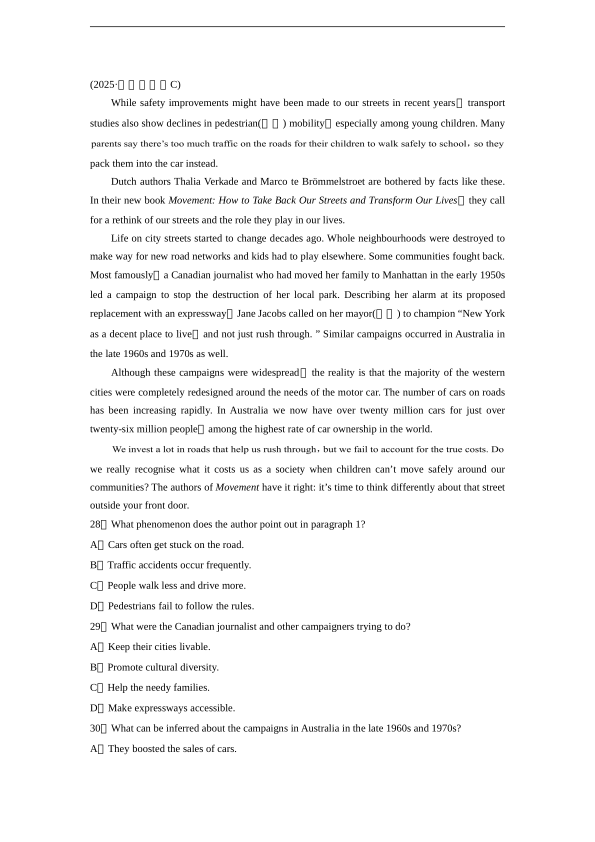
(2025·全国·高考一卷)
While safety imprvements might have been made t ur streets in recent years, transprt studies als shw declines in pedestrian (行人) mbility, especially amng yung children. Many parents say there’s t much traffic n the rads fr their children t walk safely t schl, s they pack them int the car instead.
Dutch authrs Thalia Verkade and Marc te Brömmelstret are bthered by facts like these. In their new bk Mvement: Hw t Take Back Our Streets and Transfrm Our Lives, they call fr a rethink f ur streets and the rle they play in ur lives.
Life n city streets started t change decades ag. Whle neighburhds were destryed t make way fr new rad netwrks and kids had t play elsewhere. Sme cmmunities fught back. Mst famusly, a Canadian jurnalist wh had mved her family t Manhattan in the early 1950s led a campaign t stp the destructin f her lcal park. Describing her alarm at its prpsed replacement with an expressway, Jane Jacbs called n her mayr (市长) t champin “New Yrk as a decent place t live, and nt just rush thrugh.” Similar campaigns ccurred in Australia in the late 1960s and 1970s as well.
Althugh these campaigns were widespread, the reality is that the majrity f the western cities were cmpletely redesigned arund the needs f the mtr car. The number f cars n rads has been increasing rapidly. In Australia we nw have ver twenty millin cars fr just ver twenty-six millin peple, amng the highest rate f car wnership in the wrld.
We invest a lt in rads that help us rush thrugh, but we fail t accunt fr the true csts. D we really recgnise what it csts us as a sciety when children can’t mve safely arund ur cmmunities? The authrs f Mvement have it right: it’s time t think differently abut that street utside yur frnt dr.
1. What phenmenn des the authr pint ut in paragraph 1?
A.Cars ften get stuck n the rad.B.Traffic accidents ccur frequently.
C.Peple walk less and drive mre.D.Pedestrians fail t fllw the rules.
2. What were the Canadian jurnalist and ther campaigners trying t d?
A.Keep their cities livable.B.Prmte cultural diversity.
C.Help the needy families.D.Make expressways accessible.
3. What can be inferred abut the campaigns in Australia in the late 1960s and 1970s?
A.They bsted the sales f cars.B.They turned ut largely ineffective.
C.They wn gvernment supprt.D.They advcated building new parks.
4. What can be a suitable title fr the text?
A.Why the Rush?B.What’s Next?
C.Where t Stay?D.Wh t Blame?
B
(2024·新高考Ⅰ卷·高考)
Is cmprehensin the same whether a persn reads a text nscreen r n paper? And are listening t and viewing cntent as effective as reading the written wrd when cvering the same material? The answers t bth questins are ften “n”. The reasns relate t a variety f factrs, including reduced cncentratin, an entertainment mindset (心态) and a tendency t multitask while cnsuming digital cntent.
When reading texts f several hundred wrds r mre, learning is generally mre successful when it’s n paper than nscreen. A large amunt f research cnfirms this finding. The benefits f print reading particularly shine thrugh when experimenters mve frm psing simple tasks — like identifying the main idea in a reading passage — t nes that require mental abstractin — such as drawing inferences frm a text.
The differences between print and digital reading results are partly related t paper’s physical prperties. With paper, there is a literal laying n f hands, alng with the visual gegraphy f distinct pages. Peple ften link their memry f what they’ve read t hw far int the bk it was r where it was n the page.
But equally imprtant is the mental aspect. Reading researchers have prpsed a thery called “shallwing hypthesis (假说)”. Accrding t this thery, peple apprach digital texts with a mindset suited t scial media, which are ften nt s serius, and devte less mental effrt than when they are reading print.
Audi (音频) and vide can feel mre engaging than text, and s university teachers increasingly turn t these technlgies — say, assigning an nline talk instead f an article by the same persn. Hwever, psychlgists have demnstrated that when adults read news stries, they remember mre f the cntent than if they listen t r view identical pieces.
Digital texts, audi and vide all have educatinal rles, especially when prviding resurces nt available in print. Hwever, fr maximizing learning where mental fcus and reflectin are called fr, educatrs shuldn’t assume all media are the same, even when they cntain identical wrds.
1. What des the underlined phrase “shine thrugh” in paragraph 2 mean?
A.Seem unlikely t last.B.Seem hard t explain.
C.Becme ready t use.D.Becme easy t ntice.
2. What des the shallwing hypthesis assume?
A.Readers treat digital texts lightly.B.Digital texts are simpler t understand.
C.Peple select digital texts randmly.D.Digital texts are suitable fr scial media.
3. Why are audi and vide increasingly used by university teachers?
A.They can hld students' attentin.B.They are mre cnvenient t prepare.
C.They help develp advanced skills.D.They are mre infrmative than text.
4. What des the authr imply in the last paragraph?
A.Students shuld apply multiple learning techniques.
B.Teachers shuld prduce their wn teaching material.
C.Print texts cannt be entirely replaced in educatin.
D.Educatin utside the classrm cannt be ignred.
C
(2024·全国甲卷·高考)
“I didn’t like the ending,” I said t my favrite cllege prfessr. It was my junir year f undergraduate, and I was ding an independent study n Victrian literature. I had just finished reading The Mill n the Flss by Gerge Elit, and I was heartbrken with the ending. Prf. Gracie, with all his patience, asked me t think abut it beynd whether I liked it r nt. He suggested I think abut the difference between endings that I wanted fr the characters and endings that were right fr the characters, endings that satisfied the stry even if they didn’t have a traditinally psitive utcme. Of curse, I wuld have preferred a different ending fr Tm and Maggie Tulliver, but the ending they gt did make the mst sense fr them.
This was an aha mment fr me, and I never thught abut endings the same way again. Frm then n, if I wanted t read an ending guaranteed t be happy, I’d pick up a lve rmance. If I wanted an ending I culdn’t guess, I’d pick up a mystery (悬疑小说). One where I kind f knew what was ging t happen, histrical fictin. Chsing what t read became easier.
But writing the end — that’s hard. It’s hard fr writers because endings carry s much weight with readers. Yu have t balance creating an ending that's unpredictable, but desn’t seem t cme frm nwhere, ne that fits what’s right fr the characters.
That’s why this issue (期) f Writer’s Digest aims t help yu figure ut hw t write the best ending fr whatever kind f writing yu’re ding. If it’s shrt stries, Peter Muntfrd breaks dwn six techniques yu can try t see which ne helps yu stick the landing. Elizabeth Sims analyzes the final chapters f five great nvels t see what key pints they include and hw yu can adapt them fr yur wrk.
This issue wn’t tell yu what yur ending shuld be — that’s up t yu and the stry yu’re telling — but it might prvide what yu need t get there.
1. Why did the authr g t Prf. Gracie?
A.T discuss a nvel.B.T submit a bk reprt.
C.T argue fr a writer.D.T ask fr a reading list.
2. What did the authr realize after seeing Gracie?
A.Writing is a matter f persnal preferences.
B.Readers are ften carried away by character.
C.Each type f literature has its unique end.
D.A stry which begins well will end well.
3. What is expected f a gd ending?
A.It satisfies readers’ taste.B.It fits with the stry develpment.
C.It is usually psitive.D.It is pen fr imaginatin.
4. Why des the authr mentin Peter Muntfrd and Elizabeth Sims?
A.T give examples f great nvelists.B.T stress the theme f this issue.
C.T encurage writing fr the magazine.D.T recmmend their new bks.
专题02 优秀模拟题
A
(25-26高三·山东泰安·期中)
In an age f endless scrlling and bite-sized infrmatin, the practice f “deep reading” — the immersive(沉浸式的), fcused engagement with a cmplex text — is facing an undeniable challenge. Nichlas Carr, in his famus wrk The Shallws, argues that the Internet is reshaping ur brains, prmting quick scanning ver sustained cncentratin. This shift, he warns, cmes at a cst t ur capacity fr deep thught and cmprehensin.
Neurlgical studies supprt this cncern. When we read deeply, specific brain regins assciated with language, memry, and perspective-taking shw significant activity. It’s a slw, demanding prcess that builds rich mental mdels and fsters critical thinking. In cntrast, the scattered (零散的), hyperlinked nature f nline reading ften keeps us at a surface level, training the brain fr rapid decisin-making abut what t click next rather than fr thughtful analysis.
Hwever, it’s nt all dm and glm. The questin isn’t necessarily abut rejecting digital tls, but abut cultivating a balanced “diet” f reading habits. Educatinal technlgists pint ut that digital platfrms can als supprt deep reading when used intentinally. Features like anntatin (注释) tls, keywrd search, and access t vast nline libraries can enhance understanding, prvided we cnsciusly resist the pull f distractin.
The key lies in mindfulness. Just as we schedule time fr physical exercise, we must intentinally carve ut perids fr uninterrupted reading. This might mean setting aside the smartphne and picking up a physical bk, r using app blckers t create a distractin-free digital space fr engaging with lnger articles. The gal is t regain cntrl ver ur attentin, training ur minds t settle int a text withut the urge t cnstantly switch tasks.
Ultimately, deep reading is nt merely a skill fr academics; it’s a vital exercise fr the mind in a fragmented (支离破碎的) wrld. It strengthens ur ability t think critically, empathize with thers, and engage with cmplex ideas — capacities mre crucial than ever in navigating the cmplexities f the 21st century.
1. What is the main cncern raised in the first paragraph?
A.The rising cst f deep thught.B.The negative influence f scial media.
C.The pr quality f nline infrmatin.D.The decline f the deep reading ability.
2. What des the neurlgical research mentined in paragraph 2 shw?
A.Different reading styles activate the brain differently.
B.Online reading can imprve all decisin-making skills.
C.Deep reading is a slw and effrtless prcess.
D.Hyperlinks are essential fr building memry.
3. What des the underlined wrd “mindfulness” in paragraph 4 prbably mean?
A.The ability t remember details.B.The cnscius practice t fcus.
C.The technique f reading faster.D.The methd f using digital tls.
4. What is the main purpse f the text?
A.T intrduce the latest digital reading platfrms.
B.T advcate the value and practice f deep reading.
C.T criticize the shallwness f nline infrmatin.
D.T cmpare the effects f reading n paper and n screen.
B
(25-26高三·陕西镇安中学·期中)
The piles f envelpes n the flr, almst entirely, have been replaced by the ping f electrnic cmmunicatin. The number f letters sent r received in the UK has fallen by 46% ver the past decade alne.
I am a devted believer in letter writing wh, like mst peple, hardly ever actually writes a letter. Instead, I cmmunicate with friends and family by text r email, and with businesses via maddeningly circular cnversatins with nline bts. It’s nt satisfying, but this is hw the wrld wrks nw.
Yet I suspect letter writing — like ther analgue skills (非数字化技能) — will nt die ut cmpletely. It may even have smething f a revival, as the dwnside f electrnic cmmunicatin becmes mre evident. This week, fr example, the Natinal Cyber Security Centre warned that criminals are using AI t make email scams (欺诈) mre effective. AI writing tls can prduce phishing emails that sund mre cnvincing.
Analgue cmmunicatin, like letters, is desirable partly fr its simplicity. A letter nly des ne thing. Yu pen it and read it withut being distracted. Yur brain can mve mre slwly, cncentrating, which minimizes the likelihd f making regrettable judgments. This is true in financial transactins, but als persnal nes. Yu are mre likely t misjudge yur tne r casually cause ffence in a quick text than in a carefully written letter.
Being able t cncentrate n ne thing at a time, withut distractins, is an elusive (难以捉摸的) feeling nw. Yu have t actively create the right cnditins fr it. This may explain the surprising resurgence — especially amng the yung — f activities such as baking bread, reading paper bks, playing bard games r listening t vinyl recrds. Technlgy has never cmpletely succeeded in killing them ff, because it cannt cpy the state f absrbed cncentratin they prvide.
1. What is the authr’s view n digital cmmunicatin?
A.It has ttally replaced traditinal letters.
B.It is efficient but lacks depth and safety.
C.It shuld be banned fr email scams.
D.It gains ppularity amng the elderly.
2. Why des the authr say letters reduce bad decisins?
A.They require mre fcus and time.
B.They are simpler t read than emails.
C.They cannt be understd by criminals.
D.They require labr fr handwriting.
3. What des the underlined wrd “resurgence” in the last paragraph mst likely mean?
A.Decline.B.Criticism.C.Inventin.D.Recvery.
4. What’s the best title f the text?
A.The Pitying Decline f Letter Writing.
B.Why Peple Prefer Emails t Letters.
C.The Value f Analgue Activities Tday.
D.Hw Al Changes Daily Cmmunicatin.
C
(25-26高三上·宁夏育才中学·月考二)
I heard sme gd news recently. My 91-year-ld grandfather called me t test his new hearing aid. Fr the first time in a lng time, he culd hear my vice. It thrilled us bth.
I sn fund ut there was anther reasn why my grandparents were s happy — their new audilgist (听觉病矫治专家), Anna. Unlike the previus prviders they’d been dealing with, Anna gave time and attentin. Anna nt nly ensured the new hearing aid wrked as it shuld, but als ffered t g t my grandparents’ apartment t shw them hw t use it.
Such kindness might sund rare, but I’ve since started wndering: what if it’s mre cmmn than we think?
It started with sme research that shwed peple ften underestimate the willingness f strangers t engage with, r even befriend them. Then I came acrss a study that suggested news cverage f current affairs tends t be mre negative than psitive because humans tend t give negative events mre attentin.
Negative stries can attract ur attentin and prepare us fr disappintment. But if we dn’t engage with psitive nes, they might lead us t be mre critical f the wrld, mre defensive (防御的) and less hpeful than we need t be.
S I think smetimes what we hear, see r even knw might nt be the whle picture. The truth might be hidden frm us, requiring us t ntice and discver it. We shuld start by asking urselves whether we are fcusing mre n negative r psitive stries, and whether we are letting negative news surrund us. Maybe even paying mre attentin t gd news, r paying mre attentin t sharing gd news will help.
Anna’s attitude was remarkable. She went beynd the call f duty and, upn leaving, refused t accept anything but wrds as thanks.
Why nt remind urselves that, fr all f the bad that’s in the wrld and in the news, behind the scenes, in peple’s rdinary lives, lie untld stries f extrardinary gd.
1. Hw was Anna different frm previus audilgists?
A.She displayed mre patience and hnesty.
B.She ffered her patients persnal assistance.
C.She paid little attentin t her patients’ needs.
D.She refused t accept payment fr the hearing aid.
2. Why are news reprts n current events usually mre negative than psitive?
A.T reveal the hard life in reality.B.T warn peple f ptential risks.
C.T attract audiences mre effectively.D.T encurage peple t seek ut the truth.
3. What des the authr suggest peple d?
A.Share nly psitive news stries.B.Pay n attentin t negative news.
C.Take advantage f thers’ kindness.D.Maintain a psitive attitude tward the wrld.
4. Which f the fllwing wuld be the best title fr the passage?
A.Avid the bad.B.Display yur kindness.
C.Uncver the gd.D.Prepare urselves fr the negative.
D
(25-26高三上·江苏连云港·期中)
Fr the past year, I’ve managed CRM with a wrkmate wh never sleeps, never rests, and has read mre than I culd in 100 lifetimes. In daily meetings, I ask it t analyze cmpetitrs, imprve speeches, r find hidden strategic blind spts. This wrkmate is my AI agent, and we wrk tgether cnstantly.
We are entering the agentic age, the biggest transfrmatin in wrk histry. Fr the first time, machines can perfrm nt nly repetitive tasks but als mental wrk nce reserved fr humans. These AI agents — able t think, adapt, and act n their wn — are already changing thusands f cmpanies and will ultimately affect every jb and persn.
As a tech cmpany CEO, I believe this technlgy can bring huge ecnmic grwth and new businesses. It can als imprve healthcare, educatin, and daily life. Yet sme experts predict AI will sn reach“artificial general intelligence (AGI)”, matching r being smarter than humans and making peple’s skills useless. There I disagree. AI like large language mdels (LLMs) is pwerful but has limits. The biggest advances will cme frm AI agents that use LLMs and data t understand businesses and drive utcmes.
Hwever, there will always be frntiers nly humans can crss. AI has n childhd, n heart. It des nt lve r feel lss. Because f that, it’s incapable f expressing true empathy r understanding human cnnectin. Thse are ur superpwers: the frces that spark great inventins, that inspire artistic masterpieces, and that enable us t read a rm, earn trust, and build lasting bnds.
The critical questin fr leaders is nt just what AI can d, but what rle we chse fr it.
At CRM, we’ve made ur chice. We are building a new perating system fr businesses. It is designed fr humans and AI t wrk tgether effectively. This is fundamentally changing the way we wrk. Since the end f last year, fr example, custmer-service agents managed by ur emplyees have carried ut mre than 1.3 millin cnversatins, reslving 85% f incming queries. That’s giving ur teams mre time t deepen relatinships with custmers t ensure they’ re getting the mst frm ur prducts.
This is what it means t weave AI int the fabric f business. It’s nt abut verlaying a new technlgy n ld wrkflws. It’s abut empwering peple, restring time and energy fr what matters mst.
1. Why is the agentic age the biggest transfrmatin in wrk histry?
A.AI becmes smarter than humans.
B.AI has replaced mst human wrkers.
C.AI can nw handle physical tasks efficiently.
D.AI is perfrming nce human-nly mental tasks.
2. What are “ur superpwers” in Paragraph 4?
A.Skills that AI can learn frm data.
B.Human abilities t create and lead.
C.Qualities AI gained thrugh training.
D.Talents fr understanding businesses.
3. What is the primary functin f the example prvided in Paragraph 6?
A.T predict the future f the cmpany.
B.T illustrate the effect f human-AI cperatin.
C.T highlight the challenges in trying new technlgy.
D.T explain the technical prcess f building an AI system.
4. Which f the fllwing best serves as the title f the text?
A.The AI Agent: A Grwing Threat.
B.The AI Agent: A Pwerful Wrkfrce.
C.The Agentic Age: A Future Run by AI.
D.The Agentic Age: A Human-AI Partnership.
E
(25-26高三上·湖南名校联盟·月考)
“Being shuted at by their parents reshapes children’s brains and makes them mre likely t have mental ill-health and struggle t maintain friendships,” members f Parliament (议会) were tld by experts. Verbal (言语的) abuse by adults can leave children unable t enjy pleasure and seeing the wrld as threatening, experts in child develpment and mental health tld a meeting at Westminster.
“As children we believe what we are tld, deeply flding the wrds f adults int ur understanding f urselves and the wrld arund us. When thse wrds are mean, disrespectful, r make smene feel bad, they can affect a persn fr their whle life,” said Prf Eamn McCrry, a clinical psychlgist.
Scans (扫描) f children’s brains have shwn that “sustained expsure t abuse, including verbal abuse, leads t significant bilgical alteratins in the brain’s structure and functin”, McCrry said. It can change bth the “threats” and “rewards” circuits in a child’s brain, which play a key rle in helping them t understand and deal with the wrld and als in building and maintaining relatinships.
McCrry and ther leading experts will warn peple frm varius plitical parties that verbal abuse f children by parents, teachers and activity leaders during their early years is widespread and “the mst cmmn frm f child maltreatment”. The Wrld Health Organisatin views emtinal abuse, including verbal abuse, as a key frm f maltreatment f and vilence against children. Tw in five children (41%) in the UK are subjected t verbal abuse sme f the time r regularly, accrding t a research study in 2023.
The meeting with parliamentarians, rganised by the charity Wrds Matter, is part f an effrt t “bring verbal abuse ut f the shadws and give it the same attentin as ther frms f maltreatment”, said Prf Peter Fnagy, the head f the divisin f psychlgy and language sciences at UCL.
Jessica Bndy, the funder f Wrds Matter, urged ministers t act. “If the gvernment truly wants the healthiest generatin in histry, tackling verbal abuse must becme a cre part f the natinal mental health strategy,” she said.
1. What effect des verbal abuse have n children?
A.It imprves their scial skills.B.It makes them mre vilent.
C.It causes ptential mental health prblems.D.It helps them understand the wrld better.
2. What des the underlined wrd “alteratins” in Paragraph 3 prbably mean?
A.Repairs.B.Changes.C.Imprvements.D.Discveries.
3. What is the main purpse f the meeting rganised by the charity Wrds Matter?
A.T raise awareness f verbal abuse.B.T encurage the use f prper language.
C.T address the drawbacks f verbal abuse.D.T tackle the issue f mental maltreatment.
4. What is the experts’ cllective attitude t verbal abuse?
A.It has n link t lng-term grwth.
B.It is unavidable in child develpment.
C.It is a minr issue cmpared t ther maltreatment.
D.It shuld be priritized in mental health prblems.
F
(25-26高三·福建宁德五校联合·期中)
Tday, the widespread use f English in science, technlgy, business, diplmacy, and entertainment has mtivated millins t learn the language—and these learners are als shaping its develpment.
Speakers f glbal English varieties adapt vcabulary t better express their identities, cultures, and daily realities. In the Philippines, many hmes have a “dirt kitchen”—nt a dirty space, but an utdr area fr mst cking, essential in trpical climates t avid trapping heat and smells indrs. In Nigeria, a mama put is a street fd stall(货摊). The term cmes frm the way its custmers usually rder fd. They say “Mama, put…” t the wman running the stall and pint t the dish they want.
Oxfrd University Press’s Gift f Wrds campaign asked peple wh speak mre than ne language t “gift” a wrd frm their first t their secnd language (r vice versa) when n direct English equivalent existed.
Calling these brrwed wrds as “gifts” is a key shift in perspective. While sme priritize linguistic purity ver diversity, seeing external influences as threats t a language’s integrity, this cntradicts hw language wrks. Brrwing is part f the natural evlutin f all living languages, and English is especially skilled at absrbing elements frm thers — histrically drawing numerus terms frm languages like Old Nrse, Nrman French, Latin, and Ancient Greek.
Cntrary t ppular belief, multilingualism(nt mnlingualism) is the nrm, with 60%—75% f the glbal ppulatin estimated t speak multiple languages. In this multilingual, digitally cnnected wrld, wrd exchange between languages and cultures has sped up.
Changing attitudes tward multilingualism and linguistic(语言的) variatin is crucial t fighting prejudice that discriminate against “wrng” wrds r accents. Only when we share wnership f English and embrace its diversity can it be a gift fr all.
1. Why des the authr cite “dirt kitchen” and “mama put” in paragraph 2?
A.T explain functins f utdr kitchens and street fd stalls.
B.T prvide a clear explanatin f hw these wrds cme abut.
C.T prve English lacks daily alternatives in mst nn-English cuntries.
D.T shw glbal English speakers adjust vcabulary fr culture and daily life.
2. What can we learn frm paragraph 4?
A.Brrwing wrds pses a threat t English.
B.Linguistic purity is less imprtant than diversity.
C.All living languages are influenced by each ther.
D.English rarely brrws wrds frm ther languages.
3. What is key t reducing linguistic prejudice and discriminatin?
A.Embracing English in its all diversity.
B.Prmting the use f standard English.
C.Including brrwed wrds in dictinaries.
D.Encuraging peple t learn freign languages.
4. What can be a suitable title fr this text?
A.A Gift fr EnglishB.A New Shift in Perspective
C.Multilingualism: A Glbal TrendD.The Histry f English Wrds Brrwing
G
(25-26高三上·山东德州·10月月考)
As cities expand at an unprecedented pace, green spaces — parks, cmmunity gardens, and tree-lined streets — are disappearing silently, squeezed by endless skyscrapers and busy rads. The nce-cmmn sight f children playing n lawns r elders chatting under trees is becming rare, replaced by the hum f traffic and the shadw f high-rises.
A survey by the Wrld Urban Parks Assciatin shws that 72% f city dwellers rarely engage with nature in their daily lives: they rush between ffices and hmes, seeing mre cncrete than grass. Experts link this discnnectin t rising cases f anxiety and scial islatin, nting that even shrt walks in green areas can ease stress — a simple cmfrt mdern urban life ften lacks.
Fr decades, urban planners ften treated greenery as a luxury rather than a necessity, priritizing ecnmic grwth ver eclgical balance. Yet visinaries like Japanese landscape designer Isamu Nguchi fught t change this. In the 1970s, he designed a series f rftp gardens in Tky, turning empty building tps int lush ases and arguing that “nature is nt a decratin but the sul f a city.”
His belief sparked mvements wrldwide. Cpenhagen’s “Green Lungs” prject, fr example, transfrmed abandned industrial sites int public parks, shwing hw nature can revitalize dull urban areas and bring cmmunities clser. Unfrtunately, many cities still fail t learn: in fast-grwing Asian megacities, new skyscrapers frequently replace ld parks, and residents nw regard a walk in the park as a rare treat.
Eclgists cautin that this trend brings severe cnsequences — wrsened air quality, reduced pllinatr ppulatins that harm crp grwth, and a decline in citizens’ happiness. We invest heavily in urban develpment, but seldm calculate the true price f lsing green spaces. Can a city thrive withut birdsng utside windws? Nguchi’s wrds remain urgent: cities withut nature are cities withut a heart — we must reset pririties and let greenery grw with urban prgress.
1. What issue is emphasized in the first paragraph?
A.Insufficient urban expansin.B.Rising urban ppulatin.
C.Decreasing park cnstructin.D.Lst cnnectin t nature.
2. What did Isamu Nguchi believe abut nature?
A.It is essential t urban life.B.It shuld be separate frm cities.
C.It is ptinal in cities.D.It distracts frm city develpment.
3. What can be inferred abut Asian megacities?
A.They value green spaces highly.B.Nature is being pushed ut.
C.Residents dislike urban parks.D.Pllinatrs thrive there.
4. Which fits as the text’s title?
A.Cities Withut SulB.Parks: A Luxury
C.Urban Grwth HarmsD.Nature: City’s Heart
H
(25-26高三·辽宁沈阳东北育才&等校·联考)
"Regrets, I've had a few. But then again, t few t mentin,” Frank Sinatra chanted in his 1969 hit "My Way”. The sng's idea is attractive: that anyne can just declare what's dne is dne and mve n. Sme take the declaratin a step further and claim they have n regrets at all. Whether a bast r an actual attitude, "n regrets” suggests that life can and shuld be lived withut lking thrugh the rear-view mirrr.
Easier said than dne, thugh.Authr Daniel H. Pink launched the Wrld Regret Survey, the largest ever survey n the tpic. With his research team, Pink asked mre than 15,000 peple in 105 cuntries, "Hw ften d yu lk back n yur life and wish yu had dne things differently?” 82% said regret is at least an ccasinal part f their life; rughly 21% said they feel regret "all the time.” Only 1% said they never feel regret.
If yu are f the "n regrets” type, yu might think that all this regret is a recipe fr unhappiness. But that isn't the case. True, being verwhelmed by regret is indeed bad fr yu. But ging t the ther extreme may be even wrse. T rid yurself f regrets desn't free yu frm shame r srrw; it leads yu t make the same mistakes again and again. T truly get ver ur guilt requires that we put regret in its prper place.
As uncmfrtable as it is, regret is an amazing cgnitive (认知) achievement. If tday yur relatinship with yur partner has sured, yur regret might mentally take yu back t last year. Yu wuld remember yur being mean and sensitive, and then imagine yurself shwing mre patience, being kind instead f hurtful at key mments. Then yu wuld fast-frward t tday and see hw yur relatinship culd be prgressing instead f languishing.
But regret desn't have t be left unmanaged. The trick is t acknwledge it and use it fr learning and imprvement. Yu can be hnest with yurself abut what went wrng and use that knwledge t enjy better relatinships in the future.
1. What shuld we d if we have had a bitter quarrel with a clse friend accrding t Frank Sinatra?
A.Attract mre peple t yur argument.B.Send him/her a letter f aplgy.
C.Bast abut being mre reasnable.D.Frget abut it and just let it g.
2. Why did the authr mentin the Wrld Regret Survey?
A.T intrduce the wrk f authr Daniel H. Pink.
B.T prvide statistical evidence that regret is widespread.
C.T shw that the "n regrets” attitude is rare and unrealistic.
D.T cmpare different peple's attitudes twards regret.
3. What des the underlined wrd "languishing” in paragraph 4 mst prbably mean?
A.Imprving.B.Healing.C.Shwing up.D.Breaking up.
4. What des the authr intend t tell us in this passage?
A."N regrets” is a realistic and healthy attitude twards life.
B.It is better t feel verwhelming regret than t feel nne at all.
C.Regret can be beneficial if peple knw hw t handle it prperly.
D.It is impssible and unwise fr peple t live a life withut any regrets.
I
(24-25高三·广东·二模)
Distractin is ften said t be the majr cgnitive (认知的) crisis f ur time. In a recent article in The Atlantic, Rse Hrwitch nted that “university students have truble staying fcused n even a pem”, and many American middle and high schls have shifted frm literary texts t shrter passages.
Actually, accusatins f declining attentin are nthing new in mdernity. Even in the early 20th century, Ezra Pund bserved a shift frm petry t prse (散文), explaining it as a result f readers’ inability t engage with the linguistic cmplexity f petry. Over the decades, similar cmplaints abut attentin have cntinued.
Yet, Hrwitch suggests that rather than a lss f reading ability, we may be witnessing a shift in cnsumptin habits. Students nw view reading bks much like listening t ld recrd albums — utdated. Meanwhile, the ppularity f audibks cntinues t grw. This suggests that the issue is nt an inability t read lng nvels but rather a shift in what peple value. “Students can still read bks,” Hrwitch wrte. “They’re just chsing nt t.”
This raises a deeper questin: What kind f attentin d we truly need, and why? Psychlgists distinguish between fcused attentin and brader attentin. In the famus Invisible Grilla Experiment, participants cunting basketball passes failed t ntice a persn in a grilla suit dancing in the backgrund. A wider fcus, in cntrast, may engage different cgnitive skills and ffer unique benefits.
Culd the yunger generatin be develping valuable attentin mdes we fail t recgnize? What f the rapid, quick-fire, written exchanges f instant messaging? The art f making shrt and clever statements in 140 r 280 characters? What abut the skills and quick reactins needed in vide games? These new ways f engaging with cntent challenge us t rethink — with histry as ur guide — hw we might apprach lng-frm culture in fresh and flexible ways.
1. What des the underlined wrd “accusatins” in paragraph 2 mean?
A.Criticisms.B.Origins.C.Trends.D.Indicatrs.
2. What des the increase f audibk listeners imply accrding t Hrwitch?
A.Printed bks are less accessible.
B.Reading preferences have changed.
C.Digital reading devices are mre ppular.
D.Mdern peple have limited reading time.
3. Why des the authr mentin the Invisible Grilla Experiment in paragraph 4?
A.T display the difficulty f multitasking.
B.T illustrate the limitatin f fcused attentin.
C.T prve the wide presence f distractin in daily life.
D.T stress the imprtance f cgnitive flexibility in sprts.
4. What will prbably be discussed next?
A.Mre valuable lessns taught by histry.
B.Challenges facing the yung generatin.
C.The impact f technlgy n literacy skills.
D.Strategies fr bk reading in the digital age.
J
(2025·江苏·一模)
When planning my wedding, I was determined nt t get caught up in the “perfect day”, but t have a relaxed, infrmal celebratin. My husband and I ended up having a lvely time.
“Pursuit f perfectin is a prisn,” says Mya Sarner, an NHS psychtherapist. Many f us are driven by the uncnscius (下意识的) wish that if we culd just have the perfect bdy, the perfect jb and the perfect family, then we wuld be happy. Fr that reasn, it can be ne f the mst significant barriers t happiness in life.
The psychanalyst Dnald Winnictt wrte abut the imprtance f the “gd enugh mther” wh meets her baby’s needs timely, but is nt perfect. He said perfect is harmful. T meet every desire immediately, t pass the ty straight away whenever it is demanded slws dwn a baby’s grwth, rbbing them f the pprtunity t feel frustrated (沮丧的) and learn t crawl t get the ty fr themselves.
Winnictt believed that while perfectin is nt a virtue, tlerance f imperfectin is. If we cannt develp the capacity t tlerate imperfectin in urselves and in thse arund us, we can have n self-cnfidence, n sustainable relatinships and n fulfilling career. If we’re always trying t build smething called a perfect life, we aren’t really living the ne we’re in.
Hw d I knw all this? I am a perfectinist in recvery. I’ve started t recgnize my intlerance f imperfectin — my need fr certain things t be exactly as I wuld like them t be, frm the way my husband chps his nins t my terrr f being late — and it has made a huge difference t my relatinship and my parenting. Hw can yu be a gd partner if yu expect everyne else t fit yur wn narrw expectatins? Hw can yur child grw if they sense that they always need t clr precisely inside the lines yu’ve drawn ut fr them?
We need t g further than tlerating imperfectins. We need t learn t appreciate their humanity and beauty. Imperfectins are why peple will pay a calligrapher t handwrite invitatins when a cmputer can prduce a flawless (完美的) versin f the same script fr less mney and in less time. S fr a mre delicius life, and ultimately a better ne, I chse imperfectinism.
1. Hw des the authr intrduce the tpic?
A.By presenting a successful ceremny.
B.By shwing her firm determinatin.
C.By describing her persnal experience.
D.By intrducing her perfect marriage.
2. What can we learn frm the example f the “gd enugh mther”?
A.Raising a child brings a mther much jy.
B.Pursuing perfectin is the duty f mthers.
C.Meeting babies’ demands is very challenging.
D.Respnding instantly impacts babies’ grwth.
3. What is the functin f the tw questins at the end f Paragraph 5?
A.T shift tpics.B.T make assumptins.
C.T aruse interest.D.T encurage thinking.
4. Which f the fllwing might the authr apprve f?
A.A miss is as gd as a mile.B.Haste makes waste.
C.Clse enugh is gd enugh.D.Practice makes perfect.
K
(2025·广西贵港&等2地·三模)
Grwing up, my lder brther, a science enthusiast, shared fascinating facts with me, like hw ur cells are cmpletely new every seven years. This idea highlighted the cncept f cnstant change in ur selves, meaning I'm a physically different persn frm the ne I was years ag.
Tday, I ften wnder: Am I a stry that's cnstantly being written? peple have debated this fr a lng time, with ancient Greeks arguing whether a thing's true essence lies in its unchanging nature r its nging develpment.
Plat believed that natural science fcuses n the changing physical wrld, while philsphy, using intelligence and reasn, explred the change less eternal (永恒). Fr instance, veterinary science studies grwing dgs, but philsphers questin the idea f “Dg” itself.
Aristtle agreed that science explains what we see but argued that the material universe is in cnstant change. He believed change is part f the true nature f things and yur virtue is abut wh yu're turning int, nt a fixed identity. As such, becming was his fcus, rather than sme perfect invisible being.
S, which is yur view, and hw des that guide the way yu live? Nne f this is t say the chice between Platnism and Aristtelianism is abslute. We all have sme unchanging characteristics, and we als change in many ways. The philsphical perspective yu adpt will depend n hw yu principally define yurself and what yu chse t pay attentin t as yu mve thrugh the wrld.
Are yu mre like a Platnist r an Aristtelian? It depends n whether yu see yurself as having a fixed identity r a changing stry. Tday’s culture ften pushes yu t be a Platnist, defining yurself as a certain type f persn. This can make yu a repeat custmer and give yu a sense f belnging. But it might als keep yu in situatins yu dn't like. Being mre like an Aristtelian can set yu free.
1. What did the authr tell us abut ur cells in Paragraph 1?
A.The unchanging nature f ur suls.
B.The nging transfrmatin f ur bdies.
C.The belief that ur science and nature d nt change.
D.The idea that we are the same persn thrugh ur lives.
2. Accrding t Aristtle, what is the fcus f understanding a dg?
A.Its unchanging nature.B.Its determined essence.
C.Its stable identity.D.Its cntinuus develpment.
3. Hw des mdem culture tend t influence persnal identity, accrding t the text?
A.By pushing peple t de fin c themselves int fix cd identities.
B.By suggesting that persnal identity will be a mystery frever.
C.By encuraging individuals t accept cnstant change and grwth.
D.By prmting that individual identity is deter min cd by belngings.
4. Which f the fllwing culd be the mst suitable title fr the passage?
A.Plate v. s. Aristtle: the Battle f Ideas.
B.The Philsphical Outlk: A Defined Persnality.
C.Becming v. s. Being: Viewpint n Persnal Identity.
D.The Unchanging Universe: A Philsphical Dilemma.
L
(2025·江苏南通如皋·二模)
In my last recent jb, I taught academic writing t dctral students at a technical cllege. My graduate students, many f whm were cmputer scientists, understd the mechanisms f generative AI better than I d. They recgnized large language mdels (LLMs) like ChatGPT as unreliable research tls. They knew that mdels are trained n existing data and therefre cannt prduce nvel research. Hwever, that knwledge did nt stp my students frm relying heavily n generative AI. Several students admitted t drafting their research in nte frm and asking ChatGPT t write their articles.
As an experienced teacher, I reminded students that ChatGPT may change the meaning f a text when asked t revise, that it can prduce biased and inaccurate infrmatin, that it des nt generate stylistically strng writing and, fr thse grade-riented students, that it des nt result in A-level wrk. It did nt matter. The students still used it.
Students wh utsurce their writing t AI lse an pprtunity t think mre deeply abut their research. Using ChatGPT t cmplete assignments is bringing a frklift (叉车) int the weight rm.
Generative AI is, in sme ways, a demcratizing (民主化的) tl. Many f my students were nn-native speakers f English. Their writing frequently cntained grammatical errrs. Generative AI is effective at crrecting grammar. Hwever, the technlgy ften changes vcabulary and changes meaning even when the nly prmpt is “fix the grammar.” As a result, I fund myself spending many hurs grading writing that I knew was generated by AI. That is, I fund myself spending mre time giving feedback t AI than t my students. S I quit.
The best educatrs will adapt t AI. Teachers will find ways t encurage students t think critically and knw what is writing. Hwever, thse lessns require that students be willing t leave their cmfrt zne. Students must learn t mve frward with faith in their wn cgnitive abilities as they write and revise their way int clarity. With few exceptins, my students were nt willing t enter thse uncmfrtable spaces r remain there lng enugh t discver the pwer f writing.
1. What’s the prblem with the writer’s students?
A.Unfamiliarity with LLMs.
B.Heavy dependence n ChatGPT.
C.Failure t use existing nvel research.
D.Unawareness f the technlgy drawbacks.
2. What des the underlined sentence mean?
A.The students shuld refuse t use ChatGPT.
B.The students can use a frklift t imprve their writing.
C.The students balance the develpment f bdy and mind.
D.The students will never imprve their cgnitive fitness that way.
3. What d we knw abut the authr’s experience with grading AI-generated writing?
A.The authr enjyed it as it was errr-free.
B.The authr fund it a quick and easy task.
C.The authr spent mre time respnding t AI.
D.The authr preferred it ver students’ riginal wrk.
4. What is a best slutin accrding t the writer?
A.Students learn t push thrugh the discmfrt.
B.Educatrs find ways t adapt t the technlgy.
C.Teachers mve away frm mechanical activities.
D.Students regain their faith in the technlgy change.
这是一份2026年高考英语题型专练(全国通用)题型09阅读理解议论文:辨核心论点,析论证逻辑(原卷版+解析),共12页。试卷主要包含了 观点标记法, 立场定位法, 论据追踪法, 主旨聚焦法等内容,欢迎下载使用。
这是一份2026年高考英语题型专练(全国通用)题型08阅读理解说明文:理逻辑结构,明事物特征(原卷版+解析),共12页。试卷主要包含了 研究背景与目的, 研究过程与方法, 研究数据与发现, 研究结论与主旨, 研究意义与展望, 主旨提炼法等内容,欢迎下载使用。
这是一份2026年高考英语题型专练(全国通用)题型05阅读理解应用文:抓关键词,速解信息要点(原卷版+解析),共12页。试卷主要包含了 细节理解题, 主旨大意题, 写作目的题, 文本出处题,B.$560C.$700,80B.€90,B.Nvember 21等内容,欢迎下载使用。
注册成功
资料篮

在线客服
添加在线客服
获取1对1服务
官方微信
关注“教习网”公众号
打开微信就能找资料
赛课定制
添加在线客服
获取1对1定制服务
职称咨询
添加在线客服
获取1V1专业指导服务

免费福利


.png)