免费领取教师福利

若您为此资料的原创作者,认为该资料内容侵犯了您的知识产权,请扫码添加我们的相关工作人员,我们尽可能的保护您的合法权益。

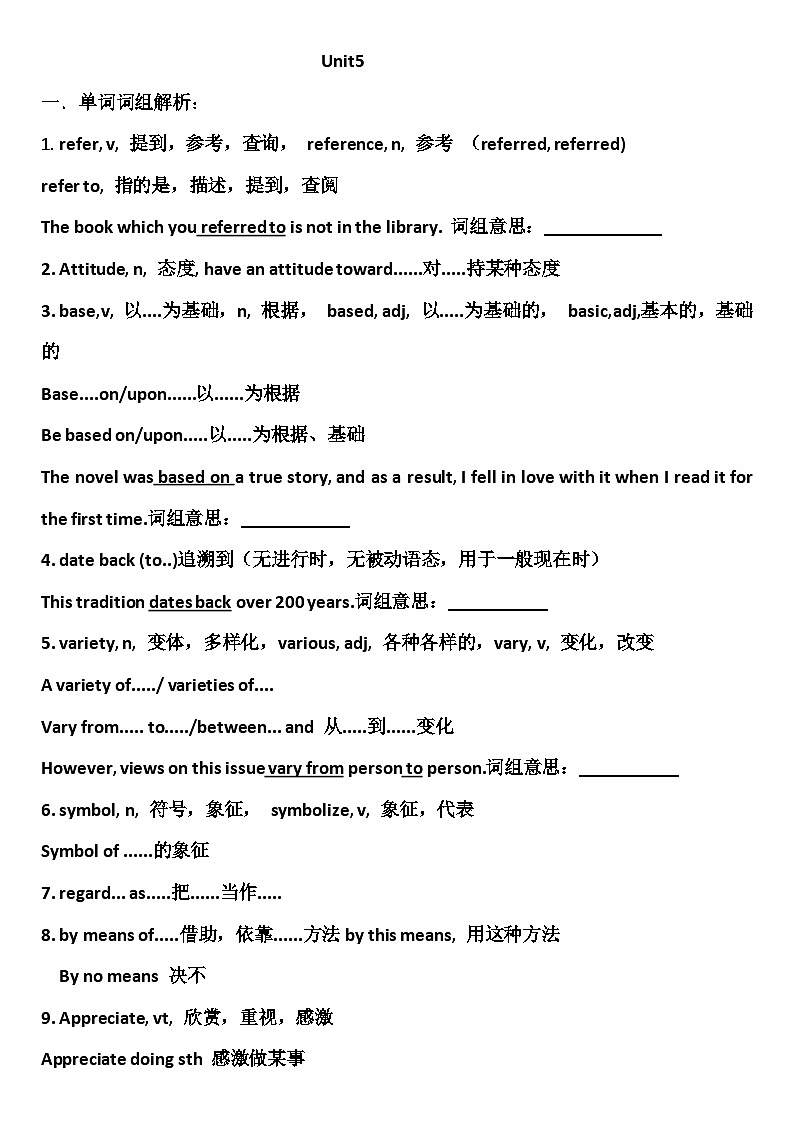
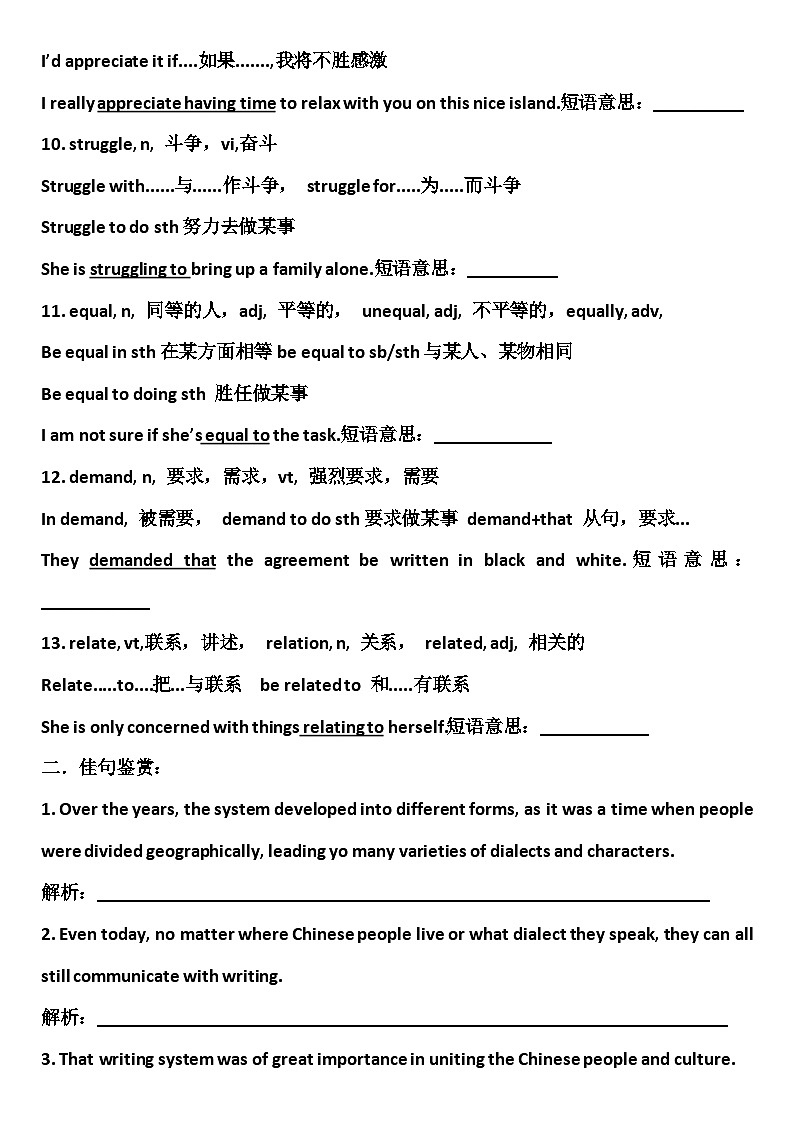
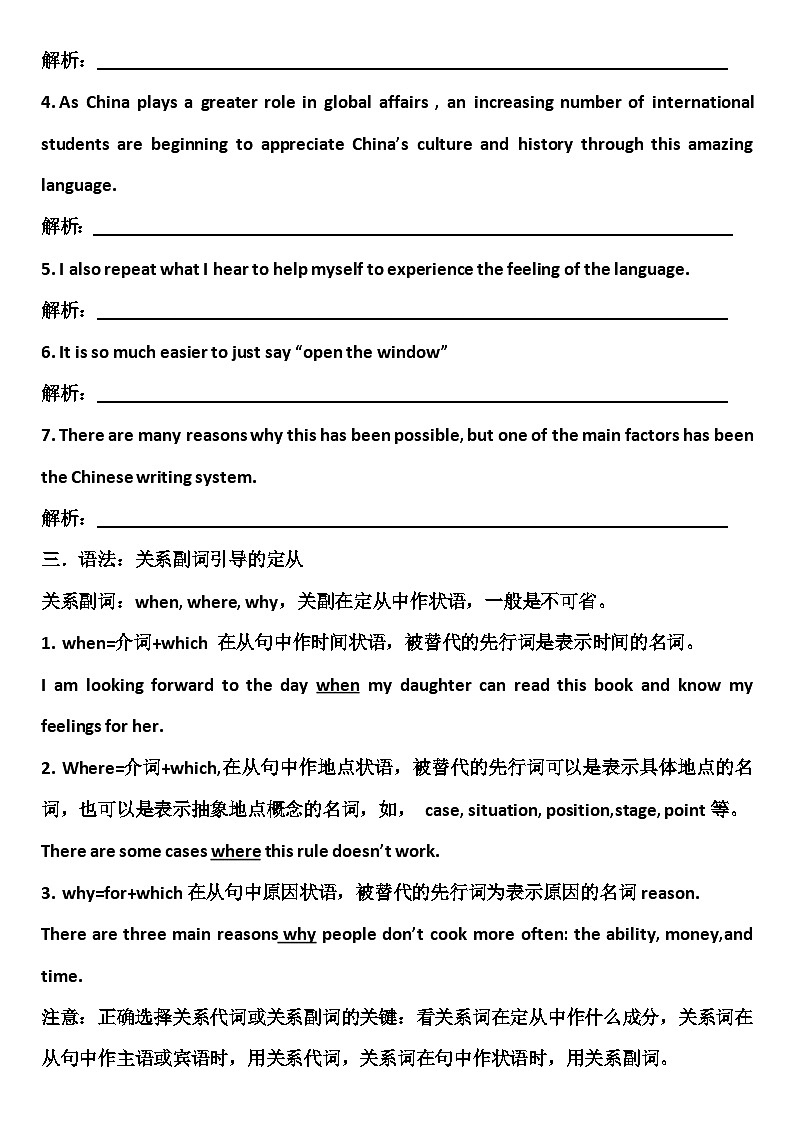
这是一份高中英语人教版 (2019)必修 第一册Unit 5 Languages around the world测试题,共7页。
refer, v, 提到,参考,查询, reference, n, 参考 (referred, referred)
refer t, 指的是,描述,提到,查阅
The bk which yu referred t is nt in the library. 词组意思:_____________
Attitude, n, 态度, have an attitude 对持某种态度
base,v, 以为基础,n, 根据, based, adj, 以为基础的, basic,adj,基本的,基础的
以为根据
Be based 以为根据、基础
The nvel was based n a true stry, and as a result, I fell in lve with it when I read it fr the first time.词组意思:____________
date back (t..)追溯到(无进行时,无被动语态,用于一般现在时)
This traditin dates back ver 200 years.词组意思:___________
variety, n, 变体,多样化,varius, adj, 各种各样的,vary, v, 变化,改变
A variety varieties
Vary and 从到变化
Hwever, views n this issue vary frm persn t persn.词组意思:___________
symbl, n, 符号,象征, symblize, v, 象征,代表
Symbl f 的象征
regard... 把当作
by means 借助,依靠方法by this means, 用这种方法
By n means 决不
Appreciate, vt, 欣赏,重视,感激
Appreciate ding sth 感激做某事
I’d appreciate it 如果,我将不胜感激
I really appreciate having time t relax with yu n this nice island.短语意思:__________
struggle, n, 斗争,vi,奋斗
Struggle 与作斗争, struggle 为而斗争
Struggle t d sth努力去做某事
She is struggling t bring up a family alne.短语意思:__________
equal, n, 同等的人,adj, 平等的, unequal, adj, 不平等的,equally, adv,
Be equal in sth在某方面相等be equal t sb/sth与某人、某物相同
Be equal t ding sth 胜任做某事
I am nt sure if she’s equal t the task.短语意思:_____________
demand, n, 要求,需求,vt, 强烈要求,需要
In demand, 被需要, demand t d sth要求做某事 demand+that 从句,要求...
They demanded that the agreement be written in black and white.短语意思:____________
relate, vt,联系,讲述, relatin, n, 关系, related, adj, 相关的
把...与联系 be related t 和有联系
She is nly cncerned with things relating t herself.短语意思:____________
佳句鉴赏:
Over the years, the system develped int different frms, as it was a time when peple were divided gegraphically, leading y many varieties f dialects and characters.
解析:____________________________________________________________________
Even tday, n matter where Chinese peple live r what dialect they speak, they can all still cmmunicate with writing.
解析:______________________________________________________________________
That writing system was f great imprtance in uniting the Chinese peple and culture.
解析:______________________________________________________________________
As China plays a greater rle in glbal affairs , an increasing number f internatinal students are beginning t appreciate China’s culture and histry thrugh this amazing language.
解析:_______________________________________________________________________
I als repeat what I hear t help myself t experience the feeling f the language.
解析:______________________________________________________________________
It is s much easier t just say “pen the windw”
解析:______________________________________________________________________
There are many reasns why this has been pssible, but ne f the main factrs has been the Chinese writing system.
解析:______________________________________________________________________
语法:关系副词引导的定从
关系副词:when, where, why,关副在定从中作状语,一般是不可省。
when=介词+which 在从句中作时间状语,被替代的先行词是表示时间的名词。
I am lking frward t the day when my daughter can read this bk and knw my feelings fr her.
Where=介词+which,在从句中作地点状语,被替代的先行词可以是表示具体地点的名词,也可以是表示抽象地点概念的名词,如, case, situatin, psitin,stage, pint等。
There are sme cases where this rule desn’t wrk.
why=fr+which在从句中原因状语,被替代的先行词为表示原因的名词reasn.
There are three main reasns why peple dn’t ck mre ften: the ability, mney,and time.
注意:正确选择关系代词或关系副词的关键:看关系词在定从中作什么成分,关系词在从句中作主语或宾语时,用关系代词,关系词在句中作状语时,用关系副词。
I will never frget the days which/that we spent tgether.
I will never frget the days when we wrked tgether.
介词+关系代词引导的定从:
基本形式:介词+whm(指人), 介词+which(指物),介词+which+名词,介词+whse+名词, 名词、不定代词、数词、比较级或最高级+f+which/whm.
It was in 1952 and Mandela was the black lawyer t whm I went fr advice.
We were put int a psitin in which we had either t accept the challenge, r give up.
介词的确定:
①根据定从中的动词或形容词与介词的搭配来确定。
The authr with whm all f us are familiar will visit ur cmpany.
②根据介词与先行词的搭配来确定。
Creating an atmsphere in which emplyees feel part f a team is a big challenge.
③根据句子意义。
Can yu lend me a pen with which I want t fill in this frm?
文章。
(一)
THE CHINESE WRITING SYSTEM:
CONNECTING THE PAST AND THE PRESENT
China is widely knwn fr its ancient civilisatin which has cntinued all the way thrugh int mdern times, despite the many ups and dwns in its histry. There are many reasns why this has been pssible, but ne f the main factrs has been the Chinese writing system.
At the beginning, written Chinese was a picture-based language. It dates back several thusand years t the use f lnggu—animal bnes and shells n which symbls were carved by ancient Chinese peple. Sme f the ancient symbls can still be seen in tday’s hanzi.
By the Shang Dynasty (arund 1600-1046 BCE), these symbls had becme a well-develped writing system. Over the years, the system develped int different frms, as it was a time when peple were divided gegraphically leading t many varieties f dialects and characters. This, hwever, changed under Emperr Qinshihuang f the Qin Dynasty (221-207BCE).
Emperr Qinshihuang united the seven majr states int ne unified cuntry where the Chinese writing system began t develp in ne directin. That writing system was f great imprtance in uniting the Chinese peple and culture. Even tday, n matter where Chinese peple live r what dialect they speak, they can all still cmmunicate in writing.
Written Chinese has als becme an imprtant means by which China’s present is cnnected with its past. Peple in mdem times can read the classic wrks which were written by Chinese in ancient times. The high regard fr the Chinese writing system can be seen in the develpment f Chinese characters as an art frm, knwn as Chinese calligraphy, which has becme an imprtant part f Chinese culture.
Tday, the Chinese writing system is still an imprtant part f Chinese culture. As China plays a greater rle in glbal affairs, an increasing number f internatinal students are beginning t appreciate China’s culture and histry thrugh this amazing language.
(二)
Learning English
Wang Le:Hey, everybdy, what are yur biggest prblems with learning English?
Liu Wen: Hi! I’ve been studying English since primary schl. I used t get high marks in English, but nw I’m having a lt f truble with my listening. When I listen t native English speakers talking in a vide, I can catch nly a few wrds. I can never quite get the main idea. Any advice?
Jia Xin: Listening t English radi prgrammes helps me get used t hw fast native speakers talk. I als repeat what I hear t help myself t experience the feeling f the language. Smetimes I even recrd my vice s I can listen t myself and cmpare my prnunciatin with the radi hst’s! My biggest headache is hw t be plite in English. It’s s much easier t just say “Open the windw!”, but in English that can sund really terrible. I have t think abut wh I’m talking t and then decide whether t say, “Open the windw, please!” r “Culd yu pen the windw, please?” r even lnger “Wuld yu mind pening the windw, please?”
Li Rui: Yeah, that’s really hard! I think it all depends n wh yu’re talking t. If I’m talking t a clse friend, I can use shrt requests, like “Open the windw”—ur relatinship is clse and we’re equals, s I nly need a few wrds t bridge the gap between us. But if I’m talking t smene wh isn’t very clse t me, I must make my request lnger—and I must make it a questin, nt a demand, e.g., “Culd yu pen the windw, please?” If I’m talking t smene senir t me, then I shuld say, “Wuld yu mind pening the windw, please?” Fr me, vcabulary is my biggest prblem—there are just SO MANY new wrds!I can’t keep all the new vcabulary straight in my head, and I certainly can’t remember hw t use them all prperly. HELP!
这是一份高中英语人教版 (2019)必修 第一册Unit 5 Languages around the world测试题,共7页。
这是一份高中英语人教版 (2019)必修 第一册Unit 5 Languages around the world课堂检测,共3页。试卷主要包含了单词拼写,语法填空等内容,欢迎下载使用。
这是一份人教版 (2019)必修 第一册Unit 5 Languages around the world当堂达标检测题,共5页。
注册成功
资料篮

在线客服
添加在线客服
获取1对1服务
官方微信
关注“教习网”公众号
打开微信就能找资料
赛课定制
添加在线客服
获取1对1定制服务
职称咨询
添加在线客服
获取1V1专业指导服务

免费福利

.png)