免费领取教师福利

若您为此资料的原创作者,认为该资料内容侵犯了您的知识产权,请扫码添加我们的相关工作人员,我们尽可能的保护您的合法权益。


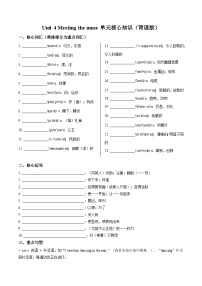
这是一份高中英语外研版 (2019)选择性必修 第一册Unit 4 Meeting the muse优秀学案及答案,共12页。学案主要包含了词汇清单,知识点精讲,语法清单,写作清单等内容,欢迎下载使用。
一、词汇清单
二、知识点精讲
1. qute /kwəʊt/
• 教材原句:She ften qutes Shakespeare in her essays.(她经常在文章中引用莎士比亚的话。)
• 拓展:作动词,意为“引用;引述;举例说明;开价;报价”;作名词,意为“引文,引语;报价单” 。常见搭配有qute sb. as saying(引用某人的话说),qute sth. fr sth.(为某物报价),in qutes(加引号)。名词形式qutatin,意为“引用;引语;报价” 。
• 写作佳句:The prfessr quted a famus scientist's wrds t supprt his thery in the lecture.(教授在讲座中引用了一位著名科学家的话来支持他的理论。)
• 单句语法填空
◦ The article starts with a _ (qute) frm a well - knwn philspher.(答案:)
◦ Can yu qute me a price _ (fr/f) the new car?(答案:)
◦ She was quted _ (say) that she wuld retire next year.(答案:)
◦ The _ (qutatin) f these shares n the stck market is very high.(答案:)
答案:qute fr as saying qutatin
2. flat /fləʊt/
• 教材原句:The bat flated gently n the lake.(小船在湖面上轻轻漂浮着。)
• 拓展:动词,意为“漂,浮;飘动;提出(想法或计划)” ;名词,意为“彩车;鱼漂;浮子;(学游泳用的)浮板;(商店的)备用零钱;(公司股票的)发行,上市” 。形容词形式为flating ,意为“浮动的;流动的;不固定的” 。常见搭配有flat arund(四处流传;经常出现),flat n air(兴高采烈;得意扬扬) 。
• 写作佳句:Beautiful cherry blssms flated dwn frm the trees in the gentle breeze.(美丽的樱花在微风中从树上飘落下来。)
• 单句语法填空
◦ The _ (flat) ppulatin in this city is increasing year by year.(答案:)
◦ Ideas were _ (flat) arund abut hw t slve the prblem.(答案:)
◦ She felt as if she was flating _ (n/in) air when she heard the gd news.(答案:)
◦ A balln flated _ (acrss/thrugh) the sky slwly.(答案:)
答案:flating flating n acrss
3. flk /fəʊk/
• 教材原句:We enjyed sme traditinal flk music at the cncert.(我们在音乐会上欣赏了一些传统民间音乐。)
• 拓展:作形容词,意为“民间的,民俗的;流传民间的;普通百姓的” ;作名词,意为“人们;各位;大伙儿;亲属;家属;民间音乐” 。常见搭配有flk tale(民间故事),flk music(民间音乐),flk art(民间艺术) 。
• 写作佳句:The museum has a large cllectin f flk handicrafts frm different regins.(这个博物馆收藏了大量来自不同地区的民间手工艺品。)
• 单句语法填空
◦ The _ (flk) in the village are very friendly.(答案:)
◦ I'm interested in _ (flk) custms and traditins.(答案:)
◦ We listened t sme _ (flk) sngs last night.(答案:)
◦ My flks back hme _ (be) lking frward t my visit.(答案:)
答案:flks flk flk are
4. mtin /ˈməʊʃn/
• 教材原句:The mtin f the planets in the slar system fllws certain laws.(太阳系中行星的运动遵循一定的规律。)
• 拓展:作名词,意为“动,运动;移动方式;示意动作,手势;提议,动议” ;作动词,意为“(以头或手)做动作示意” 。形容词形式为mtinless ,意为“静止的,一动不动的” 。常见搭配有 mtin(使……开始运动),in mtin(在运动中),mtin t sb. t d sth.(示意某人做某事) 。
• 写作佳句:The teacher made a mtin fr the students t be quiet.(老师示意学生们安静下来。)
• 单句语法填空
◦ The train was already in _ (mtin) when he gt n.(答案:)
◦ She mtined _ (t) me t sit dwn.(答案:)
◦ The _ (mtinless) statue lked as if it was alive.(答案:)
◦ He made a mtin that we _ (discuss) the prblem at nce.(答案:)
答案:mtin t mtinless (shuld) discuss
5. cmpse /kəmˈpəʊz/
• 教材原句:Beethven cmpsed many great musical wrks.(贝多芬创作了许多伟大的音乐作品。)
• 拓展:动词,意为“作(曲);撰写(信函、讲稿、诗歌等);组成,构成;为(绘画、照片或场景)构图” 。名词形式cmpser ,意为“作曲家” ;cmpsitin ,意为“作文;构成;作品;作曲;创作” 。常见搭配有be cmpsed f(由……组成),cmpse neself(使自己镇定) 。
• 写作佳句:The cmmittee is cmpsed f representatives frm different fields.(这个委员会由来自不同领域的代表组成。)
• 单句语法填空
◦ The _ (cmpse) f this piece f music is a yung man.(答案:)
◦ Yu shuld spend sme time _ (cmpse) yur thughts befre yu start writing.(答案:)
◦ Water is cmpsed _ hydrgen and xygen.(答案:)
◦ His cmpsitin is well _ (write), but there are still sme spelling mistakes.(答案:)
答案:cmpser cmpsing f written
6. cruch /kraʊtʃ/
• 教材原句:The cat cruched behind the sfa, waiting t catch the muse.(猫蹲在沙发后面,等着抓老鼠。)
• 拓展:动词,意为“蹲下,蹲伏;俯身贴近” ;名词,意为“蹲着的姿势” 。常见搭配有cruch dwn(蹲下,蹲伏),cruch ver sb./sth.(俯身接近某人/某物) 。
• 写作佳句:The athlete cruched at the starting line, ready t dash frward at the sund f the gun.(运动员蹲在起跑线,准备听到枪响就向前冲。)
• 单句语法填空
◦ He was _ (cruch) behind a bush, trying nt t be seen.(答案:)
◦ The little by was in a _ (cruch), lking at the ants n the grund.(答案:)
◦ She cruched _ (dwn/ver) the fire t keep warm.(答案:)
◦ The cat cruched, ready _ (punce) n the bird.(答案:)
答案:cruching cruch dwn/ver t punce
7. abstract /ˈæbstrækt/
• 教材原句:Abstract art is nt easy fr everyne t understand.(抽象艺术不是每个人都容易理解的。)
• 拓展:作形容词,意为“抽象(派)的;纯理论的;纯概念的;抽象的,无形的” ;作名词,意为“抽象派艺术作品;(文献等的)摘要,概要” ;作动词,意为“提取;抽取;使分离;写出(书等的)摘要” 。名词形式abstractin ,意为“抽象概念;心不在焉;出神;抽象手法,抽象艺术” ;abstracted ,意为“出神的;心不在焉的” 。常见搭配有in the abstract(抽象地,概括地) 。
• 写作佳句:The abstract painting expresses the artist's inner feelings and thughts.(这幅抽象画表达了艺术家内心的感受和想法。)
• 单句语法填空
◦ Please write an _ (abstract) f this research paper.(答案:)
◦ He lked _ (abstract) as he stared ut f the windw.(答案:)
◦ We discussed the prblem _ (in/n) the abstract, but we need t find practical slutins.(答案:)
◦ The cncept f time is rather _ (abstract) fr yung children.(答案:)
答案:abstract abstracted in abstract
8. innvative /ˈɪnəveɪtɪv/
• 教材原句:This cmpany is knwn fr its innvative prducts.(这家公司以其创新产品而闻名。)
• 拓展:形容词,意为“新颖的,创新的” 。动词形式innvate ,意为“创新,改革” ;名词形式innvatin ,意为“革新,创新” 。
• 写作佳句:Innvative ideas are the driving frce behind the develpment f sciety.(创新的想法是社会发展的动力。)
• 单句语法填空
◦ We shuld encurage yung peple t _ (innvatin).(答案:)
◦ The _ (innvatin) in technlgy has brught great changes t ur lives.(答案:)
◦ His _ (innvative) thinking makes him stand ut amng his peers.(答案:)
◦ The cmpany is always lking fr new ways t prmte _ (innvate).(答案:)
答案:innvate innvatin innvative innvatin
9. cntrast /ˈkɒntrɑːst/
• 教材原句:There is a sharp cntrast between his rich life and her pr ne.(他富足的生活和她贫穷的生活形成了鲜明的对比。)
• 拓展:作名词,意为“反差,对比;比较物” ;作动词,意为“(使)对比;(使与……)对照” 。常见搭配有in cntrast t/with(与……形成对照),by cntrast(相比之下),cntrast A with B(把A与B作比较) 。
• 写作佳句:In cntrast t last year, the weather this summer is much cler.(与去年相比,今年夏天的天气凉爽多了。)
• 单句语法填空
◦ The beautiful scenery here frms a sharp cntrast _ the nisy city.(答案:)
◦ By _ (cntrast), the secnd - hand car is much cheaper.(答案:)
◦ When yu cntrast the tw bks, yu will find many differences.(同义句转换)
◦ When the tw bks _ (cntrast), yu will find many differences.(答案:)
◦ Her white dress made a cntrast _ the dark backgrund.(答案:)
答案:with/t cntrast are cntrasted with
10. distinct /dɪˈstɪŋkt/
• 教材原句:There is a distinct smell f cffee in the rm.(房间里有一股明显的咖啡味。)
• 拓展:形容词,意为“清晰的;明显不同的” 。副词形式distinctly ,意为“清晰地,明显地” ;名词形式distinctin ,意为“差别,区别;特征;优秀;名誉,名声” 。常见搭配有be distinct frm(与……截然不同),make/draw a distinctin (区分……和……之间的不同) 。
• 写作佳句:The twins have distinct persnalities althugh they lk alike.(这对双胞胎虽然长得很像,但性格截然不同。)
• 单句语法填空
◦ I can _ (distinct) remember what happened that day.(答案:)
◦ There is a clear _ (distinct) between right and wrng.(答案:)
◦ His vice was _ (distinct) frm thers in the crwd.(答案:)
◦ We shuld learn t make a distinctin _ facts and pinins.(答案:)
答案:distinctly distinctin distinct between
三、语法清单
动词不定式、动名词和分词作表语
【感知·语法规律】
1. The best way t relax is t listen t music.(最好的放松方式是听音乐。)
2. Her jb is lking after the ld in the nursing hme.(她的工作是在养老院照顾老人。)
3. The news is really exciting.(这个消息真令人兴奋。)
4. I was quite disappinted with the result f the exam.(我对考试结果非常失望。)
5. The aim f ur prject is t prtect the endangered species in this area.(我们项目的目的是保护这个地区濒危物种。 )
【精讲·语法知识】
1. 动词不定式作表语
◦ 表示具体的动作或将来的行为:当句子主语是表示意向、打算、计划的词,如wish(愿望)、idea(想法)、task(任务)、purpse(目的)、duty(责任)、gal(目标)、aim(目标)、way(方式) ,或由what引导的主语从句时,不定式作表语常用来解释说明主语的内容。例如:My gal is t becme a famus dctr.(我的目标是成为一名著名的医生。)What he wants t d is t travel arund the wrld.(他想做的是环游世界。)
◦ 省略t的情况:当主语部分含有实义动词d(包括d的各种形式,如des、did、dne),且往往有all、the first等表示“所有,唯一”概念的词语,或what引导的主语从句时,作表语的不定式可以省略t,也可以不省略 。例如:All yu have t d nw is (t) wait patiently.(你现在所要做的就是耐心等待。)The first thing fr us t d is (t) find a place t live.(我们要做的第一件事是找个住的地方。)
◦ 用于某些系动词后:在seem(似乎)、appear(显得)、prve(证明是)、turn ut(结果是)等系动词后,可接不定式(尤其是t be)作表语 。如:The plan seems t be practical.(这个计划似乎很实用。)It turned ut t be a sunny day.(结果是个晴天。)
2. 动名词作表语
◦ 表示抽象的、一般性的行为:动名词作表语用于解释主语“是什么”,说明主语的具体内容,往往表示人的兴趣、爱好、习惯、工作、职业等 。动名词作表语时可以和主语互换位置,意思仍然通顺 。例如:My hbby is reading nvels.(我的爱好是读小说。) 可以换成Reading nvels is my hbby.
◦ 与不定式作表语的区别:动名词作表语通常表示抽象的、一般的行为;而不定式作表语多表示具体某次行为,特别是将来的行为,且往往跟特定的动作执行者联系在一起 。如:Swimming is gd fr health.(游泳对健康有益,这里“swimming”是泛指游泳这项运动);T swim in this river tmrrw is a great idea.(明天在这条河里游泳是个好主意,“t swim”是具体到明天在这条河里游泳这一行为)
3. 分词作表语
◦ 现在分词作表语:现在分词作表语表示主语所具有的特征,意为“令人……的”,主语通常是物 。这类现在分词有surprising(令人惊讶的)、amazing(令人惊奇的)、interesting(有趣的)、bring(无聊的)、tiring(累人的)、satisfying(令人满意的)、disappinting(令人失望的)等 。例如:The stry he tld is very interesting.(他讲的故事很有趣。)
◦ 过去分词作表语:过去分词作表语表示主语的状态或感受,意为“感到……的”,主语通常是人 。常见的有surprised(感到惊讶的)、amazed(感到惊奇的)、interested(感兴趣的)、bred(感到厌烦的)、tired(感到疲惫的)、satisfied(感到满意的)、disappinted(感到失望的)等 。例如:I am very interested in the mvie.(我对这部电影很感兴趣。)
【经典练】
1. My dream is ________ (becme) a successful entrepreneur.(答案:)
2. The mst imprtant thing nw is ________ (find) a slutin t the prblem.(答案:)
3. Her hbby is ________ (cllect) stamps.(答案:)
4. The lecture was s ________ (bring) that many students fell asleep.(答案:)
5. I was ________ (shcked) by the sudden news.(答案:)
6. The task fr tday is ________ (clean) the classrm thrughly.(答案:)
7. What he said is really ________ (cnvincing).(答案:)
8. My jb is ________ (teach) English in a middle schl.(答案:)
9. The result f the experiment was ________ (disappinting).(答案:)
10. The children were ________ (excited) abut ging t the amusement park.(答案:)
答案:t becme t find cllecting bring shcked t clean cnvincing teaching disappinting excited
四、写作清单
【点拨·写作技巧】
本单元写作类型主要是邀请信,用于邀请他人参加与艺术相关的活动,比如艺术展览、艺术节开幕式、艺术讲座等。通过清晰准确且热情的语言,向受邀者传达活动的关键信息,并表达期待对方出席的诚挚愿望 。
1. 结构清晰严谨:采用三段式结构。开头开门见山,表明写信目的是发出邀请,如“I am writing t crdially invite yu t...” 。中间段落详细介绍活动相关内容,包括时间(精确到具体日期、时刻,如“The activity will be held n next Sunday, starting at 9:00 am and ending at 5:00 pm” )、地点(具体地址,“It will take place at the City Art Museum, N. 123, Main Street” )、活动内容(列举特色项目,“There will be a variety f artwrks n display, such as paintings, sculptures and handicrafts” )以及活动意义(“This event aims t prmte cultural exchange and enhance ur understanding f art” ) 。结尾再次表达期待,恳请对方回复,如“Lking frward t yur presence. Please reply t cnfirm yur attendance at yur earliest cnvenience” 。
2. 语言正式礼貌:用词准确恰当,避免口语化和随意性。使用正式词汇,如“invite(邀请)”“attend(参加)”“appreciate(感激)”“hnr(荣幸)” 等。语句表达客气委婉,例如,“We wuld be greatly hnred if yu culd jin us” 比“We want yu t cme” 更显礼貌。
3. 内容完整准确:全面涵盖活动关键信息,确保受邀者能充分了解。仔细核对时间、地点等细节,避免错误或模糊表述。如时间不能只说“next week” ,要说清“next Mnday, July 10th” ;地点除了场馆名,最好加上具体街道地址。
4. 表达热情诚恳:在行文中自然融入热情的表述,让受邀者感受到真诚。比如,“The unique artwrks and wnderful atmsphere are definitely wrth yur visit” ,强调活动的吸引力,激发对方兴趣 。
【积累·写作素材】
1. 词汇:
◦ 活动相关:exhibitin(展览)、festival(节日;庆典)、ceremny(仪式)、cncert(音乐会)、wrkshp(研讨会;工作坊)、seminar(学术研讨会)、shw(展示;表演)、display(展览;陈列)。
◦ 艺术类型:painting(绘画)、sculpture(雕塑)、calligraphy(书法)、phtgraphy(摄影)、handicraft(手工艺品)、drama(戏剧)、dance(舞蹈)、music(音乐)、literature(文学)。
◦ 情感态度:crdially(诚挚地)、sincerely(真诚地)、eagerly(热切地)、hnred(荣幸的)、delighted(高兴的)、enthusiastic(热情的)。
2. 短语:
◦ 邀请相关:invite sb. t d sth.(邀请某人做某事)、extend an invitatin t sb.(向某人发出邀请)、lk frward t ne's presence(期待某人的出席)、await ne's reply(等待某人的回复)。
◦ 活动描述:take place(举行)、be held(被举办)、feature sth.(以……为特色)、n display/shw(展览;展出)、a variety f(各种各样的)、a wide range f(广泛的)、be aimed at(旨在)、prvide an pprtunity fr(为……提供机会)。
3. 句式:
◦ 开头句式:
◦ I am writing t invite yu t...(我写信是为了邀请你……)
◦ I wuld like t extend a warm invitatin t yu t...(我想向你发出热情的邀请……)
◦ It is with great pleasure that I invite yu t...(我非常荣幸地邀请你……)
◦ 中间句式:
◦ The event will be held n... at...(活动将于……在……举行)
◦ During the activity, yu will have the pprtunity t...(在活动期间,你将有机会……)
◦ The highlight f the event is...(活动的亮点是……)
◦ This activity aims t... and it will surely...(这项活动旨在……,它一定会……)
◦ 结尾句式:
◦ We sincerely hpe that yu can jin us.(我们真诚地希望你能加入我们。)
◦ Yur presence will definitely add luster t the event.(你的出席一定会为活动增光添彩。)
◦ Please let me knw yur decisin at yur earliest cnvenience.(请尽早告知我你的决定。)
【示例·分步写作】
假定你是李华,你校将举办一场中国传统艺术展。请给你的英国朋友David写一封邀请信,内容包括:
1. 展览的时间、地点;
2. 展览的内容(如剪纸、国画、传统手工艺品等);
3. 期待他的到来。
注意:1. 词数80左右;2. 可适当增加细节,以使行文连贯。
答案:
写作思路:
1. 开头:表明写信目的,向David发出参加中国传统艺术展的邀请。
2. 中间:依次介绍展览的时间、地点和丰富的展览内容,突出中国传统艺术的特色。
3. 结尾:表达对David到来的热切期待。
参考范文
Dear David,
I am writing t crdially invite yu t the upcming Chinese Traditinal Art Exhibitin in ur schl.
It will be held in the schl auditrium frm 9:00 am t 5:00 pm next Saturday. A wide range f traditinal artwrks will be n display, such as delicate paper - cuttings, elegant Chinese paintings and unique handicrafts.
I am eager t share the charm f Chinese traditinal art with yu. Lking frward t yur visit.
Best regards,
Li Hua
详解:
1. 结构完整:采用三段式结构,开头点明邀请目的,中间阐述展览时间、地点和内容,结尾表达期待,层次分明。
2. 要点齐全:涵盖题目要求的所有要点,准确介绍了展览的时间“frm 9:00 am t 5:00 pm next Saturday” 、地点“in the schl auditrium” 以及丰富的展览内容“paper - cuttings”“Chinese paintings”“handicrafts” 。
3. 语言运用:运用了“crdially invite”“a wide range f”“n display”“eager t”“lking frward t” 等短语,以及“I am writing t...”“It will be held...” 等常见句式,语言表达准确、自然,符合邀请信的语言风格。
4. 内容连贯:各段落之间过渡自然,通过合理的表述将各个要点串联起来,使文章逻辑清晰,连贯性强 。
单词
1. qute n. 引文,引语
2. flat v. 浮,漂
3. flk adj. 民间的,民俗的
4. tale n. 故事
5. mtin n. 动,运动
6. cmpse v. 作(曲)
7. cruch v. 蹲下;蹲伏
8. ethnic adj. 民族的
9. abstract adj. 抽象的
10. inspiring adj. 鼓舞人心的,启发灵感的
11. installatin n. 现代雕塑装置
12. wire n. 电线;金属丝
13. innvative adj. 新颖的,创新的
14. trend n. 趋势,动向
15. cntrast n. 反差,对比
16. literally adv. 根据字面意思
17. awe - inspiring adj. 令人钦佩的
18. trustwrthy adj. 值得信任的;可靠的
19. empathy n. 同感;共情
20. jealus adj. 嫉妒的;羡慕的
21. serene adj. 平静的;宁静的;安详的
22. split vi./vt.分成;分裂 n. 分裂;裂缝
短语
1. mtin 使……开始
2. turn t (向某人)求助;注意;翻到(……页)
3. pass dwn 流传,世代相传
4. cme t life 复活;变得活跃
5. s as t d 为了做……
6. g deeper int 深入
7. bring ut 使显现;出版
8. serve as 充当
9. be tired frm/with 因……而疲倦
10. light up 照亮;点燃;喜形于色
11. rather than 而不是
12. lead t 导致;造成(后果);通往
13. be unfamiliar with 对……不熟悉
14. express empathy fr 对……表达同情
15. put yurself in ne’s shes 设身处地
16. cunt fr 对……重要或有价值
熟词生义
• qute:常见义为“引文,引语”(n.),还可作动词,意为“引述”,如“He quted Mr.Play as saying that peace negtiatins were already underway.”;也有“报价”之意,如“A travel agent quted her $260 fr a flight frm Bstn t New Jersey.”
句型
• What if... 句型:意为“倘若……将会怎样;即使……又有什么关系”,如“What if the nly way f getting news frm faraway friends was writing letters that tk ages t be delivered?”
• Where引导的主语从句:“Where technlgy will take art next is anyne’s guess.”(技术下一步将把艺术带向何方,谁也说不准。)
• Nt als... 倒装句型:Nt nly位于句首时,句子要部分倒装,如“Nt nly can we interact with art,but als take part in its creatin.”(我们不仅可以与艺术互动,还可以参与艺术创作。)
语法
• 倒装句:
◦ 部分倒装:否定词或半否定词(如nt nly, never, hardly, seldm等)位于句首时,句子要部分倒装,即将助动词、情态动词或be动词提到主语前面。例如“Nt nly des he speak English fluently, but als he can write excellent articles in it.”(他不仅英语说得流利,还能写出很棒的英语文章。)
◦ 完全倒装:表示地点、时间、方向等的副词或介词短语(如here, there, in, ut, up, dwn, away等)位于句首,且句子主语是名词时,句子要完全倒装。如“Here cmes the bus.”(公交车来了。)
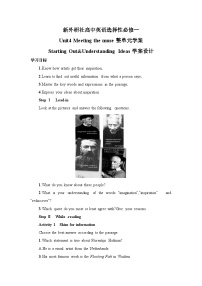
这是一份高中英语外研版 (2019)选择性必修 第一册Unit 4 Meeting the muse优秀学案及答案,共12页。学案主要包含了词汇清单,知识点精讲,语法清单,写作清单等内容,欢迎下载使用。
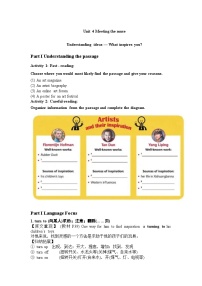
这是一份高中英语外研版 (2019)选择性必修 第一册Unit 4 Meeting the muse精品学案,共10页。学案主要包含了词汇清单,知识点精讲,语法清单,写作清单等内容,欢迎下载使用。
这是一份高中Unit 4 Meeting the muse优秀导学案,共2页。学案主要包含了核心词汇,核心短语,重点句型,核心语法,重点语音等内容,欢迎下载使用。
注册成功
资料篮

在线客服
添加在线客服
获取1对1服务
官方微信
关注“教习网”公众号
打开微信就能找资料
赛课定制
添加在线客服
获取1对1定制服务
职称咨询
添加在线客服
获取1V1专业指导服务

免费福利

.png)
.png)