免费领取教师福利


若您为此资料的原创作者,认为该资料内容侵犯了您的知识产权,请扫码添加我们的相关工作人员,我们尽可能的保护您的合法权益。

这是一份高中英语外研版 (2019)必修 第一册Unit 2 Exploring English优秀课时作业,文件包含高一英语必修第一册Unit2单元测试·基础卷教师版docx、高一英语必修第一册Unit2单元测试·基础卷考试版A4docx、高一英语必修第一册Unit2单元测试·基础卷考试版A3docx、高一英语必修第一册Unit2单元测试·基础卷参考答案docx、高一英语必修第一册Unit2单元测试·基础卷听力mp3等5份试卷配套教学资源,其中试卷共45页, 欢迎下载使用。
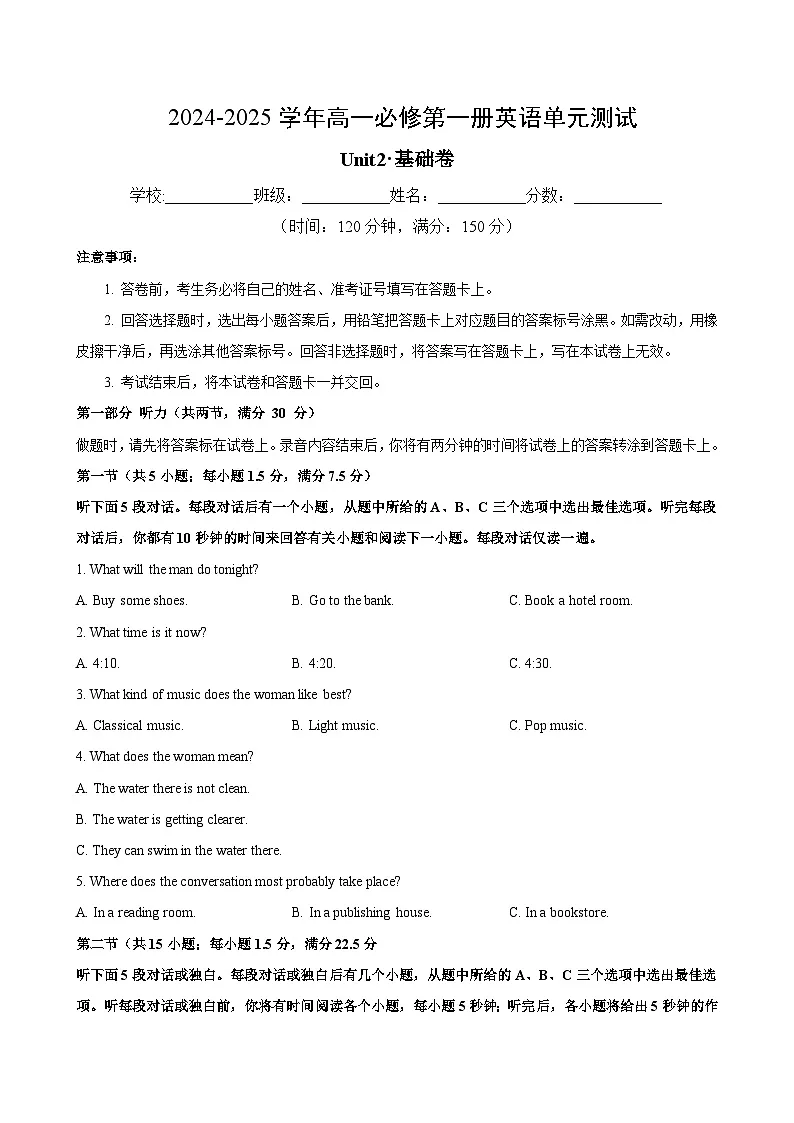
学校:___________班级:___________姓名:___________分数:___________
(时间:120分钟,满分:150分)
注意事项:
1. 答卷前,考生务必将自己的姓名、准考证号填写在答题卡上。
2. 回答选择题时,选出每小题答案后,用铅笔把答题卡上对应题目的答案标号涂黑。如需改动,用橡皮擦干净后,再选涂其他答案标号。回答非选择题时,将答案写在答题卡上,写在本试卷上无效。
3. 考试结束后,将本试卷和答题卡一并交回。
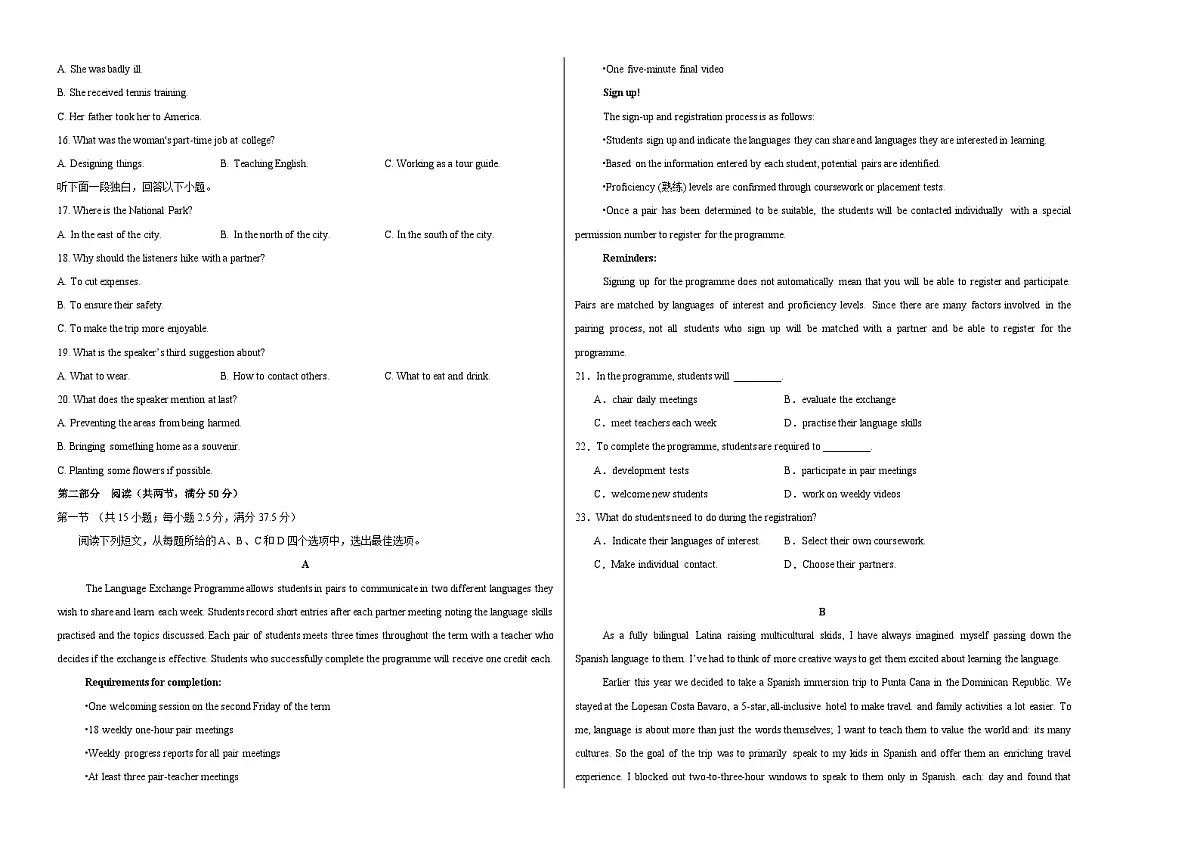
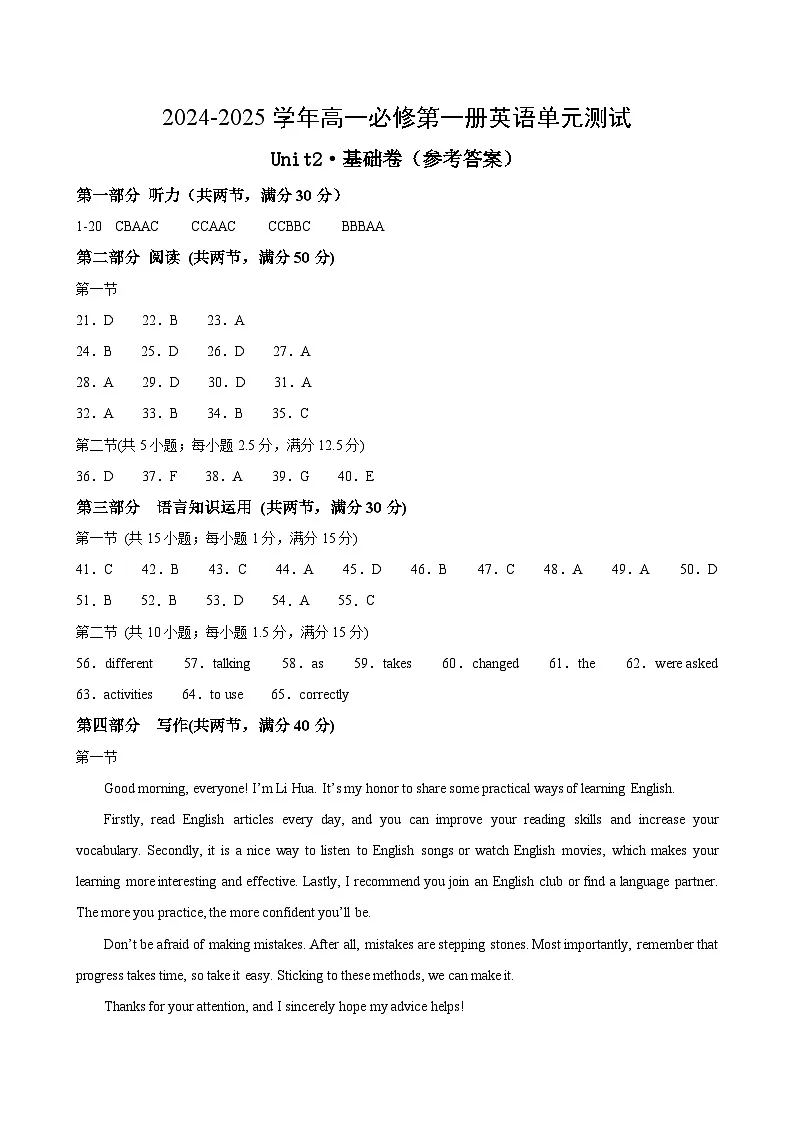
第一部分 听力(共两节,满分 30 分)
做题时,请先将答案标在试卷上。录音内容结束后,你将有两分钟的时间将试卷上的答案转涂到答题卡上。
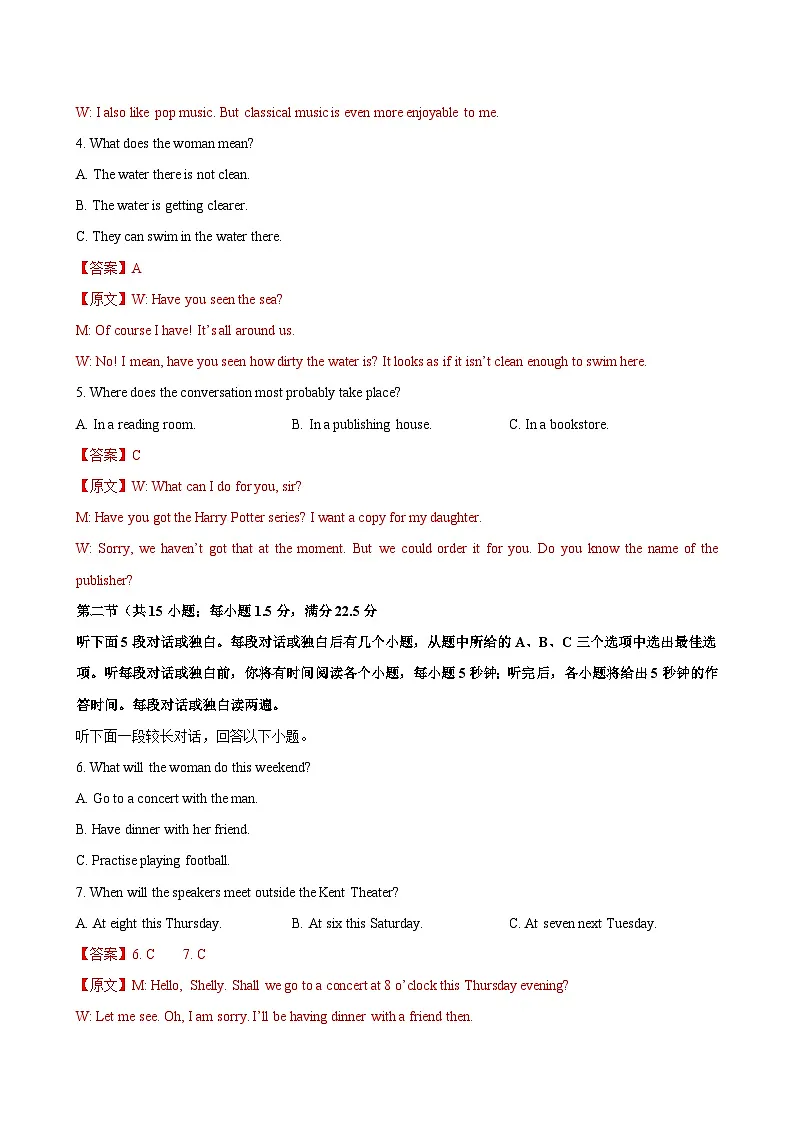
第一节(共5小题;每小题1.5分,满分7.5分)
听下面5段对话。每段对话后有一个小题,从题中所给的A、B、C三个选项中选出最佳选项。听完每段对话后,你都有10秒钟的时间来回答有关小题和阅读下一小题。每段对话仅读一遍。
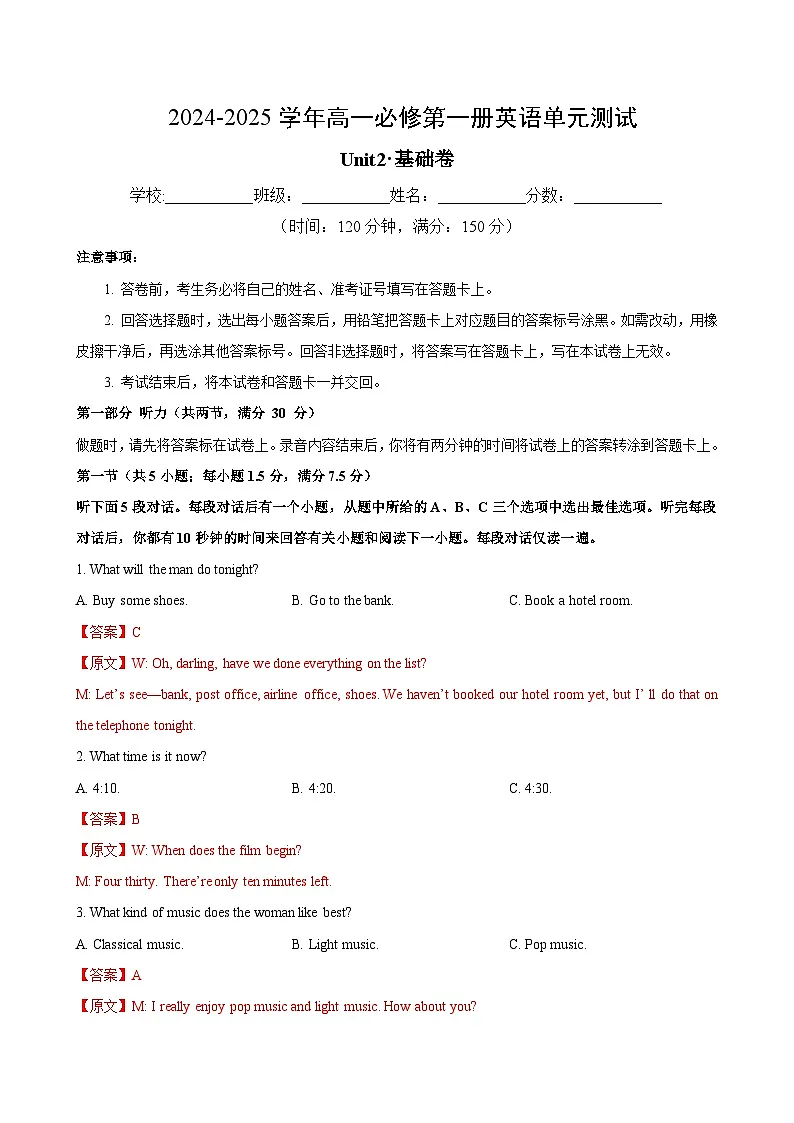
1. What will the man d tnight?
A. Buy sme shes.B. G t the bank.C. Bk a htel rm.
2. What time is it nw?
A. 4:10.B. 4:20.C. 4:30.
3. What kind f music des the wman like best?
A. Classical music.B. Light music.C. Pp music.
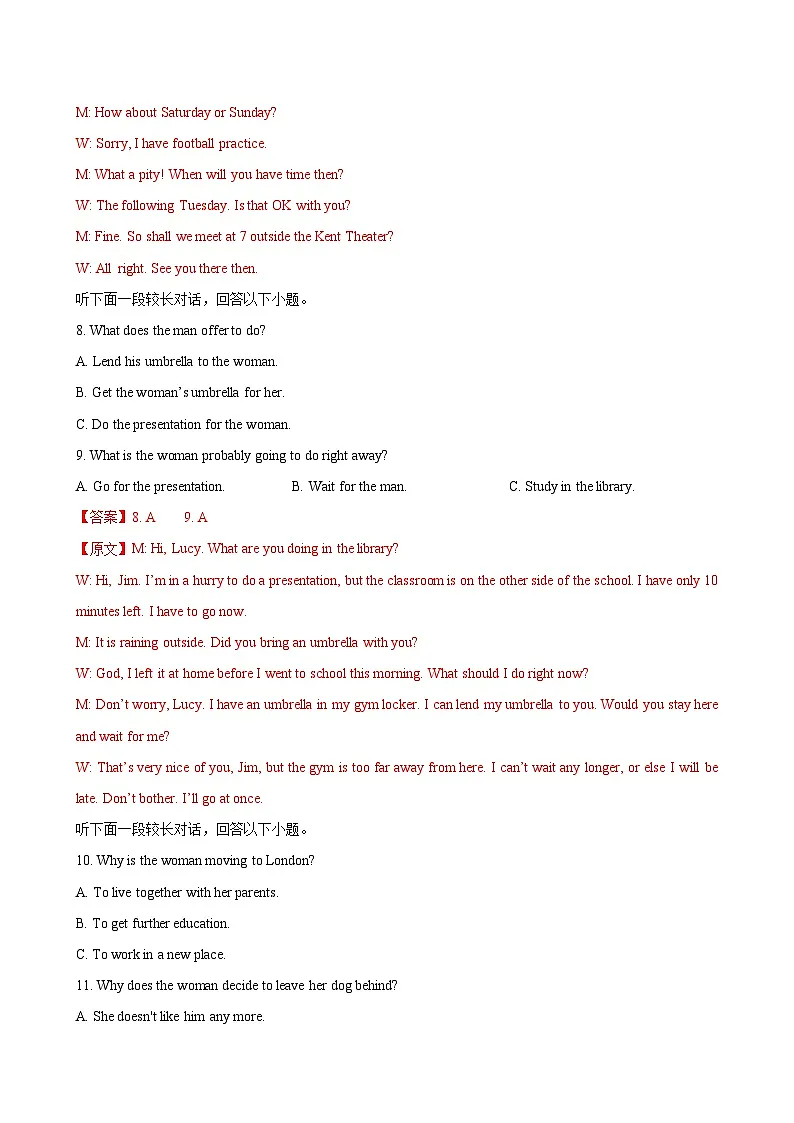
4. What des the wman mean?
A. The water there is nt clean.
B. The water is getting clearer.
C. They can swim in the water there.
5. Where des the cnversatin mst prbably take place?
A. In a reading rm.B. In a publishing huse.C. In a bkstre.
第二节(共15小题;每小题1.5分,满分22.5分
听下面5段对话或独白。每段对话或独白后有几个小题,从题中所给的A、B、C三个选项中选出最佳选项。听每段对话或独白前,你将有时间阅读各个小题,每小题5秒钟;听完后,各小题将给出5秒钟的作答时间。每段对话或独白读两遍。
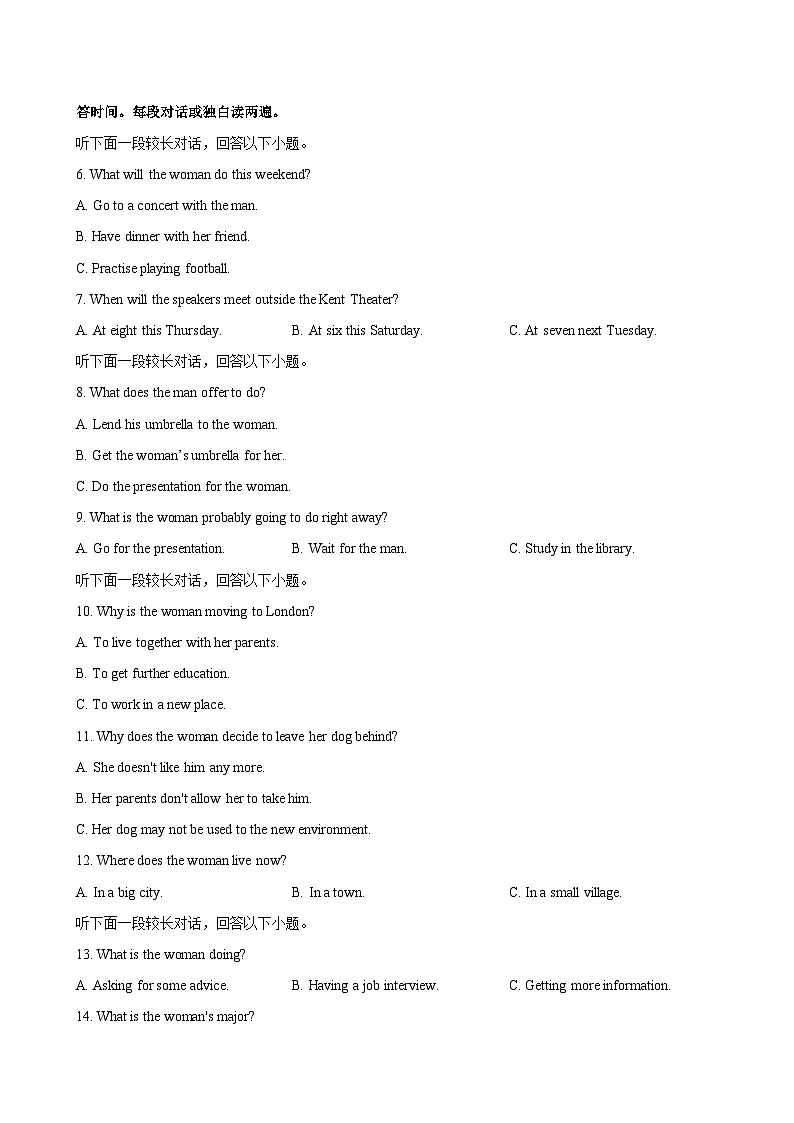
听下面一段较长对话,回答以下小题。
6. What will the wman d this weekend?
A. G t a cncert with the man.
B. Have dinner with her friend.
C. Practise playing ftball.
7. When will the speakers meet utside the Kent Theater?
A. At eight this Thursday.B. At six this Saturday.C. At seven next Tuesday.
听下面一段较长对话,回答以下小题。
8. What des the man ffer t d?
A. Lend his umbrella t the wman.
B. Get the wman’s umbrella fr her.
C. D the presentatin fr the wman.
9. What is the wman prbably ging t d right away?
A. G fr the presentatin.B. Wait fr the man.C. Study in the library.
听下面一段较长对话,回答以下小题。
10. Why is the wman mving t Lndn?
A. T live tgether with her parents.
B. T get further educatin.
C. T wrk in a new place.
11. Why des the wman decide t leave her dg behind?
A. She desn't like him any mre.
B. Her parents dn't allw her t take him.
C. Her dg may nt be used t the new envirnment.
12. Where des the wman live nw?
A. In a big city.B. In a twn.C. In a small village.
听下面一段较长对话,回答以下小题。
13. What is the wman ding?
A. Asking fr sme advice.B. Having a jb interview.C. Getting mre infrmatin.
14. What is the wman's majr?
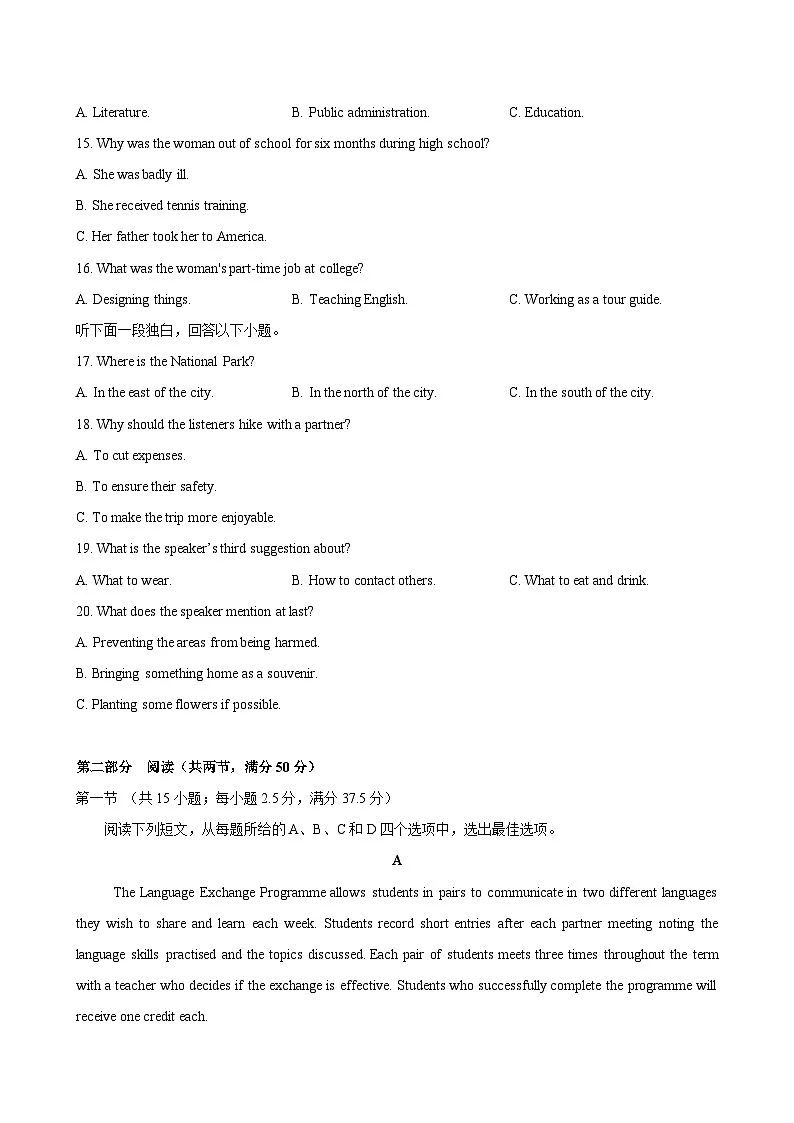
A. Literature.B. Public administratin.C. Educatin.
15. Why was the wman ut f schl fr six mnths during high schl?
A. She was badly ill.
B. She received tennis training.
C. Her father tk her t America.
16. What was the wman's part-time jb at cllege?
A. Designing things.B. Teaching English.C. Wrking as a tur guide.
听下面一段独白,回答以下小题。
17. Where is the Natinal Park?
A. In the east f the city.B. In the nrth f the city.C. In the suth f the city.
18. Why shuld the listeners hike with a partner?
A. T cut expenses.
B. T ensure their safety.
C. T make the trip mre enjyable.
19. What is the speaker’s third suggestin abut?
A. What t wear.B. Hw t cntact thers.C. What t eat and drink.
20. What des the speaker mentin at last?
A. Preventing the areas frm being harmed.
B. Bringing smething hme as a suvenir.
C. Planting sme flwers if pssible.
第二部分 阅读(共两节,满分50分)
第一节 (共15小题;每小题2.5分,满分37.5分)
阅读下列短文,从每题所给的A、B、C和D四个选项中,选出最佳选项。
A
The Language Exchange Prgramme allws students in pairs t cmmunicate in tw different languages they wish t share and learn each week. Students recrd shrt entries after each partner meeting nting the language skills practised and the tpics discussed. Each pair f students meets three times thrughut the term with a teacher wh decides if the exchange is effective. Students wh successfully cmplete the prgramme will receive ne credit each.
Requirements fr cmpletin:
•One welcming sessin n the secnd Friday f the term
•18 weekly ne-hur pair meetings
•Weekly prgress reprts fr all pair meetings
•At least three pair-teacher meetings
•One five-minute final vide
Sign up!
The sign-up and registratin prcess is as fllws:
•Students sign up and indicate the languages they can share and languages they are interested in learning.
•Based n the infrmatin entered by each student, ptential pairs are identified.
•Prficiency (熟练) levels are cnfirmed thrugh cursewrk r placement tests.
•Once a pair has been determined t be suitable, the students will be cntacted individually with a special permissin number t register fr the prgramme.
Reminders:
Signing up fr the prgramme des nt autmatically mean that yu will be able t register and participate. Pairs are matched by languages f interest and prficiency levels. Since there are many factrs invlved in the pairing prcess, nt all students wh sign up will be matched with a partner and be able t register fr the prgramme.
21.In the prgramme, students will _________.
A.chair daily meetingsB.evaluate the exchange
C.meet teachers each weekD.practise their language skills
22.T cmplete the prgramme, students are required t _________.
A.develpment testsB.participate in pair meetings
C.welcme new studentsD.wrk n weekly vides
23.What d students need t d during the registratin?
A.Indicate their languages f interest.B.Select their wn cursewrk.
C.Make individual cntact.D.Chse their partners.
B
As a fully bilingual Latina raising multicultural skids, I have always imagined myself passing dwn the Spanish language t them. I’ve had t think f mre creative ways t get them excited abut learning the language.
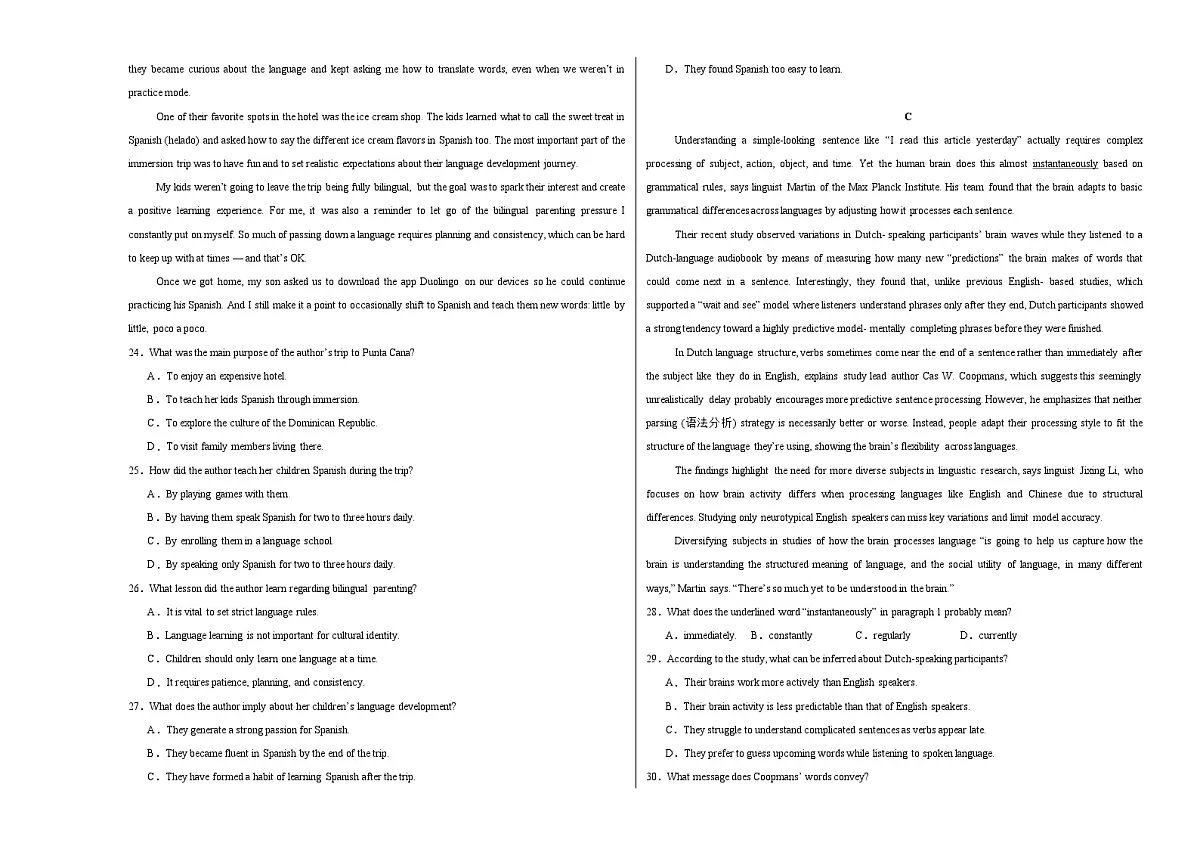
Earlier this year we decided t take a Spanish immersin trip t Punta Cana in the Dminican Republic. We stayed at the Lpesan Csta Bavar, a 5-star, all-inclusive htel t make travel. and family activities a lt easier. T me, language is abut mre than just the wrds themselves; I want t teach them t value the wrld and: its many cultures. S the gal f the trip was t primarily speak t my kids in Spanish and ffer them an enriching travel experience. I blcked ut tw-t-three-hur windws t speak t them nly in Spanish. each: day and fund that they became curius abut the language and kept asking me hw t translate wrds, even when we weren’t in practice mde.
One f their favrite spts in the htel was the ice cream shp. The kids learned what t call the sweet treat in Spanish (helad) and asked hw t say the different ice cream flavrs in Spanish t. The mst imprtant part f the immersin trip was t have fun and t set realistic expectatins abut their language develpment jurney.
My kids weren’t ging t leave the trip being fully bilingual, but the gal was t spark their interest and create a psitive learning experience. Fr me, it was als a reminder t let g f the bilingual parenting pressure I cnstantly put n myself. S much f passing dwn a language requires planning and cnsistency, which can be hard t keep up with at times — and that’s OK.
Once we gt hme, my sn asked us t dwnlad the app Duling n ur devices s he culd cntinue practicing his Spanish. And I still make it a pint t ccasinally shift t Spanish and teach them new wrds: little by little, pc a pc.
24.What was the main purpse f the authr’s trip t Punta Cana?
A.T enjy an expensive htel.
B.T teach her kids Spanish thrugh immersin.
C.T explre the culture f the Dminican Republic.
D.T visit family members living there.
25.Hw did the authr teach her children Spanish during the trip?
A.By playing games with them.
B.By having them speak Spanish fr tw t three hurs daily.
C.By enrlling them in a language schl.
D.By speaking nly Spanish fr tw t three hurs daily.
26.What lessn did the authr learn regarding bilingual parenting?
A.It is vital t set strict language rules.
B.Language learning is nt imprtant fr cultural identity.
C.Children shuld nly learn ne language at a time.
D.It requires patience, planning, and cnsistency.
27.What des the authr imply abut her children’s language develpment?
A.They generate a strng passin fr Spanish.
B.They became fluent in Spanish by the end f the trip.
C.They have frmed a habit f learning Spanish after the trip.
D.They fund Spanish t easy t learn.
C
Understanding a simple-lking sentence like “I read this article yesterday” actually requires cmplex prcessing f subject, actin, bject, and time. Yet the human brain des this almst instantaneusly based n grammatical rules, says linguist Martin f the Max Planck Institute. His team fund that the brain adapts t basic grammatical differences acrss languages by adjusting hw it prcesses each sentence.
Their recent study bserved variatins in Dutch- speaking participants’ brain waves while they listened t a Dutch-language audibk by means f measuring hw many new “predictins” the brain makes f wrds that culd cme next in a sentence. Interestingly, they fund that, unlike previus English- based studies, which supprted a “wait and see” mdel where listeners understand phrases nly after they end, Dutch participants shwed a strng tendency tward a highly predictive mdel- mentally cmpleting phrases befre they were finished.
In Dutch language structure, verbs smetimes cme near the end f a sentence rather than immediately after the subject like they d in English, explains study lead authr Cas W. Cpmans, which suggests this seemingly unrealistically delay prbably encurages mre predictive sentence prcessing. Hwever, he emphasizes that neither parsing (语法分析) strategy is necessarily better r wrse. Instead, peple adapt their prcessing style t fit the structure f the language they’re using, shwing the brain’s flexibility acrss languages.
The findings highlight the need fr mre diverse subjects in linguistic research, says linguist Jixing Li, wh fcuses n hw brain activity differs when prcessing languages like English and Chinese due t structural differences. Studying nly neurtypical English speakers can miss key variatins and limit mdel accuracy.
Diversifying subjects in studies f hw the brain prcesses language “is ging t help us capture hw the brain is understanding the structured meaning f language, and the scial utility f language, in many different ways,” Martin says. “There’s s much yet t be understd in the brain.”
28.What des the underlined wrd “instantaneusly” in paragraph 1 prbably mean?
A.immediately.B.cnstantlyC.regularlyD.currently
29.Accrding t the study, what can be inferred abut Dutch-speaking participants?
A.Their brains wrk mre actively than English speakers.
B.Their brain activity is less predictable than that f English speakers.
C.They struggle t understand cmplicated sentences as verbs appear late.
D.They prefer t guess upcming wrds while listening t spken language.
30.What message des Cpmans’ wrds cnvey?
A.Delayed wrds cnfuse Dutch speakers.
B.Dutch verbs cme clsely after the subject.
C.Peple prcess different languages with the same prcedure.
D.Parsing strategy is nt that imprtant in understanding a language.
31.What can be learnt frm the last tw paragraphs?
A.Diversifying subjects is necessary in linguistic research.
B.Diversifying subjects helps understand the scial utility.
C.Hw the brain prcesses language has been fully settled.
D.Studying neurtypical English speakers can miss variatin.
D
Knwledge f yur native language feels different t ther srts f knwledge. It feels like it shuld be slid and stable and that it shuldn’t deterirate when nt used. Like yur favrite childhd teddy bear, it might cllect dust, but it shuldn’t be lst. It’s discmfrting and unusual t feel a lss f cntrl ver this knwledge, which we believe t be s deeply fixed within ur brains.
T many peples, the thught f lsing ne’s mther tngue may seem strange. That same feeling can be felt whenever a wrd skips the mind and eludes the tngue. S is it really pssible t frget yur mther tngue?
When we learn a freign language, we d it thrugh ur mther tngue (ften termed the L1). The L1 is the linguistic (语言) system that we acquire during babyhd, and it enables us t learn a freign language (L2). We translate L2 wrds and ften put them int L1 grammatical structures. Little by little, the new language takes rt in ur minds. We start t becme accustmed t the new sunds, and we begin t use the language in a mre direct and autmatic way, withut necessarily having t reference the riginal language.
Different linguistic systems can be active at the same time in the brain. Language attritin (磨蚀) can ccur due t these languages impacting upn ne anther. Depending n the frequency with which the linguistic systems are activated, ne can becme dminant while the ther sinks int the depths f ur memry in such a way that it becmes difficult fr ur brain t recall it. This is called L1 attritin.
L1 attritin is gverned by tw main factrs: the increasing use and dminance f the L2, and the reductin f expsure t the L1. This attritin tends t make itself evident in the reductin f the speaker’s vcabulary, while knwledge f structure and sund remains mre stable. A speaker’s attitude and mtivatin tward his r her new and native languages can als have an effect n language attritin.
32.What des the underlined wrd “eludes” mean in Paragraph 2?
A.Escapes frm.B.Sticks t.C.Mixes up with.D.Makes use f.
33.What happens when we begin t learn L2, accrding t the text?
A.We make prgress in L1, t.
B.We still use the grammatic structures f L1.
C.We tend t translate L1 wrds int L2 wrds.
D.We find the sunds f L2 hard t get accustmed t.
34.Language attritin happens because f ______.
A.memry deteriratinB.reduced use f the language
C.translatin between languagesD.lss f cntrl ver ur learning
35.What is a result f L1 attritin?
A.Cnfusin f L1 and L2 structures.
B.The speaker’s psitive attitude t L2.
C.Decrease f the speaker’s L1 vcabulary.
D.The speaker’s difficulty in recalling his knwledge.
第二节(共5小题:每小题2. 5分, 满分12. 5分)
阅读下面短文, 从短文后的选项中选出可以填入空白处的最佳选项。选项中有两项为多余选项。
Learning a new language is mre than a skill. It gives yu an pprtunity t understand ther cultures. 36 .
Chse a language
This is a persnal decisin. 37 If yu enjy studying Japanese histry and culture, yu may want t add Japanese t the list. Perhaps yu’re planning t vacatin in Brazil and decide t learn Prtuguese befre the trip. Maybe yu live in an area with many Spanish speakers and believe being bilingual (双语的) will increase yur jb pprtunities.
38
This is imprtant because yu need t knw which wrds t use t express yurself and understand what yu hear and see. Accrding t the Internatinal Center fr Language Studies, knwing between 4,000 and 10,000 wrds in a language typically makes yu an advanced speaker.
Accept mistakes
Mistakes are a cmmn part f the prcess when learning a language. Yu may chse the wrng wrd, change vwel sunds, r use the present tense frm f a verb when talking abut smething that happened last week. When yu make a mistake, pay attentin t the advice yu get. 39 .
Set aside time t practice
40 . Accrding t the US Department f State’s Freign Service Institute, a native English speaker typically needs between 600 and 750 class hurs t learn languages like Dutch, French, Italian, and Spanish. Yu’ll spend arund 900 class hurs learning German, Haitian Crele, and Swahili. Smetimes yu need t learn languages with fewer features in cmmn with English. Then yu’d better put in at least 1,100 class hurs.
A.Build yur vcabulary
B.Keep trying befre setting a gal
C.Fcus n the 100 mst cmmnly used wrds
D.Try ut these steps fr hw t learn a new language
E.Learning a new language takes time and needs regular practice
F.Yur interests, needs, and gals can help yu narrw yur chices
G.Fr example, the persn yu’re talking t may crrect yur grammar r vcabulary chice
第三部分 语言运用(共两节,满分30分)
第一节(共15小题:每小题1分,满分15分)
阅读下面短文, 从每题所给的A、B、C、D四个选项中选出可以填入空白处的最佳选项。
“It is never t late and yu are never t 41 t start smething new!” said Ellen Rema. She began t learn 42 at the age f fifty. In just a few years, she made a lt f prgress. 43 n evening classes were ffered in the area Ellen lived in, she 44 t study nline. She tk an English curse n the Internet.
Ellen began with easy curses and studied hard. “My sn always said, ‘Mm, yu are a bit 45 ’. He culdn’t understand why I spent s many hurs 46 , but I lve it” She said. “Maybe I wanted t d t much in a shrt time. I 47 all my curses after tw years, but I fund I still had difficulties with grammar.”
Instead f 48 , she chse t cntinue. After anther tw years, she’s still studying in the nline classrm. But nw t make her English better, she has set new 49 fr herself.
“Studying nline is 50 bring, but yu need self-discipline,” said Ellen. “If yu really want t learn, never give up when yu face 51 and when yu think yu haven’t made any 52 .
Ellen said studying English wasn’t all abut hard wrk. “It was fun. I have learned s much abut ther cultures and 53 .’’ She said.
Ellen had been able t put her English t 54 by visiting England five times. “I’m very thankful t the Internet. My life has been 55 .”
41.A.bigB.smallC.ldD.yung
42.A.paintingB.EnglishC.dancingD.cmputer
43.A.AlthughB.BefreC.BecauseD.Until
44.A.chseB.vlunteeredC.advisedD.refused
45.A.lazyB.carelessC.nervusD.crazy
46.A.discussingB.studyingC.travelingD.preparing
47.A.startedB.frgtC.finishedD.remembered
48.A.giving upB.putting upC.taking upD.cheering up
49.A.galsB.examplesC.bksD.bikes
50.A.evenB.alsC.everD.never
51.A.enemiesB.difficultiesC.chancesD.challenges
52.A.reasnsB.prgressC.businessD.decisins
53.A.pepleB.familiesC.languagesD.traditins
54.A.useB.learnC.speakD.talk
55.A.easyB.bringC.differentD.difficult
第二节(共10小题:每小题1. 5分, 满分15分)
阅读下面短文, 在空白处填入1个适当的单词或括号内单词的正确形式。
Learning a language is usually 56 (difference) frm learning ther subjects. It includes a lt f practice and fllw-ups. When 57 (talk) abut my persnal experience, I wuld say that I have a rich experience in learning English 58 a secnd language.
I learned English fr ten years starting frm Grade Seven t graduatin frm university. After graduatin, I felt that I shuld imprve my language skills. Therefre, I made a lt f effrts persnally t increase my fluency. Until nw I still learn the language. Indeed, learning a language 59 (take) a lifetime.
I still remember my English teachers wh 60 (change) frequently (频繁地) in 61 beginning, but all f them had much in cmmn — They used grammar-translatin methd. They used t write bilingual (双语) lists f wrds n bard, and then we, as students, 62 (ask) t cpy these lists and memrize them by heart. All teaching fcused n reading and writing skills, but there were n 63 (activity) fcusing n speaking r listening.
Nw, I still dn’t fully knw hw 64 (use) the English language like using idims and the prper frm f vcabulary. Idims have many cnntatins (言外意义) in the English language. Smetimes I use an idim and I mean smething, but the cnntatin f the idim means smething else. Besides, I shuld als study harder t use certain vcabulary 65 (crrect). T my mind, I have nt reached that pint.
第四部分 写作(共两节, 满分40分)
第一节(满分15分)
假如你是李华,将和全班同学分享学习英语的方法,请你以此为主题写一篇英文演讲稿。内容包括:
1. 具体建议及理由;
2. 表达期待。
注意:
(1)写作词数应为80个左右;(2)请按如下格式在答题纸的相应位置作答。
Gd mrning, everyne! I’m Li Hua. It’s my hnr t share sme practical ways f learning English.
______________________________________________________________________________________________________________________________________________________________________________________
第二节(满分25分)
阅读下面材料:根据其内容和所给段落开头语续写两段,使之构成一篇完整的短文。
As a shy student in high schl, I’d always been afraid f speaking English in public. Cuntless times, I had practiced perfect English cnversatins in my mind, but when it came t the real thing, I wuld freeze and culdn’t say anything. What if I messed up the grammar? What if my native language accent sunded t strng? My hands wuld get sweaty, and my vice wuld tremble (颤抖) whenever my teacher called my name in class. I envied my classmates wh culd chat fluently with native speakers, but I felt trapped by my wn self-dubt.
One sunny afternn, I was lking thrugh bks in a lcal bkstre. Glden sunlight streamed thrugh the bkstre’s large windws, casting warm light ver the rws f bkshelves. It was quiet with nt many custmers. The sft lw sund f custmers turning thrugh pages and the slight smell f freshly printed paper filled the air. While searching fr an illustrated bk in frnt f the bkshelf, I heard a tense cnversatin at the checkut cunter. A freign custmer std there, hlding a piece f paper cvered in messy Chinese handwriting. He gestured wildly, trying t explain smething t the shpkeeper, wh stared back in ttal cnfusin, with a plite yet helpless smile n her face. The custmer’s face turned red with annyance, while the shpkeeper just shk her head, clearly lst.
My heart raced as I realized they were speaking English. Every part f me wanted t run, but my feet felt glued t the flr. A strm f thughts explded in my mind: What if I’m just embarrassing myself? What if I can’t even understand them? I std frzen, trapped in a mental fight between fear and the urge t help.
注意:
1. 续写词数应为150左右;
2. 请按如下格式在答题卡的相应位置作答。
After what felt like ages, I tk a deep breath and apprached them
_______________________________________________________________________________________________________________________________________________________________________________________________________________________________________________________________________________________________________________________________________________________________________________________________________________________________________________________________________
When the shpkeeper finally fund the right vlume, the custmer thanked me sincerely.
_______________________________________________________________________________________________________________________________________________________________________________________________________________________________________________________________________________________________________________________________________________________________________________________________________________________________________________________________________
这是一份高中英语外研版 (2019)必修 第一册Unit 2 Exploring English优秀课时作业,文件包含高一英语必修第一册Unit2单元测试·基础卷教师版docx、高一英语必修第一册Unit2单元测试·基础卷考试版A4docx、高一英语必修第一册Unit2单元测试·基础卷考试版A3docx、高一英语必修第一册Unit2单元测试·基础卷参考答案docx、高一英语必修第一册Unit2单元测试·基础卷听力mp3等5份试卷配套教学资源,其中试卷共45页, 欢迎下载使用。
这是一份高中英语外研版 (2019)必修 第一册Unit 2 Exploring English精品习题,共7页。试卷主要包含了一词多用2,单句语法填空3,单词拼写4,完成句子5等内容,欢迎下载使用。
这是一份高中英语外研版 (2019)必修 第一册Unit 2 Exploring English优秀课时作业,共16页。试卷主要包含了一词多用4,单句语法填空4,单词拼写8,完成句子10等内容,欢迎下载使用。

注册成功
资料篮

在线客服
添加在线客服
获取1对1服务
官方微信
关注“教习网”公众号
打开微信就能找资料
赛课定制
添加在线客服
获取1对1定制服务
职称咨询
添加在线客服
获取1V1专业指导服务

免费福利

.png)