免费领取教师福利
若您为此资料的原创作者,认为该资料内容侵犯了您的知识产权,请扫码添加我们的相关工作人员,我们尽可能的保护您的合法权益。


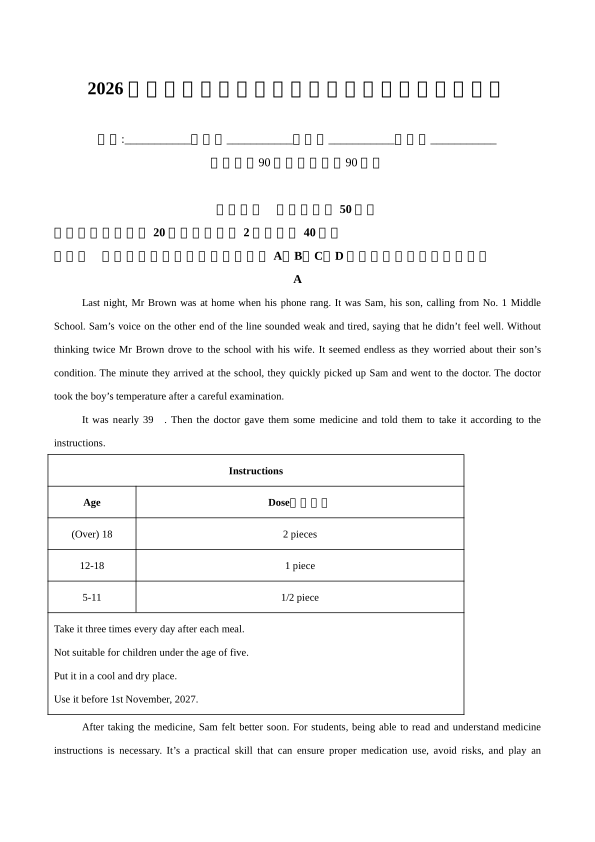
这是一份2026学年八年级下册英语期末模拟试卷(通用版 江西省卷专用),共3页。试卷主要包含了单项填空,完形填空,阅读理解,补全对话,书面表达等内容,欢迎下载使用。
学校:___________班级:___________姓名:___________分数:___________
(时间:90分钟,满分:100分)
一、单项填空(本大题共8小题,每小题1分,共8分)
请阅读下面各小题,从题中所给的A、B、C、D四个选项中选出可以填入空白处的最佳选项,并在答题卡上将该项涂黑。
1.________ it was raining heavily, the ftball match still went n as planned.
A.BecauseB.UnlessC.AlthughD.S
2.Lin dance, as an imprtant ________ in China, carries peple’s wishes fr gd luck.
A.wnderB.purpseC.traditinD.decisin
3.— I have t give a shrt bk reprt. Culd yu ________ a bk t me?
— Oliver Twist. It’s really gd.
A.encurageB.refuseC.attackD.recmmend
4.With careful planning and a lt f practice, ur team ________ finished the science prject n time.
A.successfullyB.differentlyC.terriblyD.imprtantly
5.—Ann is nt gd at speaking English.
—I ________ she shuld practice speaking English fr half an hur every day.
A.makeB.prduceC.suggestD.refuse
6.—Tmmy, dn’t make a ________ in yur rm.
—OK, mm. I’ll put away all my schl things.
A.messB.differenceC.changeD.nise
7.I think teenagers shuld take health as ________ as their studies.
A.clearlyB.heavilyC.seriuslyD.hardly
8.—Have yu ever heard f Su Dngp?
—Of curse. He’s famus fr his ________in Ci writing.
A.achievementB.prizeC.situatinsD.cnditins
二、完形填空(本大题共26小题,每小题1分,共26分)
A)请先阅读下面短文,掌握其大意,然后从各小题所给的A、B、C、D四个选项中选出可以填入相应空白处的最佳选项,并在答题卡上将该项涂黑。
Nwadays, lsing weight has becme a ht tpic in ur sciety. Many peple, 9 yung wmen, are trying varius methds t slim dwn. Sme g n extreme (极端的) diets while 10 exercise fr hurs at the gym.
Last mnth, my neighbr Lisa decided t 11 her eating habits. “I must 12 my diet,” she said, lking at 13 in the mirrr. She threw away all her junk fd and 14 a strict meal plan. Hwever, after tw weeks, she felt s 15 that she culd hardly fcus at wrk. Her dctr warned her, “Yu 16 lse weight t quickly. It’s dangerus 17 yu dn’t eat prperly.” He suggested that she fllw a balanced diet 18 . “Remember, dn’t g 19 yur bdy’s needs. Health is mre imprtant than appearance,” he added.
Lisa then 20 a grup where members encurage each ther. Nw she understands that weight lss isn’t abut suffering, 21 abut develping healthy lifestyles. She desn’t weigh herself every day 22 . With patience, she finally 23 her gal (目标) f lsing 5 kilgrams healthily.
9.A.speciallyB.especiallyC.actuallyD.finally
10.A.therB.thersC.the therD.anther
11.A.changeB.exchangeC.chargeD.chse
12.A.cntrlB.fixC.lseD.waste
13.A.herB.himC.herselfD.myself
14.A.came acrssB.came utC.came trueD.came up with
15.A.sickB.weakC.disabledD.ill
16.A.mustn’tB.wuldn’tC.shuldn’tD.might nt
17.A.unlessB.ifC.althughD.until
18.A.differentB.ppsiteC.instead fD.instead
19.A.againstB.withC.fightD.allw
20.A.madeB.checkedC.jinedD.intrduced
21.A.andB.rC.nrD.but
22.A.anywayB.anymreC.anywhereD.anyne
23.A.achievesB.getsC.raisedD.Wants
B)请先阅读下面短文,掌握其大意,然后用方框中所给词的适当形式填空,并将答案填写到答题卡的相应位置。每个词限用一次。
请先阅读下面短文,掌握其大意,然后用方框中所给词的适当形式填空,并将答案填写到答题卡的相应位置。每个词限用一次。
At the age f eleven, ne day I saw my mther washing clthes. Then I tld my mther I wanted t have a try and she agreed. 24 , when I picked up the clthes t wring (拧) the water ut, I fund hw 25 these clthes were. I culdn’t imagine hw Mm did it all by 26 .
The day 27 the Spring Festival f the same year, my family and I did the year-end cleaning (年终大扫除). In the past, my mther usually tidied up the bkcase. That year, I ffered 28 up the bkcase. But when I began t d it, I fund it difficult. First, I had t take the bks dwn befre I 29 the bkcase. It made me tired. After that, I needed t put every 30 in the right place. I didn’t knw what t d when I saw s many different kinds f bks. At that time, I realized I hadn’t 31 r even cared abut the husewrk nce befre. I was t embarrassed (尴尬的) t ask fr my mther’s help. I had t d it 32 , s it tk me a lng time t finish. Althugh I put many bks in the 33 places, my mther thanked me.
Since then, I have knwn the 34 f ding husewrk. And nw, I am nt nly gd at ding chres but als gd at taking care f myself and my family.
三、阅读理解(本大题共23小题,每小题2分,共46分)
A)请阅读下面短文,根据短文内容从每小题所给的A、B、C、D四个选项中选出最佳选项,并在答题卡上将该项涂黑。
A
The By Wh Saved the Ancient Pems
Last summer, Li Wei, a 14-year-ld by frm Beijing, visited the Tengwang Pavilin with his classmates. While they were enjying the view f the Gan River, Li Wei nticed a freign turist lking wrried. The turist held a brken camera and lked at the flr. Sme ancient pems were carved n the stne tablets nearby.
Li Wei walked ver and asked in English, “Can I help yu?” The turist explained that he had drpped his camera and brken it. He was s upset that he culdn’t take phts f the famus pems. Althugh Li Wei was shy at first, he decided t help. He tk ut his phne and tk clear phts f every pem fr the turist. He als explained the meaning f “落霞与孤鹜齐飞,秋水共长天一色” in simple English.
The turist was very grateful. “Yu are s kind,” he said. “Nw I can remember these beautiful pems frever.” Li Wei felt prud. He realized that helping thers understand Chinese culture was a wnderful thing.
35.Where did Li Wei visit last summer?
A.The Great Wall.B.The Tengwang Pavilin.
C.The Frbidden City.D.The Summer Palace.
36.Hw did Li Wei help the turist?
A.He bught him a new camera.
B.He gave him sme mney.
C.He called the plice fr help.
D.He tk phts f the pems with his phne.
37.What did Li Wei learn frm this experience?
A.Reading sme pems is very imprtant.
B.Freign turists speak highly f Nanchang.
C.Helping thers understand Chinese culture is wnderful.
D.The Tengwang Pavilin is very amazing and freigners all like it.
B
Early ne Octber mrning, a nice wman sent a yung magpie (喜鹊) t my hme fr care. The magpie flew int the frnt windw f a truck and gt hurt, but luckily the wman was passing by.
With my care, the yung magpie was ding well, but he was nt happy t find himself in a cage (笼子). Several days later, his wings were fine and nthing else was brken. He recvered (恢复). I decided t drive him t where he was fund. When I arrived, I gt the cage ut f the car and pened the dr. I ffered my arm. He jumped nt it and lked arund. I culd see he knew where he was.
Next t us was a tree. He flew straight t the tp t jin a wagtail (鹡鸰). The wagtail made lts f high singing and flew ff acrss the field. The yung magpie remained (保持) n the tp f it. I began t wrry as he still needed his parents.
The next minute I heard the singing f the wagtail again. He was flying back and tw large magpies fllwed. They landed n either side f the yung magpie, and then put their heads in the air and sang excitedly.
38.Wh sent the yung magpie t the writer’s hme?
A.A yung dctr.B.A nice wman.
C.The writer’s parents.D.The truck driver.
39.Which f the fllwing is NOT true accrding t Paragraph 2?
A.The yung magpie recvered.
B.The yung magpie knew where he was.
C.The writer drve the magpie t where he was fund.
D.The writer was unwilling (不愿意的) t let the magpie g.
40.What des the underlined wrd “it” refer t?
A.The field.B.The tree.C.The wagtail.D.The parent.
41.What is the ending f the stry?
A.The magpie brke bth his wings again.B.The magpie flew away with the wagtail.
C.The magpie gt tgether with his parents.D.The magpie disliked the writer’s hme.
42.Which f the fllwing best describes the writer?
A.Clever.B.Kind-hearted.C.Lucky.D.Hard-wrking.
C
Over the past six years, Mia Zhenjie has been teaching the skills f prcelain carving (瓷刻). Her students are children with hearing prblems at a special schl in Taiyuan, Shanxi Prvince.
Mia began learning t carve prcelain in 1997. One day, she saw a flk artist carving a cute dg n a white prcelain plate. She was amazed. Then she decided t learn the skills.
The art f prcelain carving has a lng histry and was ppular during the Qing Dynasty. Different pictures and patterns, including humans, flwers, birds and buildings, can be created n the surface f prcelain with special tls.
Accrding t Mia, different frm many traditinal frms f art, prcelain carvings can be kept frever. Hwever, it’s nt easy t carve n a very thin surface. It requires precisin (精确) and great painting skills.
Mia als wrks hard t spread the traditinal art. And starting frm 2018, Mia has been teaching students prcelain carving in the special schl. Althugh the students live in a silent wrld, they make beautiful “music” when they carve n prcelain. They’re actually gd learners f the art, because they are nt easily influenced by different sunds in the prcess f carving and can cmpletely fcus n (集中注意力于) their wrk. “They als have their wn understanding f the art,” said Mia.
With the help f ther teachers, Mia has little difficulty cmmunicating with her students. “They can read my lips (嘴唇) and then think, describe and share their understanding and questins. They get lts f happiness frm the prcess,” she said.
43.In which part f a newspaper can we see the passage?
A.Histry.B.Peple.C.Travel.D.Science.
44.Hw lng has she learned t carve prcelain?
A.21 years.B.6 years.C.15 years.D.28 years.
45.What’s the difference between the art f prcelain carving and many traditinal frms f art?
A.It will never disappear.B.It can be kept frever.
C.It is ppular amng children.D.It appeared in the Qing Dynasty.
46.Why are the students with hearing prblems gd learners f prcelain carving?
A.Because they can use the carving tls well.
B.Because they are patient and creative.
C.Because they can cmpletely fcus n the carving prcess.
D.Because they have a gd understanding f painting.
47.What’s the best title f the passage?
A.The art f prcelain carving.B.Spread the traditinal art
C.A kind-hearted flk artistD.Help children with hearing prblems
D
Everyne’s past is imprtant. It is the past that makes us wh we are tday. S, we shuld accept (接受) what has happened t us in the past. Hwever, smetimes we need t let g f the past, s as t mve n with ur lives. Why shuld we let g f the past?
We can’t change the past. Smetimes, we like t say “I wish I did that earlier” “I wish…” and s n. Hwever, the fact is that we can’t g back and change the past, but what we can d is stp thinking abut it, learn frm it, and get ready fr the future.
We shuld make space fr smething new. When we let g f ur mistakes and fears, we can make rm fr smething new t cme. The wrld is full f amazing and exciting chances. New chances will knck n ur dr when we clse the ld ne.
We need t grw. Smetimes it’s nt easy t let g f the past because it makes us t leave ur cmfrt zne. This is als why many peple are afraid f making mves. Hwever, making changes in ur life can help us becme strnger and find wh we really are. S hw can we let g f the past? Accept ur past and fcus n the gd side. Learn t enjy every day and be pen t new things. All these will pen new drs in ur life.
48.Why is it imprtant t let g f the past?
A.Because we need t grw.
B.Because we can’t change the past.
C.Because we shuld make space fr smething new.
D.All f the ther three answers.
49.Accrding t the writer, what shuld we d if we lst a ball game?
A.Wrry abut it all day lng.
B.Cry and dn’t talk with anyne.
C.Learn frm it and prepare fr the next ne.
D.Say srry t the teammates and dn’t play it anymre.
50.What is the Chinese meaning f the underlined phrase “cmfrt zne”?
A.舒适区B.居住区域C.解压方式D.压力地带
51.What’s the structure f the passage?
A.①/②③④B.①/②③/④C.①/②/③④D.①②③/④
52.Which f the fllwing is the best title fr the passage?
A.Let G f the PastB.Hw t Let G f the Past?
C.Everyne’s Past Is ImprtantD.When Shuld We Let G f the Past?
B)请先阅读下面短文,掌握其大意,然后根据短文内容从下面的七个选项中选择五个还原到文中,使短文意思通顺、结构完整,并在答题卡上将其序号涂黑。一空一句。
Yu’ve prbably heard f bks that will change yur life. And a lt f readers agree that the bk Atmic Habits (《原子习惯》) will meet yur needs.
James Clear, wh did a lt f research n the frmatin f habits, is the writer f Atmic Habits. 53 It has sld ver 15 millin cpies and has been translated int mre than 50 languages. And his website receives millins f visitrs each mnth.
54 That’s because the bk intrduces a practical system (系统) fr creating gd habits and breaking bad nes. Readers everywhere are very interested in Clear’s “science f tiny habits”.
In the bk, the writer suggests trying t get 1% better each day. Fr example, yu’d like t exercise but yu dn’t think yu have the time r energy. Clear suggests starting with tw minutes a day. Over time, the effects f this habit will increase as yu repeat the actins. 55 “All big things cme frm small beginnings,” says Clear.
Clear cntinues with the fllwing advice: Dn’t fcus n (聚焦) what yu want t achieve. 56 Fr example, tw men want t break the habit f smking. When ffered a cigarette (香烟), ne says, “N, thanks. I’m trying t give up smking.” The ther says, “N, thanks. I’m nt a smker.” While the first man still sees himself as a smker, the secnd man desn’t. Clear says, “Bad habits will die mre easily if yu fcus n wh yu want t becme.”
Atmic Habits will reshape the way yu think abut prgress and success. 57 Slwly but surely, it will have a great effect n yur health, jb and relatinships.
A.Why is it s ppular?
B.Instead, fcus n wh yu want t becme.
C.He calls these repeated actins “atmic habits”.
D.This bk is a N.1 New Yrk Times bestseller.
E.The key t success lies in setting clear lng-term gals.
F.Many readers have shared their habit-changing stries nline.
G.Als, it will give yu the tls yu need t change yur habits.
四、补全对话(本大题共5小题,每小题1分,共5分)
请阅读下面对话,根据对话内容从下面的七个选项中选择五个填入空白处,使对话通顺、合理,意思完整,并在答题卡上将其序号涂黑。一空一句。
(Linda and Mary are talking n the playgrund. Linda=L, Mary=M)
M: Hi, Linda. Yu lk sad. 58
L: Well, I lve music, but my mther desn’t allw me t listen t it.
M: 59
L: Because she thinks listening t music is nt gd fr my study.
M: 60 I als lve music. It makes me relaxed and helps me study better.
L: Right. But hw can I slve my prblem? Can yu give me sme advice?
M: Of curse. 61
L: N, I dn’t ften talk with her. We ften argue.
M: 62
L: OK, I’ll d that. Thanks fr yur advice.
A.Hw’s it ging?
B.I dn’t think s.
C.What abut yu?
D.What’s the matter?
E.But cmmunicating is a gd way.
F.Hw abut talking with yur mther?
G.Why desn’t she allw yu t listen t it?
五、书面表达(15分)
63.家务是劳动教育的一部分。我们作为家庭成员的一分子,应该学会分担家务。请你根据下面的提示信息,写一篇英语短文,说说你对做家务的看法,并分享你平时经常做的家务,以及你在做家务劳动中的收获。写作要点:
1. What d yu think f ding husewrk?
2. What kind f husewrk d yu usually d?
3. What can yu learn frm ding husewrk?
要求:
1. 短文应包括提示中所有的写作要点,条理清晰,行文连贯,可适当发挥;
2. 短文中不能出现真实的人名和地名;
3. 词数80-120,短文开头已给出,不计入总词数。
Husewrk is part f ur life. In my pinin,
____________________________________________________________________________________________________________________________________________________________________________________________________________________________________________________________________________________________________________________________________________________________________________________________________________________________________________________________________________
clean wrng hwever bk heavy difficult befre tidy alne she helped
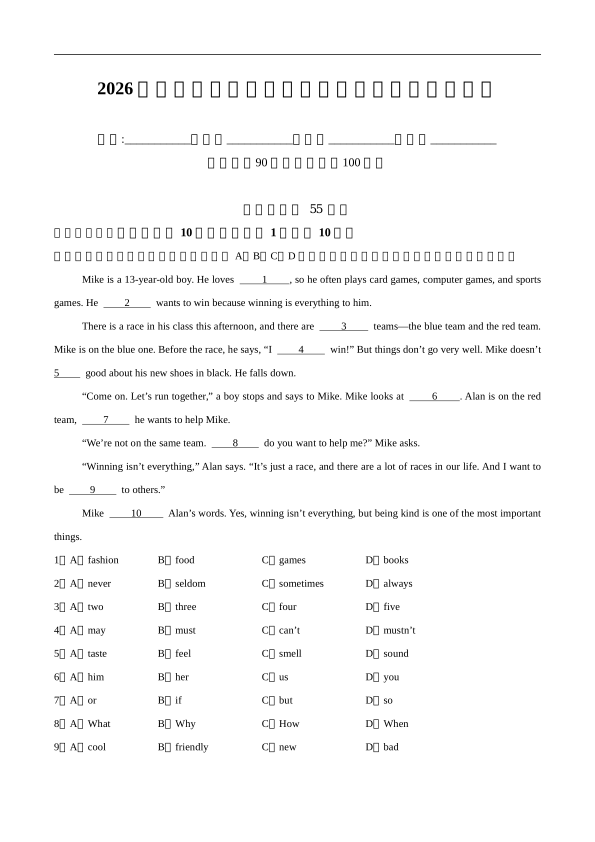
这是一份2026学年八年级下册英语期末模拟试卷(通用版 江西省卷专用),共3页。试卷主要包含了单项填空,完形填空,阅读理解,补全对话,书面表达等内容,欢迎下载使用。
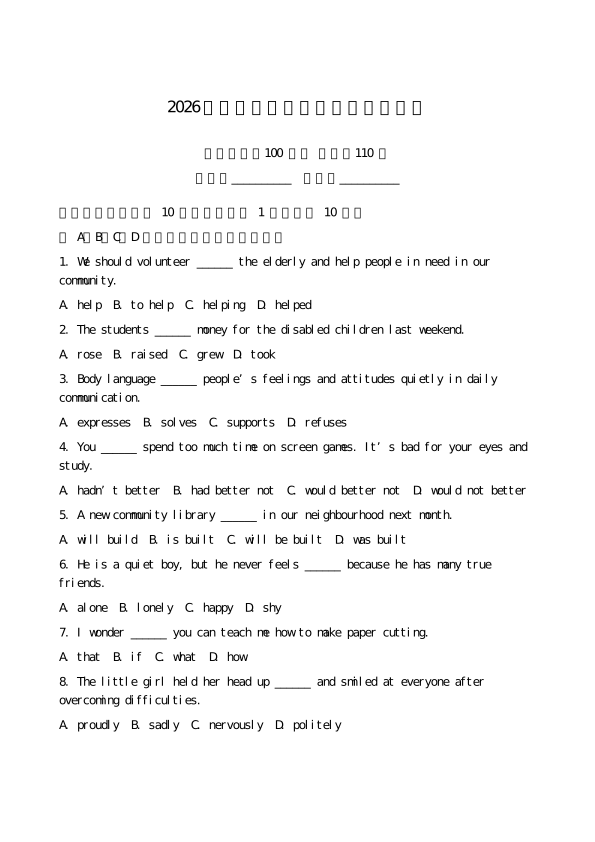
这是一份2026学年七年级下册英语期末模拟试卷(通用版 江西省卷专用),共3页。试卷主要包含了单项填空,完形填空,阅读理解,补全对话,书面表达等内容,欢迎下载使用。
这是一份期末模拟试卷(江西专用)2025-2026学年人教版英语八年级下册含答案含听力音频,共7页。试卷主要包含了听力(20分),单项选择,完形填空,阅读理解,补全对话,书面表达等内容,欢迎下载使用。
注册成功
资料篮

在线客服
添加在线客服
获取1对1服务
官方微信
关注“教习网”公众号
打开微信就能找资料
赛课定制
添加在线客服
获取1对1定制服务
职称咨询
添加在线客服
获取1V1专业指导服务

免费福利