免费领取教师福利

若您为此资料的原创作者,认为该资料内容侵犯了您的知识产权,请扫码添加我们的相关工作人员,我们尽可能的保护您的合法权益。


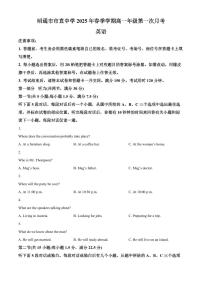
这是一份云南昭通市市直中学2026年春季学期高一年级第一次月考英语试题含答案,共23页。试卷主要包含了5 分,满分 7等内容,欢迎下载使用。
英语
注意事项:
1 .答题前,考生务必用黑色碳素笔将自己的姓名、准考证号、考场号、座位号在答题卡上填写清楚。
2 .每小题选出答案后,用 2B 铅笔把答题卡上对应题目的答案标号涂黑。如需改动,用橡皮擦干净后,再选涂其他答案标号。在试题卷上作答无效。
3 .考试结束后,请将本试卷和答题卡一并交回。满分 150 分,考试用时 120 分钟。
第一部分 听力(共两节,满分 30 分)
第一节(共 5 小题;每小题 1.5 分,满分 7.5 分)
听下面 5 段对话。每段对话后有一个小题,从题中所给的 A 、B 、C 三个选项中选出最佳选项。听完每段对话后,你都有 10 秒钟的时间来回答有关小题和阅读下一小题。每段对话读两遍。
1. What will the man prbably have fr lunch?
A. Oranges. B. Apples. C. Bananas.
2. Why is the man late?
A. He frgt abut the meeting.
B. He didn’t set an alarm.
C. His alarm didn’t ring.
3. What is the weather like nw?
A. Cl and cludy. B. Cld and snwy. C. Ht and sunny.
4. What will the wman d this weekend?
A. Take her mther t hspital.
B. Stay at hme.
C. Hang ut with the man.
5. Why d the birds sing in the mrning accrding t the article?
A. T search fr fd.
B. T prtect their hmes.
C. T enjy the mrning.
第二节(共 15 小题;每小题 1.5 分,满分 22.5 分)
听下面 5 段对话或独白。每段对话或独白后有几个小题,从题中所给的 A 、B、 C 三个选项中选出最佳选项。听每段对话或独白前,你将有时间阅读各个小题,每小题 5 秒钟;听完后,各小题将给出5 秒钟的作答时间。每段对话或独白读 两遍。
听下面一段对话,回答第 6 和第7 两个小题。
6. What is Amelia ding tday?
A. Studying. B. Wrking. C. Cking.
7. Where are the speakers prbably?
A. In a cinema. B. In a restaurant. C. In a supermarket.
听下面一段对话,回答第 8 至第 10 三个小题。
8. What type f party are the speakers preparing fr?
A. A husewarming party. B. A birthday party. C. A wedding party.
9. Hw did the wman feel at first?
A. Anxius. B. Prud. C. Excited.
10. What d we knw abut the speakers’ present hme?
A. It’s their first place.
B. It needs mre decrating.
C. It’s clse t a cake shp.
听下面一段对话,回答第 11 至第 13 三个小题。
11. What time is it nw?
A. 11:00 a. m. B. 10:00 a. m. C. 9:00 a. m.
12. What stps the wman’s flight frm taking ff n time?
A. It was heavily verbked.
B. The weather is terrible.
C. There’s smething wrng with the plane.
13. What des the man ffer the wman?
A. A free rm in the airline htel.
B. A better seat n the next flight.
C. A free meal at the airprt.
听下面一段对话,回答第 14 至第 17 四个小题。
14. What did the man say abut the stage?
A. It made him feel hmesick.
B. It lked quite rdinary.
C. It was prly designed.
15. What type f shw did the speakers see?
A. A ballet. B. A musical. C. A play.
16. What did the speakers dislike abut the shw?
A. The main stry.
B. The actin scenes.
C. The music between the scenes.
17. What is the prbable relatinship between the speakers?
A. Parent and child. B. Actr and fan. C. C - wrkers.
听下面一段独白,回答第 18 至第 20 三个小题。
18. What des the wrd “fishwife” generally mean in English?
A. A wman wh speaks ludly.
B. A request t speak luder.
C. A family rle.
19. Hw many plastic bttles have been cllected s far accrding t the speaker? A. Mre than 13,000.
B. Mre than 110,000.
C. Mre than 80,000.
20. What is the main tpic f the talk?
A. The arguments between fishermen.
B. The histry f yusa in China.
C. The yusa’s fight against cean pllutin.
第二部分 阅读(共两节,满分 50 分)
第一节(共 15 小题;每小题 2.5 分,满分 37.5 分)
阅读下列短文,从每题所给的 A 、B 、C 和 D 四个选项中,选出最佳选项。
A
In years past, many peple wuld travel ver New Year’s Eve and immerse themselves in a different culture. Cuntries arund the wrld ring in the new year with unique custms and
traditins, ften carried ut at the strike f midnight. We runded up ways t bring internatinal New Year’s Eve experiences t yu.
Japan: Eat tshikshi sba.
Shiwasu is the end-f-the-year perid in Japan, filled by many traditins like travelling t see family, attending parties and thrughly cleaning yur hme. T cmmemrate New Year’s Eve, peple eat tshikshi sba, r “year-crssing” sba, which can symblize having a lng and frtunate life alng with a clean break frm the year.
Denmark: Jump ff a chair.
In Denmark, ne des nt simply let the new year happen. Yu g n the ffense and jump int it. Just befre midnight, stp what yu’re ding and get n a chair t execute the jump like a Dane wuld.
Spain: Eat 12 grapes.
Eating grapes fr gd luck began in Spain, which is nw practiced thrughut the wrld,
particularly in Central and Suth America. Have 12 grapes handy. When the clck starts striking at midnight, eat ne with each clang.
Russia: Burn, then drink yur wishes.
Befre midnight, write dwn yur wishes fr the upcming year n a piece f paper, then
light the paper n fire. Once it’s stpped burning, sprinkle the wish-filled ashes (灰烬) int a glass f champagne and drink up after the clck strikes midnight.
1 .Which f the fllwing is NOT dne at the strike f midnight?
A .Eating year-crssing sba. B .Jumping ff the chair r ffense.
C .Cleaning the hme. D .Eating grapes.
2 .What d Russians d n New Year’s Eve?
A .Put the wish list int a glass f champagne.
B .Light the wish list with the champagne n fire.
C .Write dwn their wishes befre midnight n the paper.
D .Drink a glass f water with burnt ashes inside after midnight.
3 .In which clumn can we find the passage in a magazine?
A .Culture and Traditin B .Science and Technlgy C .Human and
Nature D .Cuisine and Cking
B
In recent years, AI has develped at a speedy pace and changed many areas f ur life. The music industry is ne f them. Tday, AI can d a lt f wrk fr music. It can write sngs, create meldies and make simple music in a shrt time.
Sme musicians are in favr f this new technlgy. AI enables them t bst their
wrking efficiency and create new pieces f music. Fr example, a singer can adpt AI t make a basic beat first. Then they add their wn lyrics and feelings r epiphany t the music. In this way, AI becmes a helpful tl fr them.
Hwever, ther musicians are wrried. They claim AI music may take away their jbs.
They believe real music cmes frm human stries, persnal experiences and emtins r
feelings, which als reflects their utlk n life and the wrld. Real music can cure peple’s
brken hearts and remedy their sul. Or at least real human music can fulfill their inner heart. In this way, machines can never truly understand the essence behind the music, creating rbtic
music. What’s mre, peple dn’t knw wh wns the f AI-made sngs, due t which sme cnflicts abut the issue f cpyright will happen in the near future.
Althugh there are wrries, AI is already arund us. It is changing hw peple make, sell and listen t music. Many music industry leaders believe that humans and AI shuld wrk
tgether. If we use AI in a right way, it will help us make better music fr the wrld.
4 .What can AI d in the music industry accrding t the passage?
A .Help cure peple’s brken hearts. B .Write sngs and create meldies.
C .Understand the essence f music. D .Slve the prblems.
5 .Sme musicians are in favr f AI because .
A .it can imprve their wrk efficiency
B .it can bring in mre mney fr them
C .it takes the place f human musicians
D .it can create music cmpletely n its wn
6 .Which f the fllwing is ne reasn why sme musicians wrry abut AI?
A .AI music lacks real human emtins.
B .AI music is t expensive t make.
C .AI makes music prductin slwer.
D .AI can hardly make simple music.
7 .What is the main idea f the passage?
A .AI has replaced human musicians cmpletely.
B .Peple hld different pinins n AI in music.
C .Real music can n lnger satisfy listeners.
D .Cpyright issue is the nly prblem f AI music.
C
The Night f the Radishes (萝卜) is an annual event held n December 23 in Oaxaca,
Mexic, where peple carve versized radishes int scenes fr a cmpetitin. The radishes grwn fr the festival are different frm the small, thin, red and white nes that are cmmnly n the
tables f mst restaurants in Mexic. Mst ften, they are nt edible. Instead, they’re used as artists’ clth and hand-carved int the different festive scenes.
The traditin f carving radishes dates back t the late 19th century, when Oaxaca’s
farmers wuld attract buyers’ attentin in the Zcal, the city’s main square, by creatively
shwing their seasnal prduce. In search f an advantage ver cmpetitrs, they’d cut their fruits and
vegetables int eye-catching shapes in the hpe f making an extra sale. This marketing technique slwly became a traditin, and in 1897, a radish-carving cmpetitin fr lcals in
Oaxaca was held.
Tday, the radish festival’s cultural rts remain the same. Early n the mrning f
December 23, Oaxaca’s main square is changed int an exhibitin space. Shrtly after the wden tables are put in rder, cmpetitrs begin t wrk n their radishes at first light. Their wrks will frmally be judged by mid - afternn. Mre than 120,000 Mexican pess (arund $6,000) are n
the line fr the best designs, which are decided by a respected judging team made up f fficials, previus winners and artists, wh will award the prizes at 18:00.
As night draws in, cmpetitrs can carry their masterpieces back hme. These radishes will be shwn n mantelpieces r utside hmes fr a few mre hurs befre the white radish flesh
begins t turn brwn and sften. In 24 hurs, they’ll be nly gd fr cmpst (肥料), frm which new radishes can grw the next year.
8 .What des the underlined wrd “edible” in paragraph 1 mean?
A .Easy t shape. B .Suitable fr carving.
C .Hard t prtect. D .Fit t be eaten.
9 .Why did Oaxaca’s farmers carve fruits and vegetables in the late 19th century?
A .T jin in lcal cmpetitins. B .T display their carving skills.
C .T appeal t mre custmers. D .T present artwrks fr festivals.
10 .What can we learn abut the radish - carving cmpetitin activity tday?
A .Judging starts in the early afternn.
B .The tp prize is ver 120,000 dllars.
C .Cmpetitrs shw their wrks until midnight.
D .Frmer winners are included in the judging team.
11 .What can be a suitable title fr the text?
A .Oaxaca’s Annual Celebratin: Fds and Celebratins in December
B .The Marketing f the Radishes: Turning Prduce int Public Attentin
C .Mexican Radishes: Grwing Oversized Vegetables fr Cmpetitins
D .The Night f the Radishes: Where Art Meets Traditin in Mexic
D
In a pl, a duck can lk calm when smthly swimming n the water’s surface while mving really fast just belw the surface t stay up. Like ducks, students appear t mve
gracefully. Hwever, beneath the surface, they’re kicking hpelessly t keep up. At tp universities, this phenmenn is knwn as “Stanfrd Duck Syndrme (综合征)”.
Experts frm Stanfrd’s Health Services explred this trubling trend: during the day,
many Stanfrd students are seen scializing in cafés, seemingly withut any stress r the need t
study. Hwever, at night, they start studying, smetimes fr the entire night, trying t keep the image f effrtless success. This cmes at a high price: tiredness and anxiety are widespread. Furthermre, it leads t a cmmn wrng idea: true talents achieve success effrtlessly, while thse wrking hard shw lw ability.
In an effrt t challenge this misunderstanding, researchers designed an experiment.
Students taking part in the experiment were asked t bserve a series f clrs carefully while
scientists tracked their brain activity thrughut the prcess. The experiment was divided int tw parts: ne with easily recgnized clrs and the ther with clrs that were quite similar, requiring mre effrt t recgnize. As the difficulty f the task increased, there was a nticeable increase in brain activity, particularly in areas linked t memry and abstract reasning (抽象推理).
The study shws that as tasks require mre effrt, mre areas f the brain “light up” and get t wrk. Grwth desn’t cme frm talent alne but frm the cntinuus applicatin f effrt. Our brain functins like a muscle. Withut effrt, even ur inbrn talents will disappear ver time.
This pushes us t recnsider the culture behind that might lead t this phenmenn. Instead f fcusing t much n results r praising highly fr inbrn talents, we shuld stress the learning prcess and cntinuus imprvement. By encuraging a culture that values effrt, we can help
students realize that intelligence is nt fixed but grws thrugh hard wrk. Such a change wuld nt nly reduce the stresses related t the “Stanfrd Duck Syndrme”, but als have a big effect n persnal develpment and the future f educatin.
12 .What des “Stanfrd Duck Syndrme” describe?
A .A ppular scial activity amng students in cafés.
B .Students appearing relaxed but struggling secretly.
C .A health issue leading t physical tiredness.
D .Students unable t keep their graceful image.
13 .What was a key finding f the experiment?
A .Tugh tasks make students frightened.
B .Brain activity imprves with task difficulty.
C .Easier tasks are beneficial t abstract reasning.
D .Clr recgnitin has nthing t d with memry.
14 .What des the authr suggest t address the syndrme?
A .Fcusing mre n immediate achievements. B .Reducing difficult academic tasks.
C .Highlighting students’ talents mre. D .Prmting an effrt-valuing culture.
15 .What is the authr’s attitude twards the culture behind the syndrme?
A .Critical. B .Objective. C .Supprtive. D .Indifferent.
第二节(共 5 小题;每小题 2.5 分,满分 12.5 分)
阅读下面短文,从短文后的选项中选出可以填入空白处的最佳选项。选项中有两项为多余选项。
D yu feel stressed? Singing is a simple and effective way t reduce stress. It is beneficial mainly in the fllwing three aspects.
Physical Benefits
16 This is especially recmmended fr the elderly and thse wh have sme frm f disability in their vice. Hwever, it is imprtant t find a capable instructr t emply gd singing techniques s as nt t further damage vcal crds (声带) r lungs (肺).
Singing als helps t imprve yur psture (姿势). Mst peple think that singing begins and ends with their muth. 17 Singing practice will get yu used t the prper bdy
psitin f standing and help yu frm the gd habit f standing straight.
Emtinal Benefits
Singing helps in reducing yur depressin and lwering yur stress level. When yu sing, yur bdy releases chemicals that make yu feel happy, easing the tensin and helping yu t
relax. 18
Scial Benefits
The scial benefits f singing are huge. 19 S peple wh suffer frm stage fright are advised t sing in frnt f family and friends befre a live perfrmance.
Singing is als very gd fr imprving yur cmmunicatin skills. It is said that singing t babies helps t prepare their brains fr language and may lessen the risk f language prblems
later in life. 20 The time spent in grup singing, whether in a chir r at karake, creates a deep and lasting bnd f friendship.
A .It can help build up yur cnfidence.
B .Try t regain yur memry by singing.
C .Singing helps yu strengthen yur immune system (免疫系统).
D .When yu sing, yu can give yur lungs a wrkut.
E .Fr adults, singing als enlarges yur circle f friends.
F .In fact, the psitin f each bdy part affects yur vice.
G .S, start t sing yur favrite sng next time yu are feeling upset.
第三部分 语言运用(共两节,满分 30 分)
第一节(共 15 小题;每小题 1 分,满分 15 分)
阅读下面短文,从每题所给的 A 、B 、C 、D 四个选项中选出可以填入空白处的最佳选项。
When Eric was a little child, the mst disappinting were the rainy days f any summer. He had been lking frward t nice summer days. Then came summer, but it .
The summer rain culd reduce Eric t crying. He it wasn’t fair. He waited s
lng t expect just a few weeks f freedm and pleasant weather. On rainy summer days, he culd nly stare ut like a bird in a . As an nly child, he had n ther kids t play with. His father wrked at hme, s he was nt truly _________, but his father culdn’t actively play with him due t wrk. Eric wuld watch whatever was n televisin t thrugh the day and make a each night that it wuldn’t be rainy the next day. His father wuld smetimes ntice that and ffer t read him a stry, which, n thse bring days, was the nly
spts.
As an adult, Eric’s mindset has . Sunny summer days are nt as exciting as
befre because he has t wrk almst every day rutinely, making him cheer fr smething
. He spends the winter expecting summer the summer expecting winter.
When summer arrives, he hates hw it is. Then, he wishes fr the cming with the summer rain.
In Eric’s childhd, summer rain his md cmpletely. Nw, hwever, he ften finds himself fr the rain t fall in summer, because it brings a welcme
frm the summer heat. That’s life — the thing is still there but we have changed ver time.
21 .A .cluded B .shne C .rained D .cleared
22 .A .assumed B .cmplained C .clapped D .criticized
23 .A .nest B .huse C .yard D .cage
24 .A .riginal B .alne C .absrbed D .hnest
25 .A .drag B .think C .see D .cut
26 .A .guess B .wish C .prmise D .balance
27 .A .cnvenient B .previus C.jyful D .rdinary
28 .A .recvered B .frmed C .cmpsed D .changed
29 .A .different B .meaningful C .alarming D .challenging
30 .A .therefre B .thus C .while D .plus
31 .A .ht B .wet C .cludy D .windy
32 .A .freedm B .prtest C .relief D .clness
33 .A .cntrlled B .reflected C .wiped D .ruined
34 .A .waiting B .perfrming C .fighting D .defending
35 .A .lessn B .message C .escape D .test
第二节(共 10 小题;每小题 1.5 分,满分 15 分)
阅读下面短文,在空白处填入 1 个适当的单词或括号内单词的正确形式。
A quiet mrning in Chazhu was 36 (gentle) awakened by the smell f gngfu tea. It carried frm a classrm at Nancheng Middle Schl, 37 had been changed int a tea
space. Here, Ye Hanzhng, an inheritr (传承者) f Chazhu gngfu tea, was guiding students, teachers and parents step by step thrugh the art f making and tasting tea. With each mvement f the teapt, he shared nt nly the skills, 38 the values and the wrldview fund in a cup f tea.
He intrduced the students 39 a simplified system based n the traditin’s 21 classic mvements 40 (cver) preparatin, brewing (冲泡) and sharing, the lessn ffered a
41 (practice) way withut lsing the spirit f gngfu tea. In Ye’s telling, gngfu tea is a
quiet philsphy f life. Prper preparatin teaches patience; seizing the right mment determines success; attentin t details 42 (shape) quality. When the students later served tea t their teachers and parents, it became a quiet way 43 (shw) respect and thanks.
Rted deeply in daily life rather than frmal ceremnies, Chazhu gngfu tea 44 (belng) t rdinary peple. In 2022, it was added t UNESCO’s list f the wrld’s intangible
cultural heritage. Tday, this traditin is entering classrms and reaching ___45___ yung, carrying with it bth a tea practice and a peaceful, respectful way f living t a wider wrld.
第四部分 写作(共两节,满分 40 分)
第一节(满分 15 分)
46 .假设你是李华,你所在的学校将在清明节(Qingming Festival)举办传统文化体验活动,请你给交换生 Tm 写一封电子邮件,邀请他参加。内容包括:
1 .告知活动时间、地点;
2 .介绍活动内容(如踏青、学习清明习俗、制作传统小食等);
3 .表达期待。
要求:
1 .词数 80 词左右;
2 .开头和结尾已给出,不计入总词数。
Dear Tm,
Yurs,
Li Hua
第二节(满分 25 分)
47 .阅读下面材料,根据其内容和所给段落开头语续写两段,使之构成一篇完整的短文。
Every Octber, my neighbrhd has a Hallween cstume cntest. My neighbr Ollie and I wuld race t the annuncement bard t find ut the theme. One year, the theme was “Dress up as yur favrite bk character”. Anther year, it was “Be smething scary”. But this year, the
theme was kind f, well, themeless.
“Be creative?” I said, reading the annuncement bard. “That’s nt really a theme, is it?” Ollie agreed.
“Let’s just find sme materials first,” I suggested, feeling cnfused.
“I've gt it!” Ollie said, grabbing a bunch f fallen leaves. He explained, “They’re free! N ne will dress up as a tree like we d!”
I lved the idea. Sn we had filled tw bags with all srts f leaves. Ollie pinted t sme bunches f shiny leaves. “These lk special,” he said, handing me a handful. I didn’t ntice the ily shine n them as I put them in my bag. Little did we knw what truble they wuld bring.
Afterwards, we wrked fr hurs.
“I’m s tired f gluing leaves,” I cmplained.
“Beleaf me,” said Ollie. “Yu’re nt the nly ne.”
I laughed. “I’ll be s releafed t be dne!”
“There’s n leafing nw,” he added lightly. “But it’ll be wrth it. These will be the mst tree-mendus cstumes f all!”
It tk us hurs t get ready the next mrning, and we prbably lst half ur leaves walking slwly t the park. Arund us, we saw witches in pinty hats and superheres in capes, but many peple turned t lk at ur leaf cstumes with surprise and admiratin. “I’ve never seen anything like that!” said a witch. “Yeah, they really stand ut,” her ghst friend agreed. “The way the
leaves mve and fall makes them lk exactly like real trees!” Hearing this, we were extremely happy.
注意 :
1. 续写词数应为 150 左右;
2. 请按如下格式在答题卡的相应位置作答。
As we std there, enjying all the nice cmments abut ur cstumes, a terrible itch (痒)
suddenly started everywhere.
_______________________________________________________________________________
_______________________________________________________________________________
Just then, the hst annunced the winner list.
1 .C 2 .C 3 .A
【导语】本文是一篇说明文。文章介绍了日本、丹麦、西班牙和俄罗斯等国在新年前夜或午夜时分举行的独特迎新习俗。
1 .细节理解题。根据第二段中“Shiwasu is the end-f-the-year perid in Japan, filled by many traditins like travelling t see family, attending parties and thrughly cleaning yur hme.(师走是日本的年末时期,有许多传统活动,比如探亲、参加派对和彻底打扫房屋。)”可知,打扫房屋是年末的常规活动,并非在午夜钟声敲响时进行。 故选 C。
2 .细节理解题。 根据最后一段“Russia: Burn, then drink yur wishes(俄罗斯:燃烧,然后喝你的愿望)”部分中“Befre midnight, write dwn yur wishes fr the upcming year n a piece f paper(午夜前,在一张纸上写下你对来年的愿望)”可知,俄罗斯人会在午夜前把愿望写在纸上。 故选 C。
3 .推理判断题。根据第一段中“Cuntries arund the wrld ring in the new year with unique
custms and traditins(世界各国以独特的习俗和传统迎接新年)”以及下文介绍了日本、丹麦、西班牙、俄罗斯等国家迎接新年的独特习俗和传统,由此可知,文章内容属于“文化与传统”范畴,最可能出现在杂志的“文化与传统”栏目。故选 A。
4 .B 5 .A 6 .A 7 .B
【导语】本文是一篇议论文。主要介绍人工智能在音乐领域的应用,以及音乐家们对此持有的支持与担忧两种不同观点。
4 .细节理解题。根据第一段中的“Tday, AI can d a lt f wrk fr music. It can write sngs, create meldies and make simple music in a shrt time.(如今,人工智能可以为音乐做很多工作。它可以写歌、创作旋律,并在短时间内制作简单的音乐。)”可知,人工智能在音乐行业可以写歌和创作旋律。故选 B 项。
5.细节理解题。根据第二段中的“Sme musicians are in favr f this new technlgy. AI enables them t bst their wrking efficiency and create new pieces f music.(一些音乐家支持这项新技术。人工智能使他们能够提高工作效率,创作新的音乐作品。)”可知,一些音乐家支持人工智能是因为它能提高他们的工作效率。故选 A 项。
6 .细节理解题。根据第三段中的“They believe real music cmes frm human stries, persnal experiences and emtins r feelings, which als reflects their utlk n life and the wrld.(他们认为真正的音乐源于人类的故事、个人经历和情感,这也反映了他们的人生观和世界观。)”以及“In this way, machines can never truly understand the essence behind the music, creating
rbtic music.(这样一来,机器永远无法真正理解音乐背后的精髓,只能创作机械的音乐。)”可知,一些音乐家担心人工智能音乐缺乏真实的人类情感。故选 A 项。
7 .主旨大意题。通读全文,尤其是第二段中的“Sme musicians are in favr f this new
technlgy.(一些音乐家支持这项新技术。)”和第三段中的“Hwever, ther musicians are
wrried.(然而,其他音乐家对此感到担忧。)”可知,文章主要围绕人们对音乐领域应用人工智能持有不同观点展开论述,因此“人们对音乐中的人工智能持有不同观点”最能概括全文主旨。故选 B 项。
8 .D 9 .C 10 .D 11 .D
【导语】本文是一篇说明文。主要介绍了墨西哥瓦哈卡州的传统节日——萝 卜之夜,讲述了该节日的起源、活动内容、比赛规则以及萝 卜作品的后续处理,展现了艺术与传统的融合。
8.词句猜测题。根据第一段“Mst ften, they are nt edible. Instead, they’re used as artists ’ clth and hand-carved int the different festive scenes. (这些萝 卜通常不edible。而是被当作艺术材料,手工雕刻成不同的节日场景。)”可知,这些萝 卜被用来雕刻而非食用,因此 edible 意为“适合食用的” 。故选 D。
9.细节理解题。根据第二段“The traditin f carving radishes dates back t the late 19th century, when Oaxaca’s farmers wuld attract buyers ’ attentin in the Zcal, the city’s main square, by
creatively shwing their seasnal prduce. In search f an advantage ver cmpetitrs, they’d cut their fruits and vegetables int eye-catching shapes in the hpe f making an extra sale. (雕刻萝 卜的传统可以追溯到十九世纪末,当时瓦哈卡的农民会在城市主广场索卡洛创意展示时令农产品,以吸引买家注意。为了在竞争中占据优势,他们把果蔬切成引人注目的形状,希望能多卖出一些。)”可知,农民雕刻果蔬是为了吸引更多顾客。故选 C。
10.细节理解题。根据第四段“Mre than 120,000 Mexican pess (arund $6,000) are n the line fr the best designs, which are decided by a respected judging team made up f fficials, previus winners and artists, wh will award the prizes at 18:00. (最佳设计的奖金超过 12 万墨西哥比索(约 6000 美元),由一个由官员、往届获奖者和艺术家组成的权威评审团评选,并于 18 点颁奖。)”可知,评审团队中包含往届获奖者。故选 D。
11.主旨大意题。全文围绕墨西哥的萝 卜之夜展开,介绍了这一节日的传统起源与艺术雕刻活动,体现了艺术与传统的结合。D 选项“The Night f the Radishes: Where Art Meets Traditin in Mexic (萝 卜之夜:墨西哥艺术与传统的相遇)”最能概括文章主旨,适合用作标题。故选
D。
12 .B 13 .B 14 .D 15 .A
【导语】本文是一篇议论文。文章介绍了“斯坦福鸭子综合征”这一现象,并通过实验说明努力对大脑发展的重要性,最后呼吁建立重视努力的文化。
12 .细节理解题。根据第一段中“Like ducks, students appear t mve gracefully. Hwever,
beneath the surface, they’re kicking hpelessly t keep up. At tp universities, this phenmenn is knwn as ‘Stanfrd Duck Syndrme’ . (像鸭子一样,学生们表面上看起来行动优雅。然而,在水面之下,他们却在拼命地蹬腿以跟上节奏。在顶尖大学,这种现象被称为‘斯坦福鸭子综合征’。)”可知,“斯坦福鸭子综合征”描述的是学生表面轻松、私下却拼命努力的现象。故选B。
13 .细节理解题。根据第三段中“As the difficulty f the task increased, there was a nticeable increase in brain activity, particularly in areas linked t memry and abstract reasning. (随着任务难度的增加,大脑活动明显增强,尤其是在与记忆和抽象推理相关的区域。)” 以及第四段中“The study shws that as tasks require mre effrt, mre areas f the brain ‘light up ’ and get t wrk. (研究表明,随着任务需要更多努力,大脑中更多的区域会‘亮起来’并开始工作。)”可知,实验的关键发现是大脑活动随任务难度提高而增强。故选 B。
14.细节理解题。根据最后一段中“Instead f fcusing t much n results r praising highly fr inbrn talents, we shuld stress the learning prcess and cntinuus imprvement. By encuraging a culture that values effrt, we can help students realize that intelligence is nt fixed but grws
thrugh hard wrk. (我们不应过度关注结果或高度赞扬天生才能,而应强调学习过程和持续进步。通过鼓励重视努力的文化,我们可以帮助学生认识到智力并非固定不变,而是通过努力得以增长。)”可知,作者建议推广重视努力的文化。故选 D。
15.推理判断题。根据最后一段中“This pushes us t recnsider the culture behind that might lead t this phenmenn. (这促使我们重新审视可能导致这一现象背后的文化。)” 以及作者提出的改变建议“Instead f fcusing t much n results r praising highly fr inbrn talents, we shuld stress the learning prcess and cntinuus imprvement. By encuraging a culture that values
effrt, we can help students realize that intelligence is nt fixed but grws thrugh hard wrk. (我 们不应过度关注结果或高度赞扬天生才能,而应强调学习过程和持续进步。通过鼓励重视努力的文化,我们可以帮助学生认识到智力并非固定不变,而是通过努力得以增长。)”可知,作者认为该现象背后的文化存在问题,对其持批判的态度。故选 A。
16 .D 17 .F 18 .G 19 .A 20 .E
【导语】本文是一篇说明文。文章主要从身体、情绪和社交三个方面介绍了唱歌给人带来的益处。
16 .由段落小标题“Physical Benefits(身体益处)”以及下文“This is especially recmmended fr the elderly and thse wh have sme frm f disability in their vice. (这对老年人和那些声音有某种残疾的人尤其推荐。)”可知,本空要说一种具体的身体益处,且该益处对老年人和声音障碍者有益。D 选项“When yu sing, yu can give yur lungs a wrkut. (当你唱歌时,你可以锻炼你的肺部。)” 能承上启下,符合题意,该选项中的“give yur lungs a wrkut”与下文的“Hwever, it is imprtant t find a capable instructr t emply gd singing techniques s as nt t further damage vcal crds r lungs.(然而,重要的是要找到一个有能力的教练,使用良好的歌唱技术,以免进一步损害声带或肺。)”相呼应,表示唱歌锻炼肺部但需注意不要损伤。故选 D。
17.由上文“Singing als helps t imprve yur psture. Mst peple think that singing begins and ends with their muth. (唱歌也有助于改善你的姿势。大多数人认为唱歌始于嘴也终于嘴。)”以及下文“Singing practice will get yu used t the prper bdy psitin f standing and help yu frm the gd habit f standing straight.(唱歌练习会让你习惯正确的站姿,并帮助你养成直立站立的好习惯。)”可知,本空要说明身体姿势对唱歌的影响,F 选项“In fact, the psitin f each bdy part affects yur vice.(事实上,身体各个部位的姿势都会影响你的声音。)” 能承上启下,符合题意,该选项中的“psitin”与下文的“bdy psitin”相呼应,表示唱歌不只用嘴,还和身体姿势相关。故选 F。
18 .由上文“When yu sing, yur bdy releases chemicals that make yu feel happy, easing the tensin and helping yu t relax. (当你唱歌时,你的身体会释放让你感到快乐的化学物质,缓解紧张并帮助你放松。)”可知,本空应承接上文,给出建议或总结。G 选项“S, start t sing yur favrite sng next time yu are feeling upset.(所以,下次你感到沮丧时,开始唱你最喜欢的歌吧。)” 中的“S”与上文构成因果关系,符合逻辑。故选 G。
19 .由上文“The scial benefits f singing are huge.(唱歌的社交益处是巨大的。)”及下文“S
peple wh suffer frm stage fright are advised t sing in frnt f family and friends befre a live perfrmance.(因此,建议患有舞台恐惧症的人在现场演出前在家人和朋友面前唱歌。)”可知,本空应说明唱歌能帮助克服舞台恐惧,即建立自信。A 选项“It can help build up yur
cnfidence.(它可以帮助建立你的信心。)”符合题意,其中的“it”指代唱歌。故选 A。
20.由上文“Singing is als very gd fr imprving yur cmmunicatin skills.(唱歌也有助于提
高沟通技巧。)” 以及下文“The time spent in grup singing, whether in a chir r at karake,
creates a deep and lasting bnd f friendship.(无论是在合唱团还是唱卡拉 OK ,一起唱歌的时
光会建立深厚持久的友谊纽带。)”可知,本空要说唱歌对成年人交友的作用,E 选项“Fr adults, singing als enlarges yur circle f friends.(对成年人来说,唱歌还能扩大你的朋友圈。)” 能承
上启下,符合题意,该选项中的“circle f friends”与下文的“friendship”相呼应。故选 E。
21 .C 22 .B 23 .D 24 .B 25 .A 26 .B 27 .C 28 .D
29 .A 30 .C 31 .A 32 .D 33 .D 34 .A 35 .C
【导语】本文是一篇记叙文。文章主要讲述了 Eric 对夏天雨天的态度随着年龄增长而发生变化的故事。
21 .考查动词词义辨析。句意:夏天来了,但却下雨了。A. cluded 变阴;B. shne 发光; C. rained 下雨;D. cleared 放晴。根据前文“When Eric was a little child, the mst disappinting were the rainy days f any summer.”和后文“The summer rain”可知,最失望的是夏日雨天,此处表示夏天来了,但却下雨了。故选 C。
22 .考查动词词义辨析。句意:他抱怨这不公平。A. assumed 假设;B. cmplained 抱怨;
C. clapped 鼓掌;D. criticized 批评。根据后文“it wasn’t fair” 以及前文提到下雨让 Eric 失望,可知他期盼好天气却遇雨天,因此心生抱怨。故选 B。
23 .考查名词词义辨析。句意:在夏天的雨天,他只能像笼子里的鸟一样盯着外面。A. nest巢; "B.huse" B. huse 房子;C. yard 院子;D. cage 笼子。根据上文“he culd nly stare ut like a bird in a”可知,他被困在屋内,如同笼中之鸟。故选 D。
24.考查形容词词义辨析。句意:他父亲在家工作,所以他并不孤单,但由于工作原因,他父亲不能积极地和他一起玩。A. riginal 原来的;B. alne 独自的;C. absrbed 全神贯注的; D. hnest 诚实的。根据上文“As an nly child, he had n ther kids t play with.” 以及“His father wrked at hme”可知,Eric 没有其他孩子一起玩,但父亲在家,所以他不是独自一人。故选
B。
25.考查动词词义辨析。句意:Eric 会看任何电视节目来打发一天的时间,并且每晚都希望第二天不会下雨。A. drag 拖延,消磨;B. think 思考;C. see 看见;D. cut 切割。根据后文“thrugh the day”可知,雨天无聊、不能外出玩耍可知,他只能看电视打发时间、熬过一天,drag thrugh表示“熬过,消磨” 。故选 A。
26.考查名词词义辨析。句意同上。A. guess 猜测;B. wish 希望;C. prmise 承诺;D. balance
平衡。根据后文“that it wuldn’t be rainy the next day”结合前文“When Eric was a little child, the mst disappinting were the rainy days f any summer.”他讨厌夏日雨天可知,他每晚许愿希望第二天不下雨。故选 B。
27.考查形容词词义辨析。句意:他的父亲有时会注意到这一点,并主动提出给他读一个故事,在那些无聊的日子里,这是唯一令人愉快的事情。A. cnvenient 方便的;B. previus 以前的;C. jyful 令人愉快的;D. rdinary 普通的。根据上文“n thse bring days” 以及“His father wuld smetimes ntice that and ffer t read him a stry”可知,雨天很无聊,父亲会给他读故事,这是雨天里唯一快乐的时光。故选 C。
28.考查动词词义辨析。句意:成年后,Eric 的心态发生了变化。A. recvered 恢复;B. frmed形成;C. cmpsed 作曲;D. changed 改变。根据后文“Sunny summer days are nt as exciting as befre”和“the thing is still there but we have changed ver time”可知,Eric 对晴天和雨天的态度与童年截然不同,他的心态发生了变化。故选 D。
29.考查形容词词义辨析。句意:晴朗的夏日不再像以前那样令人兴奋了,因为他几乎每天都要例行公事地工作,这让他为一些不同的事情欢呼。A. different 不同的;B. meaningful 有意义的;C. alarming 令人担忧的;D. challenging 具有挑战性的。根据上文“Sunny summer days are nt as exciting as befre because he has t wrk almst every day rutinely”可知,前文童年期盼晴天,成年后因工作对晴天不再兴奋可知,他的快乐来源变得不同。故选 A。
30 .考查连词词义辨析。句意:他冬天盼夏天,夏天盼冬天。A. therefre 因此;B. thus 因此;C. while 然而,表示对比; "D.plus" D. plus 而且。根据前后文“He spends the winter expecting
summer”和后文“the summer expecting winter.”可知,前后文为对比关系,冬天和夏天两种期盼的对比,while 可表示对比转折。故选 C。
31 .考查形容词词义辨析。句意:当夏天到来时,他讨厌天气有多热。 "A.ht" A. ht 热的;B. wet潮湿的;C. cludy 多云的;D. windy 多风的。根据后文“frm the summer heat”可知,夏天到来时,天气炎热。故选 A。
32.考查名词词义辨析。句意:然后,他希望夏天的雨能带来凉爽。A. freedm 自由;B. prtest抗议;C. relief 减轻;D. clness 凉爽。根据后文“cming with the summer rain” 以及常识,
可知夏雨能够带来凉爽。故选 D。
33 .考查动词词义辨析。句意:在 Eric 的童年,夏天的雨完全毁了他的心情。A. cntrlled控制;B. reflected 反射;C. wiped 擦;D. ruined 毁灭。根据后文“his md cmpletely” 以及上文提到夏雨让 Eric难过、哭泣、觉得失望可知,雨天完全破坏了他的心情。故选 D。
34 .考查动词词义辨析。句意:然而,现在他经常发现自己等待着夏天的雨落下。A. waiting等待;B. perfrming 表演;C. fighting 战斗;D. defending 防御。根据后文“fr the rain t fall in summer”和前文“Then, he wishes fr the cming with the summer rain.”他讨厌炎热、期盼
凉爽可知,他等待夏雨降临,wait fr“等待”为固定搭配。故选 A。
35 .考查名词词义辨析。句意:因为它能让人从夏日的炎热中解脱出来。A. lessn 课程;
B. message 信息;C. escape 逃跑,解脱;D. test 测试。根据后文“frm the summer heat”可知,降雨让人从酷暑中解脱,短语 welcme escape 表示“令人高兴的解脱”。故选 C。
36 .gently 37 .which 38 .but 39 .t 40 .Cvering 41 .practical
42 .shapes 43 .t shw 44 .belngs##has belnged 45 .the
【导语】本文是一篇说明文。主要介绍了潮州功夫茶这一非物质文化遗产走进南城中学课堂,传承者叶汉中向学生、老师和家长传授泡茶技艺与其中蕴含的人生哲理, 让这一传统走向更广泛的群体。
36 .考查副词。句意:潮州一个宁静的早晨被功夫茶的香味轻轻唤醒。此处修饰动词“awakened”,应用副词“gently”,表示“轻轻地”,作状语。故填 gently。
37.考查定语从句。句意: 茶香从南城中学的一间教室飘来,这间教室已被改造成了一个茶空间。此处为关系词引导的非限制性定语从句, 修饰先行词“a classrm at Nancheng Middle Schl”,指物,关系词在从句中作主语,所以使用关系代词“which”引导该定语从句。故填which。
38.考查连词。句意: 随着茶壶的每一次移动,他分享的不仅是技巧,还有一杯茶中所蕴含的价值观和世界观。“nt (als)...”是固定短语,表示“不但 而且 ”,所以此处应用“but”。故填 but。
39.考查介词。句意:他向学生们介绍了一个基于传统 21 个经典动作的简化体系。“intrduce "sb.t" sb. t sth.”是固定短语,表示“向某人介绍某物”,所以此处应用介词“t”。故填 t。
40.考查非谓语动词。句意: 这堂课涵盖了准备、冲泡和分享, 提供了一种既实用又不失功夫茶精神的方法。空处是状语, 动词“cver”和逻辑主语“the lessn”之间是主动关系,应用现在分词形式作状语,且位于句首,首字母应大写。故填 Cvering。
41.考查形容词。句意: 这堂课涵盖了准备、冲泡和分享, 提供了一种既实用又不失功夫茶精神的方法。此处修饰名词“way”,应用形容词“practical”,表示“实用的”,作定语。故填 practical。
42.考查时态和主谓一致。句意:恰当的准备教会人们耐心;抓住合适的时机决定成功;注重细节塑造品质。空处作句子的谓语,句子描述的是客观事实,应用一般现在时,主语
“attentin t details”是单数,谓语动词应用第三人称单数形式。故填 shapes。
43.考查非谓语动词。句意:当学生们后来给老师和家长端茶时,这成为了一种表达尊重和感谢的安静方式。空处是非谓语动词,作后置定语,a way t d sth.意为“做某事的方式”,
为固定结构。故填 t shw。
44.考查时态和主谓一致。句意:潮州功夫茶深深植根于日常生活,而非正式仪式,它属于普通人。空处为句子谓语,主语 Chazhu gngfu tea 为单数,谓语动词用第三人称单数形式,句子描述的是客观事实,应用一般现在时;另外也可强调“属于大众”这一状态从过去持续至今,使用现在完成时,主语为单数,助动词用 has 。故填 belngs/has belnged。
45.考查冠词。句意:如今,这一传统正走进课堂,触及年轻人,将茶艺和一种平和、尊重的生活方式带到更广阔的世界。“the + 形容词”表示一类人,“the yung”表示“年轻人” ,所以此处应用定冠词“the” 。故填 the。
46 .One pssible versin:
Dear Tm,
Hpe this email finds yu well. As yu are fascinated by Chinese traditinal culture, I am writing t sincerely invite yu t jin ur schl’s celebratin fr Qingming Festival.
The activity is scheduled t take place in the schl garden this Sunday mrning frm 9:00 t 12:00. Apart frm enjying the beautiful spring views, we will learn abut the traditins f
hnring ancestrs and appreciating nature, which carry deep cultural meanings. Besides, we will take part in sme hands-n activities like making traditinal snacks, allwing yu t experience the festival in a mre lively way.
I wuld be mre than delighted if yu culd cme and jin us. Lking frward t yur early reply.
Yurs,
Li Hua 【导语】本篇书面表达属于应用文。要求考生以李华的身份,给交换生 Tm 写电子邮件,
邀请他参加学校清明节举办的传统文化体验活动,内容包括告知活动时间、地点, 介绍活动内容(踏青、学习清明习俗、制作传统小食等),并表达期待。
【详解】1. 词汇积累
对 着迷的:be fascinated by→be crazy abut诚挚地:sincerely→earnestly
参加:take part in→participate in
快乐的:delighted→pleased
2. 句式拓展
简单句变复合句
原句:The activity is scheduled t take place in the schl garden this Sunday mrning frm 9:00
t 12:00.
拓展句:The activity that/which is scheduled t take place in the schl garden will be held this Sunday mrning frm 9:00 t 12:00.
【点睛】【高分句型 1】Apart frm enjying the beautiful spring views, we will learn abut the traditins f hnring ancestrs and appreciating nature, which carry deep cultural meanings.(运用了 which 引导的非限制性定语从句)
【高分句型 2】Besides, we will take part in sme hands-n activities like making traditinal
snacks, allwing yu t experience the festival in a mre lively way.(运用了现在分词短语作状语)
47.
As we std there, enjying all the nice cmments abut ur cstumes, a terrible itch
suddenly started everywhere. At first it was just a little uncmfrtable, but sn it became a strng burning feeling all ver my skin. My happy smile disappeared, replaced by a painful expressin. I really wanted t scratch my arms and legs. I lked at Ollie and saw he was fighting the same
prblem. His face lked wrried, and he was shaking his hands trying t resist the itch. We std perfectly still, afraid that any mvement wuld make peple ntice ur truble. Our beautiful tree cstumes nw felt like they were punishing us.
Just then, the hst annunced the winner list. When we heard ur names, we were s
excited that we almst frgt the itching. “We did it!” Ollie shuted happily. We jumped up with jy, making mre leaves fall frm ur cstumes. The crwd’s lud cheers made us feel incredibly prud. As we walked t the stage t receive ur prize, the itching didn’t seem imprtant anymre. Later that evening, when we learned that thse special leaves had caused the rash, we just laughed. Our trphy shining n the table reminded us that even with small accidents, creative ideas can lead
t the mst wnderful successes.
【导语】本文以人物为线索展开,主要讲述了作者和邻居奥利为万圣节服装比赛准备创意树叶服装,虽过程中遇到树叶引发瘙痒的小插曲,但最终凭借独特的创意赢得比赛的故事。
【详解】1. 段落续写:
①由第一段首句内容“ 当我们站在那里,享受着人们对我们服装的好评时,突然到处都开始发痒。”可知,第一段可描写作者和奥利穿上树叶服装后突然浑身发痒,但仍努力保持镇定,不想让别人发现他们的窘境。
②由第二段首句内容“就在那时,主持人宣布了获奖名单。”可知,第二段可描写作者和奥利听到自己获奖后非常激动,忘记了瘙痒,上台领奖后得知是特殊树叶导致过敏,但仍觉得创意带来成功很值得。
2. 续写线索:浑身发痒——努力保持镇定——听到获奖——激动上台领奖——得知过敏原因——觉得值得
3. 词汇激活行为类:
①消失:disappear/vanish
②上台:walk t the stage/step nt the stage
③导致:cause/bring abut情绪类:
①担心的:wrried/anxius/cncerned
②高兴地:happily/with delight
【点睛】【高分句型 1】When we heard ur names, we were s excited that we almst frgt the itching. (运用了 when 引导的时间状语从句,s that 引导的结果状语从句)
【高分句型 2】 We jumped up with jy, making mre leaves fall frm ur cstumes. (运用了现在分词作状语)
这是一份云南昭通市市直中学2026年春季学期高一年级第一次月考英语试题含答案,共24页。试卷主要包含了5 分,满分 7等内容,欢迎下载使用。
这是一份云南省昭通市市直中学2025-2026学年高一上学期第一次月考英语试卷,共18页。
这是一份云南昭通市昭阳区昭通市市直中学2025-2026学年春季学期高二年级第一次月考英语试卷含答案,共3页。试卷主要包含了5 分,满分 7,5 分,满分 37,5 英镑, 词汇激活等内容,欢迎下载使用。
注册成功
资料篮

在线客服
添加在线客服
获取1对1服务
官方微信
关注“教习网”公众号
打开微信就能找资料
赛课定制
添加在线客服
获取1对1定制服务
职称咨询
添加在线客服
获取1V1专业指导服务

免费福利