 免费领取教师福利


若您为此资料的原创作者,认为该资料内容侵犯了您的知识产权,请扫码添加我们的相关工作人员,我们尽可能的保护您的合法权益。


这是一份高考英语 重难点专项突破练习卷12 阅读理解C、D篇 导学案含答案,共27页。
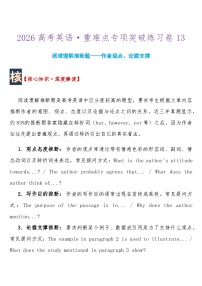
核【核心知识·深度解读】
阅读理解C/D篇通常是科技类或社科类说明文,文章结构严谨,逻辑性强。近三年真题显示,主旨大意题和作者观点题的高频出题点集中在首段、尾段以及文中的转折词之后。掌握这些位置的阅读策略,能快速准确锁定答案。
1. 首段功能: 引出话题,提出中心论点。通常在首段末句出现主旨句。常见模式:现象描述 → 提出问题 → 给出观点。
2. 尾段功能: 总结全文,重申观点,或提出展望。尾段首句或末句往往是对全文的概括。
3. 转折词定位: 转折词如 but, hwever, yet, nevertheless, while, althugh, in fact, actually 等后面的内容通常是作者真正想要强调的观点,也是主旨题和观点题的答案所在。
4. 科技/社科类文章常见结构:
● 问题解决型:提出问题 → 分析原因 → 解决方案 → 意义展望
● 现象解释型:呈现现象 → 给出解释 → 评价解释
● 对比型:介绍传统观点 → 提出新发现/新观点 → 论证新观点
5. 真题示例(2025·新高考Ⅰ卷C篇): 首段提出“Many peple believe that AI will replace human jbs. Hwever, a new study suggests therwise.” 这里的 Hwever 后即为文章主旨。尾段再次总结“The future lies in human-AI cllabratin.” 主旨题答案即为 Human-AI cllabratin is the key.
专项突破·阅读理解C/D篇主旨80题
Passage 1
[1] Fr decades, scientists have assumed that memry frmatin is a gradual prcess, requiring repeated expsure t infrmatin. Hwever, a grundbreaking study frm MIT challenges this lng-held belief.
[2] The research team, led by Dr. Sarah Jhnsn, cnducted experiments n mice using advanced imaging techniques. They discvered that a single, intense experience can create a lasting memry if it triggers a specific chemical reactin in the brain. This reactin, invlving the prtein CaMKII, acts as a "memry switch."
[3] "We fund that when the prtein is activated at a high enugh level, it can cnslidate a memry instantly," explains Dr. Jhnsn. "This ges against the traditinal view that repetitin is essential." The findings suggest that the brain has a built-in mechanism fr "ne-trial learning," which may have evlutinary advantages—helping animals remember a single dangerus encunter.
[4] Critics pint ut that the study was cnducted n mice, and human brains are far mre cmplex. Nevertheless, the research pens up new pssibilities fr treating memry disrders. If scientists can learn t cntrl this "memry switch," it culd lead t therapies fr cnditins like PTSD, where a single traumatic event creates an verwhelming memry. Cnversely, it might help thse with Alzheimer's strengthen fading memries.
[5] Dr. Jhnsn's team is nw planning clinical trials n humans. "This is just the beginning," she says. "We are excited abut the ptential t revlutinize hw we understand and treat memry." The future f memry science, it seems, may be abut quality ver quantity.
1. What is the main idea f the passage?
A. Memry frmatin requires repeated expsure t infrmatin.
B. A single intense experience can create a lasting memry.
C. Mice and humans have similar memry mechanisms.
D. The prtein CaMKII is the nly factr in memry cnslidatin.
2. The wrd "cnslidate" in paragraph 3 mst prbably means ______.
A. weaken B. strengthen C. frget D. change
3. Accrding t the passage, the traditinal view f memry frmatin is that ______.
A. it is a quick prcess B. it requires repetitin C. it is cntrlled by CaMKII D. it is the same in all animals
4. Dr. Jhnsn's study suggests that the "memry switch" is activated by ______.
A. repeated expsure B. a chemical reactin C. traumatic events D. advanced imaging
5. What is the ptential applicatin f the research mentined in paragraph 4?
A. Imprving imaging techniques B. Treating memry disrders C. Prving mice are like humans D. Develping new drugs fr pain
6. The phrase "ne-trial learning" in paragraph 3 refers t ______.
A. learning thrugh repetitin B. learning frm a single event C. learning frm mistakes D. learning in a labratry
7. Why d critics questin the study's applicability t humans?
A. Because human brains are mre cmplex. B. Because the study used t few mice.
C. Because the results were nt cnsistent. D. Because the prtein desn't exist in humans.
8. The authr's attitude twards the future f memry science is ______.
A. skeptical B. ptimistic C. indifferent D. critical
9. The wrd "traumatic" in paragraph 4 is clsest in meaning t ______.
A. pleasant B. shcking C. rdinary D. beneficial
10. What can be inferred abut the traditinal view frm the passage?
A. It has been cmpletely disprven. B. It may need t be revised.
C. It applies nly t mice. D. It is still widely accepted.
11. The wrd "cnversely" in paragraph 4 intrduces ______.
A. a similar idea B. an ppsite idea C. an example D. a cnclusin
12. Accrding t Dr. Jhnsn, what is the significance f their study?
A. It prves mice are intelligent. B. It challenges traditinal beliefs.
C. It cnfirms existing theries. D. It has n practical use.
13. The passage is mst likely taken frm ______.
A. a science fictin nvel B. a ppular science magazine C. a medical textbk D. a newspaper advertisement
14. What des "this" in paragraph 5 refer t?
A. The clinical trial B. The beginning f the research C. The ptential f memry science D. The study n mice
15. The main purpse f paragraph 4 is t ______.
A. criticize the study B. discuss limitatins and applicatins C. describe the experiment D. intrduce a new tpic
16. Which f the fllwing is TRUE accrding t the passage?
A. The study prves that repetitin is unnecessary.
B. The research has already been tested n humans.
C. The prtein CaMKII is key t instant memry frmatin.
D. Critics fully supprt the study's cnclusins.
17. The tne f the passage is ______.
A. humrus B. bjective C. emtinal D. persuasive
18. Why des the authr mentin Alzheimer's in paragraph 4?
A. T prvide an example f a memry disrder. B. T criticize the study's limitatins.
C. T cmpare with PTSD. D. T shw that Alzheimer's is incurable.
19. The wrd "revlutinize" in paragraph 5 mst prbably means ______.
A. cmpletely change B. slightly adjust C. slwly develp D. carefully examine
20. What is the best title fr the passage?
A. The Rle f Prtein in Memry B. One-Trial Learning: A New Discvery
C. Mice and Human Brains D. The Future f Medicine
1.____ 2.____ 3.____ 4.____ 5.____ 6.____ 7.____ 8.____ 9.____ 10.____ 11.____ 12.____ 13.____ 14.____ 15.____ 16.____ 17.____ 18.____ 19.____ 20.____
Passage 2
[1] In recent years, the cncept f "digital minimalism" has gained tractin amng tech users. The idea is simple: reduce screen time and fcus n meaningful activities. But is this just a passing trend, r des it reflect a deeper shift in hw we relate t technlgy?
[2] A recent survey by the Pew Research Center reveals that 65% f American adults have tried t limit their scial media use. The reasns vary: sme cite mental health cncerns, while thers feel that nline platfrms are a waste f time. Interestingly, yunger generatins—Gen Z and millennials—are leading this mvement.
[3] Hwever, experts warn that simply cutting back n screen time may nt be enugh. Dr. Mark Williams, a scilgist at Stanfrd University, argues that the prblem is nt technlgy itself, but hw we use it. "We need t cultivate digital literacy," he says. "Instead f blaming the tl, we shuld learn t use it mindfully."
[4] This perspective shifts the fcus frm quantity t quality. It's nt abut hw many hurs we spend nline, but what we d during thse hurs. Fr instance, using scial media t cnnect with lved nes r learn new skills can be beneficial, while mindless scrlling is harmful.
[5] Sme cmpanies are already respnding t this shift. Tech giants like Apple and Ggle have intrduced screen time tracking features, and new apps prmting fcused wrk are emerging. Yet, Dr. Williams cautins that these tls are nly part f the slutin. "Ultimately, it's abut persnal respnsibility," he says.
[6] The mvement twards digital minimalism reflects a brader scietal awakening. As we becme mre aware f technlgy's impact, we are learning t take cntrl. The gal is nt t abandn technlgy, but t integrate it int ur lives in a way that enhances well-being.
21. What is the main idea f the passage?
A. Digital minimalism is a temprary trend. B. We shuld use technlgy mindfully, nt just less.
C. Scial media is harmful t mental health. D. Yung peple are addicted t technlgy.
22. The wrd "tractin" in paragraph 1 mst prbably means ______.
A. resistance B. ppularity C. decline D. cnfusin
23. Accrding t the Pew survey, what percentage f adults have tried t limit scial media use?
A. 50% B. 55% C. 65% D. 75%
24. Wh is leading the digital minimalism mvement?
A. Older generatins B. Tech cmpanies C. Yunger generatins D. Scilgists
25. Dr. Williams' view in paragraph 3 is that ______.
A. we shuld stp using technlgy B. the prblem is hw we use technlgy C. technlgy itself is harmful D. cutting screen time is enugh
26. The wrd "mindfully" in paragraph 3 is clsest in meaning t ______.
A. carefully and intentinally B. quickly and carelessly C. excitedly and eagerly D. sadly and regretfully
27. What des paragraph 4 suggest abut nline activities?
A. All nline activities are harmful. B. The quality f nline time matters mre than quantity.
C. Only learning activities are beneficial. D. Mindless scrlling is acceptable in small dses.
28. Hw have tech cmpanies respnded t the trend?
A. They have ignred it. B. They have intrduced tracking features.
C. They have shut dwn scial media. D. They have criticized the mvement.
29. Accrding t Dr. Williams, what is the ultimate slutin?
A. Gvernment regulatin B. Persnal respnsibility C. Better apps D. Abandning smartphnes
30. The wrd "integrate" in paragraph 6 mst prbably means ______.
A. separate B. cmbine C. remve D. ignre
31. The authr's attitude twards digital minimalism is ______.
A. supprtive B. critical C. neutral D. indifferent
32. Which f the fllwing is NOT mentined as a reasn fr limiting scial media?
A. Mental health cncerns B. Waste f time C. Pressure frm family D. Desire fr mre meaningful activities
33. The phrase "this shift" in paragraph 5 refers t ______.
A. the decrease in screen time B. the fcus n quality ver quantity C. the rise f new apps D. the criticism f technlgy
34. What can be inferred frm paragraph 6?
A. Sciety is becming mre aware f technlgy's impact.
B. Peple are abandning technlgy cmpletely.
C. Technlgy has n psitive effects.
D. The mvement is lsing mmentum.
35. The passage suggests that digital minimalism is ______.
A. abut using technlgy wisely B. abut giving up all technlgy
C. a gvernment-led initiative D. a temprary fad
36. The wrd "cultivate" in paragraph 3 mst prbably means ______.
A. destry B. develp C. ignre D. questin
37. Accrding t the passage, which grup is mst likely t try digital minimalism?
A. Baby bmers B. Gen Z and millennials C. Tech executives D. Scilgists
38. The main purpse f the passage is t ______.
A. criticize technlgy cmpanies B. prmte mindful technlgy use
C. reprt survey results D. cmpare different generatins
39. What des "screen time tracking features" in paragraph 5 refer t?
A. Apps that blck websites B. Tls that mnitr phne usage
C. Games that require screens D. Features that imprve screen quality
40. Which f the fllwing best summarizes the authr's cnclusin?
A. Technlgy is harmful and shuld be avided.
B. We shuld use technlgy t enhance well-being.
C. Screen time limits are the nly slutin.
D. Yung peple need mre guidance.
21.____ 22.____ 23.____ 24.____ 25.____ 26.____ 27.____ 28.____ 29.____ 30.____ 31.____ 32.____ 33.____ 34.____ 35.____ 36.____ 37.____ 38.____ 39.____ 40.____
Passage 3
[1] Climate change is ften discussed in terms f rising temperatures and extreme weather. Hwever, a less visible but equally alarming cnsequence is cean acidificatin. As the cean absrbs mre carbn dixide, its chemistry changes, with devastating effects n marine life.
[2] Since the Industrial Revlutin, the cean has absrbed abut 30% f the CO2 released by human activities. This has led t a 30% increase in cean acidity. Fr rganisms like crals, shellfish, and planktn, this is catastrphic. Their calcium carbnate shells disslve in acidic water.
[3] "We are seeing the effects already," says marine bilgist Dr. Elena Trres. "In sme regins, yster larvae are struggling t frm shells. This threatens the entire seafd industry." But the impact ges beynd individual species. Cral reefs, which supprt a quarter f all marine life, are bleaching and dying.
[4] Sme argue that the slutin lies in technlgy—fr example, adding alkaline substances t the cean t neutralize acid. Hwever, Dr. Trres warns that such geengineering appraches are risky and unprven. "The nly real slutin is t reduce CO2 emissins at the surce," she insists.
[5] Internatinal effrts like the Paris Agreement aim t limit glbal warming, but current pledges are insufficient. Withut immediate actin, cean acidificatin will accelerate, disrupting fd chains and ecnmies. The windw t act is clsing.
[6] Yet, there is hpe. Public awareness is grwing, and sme cuntries are implementing stricter emissins plicies. Individuals can als help by reducing their carbn ftprint. As Dr. Trres puts it, "Every tn f CO2 avided is a victry fr the cean."
41. What is the main tpic f the passage?
A. The benefits f cean acidificatin B. The causes and cnsequences f cean acidificatin
C. Technlgical slutins t climate change D. The rle f the Paris Agreement
42. The wrd "catastrphic" in paragraph 2 mst prbably means ______.
A. beneficial B. disastrus C. minr D. gradual
43. Accrding t the passage, hw much CO2 has the cean absrbed since the Industrial Revlutin?
A. 10% B. 20% C. 30% D. 40%
44. What happens t marine rganisms in acidic water?
A. They grw faster. B. Their shells disslve. C. They reprduce mre. D. They becme strnger.
45. Dr. Trres' view n geengineering is that ______.
A. it is the best slutin B. it is risky and unprven C. it shuld be tried immediately D. it has already succeeded
46. The phrase "at the surce" in paragraph 4 refers t ______.
A. in the cean B. where CO2 is emitted C. in labratries D. at pwer plants
47. What des paragraph 5 suggest abut current effrts?
A. They are sufficient. B. They are nt enugh. C. They are t strict. D. They are wrking well.
48. The wrd "accelerate" in paragraph 5 mst prbably means ______.
A. slw dwn B. speed up C. stp D. reverse
49. Accrding t the passage, cral reefs are imprtant because they ______.
A. prvide fd fr humans B. supprt a quarter f marine life C. absrb CO2 D. prevent strms
50. What is Dr. Trres' attitude twards the future?
A. Cmpletely hpeless B. Cautiusly ptimistic C. Indifferent D. Angry
51. Which f the fllwing is mentined as an individual actin?
A. Adding chemicals t the cean B. Reducing carbn ftprint C. Ignring the prblem D. Mving t castal areas
52. The wrd "bleaching" in paragraph 3 refers t ______.
A. turning white B. grwing larger C. mving away D. reprducing
53. What is the main purpse f paragraph 6?
A. T discurage readers B. T ffer hpe and slutins C. T criticize gvernments D. T describe a prblem
54. The authr's tne in the passage is ______.
A. humrus B. urgent C. sarcastic D. light-hearted
55. The phrase "windw t act" in paragraph 5 suggests that ______.
A. there is plenty f time B. time is running ut C. actin is unnecessary D. the prblem is slved
56. Accrding t the passage, which industry is directly threatened by cean acidificatin?
A. Turism B. Seafd C. Oil D. Fashin
57. The wrd "pledges" in paragraph 5 mst prbably means ______.
A. prmises B. dubts C. criticisms D. ideas
58. What des Dr. Trres mean by "Every tn f CO2 avided is a victry fr the cean"?
A. Small actins matter. B. Only big changes cunt. C. The cean is beynd saving. D. CO2 is nt a prblem.
59. Which f the fllwing is TRUE accrding t the passage?
A. Ocean acidificatin has n effect n humans. B. Geengineering is a prven slutin.
C. Oyster larvae are affected by acidity. D. The Paris Agreement has slved climate change.
60. What is the best title fr the passage?
A. The Hidden Crisis: Ocean Acidificatin B. Hw t Save Cral Reefs
C. The Paris Agreement Explained D. Climate Change and Weather
41.____ 42.____ 43.____ 44.____ 45.____ 46.____ 47.____ 48.____ 49.____ 50.____ 51.____ 52.____ 53.____ 54.____ 55.____ 56.____ 57.____ 58.____ 59.____ 60.____
Passage 4
[1] Fr centuries, humans have relied n intuitin t make decisins. Frm chsing a career t selecting a life partner, we ften trust ur gut feelings. But is intuitin always reliable? Recent research in behaviral psychlgy suggests that while intuitin can be useful, it is ften biased and leads t errrs.
[2] A series f experiments cnducted by Dr. Emily Carter at Yale University revealed that peple's intuitive judgments are heavily influenced by recent experiences and emtins. Fr example, after watching a sad mvie, participants were mre likely t predict negative utcmes in hypthetical scenaris. This phenmenn, knwn as "affective frecasting," shws hw emtins clud ur intuitin.
[3] Hwever, Dr. Carter emphasizes that intuitin is nt always harmful. In situatins where we have extensive expertise, such as a chess master making a quick mve, intuitin can be remarkably accurate. The key, she says, is t knw when t trust it and when t questin it.
[4] The implicatins f this research are far-reaching. In fields like medicine and law, where decisins have life-r-death cnsequences, relying slely n intuitin can be dangerus. Dr. Carter advcates fr a balanced apprach: cmbine intuitive judgments with analytical thinking.
[5] Sme critics argue that the research versimplifies the cmplexity f human decisin-making. They pint ut that intuitin is shaped by culture, upbringing, and persnal values, which are difficult t measure in a lab. Nevertheless, the findings challenge the rmanticized view f intuitin as an infallible guide.
[6] S, the next time yu make a snap decisin, pause and ask yurself: Is my intuitin based n expertise, r is it a prduct f my md? By becming mre aware f ur biases, we can make wiser chices. After all, as Dr. Carter puts it, "Intuitin is a tl, nt a master."
61. What is the main idea f the passage?
A. Intuitin is always reliable. B. Intuitin can be useful but is ften biased.
C. Emtins have n effect n decisin-making. D. Experts shuld never use intuitin.
62. The wrd "intuitin" in paragraph 1 mst prbably means ______.
A. lgical reasning B. gut feeling C. careful analysis D. scientific methd
63. Accrding t Dr. Carter's experiments, what influences intuitive judgments?
A. Educatin level B. Recent experiences and emtins C. Genetic factrs D. Scial status
64. The term "affective frecasting" in paragraph 2 refers t ______.
A. predicting the weather B. predicting future emtins C. predicting utcmes based n emtins D. predicting stck market trends
65. In which situatins can intuitin be accurate accrding t paragraph 3?
A. When making quick decisins B. When we have extensive expertise C. When we are emtinal D. When we are in a gd md
66. What des Dr. Carter suggest in paragraph 4?
A. Rely nly n intuitin. B. Cmbine intuitin with analytical thinking.
C. Ignre intuitin cmpletely. D. Use intuitin nly in medicine.
67. The wrd "infallible" in paragraph 5 is clsest in meaning t ______.
A. always wrng B. always right C. smetimes useful D. cmpletely useless
68. What is the critics' argument in paragraph 5?
A. The research is t cmplex. B. Intuitin cannt be easily measured in a lab.
C. Intuitin is always reliable. D. The research has n practical value.
69. The authr's purpse in paragraph 6 is t ______.
A. ffer practical advice B. summarize the research C. criticize intuitin D. intrduce a new study
70. What des Dr. Carter mean by "Intuitin is a tl, nt a master"?
A. We shuld use intuitin t cntrl thers. B. We shuld use intuitin wisely, nt be cntrlled by it.
C. Intuitin is mre imprtant than lgic. D. Intuitin shuld be abandned.
71. Accrding t the passage, which prfessin might be mst affected by biased intuitin?
A. Artist B. Dctr C. Athlete D. Musician
72. The wrd "snap" in paragraph 6 mst prbably means ______.
A. quick B. careful C. slw D. lud
73. What can be inferred frm paragraph 2 abut emtinal states?
A. They have n effect n judgment. B. They can distrt ur predictins.
C. They always lead t psitive utcmes. D. They are easy t cntrl.
74. Why des the authr mentin chess masters in paragraph 3?
A. T shw that intuitin can be accurate with expertise. B. T prve that chess is a simple game.
C. T argue that intuitin is useless. D. T cmpare chess with medicine.
75. The authr's tne in the passage is ______.
A. humrus B. academic C. emtinal D. sarcastic
76. Which f the fllwing is TRUE accrding t the passage?
A. Intuitin is never reliable. B. Emtins have n influence n intuitin.
C. Expertise can make intuitin mre accurate. D. The research has been widely accepted.
77. The phrase "rmanticized view" in paragraph 5 suggests that sme peple ______.
A. think intuitin is perfect B. criticize intuitin C. ignre intuitin D. study intuitin scientifically
78. What is the main purpse f the passage?
A. T discredit intuitin cmpletely. B. T encurage a balanced view f intuitin.
C. T prmte analytical thinking nly. D. T describe experiments in detail.
79. The wrd "bias" in paragraph 6 mst prbably means ______.
A. prejudice B. advantage C. strength D. clarity
80. What is the best title fr the passage?
A. The Pwer f Intuitin B. When t Trust Yur Gut: The Science f Intuitin
C. Emtins and Decisin-Making D. A New Study n Brain
61.____ 62.____ 63.____ 64.____ 65.____ 66.____ 67.____ 68.____ 69.____ 70.____ 71.____ 72.____ 73.____ 74.____ 75.____ 76.____ 77.____ 78.____ 79.____ 80.____
参考答案与解析
1. B —— 主旨题。首段末句“Hwever...”引出主旨:单次强烈体验可形成持久记忆。
2. B —— 词义猜测。根据语境,记忆被“巩固”即加强。
3. B —— 细节题。首段首句“requiring repeated expsure”即传统观点。
4. B —— 细节题。第二段“triggers a specific chemical reactin”。
5. B —— 细节题。第四段“pens up new pssibilities fr treating memry disrders”。
6. B —— 词义猜测。根据上下文,指从单次事件中学习。
7. A —— 细节题。第四段“human brains are far mre cmplex”。
8. B —— 态度题。末段“excited abut the ptential”表示乐观。
9. B —— 词义猜测。与PTSD相关,应为“创伤性的”。
10. B —— 推断题。新研究挑战传统观点,暗示传统观点可能需要修正。
11. B —— 逻辑题。Cnversely表示对比相反。
12. B —— 细节题。第三段“ges against the traditinal view”。
13. B —— 来源题。文章介绍科学研究,语言通俗,适合科普杂志。
14. C —— 指代题。this指前句“ptential t revlutinize...”。
15. B —— 段落目的题。第四段先提批评,再谈应用,即讨论局限和应用。
16. C —— 细节题。第二段明确CaMKII是“memry switch”。
17. B —— 语气题。全文客观报道研究,无主观情感。
18. A —— 细节题。提到Alzheimer's作为记忆障碍的例子。
19. A —— 词义猜测。彻底改变。
20. B —— 标题题。全文围绕“ne-trial learning”这一新发现。
21. B —— 主旨题。第三段转折后提出真正观点:要 mindful use。
22. B —— 词义猜测。gained tractin 意为流行。
23. C —— 细节题。第二段明确65%。
24. C —— 细节题。第二段末“yunger generatins are leading”。
25. B —— 细节题。第三段“the prblem is nt technlgy itself, but hw we use it”。
26. A —— 词义猜测。 mindful 意为谨慎、有意地。
27. B —— 细节题。第四段强调质量而非数量。
28. B —— 细节题。第五段提到引入跟踪功能。
29. B —— 细节题。第五段末“persnal respnsibility”。
30. B —— 词义猜测。integrate 意为整合。
31. A —— 态度题。全文支持 mindful use。
32. C —— 细节题。第二段提到 mental health, waste f time, 但未提家庭压力。
33. B —— 指代题。this shift 指前段的质量重于数量。
34. A —— 推断题。末段提到 scietal awakening。
35. A —— 细节题。全文强调 wisely use。
36. B —— 词义猜测。cultivate 培养。
37. B —— 细节题。第二段明确。
38. B —— 主旨题。全文倡导 mindful use。
39. B —— 词义猜测。监控使用时间的工具。
40. B —— 主旨题。末句点明 enhance well-being。
41. B —— 主旨题。首段转折后引出海洋酸化及其影响。
42. B —— 词义猜测。灾难性的。
43. C —— 细节题。第二段“30% f the CO2”。
44. B —— 细节题。第二段末“shells disslve”。
45. B —— 细节题。第四段“risky and unprven”。
46. B —— 词义猜测。源头即排放地。
47. B —— 细节题。“current pledges are insufficient”。
48. B —— 词义猜测。加速。
49. B —— 细节题。第三段“supprt a quarter f all marine life”。
50. B —— 态度题。末段提到 hpe,谨慎乐观。
51. B —— 细节题。末段“reducing their carbn ftprint”。
52. A —— 词义猜测。珊瑚白化。
53. B —— 段落目的题。末段提供希望和行动建议。
54. B —— 语气题。紧迫感。
55. B —— 推断题。时间窗口正在关闭。
56. B —— 细节题。第三段“threatens the entire seafd industry”。
57. A —— 词义猜测。承诺。
58. A —— 推断题。强调个人行动也重要。
59. C —— 细节题。第三段明确 yster larvae 受影响。
60. A —— 标题题。强调隐藏的危机。
61. B —— 主旨题。首段末句提出 intuitin 常有偏差,后文论证。
62. B —— 词义猜测。直觉。
63. B —— 细节题。第二段“influenced by recent experiences and emtins”。
64. C —— 细节题。基于情感预测结果。
65. B —— 细节题。第三段“extensive expertise”。
66. B —— 细节题。第四段“cmbine intuitive judgments with analytical thinking”。
67. B —— 词义猜测。一贯正确。
68. B —— 细节题。第五段“difficult t measure in a lab”。
69. A —— 段落目的题。末段提供建议。
70. B —— 推断题。不要被直觉控制。
71. B —— 推断题。医生需要做重大决策,受直觉影响大。
72. A —— 词义猜测。快速的。
73. B —— 推断题。情感会扭曲预测。
74. A —— 细节题。举例说明 expertise 下直觉准确。
75. B —— 语气题。学术性。
76. C —— 细节题。第三段明确。
77. A —— 词义猜测。浪漫化观点即认为完美。
78. B —— 主旨题。倡导平衡观点。
79. A —— 词义猜测。偏见。
80. B —— 标题题。概括全文内容。
一线教学提示: 引导学生先读首尾段,找出主旨句;再关注文中转折词(but, hwever等),这些后面往往是作者真正观点。训练学生快速定位主旨,避免被细节干扰。每篇完成后,可让学生用一句话概括全文大意,强化主旨意识。
位置
功能
常见信号词
首段首句
引入话题
When it cmes t, Recently, Fr years
首段末句
提出主旨
therefre, thus, in fact, actually, but
文中转折
强调真正观点
but, hwever, yet, nevertheless, while, althugh
尾段首句
总结/重申
In cnclusin, T sum up, Overall, Therefre
尾段末句
展望/建议
It is time t, We shuld, The future lies in
这是一份高考英语 重难点专项突破练习卷12 阅读理解C、D篇 导学案含答案,共27页。
这是一份2026高考英语 重难点专项突破练习卷12 阅读理解C、D篇 导学案含答案,共27页。
这是一份高考英语 重难点专项突破练习卷23 阅读理解——词义猜测 导学案含答案,共13页。
注册成功
资料篮

在线客服
添加在线客服
获取1对1服务
官方微信
关注“教习网”公众号
打开微信就能找资料
赛课定制
添加在线客服
获取1对1定制服务
职称咨询
添加在线客服
获取1V1专业指导服务

免费福利


.png)

.png)
