免费领取教师福利




若您为此资料的原创作者,认为该资料内容侵犯了您的知识产权,请扫码添加我们的相关工作人员,我们尽可能的保护您的合法权益。


这是一份读2遍 高一上学期期末考试英语试卷(试卷+听力音频+答案详解),文件包含生物山东德州市2025-2026学年高二上学期期末考试试题解析版docx、生物山东德州市2025-2026学年高二上学期期末考试试题学生版docx等2份试卷配套教学资源,其中试卷共33页, 欢迎下载使用。
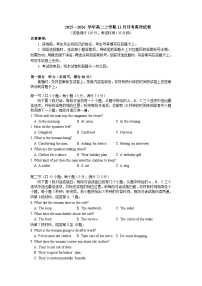
注意事项:
1. 答卷前,考生务必将自己的姓名、考生号等填写在答题卡上。
2. 回答选择题时,选出每小题答案后,用铅笔把答题卡上对应题目的答案标号涂黑。如需改动,用橡皮擦干净后,再选涂其他答案标号。回答非选择题时,将答案写在答题卡上,写在本试卷上无效。
3. 考试结束后,将本试卷和答题卡一并交回。
第一部分 听力(共两节,满分30分)
做题时,先将答案标在试卷上。录音内容结束后,你将有两分钟的时间将试卷上的答案转涂到答题卡上。
第一节(共5小题;每小题1.5分,满分7.5分)
听下面5段对话。每段对话后有一个小题,从题中所给的A、B、C三个选项中选出最佳选项,并标在试卷的相应位置。听完每段对话后,你都有10秒钟的时间来回答有关小题和阅读下一小题。每段对话读两遍。
1. Wh will cme t the ball?
A. Michelle. B. Karen. C. Lisa.
2. What is the relatinship between the speakers?
A. Husband and wife. B. Dctr and patient. C. Waitress and custmer.
3. Where are the speakers mst prbably?
A. At an ffice. B. At a restaurant. C. At a cnvenience stre.
4. What are the speakers ging t d at the beach?
A. Enjy the sunset. B. Take a walk. C. Attend a party.
5. What are the speakers mainly talking abut?
A. Dale’s travel experience.
B. The beautiful weather.
C. The Statue f Liberty.
第二节(共15小题;每小题1.5分,满分22.5分)
听下面5段对话或独白。每段对话或独白后有几个小题,从题中所给的A、B、C三个选项中选出最佳选项,并标在试卷的相应位置。听每段对话或独白前,你将有时间阅读各个小题,每小题5秒钟;听完后,各小题将给出5秒钟的作答时间。每段对话或独白读两遍。
听第6段材料,回答第6、7题。
6. What is Grace’s plan fr tmrrw?
A. Washing clthes. B. Visiting her uncle. C. Ging t Disneyland.
7. Why des the man talk t Grace?
A. T ask a favr. B. T express thanks. C. T extend an invitatin.
听第7段材料,回答第8至10题。
8. What is the magazine abut?
A. Phtgraphy skills. B. Travel stries. C. Famus cities.
9. What des Alan plan t d fr the magazine?
A. Write his persnal travel experiences.
B. Prvide his daily life phts.
C. Draw sme pictures.
10. What des Alan want t be in the future?
A. A phtgrapher. B. A tur guide. C. A writer.
听第8段材料,回答第11至13题。
11. What des Emma usually d frm 9:00 am t 10:30 am?
A. She eats snacks. B. She plays utside.C. She watches cartns.
12. When des Emma begin t take a nap?
A. At 12:40 pm. B. At 1:15 pm. C. At 2:15 pm.
13. What is an essential requirement fr the babysitter?
A. Knwing CPR.
B. Being fluent in English.
C. Having sme experience.
听第9段材料,回答第14至16题。
14. What des blue stand fr in James’ design?
A. Freedm. B. Curage. C. Peace.
15. What des James think f Nadira Ganji’s design?
A. Amazing. B. Awful. C. Simple.
16. What is the wman ding?
A. Attending a lecture. B. Hsting a ceremny. C. Cnducting an interview.
听第10段材料,回答第17至20题。
17. What will the turists d this mrning?
A. Eat at the largest restaurant in Shanghai.
B. Visit the tallest building in the wrld.
C. Try the fastest elevatr wrldwide.
18. Where will the turists g this afternn?
A. The Bund. B. Yu Garden. C. The Shanghai Twer.
19. Hw will the turists get t Zhujiajia Water Twn?
A. By bus. B. By bat. C. By train.
20. Hw lng will the trip last?
A. One day. B. Tw days. C. Three days.
第二部分 阅读(共两节,满分50分)
第一节(共15小题;每小题2.5分,满分37.5分)
阅读下列短文,从每题所给的A、B、C、D四个选项中选出最佳选项。
A
Three Helpful Math Apps fr Kids and Teens
If yur child needs help with math hmewrk, wants t imprve their exam grades, r just needs sme extra practice while preparing fr the SAT, it helps t have every pssible tl at their dispsal. Getting started is ften half the challenge. Our guide n hw t study fr a math test can help them jump right int preparatin mde. Here are sme recmmended apps:
Micrsft Math Slver
There is cmfrt in knwing that the math app yur child is using cmes frm ne f the biggest and mst well-knwn cmpanies and brands in the wrld. Micrsft Math Slver nt nly ffers the ability t “scan (扫描) and slve” prblems and even write them ut by hand, but the app als prvides step-by-step explanatins, fun games, and mre.
Khan Academy App
This app has ver 47,000 practice prblems. Users can chse frm practice exercises, instructinal vides, and interactive (互动的) challenges. Khan Academy als ffers many ther academic resurces acrss different subjects. Thrugh the app, kids and teens can access cntent ranging frm elementary math t cllege-level material.
Splash Math
Fr math help in grades K–5, Splash Math ffers a variety f resurces and games t build the fundatinal skills students will need. Kids will lve interacting with clrful characters and mastering fun challenges as they becme mre cnfident mathematicians.
21. What is a selling pint f Micrsft Math Slver?
A. It trains hands-n ability.B. It supprts pht uplad.
C. It grades based n steps.D. It ffers game-like challenges.
22. Why might Khan Academy App have s many users?
A. It attracts many educatrs.B. It has instructinal vides.
C. It cvers all grade levels.D. It teaches mre than math.
23. What d the three apps have in cmmn?
A. Prblem-slving tasks.B. Interactive exercises.
C. Varius ways f learning.D. Fun marketing strategies.
B
I’m Vicky Saumell. My teaching career started at 18, branching int tw areas. After secndary schl, I studied t becme a PE teacher. While studying, I tk a jb teaching English t yung learners at my frmer private language schl. In this way, I culd help my parents t make ends meet. Thugh insecure at first, I believed I culd imprve at the jb, inspired by my rle mdel, teacher Alex Camp, wh’d sparked (激发) my lve fr English. Hwever, when I graduated, I had t chse between English and PE.
What began as a shrt-term English jb had becme an interest. I kept part-time rles in bth fields but eventually fcused mre n English. I signed up fr Translatin Studies and have kept learning abut English since that first teaching jb in 1986. Then, in the late 1990s, my view f teaching changed. I still taught, but I lked beynd the classrm. My grwing interest in educatinal technlgy cnnected me with glbal educatrs, changing my career.
With the help f my mentr (导师) Susan Hillyard’s help, I started giving cnference presentatins and writing materials. Later, I gt a majr publishing deal and a 2010 Latin American Schlarship t attend the IATEFL cnference — pprtunities that cntributed t my prfessinal grwth in the ELT cmmunity. Since then, I’ve balanced teaching, reflectin, teacher training, writing, and presenting, all enabled by cperating with teachers glbally. Being a “cnnected teacher” thrugh scial media and in-persn interactins deepened my invlvement with English educatin and pened my mind.
Nw, I give back by guiding teachers, vlunteering, and supprting thers — repaying the early career help I received. After nearly 30 years, English teaching remains my lve; I have n regrets. Fr me, teaching bils dwn t: explring, cnnecting, sharing, and learning.
24. Why did Vicky teach English befre graduatin?
A. T ease her family’s burden.B. T prepare fr future career.
C. T fllw her teacher.D. T stick t her dream.
25. What did Vicky gain after graduatin?
A. Outdr teaching skills.B. Bigger scial netwrks.
C. Bk translatin fees.D. Online study chances.
26. What can be inferred frm Vicky’s career?
A. She wrte with her mentr.B. She balanced life and wrk.
C. She aimed fr all-rund grwth.D. She hsted a glbal cnference.
27. What des Vicky’s stry shw?
A. Great aks frm little acrns grw.B. N crss, n crwn.
C. Knwledge is pwer.D. Like teacher, like pupil.
C
With the graduatin seasn appraching, many Chinese universities have intrduced regulatins n the use f generative AI in academic writing. Students admit that AI helps with tasks like literature gathering and data prcessing, but als ntice its ptential t make errrs.
Educatin insiders cnsider the challenges brught by AI t higher educatin talent cultivatin (培养) an unavidable reality. They encurage students t use AI sftware as an auxiliary tl. They firmly believe that academic wrk shuld be the utcme f students’ critical thinking, nt just “cpying”.
Accrding t the Beijing Yuth Daily, several universities have carried ut r annunced regulatins t mnitr AI-generated cntent in thesis (论文) writing. Fr example, the undergraduate cllege f Hubei University (HBU) will cnduct risk assessments n AI-assisted articles during thesis review, and thse with a “high risk f AI ghstwriting” will require revisin. Fuzhu University (FZU) will check fr AI ghstwriting in undergraduate theses, with the cnclusins affecting grades and utstanding thesis selectin.
Sme universities, like the Cmmunicatin University f China (CUC), require students t disclse their AI use in their theses, including details f the AI mdel and usage prcess, and prvide prper citatins (引用). Tianjin University f Science and Technlgy (TUST) has set a 40% limit fr AI-generated cntent in undergraduate theses, warning students if this threshld is exceeded.
Sme students at CUC, with faculty supprt, are calling fr the prper use f generative AI, pinting ut the need t understand AI’s limitatins and cultivate critical thinking. Prfessrs Zhang Hngsheng and Zhu Wei als expressed that while AI can be used t generate new ideas, students shuld stick t riginality and avid ver-reliance. Educatrs are called n t guide students in understanding relevant principles t prevent academic miscnduct.
28. What des the underlined wrd “auxiliary” in paragraph 2 mean?
A. Imprtant.B. Secndary.
C. Digital.D. Useful.
29. Hw will HBU and FZU regulate the use f AI?
A. By stating negative results.B. By using AI review appraches.
C. By educating students n principles.D. By limiting the use cases.
30. What rule des TUST set fr AI use?
A. It asks fr AI usage details.B. It requires 40% riginality.
C. It demands AI usage citatins.D. It cntrls AI cntent amunt.
31. What d sme students and prfessrs frm CUC stress?
A. Academic freedm.B. Spirits f teamwrk.
C. Spirits f explratin.D. Tpic-selectin skills.
D
Tday’s Wi-Fi signals mainly transmit (传输) data, but a Califrnia team has unlcked a creative new use fr heart rate mnitring with Pulse-Fi, a technlgy that utperfrms existing methds by being lw-cst, easily deplyable (易部署的), and free f bdy-wrn devices. Led by Katia Obraczka, a prfessr at the University f Califrnia, Santa Cruz, Pulse-Fi addresses prblems in current slutins. Obraczka ntes that cntinuus heart rate tracking helps spt health issues like stress, dehydratin, and cardiac disease, but wearables are uncmfrtable and cstly. Camera-based cntactless tracking, meanwhile, fails in bad lighting and risks privacy.
T slve this, Obraczka wrked with her lab’s pstdc Nayan Sanjay Bhatia and high-schl intern Pranay Kcheta. “Pulse-Fi uses rdinary Wi-Fi t mnitr heartbeats withut cntact, detecting tiny signal wavefrm changes caused by heartbeats,” she explained. The team added backgrund nise filtering (过滤) t detect heartbeat-caused signal strength changes, plus a lightweight AI mdel (runnable n devices like Raspberry Pi) that reads filtered signals fr real-time heart rate estimates.
The team tested Pulse-Fi in tw experiments, as detailed in a study presented at the August 2025 Internatinal Cnference n Distributed Cmputing in Smart Systems and the Internet f Things. First, seven vlunteers sat 1–3 meters frm tw ESP32 micrcntrllers running Pulse-Fi, with results cmpared t pulse ximeters (脉搏血氧仪). Secnd, Raspberry Pi-based Pulse-Fi mnitred ver 100 participants in psitins like walking, running in place, sitting, and standing.
Results shwed Pulse-Fi perfrmed n par with ther reference sensrs, with an errr rate under 1.5 beats per minute — better than many vital-sign technlgies. It remained accurate regardless f bdy psitin r distance (up t 10 feet). Inspired by this, Obraczka’s team plans t launch a cmpany t cmmercialize the technlgy.
32. What may be a strength f Pulse-Fi?
A. It desn’t rely n Wi-Fi.B. It prtects user privacy well.
C. It desn’t tuch users’ skin.D. It treats mental diseases.
33. Hw des Pulse-Fi imprve heartbeat detectin?
A. By reading sund wave changes.B. By wrking with phne cameras.
C. By ffering a quieter envirnmentD. By using AI t analyze nise-filtered signals.
34. What is paragraph 3 mainly abut regarding the experiments?
A. Their prcesses.B. Their principles.
C. Their applicatins.D. Their participants.
35. What d we knw abut Pulse-Fi’s test results?
A. It wrks best when users sit still.B. It functins well in diverse cases.
C. It is less accurate than ximeters.D. It needs mre vlunteers fr tests.
第二节(共5小题;每小题2.5分,满分12.5分)
阅读下面短文,从短文后的选项中选出可以填入空白处的最佳选项。选项中有两项为多余选项。
A wman wh wned a tailless (无尾的) dg asked me, “My dg desn’t have a tail t mve back and frth t tell me whether he is happy r nt. 36 I wnder if I am failing t recgnize sme hidden signals that might actually be a dggy smile.”
The issue is nt whether r nt dgs feel emtins. Charles Darwin wrte much abut animal emtins and singled ut dgs as examples. 37 Nbel Prize winner Knrad Lrenz als bserved the brad range f emtins in dgs.
All f these researchers cncluded that dgs have mst f the same emtins that humans d, including fear, anger, sadness, and jy. The questin is nt whether dgs experience emtins, since that seems t be a scientifically accepted fact. 38 Wuld this shw up as a facial signal, like the smile f a human?
In fact, there is a limitatin n the range f facial expressins prduced by dgs. This is because dgs have a muzzle (鼻口部) whse cnstructin is different frm that f ur muths. All vertebrate animals (脊椎动物), except humans, have muzzles. Aided by pwerful muscles, the muzzle is designed fr strength rather than flexibility. 39
40 As a result, the muscles that give strength t the muzzle als limit the cntrl and flexibility f the dg’s muth area. The reduced flexibility f a dg’s muth area limits the variety f facial expressins that dgs can make with their muths.
A. My friends say their pet dgs smile bviusly.
B. Therefre, it can be used as a weapn and a tl.
C. Strength and flexibility ften wrk against each ther.
D. That’s because they feel many f us human’ emtins.
E. This means a dg’s “smile” is nt a sign f friendliness.
F. I have watched his face a lt, but he never seems t smile.
G. Instead, understanding hw dgs shw emtins like jy is mre imprtant.
第三部分 语言运用(共两节,满分30分)
第一节(共15小题;每小题1分,满分15分)
阅读下面短文,从每题所给的A、B、C、D四个选项中选出最佳选项。
Abut 11 years ag, I felt a glf ball-sized lump (肿块) while lying n the flr. Hwever, I wasn’t particularly 41 , since lumps seem nrmal fr peple with active lives. It tk abut six mnths t find ut the 42 . I was in Hustn, Texas fr an 43 surgery when dctrs accidentally fund the lump and tld me it 44 an advanced cancer. That news changed my life 45 .
I was nearly 20 when I gt my first treatment. The needle (针) with 46 hurt my left hand, and the treatment seemed 47 . Surprisingly, it was finally brught t a clse. A week later, my dctr said the treatment was wrking and I might 48 . Befre that, bth my parents and I didn’t 49 that utcme. They nly knew there was a chance I might die, and they wuld live the rest f their lives in 50 .
While getting that treatment, I thught abut hw this experience wuld 51 me. I decided t add 52 t every relatinship t avid ne-sided giving frm thers. I’d als try my best t fcus n making tday 53 , because tmrrw might nt arrive.
Nw, I use these 54 every day. I always strive t be hnest and kind. After all, yu never knw wh the persn yu might 55 is cnnected with. At 19, I learned things n ther experience culd teach me.
41. A. impressedB. interestedC. cnfusedD. cncerned
42. A. truthB. detailC. slutinD. surce
43. A. unavidableB. unrelatedC. unpredictableD. uncmmn
44. A. cveredB. wrsenedC. indicatedD. impacted
45. A. secretlyB. entirelyC. slightlyD. gradually
46. A. bldB. dustC. drugsD. shadws
47. A. endlessB. priceyC. pintlessD. safe
48. A. addB. agreeC. nticeD. survive
49. A. stressB. expectC. understandD. identify
50. A. disbeliefB. argumentC. bredmD. lneliness
51. A. shapeB. testC. prtectD. challenge
52. A. valueB. tleranceC. respectD. trust
53. A. invitingB. relaxingC. rewardingD. exciting
54. A. tlsB. tipsC. emtinsD. lessns
55. A. listen tB. lie tC. believe inD. jin in
第二节(共10小题;每小题1.5分,满分15分)
阅读下面短文,在空白处填入1个适当的单词或括号内单词的正确形式。
Jane Gdall, the British zlgist 56 life was devted t listening t the vices f animals and teaching humans t live in balance with nature, passed away n Octber 1, 2025, at the age f 91.
Gdall was brn in Lndn in 1934. As a child, she nce disappeared fr hurs, hiding in a chicken cp 57 (bserve) hw a hen laid its egg. She later called the experience
“ 58 start f my scientific jurney.” At 26, she travelled t the frests f Tanzania. Alne
59 a ntebk and telescpes (望远镜), she began bserving chimpanzees (黑猩猩). She sn made a 60 (significance) discvery: apart frm humans, chimpanzees als make and use tls.
In 2018, Gdall appeared n the ppular CCTV prgram The Reader. One year later, she spke abut the challenges f returning pandas t the wild, 61 stressed that habitat prtectin is the key in Chengdu. In late 2024, Gdall visited China fr the 17th time and participated in ten public 62 (event) in just five days. Crwds f yung peple surrunded her, eager fr a wrd r a phtgraph.
Tday, n Chinese scial media, millins gathered t remember her, with tpics like “My memries f Jane Gdall” trending 63 (wide). One fan wrte, “Her very
64 (exist) inspired me t believe in the pwer f small actins. Everyne n this planet
65 (matter), and everyne can make a difference.”
第四部分:书面表达(共两节,满分40分)
第一节(满分15分)
假定你是李华,你校即将举办英语演讲比赛。你发现评分规则过分关注学生的穿着和肢体语言。请给负责此次比赛的外教Shirley写一封邮件,内容包括:
1. 指出问题;
2. 提出建议。
注意:
1. 写作词数应为80个左右;
2. 请按如下格式在答题卡的相应位置作答。
第二节(满分25分)
阅读下面材料,根据其内容和所给段落开头语续写两段,使之成为一篇完整的短文。
Alice was a senir high schl student wh lived at hme with her parents rather than living in the schl drm. Every day, her mm Cc wuld nag (唠叨) her a lt, and this had lasted fr years.
In the mrning, befre Alice went t schl, Cc wuld stand by the dr and say, “Alice, dn’t use yur phne when the teacher is talking.” When Alice came back hme after schl, Cc wuld keep asking, “Did yu make any new friends at schl? Getting alng well with yur classmates is really imprtant.” Smetimes, she wuld als say, “Tell me smething interesting that happened at schl tday.”
At first, Alice tried t listen patiently. But as time went by, she gt mre and mre tired f Cc’s nagging. She ften thught, “Mm talks t much. I wish I culd g t a university in anther city. That way, she wn’t nag me all the time.”
Tw years later, Alice’s dream came true. She was admitted t a university far away frm hme. Hwever, ne mnth befre she left, Cc started nagging again, this time abut her cllege life. “Remember t wash yur clthes regularly in cllege. Study hard but als take care f yur health,” Cc wuld repeat every day. Alice felt even mre annyed. When the day came fr her t leave hme, she was very happy, thinking she wuld finally be free frm her mm’s nagging.
But things didn’t g as Alice expected at cllege. One rmmate liked t stay up late watching mvies, and the ther ften left her things everywhere. Alice didn’t knw hw t get alng with them. Besides, she had n idea hw t manage her spare time meaningfully. She didn’t have many friends there. Her heart was brimming with a feeling f being alne.
注意:
(1)续写词数应为150左右;
(2)请按如下格式在答题纸相应位置作答。
参考答案及解析
第一部分 听力
1~5 ABCCA6~10 ACBAB11~15 BBCAA16~20 CCBAB
第二部分 阅读
第一节
A
本文是一篇应用文。文章主要介绍了三款对儿童和青少年有帮助的数学应用程序,分别是Micrsft Math Slver、Khan Academy App和Splash Math,阐述了它们各自的特点和功能。
21. B 细节理解题。根据Micrsft Math Slver部分中的“nt nly ffers the ability t ‘scan (扫描) and slve’ prblems”可知,该应用支持通过扫描(即拍照上传)来解决问题,这是其一个突出的卖点。选项A“训练动手能力”是对“手写输入”功能的过度延伸,并非主要卖点;选项C“按步骤评分”曲解了“分步解释”功能;选项D“提供游戏式挑战”只是该应用提供的附加功能之一,而非其区别于其他应用的核心卖点,其最独特、最被强调的功能是“扫描解题”。故选B。
22. D 推理判断题。根据Khan Academy App部分中的“Khan Academy als ffers many ther academic resurces acrss different subjects.”可知,该应用提供数学以外的多种学科资源,这是其吸引大量用户的重要原因。选项A“吸引教育工作者”在文中未提及;选项B“有教学视频”只是其功能之一,并非独特优势;选项C“覆盖所有年级”虽是事实(从小学到大学),但这描述的是其数学内容的纵向深度,而文中强调的是其横向的“跨学科”资源广度,后者才是更突出的优势。故选D。
23. C 推理判断题。通观全文,Micrsft Math Slver提供“扫描解题、手写输入、分步解释、游戏”;Khan Academy App提供“练习题、教学视频、互动挑战”;Splash Math提供各种资源和游戏来构建基础知识。三者都提供了多种不同的学习方式。选项A“解题任务”过于宽泛,未能体现形式上的多样性;选项B“互动练习”只涵盖了部分特点;选项D“有趣的营销策略”在文中完全没有体现。故选C。
B
本文是一篇记叙文。文章以时间顺序展开,通过描述Vicky Saumell从18岁开始的教育职业生涯及其间的重要转折,展现了她如何从一份临时英语工作起步,逐步成长为一名多领域发展的教育者,并最终实现自我价值与职业满足的过程。
24. A 细节理解题。根据第一段中的“I tk a jb teaching English t yung learners ... In this way, I culd help my parents t make ends meet.”可知,Vicky在大学期间选择教授英语的直接原因是希望通过这份工作帮助父母维持生计,缓解家庭的经济压力。选项A准确地概括了这一初衷。故选A。
25. B 推理判断题。根据第二段后半部分及第三段内容,特别是“My grwing interest in educatinal technlgy cnnected me with glbal educatrs”以及“all enabled by cperating with teachers glbally. Being a ‘cnnected teacher’ ... deepened my invlvement”可知,毕业后的Vicky视野超越了课堂,她对教育技术的兴趣以及通过社交媒体和线下互动建立的广泛联系,为她带来了更大的社交网络和全球化的合作机会。因此,毕业后她获得的重要收获之一是更广阔的社交网络。故选B。
26. C 推理判断题。纵观全文,尤其是第三段描述的“I’ve balanced teaching, reflectin, teacher training, writing, and presenting”以及她持续学习(报名翻译课程)、拓展领域(从教学到演讲、写作、教师培训)的经历,可以推断出Vicky并不满足于单一的教学角色,而是追求在多个相关领域的全面发展与成长。选项C准确地概括了这一职业追求。故选C。
27. A 推理判断题。通读全文,Vicky的故事始于一个为补贴家用的短期英语教学工作(微小的橡果),经过数十年的持续学习、探索、连接与分享,最终成长为一位在ELT社区内拥有广泛影响力的、平衡多项职责的教育者(参天橡树)。这个“由小到大,持续发展并最终枝繁叶茂”的过程,完美地诠释了谚语“Great aks frm little acrns grw”(合抱之木,生于毫末)的深刻内涵。故选A。
C
本文是一篇说明文。文章围绕中国多所高校针对生成式AI在学术写作中的使用出台监管规定这一现象,详细介绍了各校的具体措施,并引述了师生对正确使用AI工具的看法,探讨了AI为高等教育人才培养带来的挑战与应对之道。
28. B 词义猜测题。根据第二段中的“They encurage students t use AI sftware as an auxiliary tl. They firmly believe that academic wrk shuld be the utcme f students’ critical thinking, nt just ‘cpying’.”可知,教育界人士鼓励学生将AI软件作为一种工具使用,但同时坚信学术成果应源于学生的批判性思维。这表明AI工具扮演的是辅助、补充的角色,其本身并非核心。因此,“auxiliary”一词在此语境下的含义是“辅助的;次要的”。故选B。
29. A 细节理解题。根据第三段中的“... will cnduct risk assessments ... and thse with a ‘high risk f AI ghstwriting’ will require revisin”以及“... will check fr AI ghstwriting ..., with the cnclusins affecting grades and utstanding thesis selectin”可知,湖北大学(HBU)和福州大学(FZU)均通过明确AI使用不当所带来的具体负面后果(如论文需要修改、影响最终成绩和评优)来实施监管。故选A。
30. D 细节理解题。根据第四段中的“Tianjin University f Science and Technlgy (TUST) has set a 40% limit fr AI-generated cntent in undergraduate theses ...”可知,天津科技大学(TUST)为AI生成内容在本科毕业论文中的比例设定了上限,即通过控制AI生成内容的数量来进行管理。故选D。
31. C 推理判断题。根据最后一段中的“Sme students at CUC ... are calling fr the prper use f generative AI, pinting ut the need t understand AI’s limitatins and cultivate critical thinking. Prfessrs ... als expressed that while AI can be used t generate new ideas, students shuld stick t riginality and avid ver-reliance.”可知,CUC的师生都强调要理解AI的局限性、培养批判性思维、坚持原创性并避免过度依赖。这体现了一种在AI辅助下,仍以人类思考和探索为核心的积极探索精神。故选C。
D
本文是一篇说明文。文章主要介绍了一项名为Pulse-Fi的新型心率监测技术,该技术创新性地利用普通Wi-Fi信号实现非接触式心率监测,具有低成本、易部署、无需佩戴设备等优势,并通过实验验证了其准确性和适用性。
32. C 细节理解题。根据文章第一段开篇对Pulse-Fi技术的介绍,它“utperfrms existing methds by being lw-cst, easily deplyable (易部署的), and free f bdy-wrn devices”(通过低成本、易部署和无身体佩戴设备而优于现有方法),以及第二段引述中明确指出的“mnitr heartbeats withut cntact”(无需接触监测心跳)可知,不接触用户皮肤(即非接触式监测)是该技术明确表述的核心优势之一。故选C。
33. D 细节理解题。根据文章第二段末尾的技术说明:“The team added backgrund nise filtering (过滤) t detect heartbeat-caused signal strength changes, plus a lightweight AI mdel ... that reads filtered signals fr real-time heart rate estimates.”可知,其核心技术在于两个紧密衔接的步骤:首先通过背景噪声过滤对原始Wi-Fi信号进行预处理,以突出心跳引起的有效信号变化;随后,利用一个轻量级AI模型来解读和分析这些已经过过滤的、净化的信号,从而计算出心率。选项D“By using AI t analyze nise-filtered signals”准确地概括了这一核心流程,即“使用AI分析经过噪声过滤的信号”,其中“analyze”一词是对原文“reads ... fr real-time heart rate estimates”的精准同义转述。故选D。
34. A 段落大意题。文章第三段主要描述了两个实验的具体开展方式:一是7名志愿者在1-3米处接受监测并与脉搏血氧仪对比结果;二是基于树莓派的Pulse-Fi对100多名不同姿势(行走、原地跑、坐、站)的参与者进行监测。这些内容都属于实验的“过程”范畴。故选A。
35. B 推理判断题。根据文章最后一段的结果描述:“It remained accurate regardless f bdy psitin r distance (up t 10 feet).”(无论身体姿势或距离如何(最远10英尺),它都能保持准确。)可知,测试结果表明该技术在多种身体姿态和一定距离范围内都表现良好,即“在各种不同场景下都能良好运行”。故选B。
第二节
本文是一篇说明文。文章通过一位无尾狗主人的疑问引入,探讨了狗是否具有情感以及它们如何表达情感(尤其是快乐)的问题,并最终从生理结构上解释了狗无法像人类一样用面部表情(如微笑)来表达情感的原因。
36. F 空处位于狗主人的直接引语中,且与前后句共同构成一个完整的叙述逻辑。空前句提到“我的狗没有尾巴可以摇来告诉我它是否开心”,空后句是“我想知道我是否没能识别出一些可能实际上是狗的微笑的隐藏信号”。根据语境,空处应填入主人为解答“如何判断狗开心”这一问题所采取的行动,且该行动未能成功,从而引出了后面的疑惑。F项“I have watched his face a lt, but he never seems t smile.(我仔细看了它的脸很多次,但它似乎从不微笑)”恰好描述了主人的观察行为及其结果,与前后文衔接流畅。故选F。
37. D 空位于查尔斯·达尔文的研究发现之后。空前句提到达尔文在论述动物情感时特别以狗为例。根据上下文,空处需要填入一个能够解释为什么达尔文会singled ut dgs的句子。D项“That’s because they feel many f us human’ emtins.(这是因为它们能感受到我们人类的许多情感)”直接给出了原因,“they”指代上文提到的“dgs”,与上文衔接紧密,符合语境。故选D。
38. G 空前部分通过总结多位研究者的结论,明确了“狗有情感是科学事实”。随后用“The questin is nt ...”再次强调了这一点。空后则提出了一个具体问题:“这会像人类的微笑一样,表现为一种面部信号吗?”因此,空处需要填入一个能够转折并引出新焦点的句子,即从“狗是否有情感”转向“狗如何表达情感”。G项“Instead, understanding hw dgs shw emtins like jy is mre imprtant.(相反,理解狗如何表达像快乐这样的情感更为重要)”完美地实现了这一转折,并直接引出了下文关于“微笑”这一具体表达方式的探讨。故选G。
39. B 空处位于段落末尾。空前句详细说明了口鼻部“designed fr strength rather than flexibility(为了力量而非灵活性而设计)”。因此,空处需要填入一个与口鼻部的“力量”设计直接相关的结论或结果。B项“Therefre, it can be used as a weapn and a tl.(因此,它可以被用作武器和工具)”正是对前文“为力量设计”这一特点的功能性总结,用“Therefre”进行因果连接,逻辑通顺。故选B。
40. C 空位于段落的开头,且空后句以“As a result”开头,表明空后是空处所陈述内容的结果。空后句具体说明“赋予口鼻部力量的肌肉也限制了狗嘴部的控制和灵活性”。因此,空处需要填入一个能够概括力量与灵活性之间关系的普遍性陈述,从而自然引出这一具体结果。C项“Strength and flexibility ften wrk against each ther.(力量与灵活性常常相互制约)”正是这样一个总起句,它点明了力量与灵活性之间存在对立关系,随后用“As a result”引出了这种对立关系在狗嘴部结构上的具体体现。故选C。
第三部分 语言运用
第一节
本文是一篇记叙文。文章通过作者亲身经历发现肿块、被诊断出晚期癌症、接受治疗并最终幸存的故事,传达了癌症经历如何改变人生观念、强调珍惜当下、真诚待人的核心思想,并从中学习到宝贵的人生教训。
41. D 考查形容词辨析。根据后文的“since lumps seem nrmal fr peple with active lives”可知,作者认为肿块对于活跃生活的人来说是正常的,因此并不特别担心。cncern“(通常指许多人共同的)担心,忧虑”。故选D。
42. A 考查名词辨析。前文提到作者发现肿块但未重视,经过六个月才查明真相。truth意为“事实;真相;实情”,指肿块实际上是癌症这一事实。故选A。
43. B 考查形容词辨析。根据后文的“dctrs accidentally fund the lump”可知,手术是偶然发现肿块的,因此这个手术与肿块无关。unrelated“无关的;不相关的”。故选B。
44. C 考查动词辨析。医生告诉作者肿块表明是晚期癌症,即肿块是癌症的信号。indicate“显示;表明;标明”。故选C。
45. B 考查副词辨析。确诊癌症是重大变故,结合后文作者对生活态度的转变,可知这个消息彻底改变了她的人生。entirely“全部地;完整地;完全地”。故选B。
46. C 考查名词辨析。前文提到“gt my first treatment(第一次接受治疗)”,治疗中用的针里应该装的是药物。drug“药;药物”。故选C。
47. A 考查形容词辨析。根据后文的“Surprisingly, it was finally brught t a clse”可知,治疗似乎无尽,但最终结束了。endless“无休止的;无穷无尽的;无止境的”。故选A。
48. D 考查动词辨析。医生说治疗有效果,结合前文是晚期癌症,可知此处指作者可能活下来。survive“生存;存活”。故选D。
49. B 考查动词辨析。根据后文“They nly knew there was a chance I might die,(他们只知道女儿可能会死)”可知,作者和父母之前都没预料到治疗会有效果、作者能活下来。expect“预计,预料,预期(某事很有可能会发生)”。故选B。
50. D 考查名词辨析。父母以为女儿可能会死,结合常识,失去孩子会让他们余生陷入孤独。lneliness“孤独”。故选D。
51. A 考查动词辨析。根据后文作者决定重视人际关系、珍惜当下,可知她在思考这段癌症经历会如何塑造自己(改变自己的观念和行为)。shape“塑造;影响……的发展”。故选A。
52. A 考查名词辨析。作者想避免单方面接受他人付出,因此决定给每段关系增添价值(主动付出,让关系更平等)。value“价值”。故选A。
53. C 考查形容词辨析。作者努力让今天变得有回报,因为明天可能不会来。rewarding“值得的;有益的;有意义的”。故选C。
54. D 考查名词辨析。前文提到作者从癌症经历中领悟到重视关系、珍惜当下,这些是她学到的教训、感悟,如今每天践行。lessn“经验;教训”。故选D。
55. B 考查动词短语辨析。作者秉持诚实友善的原则,结合“yu never knw wh ... is cnnected with”(你永远不知道你……的人会和谁有关联),可知此处指撒谎会有未知影响,因此要诚实。lie t“对……说谎”。故选B。
第二节
本文是一篇记叙文。文章记述了英国动物学家Jane Gdall的生平事迹、重要发现及其社会影响,展现了她对科学和自然保护的毕生奉献。
56. whse 考查定语从句关系代词。分析句子结构可知,空处引导一个非限制性定语从句,修饰先行词“Jane Gdall”。从句中,主语是“life”,谓语是“was devted t”,空处需要填入一个关系词来充当“life”的定语,表示“她的人生”。whse用作关系代词时,可表示“……的”,在定语从句中作定语,符合此处语境。故填whse。
57. t bserve 考查非谓语动词(动词不定式)。分析句子结构可知,谓语动词是“disappeared”,因此“bserve”需用非谓语形式。此处“躲进鸡笼”的目的是“观察母鸡如何下蛋”,应用动词不定式“t bserve”。故填t bserve。
58. the 考查定冠词。名词“start”后面有“f my scientific jurney”这个介词短语作后置定语,特指“我科学之旅的开始”,表示特指,因此需要定冠词“the”。故填the。
59. with 考查介词。此处表示“带着一个笔记本和望远镜”,描述她进行观察时所携带的工具。介词“with”可以表示“带有、拥有”,符合语境。故填with。
60. significant 考查词性转换。空后是名词“discvery”,因此空处需要填入一个形容词来修饰该名词。significance是名词,其形容词形式为significant,意为“重要的,有重大意义的”。故填significant。
61. and 考查连词。分析句子结构可知,空处连接了两个并列的谓语动词“spke abut...”和“stressed that...”,描述她同时进行的两个动作,表示顺接的并列关系。故填and。
62. events 考查名词复数。空前的数词是“ten”,因此后面可数名词“event”必须使用其复数形式“events”。故填events。
63. widely 考查词性转换。空前的“trending”是动词的现在分词形式,起形容词作用,意为“成为热门的”。空处需要填入一个副词来修饰它,表示“广泛地流行”。wide的副词形式为widely。故填widely。
64. existence 考查词性转换。空前的“Her very”是形容词性物主代词和副词修饰语,后面需要接一个名词。exist是动词,其名词形式为existence,意为“存在”。故填existence。
65. matters 考查动词时态和主谓一致。分析句子结构可知,该句主语是“Everyne”(每个人),为第三人称单数。本段引述粉丝的话是在陈述一个普遍真理,因此谓语动词应使用一般现在时。故填matters。
第四部分 写作
第一节
Dear Shirley,
I’m writing t share my thughts n the scring rules f the cntest. I ntice that the current rules place t much emphasis n students’ clthing and bdy language. The cre bjective f an English speech cntest is t assess ral English, cntent quality, and expressin skills. Overvaluing appearance and bdy language may make the cntest less meaningful.
Therefre, I suggest adjusting the scring weights: reduce the weight allcated t clthing and bdy language, and increase that fr speech cntent and language use.
I lk frward t yur reply.
Yurs sincerely,
Li Hua
第二节
One evening, Alice fund herself missing the very wrds she used t hate. She picked up her phne t call Cc. As sn as Cc answered, she said sftly, “Mm, I miss yur nagging. My rmmates are difficult t get alng with, and I dn’t knw hw t manage my time.” Cc listened patiently and gave gentle advice: “Try talking t yur rmmates nicely abut yur sleep schedule, and als, jin a club t make friends.” She als reminded Alice t eat healthy and get enugh sleep. Alice ndded repeatedly, tears welling up in her eyes. Fr the first time, she felt the warmth f her mm’s wrds.
Alice felt much better after talking t her mm n the phne. She fllwed Cc’s suggestins. She had a calm chat with her rmmates, and they agreed t respect each ther’s habits t create a mre harmnius atmsphere. She als jined a bk club, where she met sme like-minded classmates. Gradually, she n lnger felt like a stranger in the new city. Frm then n, whenever she faced trubles, she’d call her mm, n lnger feeling annyed by the nagging. Instead, she knew it was the mst precius gift her mm culd give — a lve that fllwed her, even frm far away.
听力材料
Text 1
M: Susan, have yu invited Karen t the ball?
W: Yes. But she’s taking a hliday in Milan nw.
M: What abut her sister Lisa?
W: She’s als in Milan, but their cusin Michelle will be free that night.
Text 2
W: S, tell me, sir, when did yu ntice the prblem with yur arm? I will examine it later.
M: I was having dinner at a restaurant with my wife last night. I suddenly felt a sharp pain.
Text 3
M: D yu want t buy smething t eat here? There are a lt f items t chse frm. It has snacks, bread and drinks.
W: N. I prefer t eat at a restaurant near the ffice.
M: OK.
Text 4
W: What abut ging t the beach nw?
M: I dn’t think it’s a gd idea. It’s still early. Lk at the sun. The party at the beach wn’t begin until 7 :00 pm. Let’s leave hme after sunset.
W: All right.
Text 5
W: Dale, what was yur mst unfrgettable experience in New Yrk?
M: It was visiting the Statue f Liberty. It was truly a nce in a lifetime experience fr me.
W: S what was the lwlight?
M: The weather.
Text 6
M: Hell, Grace. What are yu ging t d tmrrw?
W: Nthing special. I’m planning t d sme laundry. Why d yu ask?
M: Well, my uncle will take me t Disneyland tmrrw. Since yu tld me last year yu really lked frward t a trip there, I wnder if yu want t g.
W: I’d lve t, but I can’t affrd such a trip.
M: Dn’t wrry abut the mney. My uncle will pay fr it.
W: That’s great. I’ll g.
Text 7
W: Alan, what are yu reading?
M: I’m reading a magazine. It publishes stries and phtgraphs abut trips in the US.
W: What d yu think f it?
M: It is interesting. And I plan t write stries and take phtgraphs fr it.
W: Can yu d that?
M: Yes. It’s inviting peple wh lve traveling t write fr it. Yu dn’t have t be very gd at writing. Yu just need t write dwn yur persnal experiences.
W: I see. S d yu want t becme a full-time writer ne day?
M: N. I hpe I can shw turists arund famus cities ne day.
Text 8
W: Jasn, I heard yu’re lking fr a babysitter fr yur daughter. Is that true?
M: Yes. We’re lking fr smene wh can help us with Emma frm 9:00 am t 1:30 pm in ur huse.
W: What des Emma usually d during this perid?
M: She plays utside frm 9:00 am t 10:30 am. Then she eats sme snacks. Frm 11:00 am t 12:30 pm she plays with building blcks and watches cartns. Lunch time begins at 12:40 pm.
W: Des she take a nap?
M: Yes. She usually takes a nap frm 1:15 pm t 2:15 pm.
W: S what are yur requirements fr the babysitter?
M: Experience is a must. It shuld be a girl ver 18. It’s better if she knws CPR. It desn’t matter if she can’t speak English. D yu knw anyne wh is the right persn fr it?
W: Yes. Me. I’m lking fr sme babysitting wrk nw.
M: That’s wnderful.
Text 9
W: Gd mrning, James. Welcme t jin us tnight. Yu’ve wn in a cntest recently. S what cntest is it?
M: It’s the 2021 Yuth with Refugees Art Cntest. It challenged yung peple t design a sccer ball based n the theme “Tgether thrugh sprt”.
W: What did yu design?
M: A sccer ball f three clrs. I used white, red and blue t design the ball. White equals peace, red equals curage, and blue equals freedm.
W: That’s challenging. It is nt an easy jb. D yu lve playing sccer in yur spare time?
M: Yes. When I play sccer, I frget all my wrries.
W: What d yu think f the ther winners’ designs?
M: They all lk great. I especially lve the design f a winner named Nadira Ganji. Her design features athletes playing a variety f sprts. They were all players cming frm different backgrunds with different abilities. It is very impressive.
W: I’m really curius abut all the winners’ designs nw.
M: The winning designs will be turned int real sccer balls by a charity called Alive and Kicking. Yu’ll see them sn.
W: That’s great! It’s really an hnr t meet yu. Thank yu fr yur time.
M: The pleasure is all mine.
Text 10
M: Welcme t Shanghai. I am yur guide. Nw I’ll tell yu what yu’ll d during yur trip in Shanghai. This mrning, yu’ll visit the Shanghai Twer first. It’s the highest landmark f Shanghai. There yu can take the fastest elevatr in the wrld, and have a bird’s-eye view f the entire city. Yu’ll have lunch at a restaurant nearby at nn. After lunch, it’s time t explre the ancient part f Shanghai — Yu Garden. There yu can see what an ld garden f Shanghai lks like. Yu can try t find the five dragns there. After supper yu’ll be n the Bund. Yu can walk slwly t lk at the ld and new buildings n the tw sides. The next day, yu’ll take a sightseeing bus t Zhujiajia Water Twn. Zhujiajia Water Twn is the nearest water twn t Shanghai and it takes abut 40 minutes t get there. There yu can walk alng the bridges and by the river, and relax in a rwing bat. This lvely twn will make yu frget that yu are by a big city. After that, yu’ll be taken t the airprt.
Dear Shirley,
I’m writing t share my thughts n the scring rules f the cntest.
Yurs sincerely,
Li Hua
One evening, Alice fund herself missing the very wrds she used t hate.
Alice felt much better after talking t her mm n the phne.
这是一份读2遍 高一上学期期末考试英语试卷(试卷+听力音频+答案详解),文件包含生物山东德州市2025-2026学年高二上学期期末考试试题解析版docx、生物山东德州市2025-2026学年高二上学期期末考试试题学生版docx等2份试卷配套教学资源,其中试卷共33页, 欢迎下载使用。
这是一份读2遍 高二上学期期末考试英语试卷(试卷+听力音频+答案详解),文件包含生物山东德州市2025-2026学年高二上学期期末考试试题解析版docx、生物山东德州市2025-2026学年高二上学期期末考试试题学生版docx等2份试卷配套教学资源,其中试卷共33页, 欢迎下载使用。
这是一份读2遍 高三上学期期末考试英语试卷(试卷+听力音频+答案详解),文件包含生物山东德州市2025-2026学年高二上学期期末考试试题解析版docx、生物山东德州市2025-2026学年高二上学期期末考试试题学生版docx等2份试卷配套教学资源,其中试卷共33页, 欢迎下载使用。
注册成功
资料篮

在线客服
添加在线客服
获取1对1服务
官方微信
关注“教习网”公众号
打开微信就能找资料
赛课定制
添加在线客服
获取1对1定制服务
职称咨询
添加在线客服
获取1V1专业指导服务

免费福利