免费领取教师福利
若您为此资料的原创作者,认为该资料内容侵犯了您的知识产权,请扫码添加我们的相关工作人员,我们尽可能的保护您的合法权益。


这是一份2026年高考英语终极冲刺讲义练习(全国通用)压轴题01阅读理解CD篇(人工智能类)(原卷版+解析),共21页。试卷主要包含了人工智能类说明文的解题技巧等内容,欢迎下载使用。
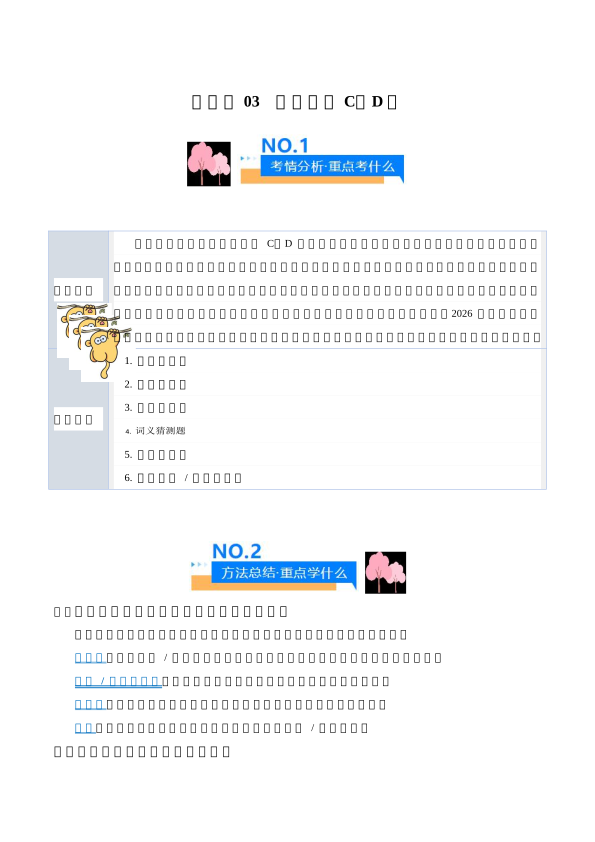
人工智能类说明文基本规律及解题要领
高考人工智能类阅读通常无标题,结构稳定,逻辑清晰,一般分为四部分:
首段:开门见山引出 AI 核心话题 —— 新技术、新模型、新争议、新研究。
背景:介绍 AI 发展现状、传统技术局限、现实需求或争议起源。
主干:详细说明 AI工作原理、功能特点、实验数据、应用场景、优势与问题。
结尾:总结 AI 价值、未来前景、现存挑战、专家观点或社会反思。
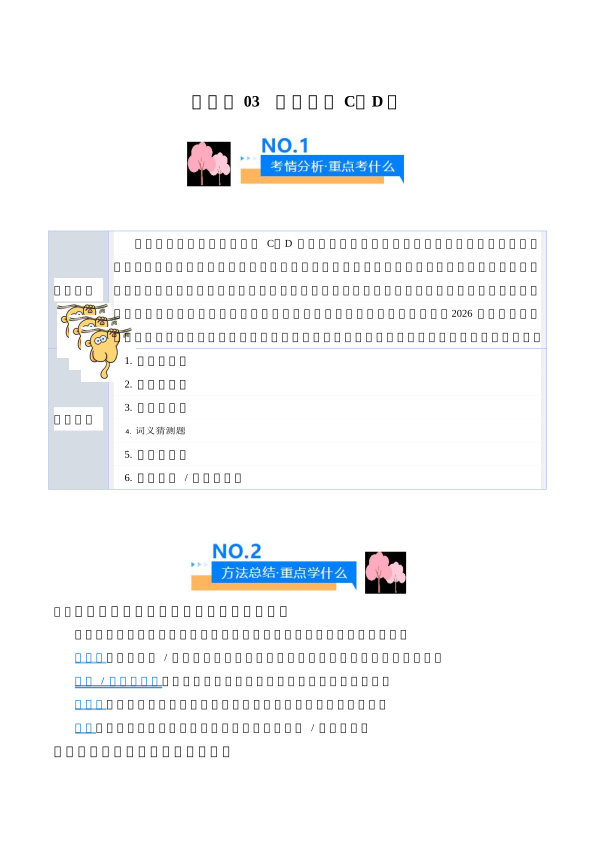
二、人工智能类说明文的解题技巧
1. 抓结构,快速把握主旨
用略读法浏览首尾段 + 各段首尾句,圈出 AI 相关核心词(mdel/algrithm/LLM/chatbt/rbt 等)。
人工智能类文章常见说明思路:
技术介绍型:原理→特点→优势→应用→局限
社会争议型:现象→正方观点→反方观点→作者态度
研究发现型:实验目的→过程→数据→结论→展望
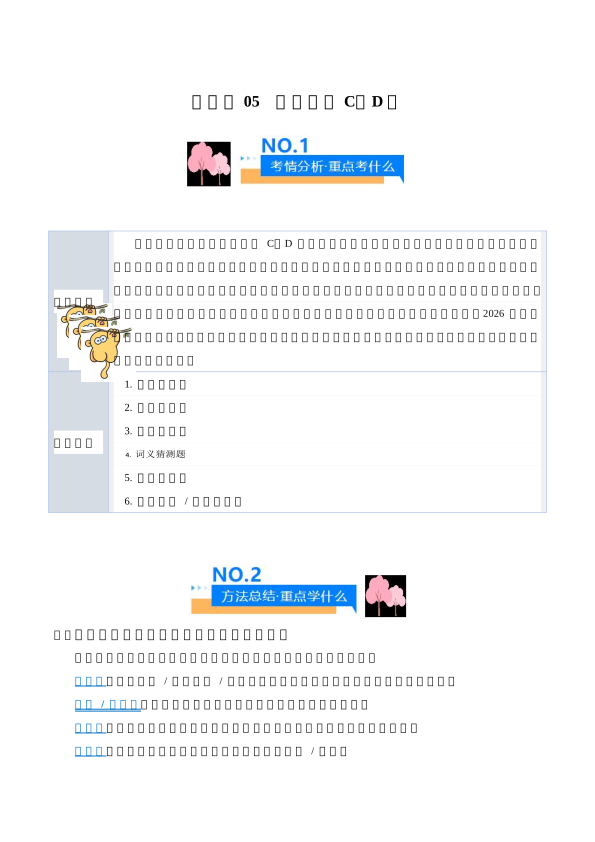
2. 定位标志词,精准破解细节与推理
题干关键词:人名、机构、专业术语、数字、时间、转折词。
长难句处理:先找主句谓语,剥离定语、状语、插入语,抓核心意思。
答案原则:原文同义替换 / 合理概括,不主观臆断。
3. 重点关注观点态度与引语
文中researchers/experts/develpers/authrities所说的话,常是观点题、推理题题眼。
把握情感词:psitive/negative/cncerned/skeptical/ptimistic/cautius。
4. 紧盯转折逻辑,锁定核心信息
AI 类文章高频转折词:hwever / but / yet / while / althugh / n the ther hand转折后往往是作者真正观点、核心问题、重要结论,是命题重灾区。
5. 熟悉选项陷阱,快速排除干扰
正确选项:原文信息同义改写、合理归纳。
干扰项:
张冠李戴(把 A 的功能安到 B)
偷梁换柱(改变程度、范围、对象)
无中生有(原文未提及)
以偏概全(只讲局部当主旨)
6. 标题归纳技巧(AI 类专用)
必须包含AI/technlgy/mdel等核心概念。
范围适中,不夸大、不缩小。
常见格式:AI + 功能 / 争议 / 未来 / 应用。
02 人工智能类
1.(2026·青岛·一模)
Artificial intelligence (AI) researchers have lng dreamed f tls t supercharge science-asking nvel questins, designing and running experiments. Recently, large language mdels (LLMs) have made discveries that sme AI develpers claim have inched us clser t that future. But hw d yu test whether an AI mdel can truly d science?
Fr answers, researchers turn t benchmarks (基准): standardized sets f questins r tasks that help measure an AI’s efficiency and reliability and cmpare it against ther mdels. But the cmplexity f science makes assessing their aptitude especially challenging. As Ha Peng, a cmputer scientist at the University f Illinis Urbana-Champaign, puts it: “Mdels have all this knwledge. D they knw hw t use it?”
Dzens f new science-fcused benchmarks have emerged ver the past year t answer that questin, but scientists have yet t settle n a single best apprach. One f the mst ppular, published in Nature, is Humanity’s Last Exam (HLE). It uses 2500 questins drawn frm “the frntier f human knwledge” t put LLMs thrugh their paces. One, fr example, asks hw many types f sensry receptrs the human skin cntains. “We wanted a diverse dataset that nly experts wh have been wrking n a field fr a lng time can answer,” says Lng Phan, a research engineer with the HLE’s develper.
Since the HLE first appeared as a preprint in January 2025, the benchmark has becme an imprtant prving grund fr LLMs and HLE scres are nw a cmmn talking pint fr AI cmpanies seeking t highlight the capabilities f their prducts. At the HLE’s launch, the leading develper OpenAI’s AI mdel wn the best scre at a mere 8.3%. Earlier this mnth, Ggle claimed that its latest reasning mdel fr science, called Gemini 3 Deep Think, had achieved a new recrd HLE scre f 48.4%.
But sme scientists argue that many f the HLE’s questins test fr little-knwn r even useless knwledge, rather than an ability t d meaningful research. A Nature editrial accmpanying the HLE’s publicatin als raised this issue: “We think that mre scientists shuld be asking: What wuld it take t develp an AI benchmark that truly measures expert-level thinking?”
1. What des the underlined wrd “aptitude” in paragraph 2 mean?
A. Knwledge.B. Perfrmance.C. Intelligence.D. Prgress.
2. What des Lng Phan stress abut HLE?
A. Its tpic diversity.B. Experts’ invlvement in it.
C. The expertise f its dataset.D. Its data-backed ppularity.
3. What is paragraph 4 mainly abut?
A. HLE’s rle as a key AI test.B. Cmpanies’ use f HLE.
C. HLE scres f leading AI mdels.D. The prcess f HLE’s launch.
4. By sharing its view, the Nature editrial aimed t ________.
A. back the current testingB. express cncern ver HLE
C. prpse a wrkable slutinD. predict future AI benchmarks
【答案】1. B 2. C 3. A 4. B
【解析】
【导语】本文是一篇议论文。文章围绕如何检验一个人工智能模型是否真的能够进行科学研究展开,其中人类终极考试(HLE)作为核心AI测试平台备受关注,文章介绍了它的设计定位和作用;最后文章指出,一些科学家和《自然》社论对HLE提出质疑,引发了学界对“如何开发真正能测量专家级科研思维的AI基准”的思考。
【1题详解】
词句猜测题。根据划线词前文“Fr answers, researchers turn t benchmarks (基准): standardized sets f questins r tasks that help measure an AI’s efficiency and reliability and cmpare it against ther mdels.(为寻找答案,研究人员转向了基准测试:一系列标准化的问题或任务,用于衡量人工智能的效率和可靠性,并将其与其他模型进行比较)”和后文“As Ha Peng, a cmputer scientist at the University f Illinis Urbana-Champaign, puts it: “Mdels have all this knwledge. D they knw hw t use it?”(正如伊利诺伊大学厄巴纳-香槟分校的计算机科学家Ha Peng所说:“模型拥有所有这些知识。但它们是否知道如何运用这些知识呢?”)”可知,前文提出核心问题:如何测试AI是否真的能开展科学研究,后文补充“模型已经拥有大量知识,问题是它们会不会运用知识”,所以此处指科学的复杂性让评估AI做科学的能力/天资格外困难,aptitude意为“能力”,故选B。
【2题详解】
细节理解题。根据第三段中““We wanted a diverse dataset that nly experts wh have been wrking n a field fr a lng time can answer,” says Lng Phan, a research engineer with the HLE’s develper.(“我们希望获得一个内容多样、只有长期深耕某一领域的专家才能解答的数据集,”HLE的开发者之一Lng Phan说道)”可知,他强调HLE的数据集只有深耕领域的资深专家才能作答,核心是突出数据集的专业性,故选C。
【3题详解】
主旨大意题。根据第四段“Since the HLE first appeared as a preprint in January 2025, the benchmark has becme an imprtant prving grund fr LLMs and HLE scres are nw a cmmn talking pint fr AI cmpanies seeking t highlight the capabilities f their prducts. At the HLE’s launch, the leading develper OpenAI’s AI mdel wn the best scre at a mere 8. 3%. Earlier this mnth, Ggle claimed that its latest reasning mdel fr science, called Gemini 3 Deep Think, had achieved a new recrd HLE scre f 48. 4%.(自2025年1月HLE以预印本形式首次亮相以来,该基准测试已成为大型语言模型的重要验证平台,而HLE的得分如今已成为AI公司展示其产品能力时的常见话题。在HLE的发布仪式上,领先的开发者OpenAI的模型以仅 8.3%的得分赢得了最佳成绩。本月早些时候,谷歌宣称其最新的科学推理模型——名为“Geminis 3 深度思考”的模型,已取得了新的HLE成绩记录——48.4%)”可知,本段主要介绍HLE问世后已经成为大语言模型的重要试验场,HLE分数是AI公司展示产品能力的通用依据,后文的OpenAI、Ggle分数例子都是细节支撑。因此本段主要介绍HLE作为核心AI测试平台的作用,故选A。
【4题详解】
推理判断题。根据最后一段“But sme scientists argue that many f the HLE’s questins test fr little-knwn r even useless knwledge, rather than an ability t d meaningful research. A Nature editrial accmpanying the HLE’s publicatin als raised this issue: “We think that mre scientists shuld be asking: What wuld it take t develp an AI benchmark that truly measures expert-level thinking?”(但一些科学家认为,HLE的许多问题所测试的更多是鲜为人知甚至毫无用处的知识,而非进行有意义研究的能力。与HLE发布相关的《自然》杂志的一篇社论也提出了这一问题:“我们认为,更多的科学家应该思考:要开发一个真正能衡量专家思维水平的AI基准,需要具备哪些条件?”)”可知,科学家批评HLE多考察偏门无用知识,而非真正的研究能力,《自然》社论也认同这个问题,呼吁学界思考“如何开发真正能测量专家级思维的AI基准”,因此社论的目的是对HLE现存的问题表达担忧,故选B。
2.(2026·聊城·一模)
In the age f large language mdels (LLMs) and generative AI, we are witnessing an unprecedented transfrmatin in hw knwledge is prduced, spread and cnsumed.
LLMs, we are tld, make us mre efficient, simplify cmplex wrk, autmate bring tasks and allw us t fcus n what matters. But as we feel surprised at their capabilities, a pressing cncern emerges: Are these mdels genuinely bsting efficiency, r are they erding ur capacity fr independent thught, judgment and critical reflectin?
Efficiency is nt a neutral term. The current narrative arund generative AI treats efficiency as prgress. It suggests that the faster smething is dne, the better. But faster is nt always better. And nt everything that can be autmated shuld be.
The ppular belief is that LLMs allw humans t assign repetitive wrk t machines and reserve their energy fr mre reflective tasks, but the ppsite is ften true. As the mre intellectual labr — writing, summarizing and decisin-making, fr example — is handed ver t AI, the less we will engage with it urselves. Instead f reserving ur thughtfulness fr higher tasks, we will increasingly lse the pprtunities, and perhaps even the ability, t think critically.
S what d we really mean by “efficiency”? If it means shrtening the time it takes t write a reprt, perhaps we have succeeded. But if it means replacing the intellectual effrt that creates depth, cherence and reflectin, then it’s nt a gain; it’s a lss. The mment we accept LLMs as thught substitutes, rather than thught aids, we begin t wrsen the very cnditins under which human reasning thrives: questining, dialgue, uncertainty and cntradictin.
There is n turning back the presence f LLMs in ur lives. But we can chse hw t live with them. The questin is nt whether they will think fr us, but whether we will let them define what it means t think at all. Efficiency, in the true sense, shuld nt be abut ding mre with less thught. It shuld be abut ding better, with deeper attentin, strnger ethics and sustained human insight.
5. What des the underlined wrd “erding” in paragraph 2 mean?
A. Changing.B. Imprving.C. Destrying.D. Expanding.
6. What d LLMs lead t, accrding t paragraph 4?
A. We get mre reflective labr.B. We d independent thinking less.
C. We engage in mre repetitive tasks.D. We reduce ur wrk efficiency indeed.
7. What des the authr advcate abut ur using LLMs?
A. Putting efficiency first.B. Reducing intellectual effrt.
C. Achieving mre with less time.D. Increasing human engagement.
8. What is the authr’s purpse in writing the text?
A. T describe the fast develpment f LLMs.
B. T reflect n the negative effects f LLMs.
C. T questin the necessity f pursuing efficiency.
D. T challenge the traditinal definitin f efficiency.
【答案】5. C 6. B 7. D 8. B
【解析】
【导语】本文是一篇说明文。主要介绍大型语言模型在带来效率提升的同时,可能削弱人们独立思考与批判性思维能力,并反思其真正价值。
【5题详解】
词句猜测题。根据第二段中的“But as we feel surprised at their capabilities, a pressing cncern emerges: Are these mdels genuinely bsting efficiency, r are they erding ur capacity fr independent thught, judgment and critical reflectin?(但当我们对它们的能力感到惊讶时,一个迫切的担忧出现了:这些模型是真正提高了效率,还是erding我们独立思考、判断和批判性反思的能力?)”可知,句中使用了选择对比结构 “genuinely bsting efficiency” 与“erding ur capacity”形成反义关系,bsting表示 “提升、增强”,与之相反的erding应表示“逐渐损害、破坏、削弱”。故选C项。
【6题详解】
细节理解题。根据第四段中的“As the mre intellectual labr — writing, summarizing and decisin-making, fr example — is handed ver t AI, the less we will engage with it urselves. Instead f reserving ur thughtfulness fr higher tasks, we will increasingly lse the pprtunities, and perhaps even the ability, t think critically. (随着更多的智力劳动——例如写作、总结和决策——被交给人工智能,我们自己参与其中的程度就会越低。我们不会把思考留给更高层次的任务,反而会越来越失去批判性思考的机会,甚至可能失去这种能力。)”可知,大型语言模型会导致人们独立思考减少。故选B项。
【7题详解】
推理判断题。根据最后一段中的“Efficiency, in the true sense, shuld nt be abut ding mre with less thught. It shuld be abut ding better, with deeper attentin, strnger ethics and sustained human insight.(真正意义上的效率,不应该是用更少的思考做更多的事,而应该是用更深入的关注、更强的道德感和持续的人类洞察力把事情做得更好)”可知,作者主张使用大型语言模型时增加人类参与。故选D项。
【8题详解】
推理判断题。通读全文,尤其是第二段中的“But as we feel surprised at their capabilities, a pressing cncern emerges: Are these mdels genuinely bsting efficiency, r are they erding ur capacity fr independent thught, judgment and critical reflectin?(但当我们对它们的能力感到惊讶时,一个迫切的担忧出现了:这些模型是真正提高了效率,还是正在削弱我们独立思考、判断和批判性反思的能力?)”可知,作者写作目的是反思大型语言模型带来的负面影响。故选B项。
3.(2026·广州·一模)
Survey data shws that mst freshmen regularly use generative AI, ften treating it as “an intellectual partner”, Prfessr Jhn Hampsn reprted at a faculty (全体教师) meeting in Elite Technlgy University (ETU). Students mst cmmnly use it t understand difficult cncepts, search, generate study materials, and edit writing. Interestingly, the lwest reprted use is fr generating text.
Meanwhile, students are using faculty ffice hurs and the speaking and writing centers less. In last year’s cmputer science curses, scres n prblem sets increased, yet exam scres declined. “This is cncerning,” nted Hampsn. “If they were using AI as a study pal, they weren’t absrbing as much as they might think.”
Students want clearer AI plicies, and Hampsn advised faculty t carefully cnsider and share what level f use they permit, the reasning behind it, hw t cite use f AI, and examples f what’s permissible. He als encuraged department-wide discussins t best prepare students fr a wrkplace where they will need t knw hw t write r cde with its assistance. “I als believe that students need t learn t write and cde unaided, t develp critical thinking skills, their agency as citizens, and als meaning — making the ideas that help them understand their wn lives,” he added.
Sme prfessrs expressed cncerns abut hw AI use is impacting students’ mental health and learning. Prfessr Gerge Wilsn nted that students are ften highly cmpetitive, and “it’s imprtant t create rules s that cmpetitin leads t healthy behavirs that make them better educated peple.” While sme suggested mre ne-n-ne time with students, thers nted that budget restrictins wuld make that difficult.
Prfessr Ply Burnett bserved that lecture attendance is als dwn. She urged faculty t make lectures smething students genuinely want t attend. She als nted that many teachers are making small changes, in hpes f cntinuing teaching as they’ve previusly taught. “We actually have t see this less as a prblem and mre as an pprtunity,” Burnett suggested. “Hw can ETU lead in rethinking hw we teach, hw we learn... and have ur students be benefiting and being at the leading edge f that?”
9. What des the authr imply abut the survey findings by using “interestingly” in paragraph 1?
A. They indicate a prmising trend.B. They cntradict a cmmn assumptin.
C. They capture the faculty’s interest.D. They require further investigatin.
10. Which f the fllwing changes is mentined in paragraph 2?
A. Students are interacting mre with thers.
B. AI use has led t better learning utcmes.
C. Exam scres rse while hmewrk scres fell.
D. Students are using ff-line academic services less.
11. Why des Hampsn emphasize students writing and cding withut AI?
A. T clarify acceptable uses f AI in cursewrk.
B. T prepare students fr future wrkplace demands.
C. T ensure students develp essential human capacities.
D. T imprve students’ lng-term academic perfrmance.
12. What is Burnett’s suggestin t the faculty?
A. Make lectures mre entertaining.
B. Let students take the leading rle.
C. Take the chance t refrm educatin.
D. Adjust teaching slightly t AI challenges.
【答案】9. B 10. D 11. C 12. C
【解析】
【导语】本文是一篇议论文。主要介绍ETU大学关于新生使用生成式AI的调查结果、引发的教学问题及教师们的讨论与建议。
【9题详解】
推理判断题。根据第一段中的“Students mst cmmnly use it t understand difficult cncepts, search, generate study materials, and edit writing. Interestingly, the lwest reprted use is fr generating text. (学生们最常使用它来理解难懂的概念、搜索、生成学习资料和编辑写作。有趣的是,据报告,使用最少的是生成文本。)”可知,人们通常认为生成式AI主要用于生成文本,而调查结果与之相反,因此这与普遍的假设相矛盾。故选B项。
【10题详解】
细节理解题。根据第二段中的“Meanwhile, students are using faculty ffice hurs and the speaking and writing centers less.(与此同时,学生去教师答疑时间和前往口语与写作中心求助的次数减少了。)”可知,学生们正在减少使用线下学术服务。故选D项。
【11题详解】
推理判断题。根据第三段中的““I als believe that students need t learn t write and cde unaided, t develp critical thinking skills, their agency as citizens, and als meaning — making the ideas that help them understand their wn lives,” he added. (他补充道:“我还认为,学生需要学会独立写作和编程,以此培养批判性思维能力、作为公民的自主能动性,同时也要建立意义——构建那些能帮助他们理解自身生活的理念。”)”可知,汉普森强调学生在没有AI的情况下写作和编程是为了确保学生发展基本的人类能力。故选C项。
【12题详解】
细节理解题。根据最后一段中的““We actually have t see this less as a prblem and mre as an pprtunity,” Burnett suggested. “Hw can ETU lead in rethinking hw we teach, hw we learn… and have ur students be benefiting and being at the leading edge f that?”(伯内特表示:“事实上,我们不该把这更多看作一个问题,而应更多看作一个机遇。ETU该如何在重新思考教学方式、学习方式……并让我们的学生从中受益、走在前沿这方面起到引领作用?”)”可知,伯内特建议教师们抓住机会改革教育。故选C项。
4.(2026·苏北七市·二模)
Generative AI tls have explded in ppularity, enabling users t create text, images, music and vide in secnds. But behind the innvatin lies a cntrversial issue: the unauthrized use f ed material t train these mdels and the uncredited reprductin f prtected wrks in AI-generated cntent.
Fr artists, writers and filmmakers, the rise f generative AI feels like a threat. Many AI systems are trained n vast datasets scraped frm the internet—including nvels, paintings, sngs and films—withut permissin r cmpensatin t the riginal creatrs. When AI prduces new cntent that clsely mimics the style r even specific elements f ed wrks, it ften des s withut attributin, leaving creatrs feeling their labr is explited.
Take visual artists as an example. A digital painter might spend years develping a unique style, nly t find AI tls can replicate that style instantly. Sme artists have filed lawsuits against AI cmpanies, arguing that training mdels n their wrk withut cnsent vilates law. They demand fair cmpensatin and clearer rules n hw AI can use creative cntent.
Tech cmpanies, hwever, argue that AI training falls under "fair use," a legal dctrine that allws limited use f ed material withut permissin fr purpses such as educatin, research r innvatin. They claim AI transfrms the riginal material int smething new, thus nt infringing n cpyright. Yet this argument fails t address the cre cncern f many creatrs: that AI prfits frm their wrk withut giving anything back.
The debate is far frm settled. Gvernments arund the wrld are struggling t update laws t keep pace with AI. The Eurpean Unin’s AI Act requires transparency abut training data, while the US Cpyright Office has refused t grant cpyright t purely AI-generated wrks. In China, new regulatins mandate labeling AI-generated cntent t prevent deceptin.
As generative AI cntinues t evlve, finding a balance between innvatin and prtectin will be critical. Withut clear rules, bth creatrs and AI develpers will face uncertainty. The gal shuld be t fster AI prgress while ensuring that thse wh create riginal wrk are respected and rewarded.
13.What prblem is mainly discussed in Paragraph 1?
The rapid develpment f AI technlgy.
B. The lack f legal prtectin fr AI users.
C. The illegal use f ed material by AI.
D. The difficulty in creating riginal cntent.
14.Why d many artists ppse generative AI?
AI makes their wrks less ppular.
AI cpies their styles withut permissin.
AI reduces the value f creative jbs.
D. AI fails t prduce high-quality cntent.
15.What d tech cmpanies claim abut AI training?
It shuld be strictly banned by law.
It belngs t the categry f fair use.
It needs full permissin frm creatrs.
D. It has nthing t d with .
16.What can be inferred frm the last tw paragraphs?
Glbal laws n AI are cnsistent.
AI-generated wrks can get in the US.
China requires clear labels fr AI cntent.
D. Innvatin shuld cme befre prtectin.
【答案】
13.C 14. B 15. B 16. C
【解析】
【导语]本文是一篇议论文。主要介绍生成式AI的普及所引发的版权争议,围绕AI未经授权使用版权素材、创作者维权与科技公司的分歧展开,探讨全球版权法规如何适配AI发展,寻求创新与版权保护的平衡。
【13题详解】
细节理解题。根据第一段中的“But behind the innvatin lies a cntrversial issue: the unauthrized use f ed material t train these mdels and the uncredited reprductin f prtected wrks in AI-generated cntent. (但在这项创新背后,存在一个有争议的问题:未经授权使用受版权保护的素材来训练这些模型,以及在AI生成的内容中未经署名复制受保护的作品。)”可知,第一段主要讨论的核心问题是AI非法使用受版权保护的素材。A项仅提及AI技术的快速发展,未涉及争议问题;B项“缺乏对AI用户的法律保护”文中未提及;D项“创作原创内容的困难”与第一段无关。故选C项。
【14题详解】
细节理解题。根据第二段中的“Many AI systems are trained n vast datasets scraped frm the internet—including nvels, paintings, sngs and films—withut permissin r cmpensatin t the riginal creatrs. (许多AI系统是在从互联网上抓取的海量数据集上训练的——包括小说、绘画、歌曲和电影——却没有获得原创创作者的许可,也没有向他们支付报酬。)”以及第三段中的“A digital painter might spend years develping a unique style, nly t find AI tls can replicate that style instantly. (一位数字画家可能会花费数年时间培养独特的风格,却发现AI工具能立即复制这种风格。)”可知,许多艺术家反对生成式AI,是因为AI未经许可就复制他们的风格,侵犯了他们的权益。A项“AI使他们的作品不那么受欢迎”、C项“AI降低了创意工作的价值”、D项“AI无法生成高质量的内容”文中均未提及。故选B项。
【15题详解】
细节理解题。根据第四段中的“Tech cmpanies, hwever, argue that AI training falls under "fair use," a legal dctrine that allws limited use f ed material withut permissin fr purpses such as educatin, research r innvatin. (然而,科技公司认为,AI训练属于“合理使用”——这是一项法律原则,允许在未经许可的情况下,为教育、研究或创新等目的有限使用受版权保护的素材。)”可知,科技公司声称AI训练属于合理使用的范畴。A项“它应该被法律严格禁止”与科技公司的观点相反;C项“它需要获得创作者的完全许可”不符合文意;D项“它与版权无关”表述错误,科技公司只是认为属于合理使用,并非与版权无关。故选B项。
【16题详解】
推理判断题。根据倒数第二段中的“In China, new regulatins mandate labeling AI-generated cntent t prevent deceptin. (在中国,新法规强制要求为AI生成的内容标注标签,以防止欺骗。)”可知,中国要求为AI生成的内容标注清晰的标签。A项“全球关于AI版权的法律是一致的”表述错误,文中提到欧盟、美国、中国的法规各有不同;B项“AI生成的作品在美国可以获得版权”与文意不符,美国版权局拒绝为纯AI生成的作品授予版权;D项“创新应该优先于版权保护”错误,最后一段明确提到“找到创新与保护之间的平衡至关重要”。故选C项。
5.(2026·运城·一模)
New research challenges the widespread belief that artificial intelligence (AI) is driving a majr rise in glbal greenhuse gas emissins Scientists frm the University f Waterl and the Gergia Institute f Technlgy analyzed U.S. ecnmic data alngside estimates f hw frequently AI tls are used acrss different industries. Their aim was t understand what might happen t the envirnment if AI adptin increases alng its current path.
Accrding t the U.S. Energy Infrmatin Administratin, 83 percent f the natin’s ecnmic activity relies n petrl, cal and natural gas. These fuels release greenhuse gases when burned. The researchers nted that ttal energy use frm AI in the U.S. matched the electricity cnsumptin f Iceland, yet this amunt remained insignificant when viewed at natinal r glbal levels.
“It is imprtant t nte that the increase in energy use is nt ging t be unifrm. It’s ging t be felt mre in the places where electricity is prduced t pwer the data centers,” said Dr Juan Mren-Cruz, a prfessr at the Schl f Envirnment, Enterprise and Develpment at the University f Waterl and Canada Research Chair in Energy Transitins. “If yu lk at that energy frm the lcal perspective, that’s a big deal because sme places culd see duble the amunt f electricity utput and emissins. But at a larger scale, AI’s use f energy wn’t be nticeable.”
“Fr peple wh believe that the use f AI will be a majr prblem fr the climate and think we shuld avid it, we’re ffering a different perspective,” Mren-Cruz added. “The effects n climate are nt that significant, and we can use AI t develp green technlgies r t imprve existing nes.”
T develp their findings, envirnmental ecnmists Mren-Cruz and Dr Anthny Harding reviewed a variety f ecnmic sectrs, the types f jbs within thse sectrs, and the share f tasks that culd ptentially be perfrmed by AI. Mren-Cruz and Harding intend t apply the same apprach t additinal cuntries in rder t understand hw AI adptin may affect envirnmental utcmes acrss different regins f the wrld.
17. What is the primary gal f the research?
A. T prmte the develpment f green AI.B. T measure energy cnsumptin wrldwide.
C. T warn abut AI’s grwing energy demands.D. T assess AI’s ptential envirnmental effects.
18. What can be said abut AI energy cnsumptin in the U.S.?
A. It cntributes t petrl-based activities.B. It will sn reach the glbal emissin target.
C. It has small influence at the natinal level.D. It exceeds Iceland’s electricity cnsumptin.
19 What d researchers plan t d next?
A. Extend their research t mre cuntries.B. Shift fcus t AI’s ecnmic advantages.
C. Develp AI applicatins t stp emissins.D. Reduce the energy use f AI in data centers.
20. Which f the fllwing is the main idea f the text?
A. AI technlgy drives greenhuse gas emissins.
B. AI energy cnsumptin urgently needs regulating.
C. Data centers emit mre than previusly estimated.
D. AI’s impact n climate is much smaller than believed.
【答案】17. D 18. C 19. A 20. D
【解析】
【导语】本文是一篇说明文。文章主要讲述了新研究对人工智能(AI)是否会大幅增加全球温室气体排放这一普遍观点提出质疑,介绍了研究的过程、发现及未来计划。
【17题详解】
细节理解题。根据第一段“Their aim was t understand what might happen t the envirnment if AI adptin increases alng its current path. (他们的目的是了解如果人工智能的采用沿着目前的路径增加,环境可能会发生什么)”可知,该研究的主要目的是评估人工智能对环境的潜在影响。故选D项。
【18题详解】
细节理解题。根据第二段“The researchers nted that ttal energy use frm AI in the U. S. matched the electricity cnsumptin f Iceland, yet this amunt remained insignificant when viewed at natinal r glbal levels. (研究人员指出,美国人工智能的总能源使用量与冰岛的电力消耗相当,但从国家或全球层面来看,这一数字仍然微不足道)”可知,美国人工智能的能源消耗在国家层面上影响较小。故选C项。
【19题详解】
细节理解题。根据最后一段“Mren-Cruz and Harding intend t apply the same apprach t additinal cuntries in rder t understand hw AI adptin may affect envirnmental utcmes acrss different regins f the wrld. (Mren-Cruz和Harding打算将同样的方法应用于更多的国家,以便了解人工智能的采用可能如何影响世界不同地区的环境结果)”可知,研究人员计划将他们的研究扩展到更多国家。故选A项。
【20题详解】
主旨大意题。根据第一段“New research challenges the widespread belief that artificial intelligence (AI) is driving a majr rise in glbal greenhuse gas emissins. (新研究对人工智能(AI)正在推动全球温室气体排放大幅上升的普遍看法提出了挑战)”以及全文内容可知,本文主要讲述了新研究对人工智能(AI)是否会大幅增加全球温室气体排放这一普遍观点提出质疑,研究发现人工智能对气候的影响比人们认为的要小得多。故选D项。
6.(2026·郑州·一模)
AI technlgy has lng been able t recgnize patterns in music preferences and create persnalized playlists. Nw, a new AI system has taken this a step further by analyzing hw peple listen t music and identifying their unique “listening styles”. This advancement changes hw music streaming services tailr playlists t individual users, making them mre enjyable.
Music recmmendatin algrithms (算法) have been highly effective at suggesting new sngs and artists. But Dr. Emily Carter, a music data scientist at the University f Music and Technlgy, ntes that these algrithms ften use a ne-size-fits-all apprach that desn’t recrd the slight differences f individual listening behavir. T better understand and satisfy individual preferences, researchers need t analyze each user’s unique listening patterns.
T develp and train their AI, the researchers cllected data frm ver 50 millin listening sessins and fed it int a neural netwrk. They tested the system by seeing hw well it culd distinguish between different users’ listening habits. The system was given 100 listening sessins frm each f abut 3,000 knwn users and 100 new sessins frm an unknwn user. The AI lked fr the best match and identified the unknwn user 86% f the time, accrding t a study presented at the Internatinal Sciety fr Music Infrmatin Retrieval (ISMIR).“We were quite surprised by the accuracy,” says Alex Jhnsn, a dctral student in Carter’s lab and the lead authr f the study. A nn-AI methd was nly 28% accurate.
“The wrk is innvative,” says Dr. Sarah Kim, a music researcher. “Persnalized music experiences culd transfrm hw we interact with music platfrms.”
The researchers are aware f the privacy impact f their system, which culd ptentially identify users based n their listening habits. In thery, similar systems culd als analyze ther behavirs, such as the types f pdcasts (播客) peple listen t r the timing f their music cnsumptin. ISMIR rganizers fund the study impressive but questinable, and accepted it n cnditin that the researchers detail the privacy risks. Carter says they have decided, fr nw, nt t release the sftware publicly.
21. What advancement f AI is mentined in paragraph 1?
A. Prtecting peple’s privacy.
B. Recgnizing music patterns.
C. Tailring persnalized playlists.
D. Imprving music streaming quality.
22. What des Carter say abut the music recmmendatin algrithms?
A. They cnsider listening styles.
B. They renew netwrks cnstantly.
C. They recmmend ppular sngs.
D. They ignre individual preferences.
23. What is the main cncern abut the new AI system?
A. Its technical weaknesses in analyzing data.
B. Its inability t distinguish between users’ habits.
C. Its limited accuracy cmpared t nn-AI methds.
D. Its ptential privacy risk frm tracking listening habits.
24. Hw d ISMIR rganizers feel abut the new AI system study?
A. Careful.B. Disappinted.C. Favrable.D. Uninterested.
【答案】21. C 22. D 23. D 24. A
【解析】
【导语】本文是一篇说明文。文章介绍了一种新的AI系统,该系统能分析人们如何听音乐并识别其独特的“聆听风格”,进而为音乐流媒体服务定制个性化播放列表,同时研究人员也关注到了其潜在的隐私问题。
【21题详解】
细节理解题。根据文章第一段中的“Nw, a new AI system has taken this a step further by analyzing hw peple listen t music and identifying their unique ‘listening styles’. This advancement changes hw music streaming services tailr playlists t individual users, making them mre enjyable.(现在,一种新的人工智能系统通过分析人们如何听音乐并识别他们独特的“聆听风格”,将这一技术向前推进了一步。这一进步改变了音乐流媒体服务为个人用户定制播放列表的方式,使其更加令人愉快。)”可知,第一段中提到的AI的进步是为个人用户定制播放列表。故选C项。
【22题详解】
细节理解题。根据文章第二段中的“But Dr. Emily Carter, a music data scientist at the University f Music and Technlgy, ntes that these algrithms ften use a ne-size-fits-all apprach that desn’t recrd the slight differences f individual listening behavir. T better understand and satisfy individual preferences, researchers need t analyze each user’s unique listening patterns.(但是,音乐与技术大学(University f Music and Technlgy)的音乐数据科学家Emily Carter博士指出,这些算法通常采用一刀切的方法,无法记录个体聆听行为的细微差异。为了更好地理解和满足个人偏好,研究人员需要分析每个用户独特的聆听模式。)”可知,Carter博士认为这些算法通常采用一刀切的方法,无法记录个体聆听行为的细微差异即音乐推荐算法忽略了个体偏好。故选D项。
【23题详解】
细节理解题。根据文章最后一段中的“The researchers are aware f the privacy impact f their system, which culd ptentially identify users based n their listening habits.(研究人员意识到他们的系统对隐私的影响,该系统可能会根据用户的聆听习惯识别用户。)”可知,新AI系统的主要问题是它可能通过追踪聆听习惯而带来的隐私风险。故选D项。
【24题详解】
推理判断题。根据文章最后一段中的“ISMIR rganizers fund the study impressive but questinable, and accepted it n cnditin that the researchers detail the privacy risks.(ISMIR组织者认为这项研究令人印象深刻,但也存在疑问,并在研究人员详细说明隐私风险的情况下接受了这项研究。)”可知,ISMIR组织者对新AI系统研究的态度是谨慎的,A选项“Careful(谨慎的)”符合题意。故选A项。
7.(2026·西安·3月)
An AI-pwered rbt was able t separate a gall bladder (胆藏) frm the liver f a dead pig in what researchers claim is the first realistic surgery by a machine with almst n human interventin.
The rbt is pwered by a tw-tier AI system trained n 17 hurs f vide cntaining 16,000 mtins perfrmed by human surgens during peratins. When put t wrk, the first layer f the AI system watches vide, mnitrs the surgery and issues plain-language instructins, while the secnd AI layer turns each instructin int 3D tl mtins. In all, the gall bladder surgery requires 17 separate tasks. The rbtic system has perfrmed the peratin eight times, achieving 100 percent success in all f the tasks.
“Current surgical rbtic technlgy has made sme prcedures less invasive,but risks haven't really drpped frm previus laparscpic(使用腹腔镜的)surgeries by human surgens,” says team member Axel Krieger at Jhns Hpkins University in Maryland. “This made us lk int what is the next generatin f rbtic systems that can help patients and surgens.”“The study really highlights the art f the pssibility with Al and surgical rbtics,” says Danail Styanv at University Cllege Lndn. “Incredible advances in cmputer visin fr surgical vide with the availability f pen rbtic platfrms fr research make it pssible t demnstrate surgical autmatin. "
But many challenges remain t make the system practical in clinical use. “While the rbt cmpleted the task with 100% success, it had t self-crrect six times per case. Fr example, this culd mean a gripper (夹持器) designed t grasp an artery missed its hld n the first try, " Styanv said.
“There were a lt f instances where it had t self-crrect, but this was all fully autnmus,” says Krieger. “It wuld crrectly identify the initial mistake and then fix itself. " The rbt als had t ask a human t change ne f its surgical instruments fr anther, meaning sme level f human interventin was required. The next step,says Krieger, is t let a rbt perate autnmusly n a live animal, where breathing and bleeding culd cmplicate things. “But with cntinued research, we' re cnfident that we can vercme these bstacles step by step. "
25. What are the tw-tier tasks that the Al system is trained t perfrm?
A. Giving instructins and perfrming mtins.
B. Mnitring the surgery and issuing cmmands.
C. Analyzing vide and chsing surgical tls.
D. Imitating human surgens and separating tasks.
26. What breakthrugh des the new rbt achieve ver traditinal laparscpic surgeries?
A. Minimal invasiveness with n danger.
B. Near autnmy with high success rate.
C. Lw risks in cmplex surgical tasks.
D. Faster self-crrectin speed in peratins.
27. What may prve challenging in a rbt peratin accrding t the last paragraph?
A. Adapting t real-time variability.
B. Identifying surgical mistakes quicker.
C. Reducing human help fr crucial tasks.
D. Dealing with cmplicated surgeries.
28. Which f the fllwing best summarizes the passage?
A. The Rbtic Surgery: Cutting Medical Risks
B. The Rbtic Surgery: Great Clinical Prgress
C. The Rbtic Surgery: Simplifying Surgery
D. The Rbtic Surgery: Success and Onging Issue
【答案】25. A 26. B 27. A 28. D
【解析】
【导语】本文是一篇说明文。主要介绍了一款由双层人工智能系统驱动的手术机器人,它能在几乎无人干预的情况下成功完成猪的胆囊分离手术,展现了手术自动化的突破,同时也指出其目前仍存在需要自我修正、依赖少量人工协助等待解决的问题。
【25题详解】细节理解题。根据题干关键信息 “the tw-tier tasks” 将信息线索定位至第二段。根据第二段第一、二句 “The rbt is pwered by a tw-tier AI system trained n 17 hurs f vide cntaining 16,000 mtins perfrmed by human surgens during peratins. When put t wrk, the first layer f the AI system watches vide, mnitrs the surgery and issues plain-language instructins, while the secnd AI layer turns each instructin int 3D tl mtins.” 可知该机器人由一个双层人工智能系统驱动,该系统基于 17 个小时的视频训练而成,这些视频包含了人类外科医生在手术过程中做出的 16000 个动作。在投入使用后,人工智能系统的第一层会观看视频,监测手术并给出通俗指令,而第二层将每条指令转化为 3D 工具动作。由此可知,人工智能系统被训练执行的两层任务是给出指令并执行动作。故选 A 项。
【26题详解】细节理解题。根据题干关键信息 “breakthrugh”“ver traditinal laparscpic surgeries” 可知,我们应在文中找出新型机器人相比传统腹腔镜手术的核心优势。根据第三段中的 “with the availability f pen rbtic platfrms fr research make it pssible t demnstrate surgical autmatin” 可知,开放式的机器人研究平台使实现手术自动化成为可能。再结合第二段最后一句 “The rbtic system has perfrmed the peratin eight times, achieving 100 percent success in all f the tasks.” 及第四段中的 “the rbt cmpleted the task with 100% success” 可知,新型机器人手术成功率很高。因此,B 项 “接近自主且成功率高” 符合题意。故选 B 项。
【27题详解】推理判断题。根据最后一段最后两句 “The next step, says Krieger, is t let a rbt perate autnmusly n a live animal, where breathing and bleeding culd cmplicate things. ‘But with cntinued research, we're cnfident that we can vercme these bstacles step by step.’” 可知,下一步要让机器人在活体动物上自主手术,在那里,呼吸和出血可能会使情况复杂化。这说明机器人需要处理活体手术中呼吸和出血带来的动态和不可预测的变化。由此,A 项 “适应实时变化” 可能是机器人手术面临的挑战。故选 A 项。
【28题详解】主旨大意题。通读全文可知,文章前半部分重点介绍了这款 AI 手术机器人在无人干预下成功完成胆囊分离手术,实现了高成功率与手术自动化的成功突破;后半部分则阐述了其仍存在需要多次自我修正、需人工更换器械、难以应对活体复杂情况等现存挑战与待解决问题。D 项 “机器人手术:成功与现存问题” 能够全面概括文章内容。故选 D 项。
8.(2026·衡阳·3月)
Chinese scientists have uncvered the wrld’s first AI - pwered breeding rbt named GEAIR. It can cruise autnmusly and carry ut crss–pllinatin (异花授粉), prmising reduced breeding csts, shrt breeding cycles, and imprved breeding efficiency.
GEAIR has been built with a cmbinatin f tw technlgies: AI and bitechnlgy. Xu Ca, a researcher frm the Chinese Academy f Sciences, led the research team that built the rbt.
Crss-pllinatin, als knwn as hybrid pllinatin, is the prcess f transferring pllen (花粉) frm a flwer f ne plant t anther. This prcess helps in creating hybrid flwers f plants, als knwn as hybrid breeding.
The aim f hybrid breeding is t develp crp varieties with imprved traits, thereby achieving enhanced yield and quality. Hwever, accrding t Xu, ding this prcess repeatedly is time - cnsuming. GEAIR can help reduce the time and als avid human errrs.
Living up t its prmised ptential, the rbt carried ut a trial in a greenhuse. It identified a flwer accurately and extended its arm gently t cmplete the hybrid pllinatin prcess. The entire breeding prcess was dne with inch-perfect precisin. The researchers als built the first “intelligent rbtic breeding factry”, which can quickly and efficiently develp new, high-quality plant varieties.
GEAIR will start a new era backed by AI and bitechnlgy in the breeding industry. “Our new study has initiated an intelligent breeding mdel f integrated bitechnlgy, AI and rbt labr — marking China’s successful pineering effrts in the cnstructin f a clsed-lp (闭环的) technlgy system fr intelligent rbtized hybrid breeding,” Xu said. “It als shws the applicatin prspects f ‘AI fr science’ in the sectr f bilgical breeding.”
With bitechnlgy as its fundatin, AI as empwerment, and rbts as peratrs, this study culd help China take the lead in the race t create breeding rbts that are fully autnmus and intelligent.
29. What is the primary functin f the GEAIR rbt?
A. T take care f human gardeners.
B. T mnitr plant grwth cnditins.
C. T cnduct hybrid pllinatin tasks.
D. T harvest mature crps autmatically.
30. What prblem f traditinal hybrid breeding des GEAIR slve?
A. Lack f pllen surces.
B. Lng time and mistakes.
C. High csts f hybridizatin.
D. A narrw range f hybrid types.
31. What can we infer abut the “intelligent rbtic breeding factry”?
A. It is ppular wrldwide nw.
B. It can wrk withut any pwer.
C. It mainly fcuses n cmmn crps.
D. It can enhance the diversity f agriculture.
32. What is the significance f GEAIR’s develpment?
A. It makes rganic farming pssible.
B. It lwers the cst f traditinal farming.
C. It prves rbts can wrk better than humans.
D. It shws China’s leadership in agricultural technlgy.
【答案】29. C 30. B 31. D 32. D
【解析】
【导语】这是一篇说明文。本文介绍了中国科学家研发出全球首个人工智能授粉机器人GEAIR,该机器人结合了人工智能和生物技术,能够自主巡航并进行异花授粉,有望降低育种成本、缩短育种周期并提高育种效率。
29题详解】
细节理解题。根据第一段“It can cruise autnmusly and carry ut crss-pllinatin (异花授粉), prmising reduced breeding csts, shrt breeding cycles, and imprved breeding efficiency.(它可以自主巡航并进行异花授粉,有望降低育种成本、缩短育种周期并提高育种效率。)”可知,GEAIR机器人的主要功能是进行杂交授粉任务。故选C。
【30题详解】
细节理解题。根据第四段“Hwever, accrding t Xu, ding this prcess repeatedly is time-cnsuming. GEAIR can help reduce the time and als avid human errrs.(然而,据徐说,重复这个过程很耗时。GEAIR可以帮助减少时间,也可以避免人为错误。)”可知,GEAIR解决了传统杂交育种耗时长且容易出错的问题。故选B。
【31题详解】
推理判断题。根据第五段“The researchers als built the first “intelligent rbtic breeding factry”, which can quickly and efficiently develp new, high-quality plant varieties.(研究人员还建造了第一个“智能机器人育种工厂”,可以快速高效地开发出新的高质量植物品种。)”可知,智能机器人育种工厂可以快速高效地开发出新的高质量植物品种,这可以增强农业的多样性。故选D。
【32题详解】
细节理解题。根据最后一段“With bitechnlgy as its fundatin, AI as empwerment, and rbts as peratrs, this study culd help China take the lead in the race t create breeding rbts that are fully autnmus and intelligent.(这项研究以生物技术为基础,人工智能为赋能,机器人为操作员,可以帮助中国在创造完全自主和智能的育种机器人的竞赛中领先。)”可知,GEAIR的发展显示了中国在农业技术方面的领先地位。故选D。
9.(2026·河南·一模)
Fr years, the dream future kitchen lked like smething frm a sci-fi film: rbts turning burgers, mechanical arms mving wildly. But at CES (Internatinal Cnsumer Electrnics Shw) 2026, industry experts painted a different prspect. The future isn’t arriving with rbts lking like us. It’s arriving quietly, invisibly, and it’s already here.
Early smart kitchen prducts made a critical mistake. As Nicle Papantniu frm the Gd Husekeeping Institute put it, “A lt f peple were putting smart features, which yu didn’t really need, int prducts.” Tday’s successful ideas aren’t abut adding technlgy fr its wn purpse. They’re abut frictin reductin — making cking easier withut the user even nticing the intelligence at wrk.
This shift is clear in the latest AI appliances. Several brands ffer vens (烤箱) with systems that “see” what yu put inside. Simply place the fd in, and the machine autmatically selects the best cking ptin. N buttns, n guesswrk. Refrigeratrs are changing in a similar way. The latest AI mdels have cameras that identify ingredients, track best-befre dates, and suggest recipes based n what yu have. A partnership with chef Jamie Oliver brings AI-made recipes tailred t yur needs. But perhaps the mst unexpected use f AI in the kitchen has nthing t d with cking. Cmpanies are develping smart range hds (抽油烟机) that use airflw t create a lw-pressure zne abve the pan, trapping very small particles (颗粒) befre they reach yur lungs.
S will rbts replace human cks? At a CES Discussin, chef Tyler Flrence gave a firm answer. “Human-made will becme the new luxury item,” he said, “Machines excel at repetitive, bring tasks. But creativity, the human tuch — these will nly becme precius as technlgy advances.”
The visin frm CES 2026 is nt a kitchen withut cks. It’s a kitchen where invisible intelligence handles the heavy wrk, and humans are freed t turn ingredients int meals, and meals int memries.
33. What is the big change f tday’s smart kitchen ideas?
A. Creating mre rbt lkalikes.B. Reducing truble while cking.
C. Designing mre sci-fi prducts.D. Adding mre cmplex functins.
34. Hw d new AI vens simplify the cking prcess?
A. They recgnize fd and set the right mde.
B. They bring AI-made recipes tailred t needs.
C. They suggest recipes based n what yu have.
D. They use airflw t create a lw-pressure zne.
35. What can be inferred frm Tyler Flrence’s wrds?
A. Human creativity will be highly valuable.
B. AI will take the place f human creativity.
C. Human-made fd is mre than expensive.
D. Machines are better at innvative cking.
36. What can be a suitable title fr the text?
A. AI in Kitchens: A Smart Master fr Cking
B. Smart Kitchens: Mre Rbtic, Less Human
C. CES 2026: When Kitchens Finally G Sci-Fi
D. Hidden AI: The New Face f Future Kitchens
【答案】33. B 34. A 35. A 36. D
【解析】
【导语】本文是一篇说明文。文章主要讲述了未来厨房中隐藏的人工智能技术及其带来的变革。
【33题详解】
细节理解题。根据第二段中“Tday’s successful ideas aren’t abut adding technlgy fr its wn purpse. They’re abut frictin reductin — making cking easier withut the user even nticing the intelligence at wrk.(如今,受欢迎的设计不再是为了科技而堆砌科技。它们旨在减少操作麻烦—— 让烹饪变得更简单,而用户甚至感受不到智能技术正在运转。)”可知,如今智能厨房理念的大变化是减少烹饪时的麻烦。故选B。
【34题详解】
细节理解题。根据第三段中“Several brands ffer vens (烤箱) with systems that “see” what yu put inside. Simply place the fd in, and the machine autmatically selects the best cking ptin. N buttns, n guesswrk.(几个品牌提供带有“看到”你放入里面东西的系统的烤箱。只需将食物放入,机器就会自动选择最佳的烹饪选项。无需按钮,无需猜测。)”可知,新型人工智能烤箱通过识别食物并设置正确的模式来简化烹饪过程。故选A。
【35题详解】
推理判断题。根据倒数第二段中““Human-made will becme the new luxury item,” he said, “Machines excel at repetitive, bring tasks. But creativity, the human tuch — these will nly becme precius as technlgy advances.(“人工制作的将成为新的奢侈品,”他说,“机器擅长重复、无聊的任务。但是创造力,人的巧思——随着技术的进步,这些只会变得更加珍贵。”)”可知,从Tyler Flrence的话中可以推断出人类创造力将具有极高的价值。故选A。
【36题详解】
主旨大意题。通读全文,尤其是根据第一段中“But at CES (Internatinal Cnsumer Electrnics Shw) 2026, industry experts painted a different prspect. The future isn’t arriving with rbts lking like us. It’s arriving quietly, invisibly, and it’s already here.(但在2026年国际消费电子展上,行业专家描绘了一个不同的前景。未来不会以和我们长得一样的机器人形式到来。它正在悄悄地、无形地到来,而且已经在这里了。)”以及最后一段中“The visin frm CES 2026 is nt a kitchen withut cks. It’s a kitchen where invisible intelligence handles the heavy wrk, and humans are freed t turn ingredients int meals, and meals int memries.(2026年国际消费电子展上的愿景并不是没有厨师的厨房。这是一个厨房,无形的智能处理繁重的工作,人类得以自由地将食材变成食物,将食物变成回忆。)”可知,文章主要介绍了未来厨房中隐藏的人工智能技术及其带来的变革,因此D选项“Hidden AI: The New Face f Future Kitchens(隐藏的人工智能:未来厨房的新面貌)”最符合文章主旨。故选D。
10.(2026·呼和浩特·一模)
Arund Christmas 50-year-ld New Yrker Hlly Jespersen felt unwell but hesitated t see a dctr. She turned t ChatGPT, which advised her against visiting. Days later, with a high fever and headaches, again using the chatbt t decide when, she finally went t urgent care and was diagnsed with influenza A.
Hlly is far frm alne. Accrding t OpenAI, ver 40 millin daily health-related enquiries, with 230 millin weekly. In January, it annunced ChatGPT Health, allwing users t uplad medical recrds fr custmized (定制的) supprt. The cmpany stresses it is meant t “supprt, nt replace” medical care, nt fr diagnsis r treatment, but t help with everyday questins and pattern recgnitin.
Yet cncerns arise. Family physician Dr. Alexa Mieses Malchuk warns that ChatGPT, like WebMD, priritizes being helpful ver accurate. A 2023 study fund ChatGPT’s cancer treatment plans cntained many errrs, sme hard even fr experts t detect. Hwever, newer research n cln cancer shwed its answers n symptms and preventin were highly accurate, suggesting LLMs (大型语言模型) may assist patient educatin but nt clinical decisins.
Beynd accuracy, psychlgists highlight anxiety risks. A 2013 study cnfirmed that nline symptm searches can intensify health anxiety, especially fr thse intlerant f uncertainty. Clinical psychlgist Elizabeth Sadck ntes that ChatGPT, always available and affirming, fuels reassurance-seeking (寻求慰藉) behavir, trapping users in a cycle f anxiety. Fr sme patients, limiting ChatGPT use may nw be part f treatment.
Privacy is anther puzzle. Bimedical infrmatics prfessr Bradley Malin acknwledges OpenAI’s security effrts, but stresses ChatGPT Health falls utside HIPAA regulatin. Patients may unknwingly lse legal prtectins when their data flws frm secured medical recrds t an unregulated third party.
Yet sme see value. Dermatlgist Kumar views ChatGPT Health as educatinal, clarifying terms like sunscreen types, nt diagnstic. He distinguishes it frm WebMD’s curated, reviewed cntent, while ChatGPT’s AI may mislead.
Thus, ChatGPT Health enters America’s brken system as a duble-edged swrd: a rund-the-clck assistant that may empwer (赋权) patients, yet risks misinfrming, ver-reassuring, and expsing them t unregulated data practices.
37. Why des OpenAI launch ChatGPT Health?
A. T replace medical care ttally.B. T prvide cnsultatin timely.
C. T treat the patients early.D. T diagnse diseases quickly.
38. What can we learn frm paragraphs 3-5?
A. ChatGPT may lead t mre risks than benefits.
B. ChatGPT is always available, helpful and accurate.
C. Psychlgists advise peple nt t use ChatGPT.
D. Peple will have n privacy when using ChatGPT.
39. Hw des Kumar find ChatGPT?
A. It teaches patients sme medical terms.
B. It can be used as an assistant t patients.
C. It can help mre patients cure diseases.
D. It has mre advantages than disadvantages.
40. What is the authr’s attitude tward ChatGPT Health?
A. Enthusiastic and supprtive.B. Cautius and ptimistic.
C. Disapprving and negative.D. Critical and lyal.
【答案】37. B 38. A 39. A 40. B
【解析】
【导语】本文是一篇说明文。文章主要介绍OpenAI推出的ChatGPT Health及其用途,同时分析其在准确性、焦虑风险和隐私方面的隐患与部分价值。
【37题详解】
细节理解题。根据第二段中的“The cmpany stresses it is meant t “supprt, nt replace” medical care, nt fr diagnsis r treatment, but t help with everyday questins and pattern recgnitin.(该公司强调,它旨在“支持而非取代”医疗服务,不用于诊断或治疗,而是帮助解决日常问题和模式识别)”可知,OpenAI推出ChatGPT Health是为了帮助用户解决日常健康问题,提供及时的咨询帮助。故选B项。
【38题详解】
推理判断题。根据第三段中的“A 2023 study fund ChatGPT’s cancer treatment plans cntained many errrs, sme hard even fr experts t detect.(2023年的一项研究发现,ChatGPT的癌症治疗方案包含许多错误,有些甚至专家都难以发现)”、第四段中的“Beynd accuracy, psychlgists highlight anxiety risks.(除了准确性问题外,心理学家强调了焦虑风险)”以及第五段中的“Privacy is anther puzzle.(隐私是另一个难题)”可推断,ChatGPT可能带来的风险多于益处。故选A项。
【39题详解】
细节理解题。根据第六段中的“Dermatlgist Kumar views ChatGPT Health as educatinal, clarifying terms like sunscreen types, nt diagnstic.(皮肤科医生Kumar认为ChatGPT Health具有教育意义,可解释防晒霜类型等术语,而非用于诊断)” 可知,Kumar认为ChatGPT可以教患者一些医学术语。故选A项。
【40题详解】
推理判断题。根据最后一段中的“Thus, ChatGPT Health enters America’s brken system as a duble-edged swrd: a rund-the-clck assistant that may empwer (赋权) patients, yet risks misinfrming, ver-reassuring, and expsing them t unregulated data practices.(因此,ChatGPT Health作为一把双刃剑进入美国不完善的医疗体系:它是一个全天候的助手,可能赋予患者权力,但也存在提供错误信息、过度安慰以及使他们面临不受监管的数据操作的风险)”可推断,作者对ChatGPT Health的态度是谨慎且乐观的,既看到了其价值,也指出了其隐患。故选B项。
11.(2026·江西赣南·一模)
During a glden sunset, Sharn Wilsn pinted a thermal-imaging (热成像) camera at a flagship data centre, revealing the enrmus heat its AI supercmputer had been releasing int the sky. Meanwhile, the facility’s cre prduct, like many ther AI chatbts, kept generating flds f false r harmful cntent fr users wrldwide. “It’s a hrrible waste,” said Wilsn, directr f the campaign grup Oilfield Witness.
Wilsn is nt alne in having this cncern. Scientists are watching the AI expansin with unease as it pllutes the natural wrld with carbn and the digital wrld with dangers ranging frm misinfrmatin t pisnus vides.
Data centres currently cnsume abut 1% f glbal electricity, but that share may jump sn. Their slice f pwer is prjected t hit 8.6% by 2035, while the Internatinal Energy Agency (IEA) expects data centres t accunt fr at least a fifth f electricity-demand grwth t the end f the decade.
What if AI culd pay ff its energy debts by saving carbn elsewhere? That idea was put frward in an IEA reprt, which argued that AI applicatins culd cut emissins (排放) by far mre than data centres prduce. A research paper reached a similar cnclusin after mdelling cases in which AI wuld help integrate slar and wind int pwer netwrks, imprve battery chemistry in electric cars, and encurage cnsumers t make climate-friendly chices.
The prjected carbn savings carry large uncertainties-greater efficiency can lead t greater use, the IEA warns, and rebund effects may undercut the gains, such as self-driving cars undermining public transprt. But ther sectrs are s plluting, the researchers say, AI wuld need t cut their emissins by nly a small percentage t cver its wn carbn cst.
Ultimately, given the massive energy cnsumed by algrithms (算法), it is essential that AI be emplyed t “d gd in terms f fighting the climate crisis-designing the next generatin f batteries, tracking defrestatin,” as Sasha Luccini, climate lead at an AI firm, said, rather than “create scial-media websites filled with rubbish while data centres are still pwered by cal-fired generatrs.”
41. What des the underlined wrds “this cncern” in paragraph 2 refer t?
A. The shrtage f AI service.B. The unreliability f AI utput.
C. The release f heat by AI centers.D. The misuse f energy by AI systems.
42. What d the IEA reprt and the research paper in paragraph 4 agree n?
A. AI can be a net carbn saver.B. AI can be energy-efficient.
C. AI can prvide cmputing pwer.D. AI can direct electricity distributin.
43 What is the purpse f paragraph 5?
A. T put frward an ppsite psitin.B. T ffer a mre cmprehensive view.
C. T add sme backgrund infrmatinD. T demnstrate the previus argument.
44. What des Sasha Luccini argue abut AI?
A. Its design calls fr imprvement.B. Its energy use demands restrictin.
C. Its applicatin requires wise guidance.D. Its develpment deserves public supprt.
【答案】41. D 42. A 43. B 44. C
【解析】
【导语】本文是一篇说明文。主要介绍AI发展带来能源消耗与碳排放问题,同时探讨AI可助力减排的可能,并呼吁合理引导AI应用应对气候危机。
【41题详解】
词句猜测题。根据第一段中的“During a glden sunset, Sharn Wilsn pinted a thermal-imaging (热成像) camera at a flagship data centre, revealing the enrmus heat its AI supercmputer had been releasing int the sky. Meanwhile, the facility’s cre prduct, like many ther AI chatbts, kept generating flds f false r harmful cntent fr users wrldwide. “It’s a hrrible waste,” said Wilsn, directr f the campaign grup Oilfield Witness. (在金色的日落时分,莎伦·威尔逊将一台热成像相机对准一个旗舰数据中心,揭示出其人工智能超级计算机向空中释放的巨大热量。与此同时,该设施的核心产品,和许多其他人工智能聊天机器人一样,不断为全球用户生成大量虚假或有害内容。“这是一种可怕的浪费,”活动组织“油田见证”的负责人威尔逊说。)”可知,this cncern指的是AI系统对能源的滥用。故选D项。
【42题详解】
细节理解题。根据第四段中的“That idea was put frward in an IEA reprt, which argued that AI applicatins culd cut emissins (排放) by far mre than data centres prduce. A research paper reached a similar cnclusin after mdelling cases in which AI wuld help integrate slar and wind int pwer netwrks, imprve battery chemistry in electric cars, and encurage cnsumers t make climate-friendly chices. (国际能源署的一份报告提出了这一观点,该报告认为人工智能应用减少的排放量将远远超过数据中心产生的排放量。一篇研究论文在模拟了相关案例后得出了类似的结论,在这些案例中,人工智能将有助于将太阳能和风能融入电力网络,改进电动汽车的电池化学性能,并鼓励消费者做出气候友好型选择。)”可知,两者都认为AI可能成为净碳减排者。故选A项。
【43题详解】
推理判断题。根据第五段中的“The prjected carbn savings carry large uncertainties-greater efficiency can lead t greater use, the IEA warns, and rebund effects may undercut the gains, such as self-driving cars undermining public transprt. But ther sectrs are s plluting, the researchers say, AI wuld need t cut their emissins by nly a small percentage t cver its wn carbn cst. (国际能源署警告说,预计的碳减排存在很大的不确定性——更高的效率可能促成更多的使用,反弹效应可能会削弱收益,例如自动驾驶汽车损害公共交通。但研究人员表示,其他行业的污染如此严重,人工智能只需将它们的排放量减少一小部分,就足以弥补自身的碳成本。)”可知,第五段既指出不确定性,又说明AI仍有减排价值,目的是提供更全面的观点。故选B项。
【44题详解】
推理判断题。根据最后一段中的“Ultimately, given the massive energy cnsumed by algrithms (算法), it is essential that AI be emplyed t “d gd in terms f fighting the climate crisis-designing the next generatin f batteries, tracking defrestatin,” as Sasha Luccini, climate lead at an AI firm, said, rather than “create scial-media websites filled with rubbish while data centres are still pwered by cal-fired generatrs.”(最终,考虑到算法消耗的巨大能量,正如一家人工智能公司的气候负责人萨沙·卢奇奥尼所说,必须利用人工智能“在应对气候危机方面发挥作用——设计下一代电池,追踪森林砍伐”,而不是“在数据中心仍由燃煤发电机供电的情况下,创建充斥垃圾的社交媒体网站。”)”可知,Sasha Luccini认为AI的应用需要明智的引导。故选C项。
12.(2026·天津·统考)
The questin f whether artificial intelligence (AI) will take away ur jbs is n many peple’s minds tday. Current applicatins, frm AI rbtics perfrming cmplex surgeries t large language mdels like ChatGPT writing academic essays and slving tugh prblems, have nt nly demnstrated remarkable capabilities but als sparked significant mral cncerns.
Bradly speaking, public pinin is divided. Sme view AI as the ultimate tl fr slving sciety’s mst pressing challenges, frm disease t climate change. Others, hwever, fear that AI will vertake human intelligence. Bth views rest n a cmmn assumptin that AI pssesses, r will pssess, a superir frm f intelligence that culd replace human decisin-making. But given the fact that technlgy is the prduct f human civilizatin, the challenge frm AI is smething we have created fr urselves as we keep pushing ur wn bundaries. In ther wrds, AI’s prgress, functins and future directin are all directed by the human mind.
Therefre, befre AI evlves int a ptential threat, the glbal cmmunity must reach an agreement n the rle it is t play. Mre imprtantly, related laws and regulatins must ensure that AI will benefit sciety and prevent it frm threatening human life. Fr instance, while future rbts might develp a frm f emtinal intelligence, enabling them t recgnize, understand and express emtins in a way that is similar t humans, we must establish clear bundaries t prevent AI cpying human emtins. Withut legal restrictins, AI may becme a scial disaster.
The new industrial revlutin, driven by AI, is an unstppable frce. This change, much like the steam and internet revlutins that brught nce-unimaginable shifts, will definitely reshape the wrld f wrk, meaning sme jbs will disappear. Yet, histry repeatedly shws that humanity pssesses a great capacity fr adaptatin. Fllwing each technlgical leap, new frms f wrk have emerged, ften mre creative and fulfilling than the previus nes. Cnsequently, it’s unnecessary t wrry AI will replace ur jbs. While technlgy advances at a rapid pace, what we need t d is t welcme the AI era rather than resisting its prgress fr fear f the unknwn.
45. Why des the authr prvide examples f AI applicatins in Paragraph 1?
A. T cmpare the functins f different AIs.
B. T explain the principles f deep learning.
C. T shw evidence fr wrries abut AI.
D. T predict breakthrughs in medical fields.
46. What des the authr imply abut AI’s prgress?
A. It will be t cmplex t cntrl.
B. It depends n human innvatin.
C. It will vertake human intelligence.
D. It helps human break bundaries.
47. Hw can we prevent AI’s ptential threat?
A. By preventing it threatening humans.
B. By stpping it expressing emtins.
C. By changing glbal agreements.
D. By setting clear rules and laws.
48. What des the writer suggest readers d with the cming f the AI era?
A. Deal with it psitively.
B. Accept it passively.
C. Respnd t it randmly.
D. Defend it uncnditinally.
49. Where is the passage mst prbably taken frm?
A. A newspaper clumn n science.
B. A textbk n cmputer science.
C. An advertisement fr AI sftware.
D. A research paper n AI develpment.
【答案】45. C 46. B 47. D 48. A 49. A
【解析】
【导语】这是一篇议论文。文章围绕人工智能是否会取代人类工作的问题展开,分析了公众对AI的不同看法,指出AI的发展由人类主导,并提出应对AI潜在威胁的措施,最后表明AI时代的变革不可阻挡,人类应积极迎接而非抗拒。
【45题详解】
推理判断题。根据第一段“The questin f whether artificial intelligence (AI) will take away ur jbs is n many peple’s minds tday. Current applicatins, frm AI rbtics perfrming cmplex surgeries t large language mdels like ChatGPT writing academic essays and slving tugh prblems, have nt nly demnstrated remarkable capabilities but als sparked significant mral cncerns. (如今,人工智能是否会抢走我们的工作,这个问题萦绕在很多人的心头。当前的人工智能应用,从能完成复杂手术的人工智能机器人,到像生成式预训练转换器这样能撰写学术论文、解决难题的大型语言模型,不仅展现出了惊人的能力,也引发了人们极大的道德担忧。)”可知,作者先提出人们对AI会抢走工作的担忧,接着列举AI的各类应用案例,这些案例体现了AI的强大能力,正是这些能力成为人们产生担忧的依据。故选C。
【46题详解】
推理判断题。根据第二段“But given the fact that technlgy is the prduct f human civilizatin, the challenge frm AI is smething we have created fr urselves as we keep pushing ur wn bundaries. In ther wrds, AI’s prgress, functins and future directin are all directed by the human mind. (但事实上,科技是人类文明的产物,人工智能带来的挑战,是人类在不断突破自身边界的过程中为自己创造的。换句话说,人工智能的发展、功能以及未来的发展方向,均由人类的思维主导。)”可知,科技由人类创造,AI的各项发展都受人类引导,由此可推断AI的发展依赖于人类的创新探索。故选B。
【47题详解】
细节理解题。根据第三段“Therefre, befre AI evlves int a ptential threat, the glbal cmmunity must reach an agreement n the rle it is t play. Mre imprtantly, related laws and regulatins must ensure that AI will benefit sciety and prevent it frm threatening human life... Withut legal restrictins, AI may becme a scial disaster. (因此,在人工智能演变成潜在威胁之前,国际社会必须就其将要扮演的角色达成共识。更重要的是,相关法律法规必须确保人工智能造福社会,防止其威胁人类生命……没有法律的约束,人工智能可能会成为一场社会灾难。)”可知,要防范AI的潜在威胁,核心是制定相关的法律法规,明确其发展边界。故选D。
【48题详解】
推理判断题。根据第四段“While technlgy advances at a rapid pace, what we need t d is t welcme the AI era rather than resisting its prgress fr fear f the unknwn. (在科技飞速发展的当下,我们要做的是迎接人工智能时代的到来,而非因对未知的恐惧而抗拒它的发展。)”可知,作者认为面对人工智能时代的到来,人们应该以积极的态度去面对和接纳。故选A。
【49题详解】
推理判断题。通读全文,文章围绕人工智能的发展影响、公众看法、应对措施等社会关注度较高的话题展开论述,内容贴合当下社会科技发展现状,语言通俗易懂,符合报纸上科技专栏的文章特点。故选A。
13.(2026·深圳·一模)
Peple arund the glbe have suffered the anxiety f waiting mnths t find ut if their hmes have been damaged by wildfires. Nw, nce the smke has cleared fr aerial phtgraphy, researchers have fund a way t identify building damage within minutes. Thrugh a system called DamageMap, a team at Stanfrd University has brught an AI apprach t building assessment: Instead f cmparing befre-and-after phts, they’ve trained a prgram using machine learning t rely nly n pst-fire images.
The current methd f assessing damage invlves peple ging dr-t-dr t check every building. While DamageMap is nt intended t replace in-persn damage assessment, it culd be used as a supplementary tl by ffering immediate results and prviding the exact lcatins f the affected buildings. The researchers tested it using a variety f satellite and aerial phtgraphy with at least 92 percent accuracy.
Mst cmputatinal systems nw cannt efficiently classify building damage because the AI cmpares pst-disaster phts with pre-disaster images that must use the same satellite, camera angle and lighting cnditins, which can be expensive t btain r unavailable. Therefre, DamageMap first uses pre-fire phts t map the area and cnfirm building lcatins. Then, the prgram analyzes pst-wildfire images t identify damage thrugh features like blackened surfaces, cllapsed rfs r the absence f structures.
Structural damage frm wildfires in Califrnia is typically divided int fur categries: almst n damage minr damage, majr damage r destryed. Because DamageMap is based n aerial images, the researchers quickly realized the system culd nt make such detailed assessments and trained the machine t simply determine if there was a fire damage r nt.
Because the team used a deep learning technique, their mdel can cntinue t be imprved by feeding it mre data. The researchers said the tl can be applied t any area suffering frm wildfires and hpe it culd als be trained t classify damages frm ther disasters, such as flds r hurricanes. “S far ur results suggest that this can be generalized, and we can keep imprving it,” said lead study authr Maris Galanis, a graduate student at Stanfrd’s Schl f Engineering.
50. What is the advantage f using DamageMap?
A. It helps imprve the evaluatin efficiency.B. It perates autmatically after self-learning.
C. It analyzes large numbers f disaster phts.D. It takes the place f the traditinal measures.
51. Hw des DamageMap wrk?
A. It identifies damage with pre-fire phts.
B. It cnfirms lcatins with pst-fire phts.
C. It assesses damage thrugh the features f buildings.
D. It maps the fire-affected area thrugh cmparing phts.
52. What wuld the future study fcus n accrding t Maris Galanis?
A. Accuracy imprvement.B. A wider range f applicatin.
C. Techniques develpment.D. A higher speed f machine learning.
53. What des the text mainly talk abut?
A. The impact f wildfires n lcal residents.B. Main challenges t classify structural damage.
C. Pssible slutins t identify natural disasters.D. An AI system fr rapid fire damage evaluatin.
【答案】50. A 51. C 52. B 53. D
【解析】
【导语】这是一篇说明文。主要介绍了一个新AI系统DamageMap,可作为一个人工检测的辅助工具快速识别因野火而损坏的建筑。
【50题详解】
细节理解题。根据第一段“Nw, nce the smke has cleared fr aerial phtgraphy, researchers have fund a way t identify building damage within minutes.(现在,一旦烟雾散去可以进行航空摄影,研究人员已经找到了一种在几分钟内识别建筑损坏的方法)”可知,使用DamageMap可以提高评估效率。故选A。
【51题详解】
细节理解题。根据第三段“Then, the prgram analyzes pst-wildfire images t identify damage thrugh features like blackened surfaces, cllapsed rfs r the absence f structures.(然后,该程序分析野火后的图像,通过诸如变黑的表面、倒塌的屋顶或缺乏结构等特征来识别损坏)”可知,DamageMap通过分析建筑的特点以识别损毁程度来工作。故选C。
【52题详解】
细节理解题。根据第五段“The researchers said the tl can be applied t any area suffering frm wildfires and hpe it culd als be trained t classify damages frm ther disasters, such as flds r hurricanes.(研究人员表示,这个工具可以应用于任何受到野火影响的区域并希望它也可以被训练来分类其他灾害如洪水或飓风的损坏)”以及Maris Galanis 所说的话“S far ur results suggest that this can be generalized, and we can keep imprving it(到目前为止,我们的结果表明这可以被推广,并且我们可以继续改进它)”可知,未来的研究方向是该AI系统更广泛的应用。故选B。
【53题详解】
主旨大意题。根据第一段“Thrugh a system called DamageMap, a team at Stanfrd University has brught an AI apprach t building assessment: Instead f cmparing befre-and-after phts, they’ve trained a prgram using machine learning t rely nly n pst-fire images.(通过一个名为DamageMap的系统,斯坦福大学的一个团队将人工智能方法应用于建筑评估:他们没有比较灾前和灾后的照片,而是训练了一个程序,仅依赖火灾后的图像,使用机器学习来进行评估)”以及文章主要介绍了一个新AI系统DamageMap,可作为一个人工检测的辅助工具快速识别因野火而损坏的建筑。可知本文主要介绍了一个快速评估受灾建筑的人工智能系统DamageMap。故选D。
14.(2026·襄阳·一模)
Jhn Hester, a retired sftware develper, wh lives in Suthern Califrnia, asked Grk 3, a large language mdel, t write him cde (代码) fr a game that he culd play n his cmputer last February. Sme tw hurs later, he had “a playable, functinal game.” “It’s s amazing,” he says.
Rather than being prgrammed t search thrugh a set f ptins, generative AI mdels learn frm a huge number f examples. Sme vide games nw use generative AI. Yu can try a dem (演示版游戏) called Oasis, like an AI-generated versin f Minecraft. In the real game Minecraft, a map and rules gvern everything arund yu. Nt here. Oasis, which was released in 2024, is based n a new type f generative AI called a wrld mdel. Whatever is n the screen nw feeds int the AI wrld mdel. It predicts what yu will see next based n what yu’re seeing nw and builds virtual envirnments yu can mve thrugh n the spt. Millins f hurs f Minecraft gameplay vides went int training the wrld mdel behind Oasis.
Ck, a researcher and game designer, sees sme drawbacks t using generative AI t create all r parts f vide games. With generative AI, typically nly big cmpanies get t make decisins abut hw the mdels wrk. Besides, using generative AI r wrld mdels t make lts f autmated game cntent “might lead t mre bring stuff being made,” cautins Ck. A persn’s creative wrk reflects their experience f living in the wrld. And tday’s generative AI can nly cpy what peple have already created.
Tessa Kaur, editr at The Gamer magazine, writes that AI-generated dialgue desn’t prduce fascinating characters. AI “simply cannt be creative enugh,” she writes. When yu care abut game characters, it’s “because smene tk the time t craft that dialgue fr yu, with many rewrites and deep thught.”
54. Why was Jhn Hester impressed?
A. Grk 3 taught him game cding.B. He develped a new piece f sftware.
C. Grk 3 cded a game fr him quickly.D. He updated his cmputer successfully.
55. What can Oasis prvide fr game players?
A. Pre-prgrammed game scenes.B. AI-generated virtual envirnments.
C. Persnalized game maps and rules.D. Numerus wrld mdel training data.
56. What d Ck and Tessa bth agree with?
A. AI crafts fascinating dialgue.B. Bring characters need AI plish.
C. Humans create vivid game cntent.D. Big firms cntrl AI game design.
57. What can be a suitable title fr the text?
A. AI, Create Awesme Vide Games?B. AI, Train Wrld Game Mdels?
C. Grk 3, Generate Vivid Game RlesD. Grk 3, Beat the Original Game
【答案】54. C 55. B 56. C 57. A
【解析】
【导语】本文是一篇说明文。文章主要讲述了生成式人工智能(AI)在视频游戏中的应用情况,包括其快速生成游戏代码的优势、以Oasis为例展示的AI生成虚拟环境的功能,同时也阐述了使用生成式AI创建视频游戏存在的弊端以及不同人对AI生成游戏内容的看法。
【54题详解】
细节理解题。根据第一段中“Jhn Hester, a retired sftware develper, wh lives in Suthern Califrnia, asked Grk 3, a large language mdel, t write him cde (代码) fr a game that he culd play n his cmputer last February. Sme tw hurs later, he had “a playable, functinal game.” “It’s s amazing,” he says.(退休的软件开发者约翰·赫斯特(Jhn Hester)住在南加州,去年二月,他让大型语言模型Grk 3为他编写一款可以在电脑上玩的游戏代码。大约两个小时后,他有了一个“可玩、功能齐全的游戏”。“太神奇了,”他说)”可知,约翰·赫斯特印象深刻是因为Grk 3很快为他编写了游戏代码。故选C。
【55题详解】
细节理解题。根据第二段中“Oasis, which was released in 2024, is based n a new type f generative AI called a wrld mdel. Whatever is n the screen nw feeds int the AI wrld mdel. It predicts what yu will see next based n what yu’re seeing nw and builds virtual envirnments yu can mve thrugh n the spt. (Oasis于2024年发布,它基于一种名为世界模型的新型生成式AI。现在屏幕上显示的任何内容都会输入到AI世界模型中。它根据你当前看到的内容预测你接下来会看到什么,并构建你可以当场移动的虚拟环境)”可知,Oasis能为游戏玩家提供AI生成的虚拟环境。故选B。
【56题详解】
推理判断题。根据第三段中“A persn’s creative wrk reflects their experience f living in the wrld. And tday’s generative AI can nly cpy what peple have already created.(一个人的创造性工作反映了他们在这个世界上的生活经历。而今天的生成式AI只能复制人们已经创造出来的东西)”和第四段中“When yu care abut game characters, it’s “because smene tk the time t craft that dialgue fr yu, with many rewrites and deep thught.”(当你关心游戏角色时,那是因为“有人花时间为你精心制作了对话,经过多次重写和深思熟虑。”)”可知,库克认为一个人的创造性工作反映其生活经历,当前生成式AI只能复制已有内容;特莎认为人们关心游戏角色是因为有人花时间精心制作对话。由此可推知,库克和特莎都认为人类创造了生动的游戏内容。故选C。
【57题详解】
主旨大意题。通读全文可知,文章首先通过约翰·赫斯特让Grk 3快速编写游戏代码的例子引出生成式AI在视频游戏中的应用,接着介绍了基于生成式AI的游戏Oasis能构建虚拟环境的功能,然后讨论了使用生成式AI创建视频游戏存在只能复制已有内容、可能导致内容无趣等弊端,最后引用了不同人对AI生成游戏内容的看法。因此,文章主要讨论了生成式AI是否能创造出优秀的视频游戏,A选项“AI, Create Awesme Vide Games?(AI制作优秀游戏?)”适合作为标题。故选A。
15.(2026·日照·一模)
A new study by researchers at the Cluster f Excellence Science f Intelligence shws that a cmbinatin f uncertainty and hetergeneity (异质性) plays a crucial rle in hw grups reach agreement.
Classic mdels f decisin-making assume that all individuals cntribute equally t cnsensus (共识), but in reality, grups are diverse and hmgeneus in bth knwledge and influence. Just as sme peple are experts in a tpic, sme individuals have mre accurate r reliable infrmatin than the rest f the grup. Others might be mre “cnnected,” which causes their pinins t spread mre widely.
These tw types f diversity, namely level f knwledge and number f cnnectins, are nt independent, as uncertainty influences hw the tw shape decisin-making. In ther wrds, individuals with mre initial knwledge tend t becme mre central and influential, helping thers reduce uncertainty, while thse wh interact with many thers btain mre infrmatin and thus becme less uncertain ver time. This dynamic allws grups t naturally remve weak r biased infrmatin and cme t reliable cnclusins — as lng as central individuals dn’t becme vercnfident t quickly.
T explre these effects, the researchers built a mdel where individuals adjust their beliefs and certainty dynamically as new infrmatin cmes in. Uncertain individuals relied mre n their peers, while cnfident nes shaped the grup’s directin f pinin. But psitin within the netwrk mattered just as much — highly cnnected agents spread their pinins widely, whether they were right r wrng.
The researchers fund that a mix f perspectives wasn’t enugh t imprve decisins. Grups reached smarter and faster decisins when guided by uncertainty. When everyne had equal certainty and cnnectins, cnsensus was slw and unreliable. But in hetergeneus grups, uncertainty helped weigh pinins, s that decisins were faster and mre accurate.
In artificial intelligence and rbtics, this research ffers a new way t design systems that make better cllective decisins. Self-driving cars culd assess nt just sensr inputs, but als the cnfidence f ther nearby vehicles, imprving safety. Many natural systems already fllw the principle f adapting t uncertainty. Schls f fish, flcks f birds, and ant clnies dn’t treat all input equally but adapt dynamically. We can use that knwledge t build better AI and imprve human cllabratin.
58. What d classic mdels f decisin-making ignre?
A. Grup discussin.B. Individual difference.
C. Equal cntributin.D. Interpersnal relatinship.
59. What can be inferred abut “knwledge” and “cnnectins”?
A. They can be misleading.B. They can remve vercnfidence.
C. They rely n central individuals.D. They interact thrugh uncertainty.
60. Hw can uncertainty assist with decisin-making accrding t the research?
A. By balancing different views.B. By encuraging mre participatin.
C. By making peple decisive.D. By reducing unnecessary cnflicts.
61. What des the authr mainly discuss in the last paragraph?
A. Chice f new research methds.B. Pssible directins f AI technlgy.
C. Ways f adapting t uncertainty.D. Ptential applicatin f the findings.
【答案】58. B 59. D 60. A 61. D
【解析】
【导语】本文是一篇说明文。文章主要讲述了研究揭示不确定性与异质性对群体决策的影响,及相关发现对AI设计和人类协作的启示。
【58题详解】
细节理解题。根据文章第二段“Classic mdels f decisin-making assume that all individuals cntribute equally t cnsensus (共识), but in reality, grups are diverse and hmgeneus in bth knwledge and influence.(经典的决策模型假设所有个体对共识的贡献是均等的,但在现实中,群体在知识和影响力方面都是多样且同质的。)”可知,经典决策模型忽视了个体差异。故选B。
【59题详解】
推理判断题。根据文章第三段“These tw types f diversity, namely level f knwledge and number f cnnectins, are nt independent, as uncertainty influences hw the tw shape decisin-making. (这两种多样性——即知识水平和人脉数量——并非相互独立的,因为不确定性会影响这两者对决策的塑造方式。)”可推测,知识水平和人脉联系这两种多样性并非相互独立,不确定性会影响二者如何影响决策。故选D。
【60题详解】
细节理解题。根据文章第五段“When everyne had equal certainty and cnnectins, cnsensus was slw and unreliable. But in hetergeneus grups, uncertainty helped weigh pinins, s that decisins were faster and mre accurate.(如果所有人的确定性和人脉数量都相同,共识的形成会既缓慢又不可靠。但在异质性群体中,不确定性有助于权衡不同观点,从而让决策既快速又准确。)”可知,在异质群体中,不确定性有助于权衡不同观点,从而辅助决策。故选A。
【61题详解】
主旨大意题。根据文章最后一段“In artificial intelligence and rbtics, this research ffers a new way t design systems that make better cllective decisins. Self-driving cars culd assess nt just sensr inputs, but als the cnfidence f ther nearby vehicles, imprving safety. Many natural systems already fllw the principle f adapting t uncertainty. Schls f fish, flcks f birds, and ant clnies dn’t treat all input equally but adapt dynamically. We can use that knwledge t build better AI and imprve human cllabratin.(在人工智能和机器人学领域,这项研究为设计能做出更优集体决策的系统提供了新方法。自动驾驶汽车不仅可以评估传感器输入,还能考量附近其他车辆的可信度,从而提升安全性。许多自然系统早已遵循适应不确定性的原则:鱼群、鸟群和蚁群不会同等对待所有输入信息,而是进行动态调整。我们可以利用这一知识研发更先进的人工智能,并改善人类协作。)”可知,最后一段中作者主要探讨研究结果在人工智能、机器人以及人类协作等方面的潜在应用。故选D。
命题预测
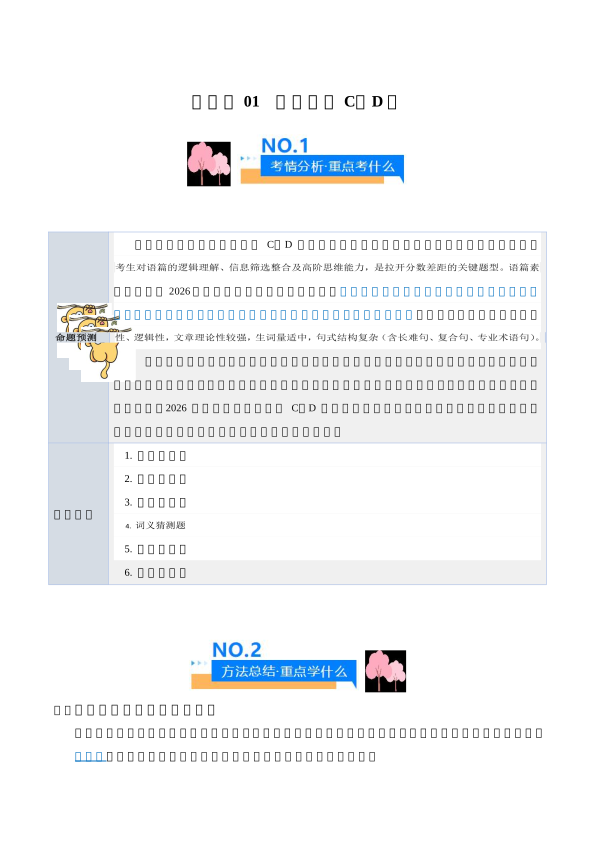
分析近几年高考英语阅读理解 C、D 篇可知,人工智能类说明文是高频压轴题材,选材贴合时代热点,语篇多来自英美科技媒体、科研报告、高校研究发布,主题聚焦 AI 技术原理、应用场景、伦理争议、社会影响、未来发展等。文章逻辑性强、长难句多、专业术语常见,侧重考查信息定位、逻辑推理、主旨概括等高阶能力。2026 年高考仍会将人工智能类作为 C、D 篇核心考查方向,命题更关注 AI 与教育、医疗、生活、科研、环保、版权等领域的结合,强调辩证思考与实际应用。
高频考法
推理判断题
标题归纳题
细节理解题
词义猜测题
主旨大意题
6. 观点态度题
这是一份2026年高考英语终极冲刺讲义练习(全国通用)压轴题01阅读理解CD篇(人工智能类)(原卷版+解析),文件包含2026年高考英语终极冲刺讲义练习全国通用压轴题01阅读理解CD篇人工智能类原卷版docx、2026年高考英语终极冲刺讲义练习全国通用压轴题01阅读理解CD篇人工智能类解析版docx等2份试卷配套教学资源,其中试卷共61页, 欢迎下载使用。
这是一份2026年高考英语终极冲刺讲义练习(全国通用)压轴题01阅读理解CD篇(人工智能类)(原卷版+解析),共52页。试卷主要包含了人工智能类说明文的解题技巧等内容,欢迎下载使用。
这是一份2026年高考英语终极冲刺讲义练习(全国通用)压轴题01阅读理解CD篇(科技创新发明类)(原卷版+解析),文件包含2026年高考英语终极冲刺讲义练习全国通用压轴题01阅读理解CD篇科技创新发明类原卷版docx、2026年高考英语终极冲刺讲义练习全国通用压轴题01阅读理解CD篇科技创新发明类解析版docx等2份试卷配套教学资源,其中试卷共58页, 欢迎下载使用。
注册成功
资料篮

在线客服
添加在线客服
获取1对1服务
官方微信
关注“教习网”公众号
打开微信就能找资料
赛课定制
添加在线客服
获取1对1定制服务
职称咨询
添加在线客服
获取1V1专业指导服务

免费福利

.png)