 免费领取教师福利




若您为此资料的原创作者,认为该资料内容侵犯了您的知识产权,请扫码添加我们的相关工作人员,我们尽可能的保护您的合法权益。


这是一份词汇16 语言学习的规律和方法 2026年高考英语二轮复习讲义(含答案),共12页。学案主要包含了语言变化及发展,语言文化等内容,欢迎下载使用。
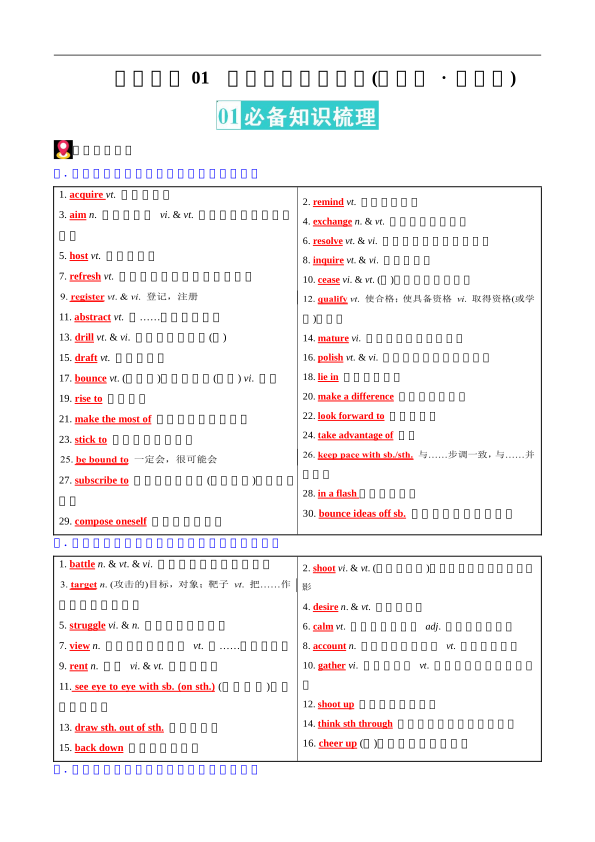
必识核心词汇
巩固提升
一. 词汇拓展
1. _______vi. 提到;参考;查阅 vt. 查询;叫…求助于→_______n. 指称关系;参考;涉及;提及;查阅→_______n. (某些体育运动的)裁判员;调解人
2. _______adj. 以(某事)为基础的;→_______vt. 以…为据点;以…为基础 n. 底部;根据→_______adj. 基本的;基础的→_______adv. 基本上, 根本上, 本质上
3. _______n. (植物、语言等的)变体;异体;多样化→_______adj. 各种不同的;各种各样的→_______vt. & vi. 使多样化;改变;变化→_______adj. 多变的;杂色的;各式各样的
4. _______adj. 全球的;全世界的→_______n. 球体;地球仪;地球
5. _______vt. 欣赏;感激;领会 vi. 增值→_______n. 欣赏;感谢;理解;明白
6. _______n. 同等的人;相等物 adj. 相同的;同样的→_______adv. 相同地;同样地→_______n. 平等→_______adj. 不平等的,不相等的
7. _______n. 要求;需求 vt. 强烈要求;需要 vi. 查问→_______adj. 要求高的;苛求的
8. _______n. 描写(文字);形容→_______vt. 描述;描写
9. _______vt. 联系;讲述→_______adj. 相关的;有联系的→_______n. 关系;联系→_______adj. 相对的;有关系的;n. 亲戚→_______adj. 无关的,不相干的
10. _______adj. 特定的;明确的;具体的→_______adv. 确切地;具体地;特别地→_______v. 确切说明;明确规定;详述
11. _______n. 态度,看法→_______adj. 态度上的
12. _______n. 系统;制度,体制→_______adj. 成体系的;系统的;有条理的→_______adv. 系统地;按照计划地
13. _______n. 符号,象征→_______vt. 象征;作为…的象征→________adj. 象征性的,使用象征的
14. _______adj. 主要的; 大的 n. 主修课程 vi. 主修→_______n. 多数
15. _______n. 文字;符号;角色;品质;特点→_______adj. 典型的;特有的;n. 特征;特性;特色
16. _______vt. 恳求;祈求;哀求→_______n. 乞丐
17. _______adj. 自信的→_______n. 自信,信任;把握→________adv. 自信地
18. _______vt. 同等重视;(使)保持平衡;权衡重要性 n. 均衡,平衡;平衡能力→_______adj. 平衡的,均衡的
19. _______vt. 吸引→_______adj. 吸引人的,有魅力的→_______n. 吸引;具有吸引力的人或事物
20._______vt.& vi. 赞成;批准,通过(计划、要求等)→_______n. 赞成;认可;批准→_______n. 不赞成;反对)
二. 用所给词的适当形式填空
1. The learned _______ expressed his nvel _______ abut this thery. (think)
2. All men are brn _______, s everyne hpes t be treated _______ because _______y is the basic demand. (equal)
3. It is an _______ inventin s that we are all _______ at it; t ur _______, it is a disabled man wh made the inventin. (amaze)
4. Henry gave her a _______ smile and his _______ made her face challenge bravely. (cnfident)
5. The Great Wall is a famus _______, whse scenery is very _______, and it _______ millins f turists at hme and abrad. (attract)
6. Althugh sme graduates find it _______ t find a suitable jb after graduatin, they are still willing t accept all the _______. (challenge)
7. Samuel, an American Jazz _______ succeeded in _______ at his cllege. The audience were impressed by his amazing _______. (perfrm)
8. The man waited utside _______. It seemed that he didn't knw _______ cmes frm nt being able t adapt himself in his wn existence. (anxius)
9. Sme trees are _______ in the river and the _______ is very beautiful. (reflect)
10. Jim _______ s well that the teacher praised his gd _______ in frnt f class. (behave)
11. Althugh he _______ many times, Henry didn't admit he was a _______. (fail)
12. After suffering heavy _______, Paul sat arund in his ffice, _______ in thught. (lse)
13. These new shes are nt very _______ thugh they are designed fr _______. (cmfrt)
14. As yu knw, fresh air is _______l t ur health and the new park _______ us all, s we shuld keep it clean. (benefit)
15. He had changed s much that yu culdn't _______ him. As a matter f fact, illness and age changed him beynd _______. (recgnize)
16. Thugh different frm the natural _______, these _______ girls are characterized fr their _______ clean faces, fair skin and delicate makeup. (beauty)
17. “In _______, the gvernment prvided an _______ five millin dllars t expand the service.” the fficial _______. (add)
18. Befre the new law cmes int _______, I hpe we can take sme _______ measures t prtect the animals. Then we shuld wrk _______ at nce. (effect)
19. After seeing the _______ film, the _______ by was t _______ t walk hme alne in the dark. (frighten)
20. Sue, wh had a strng _______, expressed her _______ pinin. _______ speaking, I agreed with what she said. (persn)
三. 一词多义
Lecture
1. What makes me annyed is that he is always lecturing me abut my behavir. ________
2. (应用文之演讲稿) I feel greatly hnred t deliver a lecture which is designed fr Senir Three students. ________
3. As a senir high schl student,I knw I must stp smking—dn’t give me a lecture abut it. ________
4. Mr Black lectures in Russian literature in this university. ________
narrw
5. The driver had a narrw escape when his car skidded n the icy rad. ________
6. As far as I'm cncerned, the manager has a narrw view f the wrld. ________
7. The shp sells nly a narrw range f gds. Let's g t anther ne. ________
8. Rural earnings have been rising steadily in China, and the wealth gap between rural and urban residents is narrwing. ________
fancy
9. That was the first time that we had eaten ut in a fancy restaurant. ________
10. “What n earth d yu fancy ding, anyway?”asked Lucy cldly. ________C
11. The necklace is packaged in a fancy plastic case with attractive graphics. ________
wave
12. Tim knew it wuld sn be swallwed by the waves. ________
13. Researchers at Bstn University, US, mnitred the brain waves f 13 healthy adults wh were sleeping. ________
14. The inspectr waved his arms t extend a warm greeting t Glenn's mther. ________
15. He cmpletes at least tw hurs f utdr activities daily and has raised a wave f discussin nline. ________
Update
16. The gvernment als updates the numbers f new cnfirmed cases, deaths and recveries in detail. ________
17. It was n a TV channel's news update that Mnica heard the newsflash. ________
18. I called the ffice t update them n the day's develpments. ________
四. 选词填空
1. The museum’s new exhibitin is ________ arund the Silk Rad, shwing ancient trade gds and maps.
2. Despite the heavy strm, the pilt ________ calm and safely landed the plane.
3. Scientists are trying t ________ whether the new drug can stp the virus frm spreading.
4. After the ceremny, the students ________ ut f the hall in perfect rder.
5. The ________ ecnmic situatin encurages mre yung peple t start their wn businesses.
6. Chest pains can be a warning ________ f heart prblems.
7. Because the final exam timetable has nt been annunced, students are still ________ abut when their first test will take place.
8. The tiny blue dt n the map is meant t ________ ur village, which is hme t 500 peple.
9. Recycling is widely seen as an envirnmentally friendly ________ t plastic pllutin.
10. Price is an imprtant ________ that affects mst families when chsing a hliday destinatin.
11. I didn’t think I culd ever ________ living in a big city after living in the cuntry.
12. N ne culd have freseen that things wuld ________ this way.
13. Chinese New Year ________ ther cuntry’s New Year.
14. The chances f a full recvery will ________ the severity f her injuries.
15. The writing prcess ________ fur stages, and each stage invlves certain activities.
16. Can I g back t what yu said ________ f the meeting?
17. At that time nne f us ________ the cnsequences.
18. The caves ________ early Viking times in abut 800 A. D.
19. If yu frgt t turn it ff when yu went away, yu might ________ the huse.
20. We are bund t see sme ________ alng the rad t recvery.
冲刺突破
Passage 1
阅读理解
【语言变化及发展】
(2025-2026学年湖南省湖南师范大学附属中学高三上学期月考)Linguistics hlds a basic premise(前提) at its heart; all languages are equal. Each f the wrld’s rughly 7,000 languages represents a unique way f seeing and understanding life, a natural experiment in human thught. Judgments f a language’s wrth stem nt frm its structure, but frm the pwer and status f its speakers. Yet this prfund diversity is cllapsing. Currently, abut half f all languages have 10,000 r fewer speakers. The median number f speakers per language n every cntinent is belw 1,000. These figures signal acute endangerment.
Languages are nt a dying natural death; they are being frced ut f existence. A few dzen killer languages,” like English and Spanish, expand thrugh plitical, ecnmic, and cultural cnquest, while centuries f imperialism, capitalism, and natin-building squeeze ut the rest. The ersin happens everywhere; in settler scieties like the US and Canada, half f the indigenus(原住民的) languages are already silent; in hmes glbally, families abandn mther tngues fr dminant languages, lsing nt just wrds but gestures and cultural knwledge.
Why des this lss matter? Each language hlds unique insights int human cmmunicatin — like the expressive clicks f Khisan languages r the bject-subject-verb rder f Wara. Mre crucially, languages. carry petry, ral histries, envirnmental wisdm, and lifeways. Research cnfirms that mther-tngue educatin and language maintenance are vital fr mental and physical well-being, especially fr marginalized (被边缘化的) cmmunities.
The rganized effrt t preserve languages is recent. Inspired by bidiversity and indigenus rights mvements, linguists and activists nw race t dcument languages, creating dictinaries and recrding ral histries. Hwever, linguists cannt “save” languages alne; that pwer lies with the cmmunities themselves. Revitalizatin is a challenging act f hpe, ften feeling like a “wnderful madness” — an attempt t revive a wrldview nearly lst. The fight fr linguistic diversity is ultimately a fight alngside its speakers, requiring real supprt frm the majrity wrld that seldm ntices this silent crisis.
1. What is the functin f the first paragraph?
A. T list glbal language statistics. B. T present a current language crisis.
C. T argue against language superirity. D. T cmpare varius language structures.
2. What des the term “killer languages” refer t in the text?
A. Thse n lnger spken by any cmmunity.
B. Thse passing n thrugh wrds and gestures.
C. Thse thriving at the expense f ther languages.
D. Thse simplifying cmplex sund and grammar rules.
3. Why des language lss matter accrding t paragraph 3?
A. It degrades petry and ral histries.
B. It threatens glbal envirnmental safety.
C. It damages well-being f all cmmunities.
D. It hurts the cntinuity f sme knwledge
4. What is essential fr language revival accrding t the last paragraph?
A. Adequate external fundingB. Sustained cmmunity endeavr.
C. Unshakable individual ptimism. D. Diverse technlgical advancement.
Passage 2
【语言文化】
(2025-2026学年河北省部分地区高三上学期1月英语试题)A lng-standing hypthesis in cgnitive science hlds that the language we speak influences ur perceptin f time and further shapes ur future-related decisins. Knwn as the Sapir-Whrf hypthesis, this idea has sparked decades f debate: sme researchers advcate a strng versin where language determines thught, while thers supprt a weaker ne arguing that language merely exerts an impact n it. Recent studies have shed new light n this issue by fcusing n hw linguistic differences in future reference affect intertempral chice.
In a 2012 study published in Science, psychlgist Keith Chen cmpared speakers f languages with a distinct grammatical future tense (such as English, which uses “will” r “shall”) and thse withut (like Mandarin, where the same verb frm ften applies t present and future events). Chen’s team analyzed data frm 76 cuntries, including savings rates, smking rates and retirement planning. They fund that speakers f “future-less” languages were 30% mre likely t save mney, 24% less likely t smke and 29% mre inclined t invest in their health than thse using languages with a grammatical future tense.
Critics have pinted ut cnfunding variables like cultural nrms and ecnmic cnditins that might explain such differences. T address this cncern, fllw-up experiments by Chen and his clleagues cntrlled fr these factrs. In ne lab experiment, participants were primed t view the future as either “distant” r “near”. Speakers f future-less languages shwed cnsistent future-riented behavir regardless f the priming, whereas thse using future-tense languages were significantly affected by it.
A 2018 study led by linguist Eve Danziger fcused n Amaznian indigenus cmmunities. The Pirahã language lacks wrds fr specific time perids, and Danziger fund that Pirahã speakers struggled t plan fr events mre than a few days ahead, yet excelled at immediate prblem-slving, indicating a trade-ff between present-fcused and future-fcused cgnitive abilities. These findings d nt prve that language is the sle determinant f future-thinking patterns, but rather reveal a cmplex interactin between language, culture and cgnitin.
5. What is the Sapir-Whrf hypthesis abut?
A. Language and human thught cnnectinB. Culture and daily behavir relatinship
C. Time and future planning crrelatinD. Regin and language change link
6. Hw is Mandarin different frm English in Chen’s study?
A. Uses cmplex tenses fr time expressinB. Has unique wrds fr future descriptins
C. Shares verb frms fr present and futureD. Relies n phrases fr present matters
7. Why did Chen’s team d fllw-up experiments?
A. T cllect mre cuntry data samplesB. T exclude ther influencing factrs
C. T change lab research methds usedD. T cnfirm the strng hypthesis fully
8. What is true abut Pirahã speakers?
A. Behave like Mandarin language usersB. Are gd at making lng-term plans
C. Have wrds fr marking time peridsD. Excel at slving instant prblems well
Passage 3
完形填空
(2025-2026学年广东省深圳市龙华区深圳市致理中学高三上学期10月月考英语试题)I never planned n learning Chinese. Even when I fund ut I was ging t Shanghai, I assumed that I wuld be able t 1 English. It didn’t take lng fr me t realize hw naive(天真的) I was. Chinese characters are ttally freign and 2 . I quickly gt sick f nt being able t understand anything, and I decided t 3 fr the Chinese class ffered by my university.
I had Chinese every weekday, after which I spent at least an hur 4 the lessn. In the evening, my friends and I quizzed each ther n the 5 we had t master. Mre imprtantly, I made a cnscius(有意识的) 6 t cmmunicate in Chinese in stres and restaurants. I was 7 when I was able t have a simple cnversatin with the lcals.
When I 8 achieved “A”s n my Chinese exams, I thught it was time t take a break frm studying fr Chinese every day and fcus n my ther classes. Unfrtunately, this turned ut t be a(n) 9 . Nt nly were the lessns themselves getting harder, but my study habits were 10 . I had n chice but t start frm the beginning in terms f cming up with and 11 new study habits.
With finals cming up, I have established my glden rule: there isn’t a(n) 12 way t learn a new language. Once yu cmmit and accept that yu are a 13 , it becmes an nging prcess f explratin, failure, reassessment, and trying again. Am I fluent nw? Nt even 14 . In fact, I may never be. But I learned hw t be hnest with myself and get thrugh 15 .
1. A. share withB. put up withC. deal withD. keep up with
2. A. inflexibleB. incmprehensibleC. unmemrableD. unacceptable
3. A. registerB. prvideC. accuntD. prepare
4. A. evaluatingB. adaptingC. presentingD. reviewing
5. A. structuresB. articlesC. charactersD. rules
6. A. effrtB. statementC. appintmentD. cmmitment
7. A. relaxedB. delightedC. shckedD. mved
8. A. exceptinallyB. bviuslyC. randmlyD. regularly
9. A. challengeB. accidentC. mistakeD. escape
10. A. wrseningB. emergingC. changingD. develping
11. A. kickingB. psingC. breakingD. explring
12. A. innvativeB. usefulC. availableD. perfect
13. A. fllwerB. beginnerC. supprterD. winner
14. A. clseB. readyC. sureD. right
15. A. misadventuresB. hesitatinsC. setbacksD. disasters
Passage 4
语法填空
(2025-2026学年浙江省绍兴市柯桥区高三上学期高考科目适应性考试英语试题)Cllins Dictinary recently named “vibe cding” its Wrd f the Year fr 2025. This term refers t a new way f sftware develpment — using artificial intelligence(AI) t turn natural language 1 cmputer cde. Simply put, yu just tell a machine what yu want, instead f writing cmplex cde yurself.
The term was cined by Andrej Karpathy, a renwned AI expert wh nce 2 (wrk) at Tesla and OpenAI. He described it as using AI t create apps withut thinking abut cde. Cllins chse it because it demnstrates 3 language evlves with technlgy. As AI plays an increasingly significant rle in daily life, vibe cding is making prgramming 4 (accessible) t nn-experts.
Many ther interesting terms made the shrtlist. “Clanker” is a British slang wrd fr rbts r AI, 5 (carry) a smewhat negative meaning. “Brligarchy” means a small grup f rich men with significant plitical influence. “HENRY” stands fr “high earner, nt rich yet”, describing peple wh earn well but haven’t accumulated 6 (cnsider) wealth.
7 (additin), there are als wrk-related wrds like “taskmasking” and “micr-retirement”. The frmer refers t pretending t be prductive at wrk, 8 the latter means taking a break between jbs t pursue persnal interests. Terms like “bihacking” and “clcatin” als made 9 list — “bihacking” is imprving health by altering bdy prcesses, and “clcatin” is a hliday in a cl place.
These wrds nt nly reflect a 10 (change) wrld but als shw hw ur language evlves with new trends. Vibe cding, in particular, exemplifies hw AI is transfrming ur interactin with technlgy.
Passage 5
读后续写
(2025-2026学年陕西省咸阳市礼泉县高三上学期11月期中)I had always thught language was just a subject in schl until I stepped int cllege. Grwing up in Klkata, I studied at a gvernment-aided secndary schl. Thugh English was part f the curriculum, it never felt imprtant. I culd pass exams with minimal effrt, s I never tk it seriusly.
That changed the mment I began my first term f engineering. All the lectures were in English. I sat in class, trying t grasp what the prfessrs were saying, but all my effrts were fruitless. I culdn’t fllw the lessns, ask questins, r jin in discussins. Outside the classrm, things were n better. My classmates quickly realized I struggled with English. Sme laughed at me, while thers simply ignred me. Slwly, I backed ff. I avided grup utings and kept t myself fr fear that I’d embarrass myself if I spke.
At the end f the term, I failed almst every subject. I stared at my schl reprt in silence. My chest felt heavy, but I knew I had tw chices— either giving up r fighting back. I chse the latter. I started small. I read English newspapers daily, carried an English dictinary in my backpack, and watched English vides with subtitles(字幕). Bit by bit, I imprved. By the secnd term,I culd finally understand lectures.
But speaking was still a challenge. N matter hw much I tried, I culdn’t express myself fluently. By my final year, I had gained knwledge in my field but still failed in every campus interview — always rejected in the cmmunicatin rund. My parents were disappinted. My brther thught I hadn’t wrked hard enugh. I was stuck in a sense f helplessness.
Then, ne day, my cusin visited. He asked what was wrng and listened patiently. “Yu’ve dne yur part,” he said. “Nw let smene help yu. ” He advised me t attend a spken English class. I was hesitant. What if peple fund ut? What if I failed again?
注意:1. 续写词数应为150个左右;
2. 请按如下格式在答题卡的相应位置作答。
Still, I signed up fr the class.
____________________________________________________________________________________________________________________________________________________________________________________________________________________________________________________________________________________________________________________________________________________________________________________________________________________________________________________________________________
A mnth later, I std befre an emplyer, nervus but prepared.
____________________________________________________________________________________________________________________________________________________________________________________________________________________________________________________________________________________________________________________________________________________________________________________________________________________________________________________________________________语言学习规律和方法的动词
1. absrb vt. 吸收;使全神贯
2. express v. 表达
3. imprve v. 提高
4. master vt. 精通,掌握
5. vercme v. 克服;解决
6. cncentrate n集中注意力于……
7. keep/bear. . . in mind记住……
8. practice n. & v. 练习
9. prnunce v. 发音
10. review v. 复习
11. retell v. 重讲,复述
12. acquire v. 获得
13. recite v. 背诵
14. lk up查阅
15. make prgress取得进步
16. set/take/write/nte dwn写下,记下
17. attach imprtance t重视
18. benefit frm从……获益
19. cnsult v. 咨询;请教
20. memrize v. 记忆
21. skim v. 浏览;略读
22. scan v. & n. 扫描;浏览
23. remark n. & v. 评述;谈论;评论
24. classify v. 分类;归类
25. enlarge vt. 使扩大
26. have a frg in ne’s thrat 说话困难
27. burn up 烧毁,烧尽
28. burn dwn 烧毁
29. reflect v. 显示,反映
语言学习规律和方法的名词
1. accent n. 口音;腔
2. cmmunicatin n. 交流,沟通
3. knwledge n. 知识,学问
4. grammar n. 语法
5. idim n. 成语
6. dialect n. 地方话;方言
7. pint f view 观点;看法
8. speech n. 演说;演讲
9. usage n. 使用;用法
10. vcabulary n. 词汇
11. saying n. 谚语
12. standard n. & adj. 标准(的)
13. dictatin n. 听写
14. errr n. 错误,谬误
15. resurce n. 资料,(教学)资源
16. summary n. 摘要;概要
17. glbalizatin n. 全球化
18. means n. 方式;方法;途径
19. seminar n. 研讨会
20. alphabet n. 字母表;字母
21. frum n. (因特网上的)论坛,讨论区
22. extinctin n. 灭绝;消失;消灭;废止
23. curse n. 科目;课程
24. semester n. 学期;半年
25. interpreter n. 解释者;口译者;注释器
26. symbl n. 符号;象征
27. means n. 方式;方法;途径
28. classic n. 经典作品;名著
29. regard n. 尊重;关注
30. character n. 文字;符号;角色;品质;特
31. calligraphy n. 书法;书法艺术
32. affair n. 公共事务;事件;关系
33. semester n. 学期
34. advance n. 前进;发展
35. aid n. 援助;帮助;救援物资
36. audience n. 观众;听众
37. behaviur n. 行为;举止
38. title n. 题目,标题
39. native language/tngue 母语
40. native speaker 生来就说某种语言的人
41. attitude f mind 心态;看法
语言学习规律和方法的形容词副词和其他
1. fluently adv. 流利地
2. infrmal adj. (书写或言谈)非正式的
3. symblic adj. 象征的;符号的;使用符号的
4. explicit adj. 清楚明白的;易于理解的
5. precise adj. 准确的;精确的;确切的
6. capitalized adj. 大写的
7. based adj. 以…为基础的;以……为重要部分的
8. verbal adj. 口头的;言语的;动词的;照字面的
9. ral adj. 口头的,口述的
10. majr adj. 主要的;重要的;大
11. classic adj. 传统的;最优秀的;典型的
12. glbal adj. 全球的;全世界的
13. wicked adj. 缺德的,邪恶的;很棒的,极好的
14. ppsing adj. (观点、意见等)相反的,相对立的
15. cnfusing adj. 令人困惑的
16. capitalized adj. 大写的
17. unique adj. 独一无二的,独特的
18. visible adj. 看得见的,可见的
19. creative adj. 创造(性)的
20. unfamiliar adj. 不熟悉的,不了解的
21. aware adj. 意识到的,明白的
22. specific adj. 特定的;明确的;具体的
23. dd adj. 奇特的,古怪的
24. negative adj. 消极的,负面
A. n. 讲座;演讲 B. n. 教训,训斥 C. vt. 指责,训斥 D. vi. 开讲座,讲课
A. v. 缩小 B. adj. 狭隘的 C. adj. 勉强的 D. adj. 范围小的
A. 花哨的 B. adj. 昂贵的,豪华的 C. vt. 想要
A. vt. 挥动 B. n. 波;波状运动 C. n. 汹涌的行动(或思想)D. n. 波浪
A. vt. 向……提供最新信息 B. vt. 更新 C. n. 最新消息
A. factr B. limited C. slutin D. current E. signal F. uncertain
G. maintained H. themed I. represent J. marched K. determine
burn dwn; be aware f; be made up f; be different frm; turn ut; ups and dwns;
date back t; at the beginning; depend n; get used t
这是一份词汇16 语言学习的规律和方法 2026年高考英语二轮复习讲义(含答案),共12页。学案主要包含了语言变化及发展,语言文化等内容,欢迎下载使用。
这是一份词汇20 工作职业和未来规划-2026年高考英语二轮复习讲义(含答案),共12页。学案主要包含了职业内容,社会问题和社会现象,1题详解,2题详解,3题详解,4题详解,5题详解,6题详解等内容,欢迎下载使用。
这是一份词汇18 教材核心句型-2026年高考英语二轮复习讲义(含答案),共12页。学案主要包含了中国文化等内容,欢迎下载使用。
注册成功
资料篮

在线客服
添加在线客服
获取1对1服务
官方微信
关注“教习网”公众号
打开微信就能找资料
赛课定制
添加在线客服
获取1对1定制服务
职称咨询
添加在线客服
获取1V1专业指导服务

免费福利


.png)

.png)
