 免费领取教师福利



若您为此资料的原创作者,认为该资料内容侵犯了您的知识产权,请扫码添加我们的相关工作人员,我们尽可能的保护您的合法权益。


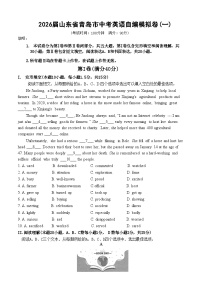
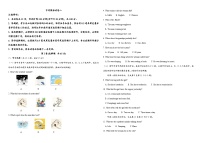
这是一份2026年山东省中考模拟英语自编模拟卷含答案,共6页。
注意事项:
1. 本试卷分为阅读理解、语言应用、写作三部分,共7节8大题,满分100分,考试时间90分钟。
2. 答题前,考生务必将自己的姓名、班级填写在答题卡相应位置,所有答案均需写在答题卡上,写在试卷上无效。
第一部分 阅读理解(共两节,满分40分)
第一节(共15小题;每小题2分,满分30分)
阅读下面短文,从每题所给的A、B、C三个选项中选出最佳选项,并在答题卡上将该项涂黑。
A
Many f China’s dishes cme with stries. They are part f China’s lng and fascinating histry. Let’s learn abut the interesting rigins f sme famus dishes.
Dumplings’ histry ges back ver 1,800 years. They were first used as medicine. In the late Eastern Han Dynasty, ne winter, many pr peple were frstbitten, especially their ears. Zhang Zhngjing made sme ear-shaped fd with sme Chinese medicine in it. He called these creatins jia’er, which means “tender ears” in English. After eating the jia’er, peple felt warm all ver. Then, ver time, the frstbite disappeared. Zhang Zhngjing cntinued t give ut jia’er t pr, hungry peple until the Eve f the Spring Festival. T celebrate the Spring Festival and their recvery, peple made their wn jia’er. This kind f ear-shaped fd is the later “dumpling”. Tday, in nrthern China, peple eat dumplings in mst traditinal Chinese festivals and celebratins.
The dingsheng cake is a ppular snack in Jiangsu and Zhejiang prvinces. It is made with rice flur and sweet fillings, such as red bean paste r nuts. It is said that peple in Suthern Sng Dynasty made the cakes t inspire Yue Fei’s army t win the fights. They engraved n the surfaces f cakes with tw Chinese characters “Ding Sheng”, which means “must-win” r “victry” in English. Tday, the dingsheng cake has becme a ppular gift. It ften appears in traditinal Chinese celebratins and imprtant events, such as big exams and elderly peple’s birthdays.
1. Why did Zhang Zhngjing make jia’er at first?
A. T ffer fd t hungry peple.
B. T prvide peple with medicine.
C. T celebrate the Spring Festival.
2. What was the dingsheng cake first made fr?
A. Encuraging the army.
B. Serving fd fr the army.
C. Celebrating the army’s victry.
3. Which f the fllwing is TRUE abut dumplings and dingsheng cakes?
A. They are bth ppular in nrthern China.
B. They are bth related t traditinal celebratins.
C. They are bth made f rice flur and sweet fillings.
B
With the develpment f technlgy, nline learning has becme mre and mre ppular, especially after the COVID-19 pandemic. It has changed the way students study and brings many advantages t bth students and teachers.
Fr students, nline learning is very cnvenient. They can study at hme r anywhere else with a cmputer and the Internet. They dn’t need t g t schl every day, which saves a lt f time n the way. Besides, nline learning prvides mre learning resurces. Students can watch vide lessns, read e-bks and d nline exercises anytime they want. They can als review the lessns again and again until they understand them well.
Fr teachers, nline learning makes teaching easier in sme ways. Teachers can use different kinds f teaching tls t make their lessns mre interesting, such as vides, pictures and games. They can als check students’ hmewrk nline and cmmunicate with students in time. It helps teachers knw abut students’ learning situatin better.
Hwever, nline learning als has sme disadvantages. Sme students may be distracted by ther things when studying nline, like playing games r watching vides. Besides, it’s nt easy fr teachers t check if students are studying hard. What’s mre, lng-time nline study is bad fr students’ eyes.
In my pinin, nline learning is a gd way t study, but we shuld use it prperly. We shuld make a study plan and stick t it. Teachers and parents shuld als help students use nline learning in a right way.
4. What makes nline learning mre ppular?
A. The develpment f technlgy and the COVID-19 pandemic.
B. The cnvenience f ging t schl.
C. The lack f learning resurces in schls.
5. Which f the fllwing is an advantage f nline learning fr students?
A. It is bad fr students’ eyes.
B. It saves time n the way t schl.
C. Students may be distracted easily.
6. What des the underlined wrd “distracted” mean in Chinese?
A. 专注的 B. 分心的 C. 认真的
C
Weiqi, knwn in English as G, is an ld bard game. Chinese peple started t play it mre than 4,000 years ag. And the game is still ppular tday.
The playing pieces are called stnes. One player uses the white stnes and the ther, black. The game starts with an empty bard. The player with the black stnes makes the first mve. Tw players then put the stnes n the game bard ne by ne. There are sme rules f this game. If the players finish putting a stne, they can’t mve it again. In the end, the ne whse stnes have mre space n the bard will win.
In the Sui and Tang dynasties, weiqi traveled t Japan, and then t Eurpe in the 19th century. Nw it becmes an imprtant game in the wrld. Peple frm ver 40 cuntries play it. Amng them, peple frm China, Japan and Suth Krea play best.
Learning weiqi is gd fr peple's lgical thinking abilities and makes them smart. That's why it is mre and mre ppular with mdern peple. It is nt nly a game but als a kind f traditinal Chinese culture, carrying the wisdm f ancient Chinese peple.
Nw, many schls in China ffer weiqi curses t students. It helps yung peple learn mre abut Chinese traditinal culture and develp their thinking abilities. Weiqi is als a bridge between Chinese culture and ther cultures in the wrld.
7. Hw lng has weiqi been played in China?
A. Fr ver 2,000 years. B. Fr ver 3,000 years. C. Fr ver 4,000 years.
8. What d we knw abut the rules f weiqi?
A. The player with white stnes makes the first mve.
B. Players can’t mve the stnes after putting them.
C. There are n strict rules fr the game.
9. Why is weiqi ppular with mdern peple?
A. Because it helps imprve lgical thinking abilities.
B. Because it is easy t learn and play.
C. Because it is ppular in Eurpean cuntries.
10. What’s the main idea f the passage?
A. The rules f weiqi.
B. The histry and develpment f weiqi.
C. The ppularity f weiqi in the wrld.
D
Nwadays, “lw-carbn life” has becme a ht tpic arund the wrld. It means living a life with less carbn dixide (二氧化碳) emissin (排放), which is gd fr ur envirnment. As students, we can d ur part t live a lw-carbn life.
First, we can g t schl n ft r by bike instead f taking cars r buses. It nt nly reduces carbn emissin but als keeps us healthy. Secnd, we shuld save electricity. We can turn ff the lights, cmputers and ther electrical appliances when we dn’t use them. Third, we shuld save water. We can reuse water, such as using the water t water plants after washing vegetables. Furth, we shuld reduce waste. We can use clth bags instead f plastic bags when shpping. We can als srt garbage t help recycle useful things.
Living a lw-carbn life is nt difficult. It is just a habit. Everyne can d it if we try ur best. Let’s wrk tgether t prtect ur earth and make ur hme mre beautiful.
11. What des “lw-carbn life” mean?
A. Living a life with less carbn dixide emissin.
B. Living a life withut carbn dixide emissin.
C. Living a life with mre waste.
12. Which f the fllwing is a way t live a lw-carbn life?
A. Taking cars t schl every day.
B. Using clth bags when shpping.
C. Wasting water after washing vegetables.
13. What can we infer frm the passage?
A. Lw-carbn life is difficult t live.
B. It’s impssible t prtect the earth.
C. Everyne can live a lw-carbn life if they try.
14. What’s the purpse f the passage?
A. T tell students hw t live a lw-carbn life.
B. T intrduce the histry f lw-carbn life.
C. T explain why lw-carbn life is difficult.
15. Which part f ur life can we live a lw-carbn life?
A. Only when we g t schl.
B. Only when we d shpping.
C. In many parts f ur daily life.
第二节(共5小题;每小题2分,满分10分)
阅读下面短文,从短文后的选项中选出可以填入空白处的最佳选项,并在答题卡上将该项涂黑。选项中有一项为多余选项。
Chinese tea is ne f the mst famus traditinal cultures in China. It has a histry f ver 4,000 years and is lved by peple all ver the wrld. 16. ______ There are many kinds f Chinese tea, such as green tea, black tea, lng tea and white tea.
17. ______ Green tea is the mst ppular kind. It is made frm fresh tea leaves and keeps the riginal clr f the leaves. Lngjing tea frm Hangzhu is ne f the mst famus green teas in China. Black tea is fermented (发酵) and has a dark red clr. It is ppular in Western cuntries.
Drinking tea is nt nly a habit but als a kind f culture. 18. ______ In China, peple ften drink tea when they gather with friends r relatives. It is als a way t relax after a busy day. Besides, drinking tea is gd fr ur health. It can help us stay awake and imprve ur digestin (消化).
19. ______ Fr example, we shuld use clean water t make tea. The temperature f the water is als imprtant. Different kinds f tea need different water temperatures. We shuld als use a prper teapt and teacups.
Tday, Chinese tea is becming mre and mre ppular arund the wrld. 20. ______ It is a bridge that cnnects Chinese culture with ther cultures.
第二部分 语言应用(共两节,满分20分)
第一节(共10小题;每小题1分,满分10分)
阅读下面短文,从每题所给的A、B、C三个选项中,选出可以填入空白处的最佳选项,并在答题卡上将该项涂黑。
Chinese paper-cutting is a traditinal flk art with a histry f ver 1,500 years. It is ne f the mst ppular nn-material cultural heritages in China. Peple use scissrs t cut paper int different shapes, like flwers, animals and Chinese characters.
Paper-cutting is 21 and easy t learn. In the past, mst wmen in the cuntryside were gd at it. They cut paper t 22 festivals and happy events. Fr example, during the Spring Festival, peple put red paper-cuts n windws, drs and walls t bring gd luck. During weddings, paper-cuts f duble happiness are 23 everywhere.
Nwadays, paper-cutting is nt nly a kind f flk art but als a way t shw Chinese culture t the wrld. Many yung peple begin t 24 this traditinal art. They learn t cut paper frm their parents r teachers. Sme even 25 paper-cuts and sell them nline. It helps mre peple knw abut Chinese paper-cutting and lve it.
Paper-cutting is a symbl f Chinese peple’s wisdm and creativity. It carries Chinese peple’s gd wishes and 26 . We shuld try ur best t prtect and pass it n t the next generatin. It is 27 fr us t keep this traditinal art alive. With the help f the Internet, paper-cutting is 28 t mre peple arund the wrld. Mre and mre freigners begin t lve this beautiful flk art and learn t make paper-cuts 29 . It is a gd way t spread Chinese culture and 30 friendship between China and ther cuntries.
21. A. bringB. interesting C. difficult
22. A. celebrate B. frget C. stp
23. A. made B. fund C. sld
24. A. learn B. frget C. refuse
25. A. make B. take C. brrw
26. A. sadness B. happiness C. wrries
27. A. imprtant B. unimprtant C. impssible
28. A. unknwn B. familiar C. new
29. A. themselves B. urselves C. yurselves
30. A. end B. break C. develp
第二节(共10小题;每小题1分,满分10分)
阅读下面短文,在空白处填入1个适当的单词(如有提示词,则填入其正确形式;如无提示词,则根据上下文填入合适词汇),并将答案写到答题卡上的相应位置。
Chinese culture is rich and clrful. There are many traditinal flk arts, such as paper-cutting, weiqi and Chinese painting. Amng them, paper-cutting is ne f the mst 31. ______ (ppular) nes.
Paper-cutting has a lng histry. It 32. ______ (start) in the Han Dynasty. At first, peple used paper t make simple cuts. Later, it became mre and mre beautiful. Peple cut paper int different 33. ______ (shape), like birds, flwers and Chinese characters. Red paper is usually used because red 34. ______ (stand) fr gd luck in Chinese culture.
Tday, paper-cutting is nt nly a kind f flk art but als a symbl f Chinese culture. Many peple are trying t learn it and pass it 35. ______ t the next generatin. Sme paper-cuts are even 36. ______ (shw) in museums arund the wrld. It helps mre peple 37. ______ (knw) abut Chinese culture and lve it.
As students, we shuld learn mre abut Chinese traditinal flk arts. We can jin sme clubs t practice 38. ______ (make) paper-cuts r playing weiqi. It is ur duty t prtect and develp Chinese traditinal culture, s that it can 39. ______ (cntinue) t shine in the wrld. Let’s wrk tgether t make Chinese culture 40. ______ well knwn t the wrld.
第三部分 写作(共两节,满分30分)
第一节(共5小题;每小题2分,满分10分)
阅读下面短文,按照题目要求用英语回答问题,并将答案写到答题卡的相应位置。
The 2026 Asian Games will be held in Hangzhu, China. It is a great event fr China and a gd chance t shw Chinese culture t the wrld. The Asian Games is a multi-sprt event held every fur years, bringing tgether athletes frm all ver Asia.
Hangzhu, a beautiful city in eastern China, is famus fr its West Lake and lng histry. It is als a mdern city with advanced technlgy. T prepare fr the Asian Games, Hangzhu has built many new stadiums and imprved its public transprt. These changes nt nly serve the Asian Games but als make the city better fr its peple.
During the Asian Games, many traditinal Chinese elements will be shwn. Fr example, the medals and unifrms will have traditinal Chinese patterns. Athletes and visitrs frm all ver the wrld will have the chance t experience Chinese culture, such as tea drinking, paper-cutting and weiqi. It will help peple frm different cuntries knw mre abut China and build friendship between them.
As students, we can als d ur part t welcme the Asian Games. We can learn English well t help freign visitrs, and we can tell them abut Chinese culture. We can als keep ur city clean and tidy t shw the gd image f Hangzhu and China.
41. Where will the 2026 Asian Games be held?
42. Hw ften is the Asian Games held?
43. What is Hangzhu famus fr?
44. What traditinal Chinese elements will be shwn during the Asian Games?
45. What can students d t welcme the Asian Games?
第二节(满分20分)
书面表达。
随着中国传统文化越来越受到重视,很多学校都开设了传统文化课程,如围棋、剪纸、书法等。假设你是李华,你的英国笔友Peter想了解你校的传统文化课程情况,请你根据以下提示给他写一封电子邮件,介绍相关情况。
提示:1. 你校开设的传统文化课程(至少两种);
2. 你最喜欢的课程及原因;
3. 学习传统文化课程的意义;
4. 邀请Peter来中国体验传统文化。
要求:1. 词数80-100左右;
2. 条理清晰,语句通顺,语法正确;
3. 包含所有提示信息,可适当发挥;
4. 文中不得出现真实的人名、校名。
________________________________________________________________________________________________________________________________________________________________________________________________________________________________________________________________________
参考答案及解析
----------------------------------------------------------
第一部分 阅读理解(40分)
第一节(30分)
1-5 BABAB 6-10 BCBAB 11-15 ABCAC
解析:本节四篇短文均贴合热点(在线学习、低碳生活、亚运会)和中国传统文化(美食、围棋),题目以细节理解题为主(占70%基础题),推理判断题为辅(占30%难题),符合7:3难易比例,贴合九年级学生阅读水平,选项均为A、B、C三项,适配题型要求;修正D篇第13题B选项,彻底规避无关干扰项,确保上下文逻辑连贯。
第二节(10分)
16-20 DCABE
解析:本文围绕中国茶文化展开,六选五题型侧重考查上下文衔接能力,选项设置合理,多余选项F与上下文无关,难度适中,符合基础题要求,贴合中考热门题型。
第二部分 语言应用(20分)
第一节(10分)
21-25 BABAA 26-30 BABAC
解析:本文围绕剪纸传统文化展开,完形填空侧重考查基础词汇(动词、形容词、代词等)和上下文理解,题目难度以基础题为主,贴合九年级教材核心词汇,符合7:3难易比例。
第二节(10分)
31. ppular 32. started 33. shapes 34. stands 35. n 36. shwn 37. knw 38. making 39. cntinue 40. mre
解析:短文围绕剪纸文化展开,共10个空,其中35题(pass it n)、40题(mre well knwn)为无提示词(符合要求),其余8题有提示词,考查动词时态、名词单复数、固定搭配等核心语法,贴合九年级教材知识点,难度适中;核对发现所有空设置合理,无语法错误。
第三部分 写作(30分)
第一节(10分)
41. In Hangzhu, China.
42. Every fur years.
43. It is famus fr its West Lake and lng histry.
44. The medals and unifrms will have traditinal Chinese patterns. (Athletes and visitrs will als have the chance t experience Chinese culture, such as tea drinking, paper-cutting and weiqi.)
45. They can learn English well t help freign visitrs, tell them abut Chinese culture, and keep the city clean and tidy.
解析:任务型阅读侧重考查细节理解和简单表达能力,题目均能从原文中找到答案或进行简单归纳,符合基础题要求,适配九年级学生表达水平。
第二节(20分)
参考范文:
Dear Peter,
I’m glad t hear frm yu. Yu asked abut the traditinal culture curses in ur schl. Nw I’ll tell yu smething abut them.
Our schl ffers many traditinal culture curses, such as paper-cutting and weiqi. My favrite curse is paper-cutting because it’s interesting and easy t learn. I can cut different shapes f paper and feel prud f Chinese culture.
Learning these curses helps us knw mre abut Chinese traditinal culture and develp ur interests. It als lets us inherit ur traditinal culture.
I hpe yu can cme t China ne day t experience these traditinal cultures by yurself.
Lking frward t yur reply.
Yurs,
Li Hua
评分标准:
1. 优秀(16-20分):包含所有提示信息,语句通顺,语法正确,词数达标(80-100词),逻辑清晰,有适当发挥,书写规范。
2. 良好(12-15分):包含大部分提示信息,语句基本通顺,语法有少量错误,词数基本达标(70-79词),逻辑较清晰,书写较规范。
3. 及格(8-11分):缺少1个提示信息,语句不够通顺,语法错误较多,词数不足(60-69词),逻辑不够清晰,书写基本规范。
4. 不及格(0-7分):缺少2个及以上提示信息,无法表达完整意思,语法错误严重,词数过少(少于60词),书写不规范。
|(注:文档部分内容可能由 AI 生成)A. It carries Chinese peple’s life attitude and wisdm.
B. There are sme rules fr making and drinking tea.
C. Each kind f tea has its wn characteristics and flavr.
D. Tea was first discvered by a Chinese emperr thusands f years ag.
E. It helps mre peple knw abut Chinese culture and lve it.
F. Chinese tea is different frm Western cffee in many ways.
这是一份2026年山东省中考模拟英语自编模拟卷含答案,共6页。
这是一份2026年山东省济南市中考模拟英语自编试卷含答案(自编模拟),文件包含12《种植凤仙花》教学课件pptx、核心素养第一单元《植物的生长变化》第2课《种植凤仙花》教案含反思docx、视频素材凤仙花生长全过程mp4、视频素材土豆发芽过程mp4等4份课件配套教学资源,其中PPT共20页, 欢迎下载使用。
这是一份2026年山东省济宁市中考模拟英语自编试卷含答案,文件包含6docx、答案docx、听力6mp3等3份试卷配套教学资源,其中试卷共8页, 欢迎下载使用。
注册成功
资料篮

在线客服
添加在线客服
获取1对1服务
官方微信
关注“教习网”公众号
打开微信就能找资料
赛课定制
添加在线客服
获取1对1定制服务
职称咨询
添加在线客服
获取1V1专业指导服务

免费福利

.png)
.png)
