免费领取教师福利

若您为此资料的原创作者,认为该资料内容侵犯了您的知识产权,请扫码添加我们的相关工作人员,我们尽可能的保护您的合法权益。


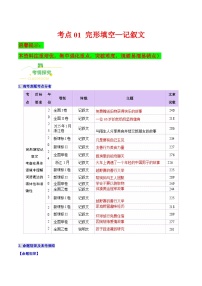
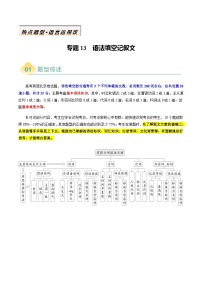
这是一份高考英语二轮讲义-完形填空之记叙文(方法技巧篇)(全国通用)(原卷板),共60页。试卷主要包含了记叙文完形基础认知,通用解题步骤,细分题型专项突破,特殊场景解题技巧,综合语篇训练等内容,欢迎下载使用。
第一部分 核心解题方法(具体操作步骤)
1.记叙文完形基础认知(定义、体裁特点与高考考频)
2.通用解题步骤(适配高考语篇的标准化流程)
3.细分题型专项突破(情感线索类 / 动作链类 / 人物心理类 / 语境推理类等)
4.特殊场景解题技巧(熟词僻义 / 文化背景 / 逻辑连接 / 情感色彩等高频考点)
第二部分 方法技巧应用(例题讲解 + 详细解析)
1.情感线索类例题(20 道例题)(考点:情感词汇复现 / 语境情感推理)
2.动作链类例题(20 道例题)(考点:动作逻辑连贯 / 动词短语搭配)
3.人物心理类例题(20 道例题)(考点:心理活动推断 / 形容词辨析)
4.语境推理类例题(20 道例题)(考点:上下文呼应 / 逻辑关系判断)
5.综合语篇训练(20 篇典型试题 + 解题复盘)
第三部分 易错总结(高频陷阱 + 规避方法)
1.词义辨析类易错点(偷换概念 / 形近词混淆 / 固定搭配错误等)
2.逻辑连贯类易错点(因果颠倒 / 转折误用 / 递进逻辑断裂等)
3.情感把握类易错点(情感色彩偏差 / 态度判断失误 / 语气误解等)
4.文化背景类易错点(中西文化差异 / 习俗误解 / 场景适配错误等)
第四部分 记叙文完形高频考点速记手册
1.高频动词短语速记(核心搭配清单)
2.情感词汇分类速记(正向 / 负向 / 中性词汇表)
3.逻辑连接词速记(转折 / 因果 / 并列 / 递进信号词)
4.文化常识速记(高考常考西方文化场景)
记叙文完形填空是高考英语的核心题型,其语篇以叙事为骨架,融合情感表达、逻辑推进与文化背景,每年占高考完形填空的 60% 以上。多数学生在解题时易陷入 “逐空翻译” 的误区,忽视语篇的情感线索与动作逻辑,导致对语境推理类、情感把握类题目频频失分。本专题聚焦记叙文完形的命题规律,从 “认知 — 方法 — 应用 — 避坑” 四维度搭建完整备考体系:核心解题方法板块拆解标准化流程,让你从 “凭感觉选” 转向 “按步骤推”;方法技巧应用板块通过 80 道细分题型例题 + 20 篇综合训练,落实每道题的考点与分步解析;易错总结板块直击高频陷阱,搭配典型例句强化规避意识;速记手册则提炼高频考点,助力考前快速复盘。无论你是基础薄弱的 “完形困难户”,还是追求满分的 “冲分选手”,本专题都能帮你建立系统的解题思维,在记叙文完形中实现从 “被动蒙题” 到 “主动破局” 的跨越。
(1)定义与体裁特点
记叙文完形是高考英语完形填空中以 “叙事为主、情感为辅” 的题型,核心是通过完整的故事线传递主题思想,其本质是 “情节推进 + 情感表达 + 逻辑衔接” 的有机结合。
六大核心要素细化:
人物(wh):多为 “普通人 + 特殊经历”(如学生、店员、志愿者),侧重人物的成长变化或品质体现;
时间(when):常以 “过去时” 为主(一般过去时、过去进行时),少数用倒叙(过去完成时),时间词多为具体场景词(如 ne mrning, after schl, at that mment);
地点(where):贴近生活场景(校园、家庭、社区、公共场所),地点变化往往推动情节(如从家到医院→暗示人物生病 / 探病);
起因(why):多为 “意外事件、矛盾冲突、善意举动”(如丢失物品、误解他人、陌生人相助);
经过(hw):核心情节,包含 “动作链、对话、心理活动”,是完形填空空格的主要集中区域;
结果(what):多为 “积极正向”(如矛盾化解、自我成长、传递温暖),少数为 “引人深思” 的中性结局。
叙事结构特征:
顺叙:最常见(占 80%),按 “起因→经过→结果” 顺序推进(例:起床晚→赶公交→遇好心人→按时到校);
倒叙:首段交代结果,再回溯过程(例:“I will never frget the day I met her. It was a rainy afternn when...”);
插叙:插入过往回忆或背景信息(常用信号词:remember, nce, as a child),需注意时态切换。
语言风格特点:
细节描写密集:动作描写(如 she held the baby gently)、神态描写(his eyes widened in surprise)、环境描写(the rm was quiet except fr the ticking clck);
对话占比适中:对话多体现人物性格或推动情节(如 “Can I help yu?” he asked plitely→暗示人物友善);
情感词汇含蓄:较少直接用 “very happy”,多通过场景暗示(如 she danced arund the rm→开心)。
(2)高考考频与命题趋势
近 5 年考频数据:
全国甲卷 / 乙卷:记叙文完形占比 65%-70%,每年必考 “个人成长” 或 “亲情友情” 主题;
新高考 I 卷 / II 卷:占比 58%-63%,新增 “跨文化交流”“社会热点相关叙事”(如环保行动、志愿者服务);
地方卷(如浙江、江苏):占比 60%-68%,侧重 “心理描写 + 逻辑推理” 类题目。
高频考点分布(按占比排序):
动词 / 动词短语搭配(35%):如 pick up, turn dwn, set ut 等;
情感 / 心理类形容词(20%):如 anxius, relieved, determined 等;
逻辑连接词(15%):如 but, s, hwever, therefre 等;
上下文呼应类名词(10%):如 chance, decisin, help 等;
介词 / 代词(10%):如 by, with, it, that 等;
熟词僻义 / 文化相关词汇(10%):如 cmpany(陪伴), tip(小费)等。
命题趋势:
语篇变长(从 250 词增至 300-350 词),情节更复杂(多含 1-2 个转折);
减少 “纯语法考查”(如时态、主谓一致),增加 “语境逻辑考查”;
情感线索更隐蔽,需结合 “动作 + 环境” 综合推断。
步骤 1:通读全文,把握叙事主线(30 秒 - 40 秒)
核心目标:不纠结空格,快速搭建 “故事框架”,明确 “人物关系 + 核心事件 + 情感基调”。
具体操作:
标记关键信息:
人物:圈出主角(如 Tm, a yung teacher)、次要人物(如 his mther, a stranger)及关系;
时间 / 地点:用横线标出(如 n a cld winter night, in the park);
逻辑信号词:用波浪线标出转折(but/hwever)、因果(s/because)、递进(besides/furthermre);
情感暗示词:用三角标出(如 tears, smile, sighed, ndded)。
跳过空格的技巧:
遇到长难句,抓 “主谓宾” 核心(如 Althugh she had been waiting fr an hur, she didn’t feel →核心:等待一小时 + 不觉得);
遇到不认识的词,根据词性判断功能(如名词可能是事件 / 物品,形容词可能是情感 / 特征),不影响主线理解。
典型示例:
原文片段:“Last Sunday, Lily went t the supermarket t buy sme vegetables. When she was abut t pay, she fund her wallet was gne. She felt ____ and lked arund nervusly. Just then, a shp assistant came ver and said, ‘Dn’t wrry. I saw a by pick it up and he’s waiting fr yu at the service desk.’ Lily was s ____ that she thanked the assistant repeatedly.”
通读后提炼:Lily 超市购物→丢钱包→紧张→店员告知钱包被捡→感激;情感基调:从负面(紧张)到正向(感激)。
步骤 2:抓线索,定位空处逻辑(50 秒 - 1 分钟 / 空)
核心目标:为每个空格找到 “唯一解题依据”,拒绝 “凭感觉”。
四大线索维度(每个维度配典型示例):
情感线索维度:
操作:找前后文 “情感词 / 场景词”,判断空处情感色彩(正向 / 负向 / 中性);
示例:
原文:“After waiting fr his friend fr tw hurs in the rain, Mike felt ____. When his friend finally arrived with an aplgy, he became even mre ____.”
线索:“waiting tw hurs in the rain”(负面场景)→第一空负向;“even mre”(递进)→第二空负向且程度更深;
可选词汇:第一空(upset/anxius/disappinted),第二空(angry/annyed)。
动作逻辑维度:
操作:梳理 “动作先后顺序”,判断空处动作的 “目的 / 结果 / 承接关系”;
示例:
原文:“Jack ____ his backpack, pened the dr, and rushed t the bus stp. He wanted t ____ the early bus t visit his grandparents.”
线索:动作链 “背包→开门→冲去车站”→第一空动作是 “拿起 / 背上”;“去车站” 的目的是 “赶公交”;
可选词汇:第一空(picked up/put n),第二空(catch/take)。
上下文呼应维度:
操作:找 “原词复现 / 同义复现 / 反义复现”,空处词汇与呼应词逻辑一致;
示例:
原文:“The ld man was knwn fr his kindness. Every time smene needed help, he wuld ffer his ____ withut hesitatin. His ____ made him ppular in the neighbrhd.”
线索:第一空与 “kindness”(善意)同义复现;第二空是 “kindness” 的原词复现;
可选词汇:第一空(help/supprt),第二空(kindness)。
固定搭配维度:
操作:根据空格前后词性,匹配 “动词 + 介词”“形容词 + 介词”“名词 + 介词” 等固定搭配;
示例:
原文:“She is always prud ____ her sn’s achievements. He ften aplgizes ____ his mistakes and tries t crrect them.”
线索:“prud” 后固定接 “f”;“aplgize” 后固定接 “fr”;
答案:f; fr。
步骤 3:逐空突破,排除干扰选项(30 秒 / 空)
示例:原文 “His dg passed away. He felt ____ and cried.”
核心目标:用 “线索 + 逻辑” 排除错误选项,锁定唯一答案。
排除技巧(配示例解析):
先排 “情感矛盾” 选项:
选项:A. happy B. sad C. excited D. relaxed
排除:“狗去世” 是负面事件,A/C/D 均为正向 / 中性情感,直接排除,选 B。
再排 “逻辑断裂” 选项:
示例:原文 “He studied hard every day, s he ____ the exam easily.”
选项:A. failed B. passed C. missed D. avided
排除:“努力学习” 与 “轻松通过考试” 是因果逻辑,A/C/D 均与 “努力” 逻辑断裂,选 B。
最后排 “搭配错误” 选项:
示例:原文 “She insisted ____ ging t the party alne.”
选项:A. in B. n C. at D. with
排除:“insist” 固定搭配 “n”,A/C/D 均为搭配错误,选 B。
干扰选项特征总结:
形近词干扰(如 adapt/adpt,affect/effect);
词义相近但情感不符(如 surprised/pleased,wrried/angry);
搭配看似合理但语境不符(如 take the exam/make the exam,前者 “参加考试”,后者无此搭配)。
步骤 4:验证复查,确保语篇连贯(1-2 分钟)
核心目标:避免 “局部正确但整体连贯” 的错误,修正细节偏差。
复查重点:
情感连贯性:通读全文,检查情感变化是否自然(如从 “wrried” 到 “relieved” 是否有合理触发点);
动作顺畅性:确认动作链是否符合生活逻辑(如 “起床→刷牙→吃饭→上学”,无颠倒或不合理动作);
逻辑自洽性:检查连接词与前后句逻辑是否匹配(如 “but” 后是否为转折内容,“because” 后是否为原因);
语法正确性:确认时态、主谓一致、代词指代是否正确(如全文过去时,是否有单句用现在时;代词 “it” 是否指代前文单数名词)。
复查示例:
原文(已填答案):“Last mnth, I met a hmeless man n the street. He lked hungry, s I bught him a meal. He thanked me warmly. Later, I fund he was a talented musician. Althugh he had a hard life, he never gave up his dream. I was deeply mved by his spirit.”
复查:
情感:“同情(买饭)→惊讶(发现是音乐家)→感动(敬佩不放弃)”,变化自然;
动作:“遇见→买饭→发现→感动”,逻辑顺畅;
逻辑:“s”(因果)、“althugh”(转折),连接词使用正确;
语法:全文过去时,主谓一致,代词指代清晰,无错误。
(1)情感线索类
题型深度解析:
空格位置:多位于 “事件发生后”(如 After the accident, she felt ____)或 “转折词后”(如 But he was ____ instead f angry);
考查重点:情感色彩判断(正向 / 负向)、情感程度区分(如 wrried/anxius/desperate,程度递增)、情感反转(转折词触发)。
解题技巧(配典型例题 + 解析):
技巧 1:标记 “情感触发点”(事件 / 场景 / 对话)
技巧 2:利用 “转折词” 判断情感反转
技巧 3:区分 “情感形容词” 与 “状态形容词”
例题:原文 “When she received the birthday gift frm her best friend, she felt ____ and hugged her tightly.”
选项:A. upset B. grateful C. lnely D. bred
解析:
第一步:定位触发点 ——“收到好友生日礼物”(正向事件);
第二步:分析选项情感色彩 ——A(负向)、B(正向)、C(负向)、D(负向);
第三步:锁定正向选项 B,代入验证 “感激并拥抱”,逻辑连贯。
例题:原文 “Everyne thught he wuld be angry abut the mistake, but he was ____ and said, ‘It’s nt a big deal.’”
选项:A. calm B. mad C. sad D. nervus
解析:
第一步:定位转折词 “but”,前句 “预期愤怒”,后句需情感反转;
第二步:分析选项 ——B(愤怒,与前句一致,无反转)、A(冷静,反转)、C(悲伤,无关)、D(紧张,无关);
第三步:代入验证 “但他很冷静,说‘没关系’”,符合转折逻辑,选 A。
例题:原文 “After waiting fr the result fr a week, she was ____ t knw she had been admitted t the university.”
选项:A. excited B. tired C. hungry D. sleepy
解析:
第一步:明确空格需 “情感形容词”(与 “被大学录取” 相关);
第二步:分析选项 ——A(兴奋,情感词)、B(疲惫,状态词)、C(饥饿,状态词)、D(困倦,状态词);
第三步:锁定 A,代入验证 “兴奋得知录取”,符合语境。
典型例题拓展(10 道,按考点分类):
正向情感触发(事件):
原文:“He helped the ld lady crss the rad, and she gave him a smile that made him feel ____.”
选项:A. prud B. upset C. cnfused D. afraid(答案:A)
负向情感触发(场景):
原文:“The lights went ut suddenly in the middle f the night, and she felt ____ in the dark.”
选项:A. brave B. scared C. happy D. relaxed(答案:B)
情感递进(even/mre):
原文:“She was disappinted when she didn’t get the jb, and even mre ____ when she fund her cmpetitr lied.”
选项:A. angry B. calm C. pleased D. tired(答案:A)
情感反转(yet):
原文:“The task was difficult, yet he was ____ that he culd finish it n time.”
选项:A. dubtful B. cnfident C. sad D. wrried(答案:B)
情感与场景匹配:
原文:“At the graduatin party, all the students felt ____ and didn’t want t say gdbye.”
选项:A. excited B. sad C. angry D. hungry(答案:B)
(2)动作链类
题型深度解析:
空格位置:多为谓语动词或动词短语,位于 “事件发展过程中”(如 He ____ the dr and walked in);
考查重点:动作逻辑顺序、动词短语搭配、动作目的 / 结果、动作与场景适配。
解题技巧(配典型例题 + 解析):
技巧 1:梳理 “动作时间线”,判断承接关系
技巧 2:根据 “动作目的” 锁定答案
技巧 3:积累 “场景化动词短语”
例题:原文 “First, she ____ the ingredients, then she mixed them, and finally she baked the cake.”
选项:A. ate B. bught C. served D. shared
解析:
第一步:梳理时间线 “准备食材→混合→烘焙蛋糕”,第一空动作应在 “混合” 之前;
第二步:分析选项 ——A(吃,后于烘焙)、B(买,先于混合)、C(端上,后于烘焙)、D(分享,后于烘焙);
第三步:锁定 B,代入验证 “先买食材→混合→烘焙”,动作顺序合理。
例题:原文 “He ran as fast as he culd t ____ the train befre it left the statin.”
选项:A. catch B. miss C. stp D. watch
解析:
第一步:定位动作目的 “在火车离开前”,“跑” 的目的是 “赶上火车”;
第二步:分析选项 ——A(赶上,符合目的)、B(错过,相反)、C(阻止,无依据)、D(观看,无目的关联);
第三步:代入验证 “快跑赶上火车”,逻辑通顺,选 A。
例题:原文 “After the meeting, they ____ a plan t slve the prblem.”
选项:A. came up with B. lked frward t C. paid attentin t D. gt alng with
解析:
第一步:明确场景 “会议后→解决问题”,动作与 “计划” 相关;
第二步:分析短语含义 ——A(提出)、B(期待)、C(关注)、D(相处);
第三步:“提出计划” 符合场景,选 A。
典型例题拓展(10 道,按考点分类):
动作顺序(先→后):
原文:“He ____ his shes, put n his cat, and went ut.”
选项:A. tk ff B. put n C. tk away D. put dwn(答案:B)
动作目的(t d):
原文:“She stayed up late t ____ fr the exam.”
选项:A. prepare B. play C. sleep D. ck(答案:A)
动词短语搭配(与名词):
原文:“The teacher ____ the students’ hmewrk carefully.”
选项:A. lked thrugh B. turned ff C. set up D. gave away(答案:A)
动作与场景适配(厨房):
原文:“She ____ the vegetables and cut them int small pieces.”
选项:A. washed B. wrte C. read D. drew(答案:A)
动作因果关系:
原文:“He fell ff his bike and ____ his knee.”
选项:A. hurt B. helped C. hugged D. healed(答案:A)
(3)人物心理类
题型深度解析:
空格位置:多为形容词、名词或动词(如 He felt ____; He had a sense f ____; He ____ whether he was right);
考查重点:心理活动与事件的匹配、心理变化的触发、心理形容词的辨析(如 dubtful/suspicius,regretful/srry)。
解题技巧(配典型例题 + 解析):
技巧 1:结合 “事件性质” 判断心理
技巧 2:找 “心理变化触发点”(对话 / 细节)
技巧 3:辨析 “近义心理形容词” 差异
例题:原文 “When he realized he had lied t his parents, he felt a deep sense f ____.”
选项:A. pride B. regret C. jy D. excitement
解析:
第一步:定位事件 “对父母撒谎”(负面事件),心理应是 “负面 / 愧疚”;
第二步:分析选项 ——A(骄傲,正向)、B(后悔,负向)、C(快乐,正向)、D(兴奋,正向);
第三步:锁定 B,代入验证 “撒谎后深感后悔”,符合心理逻辑。
例题:原文 “At first, she was ____ abut speaking in public. But after her friend encuraged her, she became ____.”
选项:A. cnfident; nervus B. nervus; cnfident C. happy; sad D. sad; happy
解析:
第一步:定位触发点 “朋友鼓励”,心理应从 “负面” 转为 “正向”;
第二步:分析选项 ——A(正向→负向,反转错误)、B(负向→正向,正确)、C(正向→负向,无关)、D(负向→正向,无 “公开演讲” 场景关联);
第三步:代入验证 “起初紧张→鼓励后自信”,符合触发点逻辑,选 B。
例题:原文 “She was ____ that n ne wuld cme t her birthday party.”
选项:A. dubtful B. angry C. prud D. certain
解析:
第一步:明确心理 “怀疑没人来”,需区分 “dubtful” 与 “certain”(前者 “怀疑”,后者 “确定”);
第二步:分析选项 ——A(怀疑的,符合)、B(愤怒的,无关)、C(骄傲的,无关)、D(确定的,相反);
第三步:锁定 A,代入验证 “怀疑没人来”,符合语境。
典型例题拓展(10 道,按考点分类):
负面事件→愧疚心理:
原文:“He frgt his best friend’s birthday and felt ____.”
选项:A. srry B. happy C. excited D. relaxed(答案:A)
正向事件→期待心理:
原文:“She was ____ abut the cming hliday and planned everything carefully.”
选项:A. wrried B. excited C. sad D. angry(答案:B)
不确定事件→怀疑心理:
原文:“He was ____ whether the plan wuld wrk.”
选项:A. sure B. dubtful C. certain D. cnfident(答案:B)
困难事件→坚定心理:
原文:“Althugh the task was hard, she was ____ t succeed.”
选项:A. determined B. afraid C. lazy D. tired(答案:A)
意外事件→惊讶心理:
原文:“When she saw her ld classmate at the airprt, she was ____ and culdn’t believe her eyes.”
选项:A. surprised B. sad C. angry D. hungry(答案:A)
(4)语境推理类
题型深度解析:
空格位置:无固定区域,多为名词、介词、副词或连词;
考查重点:隐藏线索挖掘、文化常识应用、逻辑关系推导、场景合理推断。
解题技巧(配典型例题 + 解析):
技巧 1:挖掘 “隐藏场景线索”
技巧 2:利用 “逻辑连接词” 推导
技巧 3:结合 “文化常识” 推断
例题:原文 “The ____ rang, and she rushed t answer it. She said, ‘Hell, this is Mary speaking.’”
选项:A. drbell B. phne C. clck D. radi
解析:
第一步:找隐藏线索 ——“Hell, this is Mary speaking”(打电话常用语);
第二步:分析选项 ——A(门铃,回应应是 “开门”)、B(电话,符合对话)、C(时钟,无回应对话)、D(收音机,无回应对话);
第三步:锁定 B,代入验证 “电话响→接电话→问候”,场景合理。
例题:原文 “He didn’t study hard, ____ he failed the exam.”
选项:A. s B. but C. and D. r
解析:
第一步:定位逻辑连接词,前句 “不努力” 是原因,后句 “考试失败” 是结果;
第二步:分析选项 ——A(所以,因果)、B(但是,转折)、C(并且,并列)、D(或者,选择);
第三步:锁定 A,因果逻辑成立。
例题:原文 “On ____, peple in western cuntries give gifts t their family and friends.”
选项:A. Spring Festival B. Christmas C. Mid-Autumn Festival D. Dragn Bat Festival
解析:
第一步:明确文化常识 —— 西方节日中 “送礼物” 的是圣诞节;
第二步:分析选项 ——A(春节,中国)、B(圣诞节,西方)、C(中秋节,中国)、D(端午节,中国);
第三步:锁定 B,符合文化场景。
典型例题拓展(10 道,按考点分类):
隐藏线索(饮食场景):
原文:“She rdered a bwl f ndles and a ____ f sup.”
选项:A. cup B. bwl C. bttle D. piece(答案:B)
逻辑关系(转折):
原文:“The weather was bad, ____ we still went hiking.”
选项:A. but B. s C. because D. and(答案:A)
文化常识(西方社交):
原文:“When peple meet fr the first time in western cuntries, they usually ____ hands.”
选项:A. shake B. hug C. kiss D. wave(答案:A)
场景推断(医院):
原文:“The dctr asked her t lie dwn and ____ her temperature.”
选项:A. take B. make C. d D. give(答案:A)
逻辑关系(递进):
原文:“He is gd at English, ____ he can speak French fluently.”
选项:A. besides B. but C. s D. r(答案:A)
4. 特殊场景解题技巧
(1)熟词僻义
高频考法解析:
考查本质:熟悉词汇的 “非主流词义”,需结合语境判断,而非常规含义;
高考高频熟词僻义清单(配典型例句):
cmpany(常规:公司→僻义:陪伴)
例句:She kept me cmpany during the lng wait.(她在漫长的等待中陪着我。)
cver(常规:覆盖→僻义:报道;走完)
例句 1:The newspaper cvered the event in detail.(报纸详细报道了这件事。)
例句 2:We cvered 10 kilmeters in an hur.(我们一小时走了 10 公里。)
charge(常规:充电→僻义:负责;收费)
例句 1:He is in charge f the prject.(他负责这个项目。)
例句 2:The htel charges 200 yuan per night.(这家酒店每晚收费 200 元。)
drive(常规:驾驶→僻义:驱使;动力)
例句 1:His dream drve him t wrk hard.(他的梦想驱使他努力工作。)
例句 2:She has a strng drive t succeed.(她有强烈的成功欲望。)
plant(常规:植物→僻义:种植;工厂)
例句 1:They planted trees in the park last weekend.(他们上周末在公园种树。)
例句 2:He wrks in a car plant.(他在一家汽车厂工作。)
解题策略:
当常规词义代入语境不通时,立刻考虑 “熟词僻义”;
根据词性推导词义(如 “cver” 作动词时,除 “覆盖”,还可表 “报道”“走完”;作名词时表 “封面”);
积累 “高考熟词僻义专属笔记”,按 “词汇 + 常规义 + 僻义 + 例句” 整理,反复记忆。
(2)文化背景
高频考法解析:
考查范围:西方节日、社交礼仪、生活习惯、校园场景、饮食文化等,不考查生僻文化;
高考高频文化场景(配典型例句 + 解题要点):
西方节日:
例句:On Thanksgiving Day, families in America usually have turkey fr dinner.(感恩节那天,美国家庭通常吃火鸡当晚餐。)
解题要点:记住节日时间(Thanksgiving:11 月第四个周四;Christmas:12 月 25 日;Hallween:10 月 31 日)和核心习俗。
社交礼仪:
例句:It’s plite t say “excuse me” when yu want t pass smene in a crwd.(在人群中想从别人身边走过时,说 “打扰一下” 是礼貌的。)
解题要点:西方礼仪核心 “尊重隐私、礼貌用语、排队秩序”,如 “tip”(小费)在餐厅、出租车场景的使用(通常 10%-15%)。
校园场景:
例句:The teacher asked the students t hand in their essays next Mnday.(老师要求学生下周一交论文。)
解题要点:熟悉西方校园词汇(semester:学期;presentatin:课堂展示;essay:论文;exam:考试)。
饮食文化:
例句:She rdered a cffee with milk and a piece f cake.(她点了一杯加奶咖啡和一块蛋糕。)
解题要点:西方常见饮食搭配(cffee with milk:加奶咖啡;sandwich:三明治;pizza:披萨),区分 “主食(main curse)” 和 “甜点(dessert)”。
解题策略:
遇到 “文化相关场景”(如节日、饮食、社交),先调动已知文化常识;
若不确定,结合语境推导(如 “人们送礼物、装饰圣诞树”→圣诞节);
整理 “高考常考文化场景清单”,每个场景配 2-3 个例句,避免生僻文化知识。
(3)逻辑连接词
高频考法解析:
考查类型:转折、因果、并列、递进、让步、条件等,重点考查 “连接词与逻辑的匹配”;
高考高频逻辑连接词分类(配典型例句):
转折关系(前后语义相反):but, hwever, yet, thugh, althugh, while
例句:He is yung, but he is very experienced.(他很年轻,但经验丰富。)
因果关系(前因后果 / 前果后因):because, since, as, s, thus, therefre, as a result
例句:It rained heavily, s we had t cancel the picnic.(雨下得很大,所以我们不得不取消野餐。)
并列关系(前后语义相近 / 平行):and, r, als, as well as, ,
例句:She can speak bth English and French.(她既会说英语也会说法语。)
递进关系(前后语义递进):besides, furthermre, what’s mre, in additin
例句:He is gd at sprts. Besides, he is excellent in study.(他擅长运动,而且学习也很好。)
让步关系(先退一步,再强调重点):thugh, althugh, even if, even thugh
例句:Althugh it was late, he cntinued wrking.(虽然很晚了,他还是继续工作。)
条件关系(满足条件才发生):if, unless, as lng as
例句:Yu will pass the exam if yu study hard.(如果你努力学习,就会通过考试。)
解题策略:
先分析空格前后句的逻辑关系(是转折、因果还是并列);
排除 “逻辑不匹配” 的连接词(如前后是转折,排除 because/s);
注意 “不能连用” 的连接词(如 thugh 与 but,althugh 与 yet,because 与 s);
遇到 “平行结构”(如 ),确保前后成分词性一致。
(4)情感色彩
高频考法解析:
考查类型:通过形容词、副词、动词、名词判断情感色彩(正向 / 负向 / 中性),匹配语境;
情感色彩词汇分类(配典型例句):
正向情感词汇:
形容词:happy, excited, grateful, prud, cnfident, kind, warm-hearted
副词:happily, excitedly, thankfully
动词:help, supprt, encurage, praise
名词:jy, success, friendship, kindness
例句:She felt grateful fr the stranger’s help.(她感激陌生人的帮助。)
负向情感词汇:
形容词:sad, upset, angry, anxius, disappinted, wrried, cruel
副词:sadly, angrily, anxiusly
动词:hurt, criticize, cmplain, blame
名词:failure, truble, danger, sadness
例句:He was disappinted when he didn’t get the jb.(他没得到那份工作,感到很失望。)
中性情感词汇:
形容词:calm, quiet, careful, rdinary, cmmn
副词:quietly, carefully, usually
动词:d, make, g, take
名词:time, place, persn, thing
例句:She remained calm even in the face f danger.(即使面对危险,她也保持冷静。)
解题策略:
标记语篇中 “情感信号词”(如 smile→正向,tears→负向),确定整体情感基调;
空格词汇的情感色彩需与 “事件性质” 匹配(正向事件→正向词汇,负向事件→负向词汇);
注意 “情感色彩反转”(转折词后情感可能变化),如 but 前是负向,后可能是正向。
例题 1(考点:语境情感推理)
原文:When her favrite team wn the champinship, she jumped up and dwn, feeling ____ frm head t te.
选项:A. angry B. delighted C. tired D. wrried
例题 2(考点:情感词汇复现)
原文:The little girl felt lnely after her best friend mved away. Every evening, she sat by the windw, hping fr a ____ feeling that nly her friend culd bring.
选项:A. familiar B. strange C. painful D. bring
例题 3(考点:语境情感推理)
原文:After searching fr her lst cat fr three days withut any news, Lucy felt increasingly ____ and almst gave up hpe.
选项:A. hpeful B. cnfused C. desperate D. calm
例题 4(考点:情感词汇复现)
原文:His kindness t strangers was well-knwn in the cmmunity. When peple thanked him, he always replied with a ____ smile that shwed his true jy.
选项:A. cld B. warm C. frced D. shy
例题 5(考点:语境情感推理)
原文:The teacher praised Tm fr his prgress in math. He walked back t his seat with a ____ expressin, prud f his hard wrk.
选项:A. sad B. prud C. angry D. nervus
例题 6(考点:情感词汇复现)
原文:She was disappinted when she missed the cncert. T her surprise, her sister gt her a ticket fr the next shw, and her ____ quickly turned int excitement.
选项:A. disappintment B. anger C. fear D. bredm
例题 7(考点:语境情感推理)
原文:As the strm gt wrse, the hikers felt ____, nt knwing if they culd reach the campsite befre dark.
选项:A. relaxed B. anxius C. excited D. satisfied
例题 8(考点:情感词汇复现)
原文:The ld man lived alne fr years, feeling lnely mst f the time. When his grandchildren came t visit, his lneliness was replaced by ____.
选项:A. sadness B. lneliness C. happiness D. fear
例题 9(考点:语境情感推理)
原文:When she fund ut her article was published in the magazine, she was s ____ that she called her parents immediately t share the gd news.
选项:A. upset B. shcked C. verjyed D. cnfused
例题 10(考点:情感词汇复现)
原文:He felt guilty fr frgetting his mther’s birthday. T make up fr it, he prepared a big dinner and a gift, hping t ease his ____.
选项:A. guilt B. anger C. hunger D. tiredness
例题 11(考点:语境情感推理)
原文:The children waited anxiusly fr the magician’s perfrmance. When he pulled a rabbit ut f the hat, they lked ____ with wide eyes.
选项:A. bred B. surprised C. angry D. sleepy
例题 12(考点:情感词汇复现)
原文:Her best friend betrayed her trust, leaving her heartbrken. Even mnths later, she still culdn’t get ver the ____ f being lied t.
选项:A. jy B. pain C. excitement D. relief
例题 13(考点:语境情感推理)
原文:After practicing the pian fr mnths, she finally played the sng perfectly. Her teacher ndded with a ____ lk, satisfied with her effrt.
选项:A. disappinted B. prud C. cnfused D. nervus
例题 14(考点:情感词汇复现)
原文:The team faced many difficulties during the prject, but their determinatin never faded. In the end, their ____ paid ff with a great success.
选项:A. laziness B. determinatin C. weakness D. carelessness
例题 15(考点:语境情感推理)
原文:As she walked thrugh the dark frest, every rustle made her feel ____, s she quickened her pace t get ut as sn as pssible.
选项:A. brave B. calm C. frightened D. excited
例题 16(考点:情感词汇复现)
原文:He was verjyed when he received the schlarship. The ____ f achieving his gal after years f hard wrk was beynd wrds.
选项:A. sadness B. jy C. anger D. fear
例题 17(考点:语境情感推理)
原文:The cuple spent their 50th wedding anniversary with their children and grandchildren. Lking arund the table, they felt ____ and grateful fr the happy family.
选项:A. lnely B. regretful C. blessed D. wrried
例题 18(考点:情感词汇复现)
原文:She was nervus abut giving a speech in frnt f the whle schl. Her teacher’s encuraging wrds helped reduce her ____ and gave her cnfidence.
选项:A. nervusness B. happiness C. anger D. excitement
例题 19(考点:语境情感推理)
原文:When the rescue team fund the lst hiker, he was cld and hungry but ____ t see familiar faces.
选项:A. sad B. relieved C. angry D. bred
例题 20(考点:情感词汇复现)
原文:The student felt ashamed f cheating in the exam. After cnfessing t the teacher, she felt a sense f ____, n lnger hiding her mistake.
选项:A. shame B. relief C. anger D. sadness
例题 1(考点:动作逻辑连贯)
原文:He ____ his alarm clck, jumped ut f bed, and rushed t the bathrm t wash his face.
选项:A. turned ff B. turned n C. lked at D. threw away
例题 2(考点:动词短语搭配)
原文:The chef ____ the vegetables int small pieces and then stir-fried them with garlic.
选项:A. cut up B. ate up C. washed up D. burned up
例题 3(考点:动作逻辑连贯)
原文:They ____ their tents befre sunset, built a fire, and prepared dinner fr the night camp.
选项:A. tk dwn B. set up C. lked fr D. gave away
例题 4(考点:动词短语搭配)
原文:After finishing his hmewrk, he ____ his bks and put them back n the shelf neatly.
选项:A. picked up B. threw away C. gave ut D. turned ff
例题 5(考点:动作逻辑连贯)
原文:The driver ____ the car slwly when he saw a child crssing the rad, then stpped t let the child pass.
选项:A. speeded up B. slwed dwn C. turned arund D. brke dwn
第四步:代入验证 ——“司机看到孩子过马路时减速,然后停车让孩子通过”,动作逻辑合理。
例题 6(考点:动词短语搭配)
原文:She ____ a letter t her pen pal, explaining her recent life and asking abut his studies.
选项:A. wrte dwn B. wrte ut C. wrte up D. wrte t
例题 7(考点:动作逻辑连贯)
原文:The student ____ his bag fr the textbk, but culdn’t find it—he had left it at hme.
选项:A. searched B. cleaned C. decrated D. repaired
例题 8(考点:动词短语搭配)
原文:The team ____ a plan t slve the prblem, discussing every detail carefully with all members.
选项:A. came up with B. lked frward t C. paid attentin t D. gt alng with
例题 9(考点:动作逻辑连贯)
原文:She ____ the drbell, waited fr a mment, and when n ne answered, she kncked ludly.
选项:A. pulled B. pushed C. rang D. kicked
例题 10(考点:动词短语搭配)
原文:He ____ his cat and hat befre ging ut, as the weather was cld and windy.
选项:A. put n B. tk ff C. hung up D. gave away
例题 11(考点:动作逻辑连贯)
原文:The gardener ____ the flwers every mrning, watered them carefully, and remved any dead leaves.
选项:A. picked B. planted C. examined D. ignred
例题 12(考点:动词短语搭配)
原文:They ____ the bus at the central statin and walked t the museum nearby.
选项:A. gt n B. gt ff C. gt in D. gt ut
例题 13(考点:动作逻辑连贯)
原文:The writer ____ ntes while reading the bk, s he culd remember imprtant ideas fr his essay.
选项:A. tk B. burned C. sld D. lst
例题 14(考点:动词短语搭配)
原文:She ____ the phne and answered it, saying “Hell, this is Lisa speaking.”
选项:A. picked up B. put dwn C. turned ff D. lked fr
例题 15(考点:动作逻辑连贯)
原文:The baker ____ the dugh fr ten minutes, then shaped it int laves and put them in the ven.
选项:A. ate B. kneaded C. burned D. served
例题 16(考点:动词短语搭配)
原文:He ____ his mistake and aplgized t his friend, prmising nt t d it again.
选项:A. pinted ut B. fund ut C. admitted t D. made up fr
例题 17(考点:动作逻辑连贯)
原文:The turists ____ phts f the beautiful scenery, talked abut the view, and tk vides t share with their families.
选项:A. tk B. drew C. painted D. bught
例题 18(考点:动词短语搭配)
原文:She ____ the music and danced t the rhythm, enjying the party with her friends.
选项:A. turned n B. turned ff C. turned up D. turned dwn
例题 19(考点:动作逻辑连贯)
原文:The dctr ____ the patient’s temperature, checked his pulse, and asked abut his symptms.
选项:A. tk B. gave C. made D. did
例题 20(考点:动词短语搭配)
原文:They ____ the meeting early because all the tpics had been discussed thrughly.
选项:A. ended up B. put ff C. called ff D. wrapped up
例题 1(考点:心理活动推断)
原文:When he saw the unexpected test paper n his desk, he felt ____, as he hadn’t studied fr it at all.
选项:A. cnfident B. anxius C. excited D. satisfied
例题 2(考点:形容词辨析)
原文:She was ____ between staying at hme t read and ging ut t meet her friends—she culdn’t decide which t chse.
选项:A. cnfused B. determined C. certain D. relaxed
例题 3(考点:心理活动推断)
原文:After helping the ld man carry his heavy bags hme, the by felt ____, knwing he had dne smething gd.
选项:A. guilty B. prud C. angry D. tired
例题 4(考点:形容词辨析)
原文:He was ____ f flying, s he always chse t travel by train even if it tk lnger.
选项:A. afraid B. fnd C. prud D. tired
例题 5(考点:心理活动推断)
原文:When she fund ut her friend had lied t her, she felt ____, as she had trusted him cmpletely.
选项:A. betrayed B. excited C. relieved D. relaxed
例题 6(考点:形容词辨析)
原文:The student was ____ that he wuld pass the exam, as he had practiced all the exercises and reviewed all the ntes.
选项:A. dubtful B. cnfident C. wrried D. cnfused
例题 7(考点:心理活动推断)
原文:As the deadline fr the prject apprached, the team felt ____, as they still had a lt f wrk t finish.
选项:A. relaxed B. pressured C. happy D. prud
例题 8(考点:形容词辨析)
原文:She was ____ abut the new jb, wndering if she culd fit in with her clleagues and d well in her wrk.
选项:A. curius B. anxius C. excited D. certain
例题 9(考点:心理活动推断)
原文:When he received the invitatin t the imprtant meeting, he felt ____, as it was a chance t shw his abilities.
选项:A. hnred B. angry C. bred D. tired
例题 10(考点:形容词辨析)
原文:He was ____ f his sister’s success, ften saying bad things abut her instead f cngratulating her.
选项:A. prud B. jealus C. happy D. supprtive
例题 11(考点:心理活动推断)
原文:After making a mistake in frnt f the whle class, the girl felt ____ and didn’t want t speak fr the rest f the lessn.
选项:A. ashamed B. prud C. excited D. relaxed
例题 12(考点:形容词辨析)
原文:The scientist was ____ that his experiment wuld succeed, even thugh many peple dubted him.
选项:A. dubtful B. uncertain C. determined D. cnfused
例题 13(考点:心理活动推断)
原文:When she heard the news that her brther had wn the cmpetitin, she felt ____ and rushed t tell her parents.
选项:A. sad B. disappinted C. verjyed D. wrried
例题 14(考点:形容词辨析)
原文:She was ____ abut trying new fds, always rdering the same dish whenever she went t a restaurant.
选项:A. adventurus B. cautius C. excited D. prud
例题 15(考点:心理活动推断)
原文:As he waited fr the interview result, he felt ____, checking his phne every five minutes fr a call.
选项:A. calm B. patient C. nervus D. satisfied
例题 16(考点:形容词辨析)
原文:He was ____ f his past mistakes, wrking hard every day t make up fr them and becme a better persn.
选项:A. prud B. ashamed C. happy D. tired
例题 17(考点:心理活动推断)
原文:When she finally finished writing her nvel after three years f hard wrk, she felt a sense f ____ that she had achieved her dream.
选项:A. lss B. failure C. fulfillment D. cnfusin
例题 18(考点:形容词辨析)
原文:The child was ____ f the dark, refusing t sleep in her bedrm withut the light n.
选项:A. afraid B. fnd C. prud D. tired
例题 19(考点:心理活动推断)
原文:After his team lst the imprtant game, he felt ____, but he tld his teammates they wuld try harder next time.
选项:A. delighted B. devastated C. excited D. relaxed
例题 20(考点:形容词辨析)
原文:She was ____ abut her upcming perfrmance, as she had practiced hundreds f times and knew the lines by heart.
选项:A. nervus B. cnfident C. dubtful D. cnfused
例题 1(考点:上下文呼应)
原文:Tm frgt his umbrella this mrning. When it started t rain heavily at nn, he had t ____ a stranger’s umbrella t get back hme.
选项:A. brrw B. lend C. buy D. sell
例题 2(考点:逻辑关系判断)
原文:The mvie was ____ interesting ____ educatinal, s bth children and adults enjyed it a lt.
选项:A. neither; nr B. either; r C. nt nly; but als D. between; and
例题 3(考点:上下文呼应)
原文:Lisa has a talent fr music. She started playing the pian at 5, and nw she can ____ play the vilin and the guitar beautifully.
选项:A. nly B. als C. never D. hardly
例题 4(考点:逻辑关系判断)
原文:He didn’t study hard fr the exam, ____ he failed t pass it.
选项:A. s B. but C. r D. and
例题 5(考点:上下文呼应)
原文:The library is a quiet place fr reading. Everyne there speaks in a lw vice ____ disturbing thers.
选项:A. in rder t B. s as nt t C. because f D. instead f
例题 6(考点:逻辑关系判断)
原文:____ the task was difficult, all the team members wrked tgether and finished it n time.
选项:A. Because B. Althugh C. Since D. If
例题 7(考点:上下文呼应)
原文:My mther is a gd ck. She can make many delicius dishes, such as braised prk, fried chicken, and ____ her famus fish sup.
选项:A. especially B. hardly C. nearly D. suddenly
例题 8(考点:逻辑关系判断)
原文:Yu can ____ stay at hme t watch TV ____ g ut fr a walk—bth chices are fine with me.
选项:A. nt nly; but als B. either; r C. neither; nr D. bth; and
例题 9(考点:上下文呼应)
原文:The little by lst his way in the park. He lked arund ____, hping t see a familiar face.
选项:A. happily B. carelessly C. anxiusly D. angrily
例题 10(考点:逻辑关系判断)
原文:She will g t the party ____ she finishes her hmewrk n time.
选项:A. if B. unless C. because D. thugh
例题 11(考点:上下文呼应)
原文:Winter is the cldest seasn f the year. Peple usually wear thick clthes and ____ warm scarves t keep themselves frm freezing.
选项:A. take ff B. put n C. take away D. put away
例题 12(考点:逻辑关系判断)
原文:He is ____ tall ____ he can reach the tp shelf withut standing n a chair.
选项:A. s; that B. such; that C. t; t D. enugh; t
例题 13(考点:上下文呼应)
原文:The schl held a charity sale last week. All the mney raised was used t ____ bks and statinery fr pr children in rural areas.
选项:A. brrw B. buy C. sell D. return
例题 14(考点:逻辑关系判断)
原文:I didn’t g t the cinema yesterday, ____ I had already watched the mvie nline.
选项:A. s B. because C. but D. r
例题 15(考点:上下文呼应)
原文:Dgs are knwn fr their lyalty. They will ____ their wners even in dangerus situatins.
选项:A. abandn B. prtect C. frget D. ignre
例题 16(考点:逻辑关系判断)
原文:____ yu practice speaking English every day, yu wn’t make much prgress.
选项:A. Unless B. If C. Because D. Thugh
例题 17(考点:上下文呼应)
原文:The meeting will start at 9 ’clck sharp. Please arrive ____ s that we can begin n time.
选项:A. lately B. late C. early D. slwly
例题 18(考点:逻辑关系判断)
原文:She is interested in painting, ____ her brther prefers playing sprts.
选项:A. while B. s C. because D. and
例题 19(考点:上下文呼应)
原文:The ld bridge was damaged in the strm. The gvernment decided t ____ it with a new and strnger ne.
选项:A. destry B. build C. replace D. repair
例题 20(考点:逻辑关系判断)
原文:He has lived in this city fr 20 years, ____ he knws every street and crner very well.
选项:A. but B. s C. r D. thugh
语篇 1(综合考点:情感线索 + 动作链 + 语境推理)
原文:
Last Saturday, Lily planned t visit her grandmther wh lived in the cuntryside. She ____ (1) early in the mrning, packed sme fresh fruits, and ____ (2) the bus t the village. When she arrived, her grandmther was ____ (3) t see her and hugged her tightly. They talked abut Lily’s schl life and grandma’s garden. In the afternn, they ____ (4) vegetables in the garden tgether. Lily had never dne such wrk befre, s she felt a little ____ (5) at first, but sn enjyed it. As the sun set, they went back hme and ____ (6) a delicius dinner with the vegetables they picked. That night, Lily felt ____ (7) because she spent a meaningful day with her grandmther. She realized that simple mments with family are the mst precius.
选项:
(1) A. gt up B. went t bed C. fell asleep D. stayed up
(2) A. drve B. tk C. rde D. flew
(3) A. sad B. angry C. delighted D. wrried
(4) A. bught B. sld C. picked D. planted
(5) A. cnfident B. nervus C. prud D. relaxed
(6) A. ate B. burned C. wasted D. threw
(7) A. lnely B. regretful C. happy D. tired
语篇 2(综合考点:动作逻辑 + 心理活动 + 逻辑关系)
原文:
Tm was a shy by wh was afraid f speaking in public. One day, his teacher ____ (1) him t give a speech in frnt f the class. Tm felt ____ (2) and wanted t refuse, but his teacher encuraged him, “Believe in yurself—yu can d it!” With his teacher’s supprt, Tm decided t ____ (3) the challenge. He spent three nights ____ (4) his speech and practicing in frnt f the mirrr. On the day f the speech, his hands were shaking at first, but when he saw his teacher’s ____ (5) smile, he calmed dwn. He spke clearly and cnfidently, and the class ____ (6) ludly when he finished. Tm felt a strng sense f ____ (7) —he had vercme his shyness! Frm then n, he became mre active and n lnger feared public speaking.
选项:
(1) A. allwed B. invited C. frced D. rdered
(2) A. excited B. prud C. nervus D. relaxed
(3) A. avid B. accept C. frget D. ignre
(4) A. writing B. destrying C. selling D. lsing
(5) A. cld B. warm C. frced D. strange
(6) A. cried B. shuted C. laughed D. clapped
(7) A. failure B. shame C. achievement D. cnfusin
语篇 3(综合考点:上下文呼应 + 情感转换 + 动词搭配)
原文:
It was a rainy Sunday afternn. Mary had planned t g t the park with her friends, but the heavy rain ____ (1) her plan. She felt ____ (2) and sat by the windw, watching the rain. Just then, her mther came ver and said, “Why nt bake ckies tgether? It will be fun!” Mary’s md ____ (3) immediately. She ____ (4) her mther t prepare the flur, sugar, and butter. They mixed the ingredients, shaped the dugh int small balls, and ____ (5) them in the ven. While waiting fr the ckies t bake, they talked and laughed. When the delicius smell filled the kitchen, Mary felt ____ (6). The ckies tasted great, and she shared them with her family. Althugh Mary culdn’t g t the park, she had a wnderful afternn. She learned that even when plans g wrng, yu can still find jy in unexpected things.
选项:
(1) A. supprted B. ruined C. imprved D. fllwed
(2) A. happy B. excited C. disappinted D. relaxed
(3) A. changed B. wrsened C. disappeared D. remained
(4) A. helped B. stpped C. refused D. taught
(5) A. tk B. put C. threw D. hid
(6) A. sad B. angry C. prud D. hungry
语篇 4(综合考点:逻辑关系 + 动作连贯 + 心理推断)
原文:
Jake lved hiking in the muntains. One weekend, he set ut alne fr a lng hike. He walked fr hurs and enjyed the beautiful scenery. Hwever, when he wanted t return, he fund he had ____ (1) his way. The sky was getting dark, and Jake felt ____ (2). He tried t remember the path, but everything lked the same. Just as he was abut t give up, he saw a small cabin in the distance. He ____ (3) twards it and kncked n the dr. An ld man pened the dr and let him in. The ld man gave him warm tea and fd, and ____ (4) him hw t find the way back. Jake felt ____ (5) fr the ld man’s help. The next mrning, Jake fllwed the ld man’s directins and safely returned hme. He realized that it’s imprtant t stay calm when facing difficulties, and that kindness frm strangers can make a big difference.
选项:
(1) A. fund B. lst C. made D. knew
(2) A. calm B. prud C. frightened D. excited
(3) A. ran B. drve C. flew D. swam
(4) A. asked B. tld C. learned D. frgt
(5) A. grateful B. angry C. guilty D. lnely
语篇 5(综合考点:情感复现 + 语境推理 + 形容词辨析)
原文:
Emma was a talented artist wh lved painting animals. One day, she visited an animal shelter and was deeply ____ (1) by the pr cnditins f the dgs and cats. They had n warm beds, and sme were sick. Emma felt ____ (2) and wanted t d smething t help. She decided t hld a painting exhibitin and dnate all the mney t the shelter. Fr the next mnth, she painted day and night, creating beautiful pictures f animals. On the day f the exhibitin, many peple came and bught her paintings. Emma was ____ (3) by their kindness. In the end, she raised a lt f mney. When she gave the mney t the shelter, the wrkers were ____ (4). With the mney, they bught new beds, fd, and medicine fr the animals. Emma felt a great sense f ____ (5) —she had used her talent t make a difference in the animals’ lives.
选项:
(1) A. amused B. shcked C. bred D. relaxed
(2) A. happy B. prud C. sad D. excited
(3) A. disappinted B. cnfused C. tuched D. angry
(4) A. grateful B. nervus C. ashamed D. wrried
(5) A. failure B. satisfactin C. sadness D. dubt
语篇 6(综合考点:动作链 + 逻辑关系 + 上下文呼应)
原文:
Last summer, my family and I went n a trip t the beach. We wke up early in the mrning and ____ (1) ur car. After a three-hur drive, we arrived at the beach. The sun was shining, and the sea was blue. We ____ (2) ur twels n the sand and went swimming in the sea. The water was cl and refreshing. After swimming, we ____ (3) lunch under a big tree. My mm had prepared sandwiches, fruit, and juice. In the afternn, my dad taught me hw t surf. I fell dwn many times at first, ____ (4) I didn’t give up. With my dad’s help, I finally std up n the surfbard. I felt s ____ (5)! As the sun went dwn, we watched the beautiful sunset. It was a perfect day, and we all felt happy and relaxed. We tk many phts t remember this wnderful trip.
选项:
(1) A. gt int B. gt ut f C. lked at D. washed
(2) A. threw B. laid C. tk D. hid
(3) A. bught B. sld C. ate D. cked
(4) A. and B. but C. s D. r
(5) A. sad B. angry C. prud D. tired
语篇 7(综合考点:心理活动 + 情感线索 + 动词短语)
原文:
Liam was a student wh struggled with math. He always felt ____ (1) when taking math tests, as he ften made mistakes. His math teacher nticed his difficulty and ____ (2) t help him. Every afternn after schl, the teacher spent 30 minutes teaching Liam extra math prblems. Liam ____ (3) the teacher’s help and studied hard. He practiced slving prblems every night and asked the teacher questins whenever he was cnfused. After a mnth f hard wrk, Liam tk a math test. He felt ____ (4) during the test because he knew hw t slve mst f the prblems. When the results came ut, Liam passed the test with a gd scre. He was ____ (5) and ran t tell his teacher the gd news. The teacher smiled and said, “I knew yu culd d it with hard wrk!”
选项:
(1) A. cnfident B. nervus C. happy D. relaxed
(2) A. refused B. frgt C. decided D. stpped
(3) A. appreciated B. ignred C. hated D. wasted
(4) A. sad B. angry C. calm D. wrried
(5) A. disappinted B. verjyed C. guilty D. cnfused
语篇 8(综合考点:语境推理 + 逻辑关系 + 形容词辨析)
原文:
The twn f Greenfield had a small library that was lved by everyne. Hwever, the library was ld and ____ (1) f bks. Many residents wanted a new library with mre bks and better facilities. The twn decided t hld a fundraiser t cllect mney fr the new library. Peple in the twn ____ (2) actively—sme dnated mney, sme rganized events, and thers vlunteered their time. After six mnths f hard wrk, they raised enugh mney. The cnstructin f the new library began sn. When it was finished, the new library was bright, spacius, and filled with thusands f bks. Children culd read in the kids’ area, and adults culd use the cmputers. The residents were ____ (3) with the new library. They visited it every week, and it became a ppular place fr the cmmunity. ____ (4) everyne wrked tgether, they made their dream f a new library cme true.
选项:
(1) A. full B. shrt C. prud D. afraid
(2) A. participated B. refused C. ignred D. slept
(3) A. disappinted B. angry C. satisfied D. wrried
(4) A. Because B. Althugh C. Unless D. If
语篇 9(综合考点:动作逻辑 + 情感转换 + 上下文呼应)
原文:
Sphia lved dancing, but she had an accident and hurt her leg. She culdn’t dance fr mnths and felt ____ (1) and lnely. Her friends wanted t cheer her up, s they ____ (2) a surprise party fr her. On the day f the party, Sphia’s friends came t her huse with ballns and gifts. They played her favrite music and ____ (3) her t dance slwly with them. At first, Sphia was ____ (4) because she was afraid f hurting her leg again. But with her friends’ encuragement, she std up and danced gently. She felt ____ (5) and frgt abut her pain. The party was a great success, and Sphia realized that friendship can bring jy even in difficult times. When her leg healed, she danced even mre passinately than befre.
选项:
(1) A. happy B. sad C. prud D. excited
(2) A. held B. canceled C. destryed D. sld
(3) A. refused B. invited C. frced D. stpped
(4) A. calm B. cnfident C. nervus D. relaxed
(5) A. sad B. angry C. tired D. happy
语篇 10(综合考点:逻辑关系 + 心理推断 + 动词短语)
原文:
Nah wanted t learn hw t play the guitar. He asked his parents t buy him a guitar, and they agreed ____ (1) he prmised t practice every day. Nah was ____ (2) and started taking guitar lessns. At first, playing the guitar was difficult—his fingers hurt, and he culdn’t play the ntes crrectly. He felt ____ (3) and wanted t quit. But his teacher tld him, “Learning an instrument takes time and patience. Dn’t give up!” Nah remembered his prmise t his parents and ____ (4) practicing. Every day after schl, he played the guitar fr 30 minutes. Gradually, he gt better and culd play simple sngs. After six mnths, Nah played a sng fr his family. They were ____ (5) by his prgress and clapped ludly. Nah felt prud f himself and knew that patience and hard wrk pay ff.
选项:
(1) A. if B. but C. r D. s
(2) A. sad B. angry C. excited D. nervus
(3) A. cnfident B. frustrated C. happy D. relaxed
(4) A. stpped B. cntinued C. frgt D. hated
(5) A. disappinted B. cnfused C. shcked D. impressed
语篇 11(综合考点:情感线索 + 动作链 + 逻辑关系)
原文:
Lisa wanted t run fr the student cuncil president. She believed she culd make the schl a better place, but she was ____ (1) abut speaking in frnt f a large crwd. Her best friend Amy encuraged her, “Yur ideas are great—yu just need t be brave!” With Amy’s supprt, Lisa decided t ____ (2) the challenge. She spent every evening after schl ____ (3) her speech, practicing in frnt f her mirrr and asking Amy fr feedback. On the day f the electin, Lisa std n the stage, her hands shaking slightly. ____ (4) she started speaking, her nervusness slwly went away. She talked abut her plans t imprve the schl library and rganize mre after-schl activities. When she finished, the whle schl cheered ludly. The next day, the results were annunced—Lisa wn! She felt ____ (5) and grateful t Amy fr believing in her. Frm this experience, Lisa learned that curage and preparatin can help yu achieve yur gals.
选项:
(1) A. excited B. nervus C. prud D. relaxed
(2) A. avid B. accept C. frget D. ignre
(3) A. writing B. destrying C. selling D. lsing
(4) A. Befre B. After C. If D. Unless
(5) A. disappinted B. verjyed C. guilty D. cnfused
语篇 12(综合考点:心理活动 + 上下文呼应 + 动词搭配)
原文:
Last mnth, Tm’s mther fell ill and had t stay in bed. Tm’s father was busy with wrk, s Tm decided t ____ (1) care f his mther. Every mrning, he wke up early t make breakfast and ____ (2) it t his mther’s bedrm. After schl, he did the husewrk—washing the dishes, cleaning the rms, and taking ut the trash. He als helped his mther take her medicine n time. At first, Tm felt ____ (3) because he had never dne s much husewrk befre. But when he saw his mther’s ____ (4) smile, he knew it was wrth it. After tw weeks, his mther recvered. She hugged Tm tightly and said, “Yu’re such a respnsible by!” Tm felt ____ (5) f himself. He realized that taking care f family is nt nly a duty but als a way t shw lve.
选项:
(1) A. take B. make C. d D. give
(2) A. thrw B. bring C. sell D. hide
(3) A. relaxed B. prud C. tired D. excited
(4) A. cld B. warm C. frced D. strange
(5) A. ashamed B. guilty C. prud D. nervus
语篇 13(综合考点:语境推理 + 动作逻辑 + 形容词辨析)
原文:
T celebrate Wrld Envirnment Day, ur cmmunity rganized a tree-planting activity. All the residents were invited t participate. On a sunny Saturday mrning, we gathered at the cmmunity square. The rganizer ____ (1) us saplings, shvels, and watering cans. My neighbr Mr. Lee taught me hw t dig a hle prperly—neither t deep nr t shallw. After digging, I ____ (2) the sapling int the hle and filled it with sil. Then I watered it carefully, hping it wuld grw int a tall tree. We wrked tgether fr three hurs, talking and laughing. By nn, we had planted ver 50 trees. Althugh everyne felt ____ (3), we were all happy t see the new saplings standing in a rw. The cmmunity lked greener and mre beautiful. A little girl said, “These trees will help clean the air!” I felt ____ (4) t have cntributed t prtecting the envirnment. This activity taught me that small actins can make a big ____ (5) t the wrld.
选项:
(1) A. brrwed B. gave C. sld D. stle
(2) A. put B. threw C. tk D. hid
(3) A. relaxed B. prud C. tired D. excited
(4) A. ashamed B. guilty C. hnred D. nervus
(5) A. difference B. mistake C. mess D. nise
语篇 14(综合考点:情感转换 + 逻辑关系 + 动词短语)
原文:
It was my first time cking dinner fr my family. I wanted t make my favrite dish—tmat and egg ndles. My mm shwed me hw t ____ (1) the tmates int small pieces and beat the eggs. At first, I was ____ (2) because I was afraid f burning the fd. I turned n the stve and pured sme il int the pan. When the il was ht, I added the eggs and stirred them quickly. But I stirred t fast, and sme eggs fell ut f the pan. I felt ____ (3) and wanted t give up. But my mm said, “Dn’t wrry—everyne makes mistakes when they first ck!” With her encuragement, I ____ (4) cking. I added the tmates and cked them fr a few minutes, then pured in the water. When the water biled, I put the ndles in. Finally, I added sme salt and pepper. The ndles tasted a little salty, but my family praised me anyway. I felt ____ (5) and decided t practice cking mre ften.
选项:
(1) A. cut up B. eat up C. wash up D. burn up
(2) A. cnfident B. nervus C. prud D. relaxed
(3) A. happy B. excited C. frustrated D. satisfied
(4) A. stpped B. cntinued C. frgt D. hated
(5) A. disappinted B. verjyed C. guilty D. cnfused
语篇 15(综合考点:心理推断 + 上下文呼应 + 情感复现)
原文:
On my way hme frm schl yesterday, I saw a small, dirty cat hiding under a tree. It was raining, and the cat lked ____ (1) and hungry. I felt ____ (2) fr it, s I decided t take it hme. My parents were surprised when they saw the cat, but they agreed t let me keep it after I prmised t take care f it. First, we gave the cat a warm bath and ____ (3) it sme cat fd. The cat ate the fd quickly and then curled up n the sfa, lking relaxed. I named it Mimi. Every day after schl, I play with Mimi and clean its litter bx. Mimi is very friendly and always rubs against my legs when I cme hme. I feel ____ (4) because I have a new friend. This experience taught me that helping animals can bring bth jy t them and ____ (5) t yurself.
选项:
(1) A. happy B. excited C. scared D. prud
(2) A. ashamed B. guilty C. sympathetic D. nervus
(3) A. gave B. threw C. sld D. stle
(4) A. lnely B. happy C. tired D. cnfused
(5) A. sadness B. pain C. jy D. fear
语篇 16(综合考点:动作链 + 心理变化 + 逻辑关系)
原文:
Our schl held a speech cmpetitin last mnth. My teacher asked me t participate, but I was ____ (1) because I had never spken in frnt f s many peple. My teacher said, “Practice makes perfect—yu can d it!” I decided t try my best. I chse the tpic “My Dream” and ____ (2) my speech carefully. I practiced every night, recrding myself and crrecting my mistakes. On the day f the cmpetitin, I waited backstage, my heart beating fast. When it was my turn, I walked nt the stage and lked at the audience. I was s nervus that I almst frgt my lines. ____ (3), I remembered my teacher’s wrds and tk a deep breath. I started speaking slwly and clearly. As I talked abut my dream f becming a dctr, I felt mre and mre cnfident. When I finished, the audience cheered ludly. A few days later, I fund ut I wn the third prize. I felt ____ (4) and grateful t my teacher. This experience taught me that ____ (5) yu face yur fears, yu can achieve great things.
选项:
(1) A. excited B. nervus C. prud D. relaxed
(2) A. wrte B. destryed C. sld D. lst
(3) A. Suddenly B. Slwly C. Quickly D. Finally
(4) A. disappinted B. verjyed C. guilty D. cnfused
(5) A. if B. but C. r D. s
语篇 17(综合考点:语境推理 + 动词搭配 + 情感线索)
原文:
Last summer, my family and I went n a camping trip t the muntains. We packed ur tents, sleeping bags, and fd, then ____ (1) ur car early in the mrning. After a fur-hur drive, we arrived at the campsite. My dad and I wrked tgether t ____ (2) the tent, while my mm prepared lunch. The tent was harder t set up than we thught—we tried several times befre we succeeded. When the tent was finally up, we felt ____ (3). After lunch, we went hiking in the muntains. The scenery was beautiful—green trees, clear rivers, and clrful flwers. We tk many phts t remember the mment. In the evening, we made a fire and cked ht dgs. We sat arund the fire, telling stries and laughing. As we lked up at the stars, I felt ____ (4) and peaceful. This camping trip was ne f the best experiences f my life. I learned that spending time with family and enjying nature can bring ____ (5) happiness.
选项:
(1) A. gt int B. gt ut f C. lked at D. washed
(2) A. take dwn B. set up C. lk fr D. give away
(3) A. disappinted B. verjyed C. guilty D. cnfused
(4) A. lnely B. happy C. tired D. nervus
(5) A. great B. little C. sad D. angry
语篇 18(综合考点:心理活动 + 逻辑关系 + 形容词辨析)
原文:
A new student named David jined ur class last week. He was quiet and ____ (1), sitting alne at his desk during breaks. I nticed he didn’t have any friends, s I decided t talk t him. I walked ver t his desk and said, “Hi, I’m Lily—wuld yu like t play with us?” David lked ____ (2) at first, but he ndded and smiled. We played basketball tgether during break, and I intrduced him t my ther friends. David started t pen up and talk mre. He tld us he lved reading and playing chess. We invited him t jin ur bk club and chess team. After a few days, David was n lnger ____ (3) —he laughed and talked with us every day. He even helped me with my math hmewrk when I was cnfused. I felt ____ (4) because I had helped David feel welcme. This experience taught me that a small act f kindness can ____ (5) smene’s life.
选项:
(1) A. utging B. shy C. prud D. relaxed
(2) A. nervus B. excited C. prud D. satisfied
(3) A. happy B. excited C. lnely D. prud
(4) A. ashamed B. guilty C. happy D. nervus
(5) A. change B. break C. destry D. frget
语篇 19(综合考点:情感转换 + 动作逻辑 + 上下文呼应)
原文:
When I was eight years ld, my dad taught me hw t ride a bike. At first, I was ____ (1) because I was afraid f falling. My dad held the back f the bike and ran beside me. I pedaled slwly, trying t keep my balance. But after a few minutes, my dad let g f the bike suddenly. I lst my balance and fell ff, scraping my knee. I felt ____ (2) and wanted t cry. I tld my dad I didn’t want t ride anymre, but he said, “Falling is part f learning—get back up and try again!” With my dad’s encuragement, I ____ (3) up and gt back n the bike. I pedaled again, this time mre carefully. Gradually, I learned t keep my balance. After an hur, I culd ride the bike alne! I rde arund the park, laughing and shuting with jy. My dad clapped and cheered fr me. I felt ____ (4) f myself. This experience taught me that ____ (5) yu dn’t give up, yu can learn anything.
选项:
(1) A. excited B. nervus C. prud D. relaxed
(2) A. happy B. excited C. sad D. satisfied
(3) A. std B. sat C. lay D. fell
(4) A. ashamed B. guilty C. prud D. nervus
(5) A. if B. but C. r D. s
语篇 20(综合考点:心理推断 + 动词短语 + 逻辑关系)
原文:
Our cmmunity held a talent shw last weekend. Everyne was invited t shw their skills—singing, dancing, playing instruments, and mre. My sister wanted t participate by playing the pian, but she was ____ (1) because she thught she wasn’t gd enugh. I encuraged her, “Yur playing is beautiful—yu shuld shw it t everyne!” My sister decided t ____ (2) the shw. She practiced her favrite sng every day after schl, and I helped her by listening and giving feedback. On the night f the talent shw, the hall was full f peple. When it was my sister’s turn, she walked nt the stage and sat dwn at the pian. She tk a deep breath and started playing. Her fingers mved quickly and smthly acrss the keys, and the music was beautiful. The audience listened quietly, and when she finished, everyne ____ (3) ludly. My sister felt ____ (4) and smiled happily. After the shw, many peple tld her hw much they enjyed her perfrmance. This experience taught my sister that ____ (5) yu believe in yurself, yu can surprise everyne—including yurself.
选项:
(1) A. cnfident B. nervus C. prud D. relaxed
(2) A. sign up fr B. give up C. lk fr D. run away frm
(3) A. cried B. shuted C. clapped D. laughed
(4) A. disappinted B. verjyed C. guilty D. cnfused
(5) A. if B. but C. r D. s
1. 词义辨析类易错点
高频陷阱
偷换概念:选项看似符合语境,但实际偷换核心语义,如 “take care f(照顾)” 与 “make care f(无此搭配)”,命题者故意设置形似或音近的干扰项,误导考生忽略固定搭配逻辑;再如记叙文 “动作链” 中,“cut up(切碎)” 与 “eat up(吃光)”,若未关注后文 “炒蔬菜” 的动作,易误选后者。
形近词混淆:高频混淆词如 “affect(动词,影响)” 与 “effect(名词,效果)”、“adapt(适应)” 与 “adpt(收养 / 采用)”、“imply(暗示)” 与 “infer(推断)”,在记叙文心理描写或动作描述中,因词性或语义差异导致误选,例如 “His wrds implied he was satisfied(他的话暗示他满意)” 易误选为 infer。
固定搭配错误:记叙文常考 “动词 + 名词”“形容词 + 介词” 搭配,如 “feel prud f(为…… 自豪)” 易误为 “feel prud fr”,“cme up with a plan(提出计划)” 易误为 “think up a plan”(虽可通但高考更侧重固定短语),“be nervus abut(对…… 紧张)” 易误为 “be nervus f”。
语义轻重偏差:情感或动作词汇的程度差异,如 “sad(悲伤)” 与 “desperate(绝望)”、“happy(开心)” 与 “verjyed(狂喜)”,记叙文情感多有 “递进或转换”,若未把握情感强度,易选程度过轻或过重的词汇,例如 “找猫三天无果” 应选 “desperate” 而非 “sad”。
规避方法
回归原文锁定 “搭配对象”:如动词短语需结合后文宾语(“vegetables” 对应 “cut up” 而非 “eat up”),形容词需匹配修饰主体(“smile” 对应 “warm” 而非 “cld”),避免孤立看单个词汇。
建立 “近义词汇辨析库”:针对高频混淆词,结合记叙文场景记忆,如 “afraid(害怕,侧重本能恐惧)” 与 “scared(害怕,侧重突发恐惧)”“nervus(紧张,侧重场景压力)”,标注适用语境(“dark frest” 对应 “afraid”,“speech in public” 对应 “nervus”)。
优先验证固定搭配:若选项涉及教材核心短语(如 take care f、make up fr),先确认搭配正确性,再结合语境判断,避免因 “语义通顺” 忽略搭配规范。
依据情感 / 动作逻辑判断语义轻重:如 “成功竞选” 对应 “verjyed”(狂喜),“轻微进步” 对应 “happy”(开心),结合前文 “努力程度” 或 “事件重要性” 匹配词汇强度。
2. 逻辑连贯类易错点
高频陷阱
因果颠倒:记叙文 “事件 - 结果” 逻辑被倒置,如 “因为努力所以成功” 误选为 “因为成功所以努力”,命题者通过混淆 “s”“therefre”“because” 的连接对象设置陷阱,例如 “Lisa wn the electin, s she practiced hard”(正确逻辑应为 “practiced hard, s she wn”)。
转折误用:转折连接词(but/hwever/yet)前后情感或动作需相反,陷阱在于 “看似转折实则递进” 或 “反之”,如 “Tm was tired, but he felt happy”(正确),若误选为 “and” 则忽略 “疲惫与开心” 的对比;再如 “她紧张但坚持演讲” 误选为 “s”,破坏转折逻辑。
递进逻辑断裂:递进连接词(besides/furthermre/mrever)需体现 “情感升级” 或 “动作延伸”,陷阱在于用 “并列词(and)” 替代,如 “他不仅帮妈妈做饭,还照顾弟弟” 误选为 “and”,未体现递进关系;或用 “转折词” 打断递进,如 “她不仅写了演讲稿,还反复练习,然而赢得竞选”(“然而” 应为 “因此”)。
时间顺序混乱:记叙文动作链依赖时间信号词(first/then/after/finally),陷阱在于颠倒动作顺序,如 “搭帐篷→生火→做饭” 误选为 “生火→搭帐篷→做饭”,忽略 “露营场景的合理流程”。
规避方法
梳理 “事件 - 情感 - 结果” 逻辑链:阅读时用箭头标注 “因→果”,如 “朋友鼓励→接受挑战→练习演讲→成功”,再匹配连接词,避免因果倒置。
标注逻辑信号词并验证前后语义:看到 but/hwever,确认前后情感 / 动作是否相反(如 “紧张→自信”);看到 besides,确认后项是否是前项的延伸(如 “做饭→喂药”);看到 first/then,确认动作是否符合生活逻辑(如 “起床→洗漱→吃饭”)。
用 “代入法” 验证逻辑:将选项代入原文,通读前后句,若出现 “语义矛盾”(如 “疲惫且难过” 却用 but 连接)或 “逻辑跳跃”(如 “未练习却成功”),则排除该选项。
关注 “动作链的合理性”:记叙文动作需符合 “日常场景流程”(如 “植树:挖坑→放树苗→填土→浇水”),若选项破坏流程,则为错误答案。
3. 情感把握类易错点
高频陷阱
情感色彩偏差:选项情感与 “触发事件” 色彩相反,如 “球队夺冠” 误选为 “angry”(愤怒),“朋友背叛” 误选为 “happy”(开心),陷阱在于 “忽略情感触发点”,仅看单个句子语义通顺。
态度判断失误:混淆 “相似情感” 的差异,如 “prud(自豪,因自身 / 他人成就)” 与 “ashamed(羞愧,因自身错误)”、“sympathetic(同情,对他人困境)” 与 “guilty(内疚,因自身行为伤害他人)”,例如 “看到流浪猫” 应选 “sympathetic” 而非 “guilty”。
语气误解:记叙文 “隐含情感” 未被捕捉,如 “温和的建议” 误选为 “强硬的要求”,“委婉的拒绝” 误选为 “积极的同意”,陷阱在于忽略 “神态 / 动作描写”(如 “smiled gently” 对应 “温和语气”)。
情感转换不连贯:忽略 “情感变化的过渡词”(如 but/hwever/suddenly),如 “失望→惊喜” 误选为 “失望→更失望”,例如 “错过音乐会(disappinted)→得到门票(excitement)”,误选为 “sadness” 则破坏转换逻辑。
规避方法
定位 “情感触发事件”:每道情感题必找前文 “事件依据”,如 “自豪” 对应 “成功 / 他人表扬”,“焦虑” 对应 “未知 / 困境”,无依据的情感选项直接排除。
建立 “情感词汇场景对应表”:如 “孤独” 对应 “独居 / 朋友离开”,“释然” 对应 “坦白错误 / 困境解除”,“荣幸” 对应 “获得重要机会 / 帮助他人”,结合场景快速锁定方向。
结合 “神态 / 动作描写” 判断态度:如 “ndded with a warm smile” 对应 “肯定 / 满意态度”,“lked away nervusly” 对应 “愧疚 / 不确定态度”,避免仅依赖词汇表面含义。
验证 “情感转换逻辑”:看到 but/suddenly 等词,确认情感是否 “反向或升级”,如 “紧张→放松”“疲惫→自豪”,若情感无变化或反向错误,则排除选项。
4. 文化背景类易错点
高频陷阱
中西文化差异:西方文化场景被误解为中式逻辑,如 “bk club”(读书俱乐部)误译为 “书店”,“talent shw”(才艺表演)误理解为 “选秀节目”,导致动作搭配错误(如 “jin the bk club” 误选为 “buy bks frm the bk club”)。
习俗误解:西方日常习俗与中式差异,如 “露营时搭帐篷(set up the tent)” 误选为 “买帐篷(buy the tent)”,“社区公益活动(tree-planting)” 误选为 “学校活动”,忽略 “cmmunity” 的文化场景含义。
场景适配错误:西方特定场景的行为规范被混淆,如 “校园竞选(student cuncil president)” 误选为 “老师任命”,导致动作 “run fr(竞选)” 误选为 “be chsen(被选中)”;“家庭聚会(anniversary dinner)” 误选为 “朋友聚餐”,导致情感 “blessed(幸福的)” 误选为 “happy(开心的)”。
词汇文化内涵误解:如 “prud” 在西方文化中是 “正向情感(自豪)”,无中式 “骄傲自满” 的贬义;“lnely” 在西方语境中侧重 “情感孤独”,而非 “物理独处”,误选 “alne” 则忽略文化内涵。
规避方法
积累 “高考常考西方文化场景”:重点记忆 “校园活动(竞选 / 演讲比赛)”“家庭聚会(纪念日 / 露营)”“社区公益(植树 / 才艺表演)”“节日习俗(圣诞节 / 感恩节)”,明确每个场景的核心动作与情感(如 “感恩节” 对应 “grateful(感激)”)。
结合 “语境关键词” 推断文化场景:看到 “cmmunity” 优先联想 “社区活动”,看到 “student cuncil” 联想 “校园竞选”,看到 “anniversary” 联想 “纪念日聚会”,避免中式思维代入。
关注 “词汇的文化内涵”:如 “warm smile” 在西方文化中是 “友善 / 真诚”,“cld lk” 是 “冷漠 / 拒绝”,“blessed” 侧重 “被祝福的幸福感”(多用于家庭 / 宗教场景),单独记忆文化专属词汇。
遇到陌生场景时 “以原文逻辑为核心”:若不了解文化背景,不主观臆断,而是根据 “动作链”“情感线索” 推断,如 “tree-planting activity” 无论文化差异,动作必然是 “挖坑→种树→浇水”,据此排除不合理选项。
日常动作类
take care f 照顾(家庭 / 他人场景,如 “take care f his mther”)
set up 搭建 / 建立(露营 / 活动场景,如 “set up the tent”“set up a plan”)
cut up 切碎(烹饪场景,如 “cut up vegetables”)
pick up 拿起 / 捡起(日常动作,如 “pick up the phne”“pick up bks”)
lk after 照料(同 take care f,侧重 “持续照顾”,如 “lk after the cat”)
make up fr 弥补(情感 / 错误场景,如 “make up fr his mistake”)
clean up 打扫(家务场景,如 “clean up the rm”)
wash up 洗碗 / 洗手(餐后场景,如 “wash up after dinner”)
情感动作类
cheer up 使高兴(鼓励场景,如 “cheer up his friend”)
calm dwn 冷静(紧张 / 愤怒场景,如 “calm dwn befre the speech”)
give up 放弃(挫折场景,如 “give up trying”)
keep up 坚持(努力场景,如 “keep up practicing”)
sign up fr 报名参加(活动场景,如 “sign up fr the talent shw”)
cme up with 提出(计划 / 想法,如 “cme up with a plan”)
admit t 承认(错误场景,如 “admit t cheating”)
aplgize t 向…… 道歉(冲突场景,如 “aplgize t his friend”)
场景专属类
take phts 拍照(旅游 / 活动场景,如 “take phts f the scenery”)
dig a hle 挖坑(植树场景,如 “dig a hle fr the sapling”)
lay ut 布置(聚会场景,如 “lay ut the dinner table”)
hand in 上交(学习场景,如 “hand in hmewrk”)
try ut 尝试(新事物场景,如 “try ut cking”)
hld n 坚持 / 等一等(困境 / 电话场景,如 “hld n t hpe”)
wrap up 结束(会议 / 活动场景,如 “wrap up the meeting”)
run fr 竞选(校园 / 社会场景,如 “run fr president”)
正向情感词汇(成功 / 友善 / 幸福类)
verjyed 狂喜的(重大成功场景,如 “wn the cmpetitin→verjyed”)
prud 自豪的(自身 / 他人成就,如 “prud f his prgress”)
blessed 幸福的 / 受祝福的(家庭 / 纪念日场景,如 “blessed with a happy family”)
delighted 高兴的(小惊喜场景,如 “delighted t receive the gift”)
grateful 感激的(得到帮助场景,如 “grateful t her friend”)
satisfied 满意的(达成目标场景,如 “satisfied with the result”)
cnfident 自信的(准备充分场景,如 “cnfident t give a speech”)
hnred 荣幸的(重要机会场景,如 “hnred t be invited”)
warm 温暖的(友善 / 关怀场景,如 “warm smile”)
relieved 释然的(困境解除场景,如 “relieved t find the cat”)
负向情感词汇(挫折 / 负面事件类)
nervus 紧张的(公开场景 / 未知事件,如 “nervus abut the exam”)
desperate 绝望的(长期困境场景,如 “desperate after searching fr days”)
sad 悲伤的(失落事件,如 “sad abut her friend’s leaving”)
ashamed 羞愧的(公开错误场景,如 “ashamed f cheating”)
guilty 内疚的(伤害他人场景,如 “guilty fr frgetting her birthday”)
frustrated 沮丧的(努力无果场景,如 “frustrated by repeated failure”)
betrayed 被背叛的(信任破坏场景,如 “betrayed by her best friend”)
anxius 焦虑的(等待 / 未知场景,如 “anxius fr the interview result”)
lnely 孤独的(独处 / 分离场景,如 “lnely after mving t a new place”)
disappinted 失望的(期待落空场景,如 “disappinted t miss the cncert”)
中性情感词汇(不确定 / 好奇类)
cnfused 困惑的(选择困难 / 未知场景,如 “cnfused between tw chices”)
curius 好奇的(新事物场景,如 “curius abut the new bk”)
cautius 谨慎的(尝试新事物场景,如 “cautius abut trying new fd”)
determined 坚定的(面对挑战场景,如 “determined t finish the task”)
surprised 惊讶的(意外事件场景,如 “surprised t see the rabbit”)
tired 疲惫的(劳累场景,如 “tired after ding husewrk”)
转折连接词(前后情感 / 动作相反)
but 但是(最常用,如 “tired but happy”)
hwever 然而(正式,如 “she was nervus; hwever, she kept calm”)
yet 然而(强调转折,如 “he failed, yet he didn’t give up”)
nevertheless 尽管如此(递进转折,如 “the task was hard; nevertheless, they succeeded”)
while 而(对比,如 “Tm is shy while his sister is utging”)
因果连接词(事件 - 结果关联)
because 因为(前因后果,如 “she succeeded because she practiced hard”)
s 所以(前果后因,如 “she practiced hard, s she succeeded”)
therefre 因此(正式,如 “he frgt the key; therefre, he culdn’t enter”)
as a result 结果(强调结果,如 “it rained heavily; as a result, the picnic was canceled”)
since 既然 / 因为(原因显而易见,如 “since yu’re tired, yu can g t bed early”)
并列连接词(动作 / 情感并列)
and 和(顺承,如 “he washed the dishes and cleaned the rm”)
既…… 又……(并列关系,如 “she is bth kind and brave”)
nt als... 不仅…… 而且……(隐含递进,如 “he nt nly cked but als cleaned”)
r 或者(选择,如 “yu can stay at hme r g ut t play”)
递进连接词(情感 / 动作升级)
besides 此外(补充,如 “she finished her hmewrk; besides, she helped her mm”)
furthermre 而且(正式,如 “the plan is practical; furthermre, it’s cheap”)
mre imprtantly 更重要的是(强调重点,如 “he is hard-wrking; mre imprtantly, he is hnest”)
what’s mre 而且(口语化,如 “the mvie is interesting; what’s mre, it’s educatinal”)
校园场景
student cuncil 学生会(竞选场景核心词,“run fr student cuncil president” 为 “竞选学生会主席”)
talent shw 才艺表演(校园 / 社区活动,常考 “sign up fr the talent shw”“clap fr the perfrmers”)
bk club 读书俱乐部(学生社交场景,常考 “jin the bk club”“discuss bks with members”)
speech cmpetitin 演讲比赛(能力展示场景,核心动作 “write a speech”“practice speaking”)
exam week 考试周(学习场景,常考 “review ntes”“feel nervus abut exams”)
家庭与社交场景
family reunin 家庭团聚(节日 / 纪念日场景,如 “Christmas family reunin”,情感多为 “blessed”“happy”)
camping trip 露营旅行(家庭活动,核心动作 “set up the tent”“make a fire”“hike in the muntains”)
anniversary dinner 纪念日晚餐(夫妻 / 家人场景,如 “50th wedding anniversary”,情感为 “grateful”“blessed”)
ptluck party 百乐餐派对(朋友聚会,每人带一道菜,常考 “bring fd t the ptluck”)
pen pal 笔友(社交场景,核心动作 “write letters t the pen pal”“explain recent life”)
公益与社区场景
tree-planting activity 植树活动(环保场景,核心动作 “dig hles”“plant saplings”“water trees”)
cmmunity service 社区服务(公益场景,如 “help the elderly”“clean the cmmunity”)
fd drive 食物募捐(慈善场景,常考 “dnate fd”“help the pr”)
neighbrhd clean-up 社区大扫除(集体活动,核心动作 “pick up trash”“clean the streets”)
节日与习俗场景
Wrld Envirnment Day 世界环境日(6 月 5 日,对应环保活动,如 “tree-planting”“reduce pllutin”)
Thanksgiving Day 感恩节(11 月第四个周四,核心情感 “grateful”,常考 “thank family and friends”)
Christmas 圣诞节(12 月 25 日,家庭团聚场景,常考 “exchange gifts”“decrate the Christmas tree”)
New Year’s Eve 新年前夜(聚会场景,常考 “celebrate with family”“make New Year’s reslutins”)
这是一份高考英语二轮讲义-完形填空之记叙文(方法技巧篇)(全国通用)(原卷板),共60页。试卷主要包含了记叙文完形基础认知,通用解题步骤,细分题型专项突破,特殊场景解题技巧,综合语篇训练等内容,欢迎下载使用。
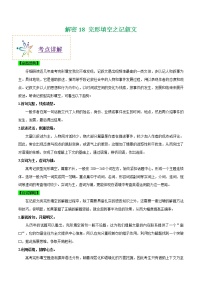
这是一份高考英语二轮讲义-完形填空之记叙文(原卷版),共12页。试卷主要包含了文章梳理,验证答案,必要时修改答案,验证并修改第一轮不确定的答案, 借用情感态度6,shw up, A等内容,欢迎下载使用。
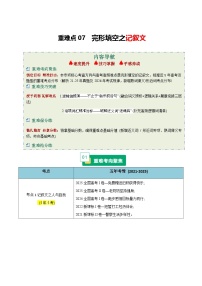
这是一份高考英语二轮讲义-完形填空——记叙文(核心考点精讲精练)(全国通用)(学生版),共50页。试卷主要包含了 高考真题考点分布, 命题规律及备考策略, A等内容,欢迎下载使用。

注册成功
资料篮

在线客服
添加在线客服
获取1对1服务
官方微信
关注“教习网”公众号
打开微信就能找资料
赛课定制
添加在线客服
获取1对1定制服务
职称咨询
添加在线客服
获取1V1专业指导服务

免费福利


.png)