免费领取教师福利

若您为此资料的原创作者,认为该资料内容侵犯了您的知识产权,请扫码添加我们的相关工作人员,我们尽可能的保护您的合法权益。


这是一份高考英语二轮讲义-完形填空之综合解题技巧(方法技巧篇)(全国通用)(学生版),共46页。
完形填空作为高考英语的核心题型,不仅考查词汇、语法等语言基础知识,更侧重检验考生对语篇逻辑的梳理能力、语境语义的推理能力和文化背景的适配能力。从近年高考命题趋势来看,完形填空的语篇选材愈发贴近生活、注重情感表达与逻辑层次,对考生的综合语言运用能力提出了更高要求。
本专题聚焦 “完形填空之综合解题技巧”,通过系统拆解题型本质、构建标准化解题流程、突破细分题型难点、总结高频易错陷阱,帮助考生建立从 “读不懂” 到 “选得准” 的能力闭环。专题开篇的核心解题方法板块,将为你搭建清晰的思维框架;方法技巧应用板块则通过 8 类考点、超 80 道例题的分步解析,让你在实战中内化技巧;易错总结板块针对高频失分点,用 “错误 - 修正 - 规避” 的闭环逻辑帮你避开陷阱;最后的速记手册则是考前冲刺的实用工具。无论你是基础薄弱的考生,还是想突破瓶颈的高分选手,本专题都能为你提供可落地、可复制的提分方案,助力你在高考完形填空中稳拿高分。
(1)定义
完形填空是基于 “语篇连贯性” 原则设计的障碍性阅读题型,命题者会在 300-400 词的完整语篇中,有针对性地挖除 20 个词汇(实词占比 80% 以上,包括动词、名词、形容词、副词;虚词占比 20% 左右,包括介词、连词、代词),要求考生结合 “语言知识 + 语篇逻辑 + 语境推理”,从四个干扰项中筛选出唯一能使文章语义连贯、逻辑通顺、语法正确的答案,本质是对 “综合语言运用能力” 的全景式考查。
(2)题型分类(附典型语篇片段示例)
叙事类:以记叙文、夹叙夹议文为主要形式,核心围绕 “人物经历 + 情感变化 + 事件发展” 展开,语篇中多含时间线索、动作链和心理描写,是高考最常考的类型(占比约 60%)
典型示例:
I still remember the day I jined the schl music club. When I walked int the classrm, all eyes turned t me. My hands were sweating, and my heart beat fast—I had never played an instrument in frnt f thers befre. The teacher nticed my nervusness and ______ me a gentle smile. “Dn’t wrry,” she said sftly, “everyne starts smewhere.”
(片段核心:人物 “紧张” 的情感 + 老师 “安抚” 的动作,体现叙事类语篇的情感与情节衔接)
说明类:以科普说明文、社会现象介绍文为主,核心是 “解释概念 + 传递信息 + 说明逻辑”,语篇结构严谨,多采用 “总 - 分” 或 “总 - 分 - 总” 格式,包含专业术语、数据或举例论证,对逻辑分析能力要求较高(占比约 25%)。
典型示例:
Bamb is ne f the mst useful plants in the wrld. It grws quickly—sme species can grw up t 91 centimeters in a single day. Unlike many ther plants, bamb has a hllw stem, which makes it light but strng. These features allw bamb t be used fr many purpses: it can be made int furniture, paper, and even buildings. In sme cuntries, bamb is als used as a ______ because it is rich in nutrients.
(片段核心:介绍竹子的 “特性” 与 “用途”,体现说明类语篇的信息传递逻辑)
议论类:以议论文、观点评论文为主,核心是 “提出观点 + 论证理由 + 总结结论”,语篇中多含逻辑连接词、态度词和论证案例,侧重考查对作者立场和逻辑关系的把握(占比约 15%)。
典型示例:
Many peple believe that success cmes frm luck, but I disagree. Luck may play a small rle, but true success depends n hard wrk and perseverance. Thse wh achieve great things rarely d s by accident. They set clear gals, make detailed plans, and keep wrking even when they face difficulties. In my pinin, luck is just an excuse fr thse wh are nt ______ t put in the effrt.
(片段核心:反驳 “成功源于运气” 的观点,论证 “努力” 的重要性,体现议论类语篇的观点与逻辑)
(3)高考考频与考查重点
分值与题量:近 5 年高考全国卷(含新高考卷)中,完形填空固定为 20 空,每题 1.5 分,共 30 分,占英语试卷总分的 20%,是仅次于阅读理解的高分值题型。
考点分布细节:
语境推理题:占比 40%(8 空左右),侧重考查 “上下文语义呼应”,需结合情节、情感、场景线索推导。
词汇复现题:占比 15%(3 空左右),包括原词复现(占比最高)、同义复现、反义复现、指代复现。
固定搭配题:占比 20%(4 空左右),以动词短语、介词短语为主,兼顾少量名词短语和习惯表达。
逻辑衔接题:占比 10%(2 空左右),集中考查转折、因果、递进、并列、让步等逻辑关系。
语法结构题:占比 10%(2 空左右),侧重时态、语态、非谓语动词、从句引导词、代词指代等基础语法。
词义辨析题:占比 5%(1 空左右),考查形近词、近义词、熟词僻义的区分。
命题趋势:语篇选材更贴近现实生活(如校园生活、社会热点、文化交流),情感导向更鲜明(如正能量、挫折教育、文化自信),对 “语篇整体把握能力” 的要求逐年提升,单纯考查词汇记忆或语法规则的题目占比持续下降。
步骤 1:跳读全文,抓主旨(30 秒 - 1 分钟)
核心目标:快速把握文章 “主题 + 情感基调 + 核心逻辑”,避免因逐空精读导致的 “只见树木不见森林”。
具体操作:
1.优先读首段(尤其是首句):首段通常交代人物、事件、背景或作者观点,是把握主旨的关键(若首句挖空,可快速扫读首段其他句子,通过名词、动词线索推断首句内容)。
2.略读中间段首句:每段首句多为主题句,可快速了解段落大意,梳理文章结构(如叙事类的 “时间顺序”、说明类的 “特性 - 用途”)。
3.细读尾段(尤其是尾句):尾段通常总结情感、升华主题或给出结论,可验证对前文主旨的判断。
4.标记关键信息:用简单符号标注核心人物(如 “Tm - 学生”)、情感基调(如 “happy→sad→determined”)、时间线索(如 “mrning→afternn→evening”)、逻辑关系(如 “but→转折”“s→因果”)。
示例演示(以叙事类语篇为例):
跳读以下语篇,标记关键信息:
I was late fr the train. I had rushed ut f the huse withut checking the time, and nw I std at the statin, watching the train disappear int the distance. My eyes filled with tears—I had prmised my grandma I wuld visit her n her birthday. Just as I was abut t give up, a kind ld man walked up t me. “Dn’t wrry,” he said, “there’s anther train in an hur. Why nt wait with me?” His wrds made me feel ______.
标记结果:主题(赶火车迟到→遇老人安慰)、情感基调(焦虑→慰藉)、核心人物(I, ld man)、逻辑(but→转折,老人的话带来变化)。
步骤 2:逐句精读,选答案(8-10 分钟)
核心目标:结合 “显性线索 + 隐性线索”,逐空锁定答案,不确定的题目暂时标记,避免卡顿。
具体操作:
1.先易后难:优先解决有 “显性线索” 的题目(词汇复现、固定搭配、语法结构),再处理需要 “隐性线索” 的题目(语境推理、逻辑衔接)。
2.显性线索示例:
题目:She ______ her mther’s advice and decided t study abrad.
选项:A. fllwed B. frgt C. refused D. changed
线索:后文出现 “decided t study abrad”,结合 “fllw ne's advice”(固定搭配),直接锁定 A。
隐性线索示例:
题目:The rm was dark and quiet. I culd hear nthing but the ______ f the rain utside.
选项:A. vice B. nise C. sund D. shut
线索:语境 “dark and quiet”“rain utside”,需推断 “雨声” 的合理表达,“sund” 泛指自然声音,符合语境,故选 C。
3.逐空分析流程:
第一步:判断空格词性(动词、名词、形容词等),缩小选项范围(如空格前是冠词 “a”,选项中不可数名词可直接排除)。
第二步:圈画空格前后的 “线索词”(情感词、动作词、逻辑词、场景词)。
第三步:结合线索词推导答案,代入选项验证语义是否通顺。
4.标记不确定题目:对没有明确线索的题目,在选项旁画 “?”,避免因纠结单个题目浪费时间,待读完全文后,上下文语义更完整,更容易推导答案。
步骤 3:复读全文,验逻辑(2-3 分钟)
核心目标:验证所选答案是否符合 “语篇连贯性”,修正因孤立解题导致的错误。
具体操作:
原选答案:The teacher asked us t finish the task, but we all succeeded in ding it.(逻辑矛盾,“but” 表转折,“succeeded” 与前文无对立)
修正答案:The teacher asked us t finish the task, but we all failed t d it.(“failed” 与 “but” 转折逻辑一致)
1.通读全文:将所有答案代入原文,逐句朗读(可默念),检查语义是否连贯、逻辑是否合理、语法是否正确。
2.重点验证场景:
情感一致性:人物情感是否贯穿上下文(如前文 “nervus”,后文若选 “excited” 需有明确转折线索)。
逻辑连贯性:逻辑连接词前后语义是否匹配(如 “but” 前是 “success”,后不可是 “achievements”,需体现对立)。
动作合理性:人物动作是否符合场景(如 “in the library” 场景中,动作不可是 “shut”)。
3.修正错误示例:
步骤 4:难题复盘,补漏洞(1-2 分钟)
核心目标:解决标记 “?” 的题目,利用 “语篇整体逻辑” 和 “选项分布规律” 辅助判断。
具体操作:
1.重新分析难题:结合全文主旨和段落逻辑,重新审视空格前后的线索(如前文提到 “kind”,后文空格可能选 “friendly” 等情感一致的词)。
2.利用选项分布规律:高考完形填空答案中,A、B、C、D 四个选项的出现次数通常为 4-6 次(均匀分布),若某选项已出现 6 次,剩余空格可优先排除该选项;若某选项仅出现 2 次,可重点验证该选项(注意:此方法仅为辅助,需以语境为核心,不可盲目依赖)。
3.规避常见误区:对 “模棱两可” 的选项,优先选择 “语义更贴合主旨”“逻辑更严谨” 的答案,避免选择 “语法正确但语义无关” 的干扰项。
(1)语境推理题(占比最高,核心题型)
核心逻辑:答案不依赖孤立的词汇或语法,而需通过 “上下文语义呼应” 推导,强调 “符合语篇场景、情感、情节的合理性”。
解题技巧(分角度细化):
1.情感线索推导:圈画空格前后的情感词(如 happy, sad, nervus, excited, disappinted),答案需与情感基调一致或符合情感变化逻辑。
2.动作线索推导:关注人物的动作链(如 “walk→sit→talk→leave”),答案需符合动作的连贯性(如前文 “pen the dr”,后文可能是 “walk in”)。
3.场景线索推导:识别语篇场景(如 hspital, classrm, restaurant, library),答案需符合场景特征(如 “in the hspital” 场景中,可能出现 “dctr, patient, medicine” 等词)。
4.情节线索推导:叙事类语篇中,答案需符合 “起因→经过→结果” 的情节发展逻辑(如前文 “lst the key”,后文可能是 “ask fr help”)。
典型例题(含分步解析):
例题 1:
Lisa had been lking frward t the schl trip fr weeks. She packed her bag the night befre, laid ut her clthes, and set her alarm fr 6 a.m. Hwever, when she wke up, the sun was already high in the sky—her alarm had nt rung. She jumped ut f bed, dressed quickly, and rushed t the bus stp. When she arrived, the bus was gne. Lisa felt ______ and almst cried.
选项:A. excited B. relieved C. heartbrken D. cnfused
解题步骤:
第一步:判断题型与情感基调。空格考查语境推理,前文情感线索为 “lking frward t”(期待),后文情节 “alarm nt rung→missed the bus”(错过班车),情感应从 “期待” 转为 “消极”。
第二步:圈画线索词。“lking frward t”“alarm had nt rung”“bus was gne”“almst cried”,均指向 “失落、伤心” 的情感。
第三步:验证选项。A. excited(兴奋的,积极情感,不符);B. relieved(释然的,积极情感,不符);C. heartbrken(心碎的,消极情感,符合 “错过期待已久的旅行” 的场景);D. cnfused(困惑的,未体现 “伤心” 的核心情感,不符),故选 C。
例题 2:
The café was small but czy. Sft music played in the backgrund, and the smell f cffee filled the air. Maria sat by the windw, watching peple walk by. She had been waiting fr her friend fr 20 minutes. Just as she was abut t call him, a man walked in and waved at her—it was her friend. Maria smiled and ______ him t sit dwn.
选项:A. refused B. invited C. stpped D. frced
解题步骤:
第一步:判断场景与动作逻辑。场景是 “café”(咖啡馆),情节是 “Maria 等朋友→朋友到来”,动作应符合 “朋友见面” 的友好场景。
第二步:圈画线索词。“smiled”(微笑,友好动作)、“it was her friend”(确认身份,无冲突),推导动作是 “友好邀请”。
第三步:验证选项。A. refused(拒绝,对立动作,不符);B. invited(邀请,友好动作,符合场景);C. stpped(阻止,对立动作,不符);D. frced(强迫,负面动作,不符),故选 B。
(2)词汇复现题(显性线索,易得分题型)
核心逻辑:语篇中某一词汇会以 “原词、同义词、反义词、指代词” 的形式重复出现,形成语义关联,答案通常是复现词汇的对应形式。
解题技巧(分类型细化):
1.原词复现:空格答案是前文或后文出现过的 “相同词汇”,多为名词、动词(需注意词性一致)。
2.同义复现:空格答案是前文或后文词汇的 “同义词或近义词”,多为形容词、副词、动词(如 “happy” 与 “pleased”,“walk” 与 “g n ft”)。
3.反义复现:空格答案是前文或后文词汇的 “反义词”,多通过转折词(but, hwever, while)连接(如 “rich” 与 “pr”,“fast” 与 “slw”)。
4.指代复现:空格答案是前文提到的 “人、事、物” 的指代(如 “he” 指代前文的男性名字,“it” 指代前文的单数名词)。
典型例题(含分步解析):
例题 1(原词复现):
Jack lves playing ftball. He plays ftball every afternn after schl, and he ften watches ftball matches n TV. His favrite ______ is Messi, a famus ftball player.
选项:A. singer B. actr C. player D. writer
解题步骤:
第一步:识别复现线索。前文多次出现 “ftball”,后文提到 “Messi, a famus ftball player”,空格处需填前文隐含的原词。
第二步:定位复现词。后文 “ftball player” 是显性复现,空格前 “favrite” 指向 “人”,与 “player” 对应。
第三步:验证选项。A. singer(歌手,与足球无关);B. actr(演员,无关);C. player(运动员,原词复现,符合);D. writer(作家,无关),故选 C。
例题 2(同义复现):
The task was difficult, but Tm did nt give up. He wrked hard fr weeks and finally succeeded. His ______ effrt made him achieve his gal.
选项:A. lazy B. hard C. quick D. easy
解题步骤:
第一步:识别复现类型。前文提到 “wrked hard”,空格处需填 “hard” 的同义词或原词,修饰 “effrt”。
第二步:定位同义线索。“wrked hard” 与 “hard effrt” 是同义复现,体现 “努力” 的核心语义。
第三步:验证选项。A. lazy(懒惰的,反义);B. hard(努力的,同义复现,符合);C. quick(快速的,无关);D. easy(容易的,反义),故选 B。
例题 3(反义复现):
Sme peple like t live in big cities because they think cities are exciting and cnvenient. Others, ______, prefer t live in small twns, saying that twns are quiet and peaceful.
选项:A. therefre B. hwever C. mrever D. besides
解题步骤:
第一步:识别复现类型。前文 “like t live in big cities” 与后文 “prefer t live in small twns” 是反义关系,空格需填转折词。
第二步:定位反义线索。“sme peple... thers...” 表示对比,“exciting and cnvenient” 与 “quiet and peaceful” 是反义描述,需转折词连接。
第三步:验证选项。A. therefre(因此,因果);B. hwever(然而,转折,符合反义复现);C. mrever(此外,递进);D. besides(除了,递进),故选 B。
(3)固定搭配题(积累型题型,提分关键)
核心逻辑:英语中存在大量 “固定结构”,即词汇之间的搭配是约定俗成的,不能随意替换,答案需符合这些固定表达。
解题技巧(分类型细化):
1.动词 + 介词 / 副词搭配:重点记忆高频动词(如 lk, take, make, get, put, cme, g)的相关搭配(如 lk up, take care f, make use f)。
2.形容词 + 介词搭配:关注常见形容词(如 afraid, interested, gd, respnsible)与介词的固定组合(如 afraid f, interested in, gd at, respnsible fr)。
3.名词 + 介词搭配:积累高频名词(如 attentin, advice, slutin, reasn)的搭配(如 attentin t, advice n, slutin t, reasn fr)。
4.习惯表达搭配:记忆固定句型(如 It’s imprtant t d, There is n dubt that)、谚语(如 Practice makes perfect)和常用短语(如 by accident, in rder t)。
注意事项:
搭配中的 “介词 / 副词” 是核心,不可混淆(如 “lk fr” 与 “lk after”,仅介词不同,语义完全不同)。
部分搭配存在 “动词 + 宾语 + 介词” 的结构(如 remind sb. f sth.,prevent sb. frm ding sth.),需注意宾语的位置。
典型例题(含分步解析):
例题 1(动词 + 介词搭配):
Sarah is lking frward ______ her grandparents next weekend. She hasn’t seen them fr three mnths.
选项:A. t visit B. visiting C. t visiting D. visit
解题步骤:
第一步:识别固定搭配。“lk frward t” 是固定搭配,意为 “期待”,其中 “t” 是介词,后接动名词形式。
第二步:排除错误选项。A. t visit(t 后接动词原形,错误);B. visiting(缺少介词 t,错误);C. t visiting(t 为介词,接动名词,正确);D. visit(动词原形,不符合搭配,错误)。
第三步:验证语义。“期待下周末看望祖父母”,语义通顺,故选 C。
例题 2(形容词 + 介词搭配):
The students are interested ______ space travel. They ften read bks and watch dcumentaries abut it.
选项:A. in B. n C. at D. with
解题步骤:
第一步:识别固定搭配。“interested in” 是固定搭配,意为 “对…… 感兴趣”,介词必须用 “in”。
第二步:排除错误选项。B. n(搭配错误);C. at(搭配错误);D. with(搭配错误)。
第三步:验证语义。“对太空旅行感兴趣”,语义通顺,故选 A。
例题 3(名词 + 介词搭配):
The teacher gave us sme gd advice ______ hw t imprve ur English writing.
选项:A. in B. n C. fr D. with
解题步骤:
第一步:识别固定搭配。“advice n sth.” 是固定搭配,意为 “关于…… 的建议”,介词用 “n”。
第二步:排除错误选项。A. in(搭配错误);C. fr(搭配错误,“advice fr sb.” 表示 “给某人的建议”);D. with(搭配错误)。
第三步:验证语义。“关于如何提高英语写作的建议”,语义通顺,故选 B。
(4)逻辑衔接题(逻辑型题型,需精准判断)
核心逻辑:空格处需填 “逻辑连接词” 或 “体现逻辑关系的词汇”,使句间、段间形成清晰的逻辑关系(转折、因果、递进、并列、让步等)。
常见逻辑关系及信号词(细化分类):
1.转折关系:前后语义对立,信号词包括 but, hwever, yet, while, n the cntrary, in cntrast。
2.因果关系:前因后果或前果后因,信号词包括 s, therefre, thus, because, since, as, due t, thanks t, as a result。
3.递进关系:语义层层加深,信号词包括 and, besides, mrever, furthermre, in additin, what’s mre。
4.并列关系:语义并列平等,信号词包括 and, r, , , nt als...。
5.让步关系:先让步后转折,信号词包括 thugh, althugh, even thugh, even if, in spite f, despite。
解题技巧:
1.分析前后句语义关系:先读懂空格前后两个句子的核心意思,判断是 “对立”“因果”“递进”“并列” 还是 “让步”。
2.匹配对应的逻辑信号词:根据语义关系,从选项中选择对应的逻辑词(若选项不是信号词,需选择体现逻辑关系的词汇)。
典型例题(含分步解析):
例题 1(转折关系):
The film was lng and slw. ______, I enjyed it very much because the stry was mving.
选项:A. Therefre B. Hwever C. Mrever D. Besides
解题步骤:
第一步:分析语义关系。前句 “电影又长又慢”(消极评价),后句 “我非常喜欢,因为故事感人”(积极评价),前后语义对立,需转折词。
第二步:匹配逻辑信号词。A. Therefre(因果,表结果);B. Hwever(转折,表对立,符合);C. Mrever(递进,表补充);D. Besides(递进,表补充)。
第三步:验证逻辑。“电影虽长但感人,我很喜欢”,逻辑通顺,故选 B。
例题 2(因果关系):
It rained heavily last night. ______, the rads were flded this mrning, and many peple were late fr wrk.
选项:A. As a result B. On the cntrary C. In additin D. Even thugh
解题步骤:
第一步:分析语义关系。前句 “昨晚下大雨”(原因),后句 “今天早上道路被淹,很多人迟到”(结果),前后是因果关系。
第二步:匹配逻辑信号词。A. As a result(因果,表结果,符合);B. On the cntrary(转折,表对立);C. In additin(递进,表补充);D. Even thugh(让步,表转折)。
第三步:验证逻辑。“因大雨导致道路被淹、迟到”,逻辑通顺,故选 A。
例题 3(让步关系):
______ he is nly 10 years ld, he can slve cmplex math prblems that many teenagers find difficult.
选项:A. Because B. Althugh C. S D. And
解题步骤:
第一步:分析语义关系。前句 “他只有 10 岁”(年龄小,看似能力有限),后句 “能解决很多青少年都觉得难的复杂数学题”(能力强),前后是让步关系(先让步后转折)。
第二步:匹配逻辑信号词。A. Because(因果,表原因);B. Althugh(让步,表转折,符合);C. S(因果,表结果);D. And(并列,表平等)。
第三步:验证逻辑。“虽只有 10 岁,但能解复杂数学题”,逻辑通顺,故选 B。
(5)语法结构题(基础型题型,需夯实语法)
核心逻辑:答案需符合英语语法规则,侧重考查 “时态、语态、非谓语动词、从句引导词、代词、冠词” 等基础语法知识。
解题技巧(分考点细化):
1.时态题:根据 “时间状语”(如 yesterday, nw, tmrrw, fr 3 years)或 “上下文时态” 判断(如叙事类多为一般过去时,说明类多为一般现在时)。
2.语态题:判断主语与谓语动词的关系(主动 / 被动),被动语态结构为 “be + 过去分词”(需注意时态与 be 动词的一致性)。
3.非谓语动词题:根据 “固定搭配”(如 want t d, enjy ding)或 “句子成分”(作主语、宾语、状语、定语)判断形式(t d, ding, dne)。
4.从句引导词题:先判断从句类型(定语从句、状语从句、名词性从句),再根据从句语义和成分选择引导词(如定语从句缺主语,指人用 wh,指物用 which/that)。
典型例题(含分步解析):
例题 1(时态题):
Tm ______ his hmewrk when his mther came back hme yesterday evening.
选项:A. des B. did C. was ding D. is ding
解题步骤:
第一步:分析时间状语和语境。时间状语 “yesterday evening”(昨晚),且 “when his mther came back”(妈妈回来时)是过去的某个瞬间,主句动作应是 “过去进行时”(表示过去某一时刻正在进行的动作)。
第二步:排除错误选项。A. des(一般现在时,错误);B. did(一般过去时,表完成的动作,错误);C. was ding(过去进行时,符合);D. is ding(现在进行时,错误)。
第三步:验证语义。“昨晚妈妈回来时,汤姆正在做作业”,语义通顺,故选 C。
例题 2(被动语态题):
A new library ______ in ur schl last year. It is nw pen t all students.
选项:A. built B. was built C. is built D. builds
解题步骤:
第一步:判断语态和时态。主语 “a new library”(新图书馆)与谓语 “build”(建造)是被动关系(图书馆被建造),时间状语 “last year”(去年),需用 “一般过去时的被动语态”。
第二步:排除错误选项。A. built(主动语态,过去式,错误);B. was built(一般过去时被动语态,符合);C. is built(一般现在时被动语态,时态错误);D. builds(主动语态,一般现在时,错误)。
第三步:验证语义。“我们学校去年建了一座新图书馆,现在对所有学生开放”,语义通顺,故选 B。
例题 3(非谓语动词题):
We decided ______ a picnic in the park this weekend. Wuld yu like t jin us?
选项:A. have B. having C. t have D. had
解题步骤:
第一步:识别固定搭配。“decide t d sth.” 是固定搭配,意为 “决定做某事”,后接动词不定式(t + 动词原形)。
第二步:排除错误选项。A. have(动词原形,缺少 t,错误);B. having(动名词,错误);C. t have(动词不定式,符合搭配);D. had(过去式,错误)。
第三步:验证语义。“我们决定这周末去公园野餐,你想加入我们吗?”,语义通顺,故选 C。
(1)长难句场景(高频失分点,需拆解能力)
场景特征:完形填空中的长难句通常包含 “定语从句、状语从句、非谓语动词、并列结构” 等复杂成分,挖空位置多在从句或修饰成分中,容易因句子结构混淆导致理解偏差。
核心解题技巧:“拆分主干→分析修饰→回归语境” 三步法
1.拆分主干:先找出句子的主谓宾(核心成分),忽略修饰成分(定语、状语、插入语),明确句子的核心意思。
拆分技巧:
找谓语动词:句子中能体现时态、语态的动词是谓语(注意区分谓语动词与非谓语动词)。
找主语:谓语动词的发出者(通常在句首,若有从句引导词,主语可能在引导词后)。
找宾语:谓语动词的承受者(通常在谓语动词后)。
2.分析修饰成分:识别定语从句(修饰名词,引导词如 wh, which, that)、状语从句(修饰动词 / 形容词 / 句子,引导词如 when, where, because, if)、非谓语动词短语(作定语、状语),明确修饰成分与主干的关系。
3.回归语境:结合主干意思和修饰成分的语义,推导空格答案(空格若在主干中,需符合主干语义;若在修饰成分中,需符合修饰对象的语义)。
典型例题(含分步解析):
例题:
The girl ______ is standing ver there is my classmate wh wn the first prize in the English cmpetitin last mnth.
选项:A. which B. wh C. whm D. whse
解题步骤:
第一步:拆分主干。句子核心主干是 “The girl is my classmate”(那个女孩是我的同学),其余部分是修饰成分。
第二步:分析修饰成分。
第一个空格所在的 “______ is standing ver there” 是定语从句,修饰先行词 “The girl”(指人),从句中缺少主语。
第二个 “wh wn the first prize... last mnth” 也是定语从句,修饰 “my classmate”(指人),从句中 wh 作主语。
第三步:推导答案。定语从句修饰人,且从句缺主语,引导词用 “wh”,故选 B。
例题 2(含非谓语动词的长难句):
After ______ the difficult exam, all the students felt relaxed and went ut t celebrate.
选项:A. finish B. finishing C. finished D. t finish
解题步骤:
第一步:拆分主干。主干是 “all the students felt relaxed and went ut t celebrate”(所有学生感到放松,出去庆祝了),“After ______ the difficult exam” 是介词短语作状语。
第二步:分析修饰成分。“after” 是介词,后接动词时需用动名词形式(作介词宾语),因此空格处需填动名词。
第三步:推导答案。A. finish(动词原形,错误);B. finishing(动名词,符合);C. finished(过去式 / 过去分词,错误);D. t finish(动词不定式,错误),故选 B。
(2)熟词僻义场景(隐蔽考点,易踩坑)
场景特征:题目中出现的词汇是考生熟悉的高频词,但考查的是其不常见的 “僻义”,若按 “常用义” 代入,会导致语义不通。
高频熟词僻义清单(结合例题):
1.run(常用义:跑)→ 僻义:运营、管理(run a cmpany/schl)
2.cver(常用义:覆盖)→ 僻义:报道(cver a stry/event)、走完(路程)(cver 10 kilmeters)
3.bk(常用义:书)→ 僻义:预订(bk a ticket/rm)
4.charge(常用义:充电)→ 僻义:收费(charge mney fr sth.)、指责(charge sb. with sth.)
5.plant(常用义:植物)→ 僻义:工厂(a pwer plant)
6.curse(常用义:课程)→ 僻义:航线、进程(the curse f the river)
解题技巧:
1.若 “常用义” 代入后语义不通,立即意识到可能考查熟词僻义。
2.结合语境和搭配推导僻义:关注词汇前后的介词、宾语等搭配(如 “run” 后接 “cmpany”,可推导为 “运营公司”)。
3.利用上下文线索验证:通过前后句的语义逻辑,确认僻义是否符合语境。
典型例题(含分步解析):
例题 1:
The cmpany is run by a grup f yung peple wh are full f creativity and energy.
选项:A. 跑 B. 运营 C. 流动 D. 竞赛
解题步骤:
第一步:判断是否考查熟词僻义。“run” 的常用义是 “跑”,代入语境 “公司被一群充满创造力和活力的年轻人跑”,语义不通,推测考查僻义。
第二步:结合搭配推导。“run” 后接宾语 “the cmpany”(公司),“运营公司” 是合理搭配,符合语境。
第三步:验证语义。“这家公司由一群充满创造力和活力的年轻人运营”,语义通顺,故选 B。
例题 2:
The newspaper will cver the imprtant meeting between the tw cuntry leaders tmrrw.
选项:A. 覆盖 B. 包括 C. 报道 D. 支付
解题步骤:
第一步:判断是否考查熟词僻义。“cver” 的常用义是 “覆盖”,代入语境 “报纸明天将覆盖两国领导人的重要会议”,语义不通,推测考查僻义。
第二步:结合搭配推导。“cver” 的宾语是 “the imprtant meeting”(重要会议),“报道会议” 是报纸的常见功能,符合语境。
第三步:验证语义。“这家报纸明天将报道两国领导人的重要会议”,语义通顺,故选 C。
(3)文化背景场景(常识型考点,需积累)
场景特征:题目涉及中西文化差异、生活常识、习俗惯例等内容,答案需符合文化背景或常识逻辑,若缺乏相关积累,容易选错。
高频文化背景考点(结合例题):
1.节日习俗:西方节日(Christmas, Thanksgiving, Hallween)、中国传统节日(Spring Festival, Mid-Autumn Festival)的相关习俗(如 Christmas 送礼物、吃火鸡;Spring Festival 贴春联、发红包)。
2.社交礼仪:西方见面礼仪(shake hands, hug)、餐桌礼仪(use frks and knives, n nise while eating);中国社交礼仪(address elders plitely, ffer seats t the elderly)。
3.生活常识:交通规则(靠左 / 右行驶)、学校教育体系、常见职业的工作内容等。
解题技巧:
1.积累常见文化背景知识:平时阅读英语文章、观看英语影视时,刻意关注文化相关内容。
2.利用上下文线索推导:若不熟悉相关文化,通过文中的举例、解释等线索推断答案(如文中提到 “red envelpes”“family reunin”,可推断与春节相关)。
典型例题(含分步解析):
例题 1(节日习俗):
On Christmas Eve, children usually hang stckings by the fireplace, hping that Santa Claus will put gifts in them during the night.
选项:A. 春节 B. 圣诞节 C. 感恩节 D. 万圣节
解题步骤:
第一步:识别文化线索。文中提到 “Santa Claus”(圣诞老人)、“hang stckings”(挂长筒袜)、“put gifts”(放礼物),这些是圣诞节的典型习俗。
第二步:排除错误选项。A. 春节(无圣诞老人、挂长筒袜习俗);B. 圣诞节(符合习俗);C. 感恩节(习俗是吃火鸡、感恩);D. 万圣节(习俗是穿 cstumes、讨糖果)。
第三步:验证语义。“圣诞夜,孩子们通常把长筒袜挂在壁炉旁,希望圣诞老人晚上会在里面放礼物”,符合文化背景,故选 B。
例题 2(社交礼仪):
In many Western cuntries, it is plite t shake hands when yu meet smene fr the first time.
选项:A. 鞠躬 B. 拥抱 C. 握手 D. 亲吻
解题步骤:
第一步:识别文化线索。“Western cuntries”(西方国家)、“meet smene fr the first time”(第一次见面)、“plite”(礼貌的),结合常识,西方国家第一次见面的礼貌礼仪是握手。
第二步:排除错误选项。A. 鞠躬(东方国家礼仪);B. 拥抱(亲密关系或特定场合礼仪,非第一次见面常规礼仪);C. 握手(符合西方礼仪);D. 亲吻(部分国家的礼仪,但非普遍常规礼仪)。
第三步:验证语义。“在许多西方国家,第一次见面时握手是礼貌的”,符合文化背景,故选 C。
例题 1(考点:上下文语义衔接、情感线索捕捉)
After mnths f hard training, Lily std n the starting line f the marathn. Her legs felt heavy, but her eyes were full f ______. She had dreamed f this mment fr years and was ready t give it her all.
选项:A. dubt B. fear C. determinatin D. cnfusin
例题 2(考点:上下文语义衔接、情感线索捕捉)
The ld huse had been empty fr years. When we pushed pen the dr, dust fell frm the ceiling, and the air smelled f damp. Hwever, the walls were still cvered with family phts that ______ warm memries f ur childhd.
选项:A. erased B. awakened C. frgt D. destryed
例题 3(考点:上下文语义衔接、情感线索捕捉)
During the fld, many peple lst their hmes. Vlunteers frm all ver the cuntry brught fd, water, and blankets t the affected areas. Their kindness ______ the hearts f thse wh were suffering.
选项:A. brke B. cled C. warmed D. hurt
例题 4(考点:上下文语义衔接、情感线索捕捉)
Tm’s dg went missing last week. He searched every street in the neighbrhd, put up psters, and asked his friends fr help. Every night, he felt ______ and hped his dg wuld cme back sn.
选项:A. excited B. lnely C. prud D. relaxed
例题 5(考点:上下文语义衔接、情感线索捕捉)
The lecture abut envirnmental prtectin was s ______ that many students stayed after class t ask the prfessr mre questins. They were eager t learn hw t prtect the planet.
选项:A. bring B. cnfusing C. fascinating D. frustrating
例题 6(考点:上下文语义衔接、情感线索捕捉)
When the little by saw the hmeless cat shivering in the rain, he felt ______. He tk ff his jacket, wrapped it arund the cat, and brught it hme t take care f it.
选项:A. angry B. srry C. afraid D. tired
例题 7(考点:上下文语义衔接、情感线索捕捉)
The team had lst three games in a rw. Everyne felt discuraged, but their cach tld them nt t give up. His ______ wrds gave them the curage t keep practicing hard.
选项:A. discuraging B. meaningless C. inspiring D. bring
例题 8(考点:上下文语义衔接、情感线索捕捉)
We planned t have a picnic in the park, but it started t rain heavily. We had t stay in the car, waiting fr the rain t stp. T ur surprise, the rain stpped after 10 minutes, and the sun came ut. We felt ______ and quickly set up ur picnic.
选项:A. disappinted B
. relieved C. wrried D. nervus
例题 9(考点:上下文语义衔接、情感线索捕捉)
The ld man had lived in the small twn all his life. He knew everyne’s name and every street crner. When he mved t the big city t live with his sn, he felt ______ and missed his hmetwn deeply.
选项:A. cmfrtable B. familiar C. lst D. happy
例题 10(考点:上下文语义衔接、情感线索捕捉)
Lisa’s best friend mved t anther cuntry. They prmised t keep in tuch with each ther. Every time Lisa receives a letter frm her friend, she feels ______ and reads it again and again.
选项:A. sad B. excited C. angry D. tired
例题 1(考点:原词复现)
Anna lves painting. She spends every weekend in her studi, mixing clrs and creating beautiful ______. Her favrite ______ is a landscape f the muntains she painted last year.
选项:A. sngs; sng B. paintings; painting C. stries; stry D. pems; pem
例题 2(考点:同义复现)
The task was challenging, but we wrked tgether and finally cmpleted it. Our ______ effrt helped us achieve ur gal. We are prud f ur ______ teamwrk.
选项:A. lazy; pr B. jint; cperative C. separate; independent D. careless; casual
例题 3(考点:反义复现)
Sme peple prefer t get up early in the mrning, while thers are ______ and like t stay in bed until nn. Early risers ften say they are mre prductive, but ______ peple argue that they wrk better at night.
选项:A. early birds; night wls B. night wls; early birds C. mrning peple; evening peple D. evening peple; mrning peple
例题 4(考点:原词复现)
The library is a quiet place fr reading. Many students g t the ______ every afternn t brrw bks r study. Last week, I brrwed three nvels frm the ______ and finished reading them in tw days.
选项:A. library; library B. park; park C. gym; gym D. cinema; cinema
例题 5(考点:同义复现)
Tm is a generus persn. He always shares his tys with his friends and helps thse in need. His ______ nature makes him very ppular amng his classmates. Everyne likes his ______ attitude twards thers.
选项:A. selfish; mean B. kind; generus C. cruel; harsh D. shy; quiet
例题 6(考点:反义复现)
The weather was ht yesterday, but tday it is ______. We wre T-shirts and shrts yesterday, but tday we need t put n sweaters and cats because f the ______ temperature.
选项:A. cld; lw B. warm; high C. ht; high D. cl; lw
例题 7(考点:原词复现)
My mther is a dctr. She wrks in a big hspital and helps sick peple every day. I am prud f my ______ because she devtes her life t saving ______.
选项:A. father; lives B. mther; lives C. sister; animals D. brther; plants
例题 8(考点:同义复现)
The mvie was extremely funny. We laughed ludly thrughut the whle film. Its ______ plt and interesting characters made us feel ______ all day.
选项:A. bring; sad B. humrus; jyful C. serius; angry D. dull; tired
例题 9(考点:反义复现)
Alice is very rganized. She always plans her wrk carefully and keeps her desk tidy. Her brther, hwever, is ______. He never makes plans and leaves his rm in a ______.
选项:A. messy; rder B. rganized; mess C. disrganized; mess D. tidy; disrder
例题 10(考点:原词复现)
We visited a histrical city last summer. The city is famus fr its ancient ______ such as castles and temples. We spent three days visiting all the ______ and learned a lt abut the lcal histry.
选项:A. buildings; buildings B. fds; fds C. animals; animals D. bks; bks
例题 1(考点:动词短语搭配)
The students are ______ the cming exam. They have been studying hard every day t prepare fr it.
选项:A. lking frward t B. taking care f C. preparing fr D. putting up with
例题 2(考点:介词短语搭配)
______ his hard wrk, Tm passed the English test with a high scre. He had spent many evenings practicing listening and reading.
选项:A. Because f B. Instead f C. In spite f D. Accrding t
例题 3(考点:习惯表达搭配)
______ it rains tmrrw, we will have t cancel the picnic. We can reschedule it fr next weekend if the weather is gd.
选项:A. As lng as B. In case C. Even if D. S that
例题 4(考点:动词短语搭配)
My sister ______ playing the pian when she was five years ld. She has kept practicing and nw she can play many difficult pieces.
选项:A. tk up B. gave up C. turned up D. lked up
例题 5(考点:形容词 + 介词搭配)
Lucy is ______ drawing. She has a natural talent fr it and her paintings ften win prizes in cmpetitins.
选项:A. gd at B. afraid f C. tired f D. angry with
例题 6(考点:介词短语搭配)
______ the help f my teacher, I imprved my English writing a lt. I used t make many mistakes, but nw my essays are mre cherent.
选项:A. Under B. With C. Fr D. By
例题 7(考点:动词 + 宾语 + 介词搭配)
The teacher ften ______ us ______ paying attentin in class. She says that listening carefully is the key t learning well.
选项:A. reminds; f B. warns; abut C. stps; frm D. prevents; frm
例题 8(考点:习惯表达搭配)
______ I knw, the meeting will be held next Mnday. Yu can cnfirm it with the secretary if yu are nt sure.
选项:A. As far as B. As lng as C. As sn as D. As well as
例题 9(考点:动词短语搭配)
The cmpany plans t ______ a new prject t prtect the envirnment. They will invest a lt f mney in develping clean energy.
选项:A. set up B. break up C. give up D. put up
例题 10(考点:名词 + 介词搭配)
There is n slutin ______ the prblem f air pllutin. It requires the jint effrts f gvernments, cmpanies and individuals.
选项:A. t B. fr C. with D. n
例题 1(考点:转折关系识别)
The dress is very beautiful, ______ it is t expensive fr me. I can’t affrd t buy it even thugh I really like it.
选项:A. and B. but C. s D. r
例题 2(考点:因果关系识别)
It was getting dark, ______ we decided t g hme. We didn’t want t drive at night because the rad was nt safe.
选项:A. because B. but C. s D. althugh
例题 3(考点:递进关系识别)
Tm is gd at playing basketball. ______, he is als an excellent swimmer. He ften takes part in cmpetitins fr bth sprts.
选项:A. Hwever B. Besides C. Therefre D. Instead
例题 4(考点:并列关系识别)
We can g t the park ______ the z this weekend. It’s up t yu t decide which ne we visit.
选项:A. and B. but C. r D. s
例题 5(考点:转折关系识别)
The task was difficult, ______ we managed t finish it n time. We wrked tgether and helped each ther vercme the challenges.
选项:A. s B. but C. because D. as
例题 6(考点:因果关系识别)
Many peple have stpped using plastic bags ______ they want t prtect the envirnment. Plastic pllutin has becme a serius prblem fr the planet.
选项:A. because B. s C. but D. althugh
例题 7(考点:递进关系识别)
The bk is interesting ______ educatinal. It tells interesting stries and teaches us valuable life lessns.
选项:A. nt nly; but als B. either; r C. neither; nr D. bth; and
例题 8(考点:并列关系识别)
She likes t read bks ______ listen t music in her free time. These activities help her relax after a lng day f wrk.
选项:A. but B. s C. and D. r
例题 9(考点:转折关系识别)
He studied very hard fr the exam, ______ he still failed. He was very disappinted because he had high expectatins.
选项:A. s B. but C. because D. therefre
例题 10(考点:因果关系识别)
The flight was delayed ______ the bad weather. We had t wait at the airprt fr three hurs befre we culd bard the plane.
选项:A. because f B. in spite f C. instead f D. accrding t
例题 1(考点:时态)
I ______ my hmewrk when my best friend called me. We talked n the phne fr nearly an hur.
选项:A. d B. did C. was ding D. am ding
例题 2(考点:语态)
A new bridge ______ acrss the river last year. It has greatly imprved the traffic between the tw twns.
选项:A. builds B. built C. was built D. is built
例题 3(考点:非谓语动词)
We decided ______ t the beach fr vacatin. The weather there is usually warm and sunny this time f year.
选项:A. g B. ging C. t g D. went
例题 4(考点:从句引导词)
I dn’t knw ______ I can finish the reprt n time. I have t much wrk t d these days.
选项:A. if B. what C. wh D. where
例题 5(考点:时态)
She ______ in this cmpany fr 10 years. She started wrking here right after graduatin.
选项:A. wrks B. wrked C. has wrked D. will wrk
例题 6(考点:非谓语动词)
______ the mrning news, many peple in the area lst their hmes in the fld.
选项:A. Accrding t B. Listening t C. Because f D. Seeing
例题 7(考点:语态)
The meeting ______ by the manager tmrrw afternn. All department heads are required t attend.
选项:A. will hld B. will be held C. hlds D. is held
例题 8(考点:从句引导词)
This is the park ______ we met fr the first time. I still remember every detail f that day.
选项:A. where B. which C. when D. why
例题 9(考点:非谓语动词)
He avided ______ her because he didn’t want t make her angry again.
选项:A. meet B. meeting C. t meet D. met
例题 10(考点:时态)
When I arrived at the statin, the train ______ already ______. I had t wait fr the next ne.
选项:A. has; left B. had; left C. will; leave D. is; leaving
例题 1(考点:形容词的情感倾向判断)
After receiving the admissin letter frm her dream university, Lily felt ______ and culdn’t help crying. All her hard wrk finally paid ff.
选项:A. disappinted B. delighted C. wrried D. bred
例题 2(考点:副词的情感倾向判断)
The teacher praised Tm ______ fr his creative design in the cmpetitin. His wrk std ut amng all the entries.
选项:A. cldly B. angrily C. highly D. carelessly
例题 3(考点:形容词的情感倾向判断)
The mvie’s ending was s ______ that many audience members left the theater with tears in their eyes. N ne expected such a sad result.
选项:A. tuching B. cnfusing C. exciting D. bring
例题 4(考点:副词的情感倾向判断)
Despite failing the exam, Lucy faced the result ______ and decided t study harder next time. She didn’t let the failure discurage her.
选项:A. bravely B. sadly C. nervusly D. hpelessly
例题 5(考点:形容词的情感倾向判断)
His ______ remarks abut her appearance made her feel uncmfrtable. She didn’t want t talk t him anymre.
选项:A. plite B. rude C. hnest D. kind
例题 6(考点:副词的情感倾向判断)
The children played ______ in the park all afternn. They laughed and ran arund, enjying every mment f their free time.
选项:A. sadly B. quietly C. happily D. anxiusly
例题 7(考点:形容词的情感倾向判断)
I fund his speech ______ because he kept repeating the same pints withut any new ideas. I almst fell asleep during it.
选项:A. interesting B. inspiring C. bring D. surprising
例题 8(考点:副词的情感倾向判断)
She aplgized ______ fr being late t the meeting. She explained that her flight had been delayed due t bad weather.
选项:A. sincerely B. carelessly C. angrily D. prudly
例题 9(考点:形容词的情感倾向判断)
The news f his prmtin was ______ t everyne in the ffice. He had wrked s hard and deserved it.
选项:A. disappinting B. shcking C. satisfying D. cnfusing
例题 10(考点:副词的情感倾向判断)
The ld cuple talked ______ abut their childhd memries. Their eyes lit up when they mentined the happy times they spent tgether.
选项:A. sadly B. warmly C. cldly D. anxiusly
例题 1(考点:西方节日文化)
On ______, peple in Western cuntries usually exchange gifts and have a big dinner with their families. It is a time t celebrate the birth f Jesus Christ.
选项:A. Thanksgiving Day B. Christmas Day C. Hallween D. Easter
例题 2(考点:中国传统节日文化)
During the Spring Festival, Chinese families usually ______ and eat dumplings. It is a traditinal custm t wish each ther gd luck fr the new year.
选项:A. set ff firewrks B. carve pumpkins C. have turkey D. exchange chclate eggs
例题 3(考点:西方社交礼仪)
In many Western cuntries, it is plite t ______ when yu meet smene fr the first time. It shws respect and friendliness.
选项:A. bw B. shake hands C. hug D. kiss n the cheek
例题 4(考点:生活常识积累)
When yu crss the street in mst cuntries, yu shuld lk ______ first t avid being hit by cars. This is a basic traffic safety rule.
选项:A. left B. right C. up D. dwn
例题 5(考点:中西文化差异)
In China, peple usually use ______ t eat rice. It is ne f the mst cmmn tableware in Chinese cuisine.
选项:A. frks B. knives C. chpsticks D. spns
例题 6(考点:西方文化常识)
______ is a famus symbl f the United States. It stands fr freedm and hpe, and many immigrants first saw it when they arrived in America.
选项:A. The Great Wall B. The Eiffel Twer C. The Statue f Liberty D. Big Ben
例题 7(考点:生活常识积累)
When yu have a cld and cugh a lt, yu shuld drink mre ______ and get enugh rest. It helps t relieve the symptms.
选项:A. cffee B. tea C. alchl D. cla
例题 8(考点:中西文化差异)
In Western cuntries, it is cmmn t tip waiters r waitresses after dining in a restaurant. The tip is usually ______ f the ttal bill.
选项:A. 5%-10% B. 15%-20% C. 30%-40% D. 50%
例题 9(考点:中国文化常识)
______ is a traditinal Chinese art frm that uses brushes and ink t create paintings r calligraphy. It is an imprtant part f Chinese cultural heritage.
选项:A. Oil painting B. Waterclr painting C. Ink wash painting D. Sculpture
例题 10(考点:生活常识积累)
T keep fd fresh fr a lng time, yu shuld put it in the ______. This appliance can lwer the temperature and slw dwn fd spilage.
选项:A. refrigeratr B. micrwave ven C. washing machine D. air cnditiner
例题 1(考点:近义词区分)
The manager ______ the plan because it was t risky and might cause great lsses t the cmpany.
选项:A. accepted B. refused C. agreed D. supprted
例题 2(考点:形近词区分)
It is ______ t drive after drinking alchl. This behavir is nt nly illegal but als dangerus t yurself and thers.
选项:A. respnsible B. irrespnsible C. pssible D. impssible
例题 3(考点:熟词僻义区分)
The newspaper will ______ the imprtant event that happened in the capital yesterday. Many readers are lking frward t the details.
选项:A. cver B. clse C. carry D. cst
例题 4(考点:近义词区分)
She has a ______ fr music. She can play the pian, the vilin and several ther instruments skillfully.
选项:A. talent B. habit C. hbby D. interest
例题 5(考点:形近词区分)
The teacher asked us t ______ the spelling mistakes in ur cmpsitins befre handing them in.
选项:A. crrect B. cnnect C. cllect D. cmplete
例题 6(考点:熟词僻义区分)
The cmpany plans t ______ a new branch in Shanghai next year. This will help expand its business in the eastern part f China.
选项:A. run B. pen C. bk D. plant
例题 7(考点:近义词区分)
The ______ f the experiment was better than expected. The researchers successfully prved their hypthesis.
选项:A. result B. reasn C. cause D. effect
例题 8(考点:形近词区分)
It is ______ t judge a persn by his appearance. Everyne has unique qualities that cannt be seen frm the utside.
选项:A. fair B. unfair C. clear D. unclear
例题 9(考点:熟词僻义区分)
He ______ a lt f mney in the stck market last year. He made a wise investment and gt high returns.
选项:A. wn B. earned C. gained D. tk
例题 10(考点:近义词区分)
The gvernment has taken ______ measures t prtect the envirnment. Many plluting factries have been clsed dwn.
选项:A. effective B. efficient C. active D. attractive
1. 偷换语境类陷阱
易错表现:考生仅聚焦空格前后 1-2 句话的局部信息,忽略全文主旨、情感基调或情节逻辑的连贯性,导致所选答案在局部语义通顺,但与整体语境(如人物情感变化、事件发展脉络、语篇主题)冲突,这是完形填空最高频的失分陷阱。
错误例句:
语篇背景:讲述 “作者参加演讲比赛,因紧张忘词,最终在老师鼓励下完成演讲并获得成长”,空格所在句:“I std n the stage, my legs shaking. The audience was quiet, and I felt ______ that I wanted t run away.”
错误选择:A. excited(兴奋的)
错误原因:仅看到 “audience was quiet”(观众安静),误判为 “期待的安静”,但结合前文 “legs shaking”(双腿发抖)、后文 “wanted t run away”(想逃跑)的整体情感线索,“excited” 与 “紧张、恐惧” 的核心基调完全矛盾。
正确例句:
正确选择:C. terrified(恐惧的)
正确逻辑:“双腿发抖 + 想逃跑” 的情节的,与 “恐惧” 情感一致,符合 “紧张忘词” 的整体语境,使语篇情感连贯。
规避方法:
1.解题前必须跳读全文,用 30 秒标记核心线索:人物情感变化(如 “nervus→encuraged→cnfident”)、事件发展逻辑(如 “prepare→fail→try again→succeed”)、语篇主题(如 “勇气、坚持、成长”);
2. 选择答案后,代入全文复读,验证该词是否与 “主题倾向、情感主线、情节逻辑” 保持一致,若出现 “局部通顺但整体矛盾”,立即排除;
3. 重点关注首尾段、段首句等主旨句,确保答案不偏离语篇核心。
2. 固定搭配混淆陷阱
易错表现:对高频动词、形容词、名词的固定搭配记忆模糊,尤其混淆搭配中的介词 / 副词(如 “lk frward t” 与 “lk up t”),或误记搭配结构(如 “decide t d” 与 “suggest ding”),导致语法形式错误或语义偏差。
错误例句:
空格所在句:“She has been lking frward ______ her favrite singer at the cncert.”
错误选择:A. t meet(错误搭配)
错误原因:混淆 “lk frward t” 的搭配结构,误将介词 “t” 当作不定式符号,认为后接动词原形,忽略 “t 为介词,需接动名词” 的固定规则。
正确例句:
正确选择:C. t meeting(正确搭配)
正确逻辑:“lk frward t ding sth.” 为固定表达,意为 “期待做某事”,介词 “t” 后必须接动名词形式,语义与 “期待见到歌手” 完全契合。
规避方法:
1. 分类记忆高频搭配:按 “动词 + 介词”(如 take care f、pay attentin t)、“形容词 + 介词”(如 interested in、respnsible fr)、“名词 + 介词”(如 slutin t、advice n)、“固定句型”(如 It’s n use ding、prevent sb. frm ding)分类整理,重点标注易错介词 / 副词;
2. 建立 “搭配错题本”,将错题中的错误搭配与正确搭配对比记忆,如 “accuse sb. f sth.(指责某人某事)” 与 “charge sb. with sth.(指控某人某事)”;
3.解题时若遇到熟悉的核心词(如 lk、take、make),先联想其常见搭配,再结合语境验证,避免孤立判断词汇含义。
3. 逻辑关系误判陷阱
易错表现:对句间、段间的逻辑关系(转折、因果、递进、并列、让步)判断失误,误将转折关系当作因果关系,或递进关系当作并列关系,导致选择的逻辑连接词或体现逻辑的词汇与语义逻辑矛盾。
错误例句:
空格所在句:“The task was extremely difficult, ______ he finished it ahead f schedule with his teammates’ help.”
错误选择:B. therefre(因此,因果关系)
错误原因:误将前句 “任务极难” 与后句 “提前完成” 视为 “因果关系”,但实际两者为 “转折关系”——“尽管任务难,但仍提前完成”,逻辑判断颠倒。
正确例句:
正确选择:D. hwever(然而,转折关系)
正确逻辑:“difficult” 与 “finished ahead f schedule” 形成语义对立,“hwever” 准确体现转折逻辑,使句间关系清晰合理。
规避方法:
1.熟记各类逻辑关系的核心信号词,建立 “逻辑词清单”(如转折关系:but、hwever、yet;因果关系:s、therefre、as a result;递进关系:besides、mrever;让步关系:thugh、althugh);
2.解题时先拆分空格前后两句的核心语义,用简单中文概括(如前句 “任务难”,后句 “提前完成”),再判断两者是 “对立、因果、补充” 还是 “让步” 关系;
3.若空格处无逻辑连接词,需选择体现逻辑关系的词汇(如转折关系选 “unexpectedly”,因果关系选 “frtunately”),代入后验证句间逻辑是否通顺。
4. 词义辨析模糊陷阱
易错表现:对形近词(如 adapt 与 adpt)、近义词(如 affect 与 effect、hard 与 hardly)的核心语义、词性或用法区分不清,仅根据词汇表面相似度或模糊记忆选择,导致语义不符或语法错误。
错误例句:
空格所在句:“The new plicy will ______ the lives f millins f peple in rural areas.”
错误选择:B. effect(影响)
错误原因:混淆 “affect” 与 “effect” 的词性和用法 ——“affect” 是动词(影响),“effect” 是名词(效果),空格处需填动词作谓语,“effect” 词性不符;同时对 “影响” 的动词形式记忆模糊,导致选错。
正确例句:
正确选择:A. affect(影响)
正确逻辑:“affect” 为动词,符合句子 “谓语动词” 的语法要求,语义 “新政策将影响农村地区数百万人的生活” 通顺合理。
规避方法:
1. 针对形近词:重点记忆 “核心差异 + 例句”,如 “adapt(适应,adapt t sth.)” 与 “adpt(采纳、收养,adpt a plan/child)”,用例句强化区分;
② 针对近义词:从 “词性、语义侧重、搭配对象” 三方面辨析,如 “hard(副词,努力地,wrk hard)” 与 “hardly(副词,几乎不,hardly eat anything)”,语义侧重完全不同;
③ 解题时先判断空格所需词性(动词、名词、形容词等),排除词性不符的选项,再结合语义侧重和搭配对象筛选答案,避免仅凭 “感觉相似” 选择。
5. 文化常识盲区陷阱
易错表现:缺乏中西文化差异、生活常识或习俗惯例的积累,对语篇中涉及的文化场景(如西方节日习俗、社交礼仪、生活规则)理解偏差,导致选择不符合文化逻辑的答案。
错误例句:
语篇背景:讲述 “西方餐桌礼仪”,空格所在句:“When dining in a Western restaurant, it is plite t use ______ t cut meat and frks t pick up fd.”
错误选择:C. chpsticks(筷子)
错误原因:缺乏西方餐桌礼仪常识,误将中国餐桌的核心餐具 “筷子” 代入西方场景,忽略 “西方餐桌以刀叉为主要餐具” 的文化常识,导致答案与文化背景冲突。
正确例句:
正确选择:A. knives(刀)
正确逻辑:西方餐桌礼仪中,“刀(knives)用于切肉,叉(frks)用于取食” 是固定习俗,符合语篇的文化背景,语义通顺。
规避方法:
1.积累高频文化常识考点:重点记忆西方节日(Christmas、Thanksgiving、Hallween)的习俗、中西社交礼仪差异(如西方初次见面握手,东方部分地区鞠躬)、生活常识(如交通规则、餐具使用、小费文化);
2.解题时若遇到陌生文化场景,不要盲目选择,可通过语篇中的解释性线索推导(如文中提到 “Santa Claus” 可推断为 Christmas,提到 “red envelpes” 可推断为 Spring Festival);
3.平时阅读英语文章、观看英语影视时,刻意关注文化相关细节,建立 “文化常识笔记”,弥补知识盲区。
核心公式:跳读抓主旨→精读选答案→复读验逻辑→复盘补漏洞
1.跳读抓主旨(30 秒):读首段首句 + 各段首句 + 尾段尾句,标记 “主题词 + 情感线 + 逻辑链”,避免 “逐空精读导致的语境割裂”;
2.精读选答案(8-10 分钟):先做 “显性线索题”(词汇复现、固定搭配、语法结构),再做 “隐性线索题”(语境推理、逻辑衔接),不确定题目画 “?”,不纠结;
3.复读验逻辑(2-3 分钟):将答案代入全文,朗读验证 “语义连贯、情感一致、逻辑通顺”,重点检查 “转折词前后是否对立、因果词前后是否有因果、动作是否符合场景”;
4.复盘补漏洞(1-2 分钟):针对标记 “?” 的题目,结合全文主旨推导,利用 “选项均匀分布” 辅助判断(高考完形 A、B、C、D 各 4-6 次),排除与主旨冲突的选项。
转折关系(前后语义对立):but(句中)、hwever(句首 / 句中,需用逗号隔开)、yet(句中,表轻微转折)、while(句首 / 句中,表对比)、n the cntrary(相反)、in cntrast(相比之下);
因果关系(前因后果 / 前果后因):s(句中)、therefre(句首 / 句中)、thus(句中)、as a result(句首)、because(句首 / 句中,接原因)、since(句首,接已知原因)、due t(后接名词 / 短语,表原因)、thanks t(后接名词 / 短语,表多亏);
递进关系(语义层层加深):and(句中)、besides(句首 / 句中)、mrever(句首)、furthermre(句首)、in additin(句首)、what’s mre(句首);
并列关系(语义平等):r(句中,表选择)、(要么…… 要么……)、(既不…… 也不……)、nt als...(不仅…… 而且……);
让步关系(先让步后转折):thugh/althugh(句首 / 句中,thugh 可放句末)、even if/even thugh(即使)、in spite f/despite(后接名词 / 短语,尽管)。
动词 + 介词 / 副词搭配(高考高频):
lk frward t(期待,t 为介词)、take care f(照顾)、pay attentin t(关注)、make use f(利用)、get alng with(与…… 相处)、deal with(处理)、cpe with(应对)、agree with(同意某人 / 观点)、agree t(同意计划 / 提议)、depend n(依赖)、rely n(依靠)、insist n(坚持)、put up with(忍受)、cme up with(提出)、catch up with(追上);
形容词 + 介词搭配(高考高频):
interested in(对…… 感兴趣)、afraid f(害怕)、gd at(擅长)、respnsible fr(对…… 负责)、different frm(与…… 不同)、similar t(与…… 相似)、familiar with(熟悉……)、familiar t(为…… 所熟悉)、angry with(对某人生气)、satisfied with(对…… 满意);
名词 + 介词搭配(高考高频):
slutin t(…… 的解决方案)、advice n(关于…… 的建议)、attentin t(对…… 的关注)、reasn fr(…… 的原因)、key t(…… 的关键)、attitude twards(对…… 的态度)、difference between(…… 之间的差异);
固定句型搭配(高考高频):
It’s imprtant/necessary fr sb. t d sth.(对某人来说做某事重要 / 必要)、It’s n use/gd ding sth.(做某事无用)、There is n dubt that...(毫无疑问……)、nt als...(不仅…… 而且……,就近原则)、(如此…… 以至于……)、(如此…… 以至于……)。
形近词辨析(核心差异 + 例句):
adapt vs. adpt:adapt(动词,适应,adapt t the new life);adpt(动词,采纳 / 收养,adpt a plan/adpt a child);
affect vs. effect:affect(动词,影响,The weather affects ur md);effect(名词,效果,The medicine has a gd effect);
3. cmplement vs. cmpliment:cmplement(动词 / 名词,补充,The wine cmplements the fd);cmpliment(动词 / 名词,赞美,She cmplimented me n my dress);
4. principal vs. principle:principal(形容词,主要的;名词,校长,the principal reasn/a schl principal);principle(名词,原则,fllw the principles);
近义词辨析(核心差异 + 例句):
1. big vs. large vs. great:big(侧重体积、规模,a big huse);large(侧重数量、面积,a large number f peple);great(侧重程度、重要性,a great success);
2. happy vs. pleased vs. delighted:happy(通用,a happy life);pleased(侧重因某事满意,be pleased with the result);delighted(程度更深,be delighted t meet yu);
3.see vs. watch vs. lk:lk(不及物,强调动作,lk at me);see(及物,强调结果,see a film);watch(及物,强调持续观看,watch TV)。
技巧 1:优先攻克 “显性线索题”—— 词汇复现、固定搭配、语法结构题直接锁定答案,无需过度推导,节省时间;语境推理、逻辑衔接题暂时标记,最后处理;
技巧 2:利用 “选项分布规律” 辅助判断 —— 若某选项已出现 6 次,剩余空格优先排除;若某选项仅出现 2-3 次,可重点验证(注意:此方法仅为辅助,需以语境为核心,不可盲目依赖);
技巧 3:优先选择 “与主旨相关的词”—— 若选项中存在 “体现语篇主题、情感基调” 的词(如主题是 “坚持”,优先选 persevere、keep trying 等),排除与主旨无关的词;
技巧 4:排除 “绝对化选项”—— 完形填空答案多为 “中性、符合逻辑” 的词,绝对化词汇(如 never、always、cmpletely、all)大概率是干扰项,除非语境明确支持;
技巧 5:信息模糊时 “逆向排除”—— 若无法确定正确答案,先排除 “语法错误(如词性不符、搭配错误)” 和 “语义明显矛盾(如情感对立、逻辑颠倒)” 的选项,剩余选项中选择 “语义最贴合上下文” 的一个;
技巧 6:时间不足时 “重点验证首尾段”—— 若只剩 3 分钟,优先确保首尾段答案正确(首尾段往往体现主旨,错误率高会影响整体得分),中间段选择 “显性线索题” 答案,不确定的题目均匀分布选项。
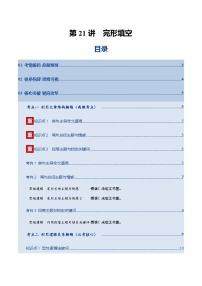
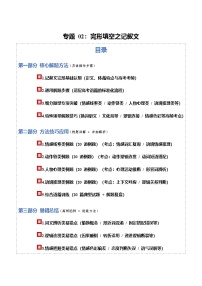
目录
第一部分 核心解题方法 (具体操作步骤)
1. 完形填空基础认知(定义、题型分类与高考考频)
2. 通用解题步骤(适配高考语篇的标准化流程)
3. 细分题型专项突破(语境推理 / 词汇复现 / 固定搭配 / 逻辑衔接等)
4. 特殊场景应对技巧(长难句 / 熟词僻义 / 文化背景等高频考点)
第二部分 方法技巧应用(例题讲解 + 详细解析)
1. 语境推理题(10 道例题)(考点:上下文语义衔接、情感线索捕捉)
2. 词汇复现题(10 道例题)(考点:原词复现、同义复现、反义复现)
3. 固定搭配题(10 道例题)(考点:动词短语、介词短语、习惯表达)
4. 逻辑衔接题(10 道例题)(考点:转折 / 因果 / 递进 / 并列关系识别)
5. 语法结构题(10 道例题)(考点:时态 / 语态 / 非谓语 / 从句引导词)
6. 情感态度题(10 道例题)(考点:形容词 / 副词的情感倾向判断)
7. 文化常识题(10 道例题)(考点:中西文化差异、生活常识积累)
8. 词义辨析题(10 道例题)(考点:形近词 / 近义词 / 熟词僻义区分)
第三部分 易错总结(高频陷阱 + 规避方法)
1. 偷换语境类陷阱(易错表现 + 错误例句 + 正确例句 + 规避方法)
2. 固定搭配混淆陷阱(易错表现 + 错误例句 + 正确例句 + 规避方法)
3. 逻辑关系误判陷阱(易错表现 + 错误例句 + 正确例句 + 规避方法)
4. 词义辨析模糊陷阱(易错表现 + 错误例句 + 正确例句 + 规避方法)
5. 文化常识盲区陷阱(易错表现 + 错误例句 + 正确例句 + 规避方法)
第四部分 完形填空高频考点速记手册
1. 高频解题步骤速记(核心公式化流程)
2. 高频逻辑词速记(转折 / 因果 / 递进等信号词清单)
3. 高频固定搭配速记(动词短语 / 介词短语分类汇总)
4. 高频易错词速记(形近词 / 近义词辨析表)
5. 临场应急技巧(时间紧张 / 信息模糊时的决策方法)
这是一份高考英语二轮讲义-完形填空之综合解题技巧(方法技巧篇)(全国通用)(学生版),共46页。
这是一份高考英语二轮讲义-完形填空之综合解题技巧(方法技巧篇)(全国通用)(教师版),共67页。学案主要包含了如果” 的条件表达等内容,欢迎下载使用。
这是一份高考英语二轮讲义-完形填空之说明文和议论文(方法技巧篇)(全国通用)(学生版),共65页。

注册成功
资料篮

在线客服
添加在线客服
获取1对1服务
官方微信
关注“教习网”公众号
打开微信就能找资料
赛课定制
添加在线客服
获取1对1定制服务
职称咨询
添加在线客服
获取1V1专业指导服务

免费福利


.png)