免费领取教师福利

若您为此资料的原创作者,认为该资料内容侵犯了您的知识产权,请扫码添加我们的相关工作人员,我们尽可能的保护您的合法权益。


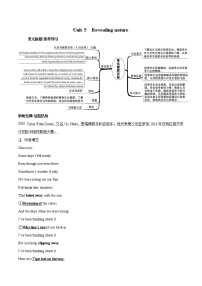
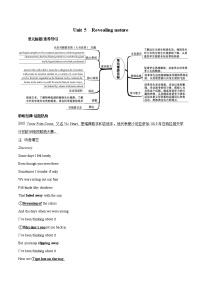
这是一份高中英语外研版 (2019)选择性必修 第一册Unit 5 Revealing nature优质学案,共11页。学案主要包含了词汇清单,知识点精讲,语法清单,写作清单等内容,欢迎下载使用。
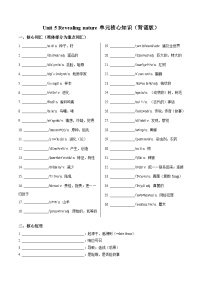
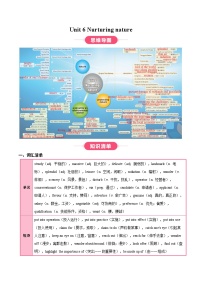
一、词汇清单
二、知识点精讲
1. seed /siːd/
• 教材原句:Farmers plant seeds in spring t grw crps.(农民们在春天播种来种植庄稼。)
• 拓展:作名词时,意为“种子,籽”,还可表示“起源,萌芽”;作动词时,意为“播种;确定(某人)为种子选手”。常见搭配有:plant seeds(播种),seed sth. with sth.(在…中播种),a seed f dubt/cnfidence(怀疑/信心的种子)。
• 写作佳句:The scientist carefully selected the best seeds fr the experiment, hping t achieve a high - yield result.(这位科学家精心挑选了最好的种子用于实验,希望获得高产的结果。)
• 单句语法填空
◦ After the rain, the farmers were busy _ (seed) the fields.(答案:)
◦ These seeds need t be planted at a _ (deep) f abut 2 centimeters.(答案:)
◦ A single _ (seed) f kindness can grw int a big tree f lve.(答案:)
◦ The cmpany is trying t _ (seed) the market with its new prduct.(答案:)
答案:seeding depth seed seed
2. distant /ˈdɪstənt/
• 教材原句:The distant muntains lked like a beautiful painting.(远处的山峦看起来像一幅美丽的画卷。)
• 拓展:形容词,意为“遥远的;久远的;疏远的;不太友好的” 。名词形式为distance(距离;远处),常见搭配有in the distance(在远处),at a distance(在一定距离处),keep ne's distance frm(与…保持距离) ,distant relative(远亲)。
• 写作佳句:We culd see the lights f the distant village twinkling in the darkness.(我们能看到远处村庄的灯光在黑暗中闪烁。)
• 单句语法填空
◦ The pht reminded him f his _ (distance) hmetwn.(答案:)
◦ The sund f the train in the _ (distant) made him feel a bit sad.(答案:)
◦ She has always been _ (distance) twards me, and I dn't knw why.(答案:)
◦ He lives in a _ (distance) place, s it's nt easy t visit him ften.(答案:)
答案:distant distance distant distant
3. suspect /səˈspekt/(v.);/ˈsʌspekt/(n.)
• 教材原句:The plice suspect him f stealing the jewels.(警方怀疑他偷了珠宝。)
• 拓展:作动词时,意为“猜想,怀疑,觉得;怀疑(某人有罪)” ,常见搭配为suspect sb. f (ding) sth.(怀疑某人做某事);作名词时,意为“嫌疑犯,可疑对象” 。形容词形式为suspicius(怀疑的;可疑的),名词形式为suspicin(怀疑;嫌疑),常见搭配有be suspicius f(对…怀疑),under suspicin(受到怀疑) 。
• 写作佳句:I suspect that there is smething wrng with the machine, s we shuld check it carefully.(我怀疑这台机器有问题,所以我们应该仔细检查一下。)
• 单句语法填空
◦ The _ (suspect) was arrested by the plice yesterday.(答案:)
◦ She was _ (suspicin) f his mtives fr helping her.(答案:)
◦ The plice have a strng _ (suspect) that he is the murderer.(答案:)
◦ They suspect him _ (be) the spy, but they have n evidence.(答案:)
答案:suspect suspicius suspicin t be
4. ancestr /ˈænsestə(r)/
• 教材原句:Our ancestrs passed dwn many valuable traditins t us.(我们的祖先给我们传承了许多宝贵的传统。)
• 拓展:名词,意为“(动物的)原种,祖先;祖宗” ,形容词形式为ancestral(祖先的;祖传的) 。
• 写作佳句:The ancient building is a precius heritage left by ur ancestrs.(这座古建筑是我们祖先留下的珍贵遗产。)
• 单句语法填空
◦ His _ (ancestr) came frm a small village in Eurpe.(答案:)
◦ This is an _ (ancestr) custm that has been preserved fr centuries.(答案:)
◦ We shuld respect the wisdm f ur _ (ancestr).(答案:)
◦ Accrding t the legend, their _ (ancestr) was a great her.(答案:)
答案:ancestrs ancestral ancestrs ancestr
5. evlve /ɪˈvɒlv/
• 教材原句:Plants and animals have evlved ver millins f years.(植物和动物经过数百万年的时间进化而来。)
• 拓展:动词,意为“进化;逐步发展;逐渐演变” ,名词形式为evlutin(进化;演变;发展),形容词形式为evlutinary(进化的;演变的;发展的) 。常见搭配有evlve frm(从…进化而来),evlve int(进化成;发展成) 。
• 写作佳句:The small startup has evlved int a large - scale enterprise in just a few years.(这家小创业公司在短短几年内就发展成了一家大型企业。)
• 单句语法填空
◦ The thery f _ (evlve) was put frward by Darwin.(答案:)
◦ Over time, the simple tl _ (evlve) int a mre cmplex and efficient ne.(答案:)
◦ These are the _ (evlutin) changes in the language.(答案:)
◦ Birds are thught t have evlved _ dinsaurs.(答案:)
答案:evlutin evlved evlutinary frm
6. characteristic /ˌkærəktəˈrɪstɪk/
• 教材原句:One f the characteristics f this plant is its bright - clred flwers.(这种植物的特征之一是它色彩鲜艳的花朵。)
• 拓展:作名词时,意为“特征,特性” ;作形容词时,意为“特有的;典型的” ,常见搭配为be characteristic f(是…的特征) 。动词形式为characterize(描述…的特征;具有…的特征) 。
• 写作佳句:The ability t adapt t new envirnments is a characteristic f successful species.(适应新环境的能力是成功物种的一个特征。)
• 单句语法填空
◦ It's _ (characteristic) f her t be s kind and helpful.(答案:)
◦ What are the main _ (characteristic) f this type f music?(答案:)
◦ The reprt _ (characteristic) the prblem as serius.(答案:)
◦ This behavir is nt _ (characteristic) f him.(答案:)
答案:characteristic characteristics characterized characteristic
7. decline /dɪˈklaɪn/
• 教材原句:The number f wild animals in this area has been declining in recent years.(近年来,这个地区的野生动物数量一直在减少。)
• 拓展:作动词时,意为“减少;下降;衰退;谢绝” ;作名词时,意为“减少;下降;衰退” 。常见搭配有decline by(下降了),decline t d sth.(拒绝做某事),in decline(在下降;在衰退),n the decline(在减少;在衰退) 。
• 写作佳句:The cmpany's prfits declined by 20% last year due t fierce cmpetitin.(由于激烈的竞争,该公司去年的利润下降了20%。)
• 单句语法填空
◦ There has been a sharp _ (decline) in the number f turists.(答案:)
◦ He declined _ (attend) the party, saying he was t busy.(答案:)
◦ The industry is _ (decline), and many wrkers are lsing their jbs.(答案:)
◦ The ppulatin f the small twn has been n the _ (decline) fr years.(答案:)
答案:decline t attend declining decline
8. blame /bleɪm/
• 教材原句:Dn't blame him fr the accident; it wasn't his fault.(别把这次事故归咎于他,这不是他的错。)
• 拓展:作动词时,意为“责怪,指责;把……归咎于” ;作名词时,意为“责备,过错” 。常见搭配有be t blame(该受责备,主动形式表被动意义),take the blame fr(为…承担责任),put/lay the blame fr sth. n sb.(把某事的责任推到某人身上) 。
• 写作佳句:We shuld nt blame thers fr ur wn mistakes but take respnsibility urselves.(我们不应把自己的错误归咎于他人,而应自己承担责任。)
• 单句语法填空
◦ Wh d yu think is t _ (blame) fr the failure f the prject?(答案:)
◦ She tk the _ (blame) fr her brther's mistake t prtect him.(答案:)
◦ They tried t put the blame _ me fr what had happened.(答案:)
◦ He was blamed _ (nt finish) the wrk n time.(答案:)
答案:blame blame n fr nt finishing
9. native /ˈneɪtɪv/
• 教材原句:This kind f plant is native t Suth America.(这种植物原产于南美洲。)
• 拓展:作形容词时,意为“原产于某地的;本国的;天生的;土著的” ;作名词时,意为“本地人;本国人;土著人” 。常见搭配有be native t(源于……的,原产于……),native language(本国语言;母语),native speaker(说母语的人) 。
• 写作佳句:The kangar is native t Australia and is ne f the cuntry's symbls.(袋鼠原产于澳大利亚,是该国的象征之一。)
• 单句语法填空
◦ As a _ (native) f this city, he knws every crner f it.(答案:)
◦ English is nt my _ (native) language, but I can speak it fluently.(答案:)
◦ The panda is native _ China.(答案:)
◦ The native _ (live) in this area have a rich cultural heritage.(答案:)
答案:native native t living
10. detect /dɪˈtekt/
• 教材原句:The new technlgy can detect very small amunts f pllutants in the air.(这项新技术可以检测出空气中极少量的污染物。)
• 拓展:动词,意为“发现,察觉(尤指不易觉察到的事物)” ,名词形式为detectin(侦查;探测;发现),detective(侦探;警探),detectr(探测器) 。
• 写作佳句:Scientists are using advanced equipment t detect signs f life n ther planets.(科学家们正在使用先进设备探测其他星球上的生命迹象。)
• 单句语法填空
◦ The _ (detect) f the virus in the patient's bdy was a crucial step in treating the disease.(答案:)
◦ The plice detective _ (detect) a strange smell in the rm during the investigatin.(答案:)
◦ Smke _ (detect) are very imprtant in preventing fires.(答案:)
◦ It was hard t _ (detect) any change in his expressin.(答案:)
答案:detectin detected detectrs detect
三、语法清单
动词-ing形式作宾语和宾语补足语
【感知·语法规律】
1. Many peple enjy reading bks abut nature.(许多人喜欢阅读关于自然的书籍。)
2. I suggest visiting the btanical garden this weekend.(我建议这个周末去参观植物园。)
3. We saw the gardener watering the flwers in the garden.(我们看到园丁在花园里浇花。)
4. The teacher fund the students discussing the prblem heatedly.(老师发现学生们在热烈地讨论这个问题。)
5. She kept me waiting fr a lng time.(她让我等了很长时间。 )
【精讲·语法知识】
1. 动词 -ing形式作宾语
◦ 常见接动词 -ing形式作宾语的动词:admit(承认),appreciate(感激;欣赏),avid(避免),cnsider(考虑),delay(推迟),deny(否认),dislike(不喜欢),enjy(喜欢),escape(逃脱),excuse(原谅),finish(完成),imagine(想象),keep(保持;一直),mind(介意),miss(错过;想念),practise(练习),risk(冒险),suggest(建议)等。例如:I appreciate having the pprtunity t wrk with yu.(我很感激有机会和你一起工作。)
◦ 动词短语后接动词 -ing形式作宾语:lk frward t(期待),be used t(习惯于),bject t(反对),devte... t...(把……奉献给),get dwn t(开始认真做),pay attentin t(注意),stick t(坚持)等 。其中t是介词,后面要接动词 -ing形式。例如:We are lking frward t hearing frm yu sn.(我们期待着尽快收到你的来信。)
◦ 在need, want, require等表示“需要”的动词后,用动词 -ing形式的主动形式表示被动意义 ,相当于t be dne结构。例如:The windw needs cleaning. = The windw needs t be cleaned.(窗户需要清洁。)
2. 动词 -ing形式作宾语补足语
◦ 常见接动词 -ing形式作宾语补足语的动词:see(看见),watch(观看),bserve(观察),ntice(注意到),hear(听见),listen t(听),feel(感觉),find(发现),have(使;让),keep(使保持)等感官动词和使役动词。例如:I heard smene singing in the next rm.(我听见有人在隔壁房间唱歌。)
◦ 动词 -ing形式作宾语补足语与宾语之间的关系:动词 -ing形式作宾语补足语时,它与宾语之间存在逻辑上的主谓关系,表示宾语正在进行的动作 。例如:We saw the children playing games n the playgrund.(我们看到孩子们正在操场上玩游戏。)“playing games”是孩子们正在进行的动作,“the children”是“playing games”的逻辑主语。
◦ “have + 宾语 + 动词 -ing形式”的用法
◦ 表示让某人或某物一直做某事:例如:He had the light burning all night.(他让灯亮了一整晚。)
◦ 表示容忍或允许某人做某事(常用于否定句):例如:I wn't have yu speaking t yur mther like that.(我不允许你那样和你妈妈说话。)
【经典练】
1. I can't imagine ________ (live) withut electricity.(答案:)
2. She suggested ________ (g) t the mvies tnight.(答案:)
3. D yu mind my ________ (pen) the windw?(答案:)
4. The teacher caught the by ________ (cheat) in the exam.(答案:)
5. We are lking frward t ________ (meet) yu again.(答案:)
6. The bss kept his wrkers ________ (wrk) fr 12 hurs a day.(答案:)
7. I remember ________ (lck) the dr, but it is pen nw.(答案:,remember ding sth. 表示记得做过某事 )
8. The by admitted ________ (break) the windw.(答案:)
9. They gt dwn t ________ (slve) the prblem as sn as they arrived.(答案:)
10. The ld man fund a dg ________ (lie) n the rad.(答案:)
答案:living ging pening cheating meeting wrking lcking breaking slving lying
四、写作清单
【点拨·写作技巧】
本单元写作类型主要是观察日记,用于记录对动植物生长过程、生活习性等方面的观察情况。通过细致入微的描写,将观察对象的变化生动呈现,传达对自然的探索与感悟 。
1. 规范格式:英语观察日记通常由日期(Date)、星期(Day)和正文组成。日期写在正文第一行的右上角,星期写在日期后,中间用逗号隔开。如“Sunday, May 5th” 。
2. 人称与时态:常用第一人称记录观察过程,让读者更有代入感。时态以一般过去时为主,记录已经发生的观察内容;描述客观事实或普遍真理,如植物生长规律时,用一般现在时;强调动作的持续性,涉及正在进行的观察,用过去进行时。比如描述植物生长,“I planted the sunflwer seeds yesterday. Nw, they are grwing well. Sunflwers usually need a lt f sunlight t grw” 。
3. 有序观察与描述:依据观察对象特点选择合适顺序。观察植物生长,按时间顺序记录播种、发芽、长叶、开花、结果等阶段;观察动物习性,可先整体介绍外貌,再从饮食、活动、繁殖等方面分述 。如写豆芽生长日记,“On the first day, I put the beans in water. The next day, small spruts began t emerge. After a few days, the spruts grew lnger” 。
4. 细节描写:细致刻画观察对象的形态、颜色、大小、动作等细节。写植物,描述叶子形状、颜色变化,“The newly - grwn leaves were light green and heart - shaped” ;写动物,描写行为动作,“The little rabbit hpped arund the cage, its fluffy tail twitching” 。融入个人感受与思考,如“Watching the seeds germinate, I was filled with excitement and hpe fr the future grwth f the plants” ,增强文章感染力。
5. 语言简洁准确:用简洁明了的语言准确传达观察内容,避免复杂生僻词汇和句子结构。比如表达植物长高,用“The plant grew taller” 而非“The plant experienced an increase in its vertical dimensin” 。
【积累·写作素材】
1. 词汇:
◦ 植物相关:seed(种子)、sprut(嫩芽;发芽)、stem(茎)、leaf(叶子,复数leaves )、bud(花蕾)、flwer(花)、fruit(果实)、rt(根)、blssm(开花;花朵)、germinate(发芽;使发芽)、blm(开花;繁荣)、wither(枯萎)、ripe(成熟的)、sw(播种)、fertilize(施肥)。
◦ 动物相关:habitat(栖息地)、behavir(行为)、hunt(捕猎)、mate(交配)、ffspring(后代)、hibernate(冬眠)、migrate(迁徙)、paw(爪子)、wing(翅膀)、feather(羽毛)、scale(鳞片)、fur(皮毛)、nest(巢穴)、rar(吼叫)、chirp(唧唧叫)。
◦ 感受相关:amazed(惊讶的)、curius(好奇的)、excited(兴奋的)、fascinated(着迷的)、hpeful(充满希望的)、impressed(印象深刻的)、satisfied(满意的)。
2. 短语:
◦ 生长过程:grw up(成长)、grw int(长成)、put dwn rts(扎根)、cme up(发芽;长出地面)、bear fruit(结果实)、g thrugh a grwth cycle(经历一个生长周期)。
◦ 动物行为:lk fr fd(寻找食物)、take care f the yung(照顾幼崽)、defend its territry(保卫领地)、sleep during the day(白天睡觉)、be active at night(夜间活跃)。
◦ 观察动作:keep an eye n(留意;密切关注)、make bservatins(进行观察)、recrd the changes(记录变化)、take ntes(做笔记)。
3. 句式:
◦ 开头常用句式:
◦ [Date] [Day]
◦ Tday, I decided t start bserving...(今天,我决定开始观察……)
◦ It has been an interesting day f bserving...(这是观察……的有趣一天)
◦ 过程描述句式:
◦ After [time perid], I nticed that...(在一段时间后,我注意到……)
◦ As the days went by, the... gradually...(随着日子一天天过去,……逐渐……)
◦ Suddenly, I saw that...(突然,我看到……)
◦ The... grew [adjective] and started t...(……长得……并开始……)
◦ 结尾感悟句式:
◦ Thrugh this bservatin, I have learned a lt abut...(通过这次观察,我学到了很多关于……)
◦ This experience f bserving... has made me mre aware f...(这次观察……的经历让我更加意识到……)
◦ I am lking frward t further bserving the grwth/behavir f...(我期待进一步观察……的生长/行为)
【示例·分步写作】
假设你是李华,英语老师让你观察绿豆的生长过程并写一篇观察日记。请根据以下要点,写一篇80词左右的英语日记。
1. 第一天,把绿豆浸泡在水里;
2. 第二天,绿豆开始发芽;
3. 第三天,豆芽变长,颜色变绿;
4. 表达自己的感受。
答案:
写作思路:
1. 开头:按日记格式,写清日期、星期,表明观察对象是绿豆。
2. 中间:依时间顺序,分别描述第一天泡绿豆、第二天绿豆发芽、第三天豆芽变化。
3. 结尾:阐述观察过程中的感受 。
参考范文
[Date] [Day]
Tday, I started t bserve the grwth f mung beans.
On the first day, I saked sme mung beans in water. The next day, small white spruts began t appear. They lked s cute. On the third day, the spruts grew much lnger and turned green.
Watching the mung beans grw, I was filled with excitement. It's amazing t see the magic f life.
详解:
1. 格式规范:开头遵循日记格式,写日期和星期 。
2. 要点齐全:涵盖题目所有要点,完整呈现绿豆生长过程及个人感受。
3. 语言运用:用“saked”“appear”“grw”“turned”等动词准确描述生长过程;“filled with excitement”“It's amazing”等表达感受,语言简洁自然。
4. 条理清晰:以时间为序,用“On the first day”“The next day”“On the third day”连接,层次分明 。
单词
annual(adj. 一年一度的),determine(v. 测定;确定),eventual(adj. 最后的),slve(v. 解决),amaze(v. 使吃惊),survive(v. 活下来;幸存),effect(n. 影响),seek(v. 寻找),measure(v. 测量),awareness(n. 认识;意识),idim(n. 成语),bserve(v. 看到;观察),variety(n. 多样化),average(adj. 平均的)
短语
seek after/fr(寻找;追求),seek sth. frm sb.(向某人寻求某物),take measures t d sth.(采取措施做某事),determine t d sth.(决定做某事),be determined t d sth.(坚决要做某事),survive frm(从……存活下来),survive n sth.(靠……生存),bserve sb. d sth.(观察某人做某事全过程),bserve sb. ding sth.(观察某人正在做某事),prfit by/frm sth.(得益于某事物),date back t(起源于;追溯到),(把……看作),suspect sb f (ding) sth(怀疑某人做过某事),blame sb fr sth(因某事而责备某人),blame sth n sb(把某事归咎于某人),be t blame (fr...)(对某事负有责任)
熟词生义
• prfit:常见义为“利润,收益”(n.),还可作动词,意为“获益”(vi.)或“对……有好处”(vt.)。
• regard:常见义为“看待;把……看作”(vt.),还可作名词,意为“注意;尊重;问候”。
• suspect:常见义为“怀疑;猜想”(vt.),还可作名词,意为“犯罪嫌疑人”,作形容词时意为“可疑的”。
句型
• sb/sth be said t have dne:意为“据说已经做了……”,如“Alexander the Great and Marc Pl were said t have visited such a tree in India.”(据说,亚历山大大帝和马可·波罗曾经在印度参观过这样的一棵树。)
• 副词作状语:如“Mre surprisingly, plants als use sund t cmmunicate.”(更令人吃惊的是,植物也用声音进行交流。),句中“Mre surprisingly”作状语,起到强调和突出语气的作用。
语法
• 过去完成时:表示在过去某个时间或动作之前已经发生或完成的动作,即“过去的过去”。结构为“had + 过去分词”。例如“He had left the ffice befre I arrived.”(在我到达之前,他已经离开了办公室。)
• 被动语态:本单元重点涉及含情态动词的被动语态(can/may/must be + 过去分词)以及一些特殊结构如“be said t...”等的被动形式。如“Tday, On the Origin f Species is regarded as ne f the mst imprtant wrks ever written.”(今天,《物种起源》被认为是有史以来最重要的著作之一。)
这是一份高中英语外研版 (2019)选择性必修 第一册Unit 5 Revealing nature优质学案,共11页。学案主要包含了词汇清单,知识点精讲,语法清单,写作清单等内容,欢迎下载使用。
这是一份英语选择性必修 第一册Unit 5 Revealing nature优质导学案,共10页。学案主要包含了词汇清单,知识点精讲,语法清单,写作清单等内容,欢迎下载使用。
这是一份高中英语Unit 5 Revealing nature精品导学案,共3页。学案主要包含了核心词汇,核心短语,重点句型,核心语法,重点语音等内容,欢迎下载使用。


注册成功
资料篮

在线客服
添加在线客服
获取1对1服务
官方微信
关注“教习网”公众号
打开微信就能找资料
赛课定制
添加在线客服
获取1对1定制服务
职称咨询
添加在线客服
获取1V1专业指导服务

免费福利

.png)
.png)