免费领取教师福利
若您为此资料的原创作者,认为该资料内容侵犯了您的知识产权,请扫码添加我们的相关工作人员,我们尽可能的保护您的合法权益。


这是一份2026年秋新教材人教版九年级上册英语期中质量评价测试卷 (含答案),共13页。
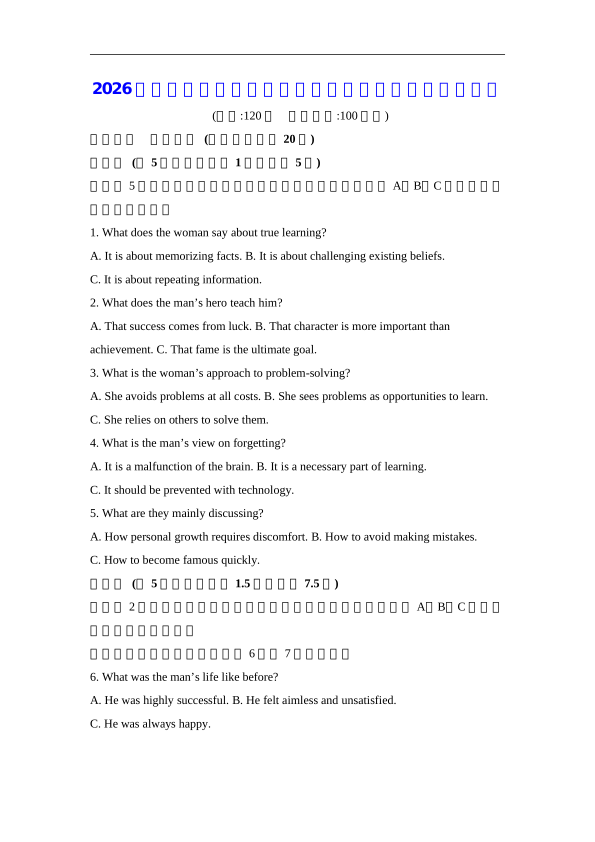
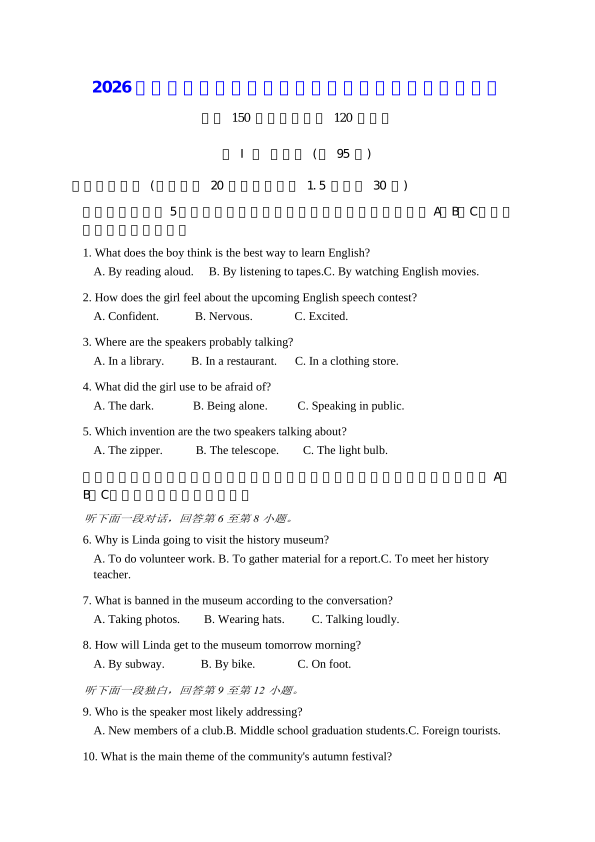
第一部分 听力理解 (共三节,满分20分)
第一节 (共5小题,每小题1分,满分5分)
听下面5段对话。每段对话后有一个小题,从题中所给的A、B、C三个选项中选出最佳选项。
1. What did the girl use t be afraid f?
A. Speaking in public. B. Dgs. C. Heights.
2. Wh des the by admire mst?
A. His father. B. His teacher. C. A famus scientist.
3. Hw des the wman remember new vcabulary?
A. By writing sentences. B. By making flashcards. C. By listening t sngs.
4. What is the man’s earliest memry?
A. Learning t ride a bike. B. Ging t the z. C. Playing with his grandfather.
5. What are they mainly talking abut?
A. Hw t imprve memry. B. Hw t learn a new skill. C. Hw t becme a her.
第二节 (共5小题,每小题1.5分,满分7.5分)
听下面2段较长对话。每段对话后有几个小题,从题中所给的A、B、C三个选项中选出最佳选项。
听下面一段较长对话,回答第6和第7两个小题。
6. What was the wman’s life like befre?
A. She was very busy. B. She was very lazy. C. She was very shy.
7. What changed her?
A. A bk she read. B. A friend she met. C. A teacher wh encuraged her.
听下面一段较长对话,回答第8至第10三个小题。
8. What subject is the by struggling with?
A. Math. B. Physics. C. English.
9. What methd des the girl suggest?
A. Study with a grup. B. Practice mre exercises. C. Use the Feynman Technique.
10. What des the by decide t d?
A. Ask the teacher fr help. B. Try the suggested methd. C. Give up the subject.
第三节 (共5小题,每小题1.5分,满分7.5分)
听下面一段独白,独白后有5个小题,从题中所给的A、B、C三个选项中选出最佳选项。
11. What did the speaker use t be like?
A. Cnfident. B. Quiet. C. Angry.
12. What event changed the speaker’s life?
A. Winning a cmpetitin. B. Lsing a family member. C. Mving t a new city.
13. Wh helped the speaker thrugh this change?
A. Her mther. B. Her teacher. C. Her best friend.
14. What did the speaker learn frm this experience?
A. It is imprtant t be strng. B. Asking fr help is kay. C. Change can be psitive.
15. What des the speaker want t d nw?
A. Help thers wh are struggling. B. Write a bk abut her experience. C. Travel t new places.
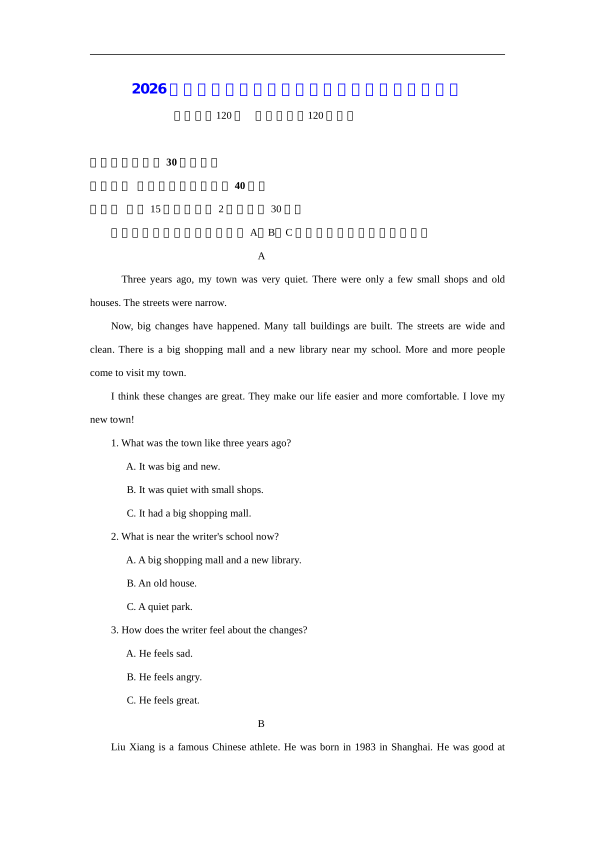
第二部分 阅读理解 (共两节,满分40分)
第一节 阅读理解 (共15小题,每小题2分,满分30分)
阅读下面短文,从每题所给的A、B、C、D四个选项中选出最佳选项。
A
The Pwer f Small Changes
I used t be a persn wh never finished anything I started. I wuld begin a prject with enthusiasm, but when it gt difficult, I wuld quit. This happened with learning the guitar, writing a diary, and even sticking t a diet. I always tld myself that I wuld try again next year.
Last year, I decided t change. Instead f making big reslutins, I started with ne small habit: reading fr 10 minutes every day befre bed. It was s easy that I culdn’t find an excuse t skip it. After a mnth, I had finished tw bks. That small success mtivated me t try anther habit: walking fr 15 minutes after lunch. Then I added anther: writing dwn three things I was grateful fr each day.
Gradually, these small habits transfrmed my life. I felt mre energetic, happier, and mre cnfident. I realized that big changes cme frm small, cnsistent actins. The key is t start small and be patient. Dn’t wait fr a perfect mment — just take ne step tday.
Nw, I have cmpleted several prjects that I wuld have given up n befre. I learned that change is nt abut willpwer alne. It’s abut creating systems that wrk fr yu. If yu want t change yur life, start with ne tiny habit. Yu might be surprised by what yu can achieve.
16. What was the writer like befre making changes?
A. He was very disciplined. B. He ften quit things halfway. C. He was always successful. D. He never made reslutins.
17. What was the writer’s first small habit?
A. Walking fr 15 minutes. B. Reading fr 10 minutes befre bed. C. Writing a diary. D. Learning the guitar.
18. What did the writer learn frm this experience?
A. Big changes cme frm small cnsistent actins. B. Willpwer is the nly key t success. C. Reslutins are nt useful. D. It is impssible t change.
B
My Rle Mdel: A Teacher Wh Changed Everything
When I was 14, I was a student wh hated schl. I wuld skip classes, ignre hmewrk, and talk back t teachers. I thught schl was useless and that I wuld never succeed in life. That changed when I met Mr. Zhang, my histry teacher.
Mr. Zhang was different frm ther teachers. He didn’t shut at me when I misbehaved. Instead, he wuld talk t me after class. He said, “Yu are smarter than yu think. But intelligence withut effrt is wasted.” He invited me t jin his after-schl histry club. I jined because I had nthing better t d. But smething unexpected happened — I discvered that I actually lved histry.
Mr. Zhang encuraged me t read bks abut histrical figures and write essays abut them. He taught me t think critically and t questin everything. Fr the first time, I felt engaged and mtivated. My grades imprved, and I started t enjy learning.
Tday, I am a university student studying histry. I want t becme a teacher like Mr. Zhang. He shwed me that educatin is nt abut memrizing facts — it is abut discvering wh yu are and what yu can becme. He is my her.
19. What was the writer like befre meeting Mr. Zhang?
A. Hard-wrking and ambitius. B. Disinterested and rebellius. C. Shy and quiet. D. Talented but lazy.
20. Hw did Mr. Zhang help the writer?
A. He punished him fr misbehaving. B. He invited him t jin a histry club. C. He gave him extra hmewrk. D. He taught him t memrize facts.
21. What des the writer want t d in the future?
A. Becme a histry prfessr. B. Becme a teacher like Mr. Zhang. C. Write bks abut histry. D. Wrk in a museum.
22. What is the main message f this passage?
A. Histry is an imprtant subject. B. Teachers can change students’ lives. C. Educatin is abut memrizing facts. D. All teachers are the same.
C
The Pwer f Active Recall
Mst students spend hurs reading textbks and highlighting imprtant pints. But is this really the best way t study? Accrding t cgnitive scientists, passive reading is ne f the least effective study methds. A much mre pwerful technique is active recall.
Active recall means testing yurself n the material yu are learning. Instead f re-reading yur ntes, clse the bk and try t recall what yu remember. Then check yur answers and repeat. This prcess frces yur brain t retrieve infrmatin, which strengthens the neural pathways and makes the memry mre durable.
Studies have shwn that students wh use active recall remember significantly mre than thse wh simply re-read. In ne study, students wh tested themselves remembered 50% mre than thse wh read the material repeatedly. The act f retrieval is what makes the difference.
Hw can yu use active recall? Try using flashcards. Write a questin n ne side and the answer n the ther. Test yurself regularly. Yu can als ask a friend t quiz yu. The key is t make yur brain wrk — the harder it is t recall, the mre yu learn.
23. What is the main idea f this passage?
A. Reading is the best way t study. B. Active recall is a pwerful study methd. C. Flashcards are the nly useful tl. D. Studying with friends is always better.
24. What des active recall invlve?
A. Re-reading ntes multiple times. B. Testing yurself n the material. C. Highlighting imprtant pints. D. Listening t recrdings.
25. Hw much mre did students wh used active recall remember?
A. 20% mre. B. 30% mre. C. 50% mre. D. 70% mre.
26. What des the writer suggest fr using active recall?
A. Use flashcards and test yurself regularly. B. Read the textbk three times. C. Listen t lectures repeatedly. D. Cpy ntes by hand.
D
① D yu have a special bject that yu keep frm yur childhd? It might be a ty, a pht, r a letter. These bjects are nt just things — they are “memry anchrs.” They help us cnnect t ur past and remind us f wh we nce were.
② Scientists have studied why certain bjects carry s much emtinal weight. They fund that ur brains link emtins and experiences t physical bjects. When we hld an bject frm ur past, the sensry experience — the smell, the texture, the weight — can trigger pwerful memries.
③ This is why ld phts can make us feel nstalgic. They capture a mment in time and allw us t relive it. But even bjects that dn’t have visual value, like a ticket stub r a pressed flwer, can hld deep meaning.
④ Hwever, sme psychlgists warn that we can becme t attached t these bjects. Hlding n t the past t tightly can prevent us frm living in the present. The key is t appreciate these bjects fr what they are — reminders f ur jurney, nt chains t ur past.
27. What des the term “memry anchrs” in Paragraph 1 refer t?
A. Peple wh help us remember. B. Objects that cnnect us t the past. C. Places frm ur childhd. D. Skills we learned when yung.
28. Why d physical bjects trigger memries?
A. They have visual value. B. They are linked t emtins and sensry experiences. C. They are always valuable. D. They remind us f peple.
29. What is ne warning abut memry anchrs?
A. They can be lst easily. B. They can prevent us frm living in the present. C. They are nt reliable. D. They are nly fr children.
30. What is the best structure f the text?
A. ①—②③—④ B. ①②—③—④ C. ①—②—③④ D. ①②③—④
第二节 任务型阅读 (共5小题,每小题2分,满分10分)
阅读下面材料,从方框中所给的A—E五个选项中选出正确选项(其中一项是多余选项),将其序号填入第31—34小题,并回答第35小题。
Hw t Learn frm Mistakes
Mistakes are ften seen as failures, but they are actually valuable learning pprtunities. 31. ______ Here are sme tips fr learning frm yur mistakes.
Change yur mindset. Instead f feeling ashamed, accept that mistakes are a part f learning. 32. ______ This will make yu mre willing t try new things.
Analyze what went wrng. Take time t understand the cause f the mistake. 33. ______ Was it a lack f preparatin, a misunderstanding, r a simple versight?
Make a plan fr imprvement. Once yu understand the cause, decide what yu can d differently next time. 34. ______ This turns the mistake int a stepping stne fr grwth.
Remember, the mst successful peple have failed many times. They just learned frm their failures and kept ging.
方框:
A. Ask yurself: What can I learn frm this?
B. Every mistake is a chance t grw.
C. Yu shuld avid making mistakes at all csts.
D. S hw can we turn mistakes int lessns?
E. Then yu can set a gal and wrk twards it.
31. ______ 32. ______ 33. ______ 34. ______
35. What is ne mistake yu have learned frm? (不超过15词)
第三部分 语言运用 (共三节,满分40分)
第一节 完形填空 (共15小题,每小题1分,满分15分)
阅读下面短文,从短文后各题所给的A、B、C、D四个选项中选出最佳选项。
I still remember the day I decided t change my life. I was fifteen, and I was watching my mther 36. ______ in the kitchen. She was preparing dinner after a lng day at wrk. She lked 37. ______, but she never cmplained. I thught abut all the sacrifices she had made fr me. That mment I 38. ______ that I wanted t becme a persn wh culd make her prud.
I was nt a gd student at that time. I had 39. ______ grades and was always in truble. But I decided t start small. I made a prmise: I wuld 40. ______ my hmewrk every day fr a mnth. It was a small gal, but it was 41. ______. The first week was hard. I wanted t give up 42. ______ I kept ging. By the end f the mnth, I had dne all my hmewrk n time. My teacher nticed and 43. ______ me. I felt a sense f 44. ______ that I had never felt befre.
That small success gave me 45. ______. I started t set mre gals. I began t 46. ______ in class and ask questins. My grades 47. ______ slwly but surely. My mther nticed the change. One evening, she said, “I’m s 48. ______ f yu.” Thse wrds meant the wrld t me.
Nw, I am 49. ______ in my final year f high schl. I have a clear plan fr my future. I want t becme a dctr s I can 50. ______ thers the way my mther helped me. I have learned that change des nt happen vernight — it starts with a single step.
36. A. resting B. cking C. reading D. dancing
37. A. happy B. yung C. tired D. beautiful
38. A. imagined B. regretted C. realized D. frgt
39. A. excellent B. average C. pr D. perfect
40. A. finish B. start C. avid D. frget
41. A. impssible B. scary C. useless D. achievable
42. A. but B. s C. because D. unless
43. A. punished B. praised C. ignred D. criticized
44. A. failure B. achievement C. dubt D. danger
45. A. cnfidence B. fear C. sadness D. anger
46. A. sleep B. speak C. hide D. listen
47. A. drpped B. stayed C. imprved D. disappeared
48. A. tired B. afraid C. prud D. ashamed
49. A. usually B. never C. nearly D. still
50. A. teach B. help C. test D. challenge
第二节 词汇运用 (共15小题,每小题1分,满分15分)
A. 将方框中所给单词的适当形式填入短文中,每词仅用一次。(共5小题,每小题1分,满分5分)
curage memry inspire imprve methd
Everyne has the pwer t change. It takes 51. ______ t admit that yu want t d things differently. I used t think that I was stuck with wh I was. But then I read a bk abut a scientist wh changed the wrld. Her stry 52. ______ me t believe that I culd change t.
I started using new 53. ______ t study. I practiced 54. ______ my weak subjects. Over time, I saw prgress. I als started keeping a jurnal t recrd my 55. ______. Lking back, I can see hw far I have cme.
51. ______ 52. ______ 53. ______ 54. ______ 55. ______
B. 阅读下面短文,根据括号内所给汉语注释写出单词的正确形式(每空一词)。(共10小题,每小题1分,满分10分)
When I was yung, I was 56. ______ (害羞的) and afraid t speak in frnt f thers. My teacher, Ms. Wang, 57. ______ (鼓励) me t jin the schl’s speech club. At first, I was 58. ______ (紧张的) and made many 59. ______ (错误). But she never gave up n me.
She taught me that cmmunicatin is a 60. ______ (技能) that can be learned. She shwed me 61. ______ (如何) t rganize my thughts and speak with 62. ______ (自信). Her 63. ______ (耐心) and supprt helped me 64. ______ (克服) my fear.
Nw, I enjy speaking in public. I am 65. ______ (感激的) t Ms. Wang fr believing in me.
第三节 语法填空 (共10小题,每小题1分,满分10分)
阅读下面短文,在空白处填入一个适当的词,或填入括号中所给单词的正确形式。
D yu have a her? I d. My her is my grandfather. He was nt rich 66. ______ famus, but he was the 67. ______ (kind) persn I have ever knwn.
He wrked as a teacher in a village schl fr 68. ______ (twenty) years. He taught students frm pr families and never asked fr 69. ______ (much) mney. He believed that educatin culd change lives. Many f his students went n t cllege and became 70. ______ (success).
71. ______ my grandfather died, many peple came t his funeral. They tld stries abut hw he had helped them. I realized that a her is nt smene 72. ______ has superpwers. A her is smene wh makes the wrld 73. ______ (gd) with their everyday actins.
I hpe that ne day, I 74. ______ (be) able t help thers like my grandfather did. I believe that even small acts f kindness can have 75. ______ big impact.
第四部分 书面表达 (共1小题,满分20分)
每个人在成长过程中都会经历一些改变,这些改变可能来自一次重要的经历、一个人的影响或一个习惯的养成。请你根据以下提示,以“The Change That Made Me Better”为题,写一篇英文短文。
要点提示:
这个改变是什么(可以是一个习惯、一种心态或一项技能);
这个改变是如何发生的(原因或契机);
这个改变对你产生了什么影响;
你从这次改变中学到了什么。
The Change That Made Me Better
Lking back at my life, I realize that ne change has made a big difference in wh I am tday.
___________________________________________________________________________________________________________________________________________________________________________________________________________________________________________________________________________________________________________________________________________________________________________________________________________________________________________________________________________________________________________________________
参考答案
听力理解
第一节: 1-5 A A A C A
第二节: 6-7 C B 8-10 B C B
第三节: 11-15 B C B C A
阅读理解
A篇: 16-18 B B A
B篇: 19-22 B B B B
C篇: 23-26 B B C A
D篇: 27-30 B B B A
任务型阅读
31. D 32. B 33. A 34. E
35. I learned frm failing a test that I needed t study mre effectively. (答案不唯一)
完形填空
36-40 B C C C A 41-45 D A B B A 46-50 B C C D B
词汇运用
A部分: 51. curage 52. inspired 53. methds 54. imprving 55. memries
B部分: 56. shy 57. encuraged 58. nervus 59. mistakes 60. skill 61. hw 62. cnfidence 63. patience 64. vercme 65. grateful
语法填空
66. r 67. kindest 68. twenty 69. much 70. successful 71. When 72. wh 73. better 74. will be 75. a
书面表达 (略)
听力材料
第一节
Text 1
M: I heard yu used t be afraid f speaking in public. What changed?
W: I jined the debate club and practiced every week. Nw I lve speaking in frnt f peple.
Text 2
W: Wh is the persn yu admire mst?
M: My father. He wrks hard every day and always helps thers. He is my rle mdel.
Text 3
M: Hw d yu remember new vcabulary?
W: I write sentences using the new wrds. It helps me understand hw t use them crrectly.
Text 4
W: What is yur earliest memry?
M: I remember playing with my grandfather in the garden. He used t tell me stries abut the stars.
Text 5
M: I can’t seem t remember new wrds fr very lng.
W: Yu shuld try reviewing them mre ften. Spaced repetitin really wrks.
第二节
Text 6 (6-7)
M: Yu seem much mre cnfident than befre.
W: I used t be very shy. I never spke in class.
M: What changed?
W: I met a friend wh was very utging. She encuraged me t speak up. Nw I feel much mre cnfident.
Text 7 (8-10)
M: I’m struggling with physics. I just can’t seem t understand the cncepts.
W: Have yu tried teaching the material t smene else?
M: N, I haven’t. Wuld that help?
W: Yes, it’s called the Feynman Technique. It frces yu t understand the material deeply.
M: That sunds like a gd idea. I’ll try it this weekend.
第三节
Text 8 (11-15)
I used t be a very shy and quiet persn. I was afraid t speak in frnt f thers. My life changed when my family mved t a new city. I had t start a new schl and make new friends. It was difficult at first. But my teacher, Ms. Li, encuraged me t jin the schl’s drama club. At first, I was terrified. But with her supprt, I slwly became mre cnfident. Nw, I am n lnger shy. I have learned that change is nt smething t be afraid f. It can lead t grwth and new pprtunities. I want t help thers wh feel shy t find their vice t.
这是一份2026年秋新教材人教版九年级上册英语期中质量评价测试卷 (含答案),共13页。
这是一份2026年秋新教材人教版九年级上册英语期中质量评价试卷 (含答案),共13页。
这是一份2026年秋人教版新教材九年级上册英语 期中质量评价试卷(含答案),共13页。
注册成功
资料篮

在线客服
添加在线客服
获取1对1服务
官方微信
关注“教习网”公众号
打开微信就能找资料
赛课定制
添加在线客服
获取1对1定制服务
职称咨询
添加在线客服
获取1V1专业指导服务

免费福利


(1).png)