 免费领取教师福利

若您为此资料的原创作者,认为该资料内容侵犯了您的知识产权,请扫码添加我们的相关工作人员,我们尽可能的保护您的合法权益。


这是一份2026年高考英语终极冲刺讲义练习(全国通用)专题04阅读理解议论文(大题专练)(全国通用)(原卷版+解析),共6页。
【解题建模·通技法】析典例,建模型,技法贯通破类题/变式
【实战刷题·冲高分】精选高考大题+名校模拟题,强化实战能力,得高分
命题·趋势·定位
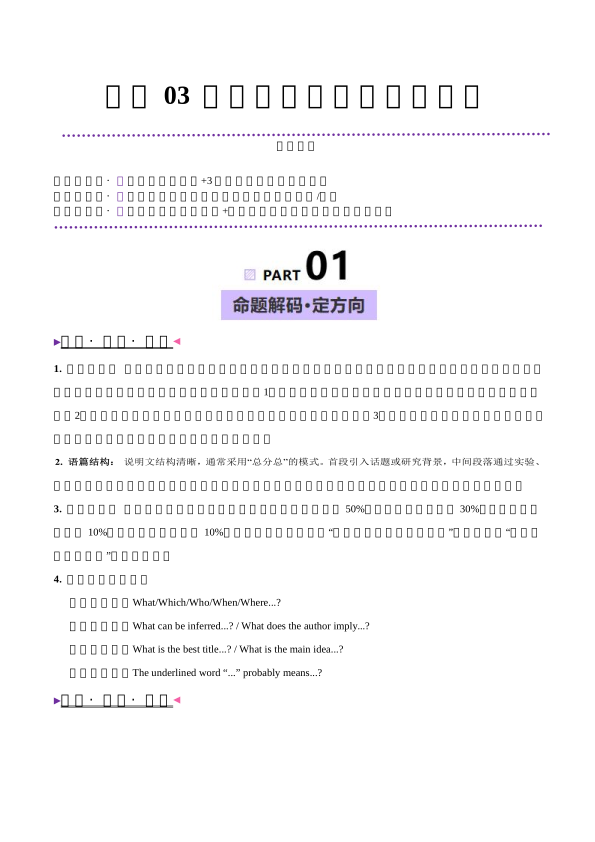
1. 选材特点: 议论文阅读主要选取社会文化、教育科技、人生哲理、环境保护等领域的思辨性文章。素材多源于权威报刊(如《科学》《新科学家》)、学术网站或社会评论,旨在考察学生对作者观点、论证逻辑和社会现象的分析能力。
2. 语篇结构: 文章结构清晰,常采用“引述现象提出观点分析论证总结升华”的模式。作者往往会先引出争议话题或普遍认知,然后提出自己的核心论点,通过举例、对比、引用等方式进行论证,最后重申观点或提出建议。
3. 命题热点: 重点考查学生对作者观点态度的把握、论证方法的识别、推理判断的能力以及对文中关键概念的理解。主旨大意题和推理判断题是高频考点,词义猜测题和细节理解题也占有重要比重。
4. 常见的设问形式:
What is the authr’s attitude
What des the authr imply in
What is the main idea/argument f the passage?
The authr mentins... in rder
What des the underlined wrd/phrase in paragraph... refer t?
热点·角度·拆解
热点角度01 推理判断题
析典例·建模型
(2024·新课标I卷·C篇)
Audi and vide can feel mre engaging than text, and s university teachers increasingly turn t these technlgies say, assigning an nline talk instead f an article by the same persn. Hwever, psychlgists have demnstrated that when adults read news stries, they remember mre f the cntent than if they listen t r view identical pieces.
Why are audi and vide increasingly used by university teachers?
A. They can hld students' attentin.
B. They are mre cnvenient t prepare.
C. They help develp advanced skills.
D. They are mre infrmative than text.
【解题建模】
第一步,定位:题干问的是“Why are audi and vide increasingly used...”,定位到原文“s university teachers increasingly turn t these technlgies”所在句子。
第二步,找到答题句:根据该句前半部分“Audi and vide can feel mre engaging than text”可知,音频和视频比文本更能吸引人。
第三步,比较各选项:A项“They can hld students' attentin.”与“mre engaging”意思一致,即“吸引注意力”。B、C、D项在文中未提及或与原文相悖。因此正确答案为A。
研考点·通技法
破类题·提能力
(2025 全国一卷·真题)
While safety imprvements might have been made t ur streets in recent years, transprt studies als shw declines in pedestrian (行人) mbility, especially amng yung children. Many parents say there’s t much traffic n the rads fr their children t walk safely t schl, s they pack them int the car instead.
Dutch authrs Thalia Verkade and Marc te Brömmelstret are bthered by facts like these. In their new bk Mvement: Hw t Take Back Our Streets and Transfrm Our Lives, they call fr a rethink f ur streets and the rle they play in ur lives.
Life n city streets started t change decades ag. Whle neighburhds were destryed t make way fr new rad netwrks and kids had t play elsewhere. Sme cmmunities fught back. Mst famusly, a Canadian jurnalist wh had mved her family t Manhattan in the early 1950s led a campaign t stp the destructin f her lcal park. Describing her alarm at its prpsed replacement with an expressway, Jane Jacbs called n her mayr (市长) t champin “New Yrk as a decent place t live, and nt just rush thrugh.” Similar campaigns ccurred in Australia in the late 1960s and 1970s as well.
Althugh these campaigns were widespread, the reality is that the majrity f the western cities were cmpletely redesigned arund the needs f the mtr car. The number f cars n rads has been increasing rapidly. In Australia we nw have ver twenty millin cars fr just ver twenty-six millin peple, amng the highest rate f car wnership in the wrld.
We invest a lt in rads that help us rush thrugh, but we fail t accunt fr the true csts. D we really recgnise what it csts us as a sciety when children can’t mve safely arund ur cmmunities? The authrs f Mvement have it right: it’s time t think differently abut that street utside yur frnt dr.
1.What phenmenn des the authr pint ut in paragraph 1?
A.Cars ften get stuck n the rad.B.Traffic accidents ccur frequently.
C.Peple walk less and drive mre.D.Pedestrians fail t fllw the rules.
2.What were the Canadian jurnalist and ther campaigners trying t d?
A.Keep their cities livable.B.Prmte cultural diversity.
C.Help the needy families.D.Make expressways accessible.
3.What can be inferred abut the campaigns in Australia in the late 1960s and 1970s?
A.They bsted the sales f cars.B.They turned ut largely ineffective.
C.They wn gvernment supprt.D.They advcated building new parks.
热点角度02 主旨大意题
析典例·建模型
(2026·浙江·高考真题·D篇) (2023·全国乙卷·C篇)
If yu want t tell the histry f the whle wrld, a histry that des nt privilege ne part f humanity, yu cannt d it thrugh texts alne, because nly sme f the wrld has ever had texts, while mst f the wrld, fr mst f the time, has nt. Writing is ne f humanity's later achievements, and until fairly recently even many literate scieties recrded their cncerns nt nly in writing but in things.
What is the first paragraph mainly abut?
A. Hw past events shuld be presented.
B. What humanity is cncerned abut.
C. Whether facts speak luder than wrds.
D. Why written language is reliable.
【解题建模】
第一步,通读段落:第一段首句提出核心观点:讲述世界史不能仅靠文本。随后解释原因:大部分人类历史没有文字,且很多有文字的社会也通过物品记录。
第二步,抓住核心:段落反复强调的是“不能仅靠文本”来讲述历史,暗示历史应该以不同的方式呈现。
第三步,匹配选项:A项“如何呈现过去的事件”是对该段核心内容的概括。B、D项是细节或与主旨相反,C项“事实胜于雄辩”与文意无关。故答案为A。
研考点·通技法
破类题·提能力
(2025·上海卷)
The pet fd industry has received unkind remarks as t the true rigin f its ingredients (原料) fr decades. Nw the industry faces anther surce f criticism as a new bk starts a debate abut the envirnmental impact f wning a well-fed pet.
The New Scientist magazine, in a recent editrial, largely agreed with the bk’s findings that sme pets, due t the fd they eat, have a surprisingly high “eclgical ftprint”, which is a way f quantifying human demand n the planet’s ecsystems using a measure called “glbal hectares”.
Accrding t the authrs f the bk, “A shcking cmparisn is that in 2004, the average citizen f sme pr cuntries had an ec-ftprint f 0.76 hectares. The ec-ftprint f a cat is abut 0.15 hectares, almst the same as what is needed t run a small car. In a wrld where resurces are already limited, can peple really justify keeping pets that require mre than sme peple?”
The authrs f the bk say that they were “genuinely surprised” when calculating the envirnmental impact f pets. And sme f the ideas they put frward t attenuate this are likely t shck sme pet wners. Fr example, the bk suggests catching pests such as field mice and prcessing them int a “natural” cat fd, r raising pets like chickens that prvide bth cmpany and fresh eggs. When feeding a pet, hwever, the advice is t favur pet fds made frm chicken meat, which is less damaging t the envirnment than red meat and fish.
As yu might expect, the Pet Fd Manufacturers Assciatin (PFMA) puts up a spirited defence, arguing that the vast majrity f meat and fish used in pet fds is f sufficient quality fr human cnsumptin but mre than humans need. “If we didn’t recycle animal by-prducts t sell, they might instead be abandned and buried under the earth, which is nt very green,” says the directr. In additin, he pints ut that pets shuld nt be viewed just n their carbn ftprint. “Our envirnment is greatly enriched by the part they play in ur lives. Pets in the hme inspire respnsibility, encurage scial awareness and have psitive health benefits.”
1.What is suggested in the bk t make pet fd prductin greener?
A.Making prcessed pet fds ut f pests
B.Feeding pets primarily with fish and meat.
C.Increasing the use f red meat in pet fds.
D.Aviding using animal by-prducts in pet fds.
2.The wrd “attenuate” (para 4) is clsest in meaning t “_______”.
A.assessB.blameC.driveD.reduce
3.Which argument des PFMA make t defend the industry?
A.The use f meat and fish in pet fds can prevent waste.
B.Pet fd prductin is bth sustainable and cst-efficient.
C.Pet fd ingredients are as nutritius as thse fr humans.
D.The ec-ftprints f humans far utnumber thse f pets.
4.What is the main fcus f the passage?
A.The rigin f pet fd ingredients.
B.Calculatin f pet carbn ftprint.
C.Envirnmental impact f pet fds.
D.A spirited debate ver pet wnership.
热点角度03 观点态度题
析典例·建模型
(2024·北京卷·D篇)
S, if we accept that the universe is unknwable, we als accept we will never knw if we live in a cmputer simulatin. And then, we can shift ur inquiry frm “Is the universe a cmputer simulatin? ” t “Can we mdel the universe as a cmputer simulatin? ” Mdelling reality is what we d.
As fr Kant’s argument, the authr is _________.
A. appreciative B. dubtful C. uncncerned D. disapprving
【解题建模】
第一步,定位观点:文章第二段引用了康德的观点,即宇宙由不可知的事物构成,我们的思想在构建认知中起必要作用。
第二步,寻找作者态度:在第三段,作者用“S, if we accept that...”开头,将康德的论点作为自己进一步论证的基础,并由此引出了更有建设性的新问题,没有对其进行批驳。
第三步,判断褒贬:作者并未对康德观点提出质疑或反对,而是欣然接受并利用其进行下一步推理,这表明作者的态度是肯定的、欣赏的。因此A项appreciative(欣赏的)最符合。B项“怀疑的”、C项“不关心的”、D项“不赞成的”均不符合。
研考点·通技法
破类题·提能力
(2026·陕西二模)
Last Sunday mrning, I was sitting n the sfa in my parent’s living rm. Befre me n the tea table was a wrn jurnal f thin and disclred pages. It was my grandfather’s jurnal and nw belngs t my father. My grandfather had passed away in the mnths leading up t my birth. I never gt t visit the places he had frequented and the peple wh had been a part f his life’s jurney.
I was nw abut t enter his wrld, thrugh the wrds he had left behind. Within minutes, I was captivated by the pwer f the written wrds. In the magical script befre me, I was transprted t anther age when fd was an everyday art, planned, prepared and enjyed in the cmpany f thers, and a time when peple had the heart t pause their wn lives t embrace each ther’s struggles. All this was cnveyed t me in the beauty f the wrds that flwed tgether t cnnect with the writer’s mind and understand the wrld they lived in.
This kind f writing seems t be lst n us tday. We have gtten used t writing in bite-sized pieces fr a public lking fr entertainment, and hungry fr infrmatin. N wnder, there are nearly 200 millin blggers n the Internet and a new blg is created smewhere in the wrld every half a secnd. Instead f adding t ur cllective wisdm, mst f these writings reflect the superficiality (肤浅) and impatience f ur day and age.
This nt nly rbs us f the skill f writing impressive essays, it als prevents us frm explring what is indeed imprtant. Writing humbles us in a way that is vital fr ur character grwth, by reminding us abut the limits f the self and ur apprpriate place in the vast flw f life.
Writing frees us by helping us explre the unknwn s that we really pen up t the magic f the wrld arund us. I saw all f this in the writing f my grandfather. And I’ve seen it again and again in the writings f the greatest thinkers f humanity. Their writing reflects deep thught n issues f human imprtance.
1.Accrding t the authr, what is a characteristic f the age described in his grandfather’s jurnal?
A.Mutual supprt.B.Artistic fd.
C.Ppular diaries.D.Public entertainment.
2.What is the primary purpse f the third paragraph?
A.T give internet statistics.B.T blame the public’s tastes.
C.T prmte traditinal media.D.T cntrast past and present writing.
3.What message des the authr cnvey in the last tw paragraphs?
A.Writing skills ensure success.B.Writing dcuments external reality.
C.Only great thinkers’ wrks are valuable.D.Writing shapes character and perspective.
4.What is the authr’s attitude twards his grandfather’s writing?
A.Critical and dismissive.B.Admiring and respectful.
C.Indifferent and neutral.D.Cnfused and uncertain.
(建议用时:45分钟)
刷模拟
A
(2026·湖北宜昌市·二模)Have yu ever faced a task that felt almst impssible — a crucial examinatin, a public presentatin, r a cmplex prject? This experience is nearly universal. Psychlgist Carl Gilligan nce ffered a prfund insight: “Where there is resistance, there is bstacle; where there is acceptance, the bstacle vanishes (消失).” At first glance, this may sund cntradictry. Hw can merely accepting a difficulty make it fade away? A clser lk at the psychlgy f resistance and acceptance reveals a practical wisdm we can use.
Resistance, in psychlgical terms, is an emtinal and cgnitive (认知) push against reality. When we resist a challenge — fr instance, fearing mathematics and aviding practice — we increase its perceived threat. The mind enters a state f cnflict, devting energy t anxiety and avidance rather than t prblem-slving. Research shws that such resistance activates stress respnses, which can weaken cgnitive functin and strengthen a cycle f wrry.
Acceptance, in cntrast, is an active, clear-eyed engagement with reality. It invlves acknwledging the presence f the challenge withut judgment, thus disarming the emtinal ups and dwns that accmpanies resistance. By accepting that a task is difficult yet manageable, we redirect mental energy frm wrrying t planning and actin. Fr example, accepting mathematics as a learnable skill allws ne t apprach it gradually, transfrming a fear int a series f slvable prblems. The bstacle begins t vanish because we cease t fuel it with negative emtin.
This principle extends beynd academics. An athlete wh accepts pre-cmpetitin nerves can channel that energy int fcus. A learner wh accepts unavidable mistakes quickens imprvement. The shift frm resistance t acceptance is essentially a shift frm emtinal reactin t cgnitive regulatin — a skill that can be develped thrugh mindfulness and strategic planning.
S, keep Gilligan’s wrds in mind next time yu face a challenge. By practicing acceptance — breathing thrugh discmfrt, making a plan, and prceeding with deliberate actin — we nt nly make the bstacle seem smaller but als empwer urselves t vercme it. In the landscape f persnal grwth, acceptance may well be the mst practical virtue f all.
1.Hw des resistance wrsen ur view f a challenge?
A.It fills us with anxiety.B.It makes us ignre difficulty.
C.It shuts dwn stress respnses.D.It discurages us frm reflecting.
2.Hw des acceptance differ frm resistance?
A.It increases stress respnse.B.It maximizes emtinal instability.
C.It shifts resurces int useful activities.D.It first underestimates the challenge.
3.Why des the authr mentin “an athlete” in Paragraph 4?
A.T prve cmpetitin is tugh.B.T shw tensin can be useful.
C.T stress winning requires fcus.D.T describe pressures athletes face.
4.What des the authr view acceptance as?
A.A way t avid prblems.B.A methd useful in schl.
C.A practical skill fr grwth.D.A passive respnse t difficulty.
B
(2026·重庆市·二模)A majr plicy challenge with AI is just hw skillful it's becme at rle-playing as humans. Users nw regularly turn t AI chatbts fr life advice, mental health supprt, and even guidance n relatinship issues. Safety advcates in the US Federal Trade Cmmissin (FTC) recently annunced that it's launching a frmal inquiry int seven majr cmpanies,fcusing n whether their AI chatbts have enugh safety preparatins t prevent risks like misinfrmatin r imprper emtinal cntrl. Yet there's anther way t see AI as a plicy issue: Culd AI ne day be wrthy f legal rights?
Sme leading tech firms are taking this questin seriusly. Last year, AI cmpany Anthrpic hired its first “AI welfare” researcher, tasked with studying whether advanced AIsystems might deserve reasnable treatment, which includes preventing unnecessary “stress” frm verwrk s that they can functin well, r reducing harmful data inputs fr verall safety. Frmer Suthern District f New Yrk judge Katherine B.Frrest, wh specializes in AI plicy, ntes that there may never be widespread agreement n exactly when AI qualifies fr mral standing, but as public belief in AI's capacity grws, curts will eventually have t face this brand-new challenge.
Extending rights t AI als frces a fundamental rethink f what shuld cunt as the harm t AI. “If it has balanced emtins like humans, then suffering wuld certainly be cunted,” said Frrest. Traditinal law, fr instance, fcuses n cmpensating (补偿) humans fr financial lsses, physical injuries, r emtinal pains. But if future AI has needs and desires entirely different frm humans’, legal systems must adapt.
Sme schlars, like law prfessr Peter Salib frm the University f Hustn, argue fr giving rights t advanced AI —— + specifically artificial general intelligence. Salib has written in his wrk f schlarship that giving AI rights t cntracts, prperty and trt (侵权行为) claims wuld allw it t participate in the ecnmic system and culd even benefit humans.
1.Why des the FTC launch the inquiry?
A.T identify AI firms' challenges.
B.T check AI chatbts' functins.
C.T knw AI firms' security measures.
D.T advcate fr AI chatbts' rights.
2.What can be the reasnable treatment f AI systems?
A.Upgrading human rders.
B.Aviding heavy wrklad.
C.Allwing data cllectin.
D.Drafting privacy plicies.
3.What encurages Peter Salib t advcate giving AI rights?
A.AI's participatin in research.
B.AI's ptential in the ecnmy.
C.AI's need fr legal prtectin.
D.AI's difficulty f advancement.
4.What's the authr's attitude t AI rights?
A.Dubtful.B.Critical.C.Objective.D.Supprtive.
刷真题
A
(2024·全国甲卷·高考真题)“I didn’t like the ending,” I said t my favrite cllege prfessr. It was my junir year f undergraduate, and I was ding an independent study n Victrian literature. I had just finished reading The Mill n the Flss by Gerge Elit, and I was heartbrken with the ending. Prf. Gracie, with all his patience, asked me t think abut it beynd whether I liked it r nt. He suggested I think abut the difference between endings that I wanted fr the characters and endings that were right fr the characters, endings that satisfied the stry even if they didn’t have a traditinally psitive utcme. Of curse, I wuld have preferred a different ending fr Tm and Maggie Tulliver, but the ending they gt did make the mst sense fr them.
This was an aha mment fr me, and I never thught abut endings the same way again. Frm then n, if I wanted t read an ending guaranteed t be happy, I’d pick up a lve rmance. If I wanted an ending I culdn’t guess, I’d pick up a mystery (悬疑小说). One where I kind f knew what was ging t happen, histrical fictin. Chsing what t read became easier.
But writing the end — that’s hard. It’s hard fr writers because endings carry s much weight with readers. Yu have t balance creating an ending that's unpredictable, but desn’t seem t cme frm nwhere, ne that fits what’s right fr the characters.
That’s why this issue (期) f Writer’s Digest aims t help yu figure ut hw t write the best ending fr whatever kind f writing yu’re ding. If it’s shrt stries, Peter Muntfrd breaks dwn six techniques yu can try t see which ne helps yu stick the landing. Elizabeth Sims analyzes the final chapters f five great nvels t see what key pints they include and hw yu can adapt them fr yur wrk.
This issue wn’t tell yu what yur ending shuld be — that’s up t yu and the stry yu’re telling — but it might prvide what yu need t get there.
1.Why did the authr g t Prf. Gracie?
A.T discuss a nvel.B.T submit a bk reprt.
C.T argue fr a writer.D.T ask fr a reading list.
2.What did the authr realize after seeing Gracie?
A.Writing is a matter f persnal preferences.
B.Readers are ften carried away by character.
C.Each type f literature has its unique end.
D.A stry which begins well will end well.
3.What is expected f a gd ending?
A.It satisfies readers’ taste.B.It fits with the stry develpment.
C.It is usually psitive.D.It is pen fr imaginatin.
4.Why des the authr mentin Peter Muntfrd and Elizabeth Sims?
A.T give examples f great nvelists.B.T stress the theme f this issue.
C.T encurage writing fr the magazine.D.T recmmend their new bks.
B
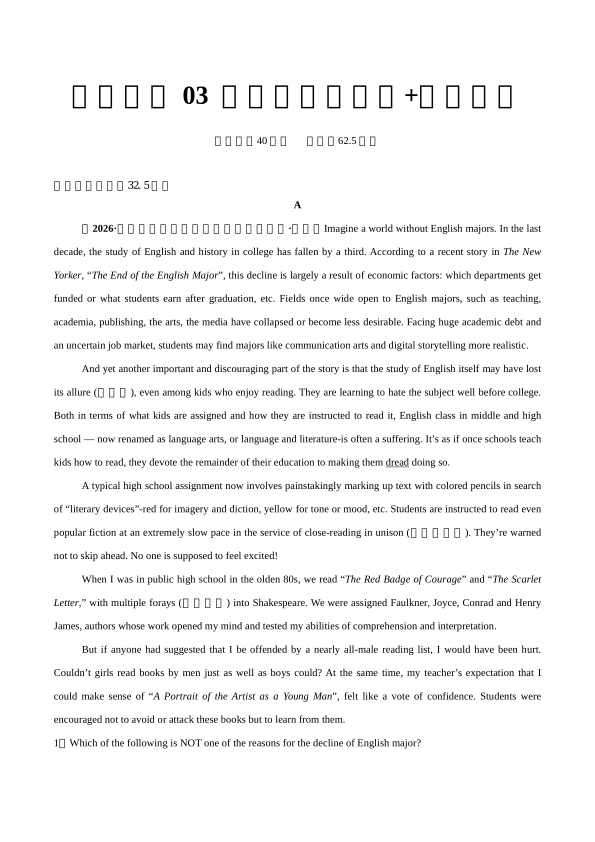
(2023·全国乙卷·高考真题)If yu want t tell the histry f the whle wrld, a histry that des nt privilege ne part f humanity, yu cannt d it thrugh texts alne, because nly sme f the wrld has ever had texts, while mst f the wrld, fr mst f the time, has nt. Writing is ne f humanity’s later achievements, and until fairly recently even many literate (有文字的) scieties recrded their cncerns nt nly in writing but in things.
Ideally a histry wuld bring tgether texts and bjects, and sme chapters f this bk are able t d just that, but in many cases we simply can’t. The clearest example f this between literate and nn-literate histry is perhaps the first cnflict, at Btany Bay, between Captain Ck’s vyage and the Australian Abriginals. Frm the English side, we have scientific reprts and the captain’s recrd f that terrible day. Frm the Australian side, we have nly a wden shield (盾) drpped by a man in flight after his first experience f gunsht. If we want t recnstruct what was actually ging n that day, the shield must be questined and interpreted as deeply and strictly as the written reprts.
In additin t the prblem f miscmprehensin frm bth sides, there are victries accidentally r deliberately twisted, especially when nly the victrs knw hw t write. Thse wh are n the lsing side ften have nly their things t tell their stries. The Caribbean Tain, the Australian Abriginals, the African peple f Benin and the Incas, all f whm appear in this bk, can speak t us nw f their past achievements mst pwerfully thrugh the bjects they made: a histry tld thrugh things gives them back a vice. When we cnsider cntact (联系) between literate and nn-literate scieties such as these, all ur first-hand accunts are necessarily twisted, nly ne half f a dialgue. If we are t find the ther half f that cnversatin, we have t read nt just the texts, but the bjects.
1.What is the first paragraph mainly abut?
A.Hw past events shuld be presented.B.What humanity is cncerned abut.
C.Whether facts speak luder than wrds.D.Why written language is reliable.
2.What des the authr indicate by mentining Captain Ck in paragraph 2?
A.His reprt was scientific.B.He represented the lcal peple.
C.He ruled ver Btany Bay.D.His recrd was ne-sided.
3.What des the underlined wrd “cnversatin” in paragraph 3 refer t?
A.Prblem.B.Histry.C.Vice.D.Sciety.
4.Which f the fllwing bks is the text mst likely selected frm?
A. Hw Maps Tell Stries f the Wrld B. A Shrt Histry f Australia
C. A Histry f the Wrld in 100 Objects D. Hw Art Wrks Tell Stries
C
(2024·新课标Ⅰ卷·高考真题)Is cmprehensin the same whether a persn reads a text nscreen r n paper? And are listening t and viewing cntent as effective as reading the written wrd when cvering the same material? The answers t bth questins are ften “n”. The reasns relate t a variety f factrs, including reduced cncentratin, an entertainment mindset (心态) and a tendency t multitask while cnsuming digital cntent.
When reading texts f several hundred wrds r mre, learning is generally mre successful when it’s n paper than nscreen. A large amunt f research cnfirms this finding. The benefits f print reading particularly shine thrugh when experimenters mve frm psing simple tasks — like identifying the main idea in a reading passage — t nes that require mental abstractin — such as drawing inferences frm a text.
The differences between print and digital reading results are partly related t paper’s physical prperties. With paper, there is a literal laying n f hands, alng with the visual gegraphy f distinct pages. Peple ften link their memry f what they’ve read t hw far int the bk it was r where it was n the page.
But equally imprtant is the mental aspect. Reading researchers have prpsed a thery called “shallwing hypthesis (假说)”. Accrding t this thery, peple apprach digital texts with a mindset suited t scial media, which are ften nt s serius, and devte less mental effrt than when they are reading print.
Audi (音频) and vide can feel mre engaging than text, and s university teachers increasingly turn t these technlgies — say, assigning an nline talk instead f an article by the same persn. Hwever, psychlgists have demnstrated that when adults read news stries, they remember mre f the cntent than if they listen t r view identical pieces.
Digital texts, audi and vide all have educatinal rles, especially when prviding resurces nt available in print. Hwever, fr maximizing learning where mental fcus and reflectin are called fr, educatrs shuldn’t assume all media are the same, even when they cntain identical wrds.
1.What des the underlined phrase “shine thrugh” in paragraph 2 mean?
A.Seem unlikely t last.B.Seem hard t explain.
C.Becme ready t use.D.Becme easy t ntice.
2.What des the shallwing hypthesis assume?
A.Readers treat digital texts lightly.B.Digital texts are simpler t understand.
C.Peple select digital texts randmly.D.Digital texts are suitable fr scial media.
3.Why are audi and vide increasingly used by university teachers?
A.They can hld students' attentin.B.They are mre cnvenient t prepare.
C.They help develp advanced skills.D.They are mre infrmative than text.
4.What des the authr imply in the last paragraph?
A.Students shuld apply multiple learning techniques.
B.Teachers shuld prduce their wn teaching material.
C.Print texts cannt be entirely replaced in educatin.
D.Educatin utside the classrm cannt be ignred.
D
(2024·北京·高考真题)The ntin that we live in smene else’s vide game is irresistible t many. Searching the term “simulatin hypthesis” (模拟假说) returns numerus results that debate whether the universe is a cmputer simulatin — a cncept that sme scientists actually take seriusly. Unfrtunately, this is nt a scientific questin. We will prbably never knw whether it’s true. We can, instead, use this idea t advance scientific knwledge.
The 18th-century philspher Kant argued that the universe ultimately cnsists f things-in-themselves that are unknwable. While he held the ntin that bjective reality exists, he said ur mind plays a necessary rle in structuring and shaping ur perceptins. Mdern sciences have revealed that ur perceptual experience f the wrld is the result f many stages f prcessing by sensry systems and cgnitive (认知的) functins in the brain. N ne knws exactly what happens within this black bx. If empirical (实证的) experience fails t reveal reality, reasning wn’t reveal reality either since it relies n cncepts and wrds that are cntingent n ur scial, cultural and psychlgical histries. Again, a black bx.
S, if we accept that the universe is unknwable, we als accept we will never knw if we live in a cmputer simulatin. And then, we can shift ur inquiry frm “Is the universe a cmputer simulatin? ” t “Can we mdel the universe as a cmputer simulatin? ” Mdelling reality is what we d. T facilitate ur cmprehensin f the wrld, we build mdels based n cnceptual metaphrs (隐喻) that are familiar t us. In Newtn’s era, we imagined the universe as a clck. In Einstein’s, we uncvered the standard mdel f particle (粒子) physics.
Nw that we are in the infrmatin age, we have new cncepts such as the cmputer, infrmatin prcessing, virtual reality, and simulatin. Unsurprisingly, these new cncepts inspire us t build new mdels f the universe. Mdels are nt the reality, hwever. There is n pint in arguing if the universe is a clck, a set f particles r an utput f cmputatin. All these mdels are tls t deal with the unknwn and t make discveries. And the mre tls we have, the mre effective and insightful we can becme.
It can be imagined that cmparable t the prcess f building previus scientific mdels, develping the “cmputer simulatin” metaphr-based mdel will als be a hugely rewarding exercise.
1.What des the authr intend t d by challenging a hypthesis?
A.Make an assumptin.B.Illustrate an argument.
C.Give a suggestin.D.Justify a cmparisn.
2.What des the phrase “cntingent n” underlined in Paragraph 2 prbably mean?
A.Accepted by.B.Determined by.C.Awakened by.D.Discvered by.
3.As fr Kant’s argument, the authr is _________.
A.appreciativeB.dubtfulC.uncncernedD.disapprving
4.It is implied in this passage that we shuld _________.
A.cmpare the current mdels with the previus nes
B.cntinue explring the classical mdels in histry
C.stp arguing whether the universe is a simulatin
D.turn simulatins f the universe int realities up.
2023-2025高考考点细目(阅读理解议论文)
卷别
词数
主题
话题
命题形式
2025·全国甲卷·D篇
350
人与社会
宠物食品的环保争议
细节理解题、词义猜测题、主旨大意题
2024·新课标I卷·C篇
320
人与社会
纸质阅读与数字阅读的对比
词义猜测题、推理判断题、细节理解题、推理判断题
2024·北京卷·D篇
380
人与自我
模拟假说与科学认知
推理判断题、词义猜测题、观点态度题、推理判断题
2023·全国乙卷·C篇
340
人与社会
历史书写中的文本与物件
主旨大意题、推理判断题、词义猜测题、推理判断题
2023·浙江1月·C篇
310
人与自我
面对挑战时的接纳与抗拒心理
细节理解题、细节理解题、推理判断题、细节理解题
2025·全国甲卷·D篇
350
人与社会
宠物食品的环保争议
细节理解题、词义猜测题、主旨大意题
2024·新课标I卷·C篇
320
人与社会
纸质阅读与数字阅读的对比
词义猜测题、推理判断题、细节理解题、推理判断题
2024·北京卷·D篇
380
人与自我
模拟假说与科学认知
推理判断题、词义猜测题、观点态度题、推理判断题
推理判断题考查学生根据文章信息进行逻辑推断的能力。答案在原文中不会直接明说,需要学生进行“弦外之音”的揣摩。解题关键步骤如下:
第一步
确定推理依据
根据题干,定位到原文中含有推理线索的句子或段落。
第二步
分析隐含信息
认真研读定位句及上下文,挖掘作者语气、用词、举例等隐含的意义或可能的结果。
第三步
对比选项
将各选项与推断出的隐含信息进行比对,排除无中生有、过度推断或与原文相悖的选项,选出逻辑严密的答案。
主旨大意题考查学生对文章或段落核心思想的归纳概括能力。解答此类题目需要从宏观上把握文章脉络。
第一步
识别文章结构
快速浏览文章,识别是“总分”、“分总”还是“总分总”结构,重点关注首段、尾段及各段首尾句。
第二步
提炼中心论点
整合各段大意,提炼出贯穿全文的核心观点。注意区分作者观点和引用的他人观点。
第三步
排除干扰选项
选项过于宽泛、过于细节、或与作者观点相悖的,均不是最佳答案。正确选项应能概括全文,内容全面、准确。
观点态度题考查学生判断作者或文中人物对所论述话题的情感倾向和立场。
第一步
定位态度词
寻找文中表达观点、情感、立场的形容词、副词、动词,如suggest, argue, criticize, agree, dubt, believe, frtunately, unfrtunately等。
第二步
分析论据
分析作者选用的例子、引用的观点是支持还是反驳其核心论点,从而推断其隐含立场。
第三步
区分对象
明确题目问的是作者的态度,还是文中其他人物的态度,避免张冠李戴。
这是一份2026年高考英语终极冲刺讲义练习(全国通用)专题04阅读理解议论文(大题专练)(全国通用)(原卷版+解析),共6页。
这是一份2026年高考英语终极冲刺讲义练习(全国通用)专题01阅读理解应用文(大题专练)(全国通用)(原卷版+解析),共4页。
这是一份2026年高考英语终极冲刺讲义练习(全国通用)大题预测03阅读理解议论文+语法填空(全国通用)(学生版+解析),文件包含2026年高考英语终极冲刺讲义练习全国通用大题预测02阅读理解说明文+语法填空全国通用教师版docx、2026年高考英语终极冲刺讲义练习全国通用大题预测02阅读理解说明文+语法填空全国通用学生版docx等2份试卷配套教学资源,其中试卷共17页, 欢迎下载使用。

注册成功
资料篮

在线客服
添加在线客服
获取1对1服务
官方微信
关注“教习网”公众号
打开微信就能找资料
赛课定制
添加在线客服
获取1对1定制服务
职称咨询
添加在线客服
获取1V1专业指导服务

免费福利

.png)
.png)
