 免费领取教师福利



若您为此资料的原创作者,认为该资料内容侵犯了您的知识产权,请扫码添加我们的相关工作人员,我们尽可能的保护您的合法权益。


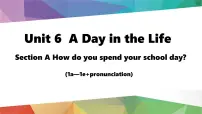
这是一份人教版(2024)七年级上册(2024)Unit 6 A Day in the Life Section A授课ppt课件,共41页。
第2课时 (Section A Pronunciation 1-2e)Unit 6 A Day in the LifeEnjoy a song辅音consonantsWhat consonants have you learnt?Review and sayPronunciationListen and repeat.发音要领辅音/s/辅音/z/舌尖前伸靠近上齿龈,让气流从舌前端和上下齿缝隙中挤出时摩擦成音发音要领辅音/ʃ/辅音/ʒ/舌身整个抬起,舌前部靠近上齿龈。双唇稍向前突出,让气流从舌面与口腔上壁间的缝隙中挤出时摩擦成音发音要领辅音/tʃ/辅音/dʒ/舌尖抵住上齿龈,让气流从舌齿间的缝隙中冲挤而出。发音要领辅音/θ/辅音/ð/舌尖轻抵上齿背或放在上下齿之间,让气流从舌齿间的缝隙中挤出时摩擦成音Let’s sort/z//ʃ//ʒ//tʃ//dʒ//θ//ð/voiceless consonant 清辅音voiced consonant 浊辅音/s/Put the consonants into the right house.Listen to the beginning part of the conversation in 2a and repeat. Notice the stressed words. Then mark other stressed words in the conversation in 2a.Lu Jiaqi: Hi! I’m Lu Jia qi, a school re porter. What’s your name? Tom: Tom.Lu Jiaqi: So Tom, what time do you usually get up? Tom: At a quarter to seven.英语中每个独立的词都有重音,但在连贯言语中有些词就失去重音了,这是因为并非所有的词在语句中都有同等的重要性。一般来说,名词、动词、形容词和副词等重读,而冠词、连词、介词、人称代词、助动词、情态动词肯定式等不重读。例如:句子重音(Sentence Stress)A: I can sing, but I can’t dance. A: Does she like history? B: No, she doesn’t. (3) A: What time do you usually get up? B: At eight thirty in the morning.Watch and thinkWatch and reviewContent words are stressed. Function words are unstressed. 实词重读,虚词弱读。The time gap between stressed words is approximately the same. 重读单词之间的时间间隔大致是相同的。Content Words (more stress)Function Words (less stress)Nouns (paper, coffee, John)Main Verbs (talk, say, find)Adjectives (tall, res, nice)Adverbs (often, slowly)Numerals (one, two, first)Prepositions (on, in, at)Articles (a, the, some)Modal verb (can, could)Conjunctions (and, but)Personal pronouns (it, he, she, I)Auxiliary Verbs (be, do, will)7:007:057:158:0016:0016:3018:2019:1021:30Pre-listeningWhere are they?What are their identities (身份)? How do you tell that? What are they talking about?Look and guess While-listeningListen to the conversation and find the answers.TomLu Jiaqia studenta school reporter校园记者at the playground.They’re talking about ____________.A. Tom’s school day routine.B. Lu Jiaqi’s school day routine.C. Tom and Lu Jiaqi’s school day routine.n. 常规If you are a school report, what questions will you ask about students’ school day routine?Listen to the conversation and fill in the blanks.Lu Jiaqi:Hi! I’m Lu Jiaqi, a school reporter. What’s your name?Tom: Tom.Lu Jiaqi: So Tom, what time do you usually get up?Tom: At 6:45.Lu Jiaqi: And then?Tom: I have breakfast at about _____________. Then I go to school at 7:50.7:10Lu Jiaqi:When do you go home?Tom: Around ____.Lu Jiaqi: What do you do after that?Tom: Sometimes I play basketball. I have dinner at ___________. Then I do my homework.Lu Jiaqi: When do you usually go to bed?Tom: At ____________.Lu Jiaqi: That’s early!Tom: Well, you know the saying, “Early to bed, early to rise!”6:309:305:00adv. & prep. 大约;环绕;到处do (one’s)homework做家庭庭作业上床睡觉早睡早起Language pointWell, you know the saying, “Early to bed, early to rise!” (教材P61 2a)rise /raɪz/ v. 起床;升起;增长 n.增加;增强(1)【不及物动词 】起床He rises from his bed quickly. 他迅速从床上爬起来。(2)【不及物动词】升起;增长表示主语在位置上升高、数量或价值等方面增加,比如太阳的升起、价格的上涨、温度的上升等The sun rises from the east.太阳从东边升起。You can watch the sea water rise and fall on the beach.你可以在沙滩看潮起潮落。(3)【可数名词】增加;增强a rise in food prices食品价格上涨a great rise in the number of students 学生人数大幅增加用rise或raise的适当形式填空。1. How does a balloon (气球) ______ in the air?2. I don’t know what my teacher says, so I _____ my hand to ask.3. The sun always ______ early in summer.4. The teacher chooses me to _______ the national flag on Monday.riseraiserisesraiseRead and choose.What time does Tom usually get up?A. At 6:30.B. At 6:40.C. At 6:45.What time does Tom go to school?A. At 7:40. B. At 7:50. C. At 8:00.Tips: We usually use what time to ask specific time. specific timeWhen does Tom usually go to bed?A. At 9:20. B. At 9:25. C. 9:30.When does Tom do his homework?A. After dinner. B. Before dinner.Tips: We use when for both specific time and any time period.time periodspecific timeRead the conversation and answer the questions.1. What does Lu jiaqi ask Tom about?2. How long does Tom stay at school?3. Why does Tom go to bed early?She asks Tom about his school day routine.Tom stays at school for about nine hours.Because he wants to get up/ rise early.v. 停留;待Language pointHow long does Tom stay at school? (教材P62 2b)how long (1)多长时间用来询问某个动作所持续的时间,其谓语动词为延续性动词,答语通常为表示一段时间的名词性短语。—How long does it take you to walk home every day? 你每天步行回家花多长时间?—Around half an hour.大约半小时。(2)多长 用来询问物体的长度。—How long is the whiteboard? 这块白板有多长?—lt’s about two meters. 大约2米。Read again and complete Tom’s school day timetable.TimeTom’s activity6:45 a.m.get uphave breakfast7:50 a.m.go homebefore dinnerhave dinnerafter dinnergo to bed7:10 a.m.go to schoolaround 5:00 p.m.play basketball6:30 p.m.do homework9:30 p.m.Tom’s school day is _______________.wonderful 精彩的meaningful 有意义的colorful 丰富多彩的planned 有计划的full 充实的…Think and sayWhat do you think of “Early to bed, early to rise!”?It is a good habit.It is good for our health.We’ll be energetic (精力充沛的) for the coming day.We won’t be in a hurry.Good to knowDon’t stay up late.Get up/Rise early.Make good use of time and plan life well.make use of使用······;利用······Lu JiaqiTomListen to the conversation again and pay attention to the stressed words. Then role-play the conversation.A: Hi! I’m .., a school reporter. What’s your name?B: Tom.A: So Tom, what time do you usually …?B: At ... I have breakfast at ... Then I … at ... …Ask a partner about his or her school day routine. Then give a report.A: What time do you get up on a school day?B: I get up at …A: When do you …?B: I …This is …’s school day routine. He / She gets up at … He / She has breakfast at … He / She goes to school at … He / She goes home at… He / She does homework at …He / She goes to bed at … SummaryKey wordsreporter, around, homework, saying, rise, stay, routinePhrasego to bed, make use ofPronunciation1. /s/ /z/ /ʃ/ /ʒ/ /tʃ/ /dʒ/ /θ/ /ð/2.句子重音 我妈妈很累,很早就上床睡觉了。 My mother is tired and _____ _____ ______early.萨莉通常晚餐后做作业。 Sally usually ____ ____ ___________ after dinner.我哥哥是一名记者。 My brother is a ________. goes to bedreporter一、根据汉语意思完成句子,每空一词。Exercisedoes her homework二、用方框中所给单词的适当形式填空。homework early stay around routine1. He goes to work on the _______ bus.2. Tom and Peter are talking about their school _______.3. We have much _________ to do every evening.4. A bird _______in the tree chirping (叽叽喳喳地叫).5. There are some big trees _________his house.earlyroutineshomeworkstaysaroundHomework1. Recite the new words and phrases.2. Practice the conversation in 2a with your friends.3. Tell your parents about your school day routine.
这是一份人教版(2024)七年级上册(2024)Unit 6 A Day in the Life Section A授课ppt课件,共41页。
这是一份英语七年级上册(2024)Unit 6 A Day in the Life Section A图片课件ppt,共38页。
这是一份人教版(2024)七年级上册(2024)Unit 6 A Day in the Life Section A教学演示课件ppt,共33页。PPT课件主要包含了get up,10 am,00 pm,30 pm,At 930,New words,Sentences等内容,欢迎下载使用。
注册成功
资料篮

在线客服
添加在线客服
获取1对1服务
官方微信
关注“教习网”公众号
打开微信就能找资料
赛课定制
添加在线客服
获取1对1定制服务
职称咨询
添加在线客服
获取1V1专业指导服务

免费福利

.png)
.png)
.png)
