 免费领取教师福利
若您为此资料的原创作者,认为该资料内容侵犯了您的知识产权,请扫码添加我们的相关工作人员,我们尽可能的保护您的合法权益。

这是一份开学摸底卷 (广东专用)2026-2027学年 外研版 九年级英语上册含听力音频含答案试卷主要包含了考生必须保持答题卡的整洁,B.18等内容,欢迎下载使用。
本试卷共12页,81小题,满分120分。考试用时90分钟。
注意事项:
1.答题前,考生务必用黑色字迹的签字笔或钢笔将自己的准考证号、姓名、考场号和座位号填写在答题卡上。用2B铅笔在“考场号”和“座位号”栏相应位置填涂自己的考场号和座位号。将条形码粘贴在答题卡“条形码粘贴处”。
2.作答选择题时,选出每小题答案后,用2B铅笔把答题卡上对应题目选项的答案信息点涂黑。如需改动,用塑料橡皮擦干净后,再选涂其他答案,答案不能写在试卷上。
3.非选择题必须用黑色字迹的签字笔或钢笔作答,答案必须写在答题卡各题目指定区域内相应位置上。如需改动,先划掉原来的答案,然后再写上新的答案;不准使用铅笔和涂改液。不按以上要求作答的答案无效。
4.考生必须保持答题卡的整洁。考试结束后,将试卷和答题卡一并交回。
一、听说应用(本大题共30小题,每小题1分,共30分;A、B、C、D部分为听力理解,
E部分为情景对话)
A.听句子(本题共5小题,每小题1分,共5分)
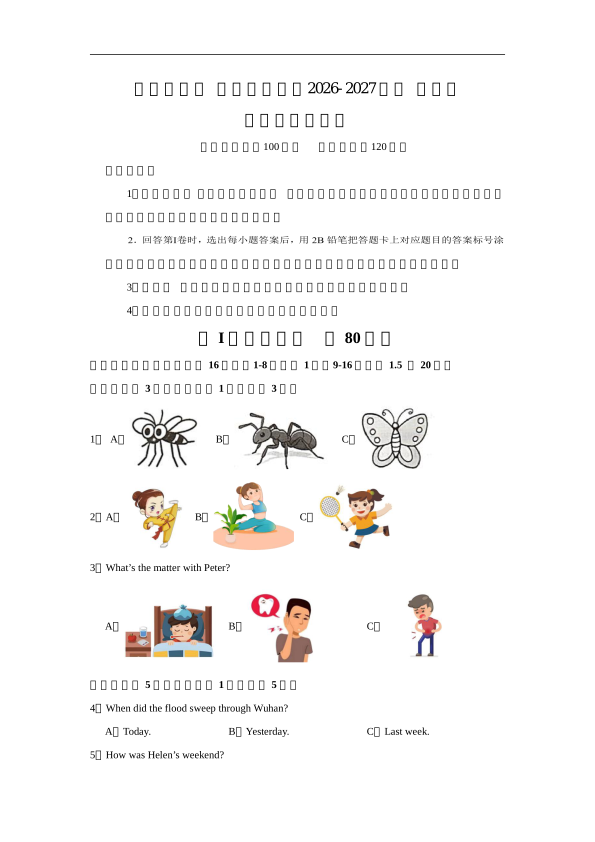
1.What des Amy lve ding?
A.B.C.
【答案】A
【原文】Amy lves making wrd cards.
2.What seasn d they talk abut?
A.B.C.
【答案】B
【原文】M: Hi, Lisa. It’s cld tday. Hw d yu feel?
W: Yeah, I feel cld, t. It is always t cld in winter in nrthern China.
M: My city is als cld in winter.
Questin: What seasn d they talk abut?
3.What is Susan’s animal sign?
A.B.C.
【答案】A
【原文】M: I was brn in the Year f the Tiger. What’s yur animal sign, Susan?
W: Oh, I was brn in the Year f the Mnkey.
4.When des Kate ften help her parents clean their huse?
A.B.C.
【答案】C
【原文】Kate ften helps her parents clean their huse n Saturday.
5.Which subject is Jhn interested in?
A.B.C.
【答案】A
【原文】W: I’m interested in Maths. Hw d yu like it, Jhn?
M: I think it’s as bring as English. But I’m crazy abut Histry.
B.听对话(本题共10小题,每小题1分,共10分)
6.Which seasn des the wman think is the best time t g fishing?
A.Winter.B.Spring.C.Summer.
【答案】A
【原文】M: The best time t g fishing is in July.
W: I dn’t think s. I think it’s in December.
7.What is Steven ging t be in the future?
A.An engineer.B.A scientist.C.A teacher.
【答案】B
【原文】A: Hw hard yu are studying, Steven!
B: Yeah, ur teacher said I will achieve my dream t be a scientist if I wrk hard.
8.What can Susan d better than Mary?
A.Dance.B.Sing.C.Paint.
【答案】B
【原文】A: Mary dance is much better than Susan, desn’t she?
B: Yes, but Susan is better at singing than Mary. Maybe it’s because Susan’s parents are bth singers.
9.What d we learn abut the girl’s hmewrk?
A.There is t much.B.There isn’t much.C.She is tired f it.
【答案】B
【原文】A: D yu and yur classmates have a lt f hmewrk t d every day?
B: N, there isn’t much, but sme f my classmates have t spend much mre time n it.
10.What are the speakers mainly talking abut?
A.A weekend plan.B.The city f Lndn.C.A travel experience.
【答案】A
【原文】M: D yu have any plans fr weekends?
W: Nthing much.
M: Well, wuld yu like me t shw yu arund in Lndn?
W: Oh, that sunds very nice. Thank yu very much.
听对话,回答小题。
11.Hw des the girl feel nw?
A.Relaxed.B.Stressed.C.Excited.
12.What des the girl d befre an exam?
A.She des mre hmewrk.B.She asks teachers fr help.C.She listens t music.
【答案】11.A 12.C
【原文】A: Hw are yur exams ging?
B: Nt bad, actually. I think I’m ding pretty well.
A: I dn’t knw hw yu stay s relaxed. I’m really stressed.
B: I always listen t relaxing music befre I have an exam, which keeps my head cl.
A: That sunds like a gd idea. I’ll try it.
请听一段对话,回答下面三个小题。
13.Hw des Mary feel?
A.Happy.B.Sad.C.Tired.
14.What was Mary ding last night?
A.Ding exercise.B.Wrrying abut the test.C.Playing cmputer games.
15.What will Mary d next?
A.Have a rest.B.See a dctr.C.Take sme medicine.
【答案】13.C 14.B 15.A
【原文】M: Mary, yu lk pale. Are yu all right?
W: I really feel tired.
M: What’s the matter?
W: I didn’t g t sleep until 2 ’clck in the mrning.
M: Oh, that’s t late. What were yu ding?
W: Nthing. I was s wrried abut my math test.
M: Well, take it easy. Yu’d better have a rest.
W: OK, I will.
C.听短文(本题共5小题,每小题1分,共5分)
请根据所听内容,从每小题所给出的三个选项中,选出一个最佳答案。短文听两遍。
16.Li Ming lives in ________.
A.ShijiazhuangB.ZhangjiajieC.Wafangdian
17.Li Ming has lived there fr ________ years.
A.10B.14C.16
18.Li Ming is ________ late fr schl.
A.usuallyB.neverC.smetimes
19.Li Ming likes ________ best f all the subjects.
A.ChineseB.EnglishC.German
20.Last year Li Ming visited ________.
A.GuangzhuB.HuizhuC.Zhuhai
【答案】16.A 17.B 18.B 19.A 20.C
【原文】
Hell! My name is Li Ming. I live in Shijiazhuang, a city in the nrth f China. I have lived here fr furteen years. I think it’s a beautiful city, and I lve it a lt. I hpe that yu will visit it smetime in the future. I am in Grade 8 this year. I get up early, and I am never late fr schl. I learn a lt f subjects. I like Chinese best, because it’s s useful and interesting. It’s very imprtant fr us t learn it well. I like reading bks t. I have a few friends frm Zhuhai, Guangdng. We ften talk and write emails. Last year I visited Zhuhai and stayed there with my friends fr five days. We rde bicycles and visited the famus bridge. What wnderful days!
D.听填信息(本题共5小题,每小题1分,共5分)
听填信息,录音中有一篇短文,根据所听内容填写下面的表格,每空一词,短文读三遍。听录音前你将有20秒钟的时间阅读表格内容。
【答案】21.eighteen 22.night 23.left 24.public 25.sixteen
【原文】
Gd afternn and welcme t England. We hpe yur visit here will be a pleasant ne. Tday, I wuld like t draw yur attentin t a few f the laws here. The first ne is abut drinking. Nw yu may nt buy wine r beer if yu are under eighteen years ld. Secndly, nise. Enjy yurselves by all means, but please dn’t make unpleasant nise, especially at night. Thirdly, crssing the street. Be careful. The traffic mves n the left side f the rad in this cuntry. Use crssing and dn’t take any chances when crssing the rad. My next pint is abut waste. It’s against the law t thrw away rubbish in a public place. When yu have smething t thrw away, please put it in yur pcket and take it hme r put it in the dustbin. Finally, smking. It is against the law t buy cigarettes if yu are under sixteen years ld.
E.情景对话(本题共5小题,每小题1分,共5分)
选择正确选项,并将答案写在横线上,其中有一个选项与对话内容无关。
(Haita is asking David abut his trip t Thailand.)
Haita: Hw was yur trip t Thailand, David?
David: It was wnderful, Haita. But I almst made a big mistake n the first day.
Haita: 26
David: I saw a cute little by. I wanted t be nice, s I reached ut t pat (轻拍) his head.
Haita: 27 We ften d that t little kids in China.
David: But the guide stpped me. He tld me it’s implite t tuch anyne’s head in Thailand.
Haita: Gd t knw. 28
David: They greet each ther by ding the “wai”. They put their palms tgether in frnt f their chest and bw a little.
Haita: I see. 29
David: Dn’t use yur left hand t pass things t them. They think the left hand is unclean.
Haita: 30 I’ll remember the custms if I g t Thailand sme day.
David: Yu’re welcme.
A.What else shuld we avid?
B.That sunds nrmal.
C.Hw d peple greet each ther there?
D.Yu shuld try it.
E.Thanks fr telling me these things.
F.What happened?
【答案】26.F 27.B 28.C 29.A 30.E
【导语】本文主要介绍了大卫向海涛讲述自己的泰国旅行经历,介绍泰国当地的风俗禁忌。
【详解】26.前文David提到旅行第一天差点犯一个大错误,后文David讲述具体发生的事情。F选项“What happened?”用于追问发生了什么,能够自然引出下文。
27.David讲述自己想去轻拍小男孩头部,后文Haita说明在中国人们经常这样对待小孩子。B选项“That sunds nrmal.”表示听起来很平常,贴合语境,为下文转折做铺垫。
28.下文David介绍泰国人互相问候的“wai”礼仪。C选项“Hw d peple greet each ther there?”针对问候方式提问,和答句对应。
29.下文David提醒不要用左手传递物品,介绍另一项禁忌。A选项“What else shuld we avid?”询问还有哪些需要避免的事情,引出新的风俗规则。
30.后文David回答 “Yu're welcme.”。E选项“Thanks fr telling me these things.”表达感谢,和答语相呼应。
二、语法选择(本大题共10小题,每小题1分,共10分)
阅读下面短文,按照句子结构的语法性和上下文连贯的要求,从各小题的四个选项中选出一个最佳答案,使短文连贯完整。
Reading classics is a gd way t imprve urselves. I finished reading Oliver Twist last week. It is ne f the mst famus British 31 .
The bk is set in ld Lndn. It tells the stry f a pr rphan* named Oliver. He lives a hard life and meets many 32 peple, but he always keeps hnest and kind. S far, this bk 33 millins f readers arund the wrld.
Frm the bk, I have learned that we shuld stick 34 ur kindness n matter what difficulties we meet. 35 uses simple but pwerful wrds t shw the scial prblems f that time. 36 many peple were pr and hmeless in the ld days, they still hped fr a better life.
I have already recmmended this bk t my classmates. It is much 37 than rdinary strybks. As students, we can learn 38 frm classic wrks. They nt nly braden ur hrizns (拓宽眼界) but als make 39 smarter and mre respnsible (负责的).
I think classic bks 40 timeless treasures. I decide t keep reading classic bks in my spare time. The wrd “rphan” means a child whse parents are dead.
31.A.classicsB.classicC.classics’D.classic’s
32.A.clearlyB.clearC.badlyD.bad
33.A.will tuchB.was tuchingC.has tuchedD.tuched
34.A.atB.tC.nD.in
35.A.WritersB.WriterC.The writerD.A writer
36.A.UntilB.AlthughC.BecauseD.Unless
37.A.meaningfulerB.meaningfulC.mst meaningfulD.mre meaningful
38.A.a ltB.a lt fC.ltsD.lts f
39.A.usB.urC.ursD.urselves
40.A.beB.amC.isD.are
【答案】
31.A 32.D 33.C 34.B 35.C 36.B 37.D 38.A 39.A 40.D
【导语】本文主要讲述了作者读完《雾都孤儿》有感,讲述书中情节与自身感悟,推荐大家多读经典文学。
【详解】31.句意:它是最著名的英国经典作品之一。
根据“It is ne f the mst famus British...”,此处为ne f the+最高级+名词复数”结构,需用复数名词。根据语境,指多部经典作品中的一部,应填classics“经典作品”符合语境;classic经典,单数,classics’经典著作的,所有格,classic’s一部经典的,所有格,均不符。
32.句意:他过着艰难的生活,遇到许多坏人,但他始终保持诚实和善良。
根据“peple”,需用形容词修饰,根据语境,生活艰难且与后文诚实善良形成对比,应指遇到坏人,应用bad“糟糕的”符合语境;clearly清楚地,副词,clear清楚的,形容词,badly糟糕地,副词,均不符。
33.句意:到目前为止,这本书已经感动了全世界数百万读者。
根据“S far”,句子应用现在完成时,根据语境,强调对现在的影响,has tuched符合句子时态。will tuch将会打动,was tuching过去正在打动,tuched过去打动,均不符。
34.句意:从书中我学到,无论遇到什么困难,我们都要坚守善良。
根据“stick”,固定短语stick t意为“坚持”,根据语境,表示坚持善良,应用t。at在,n在……上,in在……里面,均不符。
35.句意:这位作家使用简单而有力的词语来展示当时的社会问题。
根据上文提到的书,此处特指该书的作者,根据语境,需加定冠词The表示特指,应用The writer。Writers作家们,复数,Writer作家,单数,A writer一位作家,均不符。
36.句意:虽然过去许多人贫穷无家可归,但他们仍然希望过上更好的生活。
根据贫穷但仍希望,前后句意存在转折让步关系,需用Althugh。Until直到,Because因为,Unless除非,均不符。
37.句意:它比普通的故事书更有意义。
根据“than”及“much”,需用比较级,根据语境,meaningful为多音节词,比较级前加mre,应用mre meaningful。meaningfuler错误变形,meaningful有意义的,原级,mst meaningful最有意义的,最高级,均不符。
38.句意:作为学生,我们可以从经典作品中学到很多。
根据“learn”后无名词,需用副词短语修饰动词learn,应用a lt。a lt f许多,后接名词,lts不单独用,lts f许多,后接名词,均不符。
39.句意:它们不仅拓宽我们的眼界,还使我们更聪明、更负责。
根据“make”为动词,后接宾格代词作宾语,根据语境,指使“我们”变聪明,应用us。ur我们的,形容词性物主代词,urs我们的,名词性物主代词,urselves我们自己,反身代词,均不符。
40.句意:我认为经典书籍是永恒的宝藏。
根据主语“classic bks”为复数,谓语动词需用复数形式,根据语境,陈述客观事实用一般现在时,应用are。be是,原形,am是,主语I,is是,单数主语,均不符。
三、完形填空(本大题共10小题,每小题1分,共10分)
阅读短文,理解其大意,从各小题的四个选项中选择一个最佳答案。
Nw mre yung peple like traveling abrad. When we visit ther cuntries, we shuld learn abut lcal 41 . Different cuntries have different ways t greet peple. Fr example, peple in Japan usually 42 when they meet, while peple in Western cuntries ften shake hands.
It is 43 t fllw these rules. Gd manners help us make a gd 44 n lcal peple. Smetimes small mistakes may make thers feel 45 . S we need t act plitely in different scial 46 .
At the same time, while travelling, we shuld respect different cultures. We can try ur best t 47 bad habits in public. Being kind and helpful can bring great pleasure t the wrld 48 . Many vlunteers 49 their free time t help thse in truble. Mre peple will 50 t jin vlunteer activities t get a warmer wrld.
41.A.custmsB.plansC.dreamsD.effects
42.A.kissB.bwC.shakeD.hug
43.A.strangeB.necessaryC.bringD.surprising
44.A.decisinB.preparatinC.impressinD.chice
45.A.relaxedB.excitedC.happyD.uncmfrtable
46.A.ccasinsB.levelsC.timesD.parties
47.A.cnsiderB.receiveC.avidD.reduce
48.A.terriblyB.greatlyC.recentlyD.prudly
49.A.useB.takeC.hideD.save
50.A.sign upB.cme alngC.help utD.give up
【答案】
41.A 42.B 43.B 44.C 45.D 46.A 47.C 48.B 49.A 50.A
【导语】本文主要讲述年轻人出国旅行应了解当地风俗,遵守礼仪,尊重文化差异,并鼓励参与志愿活动,帮助他人,共同创造温暖世界。
【详解】41.句意:当我们访问其他国家时,我们应该了解当地的风俗。
根据后文“Different cuntries have different ways t greet peple”可知,不同国家问候方式不同属于风俗习惯。选项A符合语境。
42.句意:例如,日本人在见面时通常鞠躬,而西方国家的人经常握手。
根据文化常识,日本人见面习惯鞠躬,与西方握手形成对比。选项B符合语境。
43.句意:遵守这些规则是必要的。
根据语境,为了尊重他人,遵守规则是必要且重要的。选项B符合语境。
44.句意:良好的礼貌有助于我们在当地人心中留下好印象。
根据句意可知,固定搭配“make a gd impressin n sb.”意为“给某人留下好印象”。选项C符合语境。
45.句意:有时小错误可能会让别人感到不舒服。
根据“small mistakes”可知,错误会导致负面感受,即不舒服。选项D符合语境。
46.句意:所以我们需要在不同的社交场合表现得礼貌。
“scial ccasins”为常用搭配,意为“社交场合”。选项A符合语境。
47.句意:我们可以尽最大努力在公共场合避免坏习惯。
根据“respect different cultures”可知,应避免不良习惯以示尊重。选项C符合语境。
48.句意:善良和乐于助人能给世界带来极大的快乐。
根据“bring great pleasure”可知,此处强调程度之大。选项B符合语境。
49.句意:许多志愿者利用他们的空闲时间去帮助那些陷入困境的人。
根据语境,志愿者“使用”空闲时间做公益。选项A符合语境。
50.句意:更多的人将报名参加志愿活动,以获得一个更温暖的世界。
根据“jin vlunteer activities”可知,参加活动前需“报名”。选项A符合语境。
四、阅读理解(本大题共15小题,每小题2分,共30分)
请阅读A、B两篇短文,从每小题所给的四个选项中选出能回答所提问题或完成所给句子的最佳答案,并在答题卡上将对应选项涂黑。
A
Every May, the “China (Shenzhen) Internatinal Cultural Industries Fair” (文博会) welcmes visitrs frm arund the wrld. In 2026, the 22nd Cultural Fair attracted ver 6,000 exhibiting institutins (机构) and displayed mre than 120,000 cultural prducts.
This year’s event was especially exciting because technlgy and culture were perfectly integrated (融合). Rbt dgs walked freely amng the crwds, mving with surprising speed and skills. Drne ftball shws lit up the sky abve the exhibitin halls. 3D printers created beautiful cultural and creative gds right befre visitrs’ eyes. These high-tech shws ffered brand-new cultural experiences t visitrs.
Traditinal crafts als tk the center stage. The ancient silk fabric (织物) knwn as XiangyunSha shne under bright stage lights, attracting crwds f visitrs. Visitrs culd try their hand at blck printing (木版印刷) in the Guanlan printmaking area. Craftsmen demnstrated age-ld skills, reminding everyne that Chinese heritage (文化遗产) is still very much alive.
Yung visitrs learned a lt frm the fair. Middle schl students tk guided turs and tried many creative activities. They felt prud f Chinese culture. A 14-year-ld girl frm Shenzhen said, “I never knew ur traditins culd be s mdern and cl.”
The Cultural Fair prves that technlgy des nt replace culture. Instead, it can breathe new life int ancient traditins. By cmbining the ld and the new, China is shwing the wrld that its cultural industries have a bright and creative future.
51.What was special abut the 2026 Cultural Fair?
A.It was the first time t invite verseas visitrs.
B.It mved t a larger city fr the first time.
C.It featured high-tech displays with traditinal culture.
D.It nly fcused n traditinal Chinese crafts.
52.Which traditinal craft activity can visitrs take part in at the fair?
A.Making XiangyunSha silk fabric.B.Trying blck printing.
C.Training rbt dgs.D.Designing drne matches.
53.What is the main functin f Paragraph 3?
A.T argue that traditinal crafts are mre imprtant than technlgy.
B.T describe hw technlgy has changed printmaking.
C.T give examples f traditinal crafts at the fair.
D.T explain hw t make XiangyunSha.
54.What can we infer frm the yung girl’s wrds?
A.She had visited the fair many times befre.
B.She thught traditinal culture was bring.
C.The fair changed her view f Chinese traditins.
D.She prefers mdern technlgy t cultural activities.
55.What is the authr’s attitude tward cmbining technlgy and culture?
A.Dubtful.B.Uninterested.C.Negative.D.Psitive.
【答案】51.C 52.B 53.C 54.C 55.D
【导语】本文讲述了2026年第二十二届中国(深圳)国际文化产业博览交易会,展示了科技与传统文化的融合,并介绍了展览中的高科技展示和传统手工艺活动。
【详解】51.第二段指出“This year’s event was especially exciting because technlgy and culture were perfectly integrated”,并列举了机器狗、无人机足球和3D打印机等高科技展示,同时第三段介绍了传统手工艺,因此可知本次展会的特别之处在于“它融合了高科技展示和传统文化”。
52.第三段提到“Visitrs culd try their hand at blck printing in the Guanlan printmaking area”,明确说明参观者可以参与木版印刷活动。
53.第三段以“XiangyunSha”丝绸和“blck printing”为例,介绍了传统手工艺在展会上的展示和互动,因此该段的主要作用是“给出展会上传统手工艺的例子”。
54.第四段中一位14岁女孩说“I never knew ur traditins culd be s mdern and cl”,她的话表明她之前不了解传统可以如此现代和酷,因此可以推断“展会改变了她对中国传统的看法”。
55.最后一段作者指出“technlgy des nt replace culture. Instead, it can breathe new life int ancient traditins”并强调“China is shwing the wrld that its cultural industries have a bright and creative future”,这体现了作者对科技与文化结合的积极态度。
B
Li Bai (701—762) was a Tang Dynasty pet (诗人). Peple call him the “pet-immrtal (诗仙)”. His wrks are cl and nice. He wrte mre than 1,000 pems in his life.
Which ne f them d peple like best? It may be Thughts n a Tranquil Night. Yu can find this pem in Chinese textbks and bks like Three Hundred Tang Pems.
The pem Thughts n a Tranquil Night by Li Bai is like a shrt, beautiful stry. It’s abut missing hme very much when yu’re far frm hme. The pet used nly 20 characters. Every character f the pem is simple but we can feel his strng feelings when reading the pem. In the pem, the pet sees a pl f light frm the mn befre his bed. He wants t knw if the cld feeling results frm the harfrst n the grund. When he lks up at the bright mn, he feels a little warm because the mn makes him think f his hmeland. But at last, when he puts his head dwn, he wants t be at hme. This makes him feel very hmesick.
56.Wh wrte the pem Thughts n a Tranquil Night?
A.Du Fu.B.Li Bai.C.Bai Juyi.D.Wang Wei.
57.Hw many characters are there in the pem Thughts n a Tranquil Night accrding t the passage?
A.20.B.18.C.22.D.24.
58.Where can we find the pem Thughts n a Tranquil Night?
A.Only in Tang Dynasty bks.
B.Only in English strybks.
C.In Chinese textbks and Three Hundred Tang Pems.
D.Only in Li Bai’s diary.
59.What des the underlined wrd “hmesick” mean in Chinese?
A.生病的B.想家的C.孤独的D.寒冷的
60.What is the main idea f the pem Thughts n a Tranquil Night?
A.It tells us hw beautiful the mn is at night.
B.It describes the cld weather n a quiet night.
C.It shws the pet’s strng feeling f missing his hme when he is far away.
D.It tells us a stry abut the pet’s life in the Tang Dynasty.
【答案】56.B 57.A 58.C 59.B 60.C
【导语】本文是一篇说明文,介绍唐代诗人李白以及经典诗作《静夜思》,介绍诗歌出处、篇幅内容与诗歌表达的思乡情感。
【详解】56.原文标题下方标注诗歌作者Li Bai;下文第一句写道“Li Bai (701—762) was a Tang Dynasty pet.”,同时短文第三段开头描述“The pem Thughts n a Tranquil Night by Li Bai”,多处信息都可证明《静夜思》的作者是李白。
57.根据原文第三段“The pet used nly 20 characters.”,诗歌共20个字。
58.根据原文第二段“Yu can find this pem in Chinese textbks and bks like Three Hundred Tang Pems.”,可以在语文课本和《唐诗三百首》中找到这首诗。
59.根据原文第三段“It’s abut missing hme very much when yu’re far frm hme.”,整首诗的主题是思念家乡,因此hmesick意为“想家的”。
60.根据原文第三段“It’s abut missing hme very much when yu’re far frm hme…we can feel his strng feelings”,诗歌的主旨表达了诗人虽身处远方,但对家乡仍有着浓烈的思乡之情。
C
左栏是五则高效阅读、向AI咨询读书的指引,右栏是7个具体的例子。请为每则指引匹配对应的例子,并在答题卡上将对应选项涂黑。选项中有两项为多余项。
【答案】61.B 62.A 63.C 64.D 65.E
【导语】本文主要介绍了五条借助 AI 获取阅读建议的方法。
【详解】61.“Dn’t use cmmn , ask it t list clear reading steps.”表明,要避开常规问题,让AI列出清晰阅读步骤,B选项建议列出三个日常步骤,两周内读完小说,是清晰的步骤,正好对应。
62.“Make n spelling r wrd mistakes in yur bk-related questins,”表明,问题里不要出现拼写错误,A选项举例Mark Twain拼错成“Mark Twian”,恰好对应。
63.“But dn’t ask thers fr their persnal reading plans.”表明,不要问个人阅读计划,C选项建议不要输入“告诉我Lily的课外阅读时间表”,正好对应。
64.“If yu are nt happy with the bk reprt draft AI writes, put frward clear new needs t imprve it.”表明,如果不满意AI写的读书报告草稿,可提出清晰的新需求改进,D选项给出了具体改进要求“Please add mre cmments abut the her’s spirit”,正好对应。
65.“Never ask AI t guess yur persnal reading md”表明,不要让AI猜测你个人的阅读感受,E选项建议不要让 AI 猜测你是否喜欢经典小说,恰好对应。
五、短文填空(共10小题,每小题1.5分,满分15分)
Teachers are ften cnsidered the engineers f the human sul. But there’s ne persn in China wh is called the “teacher f teachers”.
Brn in Anhui prvince, China, in 1891, Ta studied educatinal philsphy (哲学) under the guidance f Jhn Dewey, 66 American philspher and educatr at Clumbia University, US, in 1914. But when Ta returned t China in 1917 and began his wn career as an educatr, he did nt cpy Dewey’s educatin methds 67 . He adapted (调整) them t 68 China’s educatin system.
After ding surveys in Beijing, Tianjin and Shanghai in 1921, Ta was 69 t learn that the rate f illiteracy (文盲) in China went beynd 70 percent. T slve the 70 , Ta rganized yung wrkers and farmers t study while wrking. T deal 71 the shrtage f teachers and mney, in 1927, Ta set up Xiazhuang Nrmal Cllege t train teachers and educatrs, mst f whm became teachers at schls in the cuntryside. In January 1934, he started the “Little Teacher” prgram 72 students t serve as teachers t thers, even t thse lder than themselves.
Under Ta’s guidance, there were ver 18,000 “little teachers” in Shanghai within 10 mnths. Later, there were 28 prvinces and cities 73 part in this natinwide educatin event. Even in the fight against the Japanese invaders (侵略者), Ta never frgt 74 gal. He started Yucai Middle Schl in Chngqing and ffered free educatin t 75 in need. Maybe Ta’s saying is the best explanatin fr his life: “Giving a whle heart, yet taking nthing in return, nt even a leaf f grass.”
【答案】
66.an 67.blindly 68.imprve 69.surprised 70.prblem 71.with 72.t encurage 73.taking 74.his 75.children
【导语】本文讲述了被誉为“教师之教师”的陶行知先生的教育理念及实践,他根据中国国情调整教育方法,致力于解决文盲问题,创办学校培养教师,发起“小先生”运动,并在抗战时期仍坚持免费教育。
【详解】66.句意:1891年,陶行知出生于中国安徽省,1914年,他在美国哥伦比亚大学,师从美国哲学家和教育家约翰·杜威学习教育哲学。根据“American philspher and educatr at Clumbia University, US, in 1914.”可知,此处泛指“一位美国哲学家和教育家”,且“American”以元音音素开头,应用an修饰。故填an。
67.句意:但当陶行知1917年回到中国,开始自己的教育生涯时,他并没有盲目地照搬杜威的教育方法。根据“he did nt cpy Dewey’s educatin methds”和备选词汇可知,此处是指他并没有盲目地照搬杜威的教育方法,blindly“盲目地”,副词修饰动词cpy,在句中作状语。故填blindly。
68.句意:他对它们进行了调整,以改善中国的教育体系。根据“He adapted them t…China’s educatin system.”和备选词汇可知,他调整教育方法,以改善中国的教育体系,imprvement“改善”,名词,动词不定式符号t后加动词原形imprve。故填imprve。
69.句意:1921年,陶行知在北京、天津和上海进行调查后,惊讶地发现中国的文盲率超过了70%。根据下文“t learn that the rate f illiteracy in China went beynd 70 percent.”和备选词汇可知,文盲率超过了70%,这让他感到惊讶,surprised“惊讶的”,形容词作表语,形容人。故填surprised。
70.句意:为了解决这个问题,陶行知组织年轻工人和农民边工作边学习。根据“T slve the…”和备选词汇可知,此处是指解决这个问题,prblem“问题”,这里指上文提到的文盲率高的问题,用单数形式。故填prblem。
71.句意:为了解决师资和资金短缺的问题,1927年,陶行知创办了晓庄师范学校,培养教师和教育工作者,其中大多数人成为了农村学校的教师。根据下文“the shrtage f teachers and mney”和备选词汇可知,此处指处理师资和资金短缺的问题,deal with“处理”,动词短语。故填with。
72.句意:1934年1月,他启动了“小先生”计划,鼓励学生成为老师,教导他人,甚至是那些比自己年长的人。根据“he started the ‘Little Teacher’ prgram…students t serve as teachers t thers”和备选词汇可知,启动这个计划是为了鼓励学生成为老师,encurage“鼓励”,动词,此处用动词不定式作目的状语。故填t encurage。
73.句意:后来,有28个省和城市参加了这项全国性的教育活动。根据“there were 28 prvinces and cities…part in this natinwide educatin event.”和备选词汇可知,28个省和城市参加了这项活动,take part in“参加”,动词短语;there be sb. ding sth.“有人在做某事”,此处用现在分词作后置定语。故填taking。
74.句意:即使在抗击日本侵略者的斗争中,陶行知也从未忘记他的目标。根据“Even in the fight against the Japanese invaders, Ta never frgt…gal.”和备选词汇可知,此处是指他从未忘记他的目标,应用形容词性物主代词his“他的”,修饰名词gal。故填his。
75.句意:他在重庆创办了育才中学,为有需要的孩子们提供免费教育。根据“He started Yucai Middle Schl in Chngqing and ffered free educatin t…in need.”和备选词汇可知,为有需要的孩子们提供免费教育,child“孩子”,此处用复数形式children表示泛指。故填children。
六、读写综合(本大题分为A、B两部分,共25分)
A. 回答问题(共5小题,每小题1分,共5分)
What will ur wrld be like in 2050? We are nt quite sure, but it’s interesting t make sme predictins.
Languages
English shuld still be the mst ppular language, but Chinese shuld be the secnd. Nw, many freign peple are studying Chinese as their secnd language. In the future, many ther languages will disappear (消失).
Water
Water will becme as expensive as il because many rivers will disappear. We will have t save water and pay mre fr clean water.
Educatin and Science
Mre students will study nline. Students frm all ver the wrld may study tgether n the Internet. We may eat mre genetically mdified (转基因的) fd. And mre rbts will be arund us.
Travel
Traveling in different cuntries will be mre expensive and will take mre time, s mre peple will travel in their wn cuntry. Traveling by bus, by ship r by train may becme very ppular. Of curse, flying will be the mst ppular.
76.Which language will be the mst ppular?
77.Why will water becme expensive?
78.Where may students study?
79.Hw will mst peple travel, by plane r by ship?
80.Will Chinese disappear in the future?
【答案】76.English. 77.Because many rivers will disappear. 78.On the Internet. 79.By plane. 80.N, it wn’t.
【导语】本文是一篇说明文,主要预测了2050年世界在语言、水资源、教育科学和旅行等方面的可能变化。
76.根据“English shuld still be the mst ppular language”可知,英语仍将是最流行的语言。故填English.
77.根据“Water will becme as expensive as il because many rivers will disappear.”可知,水会变贵是因为许多河流将会消失。故填Because many rivers will disappear.
78.根据“Mre students will study nline. Students frm all ver the wrld may study tgether n the Internet.”可知,学生将可能在网上学习。故填On the Internet.
79.根据“Traveling by bus, by ship r by train may becme very ppular. Of cause, flying will be the mst ppular.”可知,大多数人会乘飞机旅行。故填By plane.
80.根据“English shuld still be the mst ppular language, but Chinese shuld be the secnd. Nw, many freign peple are studying Chinese as their secnd language.”可知,汉语在未来不会消失,应作否定回答。故填N, it wn’t.
B. 书面表达(本题15分)
81. 假如你是李华,你们学校正在对本校学生英语学习的情况进行调查。请按下表提示,用英语写一篇短文,谈谈你的英语学习情况。
要求:
1. 词数80-100。
2. 所写内容必须包括表格中所提供的信息,并可作适当的发挥。
3. 不得出现真实的人名、校名、地名等相关信息。
________________________________________________________________________________________________________________________________________________________________________________________________________________________________________________________________________________________________________________________________________________________
【答案】例文:
English is widely used all ver the wrld. English helps us understand different cultures in the wrld. Speaking mre English in ur daily life can imprve ur cnfidence.
At present, I can have cnversatins with my classmates in English. I have learned ten English sngs s far. I wn the prize in the schl singing cntest last year.
Hwever, I have sme prblems learning English. I can’t use the grammar rules crrectly. Smetimes I can’t express myself clearly in writing. I ften find it hard t remember lnger sentence patterns. Despite these difficulties, I’ll keep wrking hard t imprve my English.
【详解】[总体分析]
①题材:本文是材料作文;
②时态:主要时态为“一般现在时”,谈及过去的经历时用“一般过去时”;
③提示:写作要点已给出,需涵盖“对英语的认识”“当前英语水平”和“学习中存在的问题”三部分,可适当补充细节使内容更丰富。
[写作步骤]
第一步:表明写作意图。简要介绍英语的重要性;
第二步:具体阐述写作内容。依照提示信息的要点——当前英语水平、学习中存在的问题、学习中存在的问题等均要一一阐述;
第三步:书写结语。可总结学习态度或表达改进决心。
[亮点词汇]
①all ver the wrld世界各地
②s far迄今为止
③express myself clearly清晰表达自我
[高分句型]
①Speaking mre English in ur daily life can imprve ur cnfidence. (动名词作主语)
②I ften find it hard t remember lnger sentence patterns. (find+it+宾补)
Laws t fllw in England
Drinking
Dn’t buy wine r beer if yu’re under 21 years ld.
Nise
Dn’t make unpleasant nise, especially at 22 .
The traffic
Mve n the 23 .
Waste
Dn’t thrw away waste things in 24 places.
Smking
Dn’t buy cigarettes if yu are under 25 years ld.
Thughts n a Tranquil NightLi BaiBefre my bed a pl f light—
Can it be harfrst (白霜) n the grund?
Lking up, I find the mn bright;
Bwing, in hmesickness I’m drwned.
61 Dn’t use cmmn questins when yu ask AI fr reading advice. Instead, ask it t list clear reading steps.
62 Make n spelling r wrd mistakes in yur bk-related questins, r yu may nt get crrect reading suggestins.
63 AI can answer fact questins abut bks. But dn’t ask thers fr their persnal reading plans.
64 If yu are nt happy with the bk reprt draft AI writes, put frward clear new needs t imprve it.
65 Never ask AI t guess yur persnal reading md, because it can’t knw yur inner thughts.
A.If yu want t knw Mark Twain’s bks, the wrng spelling “Mark Twian” in yur questin will make AI give wrng bk lists.
B.Instead f asking “Hw can I read well?”, yu can say “List three daily steps t finish reading a nvel within tw weeks.”
C. Dn’t input “Tell me Lily’s after-schl reading timetable,” because thers’ reading plans belng t persnal privacy.
D.If the bk reprt is t shrt, yu can write “Please add mre cmments abut the her’s spirit in this stry.”
E. Dn’t ask AI “Guess whether I like classic nvels,” as it has n way t knw yur real reading feelings.
F. Yu can brrw different kinds f strybks frm the schl library every Friday afternn.
G. It’s a gd habit t write dwn wnderful sentences while yu finish yur daily reading.
surprise; prblem; blind; with; encurage; a; take; he; child; imprvement,
项目
内容
你对英语的认识
1. 英语在全世界被广泛使用;
2. 英语有助于了解世界上不同的文化;
3. 在日常生活中多说英语能增强我们的自信心
你目前的英语水平
1. 能用英语与同学进行交流;
2. 到目前为止,已经学会了十首英文歌;
3. 去年在校歌唱大赛中获奖
你英语学习中存在的问题
1. 不能正确地运用语法规则;
2. 写作中有时不能清楚地表达自己;
3. 我发现很难记住较长的句型
这是一份开学摸底卷 (广东专用)2026-2027学年 外研版 九年级英语上册含听力音频含答案试卷主要包含了考生必须保持答题卡的整洁,B.18等内容,欢迎下载使用。
这是一份开学摸底自编模拟卷 (广东专用)2026-2027学年外研版九年级英语上册含答案,文件包含开学摸底自编模拟卷广东专用2026-2027学年外研版九年级英语上册原卷1docx、开学摸底自编模拟卷广东专用2026-2027学年外研版九年级英语上册原卷2docx等2份试卷配套教学资源,其中试卷共0页, 欢迎下载使用。
这是一份开学摸底卷 (贵州专用)2026-2027学年 外研版 九年级英语上册含听力音频含答案,共32页。试卷主要包含了本试卷分第Ⅰ卷两部分, A等内容,欢迎下载使用。
注册成功
资料篮

在线客服
添加在线客服
获取1对1服务
官方微信
关注“教习网”公众号
打开微信就能找资料
赛课定制
添加在线客服
获取1对1定制服务
职称咨询
添加在线客服
获取1V1专业指导服务

免费福利

添加在线客服
领取免费福利


.png)
