免费领取教师福利

若您为此资料的原创作者,认为该资料内容侵犯了您的知识产权,请扫码添加我们的相关工作人员,我们尽可能的保护您的合法权益。


这是一份辽宁省营口市普通高中学情调研2025-2026学年高二下学期5月期中考试英语试题(Word版附答案),文件包含译林版新版八年级下册英语Unit6Sunshineforall知识清单背诵版docx、译林版新版八年级下册英语Unit6Sunshineforall知识清单默写版docx等2份学案配套教学资源,其中学案共29页, 欢迎下载使用。
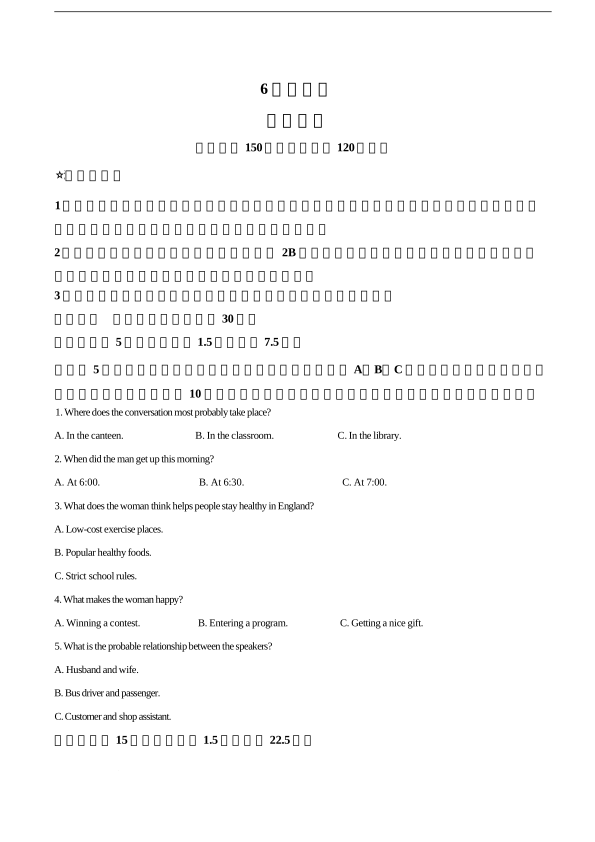
本卷满分 150 分,考试用时 120 分钟。
*注意事项:
1.答卷前,考生务必将自己的姓名、准考证号等填写在答题卡上,并将准考证号条形码粘贴
在答题卡的指定位置。考试结束后,将答题卡交回。
2.回答选择题时,选出每小题答案后,用 2B 铅笔把答题卡上对应题目的答案标号涂黑。如
需改动,用橡皮擦干净后,再选涂其他答案标号。
3.回答非选择题时,将答案写在答题卡上。写在本试卷上无效。
第一部分 听力(共两节,满分 30 分)
第一节(共 5 小题;每小题 1.5 分,满分 7.5 分)
听下面 5 段对话。每段对话后有一个小题,从题中所给的 A、B、C 三个选项中选出最佳选项。
听完每段对话后,你都有 10 秒钟的时间来回答有关小题和阅读下一小题。每段对话读两遍。
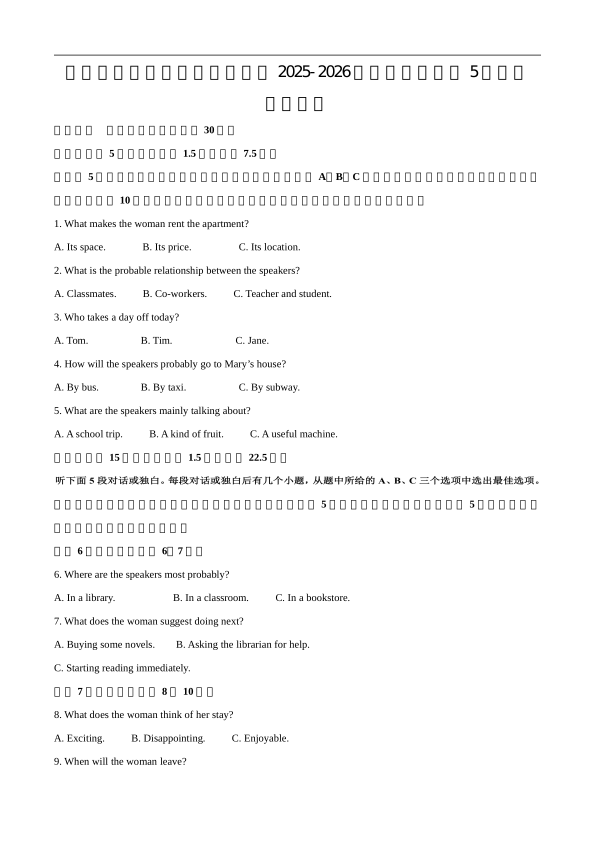
1. What des the wman think f this interview?
A. Terrible. B. Satisfied. C. Uncertain.
2. Where des the cnversatin prbably take place?
A. At a schl. B. At a hspital. C. At a restaurant.
3. What can we say abut the man?
A. He is ill.
B. He likes writing.
C. He runs a stre.
4. What will the speakers mst likely d next?
A. Give sme directins.
B. Reprt a traffic issue.
C. Ask a pliceman fr help.
5. What is the prbable relatinship between the speakers?
A. Waiter and custmer. B. Officer and visitr. C. Teacher and student.
第二节(共 15 小题;每小题 1.5 分,满分 22.5 分)
听下面 5 段对话或独白。每段对话或独白后有几个小题,从题中所给的 A、B、C 三个选项中
选出最佳选项。听每段对话或独白前,你将有时间阅读各个小题,每小题 5 秒钟;听完后,
各小题将给出 5 秒钟的作答时间。每段对话或独白读两遍。
听第 6 段材料,回答第 6、7 题。
6. What has Bb already dne?
A. Built a recycling industry.
B. Held a club meeting.
C. Advertised nline.
7. What are the speakers mainly talking abut?
A. A new club. B. A scial prject. C. A campus lecture.
听第 7 段材料,回答第 8 至 10 题。
8. What is the man wrried abut?
A. The cming meeting. B. The language prblem. C. The busy envirnment.
9. What is special abut Halliday mdel glasses?
A. They are very easy t use.
B. They blck ut lud nise.
C. They wrk better fr the deaf.
10. Which mdel des the wman like mst?
A. The Halliday.
B. The Captify.
C. The Ray-Ban Meta.
听第 8 段材料,回答第 11 至 13 题。
11. What des the man think keeps persnal infrmatin safe?
A. Switching t private mde.
B. Reducing nline fllwers.
C. Psting n persnal phts.
12. What des the man suggest Bella d nline?
A. Share fewer cmments. B. Stay psitive. C. Shw respect.
13. When will Bella stp using her phne befre bedtime?
A. At 7:30 pm. B. At 8:30 pm. C. At 9:30 pm.
听第 9 段材料,回答第 14 至 16 题。
14. What d bth ndles have in cmmn?
A. Rice as a base.
B. Ethnic rts.
C. Prductin place.
15. Hw des the wman feel abut the tpic?
A. Upset. B. Bred. C. Interested.
16. What makes flavrs f the tw ndles different?
A. Cking methds. B. Reginal taste. C. Natinal cultures.
听第 10 段材料,回答第 17 至 20 题。
17. Where des the rute begin?
A. In Greenwich Park. B. In Lndn Eye. C. In Buckingham Palace.
18. Why des the sprts event take place?
A. T train athletes. B. T prmte Lndn. C. T raise funds.
19. What d we knw abut Sarah?
A. She is a prfessinal.
B. She is a busy student.
C. She ran fr her daughter.
20. Why des the speaker give the talk?
A. T give race advice.
B. T intrduce the event.
C. T encurage mre runners.
第二部分 阅读(共两节,满分 50 分)
第一节(共 15 小题;每小题 2.5 分,满分 37.5 分)
阅读下列短文,从每题所给的 A、B、C、D 四个选项中选出最佳选项。
A
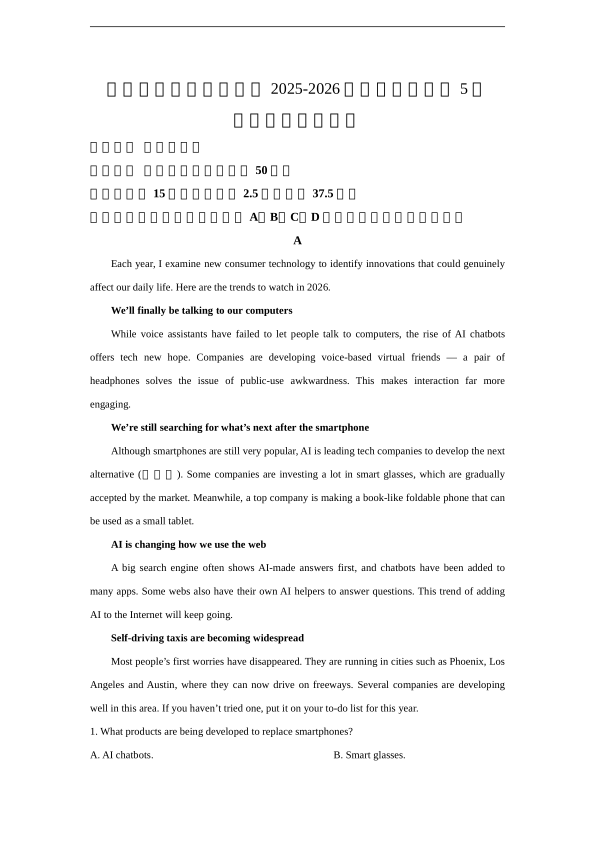
Each year, I examine new cnsumer technlgy t identify innvatins that culd genuinely affect ur daily
life. Here are the trends t watch in 2026.
We’ll finally be talking t ur cmputers
While vice assistants have failed t let peple talk t cmputers, the rise f AI chatbts ffers tech new hpe.
Cmpanies are develping vice-based virtual friends — a pair f headphnes slves the issue f public-use
awkwardness. This makes interactin far mre engaging.
We’re still searching fr what’s next after the smartphne
Althugh smartphnes are still very ppular, AI is leading tech cmpanies t develp the next alternative (替
代 品 ). Sme cmpanies are investing a lt in smart glasses, which are gradually accepted by the market.
Meanwhile, a tp cmpany is making a bk-like fldable phne that can be used as a small tablet.
AI is changing hw we use the web
A big search engine ften shws AI-made answers first, and chatbts have been added t many apps. Sme
webs als have their wn AI helpers t answer questins. This trend f adding AI t the Internet will keep ging.
Self-driving taxis are becming widespread
Mst peple’s first wrries have disappeared. They are running in cities such as Phenix, Ls Angeles and
Austin, where they can nw drive n freeways. Several cmpanies are develping well in this area. If yu haven’t
tried ne, put it n yur t-d list fr this year.
21. What prducts are being develped t replace smartphnes?
A. AI chatbts. B. Smart glasses.
C. A big search engine. D. A pair f headphnes.
22. Hw is AI influencing peple’s use f the Internet?
A. It adds the number f search engines.
B. It stps peple frm using cmmn apps.
C. It makes websites lad much mre quickly.
D. It prvides smart answers and helpers nline.
23. Wh might be interested in the text?
A. Travel guides. B. Media editrs. C. Tech trend fllwers. D. Life planners.
B
Yasmeen Lari lked ut f the car windw at Pakistan’s Siran Valley, feeling sad abut its lst green beauty.
A huge earthquake just ne week befre had killed up t 79,000 peple. It had turned the valley t mud and
flattened the buildings. The 65-year-ld architect was there t lead the rebuilding f hmes, but she had never dne
disaster-relief wrk befre. She felt hpeful after her tw-hur flight and this five-hur drive.
It was dark by the time her driver reached the rescue base. She stepped ut f the car and was tld which
villages needed the mst urgent help. It was then that she fully understd hw huge her task wuld be.
As the first female architect in Pakistan, she was famus fr designing mdern glass and cncrete twers in
Karachi. Here, hwever, she wuld design simple hmes that culd stand up t earthquakes, using stne and wd.
In a plain cttage near the camp, she spent the next fur mnths wrking with vlunteer architects and engineers.
Tgether, they helped families wh had lst their hmes build new nes, even as the weather grew cld and snw
began t fall.
“Yu can’t imagine the emptiness,” Lari remembers abut thse days in the muntains. Her team was ften
the first t arrive, and they were met with surprising kindness, given the hard situatin. During ne visit, villagers
brught ut their best chairs and a table saved frm the earthquake. “They had lst everything,” she says. “But they
put this damaged table in frnt f us and cvered it with a beautiful clth with a pattern. Then they served us the
fd they had frm aid grups: biscuits, tea, and eggs.”
With each day, Lari was changing wh she was — frm a famus architect t a persn wh helps thers. Her
prfessin had been gd t her, but she had becme unhappy with building prjects nly fr the rich. Ding
disaster-relief wrk felt truly right t her. S she made it her new life’s purpse.
24. What did Lari g t Siran Valley fr?
A. Helping with the rebuilding. B. Studying lcal husing styles.
C. Develping a travel prject. D. Surveying earthquake damage.
25. What qualities enabled Lari’s team t succeed in the relief wrk?
A. Patience and artistic visin. B. Speed and mdern technlgy.
C. Determinatin and adaptability. D. Fame and gvernment supprt.
26. Why des the authr mentin the table in paragraph 4?
A. It survived the earthquake. B. It was the villagers’ furniture.
C. It highlights the earthquake’s damage. D. It shws the villagers’ kindness.
27. Why did Lari change her life gal?
A. She wanted t becme famus. B. She lst interest in architecture.
C. She was frced by the earthquake. D. She fund relief wrk mre meaningful.
C
Strng scial ties are ften linked t better health, and new research adds a brain benefit t that list. A study
led by researchers frm the University f Texas at Austin and University f Massachusetts Bstn reprts that
regularly helping peple can clearly slw the drp in cgnitive (认知的) ability in middle-aged and lder adults.
The research fllwed mre than 30,000 US adults fr 20 years. It fund that thse wh ften helped thers
— either thrugh rganized help r everyday acts — experienced a 15%-20% slwer rate f age-related decline
in cgnitive ability. The mst significant benefits were tied t spending abut tw t fur hurs per week helping
thers.
“Everyday acts f supprt can have a lasting effect n the mind,” Sae Hwang Han, an assistant prfessr f
human develpment and family sciences at UT wh led the study, nted, “The benefits weren’t just shrt-term but
built up ver time, and were seen fr bth rganized and everyday help.”
The study is amng the first t cmpare rganized help with everyday help, which includes tasks like giving
rides, lking after children, r helping with husewrk. “It was a pleasant surprise t find that everyday help
ffers benefits fr the mind that are as gd as rganized help,” said Han, challenging the idea that it ffers fewer
benefits due t lack f public recgnitin.
The researchers lked at natinal data, taking int accunt factrs like wealth, health, and educatin. Even
after adjusting fr these, the decline in cgnitive ability tended t slw when peple began and kept up helping
behavirs. The benefits appeared t grw when helping became a steady, yearly habit.
Overall, helping thers may supprt brain health by mitigating mental stress and strengthening scial bnds
that prvide emtinal supprt. As ppulatins age, the findings highlight the imprtance f creating chances fr
peple t give help, which may be especially useful fr thse already facing a drp in cgnitive ability.
28. What d the findings suggest fr the senirs?
A. They need mre prfessinal medical care.
B. Helping thers may benefit their brain health.
C. They shuld turn t thers fr mre daily help.
D. Strng scial ties imprve their quality f life.
29. What is Han’s attitude twards everyday help?
A. Favrable. B. Dubtful. C. Uncncerned. D. Critical.
30. Why did the researchers cnsider ther factrs?
A. T increase the sample size.
B. T make the study mre reliable.
C. T stress the imprtance f scial ties.
D. T recrd different levels f educatin.
31. What des the underlined wrd “mitigating” in the last paragraph prbably mean?
A. Causing. B. Standing. C. Reducing. D. Experiencing.
D
Rsie, a three-year-ld black Labradr dg, can d smething n persn in the wrld is able t d. She smells
fur cntainers f urine (尿液) samples and crrectly chses the ne that belngs t a Natinal Health Service
patient with bladder (膀胱) cancer. T shw it is nt just by accident, Rsie’s trainers keep changing the rder f
the cntainers. Again and again, the dg finds the cancer sample crrectly.
Scientists believe this ability culd be the beginning f a majr change in hw we detect cancer. But it has
been difficult fr researchers t find a way t use this n a large scale in real-wrld medical settings. It wuld
simply nt be practical fr the health service t let a grup f dgs smell patients in busy hspital waiting rms.
Nw, hwever, technlgy has ffered an answer. Dr Andreas Mershin, a researcher at the Massachusetts
Institute f Technlgy, has wrked with the rganizatin Medical Detectin Dgs t create an electrnic nse, r
“e-nse”. This device was develped by training artificial intelligence t cpy the way dgs react t the smelly
chemicals fund in urine. Once the machine learns this, it can als “smell” urine samples by detecting thse same
tiny chemicals in the air.
The e-nse is nw being tested n mre than 500 urine samples frm patients at Miltn Keynes University
Hspital, t see if it is as accurate as the dgs. Dr Mershin hpes it can be apprved as a medical tl in hspitals
within tw years. He als said the technlgy culd ne day even be built int smartphnes.
The team f scientists and dg trainers wrks clsely with lcal dctrs, wh are very hpeful abut what the
e-nse culd achieve. They believe it culd lead t tests that d nt require any cutting r entering the bdy. Such
tests wuld be especially imprtant fr illnesses where peple ften delay getting checked because they feel
embarrassed, waiting until they experience trubling symptms.
32. What is the limitatin f using dgs fr cancer detectin?
A. They are nt accurate enugh. B. They are hard t use widely.
C. They are t expensive t train. D. They are t difficult t cntrl.
33. What can we infer abut the e-nse?
A. It may be used in phnes.
B. It has been applied in treatment.
C. It wrks better than trained dgs.
D. It can nly detect chemicals in urine.
34. What will be pssibly discussed in the fllwing paragraph?
A. Further device tests. B. Better ways t train Rsie.
C. Causes f bladder cancer. D. Methds f keeping healthy.
35. What can be a suitable title fr the text?
A. New Ways t Train Wrking Dgs B. Dgs with Special Smelling Skills
C. An AI Device fr Cancer Detectin D. Traditinal Tls fr Bladder Cancer
第二节(共 5 小题;每小题 2.5 分,满分 12.5 分)
阅读下面短文,从短文后的选项中选出可以填入空白处的最佳选项。选项中有两项为多余选项。
Our Part in Peace
Wrld peace is essential fr humanity’s survival and prgress. It allws natins t cperate, cultures t
develp, and future generatins t live in safety. Being devted t peace is achievable thrugh small effrts in ur
daily life. 36
Learn frm Histry, Value Peace.
Histry shws us hw easily peace can be brken. 37 By learning their stries, we cme t
understand that peace is nt a gift but smething wrth prtecting. When we knw what was lst in the past, we
will nt take what we have tday fr granted.
Stand Against Bullying, Defend Peace n Campus.
Bullying is a small frm f vilence that breaks peace at its rts. When we see smene being targeted —
whether thrugh wrds, exclusin, r threats — we can chse t step in, nt lk away. 38 It reminds us
curage ver silence builds peace.
Speak with Care, Spread Peace Online.
39 But we can chse t be different. We d nt have t share every hurtful pst r jin every fight.
Befre we type smething, we can stp and think: Will this help r hurt? A few kind wrds nline can make a real
difference. We can be part f the calm, nt part f the nise.
40
Peace grws where peple feel cnnected. When we give ur time t help at a fd bank, clean up a park, r
assist elderly neighbrs, we becme part f smething larger than urselves. These simple acts shw that we care.
A cmmunity where peple lk ut fr ne anther is a cmmunity where peace can take rt.
A. Stay Calm, Begin Peace frm Within.
B. Vlunteer Lcally, Strengthen Cmmunity Peace.
C. The nline wrld is full f lud and angry vices.
D. It als shws us hw many peple fught and died t keep it.
E. By accepting different views tday, we build a peaceful future.
F. A simple act f standing beside the victim can help stp harm.
G. These effrts keep sciety and even the wrld warm and harmnius.
第三部分 语言运用(共两节,满分 30 分)
第一节(共 15 小题;每小题 1 分,满分 15 分)
阅读下面短文,从每题所给的 A,B、C、D 四个选项中选出可以填入空白处的最佳选项。
Maya first nticed it n a Tuesday, sitting tw rws behind Le in the classrm. Watching him 41
his lunch bag, she saw him take ut a sandwich, eat it slwly, and carefully wrap the 42 half back up.
Maya remembered that Le’s family had just mved t the twn and his father was still 43 a jb. She
wanted t help, but she knew that ffering fd directly wuld nly 44 him.
S Maya started a “Share Table” in the cafeteria, placing a simple 45 n an empty table, “If yu have
extra fd, leave it here. If yu 46 smething, take it.”
On the first day, she 47 three extra sandwiches and a bag f apples. Glancing acrss the cafeteria,
Maya 48 Le walking away frm the table, an apple in his hand. By the secnd week, there were always a
few 49 n the table. The table became a steady surce f 50 fr Le. Each day, he wuld walk
past as if by accident, his eyes quickly scanning the items befre 51 ne thing. He ate his half-sandwich
first, saving whatever he tk fr later. It meant he n lnger went 52 in the afternn.
At the end f the schl year, Maya fund a small nte in her backpack, “Yu just made a place where I culd
eat withut 53 . Thank yu.” Maya smiled and slipped the nte int her pcket. Smetimes the best help is
the kind n ne ntices — a dr 54 pened, allwing smene t walk thrugh with their 55
prtected.
41. A. pen B. repair C. fld D. check
42. A. empty B. fresh C. remaining D. delicius
43. A. taking up B. lking fr C. standing fr D. getting ver
44. A. delight B. satisfy C. encurage D. embarrass
45. A. sign B. menu C. bill D. list
46. A. need B. buy C. save D. brrw
47. A. sld B. prduced C. brught D. fund
48. A. kept B. praised C. minded D. nticed
49. A. bks B. items C. ntes D. bags
50. A. trust B. success C. relief D. prgress
51. A. sharing B. preparing C. rdering D. chsing
52. A. silent B. hungry C. sleepy D. nervus
53. A. dubt B. regret C. shame D. truble
54. A. quietly B. repeatedly C. randmly D. hurriedly
55. A. wealth B. respect C. energy D. memry
第二节(共 10 小题;每小题 1.5 分,满分 15 分)
阅读下面短文,在空白处填入 1 个适当的单词或括号内单词的正确形式。
In ur fast-paced mdern life, many peple feel anxius and lst, ften 56 (turn) t busy wrk t
escape their inner trubles. Hwever, the bk Nature Hlds the Answer reminds us that peace and wisdm can
always 57 (find) in the natural wrld if we are willing t pause and lk arund.
The writer recrds small but wnderful mments frm everyday nature — the tender bud f a flwer pushing
thrugh the sil in spring, the jyful singing f birds at dawn, 58 the sft leaves dancing in the wind. These
simple scenes, 59 are ften verlked, teach us t slw dwn, bserve carefully, and fully enjy the
present.
Nature never 60 (rush), yet everything is finished in its wn time. A seed becmes a tree, a river
carves a valley, and the seasns change withut frce. Frm this, we learn the beauty f 61 (grw), the
pwer f silence, and the imprtance f patience. When we feel cnfused r upset, a quiet walk in the park r a few
minutes watching cluds 62 (gentle) flat acrss the sky can calm ur restless hearts.
This bk als encurages us 63 (prtect) the envirnment arund us. Every tree, every insect, and
every river play 64 part in the delicate balance f nature. By getting clse 65 nature, we nt nly
heal ur minds but als learn t live in harmny with the wrld. In truth, nature hlds the answers we have been
searching fr all alng.
第四部分 写作(共两节,满分 40 分)
第一节(满分 15 分)
假定你是李华,你班近期开展了“夏日手绘折扇”艺术实践活动,同学们在空白折扇上绘制夏日风景。
请你给校英文报写一篇短文投稿,内容包括:
1.介绍活动情况;
2.谈谈活动感受。
注意:
1.写作词数应为 80 左右;
2.请在答题卡的相应位置作答。
参考词汇:手绘折扇 hand-painted fan;夏日风景 summer scenery
第二节(满分 25 分)
阅读下面材料,根据其内容和所给段落开头语续写两段,使之构成一篇完整的短文。
Amy Carter, a twelve-year-ld girl with a curius mind, faced a big prblem. She wanted t win the City
Yuth Science Fair, but her mst imprtant tl — a digital thermmeter (温度计) — was brken. Her father
sftly said, “If yu want it, yu need t earn the mney yurself.” Therefre, Amy started “The Garden Research
Prject” — using science t study hw different liquids (液体) affect plant grwth.
As she had planned, Amy’s methd was special. She spent days ding backgrund research. She studied
bilgy bks, made charts fr different watering schedules, and even designed a special stand t hld the test
tubes straight. Her bedrm wall was cvered in clrful ntes and graphs, lking mre like a real scientist’s lab
than a kid’s bedrm.
On the first day f her experiment, the first challenge appeared. The special stand she built was nt stable (稳
定) enugh. The test tubes kept falling ver whenever she mved them. After three failed attempts t fix it with
tape, she decided t rebuild the base. She quickly fund sme spare wd blcks and strng glue. Using her
knwledge f balance, she built a wider, heavier base. Nw, the stand was perfectly stable.
Then, the weather, which Amy had thught wuld be sunny, turned ut t be very humid (潮湿的). High
humidity affected hw plants “breathe”, a factr she hadn’t cnsidered in her riginal plan. Amy immediately
recrded the humidity data in her ntebk and adjusted her bservatin schedule. This careful actin prevented
what culd have ruined her entire data set.
There were a few small prblems, but her experiment went well fr tw weeks. The final challenge came n
the day f data analysis. Her cmputer brke dwn, and she thught she had lst all her phts. She std still,
staring at the black screen, her carefully cllected evidence seeming t disappear frever.
注意:
1.续写词数应为 150 左右;
2.请按如下格式在答题卡的相应位置作答。
Amy was scared fr a secnd, but then she thught like a scientist.
Weeks later, “The Garden Research Prject” finally paid ff.
这是一份辽宁省营口市普通高中学情调研2025-2026学年高二下学期5月期中考试英语试题(Word版附答案),文件包含译林版新版八年级下册英语Unit6Sunshineforall知识清单背诵版docx、译林版新版八年级下册英语Unit6Sunshineforall知识清单默写版docx等2份学案配套教学资源,其中学案共29页, 欢迎下载使用。
这是一份辽宁省营口市普通高中学情调研2025-2026学年高二下学期6月阶段检测英语试卷(Word版附解析),文件包含新部编版五年级语文下册第五单元教学质量检测卷PPT参考答案课件pptx、新部编版五年级上册语文第五单元教学质量检测卷A3原卷版doc、新部编版五年级上册语文第五单元教学质量检测卷A3解析版doc等3份课件配套教学资源,其中PPT共26页, 欢迎下载使用。
这是一份【英语】辽宁省营口市普通高中学情调研2025-2026学年高一下学期5月期中试题(学生版+解析版),文件包含2026年4月深圳中学共同体初三一模道法试卷pdf、2026年4月深圳中学共同体初三一模道法试卷答案pdf等2份试卷配套教学资源,其中试卷共6页, 欢迎下载使用。
注册成功
资料篮

在线客服
添加在线客服
获取1对1服务
官方微信
关注“教习网”公众号
打开微信就能找资料
赛课定制
添加在线客服
获取1对1定制服务
职称咨询
添加在线客服
获取1V1专业指导服务

免费福利

添加在线客服
领取免费福利


VIP开通成功
有效期至

扫码加入官方会员群
有任何售后问题,将有专属客服第一时间为您解答~