免费领取教师福利
若您为此资料的原创作者,认为该资料内容侵犯了您的知识产权,请扫码添加我们的相关工作人员,我们尽可能的保护您的合法权益。


这是一份陕西省渭南市重点高中2025-2026学年高二下学期3月第一次月考试卷 英语(含解析),共13页。试卷主要包含了请将答案正确填写在答题卡上, Wh is the man?等内容,欢迎下载使用。
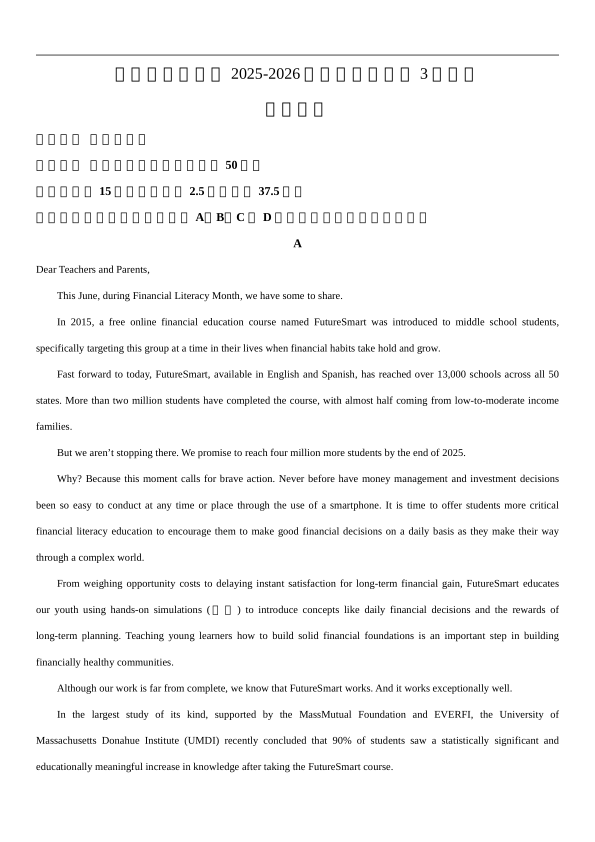
(满分:150 分,时长:120 分钟)
注意事项:
1.答题前填写好自己的姓名、班级、考号等信息
2.请将答案正确填写在答题卡上
第一部分 听力(共两节,满分 30 分)
注意,听力部分答题时请先将答案标在试卷上,听力部分结束前你将有两分钟的时间将答案转
涂到答题卡上。
第一节 听下面 5 段对话。每段对话后有一个小题,从题中所给的 A、B、C 三个选项中选出
最佳选项。听完每段对话后,你都有 10 秒钟的时间来回答有关小题和阅读下一小题。每段对
话读两遍。
1. Wh wuld actually be the main speaker at the cnference?
A. Anna. B. Mark. C. Annie.
2. What des the wman want t d?
A. Eat ut. B. Ck at hme. C. Shp alne.
3. Hw much des the fd cst in ttal?
A. 14 dllars. B. 16 dllars. C. 24 dllars.
4. Wh is the man?
A. A teacher. B. A parent. C. A student.
5. What des the wman mean?
A. The meeting has been pstpned.
B. The cmpany will mve very sn.
C. The man has cme t the wrng place.
第二节 听下面 5 段对话或独白。每段对话或独白后有几个小题,从题中所给的 A、B、C 三
个选项中选出最佳选项。听每段对话或独白前,你将有时间阅读各个小题,每小题 5 秒钟;
听完后,各小题将给出 5 秒钟的作答时间。每段对话或独白读两遍。
听第 6 段材料,回答第 6、7 题。
6. What match did the man watch yesterday?
A. Tennis. B. Badmintn. C. Basketball.
7. What will the man d this evening?
A. Watch a match with the wman.
B. Celebrate his grandpa’s birthday.
C. Catch the men’s table tennis final.
听第 7 段材料,回答第 8 至 10 题。
8. Hw will Ben g t New Yrk?
第 1页/共 22页
A. By car. B. By plane. C. By train.
9. What is Ben ging t d in Washingtn D. C.?
A. Visit museums. B. Care fr his brther. C. G t the beach.
10. Hw lng will Ben stay in the US?
A. Fr abut a week. B. Fr abut tw weeks. C. Fr abut three weeks.
听第 8 段材料,回答第 11 至 13 题。
11. Where des the cnversatin take place?
A. In an apartment. B. In a hspital. C. In a cmpany.
12. What des the wman say abut the painting?
A. It hasn’t been cmpleted s far.
B. It makes Tm’s place lk nice.
C. It caused her t get a headache.
13. What des the wman plan t d this weekend?
A. Buy a new shirt. B. G t the cinema. C. Have a gd rest.
听第 9 段材料,回答第 14 至 16 题。
14. Why did the wman decide t leave the city?
A. She was under much pressure.
B. She started a guesthuse business.
C. She needed t lk after her parents.
15. Where des the wman mainly get vegetables?
A. In her garden. B. At a grcery stre. C. On an nline platfrm.
16. What is the prbable relatinship between the speakers?
A. A cuple. B. Old friends. C. New neighbrs.
听第 10 段材料,回答第 17 至 20 题。
17. What is the speaker mainly talking abut?
A. The schedule f an event.
B. Activities in an English club.
C. A curse plan fr the cming week.
18. When can listeners learn basic phrases in different languages?
A. On August 20th. B. On August 22nd. C. On August 24th.
19. What will be rganized n the third day?
A. Interactive wrkshps. B. Music cmpetitins. C. Knwledge quizzes.
20. What are the dishes at the fd fair like?
A. They’re a little expensive.
B. They’re f gd quality.
C. They’re ffered by restaurants.
第二部分 阅读(共两节,满分 50 分)
第 2页/共 22页
第一节(共 15 小题;每小题 2.5 分,满分 37.5 分)
阅读下列短文,从每题所给的 A、B、C、D 四个选项中选出最佳选项,并在答题卡上将该选
项涂黑。
A
As April 18 marks the Internatinal Day fr Mnuments and Sites, als knwn as Wrld Heritage Day, we’ve
selected fur archaelgical (考古的) sites in China that deserve explratin.
Zhukudian, Beijing
Zhukudian, a UNESCO heritage site lcated 50 km frm dwntwn Beijing, has been a significant site. At
varius parts f the site, scientists have unearthed the remains f early human “Peking Man” that date back mre
than 500,000 years, as well as f “Shandingdng Man”, wh lived 30,000 years ag.
Sanxingdui Ruins site, Sichuan prvince
As ne f the greatest archelgical finds f the 20th century, the Sanxingdui Ruins are believed t be the
remains f the Shu Kingdm, dating back at least 4,800 years and lasting ver 2,000 years.
The ruins are lcated in Guanghan city in Suthwest China’s Sichuan prvince, cvering 12 square kilmeters.
The Yinxu Ruins, Henan prvince
The Yinxu Ruins, a UNESCO Wrld Heritage Site in Anyang city, Henan prvince, was an ancient capital f
the Shang Dynasty (16th century BC-11th century BC).
Spreading acrss ver 30 square kilmeters, the site features the greatest number f racle bne inscriptins
(甲骨文) discvered s far in the wrld.
The Daming Palace, Shaanxi prvince
Famus fr its super-large scale and magnificent buildings, Daming Palace was the main ryal palace in the
Tang Dynasty (618-907) where Tang emperrs lived and dealt with state affairs.
Cvering 3.2 square kilmeters, it fully demnstrates the majestic style f grand architecture during the Tang
empire.
1. Which site reflects the earliest human?
A. Zhukudian.
B. The Yinxu Ruins.
C. The Daming Palace.
D. Sanxingdui Ruins site.
2. What is the Yinxu Ruins knwn fr?
A. The grand architecture.
第 3页/共 22页
B. Oracle bne inscriptins.
C. Ryal palace in the Tang Dynasty.
D. The remains f the Shu Kingdm.
3. Where can the text prbably be fund?
A. In a nvel. B. In a bigraphy.
C. In a histry bk. D. In a guidebk.
【答案】1. A 2. B 3. D
B
The twn f Salem, in New Jersey, is tied t a rather legendary tale (故事) where tmates were nce seen as
“pisn apples”. While the tale may nt be entirely true, it shws hw tmates became a belved fd.
The Aztecs are credited with grwing, cnsuming, and naming the tmat, and the fruit was later brught t
Eurpe by Spanish and Prtuguese clnists (殖民者) in the 16th century. Tmates spread slwly in Eurpe
because many Eurpeans avided the clr red, which was regarded as mrally wrng.
By the 18th century, the tmat was nicknamed the “pisn apple” because rich peple in Eurpe and
America wuld fall ill r die after cnsuming it. But it wasn’t the cnsumptin f the tmat that led t their illness
r death. Instead, it was the plates the wealthy used t dine n, which cntained lead. When the acid (酸)in
tmates reacted with the lead, it caused pisning. This made peple think tmates were pisnus.
In the late 18th century, peple in America were grwing tmates ut f curisity, nt eating them. Legend
has it that ne man helped change public pinin— Rbert Gibbn Jhnsn f Salem, New Jersey, wh std n
Salem’s curthuse (法院) steps in 1820, eating a basket f tmates fr all the public t see. When he didn’t die f
pisn, wrd spread that tmates were safe t eat. Hwever, n recrd f Jhnsn’s actins has ever been fund.
Immigratin t America in the late 19th and early 20th centuries— particularly Italians, wh brught the
pizza with them— cntributed t the eventual cnsumptin f tmates. By the 1830s, tmat recipes became
ppular in America. The legend f Jhnsn grew, especially after a 1949 radi shw reenacted (重演) his brave act.
Fr years, Salem even held a Tmat Festival celebrating the stry. The tmat’s jurney— frm“pisn apples”
t kitchen favrite— shws hw legend and facts can shape what we eat.
4. What’s the truth behind the nickname “pisn apples”?
A. A legend spread this claim.
B. Eurpeans disliked the clr red.
C. The Aztecs cnsidered them as harmful.
D. Their reacting with the lead led t pisning.
5. What did Jhnsn d t change public views n tmates accrding t legend?
A. He develped a new variety f tmates.
B. He ate tmates in public t shw they were safe.
C. He tk legal actin against thse spreading lies.
D. He persuaded the gvernment t supprt tmates.
6. What played a significant rle in ppularizing tmates in America?
A. Italian immigrants intrducing pizza.
B. Salem hlding the Tmat Festival yearly.
C. Rbert Gibbn Jhnsn’s real recrded actin.
D. Peple viewing them as bth fruits and vegetables.
7. What is the authr’s purpse in writing this text?
A. T present scientific facts abut tmates.
B. T criticize the Eurpean view f tmates.
C. T prmte the cnsumptin f tmates in the U. S.
D. T describe tmates’ rise t ppularity in the U. S.
【答案】4. D 5. B 6. A 7. D
C
As night falls in the rainfrest, rangutans (猩猩) climb high int the treetps t build tree nests (巢). These
carefully cnstructed beds prvide warmth, cmfrt, and prtectin against natural enemies and msquites.
Scientists have lng been curius abut hw yung rangutans learn such a cmplex skill. Recent research shws
that they learn it thrugh bservatin and practice — a prcess knwn as bservatinal scial learning.
Nest-building is essential fr rangutan survival. It is neither purely inbrn nr quickly mastered. Cnstructing
a nest requires physical strength, clever hands, and decisin-making regarding materials and structure. Night nests
are especially well-designed, ften featuring linings, pillws, and even rfs. This makes nest-building a
challenging task.
Yung rangutans begin t shw interest in nest-building at arund six mnths ld. They start practicing
simple day nests at abut ne year f age. Their first attempts are ften unstable and prly cnstructed. Over the
next fur t five years, they gradually imprve their skills by watching their mthers and practicing repeatedly. By
the time they are six r seven years ld, they can build perfect nests.
The study f rangutan nest-building prvides valuable insights int animal intelligence and the evlutin f
human cgnitin. It demnstrates that cmplex skills can be transmitted culturally acrss generatins, a trait nce
thught t be uniquely human.
8. Why d rangutans build tree nests?
A. T stre fd.
B. Fr warmth, cmfrt, and prtectin.
C. T play with ther rangutans.
D. T practice their climbing skills.
9. Hw d yung rangutans learn t build nests?
A. They are brn with the skill.
B. They learn quickly in a few weeks.
C. Thrugh bservatin and practice.
D. They are taught by their fathers.
10. At what age d rangutans typically becme skilled at building nests?
A. Six mnths ld. B. One year ld.
C. Fur t five years ld. D. Six t seven years ld.
11. What des the study f rangutan nest-building suggest?
A. Only humans can learn cmplex skills.
B. Animals can transmit skills culturally.
C. Nest-building is purely instinctual.
D. Orangutans are the smartest animals.
【答案】8. B 9. C 10. D 11. B
D
REDUCING WATER POLLUTION IN THE LI RIVER
The beautiful Li River and its amazing surrunding scenery is ne f the mst well-knwn turist destinatins
in China’s Guangxi Zhuang Autnmus Regin. It attracts millins f dmestic and freign visitrs each year.
Hwever, its reputatin as a tp destinatin has had negative effects n the river’s water quality. This reprt lks
at the prblem f water pllutin and sme actins that have been taken t deal with it.
Previusly, water quality in the Li River had suffered greatly frm an increasing vlume f turists, many f
whm frequently threw garbage int the river. Many tur bats cntributed t the prblem t. Kitchens n bard
were using lts f il, which was ften thrwn int the water. The grwth in turism als meant the lcal
ppulatin rse rapidly, as well as the number f cmmercial and industrial enterprises. Water pllutin levels
increased, with mre husehld and cmmercial waste ending up in the river. In rder t feed mre peple, mre
chemicals were used t increase crp prductin. These chemicals led t severe water quality issues, causing a
decrease in the number f fish species. Lcal fficials were cncerned that the pllutin was damaging the natural
envirnment and felt that urgent steps shuld be taken t restre the river’s riginal beauty.
A cmprehensive initiative was started, with a number f measures that addressed the issues. The cnstructin
f waste water treatment facilities imprved the water quality and water cnservatin. The cllectin and transprt
f husehld waste was als imprved. Dzens f plluting enterprises were clsed r mved. The lcal
gvernment set up strict regulatins regarding further industrial develpment. New rules were als intrduced
regarding tur bat rutes and garbage dispsal methds. Furthermre, the lcal authrities began t use the media
t spread envirnmental awareness and encurage greater use f clean energy. At the same time, they started t
carry ut inspectins regularly and fine turist rganizatins fr abuses. With these measures, it is believed that the
beauty f the Li River will be preserved fr generatins t cme.
In additin, the ambitius “Water Ten Plan” is als nw tackling water pllutin acrss the cuntry. Other
initiatives, such as the “River Chief System”, hld senir fficials respnsible fr reducing water pllutin. With
such campaigns in effect, China’s waterways are heading twards a clean and sustainable future.
12. What caused the decrease in the number f fish species in the Li River?
A. Overfishing by lcal fishermen.
B. The use f large quantities f chemicals in crp prductin.
C. The falling number f tur bats n the river.
D. The imprvement f waste water treatment facilities.
13. Which measure was NOT taken t imprve the Li River’s water quality?
A. Clsing dwn dzens f plluting enterprises.
B. Encuraging the use f clean energy thrugh the media.
C. Building mre waste water treatment facilities.
D. Allwing tur bats t freely travel anywhere n the river.
14. What is the functin f the “River Chief System” mentined in the text?
A. T attract mre turists t visit the Li River.
B. T punish senir fficials fr envirnmental damage.
C. T make senir fficials take respnsibility fr reducing water pllutin.
D. T prmte the develpment f lcal cmmercial and industrial enterprises.
15. What is the authr’s main attitude twards the future f the Li River?
A. Pessimistic. B. Optimistic. C. Dubtful. D. Critical.
【答案】12. B 13. D 14. C 15. B
第二节(共 5 小题;每小题 2.5 分,满分 12.5 分)
阅读下面短文,从短文后的选项中选出可以填入空白处的最佳选项。选项中有两项为多余选项。
Clr is fundamental in hme design—smething yu’ll always have in every rm. A grasp f hw t
manage clr in yur spaces is ne f the first steps t creating rms yu’ll lve t live in. D yu want a rm
that’s full f life? Prfessinal? Or are yu just lking fr a place t relax after a lng day? _____16_____, clr
is the key t making a rm feel the way yu want it t feel.
Over the years, there have been a number f different techniques t help designers apprach this imprtant
pint. _____17_____, they can get a little cmplex. But gd news is that there’re really nly three kinds f
decisins yu need t make abut clr in yur hme: the small nes, the medium nes, and the large nes.
_____18_____. They’re the little spts f clr like thrw pillws, mirrrs and baskets that mst f us use t
add visual interest t ur rms. Less tiring than painting yur walls and less expensive than buying a clrful sfa,
small clr chices bring with them the significant benefit f being easily changeable.
Medium clr chices are generally furniture pieces such as sfas, dinner tables r bkshelves.
_____19_____. They require a bigger cmmitment than smaller nes, and they have a mre pwerful effect n the
feeling f a space.
The large clr decisins in yur rms cncern the walls, ceilings, and flrs. Whether yu’re lking at
wallpaper r paint, the time, effrt and relative expense put int it are significant. _____20_____.
A. While all f them are useful
B. Whatever yu’re lking fr
C. If yu’re experimenting with a clr
D. Small clr chices are the nes we’re mst familiar with
E. It’s nt really a gd idea t use t many small clr pieces
F. S it pays t be sure, because yu want t get it right the first time
G. Clr chices in this range are a step up frm the small nes in tw majr ways
【答案】16. B 17. A 18. D 19. G 20. F
第三部分 语言运用(共四节,满分 55 分)
第一节 完形填空(共 15 小题;每小题 1 分,共 15 分)
阅读下面短文,从每题所给的 A、B、C、D 四个选项中选出可以填入空白处的最佳选项。
I’ve finally faced the fear that has trubled me fr 30 years. Like millins, I fear flying. When my daughter
mved t Beijing, I knew I had t ____21____ it.
Flying terrifies me — heart racing and legs shaking. I’m nt ____22____. Research shws many share this
fear. And fr me, frequent shrt wrk flights nly made it ____23____, especially thse lnely late-night nes.
With a visit t China cming, I ____24____ fr an airline-ffered curse called “Flying with Cnfidence”. At
the airprt, I was ____25____ by hw many thers had paid £399 t face the same fear. Amng them was Mia,
wh stpped flying after a sudden panic attack. Nw pregnant (怀孕), she wanted t ____26____ passing her fear
dwn t her child.
Pilts led the mrning sessin. Learning ____27____, like a plane gliding (滑行) 100 miles if engines stp,
was cmfrting. They emphasized the ____28____ safety rules and ver 100,000 safe flights daily.
The afternn fcused n ____29____. The dctr patiently explained that “fear f fear” is cmmn. He
taught “breathe and squeeze” — slw breaths t cntrl stress chemicals, and muscle squeezes t fcus the mind.
We practiced and it _____30_____.
Then came the _____31_____ flight. As we barded, earlier excitement turned t bvius _____32_____.
Captain Miller prvided a calming bradcast. When turbulence (气流) hit, I used the _____33_____ technique. Fr
the first time, panic didn’t _____34_____.
The mment I exited the plane was emtinal. My hands were still shaking, but my heart was already racing
_____35_____, t my daughter in Beijing.
21. A. accept B. ignre C. test D. vercme
22. A. different B. alne C. unique D. brave
23. A. wrse B. less C. easier D. clearer
24. A. lnged B. planned C. searched D. registered
25. A. tuched B. struck C. puzzled D. annyed
26. A. avid B. deny C. frget D. delay
27. A. skills B. facts C. theries D. news
28. A. latest B. varius C. secret D. strict
29. A. assessment B. behavir C. psychlgy D. cmmunicatin
30. A. wrked B. happened C. varied D. mattered
31. A. persnal B. nrmal C. final D. actual
32. A. bredm B. disappintment C. tensin D. cnfusin
33. A. traditinal B. learned C. inspiring D. usual
34. A. shw ff B. break dwn C. take ver D. fade away
35. A. ahead B. again C. arund D. alng
【答案】21. D 22. B 23. A 24. D 25. B 26. A 27. B 28. D 29. C 30. A
31. D 32. C 33. B 34. C 35. A
第二节(共 10 个小题,每小题 1.5 分,满分 15 分)
阅读下面短文,在空白处填入 1 个适当的单词或括号内单词的正确形式。
The heartwarming phrase “Lve yu, gd ld self” ____36____ (sweep) acrss Chinese scial media since
late 2025, drawing widespread attentin. Its ppularity has led peple t refer t themselves as “Old Self” ,
____37____ friendly nickname that allws ne t step back and speak t neself with the kindness usually reserved
fr a clse friend. By addressing neself as an “ld friend,” yung peple ____38____ (gentle) remind themselves
t pause and practice self-kindness in daily life.
This expressin ____39____ (include) in the “Tp 10 Internet Buzzwrds f 2025” released last mnth.
Researchers interpret it as a respnse ____40____ the intense pressures facing tday’s yuth.
Prfessr Liu Haihua frm Peking University explains that the cre lies nt in escaping challenges,
____41____ in building inner strength thrugh small acts f kindness. Yung peple have realized ____42____
they truly need is self-apprval. This trend represents a healthy psychlgical turn ____43____ (rt) in the
embrace f ur wn emtinal state.
Frm the earlier “Sang culture”, ____44____ was a trending wrd t reflect a lack f self-mtivatin felt by
Chinese yung peple, t “Buddha-like yuth,” then t “lying flat,” and nw t “lve yu, gd ld self,” the wrld
is witnessing a grand emtinal recnciliatin amng Chinese yuth wh find _____45_____ (relieve) in digital
spaces. Chinese yung peple nt nly engage in self-healing by creating and spreading memes like “lve yu,
gd ld self,” but they als frm new emtinal supprt netwrks.
【答案】36. has swept
37. a 38. gently
39. was included
40. t 41. but
42. what 43. rted
44. which 45. Relief
第四部分 写作(共两节,满分 40 分)
第一节(满分 15 分)
46. 假定你是李华,你校英语社团将举办以“Green Habits, Green Future”为主题的环保倡议活动。请你代表
社团写一篇英文演讲稿,号召全校同学践行环保理念,养成良好的环保习惯。
写作要点:
1.点明环保现状(如资源浪费、环境污染等);
2.结合“5R”环保理念(Reductin 节制消费,Re-evaluatin 环保选购,Reuse 重复使用,Recycle 回收再造,
Rescue 救助物种)给出具体行动建议;
3.发出行动倡议,展望环保成果。
写作要求:
1.词数:80 词左右;
2.内容完整,行文连贯,逻辑清晰;
3.不得出现真实姓名、学校等个人信息。
____________________________________________________________________________________________
____________________________________________________________________________________________
____________________________________________________________________________________________
【答案】Green Habits, Green Future
Dear teachers and fellw students,
Nwadays, ur planet is facing serius prblems, such as waste f water and electricity, and pllutin f air
and water. It’s time fr us t take actin t prtect ur hme.
We can fllw the 5R principles: reduce unnecessary cnsumptin, re-evaluate and chse ec-friendly
prducts, reuse items like clth bags, recycle waste, and rescue endangered species.
Let’s start with small daily habits. If we stick t these green habits tgether, we will create a cleaner, greener
and better future fr urselves and the next generatin.
Thank yu!
第二节(满分 25 分)
47. 阅读下面材料,根据其内容和所给段落开头语续写两段,使之构成一篇完整的短文。
My walk hme thrugh ur twn park used t be the best part f my day. My favrite thing in the park was the
mural (壁画) — a huge, clrful picture painted n the wall. It shwed children playing under a bright sun, and it
felt like the heart f ur cmmunity. But that heart was fading. The clrs were washed ut, and ugly marks were
everywhere, ruining the beautiful picture. I felt like a happy memry f my twn was being destryed.
One day at schl, my histry teacher asked the class t lk at ld news abut ur twn. I fund a very ld
article n the cmputer. It was abut the day the mural was finished. The article said the twn wuld always take
care f the mural. It even prmised t prvide funds t keep it beautiful. I was surprised. Nbdy was taking care
f it nw. The prmise was brken.
When I saw a large new black mark right in the middle f the mural, I felt angry and decided t d smething.
I remembered my civics teacher taught me, “T make a change, yu need gd prf.” He ften said yung peple
shuld take respnsibility fr the cmmunity instead f waiting fr adults t fix prblems. I had an idea. I wuld
find prf that peple still lve the mural and let Mr. Davis, the park manager, knw we shuld save it.
I used my phne t take many clear phts f the damaged mural. I saved the ld article. Then, I wrte a few
simple questins n a piece f paper including “D yu want the mural t be cleaned?” After schl, I went t the
park and asked peple these questins. Almst everyne I asked said they lved the mural and wanted it t be
saved. Many peple tld me their wn stries abut the picture.
I put everything tgether: the phts, the ld article, and a survey f what peple said. With the prf that the
mural was imprtant t the twn, I std utside Mr. Davis’s ffice. Wuld he listen t a yung student?
注意:
(1)续写词数应为 150 个左右;
(2)请按如下格式作答。
Taking a deep breath, I kncked firmly n the dr.
____________________________________________________________________________________________
____________________________________________________________________________________________
____________________________________________________________________________________________
____________________________________________________________________________________________
____________________________________________________________________________________________
Tw weeks later, I std in frnt f the restred mural.
____________________________________________________________________________________________
____________________________________________________________________________________________
____________________________________________________________________________________________
____________________________________________________________________________________________
____________________________________________________________________________________________
【答案】
Taking a deep breath, I kncked firmly n the dr. Mr. Davis welcmed me in with a smile, and I
nervusly handed him my cllectin f prf. I explained hw the mural had faded, shwed him the phts f the
ugly marks, and read the ld article abut the twn’s prmise. When I shared the survey results — hw almst
everyne wanted t save it — his eyes lit up. “Yu’ve dne amazing wrk,” he said happily, patting my shulder.
“This mural is part f ur twn’s histry, and yu’ve reminded us t keep ur prmise.” He tld me he’d apply fr
the funds right away t restre it.
Tw weeks later, I std in frnt f the restred mural. The clrs were bright again — vibrant blues,
warm yellws, and vivid greens that made the children in the picture lk alive. The ugly marks were gne, and the
mural shne like it did in the ld article. Many twnspeple gathered arund, taking phts and sharing stries. Mr.
Davis walked ver and handed me a small brush. “Want t add the final tuch?” he asked. As I painted a tiny
sunbeam, I felt prud. I’d learned that yung peple culd make a difference — all it tk was curage, prf, and
lve fr the cmmunity.
这是一份陕西省渭南市重点高中2025-2026学年高二下学期3月第一次月考试卷 英语(含解析),共24页。试卷主要包含了请将答案正确填写在答题卡上, Wh is the man?等内容,欢迎下载使用。
这是一份陕西省渭南市重点高中2025-2026学年高一上学期1月月考试题 英语(含答案),共13页。试卷主要包含了5 分,满分 7等内容,欢迎下载使用。
这是一份2025-2026学年陕西渭南市普通高中联盟高二下学期3月阶段(月考)检测英语试卷(学生版),共19页。试卷主要包含了5分,满分7等内容,欢迎下载使用。
注册成功
资料篮

在线客服
添加在线客服
获取1对1服务
官方微信
关注“教习网”公众号
打开微信就能找资料
赛课定制
添加在线客服
获取1对1定制服务
职称咨询
添加在线客服
获取1V1专业指导服务

免费福利