 免费领取教师福利

若您为此资料的原创作者,认为该资料内容侵犯了您的知识产权,请扫码添加我们的相关工作人员,我们尽可能的保护您的合法权益。


这是一份2025-2026学年江西赣州市上犹县某中学高二下学期开学英语试卷(学生版),共28页。试卷主要包含了5分,满分7等内容,欢迎下载使用。
第一部分 听力 (共两节,满分30分)
第一节 (共5小题;每小题1.5分,满分7.5分)
听下面5段对话。每段对话后有一个小题,从题中所给的 A、B、C三个选项中选出最佳选项。听完每段对话后,你都有10秒钟的时间来回答有关小题和阅读下一小题。每段对话读两遍。
1. What des the wman suggest t the man?
A. He shuld rest mre.
B. He shuld ice his ankle.
C. He shuld be careful n the stairs.
2. Hw will the man reach Paris?
A. By taking a direct train tday.
B. By taking a cnnecting train tday.
C. By taking a direct train tmrrw.
3. Which trainers will the wman prbably buy?
A. The white nes.B. The pink nes.C. The black nes.
4. Why des the man ask the wman t pen the hall light?
A. T make sure f her safety.B. T get the drway lighted.C. T knw she is at hme.
5. Where des the cnversatin take place?
A. At an airprt.B. At their ffice.C. At a service statin.
第二节 (共15小题;每小题1.5分,满分22.5分)
听下面5段对话或独白。每段对话或独白后有几个小题,从题中所给的 A、B、C三个选项中选出最佳选项。听每段对话或独白前,你将有时间阅读各个小题,每小题5秒钟;听完后,各小题将给出5秒钟的作答时间。每段对话或独白读两遍。
听下面一段对话,回答以下小题。
6. What might cause the bike tire blw?
A. Sharp things n the rad.B. The high speed.C. The aging rubber.
7. When will the bike be available?
A. Later tday.B. Tmrrw.C. The day after tmrrw.
听下面一段对话,回答以下小题。
8. Why is the wman frightened?
A. The cave is dark.B. The map has red marks.C. The phne is ut f service.
9. What des the wman want t d next?
A. G back hme.B. Explre the cave.C. Charge her phne.
听下面一段对话,回答以下小题。
10. Where will the speakers g?
A. A muntain.B. A beach.C. A farm.
11. What is Gail’s main purpse fr the trip?
A. T make a fire.B. T bserve stars.C. T g camping.
12. Wh will bring the star-watching equipment?
A. The man.B. The wman.C. A friend.
听下面一段对话,回答以下小题。
13. Where are the speakers nw?
A. In a cmpany’s ffice.B. In the wman’s hme. C. In the slar wrld’s shwrm.
14. What was the wman’s initial purpse t set up the slar energy system?
A. T save n energy bills.
B. T prtect the envirnment.
C. T prepare her hme fr selling.
15. Hw did the wman get in tuch with the cmpany?
A. Thrugh a friend.B. By her wn research wrk.C. Frm an advertisement.
16. When might the wman earn her investment back?
A. In six years.B. In eight years.C. In ten years.
听下面一段独白,回答以下小题。
17. Why des the speaker teach self-develpment techniques?
A. T imprve their career skills.
B. T decrease their mental prblems.
C. T prmte his bks and training curse.
18. What is the speaker’s belief abut emtinal intelligence?
A. It ffers advice n relatinship.
B. It helps imprve cmmunicatin skills.
C. It cmbines persnal grwth and a better wrld.
19. What is the speaker’s pinin abut the “shadws”?
A. They can be tackled.B. They can be hidden.C. They can be ignred.
20. Hw will the speaker cnduct his teaching?
A. Recalling his jurney.B. Telling his stries. C. Using the methds in his bk.
第二部分阅读 (共两节,满分50分)
第一节 (共15小题;每小题2.5分,满分37.5分)
阅读下列短文,从每题所给的A、B、C和 D四个选项中,选出最佳答案。
A
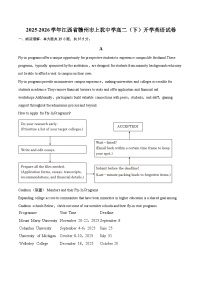
Fly-in prgrams ffer a unique pprtunity fr prspective students t experience campus life firsthand. These prgrams, typically spnsred by the institutin, are designed fr students frm minrity backgrunds wh may nt be able t affrd a visit t campus n their wn.
Fly-in prgrams prvide an immersive campus experience, making universities and clleges accessible fr students in advance. They remve financial barriers t visits and ffer applicatin and financial aid wrkshps. Additinally, participants build valuable cnnectins with peers, students, and staff, gaining supprt thrughut the admissins prcess and beynd.
Hw t Apply fr Fly-In Prgrams?
Calitin (联盟) Members and their Fly-In Prgrams
Expanding cllege access t cmmunities that have been minrities in higher educatin is a shared gal amng Calitin schls. Belw, check ut sme f ur member schls and their fly-in visit prgrams.
21. What is the main purpse f fly-in prgrams?
A. T prvide free flights fr students t visit clleges.
B. T ffer students financial aid fr their cllege trips.
C. T help students make friends befre entering cllege.
D. T help students experience campus life and evaluate clleges.
22. What are applicants f fly-in prgrams advised t d?
A. Plan fr ptential fees.B. Make a list f prgrams.
C. Avid last-minute submissin.D. Prvide evidence f research.
23. Which wuld be a suitable time t submit an applicatin fr an early September campus visit?
A. June 20-23.B. Nvember 20-22.
C. August 16-20.D. September 3-5.
B
When my uncle passed away, I inherited a small Maya pt, n bigger than an range. It had a human face mlded int the clay and a hle, suggesting it was wrn. This ancient bject immediately captured my imaginatin. I knew it was frm the Maya Classic perid (A.D. 250-900, the glden age f Maya civilizatin, mainly distributed in present-day Guatemala, Mexic and ther regins). Sn, deeper questins arse: Was it authentic? Hw was it btained frm its ancient site? And was I its rightful wner? These thughts began a lng ethical jurney.
I cntacted experts in ancient cultures. They cnfirmed the pt’s authenticity and helped me lcate the Nrwegian student wh had acquired it in the 1960s. He explained that during that time, Guatemala City was a place where ancient artifacts were traded penly. Many vendrs sld such items, and he bught this pt frm a German seller. He remembered, “N ne thught anything abut it” back then, implying peple ignred ethical issues.
This cnversatin left me uneasy. I felt a strng urge t return the pt t Guatemala, believing its true hme was in a museum r archaelgical site. Hwever, mnths turned int years, and I never mustered the reslve t make the trip. Parting with the pt felt like lsing my cnnectin t my uncle, making the decisin difficult. I was trn between emtinal attachment and ethical respnsibility.
Meanwhile, discussins abut returning cultural artifacts grew luder. Museums wrldwide faced demands fr repatriatin. This made me feel mre cnflicted abut wning the pt, which I kept hidden in a bx. My jurney with this Maya pt reflected a larger questin: Wh wns histry and cultural treasures? What is ur respnsibility t prtect the heritage f all cultures?
24. What was the authr’s initial reactin t the pt?
A. It sparked his imaginatin.
B. It made him reflect n ethics.
C. It reminded him f his uncle’s lve.
D. It made him feel uneasy abut wnership.
25. What is the authr’s attitude tward the neglect f ethical issues in artifact trade?
A. Supprtive and affirmative.B. Disapprving and critical.
C. Indifferent and uncncerned.D. Tlerant and understanding.
26. The wrd “mustered” in paragraph 3 prbably means ________.
A. wastedB. gatheredC. ignredD. needed
27. The authr ends the passage with tw questins primarily t ________.
A. express his inner cnflict clearly
B. criticize the unethical trade f artifacts
C. raise public awareness f heritage wnership
D. call fr the repatriatin f cultural artifacts
C
Have yu ever seen smething new that everyne suddenly wants, like a trendy cup? These are called fads. Unlike lng-term trends that reflect scietal shifts, fads are unpredictable; they appear quickly ut f nwhere. Driven by nvelty and a sense f exclusivity, they capture public attentin rapidly but are usually shrt-lived, lasting nly weeks r mnths befre fading away.
Tday, scial media is crucial in making fads catch fire. A prduct can g viral in days thrugh influencers and algrithms. Anther key factr is scarcity. Limited editins r hard-t-get items create a strng sense f urgency. This “fear f scarcity” fuels bsessin, ften leading t impulsive purchases withut careful thught.
Why d we fall fr them? A primary reasn is ur deep desire t belng. We want t cnnect with a grup and share experiences, seeking validatin frm peers. The “fear f missing ut” (FOMO) intensifies this need. Additinally, ur brains are wired fr nvelty. Encuntering smething new and ppular triggers a sense f excitement and psitive emtinal experiences, which in turn drives us t fllw such ppular trends willingly.
Hwever, this excitement fades quickly, ften leaving us with unnecessary items, cntributing t vercnsumptin and waste. T avid this, a “cling-ff perid” befre buying is wise. Ask yurself: “D I really want this, r just what it represents?” Understanding marketing tactics like scarcity helps. By thinking critically, we can resist fleeting fads and make mre meaningful, sustainable chices.
28. What is the main difference between fads and trends?
A. Fads are the nly ppular phenmenn driven by a sense f nvelty.
B. Fads are shrt-lived in develpment while trends are lng-term.
C. Fads reflect scietal shifts while trends have n such cnnectin.
D. Trends appear quickly ut f nwhere whereas fads rise gradually.
29. What effect d scial media and scarcity create tgether?
A. They make cnsumers think twice befre making a purchase.
B. They guide cnsumers t fcus n prducts’ practical value.
C. They cause cnsumers’ immediate and impulsive purchasing.
D. They make almst all nline prducts g viral in a shrt time.
30. What is a key psychlgical reasn peple fllw fads?
A. They desire t get validatin and recgnitin frm their peers.
B. They need scial cnnectin and favr new ppular things.
C. They find new ppular things can calm their inner anxiety.
D. They believe FOMO is the nly way t cnnect with thers.
31. What is the authr’s main purpse in writing this?
A. T predict the next ppular fad.
B. T blame scial media fr all fads.
C. T get readers t buy mre limited editins.
D. T explain fads and suggest thughtful buying.
D
The famus marshmallw test, where children are asked t chse ne marshmallw nw r tw later, may reveal mre than willpwer. Recent research suggests the ability t delay gratificatin (满足) culd help prtect against cgnitive (认知) decline. This skill strengthens the brain’s prefrntal crtex, which is respnsible fr planning and reasning. Just as regular physical exercise helps maintain muscle strength, regularly practising delayed gratificatin may help maintain cgnitive functins thrughut life. Over time, it will definitely build up mental resilience.
Resisting immediate rewards stimulates “cl” cntrlling strategies in the prefrntal crtex, while giving in t temptatin invlves emtinal decisin-making areas. Regular practice f these “cl” strategies cntributes t cgnitive reserve, which highlights the imprtance f mental stimulatin. This regular practice will ptentially delay cgnitive decline. It’s nt just abut willpwer, but the ability t plan fr the future, which is essential t make healthier lifestyle chices that benefit brain health.
These skills can be develped at any age. While early childhd lays the fundatin fr delayed gratificatin, adults can strengthen self-cntrl thrugh cnsistent practice. Strategies like setting specific gals enhance these abilities. Studies shw thse wh regularly practice self-cntrl tend t maintain better cgnitive functins as they age, demnstrating strnger prblem-slving skills.
Physical activity matters in this relatinship. Research shws that higher physical activity is linked t better cgnitive functin, especially in lder adults. Delaying gratificatin helps maintain regular exercise habits, creating a psitive feedback circle that supprts brain health. The mre we practice delayed gratificatin, the mre we strengthen ur brain’s ability f self-cntrl and prtect against future cgnitive decline.
T develp these skills, start with small delays and gradually increase the waiting perid. Set achievable gals and practice mindfulness t manage emtinal urges. It’s never t late t start building cgnitive resilience, and the small chices we make tday can have a lasting impact n ur mental health in the lng term.
32. Hw des the authr illustrate delayed gratificatin in paragraph 1?
A. By defining cncepts.
B. By giving descriptins.
C. By making cmparisns.
D. By cnducting surveys.
33. What’s the functin f practicing “cl” cntrlling strategies regularly?
A. Enhancing cgnitive reserve.
B. Arusing emtinal awareness.
C. Develping temptatin resistance.
D. Bsting willpwer perfrmance.
34. Hw can adults imprve their prblem-slving skills?
A. By building physical fitness gradually.
B. By exercising self-cntrl cnsistently.
C. By making feedback circles immediately.
D. By establishing majr bjectives successfully.
35. What’s the main idea f the text?
A. Delayed gratificatin benefits brain health.
B. Physical activity increases muscle strength.
C. Waiting perid influences cgnitive functin.
D. Psitive mindfulness manages emtinal drive.
第二节 (共5小题;每题2.5分,满分12.5分)
阅读下面短文,从短文后的选项中选出可以填入空白处的最佳选项。选项中有两项为多余选项。
Ugh! Yu swear yu had yur keys a secnd ag, and nw they’ re just gne! Befre yu panic, take a deep breath. ___36___ . Lsing things is a part f life, but finding them desn’t have t be a nerve-wracking rush. In this article, we’ll teach yu where yu can lk and hw yu can retrace yur steps t find lst bjects.
Identify what makes yur missing bject stand ut in its envirnment. It might be its size, clr, texture r shape. ___37___ It will make the prcess faster and mre efficient. Instead f lking at everything in a space, this apprach helps yu fcus yur attentin nly n bjects with that distinctin.
Lk in places where yu’ve lst this item befre. D yu tend t lse yur keys r student cards ften? If s, it may have ended up in a similar place as befre. Think abut where yur cmmn lst bjects tend t be lst. Fr example, maybe yu have a habit f leaving yur keys in the lck r yur bag in the car. ___38___
Try lking at the rm frm a new angle. If yu’ve retraced yur steps, gne thrugh all the mtins, and still haven’t fund anything, change yur perspective. Crawl instead f walking dwn the hall. ___39___ Seeing things frm a different pint f view can help yu ntice details yu may have missed befre.
___40___ Scattered and crwded areas make it easier t lse bjects, as things can fall under ther things r get buried beneath piles. Regularly clean and tidy up living spaces, s yu wn’t have t spend mre time lking fr things later n.
A. Or sit where yu were standing.
B. Then search based n that unique feature.
C. Lk in the messiest areas f yur living space.
D. Everyne misplaces things every nw and again.
E. Check these places befre extending yur search.
F. The best thing yu can d t avid lsing things is be rganized.
G. Thinking abut the last time yu saw it helps yu retrace yur steps.
第三部分 语言运用 (共两节,满分30分)
阅读下面短文,从话题所给的A、B、C、D四个选项中,选出可以填入空白处的最佳选项。
My family was in a pr financial situatin when I was yung. In rder t ____41____ the family, my parents were frced t ____42____ a variety f jbs, sme f which required them t wrk nights. ____43____, I spent a great deal f time at my grandparents’ hme and became especially ____44____ t my grandmther, Markland Natalie.
____45____ living in the Arizna desert, my grandmther maintained a garden f herbs and vegetables. I wuld help harvest the fd t make dishes frm ____46____ fund in ne f her treasured ckbks. I still remember the happy memries and life lessns taught t me by my grandmther, many f which tk place in the ____47____.
My grandmther used t try t tell me abut ____48____ and hw t be a gd human being. She’d get all the ingredients fr a stew (炖菜) and she’d lk at it and she’d g, “Nw see hney, this is hw the ____49____ wrks: sme peple are cucumbers; sme peple are tmates. It wuld be a really ______50______ stew if yu just put cucumbers in there. But if yu ______51______ them with eggs r sme prk, then yu make this wnderful thing. And all these different peple cme tgether t make this wnderful thing called ur wrld”.
Thse happy memries and life lessns were ______52______ n my mind. My grandmther used t tell me the sky is black velvet and thse twinkling stars are the ______53______ f thse wh have left the wrld. They watch ver us and their light is a ______54______ reminder f their lve and presence. S, every time I ______55______ at the sky, my grandmther is there.
41. A. prmteB. prvideC. supprtD. supply
42. A. take utB. take backC. take ffD. take n
43. A. AdditinallyB. CnsequentlyC. PreviuslyD. Eventually
44. A. attachedB. ppsedC. addictedD. cmmitted
45. A. DespiteB. BeyndC. BesidesD. Thrugh
46. A. recipesB. instructinsC. ntesD. articles
47. A. gardenB. kitchenC. yardD. balcny
48. A. tleranceB. cnfidenceC. acceptanceD. perseverance
49. A. uninB. familyC. wrldD. planet
50. A. disturbingB. bringC. disgustingD. cnfusing
51. A. mixB. cverC. fillD. lay
52. A. markedB. centeredC. fcusedD. impressed
53. A. valuesB. mindsC. mralsD. suls
54. A. casualB. cnstantC. cnsistentD. cnscius
55. A. lk thrughB. lk verC. lk upD. lk arund
第二节 (共10小题;每小题1.5分,满分15分)
阅读下面短文,在空白处填入1个适当的单词或括号内单词的正确形式。
Xu Xiake, a renwned gegrapher and travel writer f the Ming Dynasty, ____56____ (devte) ver thirty years t explring China’s magnificent landscapes. His jurney t Guilin, famus fr its breathtaking karsts, reflects the deep ____57____ (cnnect) between Chinese travelers and their hmeland’s natural beauty. These karsts, frmed by limestne ____58____ (shape) the landscape ver millins f years, embdy the harmny between nature and time. Fr Xu Xiake, these frmatins were nt just natural wnders — he was amng the pineers wh ____59____ (systematic) studied and recrded these features, cntributing significantly ____60____ China’s gegraphical heritage.
In the late Ming Dynasty, turism flurished as a cultural practice. Peple traveled extensively t visit temples, climb muntains, and appreciate ____61____ (traditin) scenery, demnstrating an early frm f cultural turism. Xu Xiake’s writings, ____62____ are filled with petic bservatins, cntinue t inspire mdern Chinese ____63____ (value) nature and histry, even in an era dminated by digital distractins. Xu famusly said, “A great man shuld in the mrning be at the blue sea, and in the evening at Munt Cangwu.” This philsphy encurages ____64____ (we) t braden ur hrizns and embrace the vastness f ur culture and land. Since then, his wrk ____65____ (deepen) ur understanding f China’s gegraphy and culture.
第四部分 写作 (共两节,满分40分)
第一节 (满分15分)
66. 你校英文报Yuth举办以“高三年级是否应该开设音乐课”为主题的征文比赛,请你写一篇短文投稿。内容包括:
(1) 陈述观点;
(2) 说明理由。
注意:
(1)写作词数应为80个左右;
(2)请按如下格式在答题纸的相应位置作答。
Shuld Music Classes Be Offered t Senir 3 Students?
_____________________________________________________________________________________________________________________________________________________________________________________________________________________________________________
第二节 (满分25分)
67. 阅读下面材料,根据其内容和所给段落开头语续写两段,使之构成一篇完整的短文。
Five years ag, I had a nine-t-five jb, and I usually cmmuted t wrk by bus. Thse lng, tiring hurs f traveling were always annying. But ne day, it was healing.
It was a warm March evening, and I’d just taken a seat n the bus that wuld take me hme. I sat in the third rw, by the windw, n the driver’s side. It was nearly 6:00 p.m., but the bus was nt yet full and the driver gave n indicatin that he intended t get the bus n the rad anytime sn.
A middle-aged wman tk a seat ppsite me. She was crying. Nt speaking t anyne in particular, she tearfully narrated (叙述) her stry.
She had cme t the city t visit her daughter. On the way t the terminal, a thief had snatched ne f her bags. It had cntained half f the mney she’d brught with her. The ther half was rlled in a handkerchief and hidden under her bluse, s she frtunately still had sme mney left.
The bus cnductr, driver, and ther passengers listened t her tale. After a few minutes, she stpped crying, remved sme cheese bread frm her bag, and began t eat, still lking wrried.
An ld man in ld and wrn-ut clthes gt n the bus. He sat in the seat directly in frnt f the wman.
After a few minutes, all seats were taken. The driver gt behind the wheel and started the engine. The bus cnductr cllected tickets and began asking us where we were getting ff. When he came t the ld man’s seat, he became suspicius and asked the ld man whether he had any mney. The ld man admitted that he did nt. He explained that he had spent all his mney this mrning when he’d accidentally gt n the wrng bus and nw he was trying t g hme.
注意:1. 续写词数应为150左右;2. 请按如下格式作答。
Upn hearing this, the bus cnductr rdered the ld man t get ff the bus.
_____________________________________________________________________________________________________________________________________________________________________________________________________________________________________________
The wman seated behind the ld man was als listening and bserving the incident.
_____________________________________________________________________________________________________________________________________________________________________________________________________________________________________________Prgramme
Visit Time
Deadline
Munt Marty University
Nvember 20-22, 2025
September 8
Clumbia University
September 4-6, 2025
June 25
University f Michigan
Octber 8-10, 2025
July 31
Wellesley Cllege
December 18, 2025
Octber 20
这是一份2025-2026学年江西赣州市上犹县某中学高二下学期开学英语试卷(学生版),共28页。试卷主要包含了5分,满分7等内容,欢迎下载使用。
这是一份江西省赣州市上犹县上犹中学2024-2025学年高二下学期开学英语试题,共6页。试卷主要包含了5 分,满分 7, B等内容,欢迎下载使用。
这是一份江西赣州市上犹县上犹中学2025-2026学年高二下学期开学英语试题含答案,共50页。试卷主要包含了5 分,满分 7,5 分,满分 37等内容,欢迎下载使用。
注册成功
资料篮

在线客服
添加在线客服
获取1对1服务
官方微信
关注“教习网”公众号
打开微信就能找资料
赛课定制
添加在线客服
获取1对1定制服务
职称咨询
添加在线客服
获取1V1专业指导服务

免费福利



.png)
