免费领取教师福利



若您为此资料的原创作者,认为该资料内容侵犯了您的知识产权,请扫码添加我们的相关工作人员,我们尽可能的保护您的合法权益。


这是一份天津市东丽区2026届高三质量调研试卷(一)英语试题(含答案),共10页。试卷主要包含了5 分,满分 30 分),5 分,满分 50 分)等内容,欢迎下载使用。
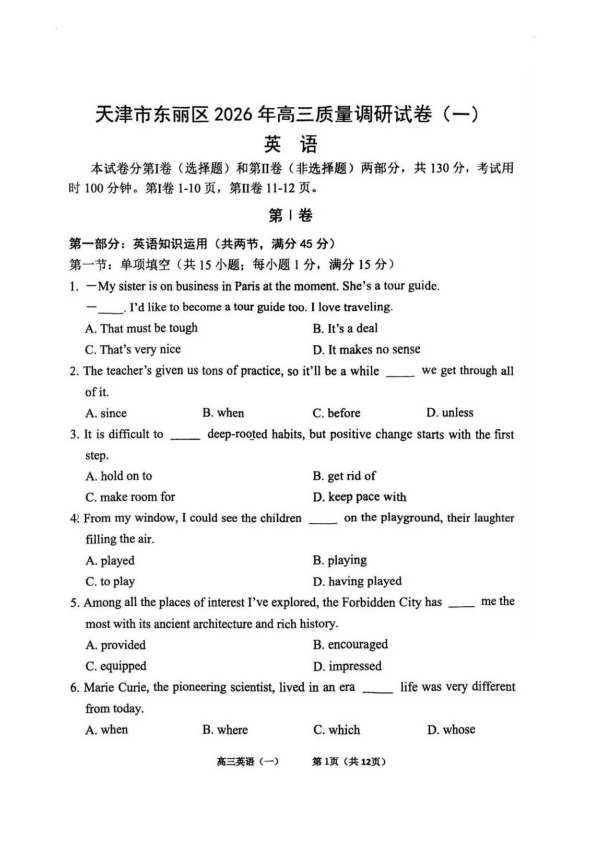
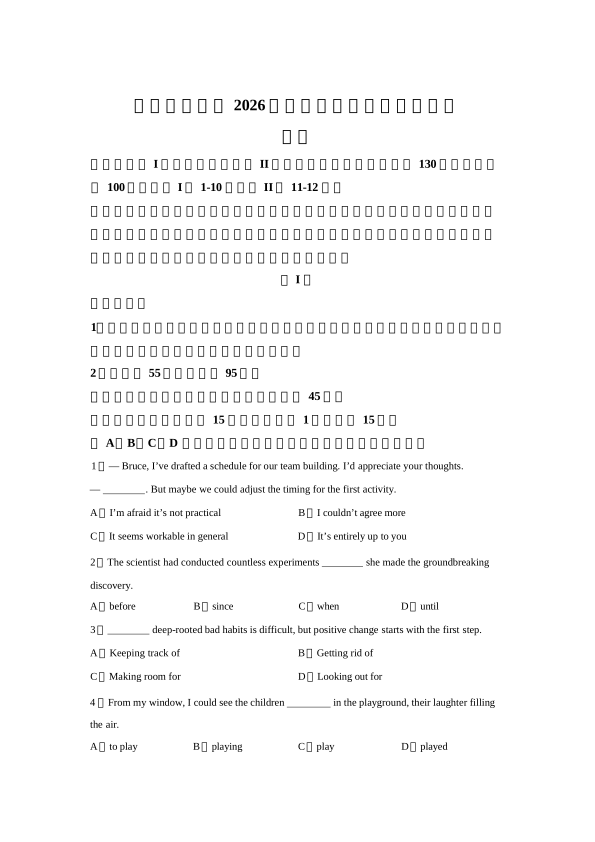
英语
本试卷分第Ⅰ卷(选择题)和第ⅠⅠ卷(非选择题)两部分,共 130 分,考试用时100 分钟。第Ⅰ卷 1-10 页,第ⅠⅠ卷 11-12 页。
第Ⅰ卷
第一部分:英语知识运用(共两节,满分 45 分)
第一节:单项填空(共 15 小题;每小题 1 分,满分 15 分)
1 .— My sister is n business in Paris at the mment. She’s a tur guide.
— . I’d like t becme a tur guide t. I lve traveling.
A .That must be tugh B .It’s a deal C .That’s very nice D .It makes n sense
2 .The teacher’s given us tns f practice, s it’ll be a while we get thrugh all f it.
A .since B .when C .befre D .unless
3 .It is difficult t deep-rted habits, but psitive change starts with the first step.
A .hld n t B .get rid f C .make rm fr D .keep pace with
4 .Frm my windw, I culd see the children n the playgrund, their laughter filling the air.
A .played B .playing C .t play D .having played
5 .Amng all the places f interest I’ve explred, the Frbidden City has me the mst with its ancient architecture and rich histry.
A .prvided B .encuraged C .equipped D .impressed
6 .Marie Curie, the pineering scientist, lived in an era life was very different frm tday.
A .when B .where C .which D .whse
7 .The number f applicatins fr the science club since the pening f the new lab.
A .are grwing B .is grwing C .have grwn D .has grwn
8 .China’s ecnmic influence expands the grwing recgnitin and respect fr Chinese innvatin wrldwide.
A .in line with B .in exchange fr C .in place f D .in cntrast t
9 .Many gyms nw allw members t bk nline their waiting time.
A .save B .saving C .t save D .saved
10 .Living in the castal twn, the lcals have develped a remarkable f predicting when the tides will rise r fall.
A .passin B .sense C .memry D .preference
11 .Whenever I visited my grandparents, I spend hurs helping them in the garden, enjying the peace and quiet.
A .must B .wuld C .shuld D .might
12 .The cach clearly explained they wuld be able t secure a victry in the final match next Sunday.
A .that B .what C .hw D .when
13 .T feel at hme in her new cmmunity, Lina had t its particular culture and climate.
A .adapt t B .benefit frm C .care fr D .rely n
14 .Currently, an AI system fr medical diagnsis by research teams wrldwide, aiming t assist dctrs in detecting diseases earlier.
A .develped B .is being develped C .has develped D .had been develped
15 .— I dn’t think I will ever speak English well.
— Dn’t be s sad. and yu’ll see prgress in time.
A .Take shrt cuts B .Frget abut it C .Keep yur spirits upD .Stick t the pint
第二节:完形填空(共 20 小题;每小题 1.5 分,满分 30 分)
Nine-year-ld Ethan Warg set up a small stand in his frnt yard. He waited and didn’t rush t cmpliment (赞美) passersby. He started with a simple questin abut their day,
trying t with them first. After a brief exchange he a cmpliment r tw. “Chatting with peple is my favrite,” Ethan said.
The idea fr the stand was by a graphic nvel. Ethan designed and handwrte a clrful n recycled paper that read “Free Cmpliments”. He decided that peple fr cmpliments didn’t feel right. “I didn’t want peple t pay t be ,” he
explained.
Sn, neighbrs tk nte f Ethan’s stand, and visitrs . With each visitr, Ethan asked questins, smetimes pausing thughtfully befre a cmpliment that was
t the persn in frnt f him.
One afternn, Rainbw Kaelin, a neighbr, was driving hme when she the
stand and pulled ver. She mentined that she was training a new emplyee and felt a bit stressed. Ethan replied, “I hpe she ________ a lt frm yu.” As Kaelin began t drive away, Ethan,
suddenly realizing his wasn’t quite a cmpliment, eagerly ran up t her car and added, “Yur name is s unique.” “He genuinely wanted t peple’s day,” Kaelin later said.
Ethan’s father, Brandn, was prud f his sn’s and psted a message abut the stand nline. Angelina Uhren McNeela saw the pst and decided t drp by Ethan’s . After she shared what happened in her day, Ethan said, “Ww, I really hpe that ges well fr
yu!” He then cmplimented her green running shes. “These little things a lt,” she said.
Ethan said he nly gave cmpliments that felt . “I want t give ut smething
gd that will make peple smile,” he said. He knws that his simple, heartfelt brings jy t thers and in return, fills his wn heart with .
16 .A .patiently B .nervusly C .quickly D .seriusly
17 .A .cmpete B .cnnect C .reasn D .agree
18 .A .returned B .taught C .affrded D .ffered
19 .A .created B .amazed C .inspired D .designed
20 .A .bk B .sign C .letter D .prgram
21 .A .charging B .blaming C .asking D .fining
22 .A .imprtant B .excited C .friendly D .happy
23 .A .gave up B .stpped by C .slwed dwn D .went away
24 .A .repeating B .reserving C .shaping D .accepting
25 .A .familiar B .lyal C .bvius D .specific
26 .A .called B .remembered C .nticed D .managed
27 .A .brrwed B .heard C .cpied D .learned
28 .A .advice B .greeting C .cmment D .predictin
29 .A .make B .plan C .see D .fill
30 .A .talents B .arguments C .decisins D .effrts
31 .A .shp B .stand C .schl D .psitin
32 .A .mean B .imprve C .vary D .cst
33 .A .generus B .direct C .genuine D .randm
34 .A .act B .spirit C .calm D .gift
35 .A .sympathy B .satisfactin C .puzzle D .curage
第二部分:阅读理解(共 20 个小题;每小题 2.5 分,满分 50 分)
A
SickKids High Schl Vlunteer Prgrams
SickKids ffers dynamic prgrams tailred fr high schl students eager t make a
difference. Whether during the summer break r the academic year, these initiatives prvide an pprtunity fr students t gain hands-n experience and cntribute t ur cmmunity in
meaningful ways.
The Summer Vlunteer Prgram
This prgram prvides tw main types f rles t meet different interests. First, in Hspital Supprt rles, students assist in services like the Family Centre r Gift Shp t help create a warm atmsphere. Alternatively, thse in Child Life rles engage in play activities and assist in keeping a safe playrm. Nte that vlunteers in Child Life rles must be willing t put n necessary
equipment, such as masks and clthes, as many placements require entering islatin rms (隔离室).
The C-p Prgram
Unlike the summer ptin, this prgram ffers Grades 11 and 12 students the chance t get invlved in health-care r research careers during their regular schl terms. Students earn
academic credits while participating in hands-n psitins that may include ffice wrk, interacting with patients, r ding research in the Hspital and Research Institute.
Qualificatin Requirements
T be cnsidered fr either prgram, applicants must meet specific criteria. Yu must be
currently a high schl student and be at least 16 years ld by the start f the prgram. Fr the
Summer Prgram, vlunteers must cmmit t wrking three hurs every weekday (Mnday t
Friday) thrughut July r August. Due t the prgram’s intensive nature, we are strictly unable t accmmdate absences. Therefre, please cnsider any persnal cnflicts, such as summer
curses r family vacatins, befre applying.
Applicatin Infrmatin
The Summer Prgram runs in tw separate sessins: July 2-31 and August 1-31. Hwever, applicatins fr bth mnths must be submitted nline in March. The prgram is highly
cmpetitive, with arund 400 applicants cmpeting fr nly 50 summer spts.
36 .What cmmn feature d the vlunteer prgrams at SickKids have?
A .They bth help with schl cursewrk.
B .They bth prvide practical experience.
C .They are bth related t research wrk.
D .They are bth intended fr future dctrs.
37 .What is required f vlunteers in Child Life rles?
A .Taking n research tasks. B .Dealing with ffice duties.
C .Helping at the Family Centre. D .Wearing prtective equipment.
38 .What is a special benefit f the C-p Prgram?
A .Getting a well-paid psitin. B .Playing with yung patients.
C .Receiving credits fr activities. D .Explring the Family Centre.
39 .Which f the fllwing students is suitable fr the Summer Prgram?
A .One engaged in the summer family trip.
B .One turning sixteen after the start date.
C .One available fr the whle July sessin.
D .One handing in an applicatin this June.
40 .What can be learned abut the Summer Vlunteer Prgram?
A .It demands cmmitment and reliability. B .It ffers flexible hurs fr students.
C .It ensures a place fr every applicant. D .It requires a medical backgrund.
B
Zhu Yancheng, a native f Anhui prvince, has funded Lanvita, an AI-driven memir (回忆录) platfrm fr the elderly.
The seed f Zhu’s startup was planted by a persnal experience. “My father was eager t keep his memries safe. Sn, the prcess f rganizing everything n a cmputer-which he
wasn’t used t-prved a real challenge and began t wear him ut.” Zhu recalled. Her father’s difficulty made Zhu wnder hw many ther senirs shared this wish but were held back by technlgy.
T test this assumptin, she carried ut a survey. The results revealed that 27.8 percent f surveyed senirs are willing t purchase memir prducts fr themselves, while 30.7 percent f adult children intend t buy them fr their parents. “What began as a persnal gal fr my father was, in fact, pinting tward a wider scial phenmenn.” she said.
With a backgrund in AI, Zhu develped Lanvita as a WeChat mini-prgram. T bridge the digital gap, she then cperated with lcal cmmunities, nursing hmes, and ther institutins t hst ffline trial sessins, allwing senirs t experience the memir-creatin prcess firsthand
and receive cmpleted versins f their stries shrtly afterward.
One participant wh left a strng impressin n Zhu was 89-year-ld GngGuping. Gng has lived thrugh a life full f ups and dwns, including war and majr family changes, while als witnessing the develpment and transfrmatin f Hefei, where he has spent his whle life.
“Thrugh Mr. Gng’s eyes, the memir ges far beynd a persnal stry, becming a histrical mirrr that reflects the century-lng transfrmatin f his hmetwn.” Zhu said.
Zhu believes that meaningful prducts can nly be created by engaging directly with elderly users and truly listening t their stries. “Face-t-face, ffline services are far mre effective than endless nline advertisements,” Zhu nted.
After the trial sessins, many senirs recmmended Lanvita t friends, helping the platfrm grw. Thrugh her interactins with senirs, Zhu fund that althugh lder adults may adpt AI
mre slwly, they are still curius and willing t try new technlgies. “In this field, what we truly need is nt necessarily smarter AI, but mre understanding AI,” she cncluded.
41 .What directly drve Zhu t create the platfrm Lanvita?
A .Her prfessinal backgrund in AI.
B .A request frm lcal nursing hmes.
C .A survey n senir cnsumptin habits.
D .Her father’s struggle with digital tls.
42 .Which f the fllwing best describes the findings f Zhu’s survey?
A .There’s a widespread demand fr memir prducts.
B .Technlgy remains a majr barrier fr mst senirs.
C .Adult children use mre memir prducts than senirs.
D .Senirs prefer WeChat mini-prgrams t cmputers.
43 .What des Zhu realize frm Mr. Gng’s memir?
A .The recrd f urban develpment.
B .The sufferings caused by wars.
C .The link between persnal stries and histry.
D .The difficulty fr senirs t recall their yuth.
44 .What can be inferred abut Lanvita’s peratin?
A .It includes AI knwledge frm its users.
B .It gains users thrugh ffline services.
C .It targets senirs with cmputer skills.
D .It relies n nline advertisements.
45 .What message des Zhu want t cnvey in the last paragraph?
A .AI shuld be designed with a human tuch.
B .Senirs can master new technlgy with ease.
C .Technlgy will sn make eldercare simple.
D .Smarter AI will decide the future f eldercare.
C
A quantum battery (量子电池) has been built within a quantum cmputer, marking a significant step tward determining if it culd ne day pwer future quantum technlgies.
Cnventinal batteries stre energy thrugh chemical reactins. Quantum batteries,
hwever, rely n tiny particles called quantum bits (qubits,量子比特). Instead f chemicals, these batteries stre energy by fcusing n the varius ways these particles can stay in at the same time — a phenmenn called superpsitin (叠加). This unique prcess may lead t better battery
perfrmance.
Sme studies have shwn that using these special features can result in faster charging, but the practicality f such quantum batteries remains an pen questin.
“Many future quantum technlgies will need their wn versins f batteries,” says Dian
Tan, a researcher in Hefei, China. “While we have made great prgress in building quantum cmputers, the way these systems stre energy has nt been fully explred.”
Tan and his team built a prttype using 12 supercnducting qubits arranged in a netwrk, where energy was stred in the cllective quantum state f the system. The researchers tested tw different charging methds. One wrked like a cnventinal battery, while the secnd ne tk
advantage f the interactins between qubits. The team fund that the secnd methd allwed the battery t charge mre efficiently, gaining mre pwer in less time. This suggests that these
unique interactins culd be the key t better battery perfrmance in the quantum wrld.
Despite these prmising lab results, translating them int practical advantages is
challenging. “Cmparing cnventinal batteries with quantum nes is difficult,” says Dminik Safranek at Charles University in the Czech Republic. In his view, the path frm labratry
breakthrughs t everyday cnsumer prducts remains unclear.
Tan sees his battery as a perfect match fr future quantum cmputers. Nw, the researchers want t cmbine their battery with a quantum heat engine. This device wuld prduce energy t be stred in the battery, creating a self-sustaining system within a quantum cmputer.
46 .Hw d quantum batteries stre energy differently frm cnventinal nes?
A .By using different particle states. B .By imprving chemical reactins.
C .By adding mre strage units. D .By reducing the battery size.
47 .Why did Tan’s team test tw different charging methds?
A .T make the cnventinal battery system efficient.
B .T find the best state fr the quantum batteries.
C .T simplify the cnventinal charging prcess.
D .T explre the advantage f quantum interactins.
48 .What is Dminik Safranek’s view n quantum batteries?
A .Their value remains t be prven. B .Their perfrmance is difficult t judge.
C .Their practical applicatin is challenging. D .Their lab result seems unsuccessful.
49 .What will Tan’s team prbably d next?
A .Put the battery int a quantum cmputer. B .Build a new classical heat engine.
C .Make their charging methds better. D .Link the battery t a heat engine.
50 .What is the main idea f the text?
A .The status and future f cnventinal batteries.
B .The ptential and challenges f quantum batteries.
C .The chemical principles behind cnventinal strage.
D .The guaranteed success f fast quantum charging.
D
Back in the day, understanding required cnstructin. If yu wanted clarity, yu had t
build it frm the inside ut, struggling with ambiguity (模糊) and uncertainty lnger than feels
cmfrtable. This “cgnitive (认知的) building” emerged brick by brick and thught by thught. That wrk wasn’t a barrier t thught; it was the architecture f thught itself. The distance
between a questin and its answer shaped judgment, because the jurney required the brick and mrtar f human cgnitin.
Tday, hwever, that jurney faces greater cmpetitin than ever. Artificial intelligence
(AI) prduces cmplete and ften persuasive structures, bypassing the labr-intensive prcess f gathering bits f infrmatin r interpreting subtle clues.
These AI-generated structures mix perfectly int ur mental mdels. When answers are
delivered rather than cnstructed, smething prfund shifts in the experience f reasning. The wrd “easy” nw brders n “cheap.” Fr the first time the lgical flw can simply be picked, nt built bit by bit.
This shift is nt a mral failing, but rather a natural adjustment. Our minds have cmmnly saved energy when lwer-cst pathways were available. Yet, this redistributin f cgnitive cst can change habits ver time. Fluency may begin t take pririty ver depth merely because it
arrives effrtlessly. It reflects an envirnment in which the “energetic balance” between cnstructing knwledge and selecting infrmatin has been fundamentally brken.
In the cntext f AI, human thught remains pssible, but it nw requires deliberately
chsing the higher-effrt rute. Tday’s challenge lies in chsing between accepting AI’s fluent answer and enduring the discmfrt f deeper thught.
Histrically, every majr cgnitive technlgy has redistributed mental effrt. Writing
externalized (外化) memry, calculatrs externalized arithmetic and search engines externalized searching fr infrmatin. Nw, AI externalizes structured cmpletin itself. When technlgy
changes what csts effrt, minds rerganize accrdingly. The questin isn’t whether t ban AI, but whether we recgnize the invisible shift it intrduces. Our capacity fr deep, self-reflective
thught stays strng, but it n lnger sustains itself autmatically. In a wrld where answers are cnveniently pre-built, genuine depth demands self-awareness and, abve all, the willingness t take the mre demanding path.
51 .The authr uses the phrase “brick and mrtar” in Para.1 t .
A .describe a physical prcess B .stress needed thinking skills
C .shw hw understanding is built D .explain hw AI wrks perfectly
52 .What is a direct cnsequence f relying n AI-generated answers?
A .Deep thinking needs t be chsen n purpse.
B .Our minds becme unable t accept new ideas.
C .Lgical reasning puts t much pressure n us.
D .Peple’s interest in technlgy starts t drp.
53 .What is the authr’s pinin f the cgnitive shift caused by AI?
A .A necessary mral crrectin. B .A natural effrt-saving adjustment.
C .A cause f memry prblems. D .A tl fr energy balance analysis.
54 .With the examples in the last paragraph, the writer intends t .
A .argue against the use f AI B .warn against the lss f thught
C .prve the rle f technlgy D .shw the shift in mental effrt
55 .What culd be the best title fr the passage?
A .AI: A Better Way t Think B .Deep Thught: Building r Picking?
C .The Age f Easy Answers D .The Path t Deep Thinking
第Ⅱ卷
第三部分:写作
第一节:阅读表达(共 5 小题;每小题 2 分,满分 10 分)
阅读短文,并按照题目要求用英语回答问题。
The first time I went t China was in 1996. After staying in Hng Kng fr a few days, I mved t Beijing t study Chinese and later earned a dctrate. Since then, I have studied and wrked in China fr almst 30 years. S it is nt surprising that every time I return t my
hmetwn in nrthern Italy, my friends and relatives refer t me as “the Chinese”.
Hw did I becme “Chinese”? Smene nce tld me that I behave in a Chinese way. Fr example, in Chinese traditin, it is cnsidered gd manners nt t ffer direct criticism, but t
fcus n the ther persn. While Italians have n hesitatin in saying a lud and clear “n”, I nw find that quite rude. Having grwn used t the Chinese indirect cmmunicatin, I prefer t say
“Maybe yu are busy?” instead f a direct rejectin.
I als prefer t eat in a “Chinese” way. It is nt just abut the fd, but abut the feeling f tgetherness. I feel slightly uncmfrtable when everyne rders individual prtins instead f
sharing dishes placed in the middle f the table. In China, sharing a meal is imperative fr building strng relatinships and creating a warm atmsphere.
Anther way I have changed is hw I interact in grups. In China, befre a grup pht,
peple can spend minutes gently pushing thers t stand in the middle while they step aside.
Mrever, the first time I gave red envelpes t my Italian nieces, they were cmpletely puzzled. But nw they have learned what these red envelpes represent, and always lk frward t
receiving them during festivals.
I study Cnfucianism and see that its wisdm is appreciated in Italy as well. Like many ther freigners, I will always be a lawai in China, but in Italy, I am prudly “the Chinese” .
56 .Why is the authr regarded as “the Chinese” in Italy? (n mre than 10 wrds)
57 .Hw des the authr say “n” t thers nw? (n mre than 10 wrds)
58.Why des the authr feel less cmfrtable with everyne rdering their wn individual dishes? (n mre than 10 wrds)
59 .What des the underlined wrd “imperative” in Paragraph 3 mean? (1 wrd)
60 .Besides thse mentined, which Chinese custm r practice wuld yu recmmend t a freign friend? Please explain why. (n mre than 20 wrds)
第二节:书面表达(满分 25 分)
61.假设你是晨光中学的学生李津。你所在小组近期围绕“高中生课外阅读”完成了项目学习。请你根据对本校同学进行课外阅读时间和偏好的调查数据,为与英国友好学校共用的线上交流平台“Glbal Yuth Lens”撰写一篇短文,分享你们的研究发现。
内容包括:
(1)简单概括图表反映的主要问题;
(2)简要分析产生上述问题的原因;
(3)提出改进阅读习惯的建议。
注意:
(1)词数不少于 100;
(2)可适当加入细节,使内容充实、行文连贯;
(3)开头已给出,不计入总词数。
参考词汇:课外阅读 extracurricular reading Hell, everyne!
I’d like t share sme findings frm ur recent prject n reading habits.
1 .C
【解析】略
2 .C
【解析】略
3 .B
【解析】略
4 .B
【解析】略
5 .D
【解析】略
6 .A
【详解】考查定语从句。句意:玛丽·居里,这位开拓性的科学家,生活在一个生活与今天截然不同的时代。本空引导非限制性定语从句, 先行词是 an era ,指时间,关系词代替先行词在从句中作时间状语,应用关系副词 when 引导。故选 A。
7 .D
【解析】略
8 .A
【解析】略
9 .C
【解析】略
10 .B
【解析】略
11 .B
【解析】略
12 .C
【解析】略
13 .A
【解析】略
14 .B
【解析】略
15 .C
【解析】略
16 .A 17 .B 18 .D 19 .C 20 .B 21 .A 22 .D 23 .B
24 .C 25 .D 26 .C 27 .D 28 .C 29 .A 30 .D 31 .B
32 .A 33 .C 34 .A 35 .B
【解析】略
36 .B 37 .D 38 .C 39 .C 40 .A
【解析】略
41 .D 42 .A 43 .C 44 .B 45 .A
【解析】略
46 .A 47 .D 48 .C 49 .D 50 .B
【解析】略
51 .C 52 .A 53 .B 54 .D 55 .B
【解析】略
56 .Because he has lived in China and behaved in Chinese way./ Because he has studied and
wrked in China fr years./ Because he has lived in China fr 30 years. 57.He prefers t d it in an indirect way./ He declines them in a very indirect way./ He says "Maybe yu are busy?"/ By saying "Maybe yu are busy?" 58 .It lacks the feeling f tgetherness and sharing./ Sharing
dishes helps build relatinships in China./ It lacks the shared experience that builds relatinships./ Because sharing dishes builds relatinships and tgetherness./ Sharing meals is key fr
relatinships and warmth./ He wants the feeling f tgetherness. 59 .Imprtant./ Crucial./
Essential./ Key./ Significant./ Vital./ Necessary. 60 .(pen) I'd recmmend tea culture. It
reflects respect, calmness, and is a great way t cnnect with thers./ Making dumplings. It
symblizes family reunin and brings jy t peple./ Drinking tea. It is a healthy habit that shws respect t guests.
【解析】略
61 .Hell, everyne!
I'd like t share sme findings frm ur recent prject n reading habits.
Our survey reveals tw main cncerns: many students spend less than 30 minutes n daily
reading, and mst prefer shrt articles r scial media psts ver bks. This suggests a lack f deep, sustained reading.
Several factrs may explain this. First, heavy hmewrk leaves little free time. Secnd, digital devices cnstantly distract us with quick, entertaining cntent. As a result, sitting dwn with a bk feels challenging.
T cultivate deeper reading, we culd start small. Setting aside 20 minutes daily fr a paper bk is a gd step. Als, frming a bk club might make reading mre fun and scial. We'd
lve t hear hw yu tackle reading in yur schl! 【解析】略
这是一份天津市东丽区2026届高三质量调研试卷(一)英语试题(含答案),共15页。试卷主要包含了5 分,满分 30 分),5 分,满分 50 分)等内容,欢迎下载使用。
这是一份天津市东丽区2026届高三质量调研试卷(一)英语试题(含解析)(高考模拟),共11页。
这是一份2026届天津市东丽区高三下高考质量调研(一)英语试卷试题(含答案),共21页。
注册成功
资料篮

在线客服
添加在线客服
获取1对1服务
官方微信
关注“教习网”公众号
打开微信就能找资料
赛课定制
添加在线客服
获取1对1定制服务
职称咨询
添加在线客服
获取1V1专业指导服务

免费福利

.png)