免费领取教师福利
若您为此资料的原创作者,认为该资料内容侵犯了您的知识产权,请扫码添加我们的相关工作人员,我们尽可能的保护您的合法权益。

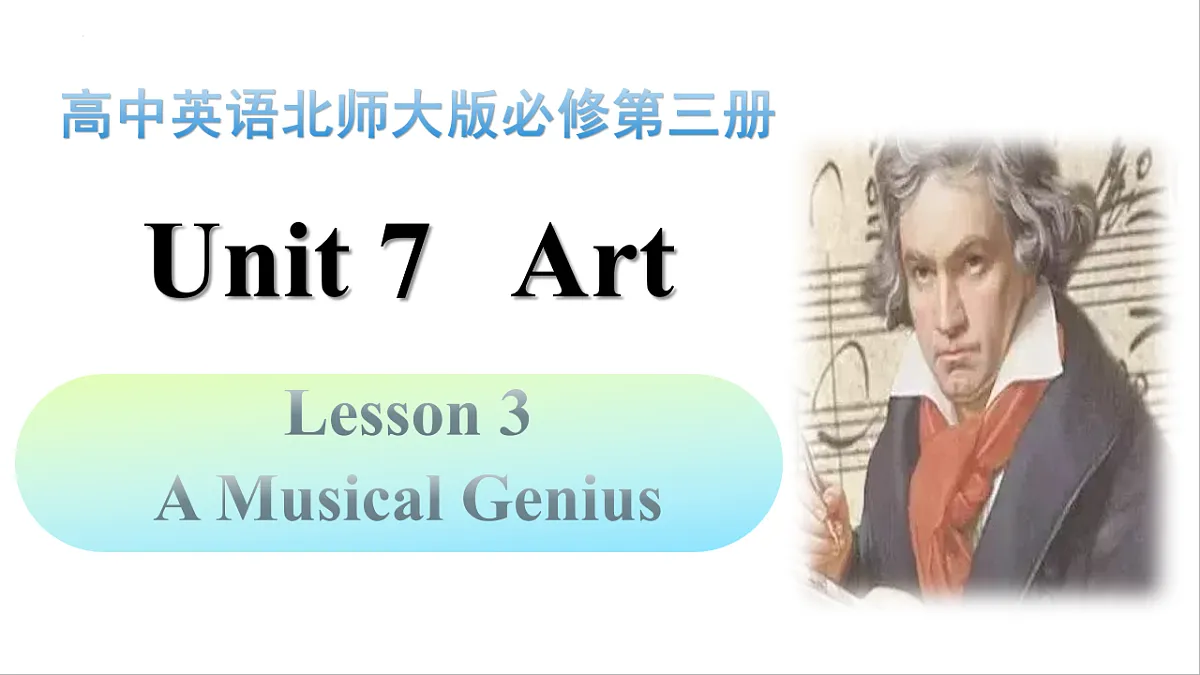
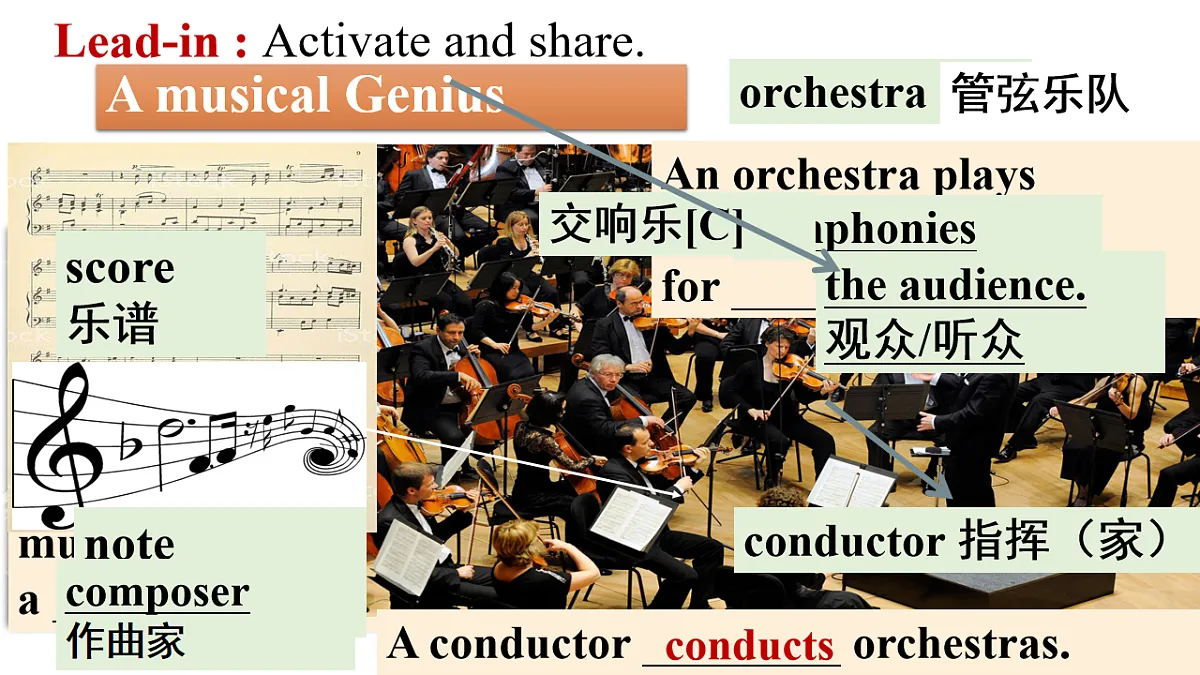
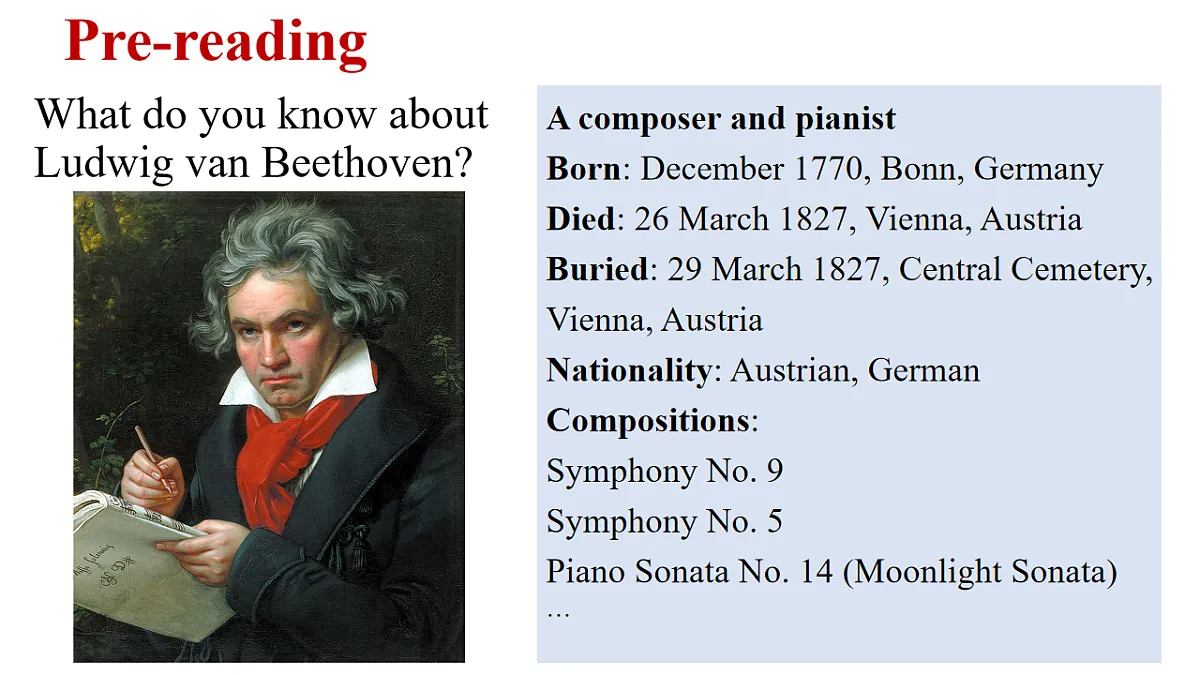
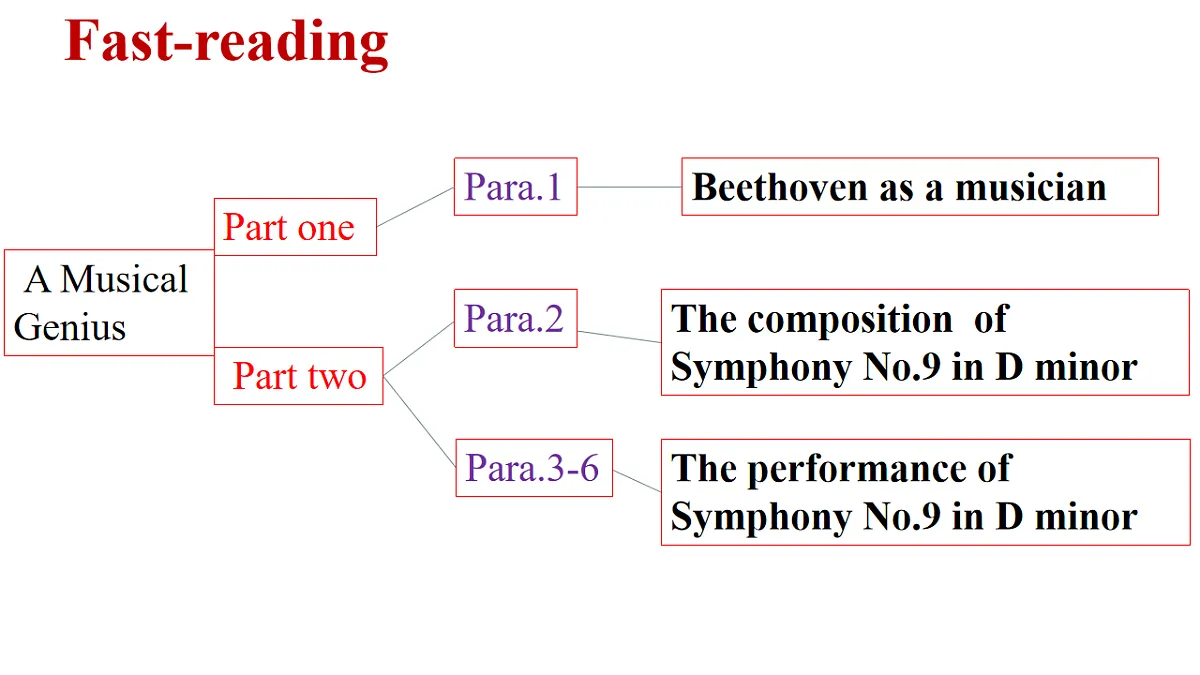
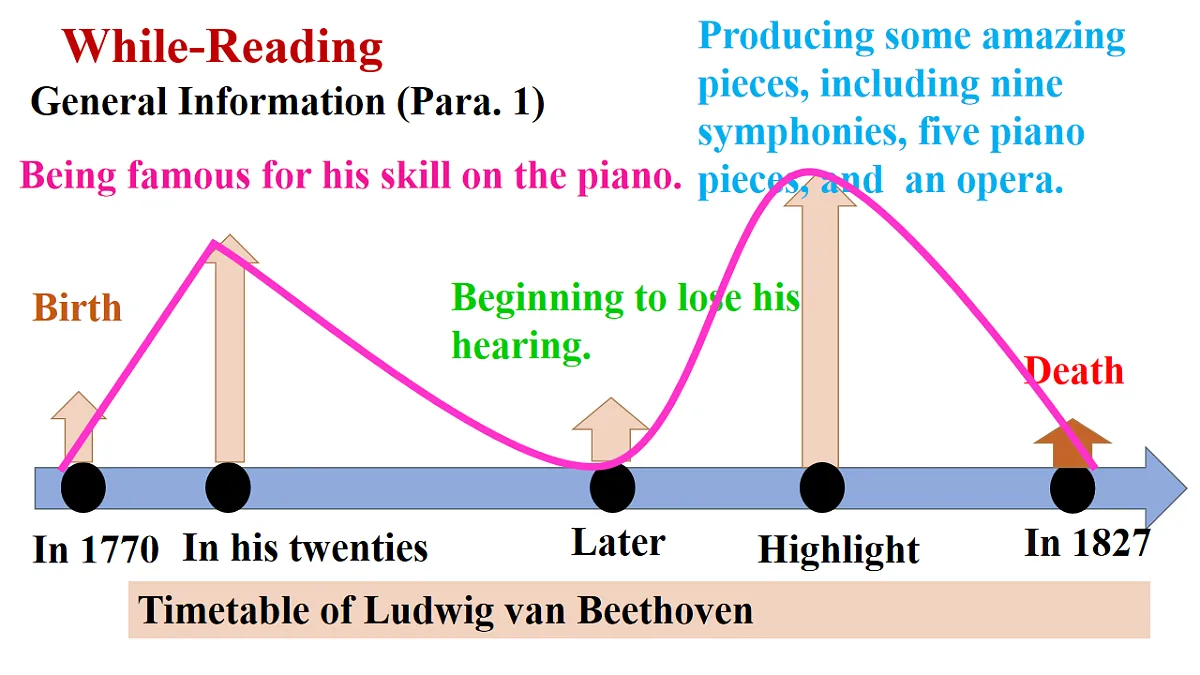
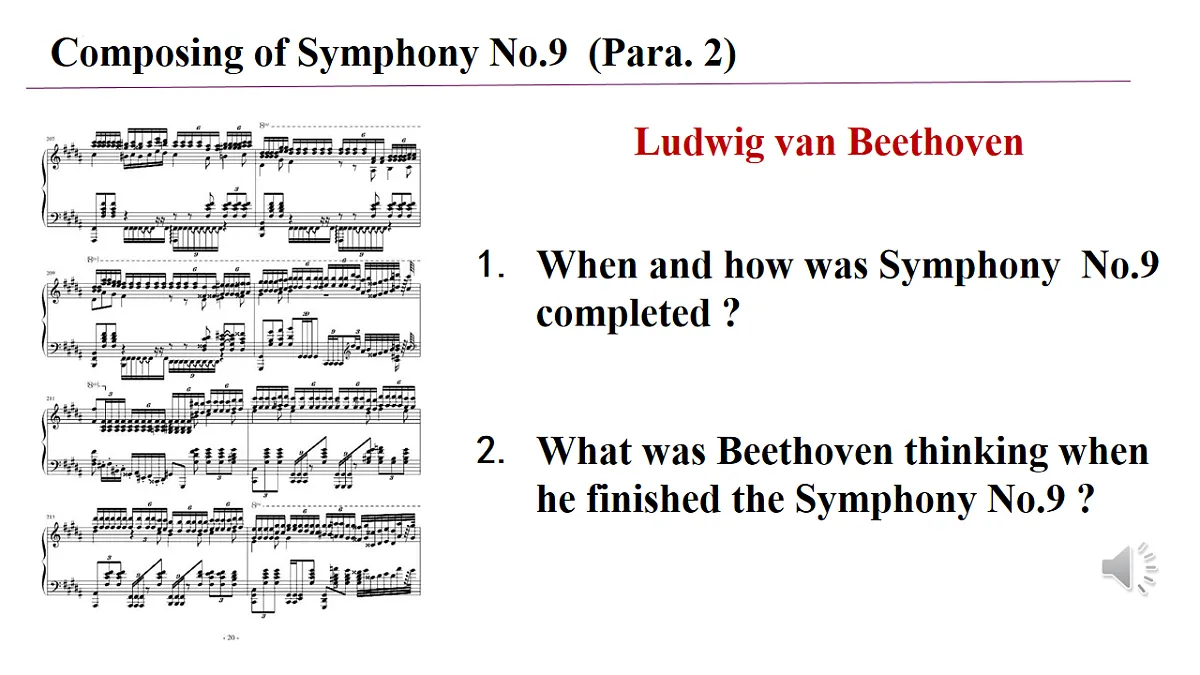
高中英语北师大版必修第三册Unit 7 ArtLesson 3A Musical GeniusTo read and talk about Ludwig van BeethovenTo read for deep understandingTo summarise informationTo learn about and practise word buildingContents1. Lead in2. Pre-reading3. While Reading4. Post Reading5. Summary6. Language Focus7. Homework目录页A person who composes music is called a .A musical Geniusscore 乐谱conductor 指挥(家)orchestra管弦乐队An orchestra plays on stage for .note音符symphoniesA conductor orchestras.conductscomposer作曲家交响乐[C]the audience.观众/听众Lead-in : Activate and share.What do you know about Ludwig van Beethoven?A composer and pianistBorn: December 1770, Bonn, GermanyDied: 26 March 1827, Vienna, AustriaBuried: 29 March 1827, Central Cemetery, Vienna, AustriaNationality: Austrian, GermanCompositions:Symphony No. 9Symphony No. 5Piano Sonata No. 14 (Moonlight Sonata)… Pre-reading A Musical GeniusPart one Part twoPara.1The composition of Symphony No.9 in D minor The performance of Symphony No.9 in D minorBeethoven as a musicianPara.2Para.3-6Fast-readingIn 1770BirthBeing famous for his skill on the piano.LaterBeginning to lose his hearing.Highlight In 1827DeathIn his twenties Producing some amazing pieces, including nine symphonies, five piano pieces, and an opera.Timetable of Ludwig van BeethovenGeneral Information (Para. 1)While-ReadingComposing of Symphony No.9 (Para. 2)Ludwig van Beethoven1. When and how was Symphony No.9 completed ?2. What was Beethoven thinking when he finished the Symphony No.9 ? Performance of Symphony No. 9 (Para 3 ~ 6)Ludwig van Beethoven:BeforeDuringAfterThe audience: Read sentences related to people’s reactions and use some adjectives to describe them.Beethoven was afraid that the performance would be a disaster (line 22 )For more than an hour, Beethoven jumped about in front of the orchestra, waving his arms wildly in the air, and madly turning the pages of his score. (line 28~30 )But Beethoven continued conducting, his head buried in the score. It was not until Caroline Unger, one of the singers, took his arm and turned him to face the audience that the great man realised his symphony was a success. (line 34~37 )Later, Caroline remembered that Beethoven was the not the only one who got a surprise. (line 39)Beethoven’s reaction to the performanceafraid, nervous excited , focused, passionate, confused, unbelievablesurprised Composing of Symphony No.9: took several years, completed in ViennaPerformance of Symphony No.9: For more than an hour, Beethoven jumped about in front the orchestra, waving his arms widly in the air, and madly turning the pages of his score, The whole time, Umlauf stood quietly by his side, skillfully guiding the orchestra through the most amazing piece of music the world had ever know.Skill BuilderGraphic OrganisersGraphic Organisers are a pictorial way of organising and illustrating information in a text. These include flow charts, tables and diagrams.Determine the type of the text (e.g. narrative, argumentation, description, or exposition).Analyse the writing technique. Does the text include sequencing, facts and opinion, cause and effect? Does it compare and contrast?Determine which type of graphic organiser will illustrate the text in the most effective way. Answer the questions based on your notes. Read the story again if needed.41. When and how was Symphony No. 9 completed? What was Beethoven thinking when he finished the symphony?2. How do you think Beethoven felt while he was conducting the orchestra? Find evidence from the text.Personally, Beethoven was very excited when conducting the ninth symphony.One day in February 1824, the famous German composer's ninth symphony was finally completed, Beethoven tried to imagine how people would respond when they heard it for the first time. Pair Work. Choose one of the following topics to introduce to your partner.5Beethoven as a musicianThe performance of Symphony No. 9Post-Reading Group Work. Think and share.61. The description of Beetnoven's behaviour in the performance shows that he was deaf. Can you find the hints? Why did most of the audience have no idea that he was deaf?“And the whole time, Umlauf stood quietly by his side, skilfully conducting the orchestra.” The music ended but Beethoven continued to conduct. “It was not until Caroline Unger took his arm and turned him to face the audience that the great man had realised his symphony was a success.” The audience might think Beethoven was deeply lost in his own music.2. How did Caroline feel when she said “The one person in the room who didn't hear the symphony—and never would—was the very man who composed it.”?She felt very very sorry that Beethoven coldn't hear the music he composed. It was such a pity and she might feel it unfair for him. She must have wished Beethoven was not deaf.Audience’s reaction to the performanceThe audience did not hesitate to applaud loudly as the famous composer walked out onto the stage for the first time in 12 years.As the final, joyous note signalled the end of the symphony, the audience jumped to their feet, clapping and waving their hats. The audience was shocked as well.respectful, excitedexcited, impressed What makes Ludwig van Beethoven a musical genius?Ambitious GreatEnthusiasticNever give upIntelligentUniqueStrong-willedSummary took charge of waving their hats turned him to face backstage atmosphere jumped to their feet with a broad smile madly turning the pagesBefore the performance, the _____________________ was tense.Michael Umlauf joined him and together, the two men _______________ the orchestra.Beethoven jumped about in the front of the orchestra, waving his arms wildly in the air, and _____________________ of his score.backstage atmosphere took charge ofmadly turning the pagesComplete the sentences with the phrases.Focus on Language74. As the final note signalled the end, the audience _________________, clapping, cheering, and waving their hats.5. Caroline Unger took Beethoven’s arm and ________________ the audience.6. In an interview afterwards, Caroline said _________________, “The audience was shocked as well.turned him to face with a broad smilejumped to their feetFocus on Languagecomposerperformerhesitationproductionproducerresponsecomposeperformmusical productivejoyousresponsiveconductorFocus on Language: Complete the Word Builderhesitant8Focus on LanguageIt has always been my dream to __________ an orchestra.The musician __________ with nervousness before he began to play.Beethoven is recognised as a __________ genius by people around the world.Beethoven is the __________ of Symphony No. 9 in D minor.conducthesitatedmusicalcomposerComplete the sentences with the correct form of the words in the Word Builder.95. To his mother’s _____, he won the first prize.6. She told me about the wonderful ___________ that she had been to last week.7. The audience’s _________ to the performance of the symphony was extraordinary.8. Though Beethoven lost his hearing, he ________ some amazing pieces of music.joyperformanceresponseproducedFocus on LanguageComplete the sentences with the correct form of the words in the Word Builder. Wolfgang Amadeus Mozart is a well-known classical 1. _________ (music) who was born in 1756. Mozart was very gifted as a child and by the age of five he had 2. ___________ (compose) a piece of music. His father was his teacher initially and he was shocked by the ability of his young son. From the age of 17, Mozart began to write and 3. __________ (conductor) operas, which were 4. ___________ (perform) in front of European royally. Over the years of his performing and writing, it was clear that Mozart was far more gifted and talentedmusiciancomposedconductperformedComplete the text with the correct form.Focus on Languagethan others in his field, although at times, he found that people showed 5. _________ (hesitate) to support him financially. His music was known for being very dramatic and complicated for orchestras to play. Mozart 6. __________ (production) some of his most famous 7. ________ (musician) works in the last years of his life including The Marriage of Figaro in 1786 and The Magic Flute in 1791. His last work was a piece of 8. ________ (musical) called Requiem, which was unfinished when he died in 1791.musicproducedmusicalhesitationFocus on LanguageEXPRESS YOURSELFPair WorkWhich part of the story about Beethoven impressed you most? Why?10EXPRESS YOURSELFFind some pieces of Beethoven's music online. Discuss how you feel when listening to his music.11Write a passage entitled “ My understanding of genius” with no more than 150 words.
注册成功
资料篮

在线客服
添加在线客服
获取1对1服务
官方微信
关注“教习网”公众号
打开微信就能找资料
赛课定制
添加在线客服
获取1对1定制服务
职称咨询
添加在线客服
获取1V1专业指导服务

免费福利


.png)