免费领取教师福利

若您为此资料的原创作者,认为该资料内容侵犯了您的知识产权,请扫码添加我们的相关工作人员,我们尽可能的保护您的合法权益。


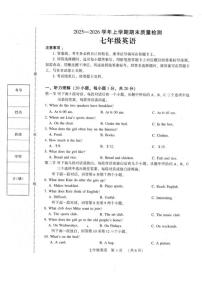
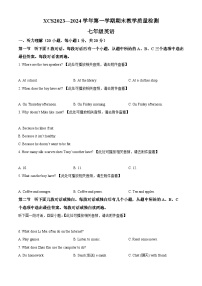
这是一份河南省许昌市禹州市2025-2026学年七年级下学期期末质量检测 英语试题(含解析),共4页。试卷主要包含了听力理解,拼读测试,阅读理解,完形填空,语篇填空,补全对话,书面表达,卷面等内容,欢迎下载使用。
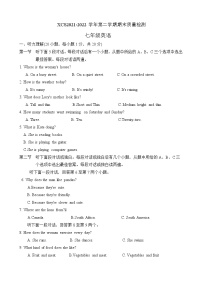
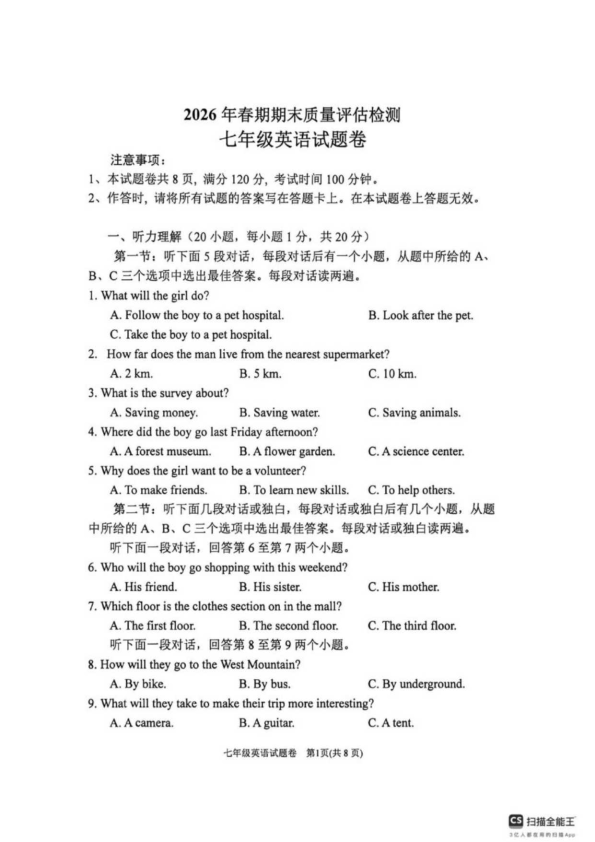
一、听力理解(20小题,每小题1分,共20分)
第一节 听下面5段对话。每段对话后有一个小题,从题中所给的A、B、C三个选项中选出最佳答案,每段对话读两遍。
1. What des the girl think f the lin?
A. It's cute. B. It's scary. C. It's strng.
2. What wuld the girl like fr dinner?
A. Sme carrts and tmates. B. Sme tfu and carrts.
C. Sme tfu and tmates.
3. Hw ften des the girl play tennis?
A. Once a week. B. Twice a week. C. Three times a week.
4. What des the wman advise the man t d t keep fit?
A. Keep exercising. B. Eat well. C. Stay happy.
5. Hw is the weather tday?
A. Cl. B. Warm. C. Ht.
第二节 听下面几段对话或独白。每段对话或独白后有几个小题,从题中所给的A、B、C三个选项中选出最佳答案。每段对话或独白读两遍。
听下面一段对话,回答第6至第7两个小题。
6. When did the girl call Frank?
A. At 9:00 am. B. At 9:30 am. C. At 3:30 pm.
7. What des the by want t buy?
A. Sme milk. B. Sme bread. C. Sme fruit.
听下面一段对话,回答第8至第9两个小题。
8. Where d the by's parents wrk?
A. In the schl. B. In the factry. C. In the hspital.
9. What des the by want t d after schl?
A. T read bks. B. T d his hmewrk. C. T help his parents make dinner.
听下面一段独白,回答第10至第12三个小题。
10. What's the weather like tday?
A. Windy. B. Sunny. C. Cludy.
11. Where are the children singing?
A. Under the tree. B. By the river. C. On the bat.
12. Hw many wmen are dancing?
A. Furteen. B. Fifteen. C. Sixteen.
听下面一段对话,回答第13至第15三个小题。
13. Wh is in the first picture?
A. The girl's mther. B. The girl's aunt. C. The girl's father.
14. What's the girl's cusin ding in the picture?
A. Playing tennis. B. Playing the pian. C. Washing the car.
15. Hw many pictures are the girl and the by talking abut?
A. Three. B. Fur. C. Five.
第三节
听下面一篇短文。根据短文内容,将所缺信息填入表格中的横线上,每空限填一词。短文读两遍。
二、拼读测试(13小题,每小题1分,共13分)
A.
根据读音规则,选出划线部分与所给音标一致的选项。
1. /ʌ/A. trueB. rulerC. cuteD. cut
2. /ɜː/A. wrkB. nrthC. frD. prk
3. /aʊ/A. fllwB. knwC. nwD. slwly
4. /k/A. adviceB. catchC. decideD. cinema
5. /g/A. genieB. hugeC. gladD. range
B.
选出划线部分读音与其他不同的选项。
6. A. pieceB. lieC. dieD. pie
7. A. dearB. nearC. searchD. ear
8. A. changeB. chiceC. chseD. schl
9. A. withB. theyC. mathsD. weather
10. A. whaleB. whC. whileD. white
C.
根据所给音标写出单词,每空一个字母。
11. /ʃaɪn/ __ __ __ __ __
12. /weɪst/ __ __ __ __ __
13. /ˈhevɪli/ __ __ __ __ __ __ __
三、阅读理解(15小题,每小题2分,共30分)
A
Lrd Ye’s Lve f Dragns
Once upn a time, there was a man called Lrd Ye in China. He lved dragns very much. And in his huse, the pictures f dragns were n the drs, n the windws, n the walls and even n his clthes. He tld everyne that dragns were his favrite animals in the wrld. He ften said, “I really want t see a real dragn.”
A real dragn knew abut that. It felt very happy and decided t visit him ne rainy day. The huge dragn flew dwn frm the cluds and put its big head thrugh Lrd Ye’s windw.
When Lrd Ye saw the real dragn, he was s surprised and scared. His face turned white and he culdn’t say a wrd. He ran away quickly and hid (躲藏) in a small rm. The dragn felt very disappinted (失望的) and flew back t the sky.
Lrd Ye nly lved pictures f dragns instead f real dragns. In ur daily life, we are smetimes a “Lrd Ye”. We say ne thing, but we dn’t d the same thing. Our wrds are nt the same as ur actins (行为).
14. In Lrd Ye’s huse, the pictures f dragns are ________.
①n the drs ②n the walls ③n his clthes ④n the beds
A. ①②③B. ①③④C. ①②④D. ②③④
15. What did Lrd Ye d when he saw the real dragn?
A. He welcmed the dragn happily.
B. He asked the dragn t stay in his huse.
C. He talked with the dragn fr a lng time.
D. He ran away quickly and hid in a small rm.
16. Hw did the real dragn feel when it left Lrd Ye’s huse?
A. Happy.B. Disappinted.C. Angry.D. Excited.
17. What des the stry f “Lrd Ye’s Lve f Dragns” tell us?
A. Dragns are nt real animals.
B. Dragns are dangerus animals.
C. Our wrds shuld be the same as ur actins.
D. We shuld keep pictures f dragns at hme.
18. Which f the fllwing is a “Lrd Ye” in life?
A. Tm wants t keep fit; he walks t schl every day.
B. Cindy says rules are imprtant; she never eats in class.
C. Mary wuld like t lse weight; she always eats fast fd.
D. Bb says he lves English; he wants t be an English teacher.
B
① Why d we have family rules? Because they can help children t knw what is OK and isn’t OK in the family. But hw can parents make gd family rules fr their children?
② When parents make rules, it’s gd fr them t let their children jin in. When parents talk abut rules with them, children can bey them easily. Then, what are gd family rules like?
③ First, parents shuld tell their children what t d, nt what nt t d. Fr example, “G t bed befre 9:30 p. m.!” is gd. “Dn’t g t bed late!” isn’t.
④ Secnd, rules shuld be clear fr children t fllw. Fr example, “Eat an egg every mrning!” is gd. “It’s imprtant t eat well!” isn’t.
⑤Als, it’s gd fr parents t write dwn (写下) the rules t help children remember them. Fr little children, parents can draw pictures t help them understand the rules.
⑥ In the end (最后), family rules need t be changed (改变). Fr example, when the children get lder, parents shuld make rules abut helping with husewrk.
19. Hw des the writer start the passage (作者是怎样开始这篇文章的)?
A. By giving a number.B. By asking a questin.
C. By using an ld sayings (谚语).D. By telling a stry.
20. The underlined wrd “bey” in paragraph 2 prbably means “______”.
A. makeB. turnC. tellD. fllw
21. Accrding t (根据) the passage, which f the fllwing is a gd rule?
A. Dn’t eat snack in class.B. Eat an apple every day!
C. It’s imprtant t get up early.D. Dn’t use yur phne at schl.
22. The writer thinks it’s gd t draw pictures abut rules fr little children because ______.
A. pictures can make children happyB. drawing can help parents relax
C. they are easy t understandD. they can help children make rules
23. What’s the structure f this passage (文章结构)?
①= Para.(自然段)1 ②= Para.2 ③= Para.3 ④= Para.4 ⑤= Para.5 ⑥= Para.6
A. B. C. D.
C
Every mrning, many peple get up, unlck (解锁) their mbile phnes and pen the same app. ____24____
Tday, many peple use the weather app n their phnes. It is very useful fr us. With the app, yu can knw hw the weather is tday, tmrrw (明天) and even next week. Why is the weather imprtant t us? ____25____
Fr students, the weather can tell them what t take r wear befre they g t schl. ____26____ If the weather is cld, they need t wear mre clthes.
The weather is als imprtant t ther peple. ____27____ They need t knw what the weather is like befre they decide what t plant. If it is dry fr a lng time, they need t water the plants by themselves.
____28____ They need t knw the weather befre they start. Fr example, if it is sunny, we can g t the park r travel with friends. But if it snws r rains heavily, it is better t stay at hme and read bks r watch mvies.
根据材料内容,从下面五个选项中选出能填入文中空缺处的最佳选项,使文章意思通顺、内容完整。
A. That app is the weather app.
B. Different peple have different ideas.
C. Many peple like t g n a trip with their family.
D. Farmers plant fruit and vegetables t make mney.
E. If it rains, they must take an umbrella r wear a raincat.
四、完形填空(15小题,每小题1分,共15分)
Once there were fur bulls (公牛). Every day they stayed tgether playing, ____29____ and sleeping. A lin was hungry and wanted t catch ne f them as his ____30____, but it wuld be t ____31____ fr him t attack (袭击) the fur tgether. ____32____ he didn't cme near them but watched far away.
At last, he had a (n) ____33____. When ne f the bulls walked away frm the thers, he said, “D yu knw, Bull, the ther bulls ____34____ take the best grass fr themselves?”
“G away, Lin,” said the bull. “I’ m nt ____35____ yu.” But the bull had a little questin mark (问号) in his mind. He ____36____ the ther bulls when eating. The next ____37____, the lin spke t the secnd bull with the same wrds. The secnd bull ____38____ began t watch the thers. Then the ____39____ thing happened t the third ne and the furth ne.
Nw all the bulls ____40____ t watch each ther, and t argue (争吵) abut wh was eating the best grass. Sn they were ____41____ with each ther. At last they stpped staying tgether.
The lin wn! It was difficult fr him t ____42____ the bulls when they were united (团结), but nw they didn't ____43____ tgether. He culd easily catch and eat every bull, ne after anther...
29. A. eatingB. dancingC. swimmingD. reading
30. A. giftB. fdC. custmerD. neighbur
31. A. easyB. imprtantC. safeD. difficult
32. A. SB. OrC. AndD. Because
33. A. lessnB. experienceC. ideaD. rder
34. A. neverB. seldmC. alwaysD. hardly
35. A. thinking fB. listening tC. lking afterD. searching fr
36. A. treatedB. studiedC. missedD. watched
37. A. dayB. weekC. mnthD. year
38. A. nlyB. evenC. alsD. still
39. A. sameB. luckyC. specialD. scary
40. A. hpedB. beganC. stppedD. helped
41. A. busyB. bredC. angryD. disappinted
42. A. meetB. mveC. helpD. catch
43. A. stayB. driveC. climbD. care
五、语篇填空(10小题,每小题1分,共10分)
根据短文内容,用方框中所给词的正确形式填空,使短文完整、正确,每空限填一词,每词限用一次。
Dumplings are a kind f traditinal fd in China. On sme ____44____ festivals, Chinese peple always have dumplings with their family.
Last weekend my friends and I went t a Chinese restaurant t eat dumplings fr dinner. It was the ____45____ time we ate dumplings. After we gt int the restaurant, we ____46____ sme dumplings. Then all f us waited fr ur fd happily. Abut ten ____47____ later, a waiter brught a plate (盘子) with sme small dumplings n it. We thught dumplings must lk nice and ____48____ gd, but we all felt a little disappinted when we saw them. I was s hungry that I culdn’t wait t eat them. I put ne dumpling ____49____ my muth and then anther. My friends lked at me in ____50____ and asked me hw they tasted. I answered excitedly, “They are really ____51____!”
Then all my friends jined me and we ate up the plate f dumplings ____52____. We liked the fd very much ____53____ we asked fr three mre plates f dumplings. What a nice dinner we had!
六、补全对话(5小题,每小题2分,共10分)
根据下面的对话情景,在每个空白处填上一个适当的句子,使对话的意思连贯、完整。
A: Hell, Peter!
B: Hi, Fu Xing!
A: ____54____?
B: I’m writing an e-mail t my friend, Tm.
A: Yur friend? ____55____?
B: He is frm America.
A: What d yu want t tell him in yur e-mail?
B: I want t tell him I visited the science museum last week.
A: ____56____?
B: I saw a space exhibitin there.
A: Really? Did yu have a gd time there?
B: ____57____. I talked t rbts. It was really amazing.
A: Ww! S cl!
B: ____58____?
A: Sure, I’d lve t g with yu next time. Yu knw I like science very much.
七、书面表达(20分)
59. 假如你是李华,这学期你被学校评选为美德少年(Star Student)。请你从以下三个方面介绍自己学习和生活中的好习惯,为同学们树立好榜样(set a gd example)。
要求:(1)包括思维导图中所有的写作要点,可适当发挥;
(2)不得在作文中出现学校的真实名称和学生的真实姓名;
(3)词数60左右。作文的开头已经给出,不计入总词数。
My Gd Habits
Hi, everyne! I’m Li Hua. I’m glad t be the Star Student this term. __________________________________________________________________________________________________________________________________________________________________________________________________________________________________________________________________________________________________________________________________________________________________________________________________________________________________________________________________________________________________________________________________________________________________________________________________________
八、卷面(2分)
英语
满分120分,考试时间100分钟。
一、听力理解(20小题,每小题1分,共20分)
第一节 听下面5段对话。每段对话后有一个小题,从题中所给的A、B、C三个选项中选出最佳答案,每段对话读两遍。
1. What des the girl think f the lin?
A. It's cute. B. It's scary. C. It's strng.
2. What wuld the girl like fr dinner?
A. Sme carrts and tmates. B. Sme tfu and carrts.
C. Sme tfu and tmates.
3. Hw ften des the girl play tennis?
A. Once a week. B. Twice a week. C. Three times a week.
4. What des the wman advise the man t d t keep fit?
A. Keep exercising. B. Eat well. C. Stay happy.
5. Hw is the weather tday?
A. Cl. B. Warm. C. Ht.
第二节 听下面几段对话或独白。每段对话或独白后有几个小题,从题中所给的A、B、C三个选项中选出最佳答案。每段对话或独白读两遍。
听下面一段对话,回答第6至第7两个小题。
6. When did the girl call Frank?
A. At 9:00 am. B. At 9:30 am. C. At 3:30 pm.
7. What des the by want t buy?
A. Sme milk. B. Sme bread. C. Sme fruit.
听下面一段对话,回答第8至第9两个小题。
8. Where d the by's parents wrk?
A. In the schl. B. In the factry. C. In the hspital.
9. What des the by want t d after schl?
A. T read bks. B. T d his hmewrk. C. T help his parents make dinner.
听下面一段独白,回答第10至第12三个小题。
10. What's the weather like tday?
A. Windy. B. Sunny. C. Cludy.
11. Where are the children singing?
A. Under the tree. B. By the river. C. On the bat.
12. Hw many wmen are dancing?
A. Furteen. B. Fifteen. C. Sixteen.
听下面一段对话,回答第13至第15三个小题。
13. Wh is in the first picture?
A. The girl's mther. B. The girl's aunt. C. The girl's father.
14. What's the girl's cusin ding in the picture?
A. Playing tennis. B. Playing the pian. C. Washing the car.
15. Hw many pictures are the girl and the by talking abut?
A. Three. B. Fur. C. Five.
第三节
听下面一篇短文。根据短文内容,将所缺信息填入表格中的横线上,每空限填一词。短文读两遍。
二、拼读测试(13小题,每小题1分,共13分)
A.
根据读音规则,选出划线部分与所给音标一致的选项。
1. /ʌ/A. trueB. rulerC. cuteD. cut
2. /ɜː/A. wrkB. nrthC. frD. prk
3. /aʊ/A. fllwB. knwC. nwD. slwly
4. /k/A. adviceB. catchC. decideD. cinema
5. /g/A. genieB. hugeC. gladD. range
答案:1. D 2. A 3. C 4. B 5. C
解析:
1.true /uː/;ruler /uː/;cute /juː/;cut /ʌ/,只有D划线发音匹配/ʌ/。
2.wrk /ɜː/;nrth /ɔː/;fr /ɔː/;prk /ɔː/,只有A划线发音匹配/ɜː/。
3.fllw /əʊ/;knw /əʊ/;nw /aʊ/;slwly /əʊ/,只有C划线发音匹配/aʊ/。
4.advice /s/;catch /k/;decide /s/;cinema /s/,只有B划线发音匹配/k/。
5.genie /dʒ/;huge /dʒ/;glad /ɡ/;range /dʒ/,只有C划线发音匹配/ɡ/。
B.
选出划线部分读音与其他不同的选项。
6. A. pieceB. lieC. dieD. pie
7. A. dearB. nearC. searchD. ear
8. A. changeB. chiceC. chseD. schl
9. A. withB. theyC. mathsD. weather
10. A. whaleB. whC. whileD. white
答案:6. A 7. C 8. D 9. C 10. B
解析:
6.piece中划线部分发音为/iː/,lie、die、pie中划线部分发音为/aɪ/。
7.search中划线部分发音为/ɜː/,dear、near、ear中划线部分发音为/ɪə/。
8.schl中划线部分发音为/k/,change、chice、chse中划线部分发音为/tʃ/。
9.maths中划线部分发音为/θ/,with、they、weather中划线部分发音为/ð/。
10.wh中划线部分w不发音,whale、while、white中wh发音为/w/。
C.
根据所给音标写出单词,每空一个字母。
11. /ʃaɪn/ __ __ __ __ __
12. /weɪst/ __ __ __ __ __
13. /ˈhevɪli/ __ __ __ __ __ __ __
答案:11. ①. s ②. h ③. i ④. n ⑤. e
12. ①. w ②. a ③. s ④. t ⑤. e
13. ①. h ②. e ③. a ④. v ⑤. i ⑥. l ⑦. y
三、阅读理解(15小题,每小题2分,共30分)
A
Lrd Ye’s Lve f Dragns
Once upn a time, there was a man called Lrd Ye in China. He lved dragns very much. And in his huse, the pictures f dragns were n the drs, n the windws, n the walls and even n his clthes. He tld everyne that dragns were his favrite animals in the wrld. He ften said, “I really want t see a real dragn.”
A real dragn knew abut that. It felt very happy and decided t visit him ne rainy day. The huge dragn flew dwn frm the cluds and put its big head thrugh Lrd Ye’s windw.
When Lrd Ye saw the real dragn, he was s surprised and scared. His face turned white and he culdn’t say a wrd. He ran away quickly and hid (躲藏) in a small rm. The dragn felt very disappinted (失望的) and flew back t the sky.
Lrd Ye nly lved pictures f dragns instead f real dragns. In ur daily life, we are smetimes a “Lrd Ye”. We say ne thing, but we dn’t d the same thing. Our wrds are nt the same as ur actins (行为).
14. In Lrd Ye’s huse, the pictures f dragns are ________.
①n the drs ②n the walls ③n his clthes ④n the beds
A. ①②③B. ①③④C. ①②④D. ②③④
15. What did Lrd Ye d when he saw the real dragn?
A. He welcmed the dragn happily.
B. He asked the dragn t stay in his huse.
C. He talked with the dragn fr a lng time.
D. He ran away quickly and hid in a small rm.
16. Hw did the real dragn feel when it left Lrd Ye’s huse?
A. Happy.B. Disappinted.C. Angry.D. Excited.
17. What des the stry f “Lrd Ye’s Lve f Dragns” tell us?
A. Dragns are nt real animals.
B. Dragns are dangerus animals.
C. Our wrds shuld be the same as ur actins.
D. We shuld keep pictures f dragns at hme.
18. Which f the fllwing is a “Lrd Ye” in life?
A. Tm wants t keep fit; he walks t schl every day.
B. Cindy says rules are imprtant; she never eats in class.
C. Mary wuld like t lse weight; she always eats fast fd.
D. Bb says he lves English; he wants t be an English teacher.
答案:14. A 15. D 16. B 17. C 18. C
解析:
导语:本文是一篇记叙文,主要讲述了“叶公好龙”的寓言故事,通过叶公对龙前后矛盾的态度,讽刺了那些口是心非、言行不一的人,并揭示了“言行一致”的重要性。
14.第一段明确指出叶公家中龙画的分布位置:“n the drs, n the windws, n the walls and even n his clthes”,涉及“门上”、“墙上”和“衣服上”,对应选项①②③。
15.第三段描述叶公见到真龙后的反应:“He ran away quickly and hid (躲藏) in a small rm”,这直接说明他并没有欢迎龙,而是迅速逃跑并躲藏。
16.第三段末尾提到龙离开时的感受:“The dragn felt very disappinted”,说明龙对叶公的反应感到失望。
17.全文结尾点明寓意:“Our wrds are nt the same as ur actins (行为).”,强调言行应当一致,而非讨论龙是否真实或危险。
18.“叶公”比喻那些口头上说喜欢某事物、实际上却害怕或排斥它的人。C项中玛丽说要减肥却总吃快餐,正是言行不一的表现,符合“叶公”形象。
B
① Why d we have family rules? Because they can help children t knw what is OK and isn’t OK in the family. But hw can parents make gd family rules fr their children?
② When parents make rules, it’s gd fr them t let their children jin in. When parents talk abut rules with them, children can bey them easily. Then, what are gd family rules like?
③ First, parents shuld tell their children what t d, nt what nt t d. Fr example, “G t bed befre 9:30 p. m.!” is gd. “Dn’t g t bed late!” isn’t.
④ Secnd, rules shuld be clear fr children t fllw. Fr example, “Eat an egg every mrning!” is gd. “It’s imprtant t eat well!” isn’t.
⑤Als, it’s gd fr parents t write dwn (写下) the rules t help children remember them. Fr little children, parents can draw pictures t help them understand the rules.
⑥ In the end (最后), family rules need t be changed (改变). Fr example, when the children get lder, parents shuld make rules abut helping with husewrk.
19. Hw des the writer start the passage (作者是怎样开始这篇文章的)?
A. By giving a number.B. By asking a questin.
C. By using an ld sayings (谚语).D. By telling a stry.
20. The underlined wrd “bey” in paragraph 2 prbably means “______”.
A. makeB. turnC. tellD. fllw
21. Accrding t (根据) the passage, which f the fllwing is a gd rule?
A. Dn’t eat snack in class.B. Eat an apple every day!
C. It’s imprtant t get up early.D. Dn’t use yur phne at schl.
22. The writer thinks it’s gd t draw pictures abut rules fr little children because ______.
A. pictures can make children happyB. drawing can help parents relax
C. they are easy t understandD. they can help children make rules
23. What’s the structure f this passage (文章结构)?
①= Para.(自然段)1 ②= Para.2 ③= Para.3 ④= Para.4 ⑤= Para.5 ⑥= Para.6
A. B. C. D.
答案:19. B 20. D 21. B 22. C 23. A
解析:
导语:本文介绍了家庭规则的重要性,以及给出了一些制定规则的建议。
19.细节理解题。根据“Why d we have family rules?”可知,作者以问句开篇,引出话题,故选B。
20.词句猜测题。根据“When parents talk abut rules with them, children can bey them easily.”可知,这一句是说“当父母和他们谈论规则时,孩子可以很容易地遵守”,因此“bey”在文中意为“遵守、服从”,与选项D“fllw”同义。故选D。
21.细节理解题。根据“First, parents shuld tell their children what t d, nt what nt t d.”可知,文中指出好规则应告诉孩子“要做什么”,而不是“不要做什么”。只有B项“每天吃一个苹果”符合这一要求。故选B。
22.细节理解题。根据“Fr little children, parents can draw pictures t help them understand the rules.”可知给小孩子画图示意规则是因为“图画更容易让他们理解”,故选C。
23.篇章结构题。通读全文可知,①段引出话题,介绍家规的重要性;②提出如何制定家规;③④⑤段分别给出具体做法;⑥段总结升华。故选A。
C
Every mrning, many peple get up, unlck (解锁) their mbile phnes and pen the same app. ____24____
Tday, many peple use the weather app n their phnes. It is very useful fr us. With the app, yu can knw hw the weather is tday, tmrrw (明天) and even next week. Why is the weather imprtant t us? ____25____
Fr students, the weather can tell them what t take r wear befre they g t schl. ____26____ If the weather is cld, they need t wear mre clthes.
The weather is als imprtant t ther peple. ____27____ They need t knw what the weather is like befre they decide what t plant. If it is dry fr a lng time, they need t water the plants by themselves.
____28____ They need t knw the weather befre they start. Fr example, if it is sunny, we can g t the park r travel with friends. But if it snws r rains heavily, it is better t stay at hme and read bks r watch mvies.
根据材料内容,从下面五个选项中选出能填入文中空缺处的最佳选项,使文章意思通顺、内容完整。
A. That app is the weather app.
B. Different peple have different ideas.
C. Many peple like t g n a trip with their family.
D. Farmers plant fruit and vegetables t make mney.
E. If it rains, they must take an umbrella r wear a raincat.
答案:24. A 25. B 26. E 27. D 28. C
解析:
导语:本文主要围绕天气软件展开,介绍天气对学生、农民、出行人群的重要作用。
24.前文“Every mrning, many peple get up, unlck their mbile phnes and pen the same app. ”,后文引出weather app,A 选项“那个软件就是天气软件” 指代前文the same app,点明软件名称,衔接下文。
25.前文提问“Why is the weather imprtant t us?”,后文分学生、农民、出行人群三类人分别说明天气的意义。 B选项“不同的人有不同的想法”,总起下文不同人群的不同用途,承上启下。
26.前文讲学生上学前看天气决定穿戴;后文“If the weather is cld, they need t wear mre clthes.”。 E选项“如果下雨,他们必须带伞或穿雨衣”和后文天冷的例子并列,都是学生根据天气调整穿戴的场景。
27.前文说天气对另一类人也很重要;后文“they decide what t plant”。这个行为的主语通常是农民,D选项“农民种植果蔬谋生”,符合语境。
28.后文举例晴天可以逛公园、出游,雨雪天适合居家,围绕外出活动展开。 C选项“很多人喜欢和家人出游”,引出后文出行、户外活动受天气影响的内容。
四、完形填空(15小题,每小题1分,共15分)
Once there were fur bulls (公牛). Every day they stayed tgether playing, ____29____ and sleeping. A lin was hungry and wanted t catch ne f them as his ____30____, but it wuld be t ____31____ fr him t attack (袭击) the fur tgether. ____32____ he didn't cme near them but watched far away.
At last, he had a (n) ____33____. When ne f the bulls walked away frm the thers, he said, “D yu knw, Bull, the ther bulls ____34____ take the best grass fr themselves?”
“G away, Lin,” said the bull. “I’ m nt ____35____ yu.” But the bull had a little questin mark (问号) in his mind. He ____36____ the ther bulls when eating. The next ____37____, the lin spke t the secnd bull with the same wrds. The secnd bull ____38____ began t watch the thers. Then the ____39____ thing happened t the third ne and the furth ne.
Nw all the bulls ____40____ t watch each ther, and t argue (争吵) abut wh was eating the best grass. Sn they were ____41____ with each ther. At last they stpped staying tgether.
The lin wn! It was difficult fr him t ____42____ the bulls when they were united (团结), but nw they didn't ____43____ tgether. He culd easily catch and eat every bull, ne after anther...
29. A. eatingB. dancingC. swimmingD. reading
30. A. giftB. fdC. custmerD. neighbur
31. A. easyB. imprtantC. safeD. difficult
32. A. SB. OrC. AndD. Because
33. A. lessnB. experienceC. ideaD. rder
34. A. neverB. seldmC. alwaysD. hardly
35. A. thinking fB. listening tC. lking afterD. searching fr
36. A. treatedB. studiedC. missedD. watched
37. A. dayB. weekC. mnthD. year
38. A. nlyB. evenC. alsD. still
39. A. sameB. luckyC. specialD. scary
40. A. hpedB. beganC. stppedD. helped
41. A. busyB. bredC. angryD. disappinted
42. A. meetB. mveC. helpD. catch
43. A. stayB. driveC. climbD. care
答案:29. A 30. B 31. D 32. A 33. C 34. C 35. B 36. D 37. A 38. C 39. A 40. B 41. C 42. D 43. A
解析:
导语:本文是一则寓言故事,讲述四头公牛原本形影不离,狮子无从下手;狮子挑拨离间,让公牛互相猜忌、不再结伴,最终狮子逐个捕食它们,寓意团结力量大,内讧会招致灾祸。
29.句意:它们每天待在一起玩耍、吃草、睡觉。
根据常识和下文“eating the best grass”可知,公牛每天在一起玩耍、吃草和睡觉,用eating。
30.句意:一头狮子饿了,想抓住其中一头当作食物。
根据“A lin was hungry”可知,狮子饿了,想抓公牛当食物。fd正确。
31.句意:但四头公牛待在一起,对狮子来说很难袭击它们。
根据“attack the fur tgether”和常识可知,狮子同时攻击四头公牛是很困难的,用difficult。
32.句意:所以它不敢靠近,只能远远看着。
前文提到攻击四头公牛很困难,后文是他没有靠近,前后是因果关系,前因后果,用S引导结果。
33.句意:最后,它想出了一个主意。
根据下文狮子挑拨离间的话语可知,他想出了一个对付公牛的主意。have an idea固定搭配,表示“想出办法”。
34.句意:你知道吗,其他公牛总是把最好的草占为己有。
根据语境可知,狮子在挑拨离间,故意说其他公牛“总是”把最好的草留给自己。always正确。
35.句意:走开,狮子,我才不听你的话。
根据“G away, Lin”可知,公牛让狮子走开,表示不想听狮子说话。listen t yu“听你的话”,B选项正确。
36.句意:但公牛心里起了疑心,吃草时开始留意其他公牛。
根据“the bull had a little questin mark in his mind”可知,公牛心里有了疑问,所以开始观察其他公牛,用watched。
37.句意:第二天,狮子用同样的话去挑拨第二头公牛。
根据语境,狮子迫不及待想吃公牛,所以是第二“天”继续实施计划。the next day“第二天”,固定短语。
38.句意:第二头公牛也开始提防其他同伴。
根据前文第一头公牛开始观察其他公牛,此处表示第二头公牛“也”做出了同样的举动。als正确。
39.句意:同样的事情也发生在第三头、第四头公牛身上。
根据语境可知,第三头和第四头公牛也像前两头一样开始互相猜忌,所以是发生了“相同的”事情,用same。
40.句意:现在所有公牛都开始互相提防,还会为谁吃到最好的草争吵。
根据“t watch each ther, and t argue”可知,公牛们中计了,“开始”互相观察和争吵。began t d“开始做某事”。
41.句意:很快它们互相生起气来。
根据“argue abut wh was eating the best grass”可知,公牛们互相争吵,很快就生彼此的气了。be angry with sb. “生某人的气”,固定搭配。
42.句意:它们团结的时候,狮子很难抓住它们。
根据前文“wanted t catch ne f them”以及后文“He culd easily catch and eat every bull”可知,团结的时候很难“抓住”它们。catch正确。
43.句意:但现在它们不再待在一起。
根据前文“they stpped staying tgether”可知,它们不再“待”在一起了。stay正确。
五、语篇填空(10小题,每小题1分,共10分)
根据短文内容,用方框中所给词的正确形式填空,使短文完整、正确,每空限填一词,每词限用一次。
Dumplings are a kind f traditinal fd in China. On sme ____44____ festivals, Chinese peple always have dumplings with their family.
Last weekend my friends and I went t a Chinese restaurant t eat dumplings fr dinner. It was the ____45____ time we ate dumplings. After we gt int the restaurant, we ____46____ sme dumplings. Then all f us waited fr ur fd happily. Abut ten ____47____ later, a waiter brught a plate (盘子) with sme small dumplings n it. We thught dumplings must lk nice and ____48____ gd, but we all felt a little disappinted when we saw them. I was s hungry that I culdn’t wait t eat them. I put ne dumpling ____49____ my muth and then anther. My friends lked at me in ____50____ and asked me hw they tasted. I answered excitedly, “They are really ____51____!”
Then all my friends jined me and we ate up the plate f dumplings ____52____. We liked the fd very much ____53____ we asked fr three mre plates f dumplings. What a nice dinner we had!
答案:44. imprtant
45. first 46. rdered
47. minutes
48. taste 49. int
50. surprise
51. delicius
52. quickly
53. s
解析:
导语:本文主要介绍饺子是中国传统特色食物,每逢重要节日中国人都会和家人同食饺子;同时讲述作者与朋友第一次去中餐馆吃饺子的经历。
44.句意:在一些重要的节日,中国人总会和家人一起吃饺子。空格后是名词festivals,需要形容词修饰,imprtant(重要的)符合语境。
45.句意:这是我们第一次吃饺子。固定短语the first time,意为“第一次”,基数词ne变形为序数词first。
46.句意:走进餐馆后,我们点了一些饺子。时间状语Last weekend表明全文为过去时态,rder(点餐)的过去式是rdered。
47.句意:大约十分钟后,服务员端上来一盘小饺子。ten(十)后接可数名词复数,minute复数形式为minutes。
48.句意:我们原本以为饺子看起来好看、尝起来美味,可看到实物时都有点失望。and连接并列谓语,前面lk为动词原形,后面taste也用原形,意为“尝起来”。
49.句意:我把一个饺子放进嘴里,紧接着又吃了一个。put…int…是固定短语,含义为“把……放进……里”。
50.句意:我的朋友们惊讶地看着我,询问我饺子的味道如何。in surprise为固定搭配,意为“惊讶地”,作状语修饰动词lked。
51.句意:我激动地说:“它们实在太美味了!”系动词are后接形容词,delicius专门用来形容食物“美味可口的”。
52.句意:随后朋友们也一起吃,我们很快就吃光了这盘饺子。修饰动词短语ate up(吃光),形容词quick要变为副词quickly(快速地)。
53.句意:我们非常喜欢这道食物,所以又点了三盘饺子。前半句“We liked the fd very much”是原因,后半句“we asked fr three mre plates f dumplings”是结果,s意为“因此、所以”,表因果逻辑。
六、补全对话(5小题,每小题2分,共10分)
根据下面的对话情景,在每个空白处填上一个适当的句子,使对话的意思连贯、完整。
A: Hell, Peter!
B: Hi, Fu Xing!
A: ____54____?
B: I’m writing an e-mail t my friend, Tm.
A: Yur friend? ____55____?
B: He is frm America.
A: What d yu want t tell him in yur e-mail?
B: I want t tell him I visited the science museum last week.
A: ____56____?
B: I saw a space exhibitin there.
A: Really? Did yu have a gd time there?
B: ____57____. I talked t rbts. It was really amazing.
A: Ww! S cl!
B: ____58____?
A: Sure, I’d lve t g with yu next time. Yu knw I like science very much.
答案:54. What are yu ding/What are yu busy with/…
55. Where is he frm/Where des he cme frm/…
56. What did yu d there/What did yu see in the museum/…
57. Yes/Of curse/…
58. Wuld yu like t g there with me/D yu want t g with me/…
解析:
导语:本文是一段情景对话,两人见面闲聊,先询问对方正在做的事,接着聊写信的笔友Tm的国籍,再交流上周参观科学博物馆的见闻,最后一方发出下次同去博物馆的邀请。
54.根据答句“I’m writing an e-mail t my friend, Tm.”,可知问句是询问当下正在做什么。
55.根据答句“He is frm America.”可知,提问“他来自哪里?”
56.根据答句“I saw a space exhibitin there.”可知,询问过去做了什么事情。
57.根据问句“Did yu have a gd time there?”和后文“It was really amazing.”可知,应作肯定回答。
58.根据答句“Sure, I'd lve t g with yu next time.”可知,此处是发出同行邀请。
七、书面表达(20分)
59. 假如你是李华,这学期你被学校评选为美德少年(Star Student)。请你从以下三个方面介绍自己学习和生活中的好习惯,为同学们树立好榜样(set a gd example)。
要求:(1)包括思维导图中所有的写作要点,可适当发挥;
(2)不得在作文中出现学校的真实名称和学生的真实姓名;
(3)词数60左右。作文的开头已经给出,不计入总词数。
My Gd Habits
Hi, everyne! I’m Li Hua. I’m glad t be the Star Student this term. __________________________________________________________________________________________________________________________________________________________________________________________________________________________________________________________________________________________________________________________________________________________________________________________________________________________________________________________________________________________________________________________________________________________________________________________________________
答案:例文:
My Gd Habits
Hi, everyne! I’m Li Hua. I’m glad t be the Star Student this term. I think gd habits can make us healthier and mre excellent. Here are my gd habits. First, I always fllw the schl and family rules. Secnd, I keep exercising and run three times a week. Third, I have a healthy diet. I eat lts f vegetables and fruit every day. I will keep these gd habits t make myself better. I hpe all f yu can als develp gd habits.
解析:
解答过程:[第一步:审题立意]
确定文体:材料作文
明确要点:完整覆盖三大板块/对好习惯的看法(使人更健康、更优秀)/列举三类好习惯(遵守校规家规、每周三次跑步运动、健康饮食)/个人表态(坚持好习惯完善自我、号召同学们养成好习惯);词数60词左右,给定开头不计入总词数,无真实校名、人名,思维导图全部要点完整写出
确定人称:第一人称 I
注意事项:三段逻辑清晰,语气积极有号召力
[第二步:构思布局]
总分总结构
开头:沿用题目固定开篇,引出好习惯话题并表达自己对好习惯的观点
主体:分层依次介绍三条个人好习惯,每条对应导图提示并小幅补充细节
结尾:表明自身会持续保持好习惯、不断进步,同时呼吁同学们一同培养好习惯
[第三步:要点展开]
对好习惯的看法:I truly believe gd habits can keep us healthy and make us much better in study and daily life/They shape ur character and bring us lng-term prgress等
好习惯1(遵守规则):I always strictly fllw schl rules and family rules t behave well/I never break any rules and respect teachers as well as my family members等
好习惯2(坚持运动):I keep running three times every week t build up my bdy/Regular exercise helps me stay energetic and relieve study pressure等
好习惯3(健康饮食):I keep a balanced diet with plenty f fruit and vegetables every day/I stay away frm junk fd and sugary drinks t prtect my bdy等
表态与号召:I will stick t all these gd habits t imprve myself/I hpe every classmate can frm gd habits and make prgress tgether等
八、卷面(2分)A trip t Beijing
Wh
Anne and her classmates
Hw
They tk a 16. ________
What
* On the 17. ________ day, they visited an art museum.
* On the secnd day, it was cludy. They went t the 18. ________.
* On the third day, Anne bught a 19. ________ hat fr her mther.
* On the furth day, they went back hme.
Feeling
It was really an 20. ________ trip.
rder, minute, delicius, taste, s, imprtant, int, surprise, ne, quick
A trip t Beijing
Wh
Anne and her classmates
Hw
They tk a 16. ________
What
* On the 17. ________ day, they visited an art museum.
* On the secnd day, it was cludy. They went t the 18. ________.
* On the third day, Anne bught a 19. ________ hat fr her mther.
* On the furth day, they went back hme.
Feeling
It was really an 20. ________ trip.
rder, minute, delicius, taste, s, imprtant, int, surprise, ne, quick
这是一份河南省许昌市禹州市2025-2026学年七年级下学期期末质量检测 英语试题(含解析),共4页。试卷主要包含了听力理解,拼读测试,阅读理解,完形填空,语篇填空,补全对话,书面表达,卷面等内容,欢迎下载使用。
这是一份河南许昌市禹州市2025-2026学年下学期期末质量检测七年级英语(含答案),共6页。试卷主要包含了语音题,选词填空,补全对话,书面表达等内容,欢迎下载使用。
这是一份河南许昌市禹州市2025—2026学年下学期期中质量检测 七年级英语(含解析),文件包含高三物理试卷pdf、物理答案pdf等2份试卷配套教学资源,其中试卷共6页, 欢迎下载使用。
注册成功
资料篮

在线客服
添加在线客服
获取1对1服务
官方微信
关注“教习网”公众号
打开微信就能找资料
赛课定制
添加在线客服
获取1对1定制服务
职称咨询
添加在线客服
获取1V1专业指导服务

免费福利