免费领取教师福利


若您为此资料的原创作者,认为该资料内容侵犯了您的知识产权,请扫码添加我们的相关工作人员,我们尽可能的保护您的合法权益。


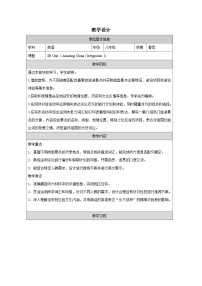
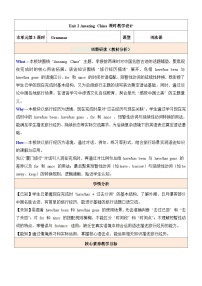
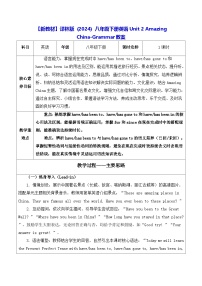
这是一份牛津译林版(2024)八年级下册(2024)Grammar表格教案,共3页。
课程基本信息
学科
英语
年级
八年级
学期
春季
课题
8B Unit2 Amazing China (Grammar)
教学目标
通过本课时的学习,学生能够:
1 观察和探究have/has been和have/has gne用来谈论去某地时的语义特征及用法,并以表格总结归纳常用的短暂性动词在与fr或since 连用时转化为延续性动词的规则、句式特点和表达的含义。
2 在分享旅行经历等具体语境中正确使用have/has been和have/has gne谈论去某地参观,根据不同的语境巩固和内化短暂性动词和延续性动词的用法。
3 正确运用have/has been、have/has gne、fr和since,写出四个句子描写自己的旅游经历,提升对知识的综合运用能力,深化对旅游体验的理解和感悟。
教学内容
教学重点
1. 区分 “have/has been t”(去过某地已返回)与 “have/has gne t”(去了某地未返回)的用法,能在语境中正确选择。
2. 掌握 “fr + 一段时间” 与 “since + 时间起点/一般过去时从句” 的用法差异,能准确填空。
3. 牢记核心短暂性动词与延续性动词的转换形式,能在现在完成时中正确运用延续性动词与 “fr/since” 连用。
教学难点
1. 灵活区分 “have/has been t” 与 “have/has gne t” 的语境差异。
2. 熟练掌握短暂性动词与延续性动词的转换,尤其在肯定句中正确运用延续性动词与 “fr/since” 搭配,避免语法错误。
3. 能在口语交流和书面写作中自然、准确地整合运用所学语法,表达完整的旅行相关信息。
教学过程
1. Warm up
(1) Start the class with tw interactive questins: “Have yu ever been t Xiamen?” and “Where did yu g last hliday?”
(2) Invite several students t share their answers.
(3) Present tw sentences: “Sme f my friends have gne t Xiamen. They are nt here nw.” and “Sme f my friends have been t Xiamen. They are back nw.”
(4) Ask students t bserve the differences between the tw sentences and guess the meanings f “have gne t” and “have been t”, leading naturally t the first grammar tpic.
2. Presentatin: have/has been t vs. have/has gne t
(1) Shw Daniel and Millie’s cnversatin abut Xiamen.
(2) Ask students t read it alud and pay attentin t the use f “have been t” and “have gne t”. (3) Guide students t summarize the rules: We use “have/has been t” when smene went t a place and has cme back; we use “have/has gne t” when smene went t a place and is still there.
(4) Intrduce extended structures: “have/has gne + adv.” “have/has been + adv.” and “have/has been in sp.”.
(5) Ask students t cmplete Exercise A1 by filling in the blanks with the crrect frms f “have been/gne”.
(6) Check the answers tgether.
3. Practice: have/has been t vs. have/has gne t
(1) Assign Exercise A2 (Millie’s diary entry) t students, asking them t cmplete it independently with the crrect frms f “have been/gne”.
(2) Invite students t share their answers and explain their chices.
(3) Organize Exercise A3: Ask students t wrk in pairs, talk abut their travel experiences using “have been t” and “have gne t”, and invite 2-3 pairs t present their dialgues in class.
4. Presentatin: fr vs. since and verb transfrmatin
(1) Shw the text abut the teacher’s uncle living in Nanjing.
(2) Ask students t read it and pay attentin t the use f “fr” and “since”.
(3) Guide students t summarize the rules: “fr” is used with a perid f time, while “since” is used with the starting pint f a perid.
(4) Present the key pint.
5. Practice: fr vs. since and verb transfrmatin
6. Prductin
(1) Organize grup wrk: Divide students int grups f 4-5. Each grup member shares their travel experiences by filling in the infrmatin: “Where have yu been?”, “When did yu g/return?”, “Hw many days have yu been there?”, “What did yu d?”.
(2) Encurage students t use the grammar learned in the class.
(3) Invite ne representative frm each grup t share the grup’s travel stries with the whle class.
(4) Assign the task f writing a shrt travel diary: Ask students t chse ne city, use “have/has been (t)”, “fr/since” and the learned vcabulary t write a diary.
7. Summary and Hmewrk
(1) Summarize the key cntent f the lessn with students.
(2) Assign hmewrk:
Cmpulsry hmewrk includes cmpleting and plishing the travel diary, and reviewing the grammar pints learned tday;
Optinal hmewrk is t share the travel diary with classmates r family members in English.
这是一份牛津译林版(2024)八年级下册(2024)Grammar表格教案,共3页。
这是一份初中英语牛津译林版(2024)八年级下册(2024)Reading表格教学设计及反思,共3页。
这是一份初中牛津译林版(2024)Reading表格教案设计,共4页。

注册成功
资料篮

在线客服
添加在线客服
获取1对1服务
官方微信
关注“教习网”公众号
打开微信就能找资料
赛课定制
添加在线客服
获取1对1定制服务
职称咨询
添加在线客服
获取1V1专业指导服务

免费福利


.png)