免费领取教师福利


若您为此资料的原创作者,认为该资料内容侵犯了您的知识产权,请扫码添加我们的相关工作人员,我们尽可能的保护您的合法权益。

这是一份初中英语人教版(2024)八年级下册(2024)Unit 6 Crossing CulturesSection A课文内容ppt课件,共30页。PPT课件主要包含了新课引入,新课讲解,that,surprised,as soon as,surprising,unless,interested,Germany,归纳小结等内容,欢迎下载使用。
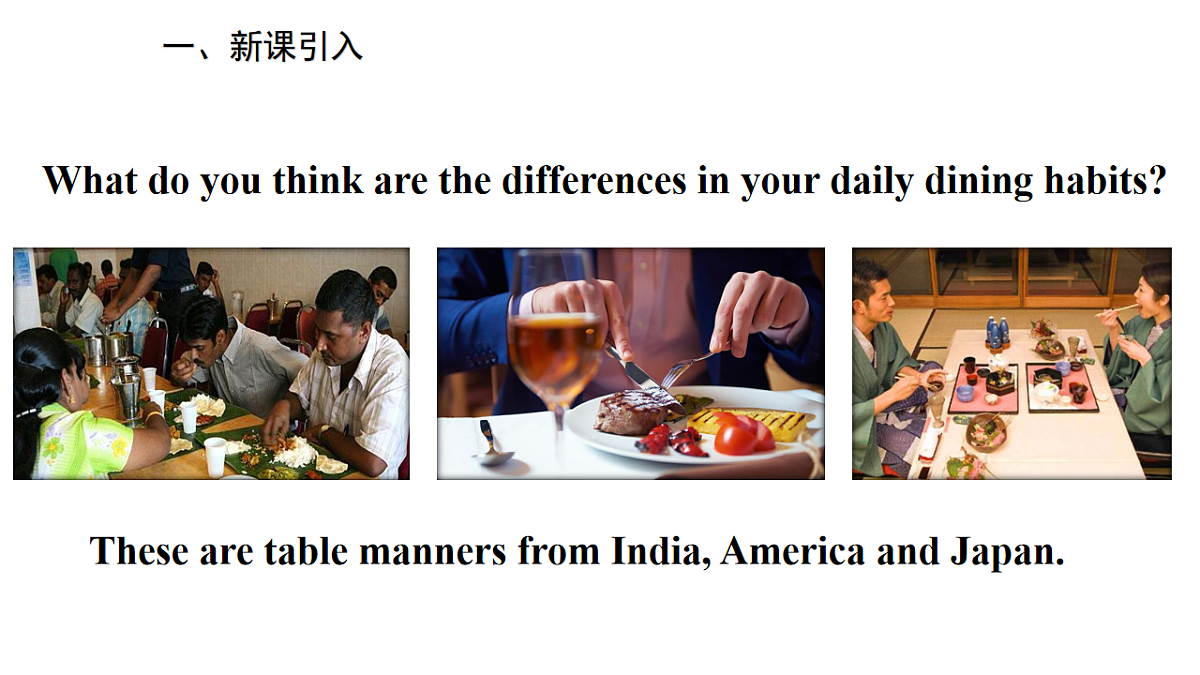
What d yu think are the differences in yur daily dining habits?
These are table manners frm India, America and Japan.
What table manners d yu knw in ther cuntries?
What if yu dn’t knw abut them?
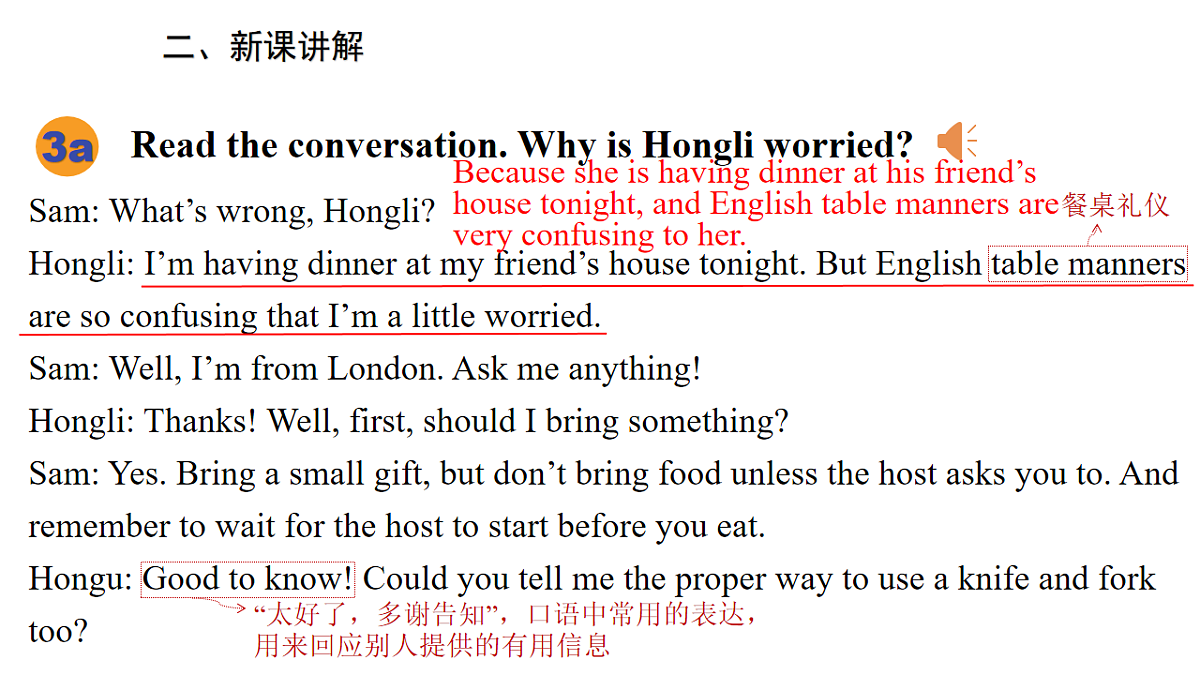
Read the cnversatin. Why is Hngli wrried?
Sam: What’s wrng, Hngli?Hngli: I’m having dinner at my friend’s huse tnight. But English table manners are s cnfusing that I’m a little wrried.Sam: Well, I’m frm Lndn. Ask me anything!Hngli: Thanks! Well, first, shuld I bring smething?Sam: Yes. Bring a small gift, but dn’t bring fd unless the hst asks yu t. And remember t wait fr the hst t start befre yu eat.Hngu: Gd t knw! Culd yu tell me the prper way t use a knife and frk t?
“太好了,多谢告知”,口语中常用的表达,用来回应别人提供的有用信息
Because she is having dinner at his friend’s huse tnight, and English table manners are very cnfusing t her.
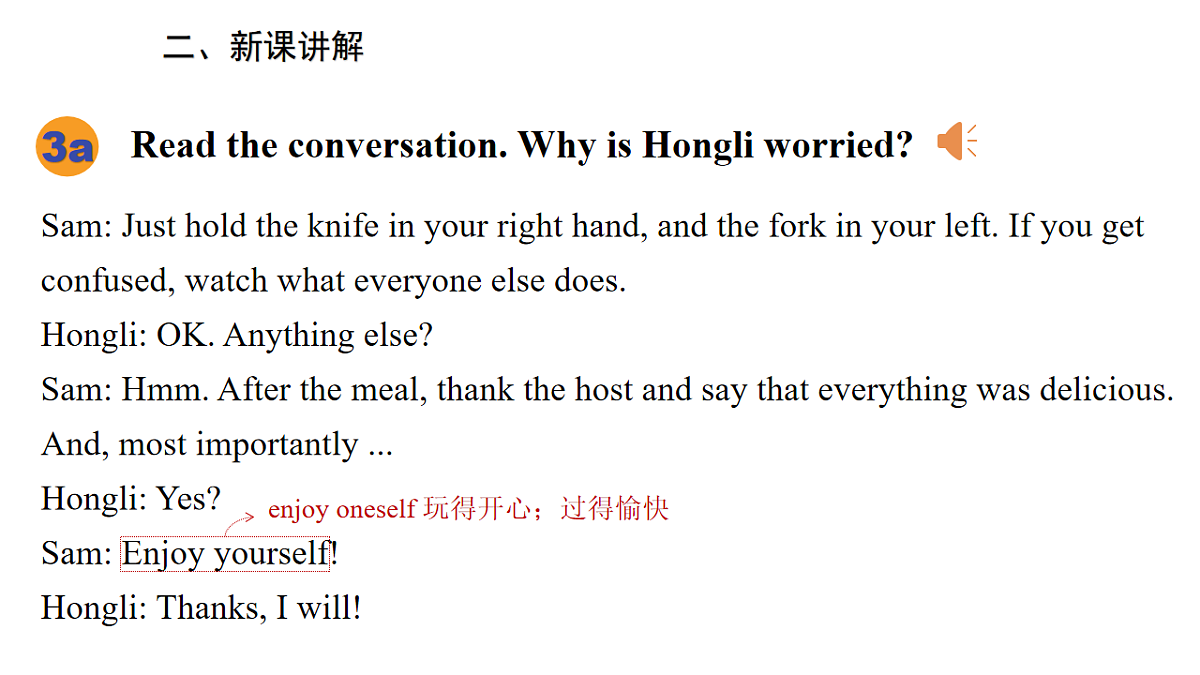
Sam: Just hld the knife in yur right hand, and the frk in yur left. If yu get cnfused, watch what everyne else des.Hngli: OK. Anything else?Sam: Hmm. After the meal, thank the hst and say that everything was delicius. And, mst imprtantly : Yes?Sam: Enjy yurself!Hngli: Thanks, I will!
enjy neself 玩得开心;过得愉快
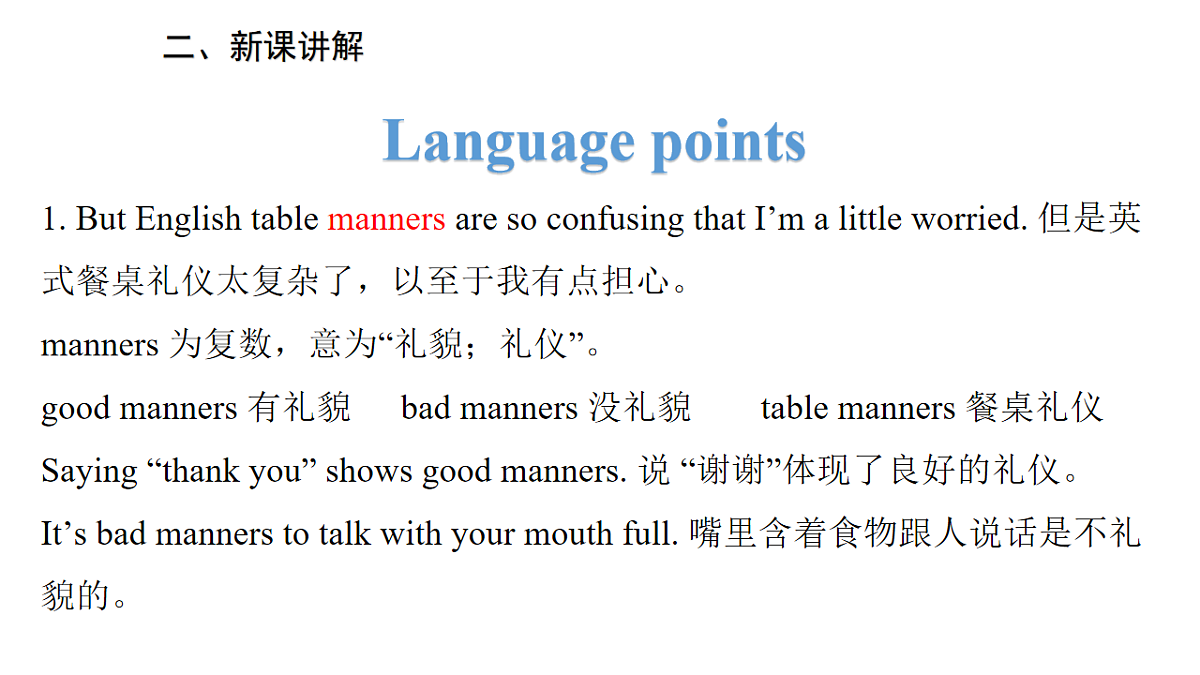
Language pints
1. But English table manners are s cnfusing that I’m a little wrried. 但是英式餐桌礼仪太复杂了,以至于我有点担心。manners 为复数,意为“礼貌;礼仪”。gd manners 有礼貌bad manners 没礼貌table manners 餐桌礼仪Saying “thank yu” shws gd manners. 说 “谢谢”体现了良好的礼仪。It’s bad manners t talk with yur muth full. 嘴里含着食物跟人说话是不礼貌的。
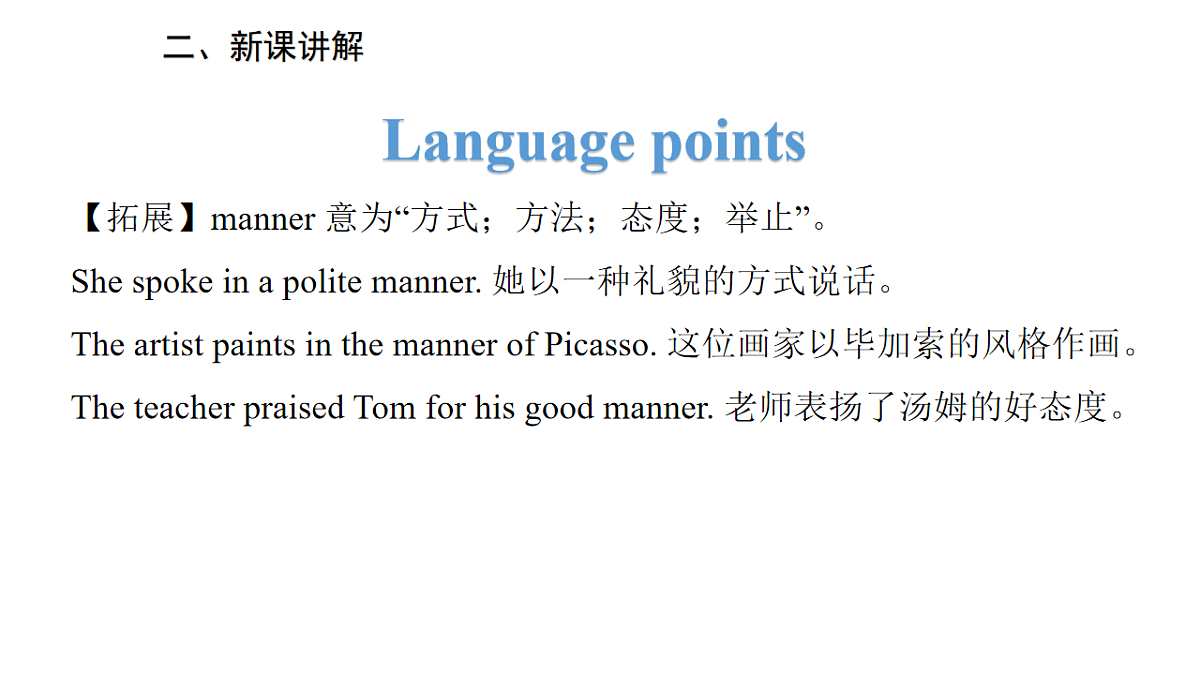
【拓展】manner 意为“方式;方法;态度;举止”。She spke in a plite manner. 她以一种礼貌的方式说话。The artist paints in the manner f Picass. 这位画家以毕加索的风格作画。The teacher praised Tm fr his gd manner. 老师表扬了汤姆的好态度。
2. Culd yu tell me the prper way t use a knife and frk t? 你也能告诉我使用刀叉的正确方法吗?prper 作形容词,意为“合适的;恰当的;正确的;正式的”。It’s nt a prper way t slve the prblem. 这不是解决问题的恰当方式。Yu shuld wear prper clthes fr the party. 你应该穿合适的衣服去参加派对。His answer desn’t seem prper. 他的答案似乎不太正确。
【拓展】常见搭配:(1) in the prper rder 按正确的顺序Please put these bks in the prper rder n the shelf. 请把这些书按正确的顺序放在书架上。(2) prper nun 专有名词“Beijing” and “Tm” are prper nuns. “北京”和“汤姆”是专有名词。
Make ntes abut having dinner at a friend’s huse in the UK.
Bring a small gift. Dn’t bring fd unless the hst asks.
Wait fr the hst t start eating first. Hld the knife in yur right hand, frk in yur left. If cnfused, watch what thers d.
Thank the hst.Say “Everything was delicius.”
Listen t the cnversatin. Then rle-play it.
Imagine that yur freign friend is ging t have dinner at a Chinese persn’s huse fr the first time. Use the tips belw t give him r her sme advice.
● Wait fr lder peple t start eating.● Sit up straight. Keep yur elbws ff the table.● D nt stand up t reach fr fd. Ask thers t pass yu the dish.● Use serving chpsticks and spns t take fd frm shared dishes.
A: I’m ging t a Chinese friend’s huse fr dinner. Culd yu give me sme advice n table manners? B: Sure! First, ...
keep ... ff 让……远离
pass sb sth 把某物递给某人
3. Keep yur elbws ff the table. 不要把胳膊肘放在餐桌上。keep ff 的用法如下:(1) 意为“不接近;远离”。Keep ff the grass! 勿踏草坪!(2) 意为“不碰;不吃;不喝”。The dctr tld him t keep ff junk fd. 医生告诉他不要吃垃圾食品。
(3) 意为“避开;不谈及”。He always tries t keep ff the argument. 他总是尽量避开争论。(4) 意为“使不接近;使远离”。The high fence keeps ff the wild animals. 高高的栅栏使野生动物不能靠近。
A: I’m ging t a Chinese friend’s huse fr dinner. Culd yu give me sme advice n table manners? B: Sure! First, wait fr lder peple t start eating befre yu d. Then, sit up straight and keep yur elbws ff the table—it’s plite. Als, dn’t stand up t reach fr fd. Just ask thers t pass the dish t yu. And remember t use serving chpsticks r spns when yu take fd frm the shared dishes. A: Thanks a lt! That helps me a lt.B: N prblem! Just relax and enjy the meal.
Read the sentences. What d the wrds in red mean? Hw are the pairs f wrds in blue used differently?
s ... that ... 如此……以至于……
-ed 形容词:描述 “人的感受”,主语 / 修饰对象是 “人”;-ing 形容词:描述 “事物的性质”,主语 / 修饰对象是 “事物”。
Cmbine the sentences using the wrds in brackets.
1. Türkiye: Peple dn’t kiss ne anther n the cheek. They can d s if theyare gd friends. (unless)________________________________________________________________________________________________________________________________2. Japan: Take ff yur shes. Yu d this when yu enter smene’s hme. (assn as)________________________________________________________________________________________________________________________________
In Türkiye, peple dn’t kiss ne anther n the cheek unless they are gdfriends.
Take ff yur shes as sn as yu enter smene’s hme.
3. Kenya: Being late is very cmmn. Yu shuld be patient and nt expectpeple t be n time. (s ... that)________________________________________________________________________________________________________________________________4. China: Sticking chpsticks int a bwl f rice is very rude. Yu shuld avid it. (s ... that)________________________________________________________________________________________________________________________________
Being late is s cmmn that yu shuld be patient and nt expect peple t be n time.
Sticking chpsticks int a bwl f rice is s rude that yu shuld avid it.
5. Mexic: Dn’t use smene’s first name if yu dn’t knw him r her well.Yu can use it if the persn invites yu t d s. (unless)________________________________________________________________________________________________________________________________
Dn’t use smene’s first name unless yu knw him r her well r the persn invites yu t d s.
Cmplete the passage with the wrds in the bx. Can yu tell where the writer is frm?
D yu knw what culture shck is? Yu may feel it when yu experience a new culture, because the new culture is __________ different frm yur wn __________ yu feel __________. Fr example, I experienced this __________ I gt ff the plane in Peru last year. Peple were standing n my right and left, even thugh there was plenty f space n the bus! That was really __________ t me. In Germany, peple usually like mre persnal space, and we dn’t stand clse t smene __________ we knw them very well. But nce I was used t it, I became mre curius and __________ in learning abut the culture there. It’s s __________ t discver cultural differences like this!
surprising surprised interesting interesteds ... that as sn as unless
interesting
be used t ... 习惯于……
get ff 从交通工具(如公共汽车、火车、自行车等) 上下来
4. But nce I was used t it, I became mre curius and interested in learning abut the culture there. 但一旦我习惯了它,我就对了解那里的文化变得更加好奇和感兴趣了。【辨析】be used t, get used t 与 used t
He is used t getting up early. 他习惯早起。 Wd is used t make paper. 木材被用来造纸。I’m getting used t the new schl life. 我在逐渐习惯新的学校生活。I used t play ftball after schl. 我过去常常在放学后踢足球。
1. New wrds and phrases:manner, s ... that, cnfusing, unless, prper, sit up, keep ... ff, elbw, serving, chpstick, serving chpsticks, embarrassing, be / get used t, cultural
2. Target language:the sentences with unless, as sn as, s ... that ...
一、完成句子1. 在中国,人们十分重视餐桌礼仪。In China, peple pay much attentin t __________________.2. 谈论天气是一个开始谈话的恰当方式。Talking abut the weather is _________________________________.3. 你要避开地上的碎玻璃,不然可能会受伤。Yu shuld ______________ the brken glass n the flr, r yu might get hurt.4. 我的爸爸习惯于帮助别人,他非常的善良。My father ______________ helping thers and he is very kind.
table manners
a prper way t start a cnversatin
二、阅读理解Explring different parts f the wrld can be exciting, but it can als be challenging and lead t culture shck and feelings f stress.When I mved t Tuscany, Italy, right after my cllege, I was fascinated by the beautiful views. Wh wuldn’t be? The high muntains, histrical buildings and delicius fd made every minute f the lng flight jurney wrthwhile. I was excited abut my new beginning. But then, I started t ntice little things.As an American, I am used t a bit f persnal space, Where I’m frm, bumping up against r standing very clse is cnsidered implite. Hwever, this culdn’t be further frm the truth in Italy.Nt knwing the language was als challenging. Smetimes, I wuld feel helpless. This, thugh, is where ne part f Italian culture came in handy. Italians like t speak with their hands—a habit I’ve carried ver until this day.
Of curse, having experienced culture shck in ne cuntry desn’t mean yu can get used t it in anther. Years later, when mved t China, my experience was special. The culture there was smething very freign—dwn t hw t buy things. Befre mving there, I had never heard f WeChat r Alipay. I wasn’t prepared at all fr hw imprtant these things wuld be.Althugh maybe being far away frm my hme cuntry can smetimes seem upsetting, experiencing culture shck reminds me that I am explring different parts f the wrld and that I shuld be thankful fr what I’m taking in. An America-British authr nce said that “the greatest payback f travel is t be able t experience everyday things as if fr the first time”.
( ) 1. What culture shck did the authr experience in Italy?A. The views in Italy are nt as beautiful as imagined.B. Italians dn’t learn freign languages.C. Italians stand quite clse t each ther.D. The Italian way f speaking with feet.( ) 2. What happened when the authr arrived in China?A. She started t buy things nline.B. She experienced culture shck again.C. Her experience in Italy helped her get used t the life in China.D. She realized that WeChat and Alipay were nt imprtant.
( ) 3. Which f the fllwing best shws the structure f the passage?A. ①; ②③④; ⑤; ⑥; ⑦B. ①②; ③④; ⑤⑥; ⑦C. ①; ②③④; ⑤⑥⑦D. ①②; ③④⑤⑥; ⑦
这是一份初中英语人教版(2024)八年级下册(2024)Unit 6 Crossing CulturesSection A课文内容ppt课件,共30页。PPT课件主要包含了新课引入,新课讲解,that,surprised,as soon as,surprising,unless,interested,Germany,归纳小结等内容,欢迎下载使用。
这是一份初中英语人教版(2024)八年级下册(2024)Section A授课ppt课件,共36页。PPT课件主要包含了新课引入,新课讲解,greeting,bow,right,knife,a lot of,cows,walk,归纳小结等内容,欢迎下载使用。
这是一份初中英语Unit 6 Crossing CulturesSection B课堂教学课件ppt,共33页。PPT课件主要包含了新课引入,新课讲解,unsafe,informal,impolite,improper,happy,patient,normal,properly等内容,欢迎下载使用。
 新教材
新教材注册成功
资料篮

在线客服
添加在线客服
获取1对1服务
官方微信
关注“教习网”公众号
打开微信就能找资料
赛课定制
添加在线客服
获取1对1定制服务
职称咨询
添加在线客服
获取1V1专业指导服务

免费福利

.png)