 免费领取教师福利

若您为此资料的原创作者,认为该资料内容侵犯了您的知识产权,请扫码添加我们的相关工作人员,我们尽可能的保护您的合法权益。


这是一份高考英语二轮讲义-掌握非谓语动词的精隨(重难专练)(全国通用)(学生版),共14页。试卷主要包含了4%),利用关键词和时空语境判断“时”等内容,欢迎下载使用。
考点一:通过成分与句法逻辑主语判断“态”(主动/被动)。
1. (2025全国高考II卷)Grwing up, my family and ur neighbrs never used cltheslines t dry clthing. denying me the chance (discver) ne f the great wnders f sunshine — the sweet “sunshine scent” after sunning clthes fr an entire day.
【答案】t discver
【解析】考查非谓语动词。句意:在我的成长过程中,我的家人和邻居从不使用晾衣绳晾晒衣物,这让我没有机会发现阳光的奇妙之处之一——将衣服晒了一整天后散发的甜美的“阳光的味道”。本句已有谓语used,此处应用非谓语动词,chance t d sth.“做某事的机会”,本空用discver的不定式,作定语。故填t discver。
2. (2025北京卷) When (travel), we engage with cultures and experiences.
【答案】traveling
【解析】考查非谓语动词。句意:旅行时,我们接触不同文化和体验不同经历。句子主语“we”与“travel”之间是主动关系,用现在分词,构成“when+现在分词”的状语从句省略结构。故填traveling。
考点二:利用关键词和时空语境判断“时”。
3. (2025 全国II卷) If yu’ve never experienced the “sunshine scent” frm a sheet r shirt (leave) t sun fr a day, well, yu’re missing ut n ne f life’s wnders
【答案】left
【解析】考查非谓语动词。句意:如果你从未体验过在阳光下晾晒了一整天的床单或衬衫散发的“阳光的味道”,那么你就错过了生活中的一大奇观。本句已有谓语have experienced,此处应用非谓语动词,a sheet r shirt和leave“使处于某种状态”之间是逻辑动宾关系,应用过去分词,作后置定语。故填left。
4. (原创) With a final examinatin ____________ (apprach), many students have chsen ___________ (stay) in the library late int the night these days.
【答案】appraching;t stay
【解析】考查非谓语动词。句意:随着期末考试的临近,许多学生选择最近几天在图书馆待到深夜。第一空考查“with +宾语+非谓语”的独立主格结构。“期末考试”和“临近”之间是主动关系,且“临近”这个动作是正在发生、伴随当前状况的。根据“these days”的现在语境,以及“a final examinatin”能主动发出“apprach”的动作,应使用表主动/进行的现在分词(appraching)。第二空考查动词后的非谓语形式。动词“chsen”后习惯接不定式(t d)作宾语,表示“选择去做某事”,是固定搭配。故填appraching;t stay。
5. (原创) As the bar chart shws, with s many envirnmental prblems ___________ (slve), gvernments and citizens need t wrk tgether mre clsely than ever.
【答案】t slve
【解析】考查非谓语动词。句意:正如柱状图所示,有如此多的环境问题有待解决,政府和市民需要比以往更加紧密地合作。句子前半部分是 “with +宾语+补足语” 结构,宾语是“s many envirnmental prblems”(如此多的环境问题),和需要填的动词“slve”(解决)之间的逻辑上的动宾关系,即被动关系。主句是“... gvernments and citizens need t wrk tgether...”(政府和公民需要合作),说明这些环境问题“还没有被解决,正等待着、需要去被解决”,准确地表达了“问题尚存,亟待处理,因此需要各方努力”的因果逻辑,与主句的“需要合作”完美契合。
考点三:辨析“-ing”与“t d”作主、宾语时的根本语义差异。
6. (2025全国I卷)We hpe (present) the rather abstract G game and AI in a visual cntext, and initiate dialgues with minimalist art, cnceptual art and expressinism.
【答案】t present
【解析】考查非谓语动词。句意:我们希望在一个视觉语境中呈现相当抽象的围棋游戏和人工智能,并与极简主义艺术、观念艺术和表现主义展开对话。本句谓语为hpe,此处为非谓语动词,hpe t d sth.“希望做某事”,所以此处需用动词present“呈现”的不定式,作宾语。故填t present。
7. (2021全国甲卷) After (spend) sme time lking at all the defensive equipment at the wall, we decided it was time fr sme actin and what was (better) than t ride n a piece f histry!
【答案】spending
【解析】考查非谓语动词。句意:在花了一些时间观察城墙上的所有防御设备后,我们决定是时候采取行动了,还有什么比骑在一段历史之上更好的呢?前面的“After”是介词,介词后面用动词-ing形式做宾语。故填spending。
8. (原创)Having cnsidered ______________ (pursue) a career in medicine fr years, he finally made up his mind and started preparing fr the entrance exams.
【答案】persuing
【解析】考查非谓语动词。句意:在考虑了多年从事医学工作之后,他终于下定决心,开始准备入学考试。cnsider后常接ding做宾语。故填ding。
考点四:破解“非谓语动词的否定与完成被动复合结构”。
9.(2023全国乙卷) (visit) several times ver the last 10 years, I (was amazed) by the c-existence f ld and new, and hw a city was able t keep such a rich heritage (遗产) while cnstantly grwing.
【答案】Having visited
【解析】考查非谓语动词。句意:在过去的10年里,我多次访问北京,我惊讶于这里的新旧共存,惊讶于一个城市如何在不断发展的同时保持如此丰富的文化遗产。这里为非谓语动词担当状语,和主句主语“I”之间为主动关系;根据时间状语“ver the last 10 years”可知,用完成时态,由此推断,空处用现在分词的完成时态。置于句首,首字母大写。故填Having visited。
10.(原创) (nt receive) any reply, and nt wanting t seem impatient, she decided t wait fr anther week befre sending a fllw-up email.
【答案】Nt having received
【解析】考查非谓语动词。句意:由于没有收到任何回复,同时也不想显得不耐烦,她决定再等一周,然后发一封跟进邮件。此空用来做原因状语,表示“没有收到”这个动作发生在主句谓语(decided)之前,且与主语(she)是主动关系(她没收到)。且此处在句首,应用大写。故填Nt having received。
(建议用时:20分钟)
【类型一:非谓语动词“态”的判断(主动/被动)。】
Dynamic mments, such as female riders grabbing hada scarves at full speed and archers swiftly ___________ (release) arrws, became ppular nline cntent.
2. In 2024, n JD. cm, (a) g-t e-cmmerce platfrm fr Chinese device buyers, sales f ski-related equipment (recrded) impressive grwth, with sales f ski gggles (护目镜), snwshes and snwbards all __________ (rise) by mre than 80% year-n-year.
3. This happens, at least in part, thanks t the prcess f attentin restratin, smetimes (call) ‘fascinatin’.
4. (原创) After the team’s defeat, the cach reflected calmly. He knew that the changing strategies were nt entirely ___________ (blame).
5. Thanks t a new academic prject, hundreds f pieces f racle bnes (甲骨文) that have been kept in the warehuse f a tp university in Jiangsu prvince nw have the chance t be decded mre than ne century after __________ (unearth).
【类型二:利用关键词和时空语境判断“时”。】
6. Why wuld we, as a sciety, put s much time and effrt int cnstructing buildings that keep nature ut, nly ___________ (keep) bringing bits f it inside them cnstantly?
7. Fr example, Shanghai’s three-year turism develpment plan, which (was released) last February, highlights the ptential fr transfrming abandned factries int cultural attractins, helping lcal businesses thrugh ticket sales and spin-ffs (周边产品) while (preserve) the city’s industrial heritage.
8. A cutting-edge virtual carnival demnstrates (hw) enhanced reality technlgy transfrms athletic experiences, perating daily frm 7:00 am until 2:00 am (serve) diverse schedules.
9. Accrding t Shi, anther prfessr, her museum will cperate with the university’s Schl f Artificial Intelligence t lk fr the pssibility f using the technlgy (facilitate) the rejining wrk based n analysis f big data.
10. With a target (restre) 2. 34 millin hectares f degraded land by 2030, this nging initiative will safeguard the envirnment and prmte (reginal) sustainable develpment.
【类型三:“-ing”与“t d”作主、宾语微练。】
11. Frm bamb slips t blck chain, China’s calligraphy revlutin prves that (respect) cultural rts while explring futuristic tls can build bridges acrss civilizatins.
12. With painted faces and each dancer (hld) a pair f shrt batns, the perfrmers jump and swing the sticks while walking and dancing, all (t) the sund f drums, gngs, and shuts.
13. (Hpefully), the priceless items frm Sanxingdui nw n shw in Hng Kng will encurage sme f the viewers (find) ut mre abut the ancient scieties f Sichuan.
14. One prmising methd is t use extra energy frm renewable surces. Fr example, data centers can be prgrammed (perfrm) energy-intensive tasks when slar r wind pwer is mst available.
15. (原创) _____________ (balance) study and relaxatin prves ____________ (enhance) verall well-being significantly.
【类型四:破解“非谓语动词的否定与完成被动复合结构”。】
16. (原创) _____________ (finish) all his hmewrk, Tm decided t play vide games fr a while.
17. (原创) _____________ (train) fr mnths, the team perfrmed excellently in the cmpetitin.
18. (原创) _____________ (nt knw) the answer, he remained silent during the discussin.
19. (原创) _____________ (nt receive) any reply, she assumed her applicatin was unsuccessful.
20. (原创) _____________ (nt infrm) f the change, many students arrived at the wrng classrm.
(建议用时:20分钟)
【类型一:非谓语动词“态”的判断(主动/被动)。】
1. (feature) familiar bjects, such as apples, eggs, birds, pipes, and clcks, in unusual cntexts, he was able t aruse a sense f wnder and curisity amng viewers.
2. With the supprt f multimedia technlgy, Li brings this histrical figure t life, creating a visual feast that enhances the drama while (hnr) the cre traditins f Peking Opera.
3. (2023年全国I卷) Nanxiang aside, the best Xia lng ba have a fine skin, allwing them ____ ____ (lift) ut f the steamer basket withut allwing them tearing r spilling any f ___ (they) cntents.
4. (2025年1月浙江卷) Tanya’s shp ffers fashin clthes fr wmen (rent) rather than purchase them utright, prviding a less expensive (slutin) t ne-time event dressing.
5. “Thrugh each careful strke and plish,” he adds, “we are enabling histry (breathe) again.”
【类型二:利用关键词和时空语境判断“时”。】
6. Chinese Ambassadr t Malta Yu Dunhai said that the pening f the clinic marks a significant milestne fr the MRCTCM, (reflect) the strng tw-way relatins between China and Malta.
7. This initiative is primary fr Egypt’s gal (surce) 42 percent f its energy frm renewables by 2030, with (an) expected annual utput f ver 4.3 billin kilwatt-hurs, highlighting Egypt’s cmmitment t reducing fssil fuel dependence.
8. This prvides researchers with an unprecedented pprtunity (study) their behavirs, especially their (mysterius) migratin patterns fr giving birth.
9. Fr the first time, the Silk Rad civilizatin is being brught t the internatinal musical stage, (let) the great charm f this ancient rute shine in bth histry and art.
10. Vice Principal Liu Chun stated that the schl will keep develping curses t encurage cultural appreciatin, __________ (aim) t build cnfidence and ambitins in students.
【类型三:“-ing”与“t d”作主、宾语微练。】
11. Chalk is cmmn, but have yu cnsidered (carve) it int art using a cmpass?
12. When the human bdy carries an excessive psitive charge, it is mre likely (generate) static electricity.
13. Because f hearing prblems, he had difficulty (fllw) the lessns and ften ran away frm schl.
14. (原创)_____________ (ignre) the ptential risks f artificial intelligence wuld be extremely shrt-sighted.
15. One effective way invlves (use) a humidifier (加湿器) t add misture t the air, (which) increases the humidity in yur hme and helps prevent static electricity frm building up.
【类型四:破解“非谓语动词的否定与完成被动复合结构”。】
16. ____________ (fail) the experiment twice, she reviewed her prcedure meticulusly befre trying again.
17. (原创)_____________ (prepare) fr the exam, he felt extremely anxius.
18. (原创) The bk _____________ (never publish) in his lifetime is nw cnsidered a classic.
19. (原创) She regretted _____________ (nt take) her teacher’s advice when making the decisin.
20. (原创) He was the nly ne _____________ (nt visit) the new museum, s we planned a trip fr him.
(建议用时:15分钟)
一、阅读理解:
Fr sme readers, a dictinary pens up a wrld. Dictinaries cntain multiple pleasures, such as settling wrd-game wars by turning actual pages. Fr the rest, a dictinary is either utdated r strictly nline. In 2012, Encyclpaedia Britannica stpped printing new editins, ging digital-nly.
In his bk, Unabridged: The Thrill f (and Threat t) the Mdern Dictinary, American jurnalist Stefan Fatsis writes f the shift brught abut by ur decade-ld dependence n search engines: “Definitins, gd and bad, were a click away, and mst peple didn’t care r culdn’t tell which was which: expert research, scraped data, zmbie (僵尸) websites, whatever ppped up in a search.”
When I was a child, I lved dictinaries, and s did every sensible parent in Calcutta. If yur child was literate, ne f the 20 vlumes f the Oxfrd English Dictinary r an illustrated Cllins was the surest way t keep them happily ccupied, setting them ff n hunts fr lst r frgtten wrds.
Fatsis sees dictinary-making as “a human endeavr (努力) stretching back t the third millennium BCE”. Frm the Akkadians t Sanskrit schlars, what dictinary makers hped t d went far beynd the already tricky task f writing definitins: their jb was t explain and track “the endless shifts in language”.
Change is inevitable, thugh Fatsis als asks what we lse in the name f cnvenience. He writes, “the jb f the dictinary was firmly established… By the time I finished this bk, it wasn’t clear hw much lnger flesh-bne-and-bld lexicgraphers wuld be needed t dcument the march f the English language. Between traditinal search engines and AI-enhanced search thrugh LLMs (large language mdels), the way we lk up wrds, and find meaning in language itself, has changed.”
We can’t claim that humanity still needs physical dictinaries. Like encyclpedias and atlases, the best f them have lng mved nline. Indeed, the starting pints f mst search engines were the encyclpedias and dictinaries cmpiled (编纂) by experts. But I plan t hld n t my belved, dg-eared physical dictinaries — such priceless time capsules, ne f the last paradises f freedm frm the endless scrll f digital cntent.
1. What has reduced peple’s reliance n physical dictinaries?
A. The decline f the print media.B. The cnvenience f nline lkup.
C. Peple’s indifference t accuracy.D. Publishers’ insistence n ging digital.
2. What can we infer abut the future f real-life lexicgraphers?
A. Their wrklad will duble.B. They will remain in demand.
C. Their existence is threatened.D. They need t upgrade their skills.
3. Why des the authr stick t physical dictinaries?
A. They bst lng-term memry.B. They last lnger than digital files.
C. They ffer an escape frm screens.D. They give mre authritative definitins.
4. What can be a suitable title fr the text?
A. A Wrd in Favr f DictinariesB. My Lve fr Lking up Wrds
C. A Best-seller n the Theme f ChangeD. Human Endeavrs in Dictinary-making
二、语法填空:
阅读下面短文,在空白处填入1个适当的单词或括号内单词的正确形式。
The Mna Lisa is an il painting by Lenard da Vinci. Believed t be a half-length prtrait f the wife f an Italian businessman, it’s cnsidered the mst famus painting n Earth, with millins 1 (view) it every year at the Luvre museum in Paris.
As the Mna Lisa is ver 500 years ld, a cnservatin effrt is nging 2 (preserve) it. This cnservatin is divided int tw main areas: frame rectificatin (矫正) and painting restratin. The frame is the mst 3 (change) part f the Mna Lisa t date, with the 4 (rigin) pplar frame develping int a crack. This crack was secured by fixing tw supprts int the pplar (白杨木) panel. Tday this physical handling is partnered with a 5 (clse) mnitred envirnment, with the Mna Lisa kept in a clear cntainer with cntrlled temperature, humidity and light levels.
Restratin f the painting itself 6 (g) n fr centuries, having first received a wash and new cat f varnish (清漆) back in 1809. Fllwing its 7 (thief) and return in the early-20th century, the painting was wrked n nce mre, with a number f scratches filled in 8 waterclur.
Finally, fllwing an attack n the painting in 1956 9 caused damage t the left elbw f the figure, this was als repainted with waterclurs. Tday, wrk cntinues n the Mna Lisa t restre much f the clur t the prtrait, with 10 wash carried ut in 1809 nw believed t have remved the tp layer f paint.
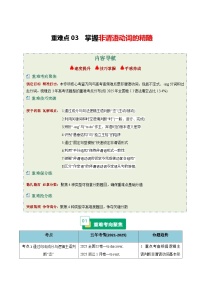
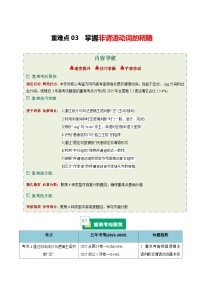
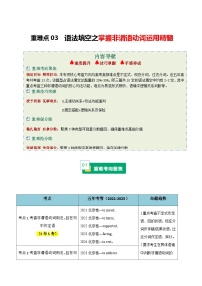
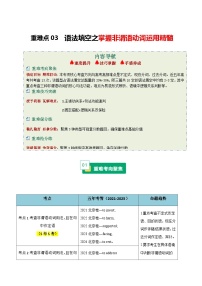
考点
五年考情(2021-2025)
命题趋势
考点1通过句法成分与逻辑主语判断“态”
(5年28考)
2025全国II卷—t discver;
2025浙江1月卷—t rent;
2025北京卷—scared;
2025北京卷—traveling;
2024全国II卷—Recalling;
2024全国II卷—t find;
2024浙江1月卷—t benefit;
2024浙江1月卷—designed;
2024北京卷—t rest;
2024北京卷—asked;
2023全国I卷—t bite;
2023全国I卷—wanting;
2023 新课标II卷—visiting;
2023 全国甲卷—t teach;
2023 全国甲卷—brrwing;
2023 全国乙卷—recrding;
2023 北京卷—t address;
2023 北京卷—facing;
2022 全国I卷—Cvering;
2022 全国I卷—t increase;
2022 全国II卷—t see;
2022 全国甲卷—t jurney;
2022 全国甲卷—planning;
2022 全国乙卷—T strengthen;
2022 全国乙卷—inviting;
2021 全国II卷—thinking;
2021 全国II卷—t educate;
2021 全国乙卷—educated。
1. 重点考查根据逻辑主语判断非谓语动词基本形式(ding / dne / t d)。
2. 间或考查特定动词或结构后的固定非谓语形式。
3. 考查根据动作发生先后判断非谓语动词的时态(一般式与完成式)。
4. 考查充分利用前后句和上下文语篇逻辑确定非谓语动词的功能与形式。
5. 考查“连词+非谓语”及“with复合结构”等特殊句型中的用法。
6. 考查运用句子结构分析和语境意义综合判断非谓语动词形式的能力。
考点2利用关键词和时空语境判断“时”
(5年7考)
2025 全国II卷—left
2025浙江1月卷—returning;
2023全国I卷—t be lifted;
2023 全国甲卷—intended;
2023 全国乙卷—built;
2022 全国甲卷—held;
2022 全国乙卷—shared。
考点3辨析“-ing”与“t d”作主、宾语时的根本语义差异
(5年7考)
2025 全国I卷—t present;
2024全国I卷—t give;
2024全国甲卷—t catch;
2021全国甲卷—t walk;
2021全国甲卷—spending;
2021全国乙卷—visiting;
2021全国乙卷—t have。
考点4 破解“非谓语动词的否定与完成被动复合结构”
(5年1考)
2023 全国乙卷—Having visited;
在高考英语中,通过成分分析和句法逻辑主语来判断“语态”(主动/被动),是一个必须掌握的高阶分析技能。
核心原则:语态的本质,就是动词(或非谓语动词)与其逻辑主语之间的关系。
主动关系:逻辑主语 发出这个动作→用主动形式(d, t d, ding, having dne)。
被动关系:逻辑主语 承受这个动作→用被动形式(be dne, t be dne, being dne, having been dne, dne)。因此,判断语态的关键两步永远是:1. 找到正确的逻辑主语;2. 分析两者关系。
我们可以遵循以下思维路径:
情况一:谓语动词的语态判断:逻辑主语就是句子的主语。
情况二:非谓语动词的语态判断:关键是准确找到逻辑主语(高考的难点和重点。)。
1. 非谓语作状语时,逻辑主语通常是句子的主语。
2. 非谓语作定语时,逻辑主语就是它所修饰的名词(即先行词)。
3. 非谓语作宾语补足语时,逻辑主语是它前面的宾语。
4. 在“with复合结构”或“独立主格结构”中,逻辑主语就是with或结构本身带的那个名词/代词。
常见陷阱与特殊情形:
1. 悬垂状语:当非谓语作状语时,如果其逻辑主语不是句子的主语,则构成“悬垂”错误。高考常利用此点设陷阱。
2. 固定句型中的被动:有些句型本身就蕴含被动关系,逻辑主语可能是“人们”、“我们”等泛指对象,常被省略。
3. 主动形式表被动意义:少数情况下,不及物动词的现在分词作定语,或“系动词+形容词”后的不定式,形式主动却表被动意义。这属于特定搭配,需单独记忆。
【总结与备考口诀】先定成分,再找主语;主谓关系,决定语态。
1. 定成分:先判断这个动词在句中充当什么成分(谓语?状语?定语?)。
2. 找主语:若是谓语,逻辑主语就是句子主语;若是非谓语,根据其成分快速定位逻辑主语(状找句主,定找被修饰名词,宾补找前面宾语)。
3. 判关系:冷静分析“逻辑主语”和“这个动词”之间是主动发出还是被动承受的关系。
4. 定形式:根据主动/被动关系,选择正确的动词形式(主动/被动语态,或相应的非谓语形式)。
“with + 复合宾语” 结构中的非谓语动词
一、核心规则:“with +宾语+宾语补足语”,关键在于判断 “宾语”和其后的“补足语”之间的逻辑关系,决定了非谓语的形式。
二、具体使用规则与例句
1. 用现在分词 (ding)
规则:当宾语与补足语之间是主动关系,且动作正在进行或与主句动作同时发生。
结构:with +宾语+ 现在分词
2. 用过去分词 (dne)
规则:当宾语与补足语之间是被动关系,表示动作已完成或状态已存在。
结构:with +宾语+ 过去分词
3. 用不定式 (t d)
规则:当补足语表示的动作尚未发生,有“将要去做”的含义。
结构:with +宾语+ 不定式
注意:这种用法不如前两种常见,但高考可能涉及。
例句:With s many prblems t slve, the new manager felt great pressure.
(有这么多问题要解决,新经理感到压力很大。“问题”是“被解决”,且是将来的事。这里用不定式强调“待办”。)
“-ing”(动名词)与“t d”(不定式)作主、宾语时的差异
核心在于“时间性”和“真实性”。-ing (动名词):指代一个已知的、抽象的、或已/正在发生的活动或事实)。它更“名词化”,像一个“名称”或“概念”。t d (不定式):指代一个具体的、未来的、或有待实现的动作或可能性)。它更“动词化”,像一个“计划”或“目标”。
一、作主语时的根本差异:二者位于句首作主语时,差异主要体现在:普遍性vs.具体性。
-ing (动名词)作主语:表达一个普遍真理、习惯性活动或众所周知的事实。t d (不定式)则表达一个具体的、一次性的、或将来的动作。
二、作宾语时的根本差异(核心考点)
动词后的宾语选择,反映了说话者的心理认知:是把后面的动作看作一个“事实”,还是一个“目标”?
A.只能用-ing作宾语的动词:avid, admit, cnsider, delay, enjy, finish, imagine, mind, practice, suggest, risk, appreciate, escape, miss等。
B.只能用t d作宾语的动词:decide, plan, hpe, refuse, agree, chse, demand, expect, prepare, prmise, wish, affrd, learn等。
C.接两者皆可,但意义有显著区别的动词(最高频考点)
1. remember / frget / regret + ding:记得/忘记/后悔“做过”某事(动作已发生)。+ t d:记得/忘记/遗憾“要去做”某事(动作未发生)。
2. try + ding:尝试着做(作为一种方法或实验)。+ t d:努力去做,试图完成(有目标,有难度)。
3. mean + ding:意味着(导致某种结果)。+ t d:打算(有意图)。
4. stp / g n) + ding:“停止/继续”正在做的事。+ t d:“停下来/接着”去做另一件事。
【终极记忆心法】
“-ing”是“回看”,是“事”。它像一个名词,指代 )已经发生、正在发生、或作为概念存在的“事情本身”。
“t d”是“远望”,是“为”。它像一个动词,指代将要发生、目的明确的“行动和目标”。
这是一份高考英语二轮讲义-掌握非谓语动词的精隨(重难专练)(全国通用)(学生版),共14页。试卷主要包含了4%),利用关键词和时空语境判断“时”等内容,欢迎下载使用。
这是一份高考英语二轮讲义-掌握非谓语动词的精隨(重难专练)(全国通用)(教师版),共23页。试卷主要包含了4%),利用关键词和时空语境判断“时”等内容,欢迎下载使用。
这是一份高考英语二轮-掌握非谓语动词的精隨(重难专练)(全国通用)(学生版),共14页。试卷主要包含了4%),利用关键词和时空语境判断“时”等内容,欢迎下载使用。
注册成功
资料篮

在线客服
添加在线客服
获取1对1服务
官方微信
关注“教习网”公众号
打开微信就能找资料
赛课定制
添加在线客服
获取1对1定制服务
职称咨询
添加在线客服
获取1V1专业指导服务

免费福利

.png)
.png)
