 免费领取教师福利

若您为此资料的原创作者,认为该资料内容侵犯了您的知识产权,请扫码添加我们的相关工作人员,我们尽可能的保护您的合法权益。


这是一份高考英语二轮讲义-读后续写家人亲情专题(全国通用)(教师版),共19页。学案主要包含了技法解析,高分句型1,高分句型2等内容,欢迎下载使用。
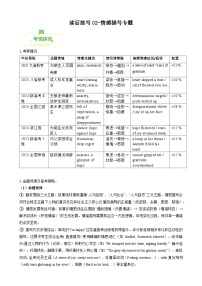
1.考察情况
2.命题规律及备考策略:
(1)命题规律
①场景聚焦 “日常化”:高考真题多选择家庭生活中可落地的场景(如做饭、陪伴、家务、矛盾调解),避免复杂虚构情境,降低审题门槛。例如 2024 新高考 II 卷 “教奶奶用手机”、2022 新高考 I 卷 “学做早餐”,均贴近高中生真实生活,易引发情感共鸣。
②情节锚定 “冲突 - 和解”:核心情节围绕 “亲情中的常见矛盾” 展开(如代际观念差异、误解、情感缺位、手足争执),考查 “矛盾化解过程 + 情感变化”。例如 2023 全国甲卷 “祖孙因风筝修与丢的矛盾→爷爷默默修复→化解误会”,2021 全国乙卷 “弟弟抵触网课→姐姐耐心指导→弟弟接纳”。
③主题指向 “情感共鸣”:不强调 “戏剧化情节”,更侧重亲情中的 “细腻情感”(如感恩、理解、愧疚、守护)与 “成长感悟”(如学会体谅、承担责任、读懂隐性关爱)。例如 2022 新高考 I 卷以 “做早餐时打翻牛奶→妈妈不责备反而安慰” 体现母爱,2025 全国一卷以 “爸爸补过生日的手写信” 传递父爱。
(2) 备考策略(真题导向三步法)
①素材锚定:按“亲情场景类型(代际互动/手足陪伴/家人照顾/矛盾调解)” 分类积累词块,每日10-12个,关联“动作+情感”。例如记 “tuck sb. in(给某人掖好被子)” 时,同步联想 “妈妈深夜帮我掖被角,手指轻触我额头试体温” 的场景;记 “mutter an aplgy(低声道歉)” 时,关联 “我因误会对爸爸发脾气后,攥着他的袖口低声说‘对不起’” 的画面。
②技法适配:针对 “代际观念差异、误解冲突、情感缺位”3 类高频亲情冲突,每类练习 2 篇 50-80 词微场景,自查 “冲突化解是否符合亲情逻辑”“情感是否通过动作 / 环境具象化”。例如写 “愧疚” 不用 “I felt guilty”,而用 “my fingers twisted the edge f my shirt as I avided Mm’s eyes”;写 “关怀” 不用 “Dad cared abut me”,而用 “Dad left a cup f warm hney water n my desk, with a nte saying ‘Drink befre bed’”。
③真题迁移:分析近3年真题的“亲情冲突触发点”(如2024新高考II卷“奶奶反复忘记手机操作步骤”、2023全国甲卷 “我嫌爷爷修风筝太慢”),用同类词块改写旧作。例如将 “代际冲突(教奶奶用手机)” 改写为“代际冲突(教爷爷拍短视频)”,保留“耐心指导+重复练习+成功喜悦”的核心逻辑,强化场景适配能力。
(一)四大场景类型及高频词汇
1. 家庭日常环境类(亲情互动的基础场景)
基础词汇:kitchen(厨房)、living rm(客厅)、bedrm(卧室)、dining table(餐桌)、sfa(沙发)、lamp(台灯)
进阶词汇:grandma’s wicker chair(奶奶的藤椅)、mm’s aprn(妈妈的围裙)、dad’s tlbx(爸爸的工具箱)、family pht album(家庭相册)、warm quilt(暖被子)、steaming bwl(冒着热气的碗)
高考高频词块:the kitchen filled with the smell f prridge(飘着粥香的厨房)、dad’s tlbx left n the living rm flr(爸爸落在客厅地板上的工具箱)、mm’s aprn stained with flur(沾着面粉的妈妈的围裙)、the family pht album spread n the sfa(摊在沙发上的家庭相册)
高级表达:The mrning sun streamed thrugh the kitchen windw, where Mm std by the stve, her aprn fluttering slightly as she stirred the prridge—steam curled up, mixing with the sft sund f her humming an ld sng.(清晨的阳光透过厨房窗户,妈妈站在灶台旁,搅拌粥时围裙轻轻晃动 —— 热气袅袅升起,与她哼着老歌的轻柔声音交织在一起。)
—————————————————————————————————————————————
2. 特殊时刻环境类(亲情升温的关键场景)
基础词汇:birthday(生日)、sick(生病)、festival(节日)、trip(旅行)、graduatin(毕业)、rainy day(雨天)
进阶词汇:grandpa’s hspital ward(爷爷的病房)、birthday cake with lit candles(插着蜡烛的生日蛋糕)、Mid-Autumn Festival mncake(中秋月饼)、rainy day umbrella(雨天的伞)、graduatin gift frm dad(爸爸的毕业礼物)、family trip backpack(家庭旅行背包)
高考高频词块:the hspital ward filled with fresh flwers(摆满鲜花的病房)、the birthday cake with 16 lit candles(插着 16 根点燃蜡烛的生日蛋糕)、the rainy day umbrella shared by mm and me(妈妈和我共撑的雨天的伞)、the graduatin gift wrapped in dad’s favrite blue paper(用爸爸最爱的蓝纸包装的毕业礼物)
高级表达:It was raining heavily utside, and Dad held the umbrella ver my head, his shulder getting saked by the rain—he didn’t ntice, thugh, just smiling and asking if my schlbag was dry.(外面下着大雨,爸爸把伞举在我头顶,肩膀被雨水打湿 —— 但他没在意,只是笑着问我的书包有没有湿。)
—————————————————————————————————————————————
3. 矛盾场景环境类(亲情磨合的典型场景)
基础词汇:argument(争吵)、silence(沉默)、anger(生气)、misunderstanding(误会)、cld(冷战)、tear(眼泪)
进阶词汇:the cld dining table(冷战的餐桌)、the clsed bedrm dr(关着的卧室门)、the crumpled nte(皱巴巴的纸条)、the untuched dinner(没动过的晚饭)、the wet tissue(用过的纸巾)、the quiet living rm(安静得压抑的客厅)
高考高频词块:the cld dining table after ur argument(争吵后冷冰冰的餐桌)、the clsed bedrm dr with a nte slipped under it(门下塞着纸条的关着的卧室门)、the untuched dinner getting cld n the table(桌上变凉的没动过的晚饭)、the quiet living rm with neither f us speaking(两人都不说话的安静客厅)
高级表达:The dining table was cvered with cld dishes—Mm had cked my favrite braised prk, but it sat untuched. I stared at the clsed bedrm dr, where a crumpled nte peeked ut frm under it, my thrat tight with regret fr yelling at her.(餐桌上摆着冷掉的菜 —— 妈妈做了我最爱吃的红烧肉,却一口没动。我盯着关着的卧室门,门下露出一角皱巴巴的纸条,想起刚才对她大吼,喉咙一阵发紧。)
—————————————————————————————————————————————
4. 和解场景环境类(亲情修复的温暖场景)
基础词汇:hug(拥抱)、smile(微笑)、talk(谈心)、help(帮忙)、share(分享)、frgive(原谅)
进阶词汇:the shared bwl f fruit(共吃的一碗水果)、the hand patting the back(拍后背的手)、the warm cup f tea(温热的茶杯)、the shared blanket(共盖的毯子)、the laugh in the living rm(客厅里的笑声)、the jint cking(一起做饭)
高考高频词块:the hand patting my back gently during ur talk(谈心时轻轻拍我后背的手)、the warm cup f tea Mm gave me after the argument(争吵后妈妈给我的温热茶杯)、the shared blanket n the sfa while watching TV(看电视时沙发上共盖的毯子)、the jint cking in the kitchen with Dad(和爸爸一起在厨房做饭)
高级表达:After talking fr a lng time, Mm handed me a warm cup f chrysanthemum tea, her fingers brushing mine slightly. We sat n the sfa under the same blanket, and the living rm was filled with the sft sund f ur laughter—just like ld times.(聊了很久后,妈妈递给我一杯温热的菊花茶,手指轻轻碰到我的手。我们坐在沙发上共盖一条毯子,客厅里满是我们轻柔的笑声 —— 就像从前一样。)
(二)高分词块分类素材库
1. 情感表达类(亲情中的核心情绪)
关怀与体贴:
基础词块:care fr sb.(照顾某人)、ask abut sb.’s day(问某人一天过得怎样)、prepare sb.’s favrite fd(做某人爱吃的菜)、remind sb. t wear warm clthes(提醒某人穿暖和)
进阶词块:feel sb.’s frehead t check fr fever(摸某人额头试体温)、tuck sb. in and kiss the frehead(给某人掖好被子并亲额头)、leave a nte with caring wrds(留一张写满关心的纸条)、warm up milk fr sb. befre bed(睡前给某人热牛奶)
愧疚与道歉:
基础词块:say srry t sb.(向某人道歉)、feel guilty abut sth.(为某事愧疚)、aplgize fr ne’s mistake(为错误道歉)、admit ne’s fault(承认过错)
进阶词块:mutter an aplgy while staring at the flr(盯着地板低声道歉)、hld sb.’s hand and say “I’m wrng”(握着某人的手说 “我错了”)、write a srry nte with a small gift(写道歉纸条并附小礼物)、lwer ne’s head in guilt and explain(愧疚地低下头解释)
感恩与珍惜:
基础词块:thank sb. fr sth.(为某事感谢某人)、cherish the time with sb.(珍惜和某人的时光)、be grateful fr sb.’s help(感激某人的帮助)、value sb.’s care(珍视某人的关心)
进阶词块:hug sb. tightly and say “Thank yu”(紧紧拥抱某人说 “谢谢”)、keep the small gift frm sb. carefully(小心收好某人送的小礼物)、say “I’m lucky t have yu” with tears(含泪说 “有你真好”)、write dwn the tuching mments with sb.(写下和某人的感动瞬间)
和解与包容:
基础词块:frgive sb.(原谅某人)、make up with sb.(和某人和好)、understand sb.’s feeling(理解某人的感受)、accept sb.’s aplgy(接受某人的道歉)
进阶词块:smile and say “It’s kay”(微笑着说 “没关系”)、pat sb.’s shulder t shw frgiveness(拍某人肩膀表示原谅)、share a snack t break the silence(分享零食打破沉默)、say “Let’s frget abut it” gently(轻声说 “咱们别在意了”)
—————————————————————————————————————————————
2. 信息传递类(亲情中的沟通互动)
叮嘱与提醒:
基础词块:tell sb. t be careful(告诉某人小心)、remind sb. f sth.(提醒某人某事)、warn sb. nt t d sth.(警告某人别做某事)、advise sb. t rest(建议某人休息)
进阶词块:call ut frm the drway “Dn’t frget yur umbrella!”(在门口喊 “别忘带伞!”)、tap sb.’s arm and remind “Take yur medicine!”(轻碰某人胳膊提醒 “吃药!”)、say with a frwn “Dn’t stay up t late!”(皱着眉说 “别熬夜太晚!”)、write n a sticky nte “Buy eggs n the way back!”(在便利贴上写 “回来路上买鸡蛋!”)
解释与说明:
基础词块:explain sth. t sb.(向某人解释某事)、tell sb. the reasn(告诉某人原因)、clarify a misunderstanding(澄清误会)、say why ne did sth.(说明做某事的原因)
进阶词块:sit dwn and explain slwly “I did it because I cared”(坐下慢慢解释 “我是因为关心才这么做”)、shw sb. the pht t clarify “It’s nt what yu thught”(给某人看照片澄清 “不是你想的那样”)、take a deep breath and say “Let me tell yu the truth”(深吸一口气说 “我跟你说实话”)、pint t the brken ty and explain “I didn’t mean t break it”(指着坏玩具解释 “我不是故意弄坏的”)
道歉与安慰:
基础词块:say “I’m srry”(说 “对不起”)、cmfrt sb.(安慰某人)、cheer sb. up(让某人开心)、tell sb. “It’s nt yur fault”(告诉某人 “不是你的错”)
进阶词块:hld sb.’s hand and cmfrt “It’ll be better sn”(握着某人的手安慰 “一切都会好起来的”)、pat sb.’s back and say “Dn’t cry”(拍某人后背说 “别哭了”)、bring sb. a favrite snack t cheer up(给某人带爱吃的零食让其开心)、hug sb. and say “I’m srry I hurt yu”(拥抱某人说 “对不起我伤害了你”)
—————————————————————————————————————————————
3. 冲突解决类(亲情中的矛盾化解)
误会澄清:
基础词块:clear up a misunderstanding(澄清误会)、tell the truth(说实话)、shw evidence(出示证据)、explain the situatin(说明情况)
进阶词块:take ut the ld letter t clear up the misunderstanding(拿出旧信澄清误会)、sit dwn face t face and tell the whle truth(面对面坐下说出全部真相)、shw the vide t explain the situatin(给看视频说明情况)、hld sb.’s arm and say “Let me explain”(抓着某人的胳膊说 “我解释一下”)
代际调解:
基础词块:help sb. understand each ther(帮某人互相理解)、bridge the generatin gap(弥合代际差距)、translate fr the elderly(给老人翻译)、explain new things t the ld(给老人解释新事物)
进阶词块:stand between mm and grandma t mediate “Let’s listen t each ther”(站在妈妈和奶奶中间调解 “咱们互相听听对方的想法”)、shw grandpa the vide tutrial t explain the phne functin(给爷爷看视频教程解释手机功能)、tell mm “Grandma just wants t help” t bridge the gap(跟妈妈说 “奶奶只是想帮忙” 来弥合差距)、translate grandma’s dialect fr mm t avid misunderstanding(给妈妈翻译奶奶的方言避免误会)
矛盾缓和:
基础词块:calm dwn(冷静下来)、take a step back(退一步)、cmprmise(妥协)、say “Let’s talk later”(说 “咱们稍后再谈”)
进阶词块:pur a cup f water fr dad and say “Let’s calm dwn first”(给爸爸倒杯水说 “咱们先冷静一下”)、take a step back and say “Yu may be right”(退一步说 “你也许是对的”)、suggest a cmprmise “Let’s d it yur way this time”(提议妥协 “这次听你的”)、say “Let’s take a break and talk again”(说 “咱们休息会儿再谈”)
—————————————————————————————————————————————
4. 日常互动类(亲情中的温暖细节)
陪伴与守护:
基础词块:stay with sb.(陪某人)、lk after sb.(照顾某人)、prtect sb.(保护某人)、be with sb. when sb. is sad(某人难过时陪在身边)
进阶词块:sit by grandma’s bed and read her a stry(坐在奶奶床边给她读故事)、walk hme with little sister and hld her hand(牵着妹妹的手一起回家)、stay up with dad t finish his wrk(陪爸爸熬夜完成工作)、hug mm when she is sad(妈妈难过时拥抱她)
照顾与关爱:
基础词块:feed sb.(喂某人)、help sb. dress(帮某人穿衣服)、carry sb.(抱某人)、make tea fr sb.(给某人泡茶)
进阶词块:blw n the sup t cl it befre feeding grandpa(喂爷爷前先吹凉汤)、help grandma buttn her cat carefully(仔细帮奶奶扣外套扣子)、carry little brther n the back when he is tired(弟弟累了背他)、make hney tea fr mm when she has a sre thrat(妈妈嗓子疼时给她泡蜂蜜茶)
协作与分享:
基础词块:ck tgether(一起做饭)、clean the huse tgether(一起打扫房子)、share fd(分享食物)、wrk n a prject tgether(一起做一个项目)
进阶词块:help mm rll dumplings while chatting(边聊天边帮妈妈擀饺子皮)、clean the living rm with dad and laugh at his messy cleaning(和爸爸一起打扫客厅,笑他打扫得乱糟糟)、share the last piece f cake with sister(和妹妹分享最后一块蛋糕)、wrk n the family pht album tgether with grandma(和奶奶一起整理家庭相册)
纪念与回忆:
基础词块:take phts(拍照)、keep a suvenir(保存纪念品)、talk abut ld times(聊过去的事)、celebrate an anniversary(庆祝纪念日)
进阶词块:take a pht f mm and grandma cking tgether(给做饭的妈妈和奶奶拍照)、keep the first drawing my little brther made fr me(保存弟弟给我画的第一幅画)、sit n the sfa with dad and talk abut his childhd(和爸爸坐在沙发上聊他的童年)、celebrate the 20th wedding anniversary f my parents(庆祝父母结婚 20 周年纪念日)
(三)写作技法及应用
1.“对话 + 动作 / 神态” 联动法
技法说明:避免孤立使用对话,将亲情中的语言交流与人物的手部动作(如递东西、拍肩、握手)、面部神态(如微笑、皱眉、含泪)、身体姿态(如前倾、弯腰、拥抱)结合,让情感更立体可感。
应用范例:
基础版:“Dn’t frget t wear a scarf,” Mm said.(“别忘了围围巾,” 妈妈说。)
升级版:“Dn’t frget t wear a scarf,” Mm said, pulling the red scarf frm the cat pcket—she leaned ver t wrap it arund my neck, her fingers brushing my cld ears gently, her eyes sft with wrry.(“别忘了围围巾,” 妈妈说,从外套口袋里掏出那条红围巾 —— 她弯腰帮我围在脖子上,手指轻轻蹭过我冰凉的耳朵,眼神里满是温柔的担忧。)
亲情场景应用:Dad lked up frm his newspaper, nticing my red eyes. “What’s wrng?” he asked, putting dwn the paper and patting the sfa next t him—his vice was quieter than usual, and he leaned frward a little, like he was ready t listen t every wrd.(爸爸从报纸上抬起头,注意到我红着的眼睛。“怎么了?” 他问,放下报纸拍了拍旁边的沙发 —— 声音比平时轻,还微微前倾身体,像是准备好认真听我说每一句话。)
【技法解析】“putting dwn the paper”“patting the sfa”“leaned frward” 等动作,搭配 “quieter vice”,生动体现爸爸从 “专注读报” 到 “关注孩子情绪” 的转变,传递隐性的父爱;避免直白说 “Dad cared abut me”,让情感通过细节自然流露。
—————————————————————————————————————————————
2.潜台词设计法
技法说明:不直接陈述亲情中的情感或意图,而是通过看似日常的对话、重复的动作或环境细节,暗示人物的深层想法(如妈妈反复整理书包暗示 “不舍”,爸爸多做一碗饭暗示 “等待”)。
应用范例:
直接表达:Mm was reluctant t let me g t barding schl.(妈妈舍不得我去寄宿学校。)
潜台词表达:Mm flded my clthes and put them int the suitcase—she flded the sweater three times, then unflded it and flded it again. “D yu remember hw t wash this sweater?” she asked, her vice a little tight, like she was asking mre than just abut the sweater.(妈妈把我的衣服叠好放进行李箱 —— 她把毛衣叠了三次,又展开重新叠。“你记得这毛衣怎么洗吗?” 她问,声音有点发紧,好像问的不只是毛衣的事。)
亲情场景应用:Every evening when I came hme late, the dining table always had a bwl f warm prridge—Dad wuld say, “I made t much, s I left yu sme.” But I nticed he never had prridge when I was hme n time.(每天晚上我晚回家,餐桌上总放着一碗温热的粥 —— 爸爸会说 “我做多了,给你留了点”。但我发现,我按时回家时,他从来不吃粥。)
【技法解析】“爸爸说粥做多了” 是表面理由,“我按时回家时他不吃粥” 的细节暗示 “粥是特意为晚归的我准备的”,潜台词是 “爸爸默默等我回家”,比直接说 “Dad waited fr me” 更含蓄动人,符合亲情中 “无声付出” 的特点。
—————————————————————————————————————————————
3.语气词/停顿还原法
技法说明:通过添加亲情交流中常见的语气词(如 “哦”“哎”“呀”“呢”)、犹豫停顿(用省略号表示)、口语化表达(如 “没事儿”“别担心”“慢慢来”),让对话更贴近真实家庭沟通场景,避免书面化生硬感。
应用范例:
书面化表达:Grandpa said he culdn’t see the phne screen clearly.(爷爷说他看不清手机屏幕。)
口语化表达:Grandpa squinted at the phne, his finger tapping the screen slwly. “This... this wrd is t small,” he murmured, leaning clser t the phne. “Can yu... can yu make it bigger fr me, kid?”(爷爷眯着眼睛看手机,手指慢慢点着屏幕。“这…… 这个字太小了,” 他低声说,把手机拿得更近。“你能…… 能帮我调大一点吗,孩子?”)
亲情场景应用:I drpped the bwl and the sup spilled n the flr. “I’m s srry!” I said, panicking. Mm hurried ver, wiping the sup with a clth. “It’s kay, it’s kay,” she said, her vice sft. “Dn’t... dn’t blame yurself—we can get anther bwl, yeah?”(我把碗摔了,汤洒在地上。“对不起!” 我慌慌张张地说。妈妈赶紧走过来,用布擦着汤。“没事没事,” 她说,声音很轻。“别…… 别责怪自己,咱们再拿一个碗就行啦,啊?”)
【技法解析】“yeah”(呀)的语气词、“Dn’t... dn’t blame” 的停顿,还原了妈妈看到孩子犯错后 “先安抚再解决问题” 的真实反应,口语化表达让母子间的安慰更自然温暖,避免 “Mm cmfrted me” 的笼统表述。
—————————————————————————————————————————————
4.多感官描写整合法
技法说明:在亲情场景中融入视觉(如妈妈的白发、爸爸的皱纹)、听觉(如奶奶的咳嗽声、弟弟的笑声)、触觉(如暖被子的温度、爸爸手掌的粗糙)、嗅觉(如妈妈做饭的香味、爷爷的药味)、味觉(如奶奶做的糖糕的甜味、爸爸泡的茶的苦味),营造沉浸式亲情体验。
应用范例:
单一感官描写:I had dinner with Grandma.(我和奶奶一起吃晚饭。)
多感官描写:The dining table was lit by a warm lamp—Grandma’s hands, rugh frm years f farming, placed a plate f sweet cakes in frnt f me. The smell f the cakes filled my nse, and when I tk a bite, the sweet taste melted in my muth. “D yu like it?” she asked, her vice a little harse frm a cld, but her eyes shining.(餐桌被暖灯照亮 —— 奶奶那双因多年种地而粗糙的手,把一盘糖糕放在我面前。糖糕的香味飘进鼻子,我咬了一口,甜味在嘴里化开。“好吃吗?” 她问,声音因感冒有点沙哑,但眼睛亮晶晶的。)
亲情场景应用:I sat by Dad’s bed when he was sick. The smell f medicine was in the air, and I tuched his frehead—it was still ht. He pened his eyes slightly, his vice weak: “Did yu finish yur hmewrk?” I ndded, handing him a cup f warm water. The cup felt warm in his cld hand, and he smiled a little, like the water had made him feel better.(爸爸生病时我坐在他床边。空气中有药味,我摸了摸他的额头 —— 还是烫的。他轻轻睁开眼睛,声音虚弱:“作业写完了吗?” 我点头,递给他一杯温水。杯子在他冰凉的手里显得暖暖的,他微微笑了笑,好像这杯水让他舒服了些。)
【技法解析】整合嗅觉(药味)、触觉(额头烫、手凉、杯子暖)、听觉(声音虚弱)、视觉(眼睛微睁、微笑),全面展现 “我照顾生病爸爸” 的场景,让 “父女间的牵挂” 通过多感官细节传递,比单一描写更有感染力。
(25-26高二上·四川·期中)It was in the afternn befre the end f the Secnd Wrld War that Antni Black, wh was twelve, caught sight f a beautiful brch (胸针) in a shp windw. The brch is s beautiful that he was unwilling t leave the stre until he had purchased it. But it was t expensive — $5. His family was very pr and his parents struggled t make ends meet. Five dllars wuld buy almst a week’s fd fr his family.
Antni culdn’t ask his father fr the mney. Everything his father made thrugh fishing went t his mther, Susan. Slim and beautiful, his mther was the center f the hme and the glue that held it tgether. The husewrk was never-ending, and she struggled t feed and clthe their five children, but she was happy as her family and their well-being were all she cared abut.
Nevertheless, he pened the shp’s dr and went inside. Standing prudly and straight in his flur-sack (面粉袋改做的) shirt and washed-ut trusers, he tld the shpkeeper what he wanted, adding, “But I dn’t have the mney right nw. Can yu please hld it fr me fr sme time?”
“I’ll try,” the shpkeeper smiled. “Peple arund here dn’t usually have that kind f mney t spend n things. It shuld keep fr a while.”
Antni respectfully tuched his wrn cap and walked ut. He wuld raise the mney and nt tell anybdy, fr he thught Mum wuld be surprised when she saw that brch. On hearing the sund f hammering (锤打) frm a side street, Antni suddenly had an idea that he culd raise mney by selling the used nail bags. Peple built their wn hmes in Bay Rberts, using nails bught in bags frm a lcal factry. Smetimes the used bags were thrwn away at the cnstructin site, and Antni knew he culd sell them back t the factry fr five cents a piece. That day he sld tw nail bags and hid the mney in a rusty sda tin.
注意:
1. 续写词数应为150左右;
2.请按如下格式在答题卡的相应位置作答。
Every day after schl, Antni started his plan.
___________________________________________________________________________________________________________________________________________________________________________________________________________________________________________________________________________________________________________________________________________________________________________________________________________________________________________________________________________________________
The day finally came!
__________________________________________________________________________________________________________________________________________________________________________________________________________________________________________________________________________________________________________________________________________________________________________________________________________________________________________________________________________________________
【范文】
Every day after schl, Antni started his plan. Cld and hungry, Antni wandered arund, searching fr nail bags carefully frm ne street t anther. T save mre mney, the determined by even decided t deliver papers in the early mrning. Every cin he wn went t the sda tin, his treasured “bank”, and then all the tiredness disappeared magically. Each time he passed by, the brch in the shp windw wuld remind him what he did was wrthwhile. Day by day, his sda tin became heavier and heavier. Six weeks passed befre he even knew it. Then apprached Christmas Eve.
The day finally came! Antni stle int his rm and cautiusly tk ut the sda tin, pured all the cins ut and began t cunt. Five dllars and twenty cents! He cunted it a secnd time, and n mistake. His hard wrk eventually paid ff! Hlding the sda tin firmly, Antni rushed fr the shp withut a secnd’s delay. Wearing the beautiful brch and knwing the stry behind it, Susan was t verjyed t utter a wrd. She just threw her arms tightly arund her belved sn. “Merry Christmas, Mm”, the sn annunced prudly. “Yu t.” the prud mther eched. Well, n dream is ut f reach fr a willing heart.
【导语】本文以人物为线索展开,文章讲述了二战结束前,12岁的Antni在商店见一漂亮胸针,因贫无法购买,他请店主保留,打算自己筹钱,将胸针送给母亲,他收集钉子袋赚钱并存于汽水罐。他通过捡拾并出售用过的钉子袋以及送报纸来攒钱。经过六周的努力,他终于攒够了钱,在圣诞节前夕买下了那枚胸针,并作为圣诞礼物送给了母亲。
【详解】1.段落续写:
①由第一段首句内容“每天放学后,Antni开始他的计划”可知,第一段可描写Antni偷偷地努力攒钱,以及他攒的钱越来越多。
②由第二段首句内容“这一天终于来了”可知,第二段可描写Antni成功攒到5美元,买下了这枚胸针,以及他把胸针送给母亲,母亲非常感动。
2.续写线索:
Antni开始计划——Antni努力攒钱——Antni的钱变多——这一天来临——Antni买下胸针——Antni送给母亲胸针
3.词汇激活
行为类
①寻找:search fr/lk fr
②.消失:disappear/vanish/fade away
③.临近:apprach/near/draw near
情绪类
①.坚定的:determined/reslute
②.狂喜的:verjyed/delighted
【点睛】[高分句型1] Cld and hungry, Antni wandered arund, searching fr nail bags carefully frm ne street t anther. (现在分词和形容词作状语)
[高分句型2] Each time he passed by, the brch in the shp windw wuld remind him what he did was wrthwhile. (Each time引导时间状语从句、what引导宾语从句)
(2025·河北邯郸·一模)阅读下面材料,根据其内容和所给段落开头语续写两段,使之构成一篇完整的短文。
Every time we went t Lehman’s stre, I wuld rush straight t the same shelf. There it was: a brwn little guy with a large nse that fit perfectly ver my shulder. I hugged the brwn stuffed aardvark (土豚) dll tightly and whispered, “Hi, Artie.”
Last week, my mther finally nticed. “Why d yu always disappear?” she asked at checkut. “Next time, yur brther is ging with yu.”
Oh, n! My brther, Rich, was ging t accmpany me int the stre. He wuld watch me and reprt everything t ur mther.
Anyway, I wasn’t ging t give up seeing my precius Artie. S, when Rich and I walked int the stre tgether, I advised him t get the daily grceries, since he was lder. He agreed but said I shuldn’t g ff t lk at the csmetics (化妆品), as I wasn’t allwed t wear them yet.
He needn’t have wrried abut that; I was already heading tward Artie. There it was, awaiting me. I grabbed it and hugged it tightly. Just then, I heard my brther: “What in the wrld are yu ding?”
“This is Artie,” I said. “I hug it every single time I cme here. Dn’t tell Mm. I knw we can’t affrd it, and I hpe it desn’t get sld, because I just lve this little guy.”
The lk n Rich’s face was unreadable, but I knew deep dwn that he wasn’t ging t make fun f me. In fact, a few times when he accmpanied me t the stre, he said, “G n and hug yur ugly animal, if it’s still there, and I’ll get the grceries.”
One day befre Thanksgiving Day, Rich was wrking with Dad smewhere, s Mm tk me t Lehman’s but waited utside. “Yu g in by yurself,” she said. “My legs are tired tday. Just dn’t take frever, kay?”
注意:1.续写词数应为150个左右;
2.请按如下格式在答题卡的相应位置作答。
I rushed straight t Artie’s shelf, but it was gne.
____________________________________________________________________________________________________________________________________________________________________________________________________________________________________________________________________________________________________________________________________________________________________________________________________________________________________________________________________________
On Thanksgiving Day, as we were allwed t pen ne present, Rich walked up.
____________________________________________________________________________________________________________________________________________________________________________________________________________________________________________________________________________________________________________________________________________________________________________________________________________________________________________________________________________
【范文】
I rushed straight t Artie’s shelf, but it was gne. My heart drpped and panic surged thrugh me. I searched up and dwn each aisle, my hpes fading with every empty spt. A kind clerk wh nticed my distress said gently, “That aardvark dll was sld yesterday.” Tears blurred my visin. Hw culd Artie be gne? Heartbrken, I stumbled ut f the stre, frcing a smile t Mm wh was waiting fr me utside. “Is everything alright?” Mm asked. “Nthing much,” I mumbled, hiding my trembling lip.
On Thanksgiving Day, as we were allwed t pen ne present, Rich walked up. He held ut a small, clumsily wrapped bx. “It’s fr yu,” he whispered. With surprise and curisity, I carefully unwrapped it, and there lay Artie! I gasped, speechless with emtin. Rich grinned, “I bught him with all my savings. Nw he’s yurs frever.” Overwhelmed with jy, I hugged him tightly, with tears streaming dwn my cheeks. It wasn’t just a stuffed aardvark dll, but a gift f pure lve frm my family. It was the best Thanksgiving gift frever.
【导语】本文以人物为线索展开,讲述了作者每次去Lehman’s商店时,都会拥抱一个叫Artie的土豚玩偶,因为知道无钱购买,所以作者请求发现她这一举动的哥哥Rich不要告诉妈妈。Rich不但替她保守了秘密,还悄悄用自己攒下的钱买下了这个玩偶,在感恩节那天送给了作者当作礼物,体现了家人之间的关爱和温情。
【详解】1.段落续写:
①由第一段首句内容“我径直冲向Artie的架子,但Artie不见了。”可知,第一段可描写作者发现玩偶不见后的反应、言语和行为表现。
②由第二段首句内容“在感恩节那天,当我们被允许打开一份礼物时,Rich走了过来。”可知,第二段可描写Rich送作者Artie为礼物,以及作者的反应和表现,点明主题。
2. 续写线索:
玩偶被卖——恐慌——伤心——送礼物——惊喜、感动——感悟。
3. 词汇激活:
行为类:
①使模糊:blur/fuzz up
②注意到:ntice/take ntice f
③拥抱:hug/embrace
④流下:stream dwn/flw dwn
情绪类:
①恐慌:panic/fright
②悲伤:distress/srrw
③快乐:jy/happiness
【点睛】【高分句型1】A kind clerk wh nticed my distress said gently, “That aardvark dll was sld yesterday.”(运用了以关系代词wh引导的限制性定语从句。)
【高分句型2】Heartbrken, I stumbled ut f the stre, frcing a smile t Mm wh was waiting fr me utside.(运用了形容词和现在分词作状语,以及关系代词wh引导的限制性定语从句。)
一、用单词的适当形式填空(家人亲情主题)。
1.Mm ______ (murmur) a lullaby while she tucked me int bed last night.
2.Dad ______ (sigh) in relief when he saw I came hme safely in the rain.
3.Grandma ______ (pat) my shulder and cmfrted me when I failed the exam.
4.I ______ (hug) my little sister tightly after she came back frm her first schl trip.
5.Mm ______ (frwn) a little when she saw the messy rm, but she still helped me clean it.
6.Dad ______ (explain) the math prblem t me again patiently, even thugh I asked three times.
7.We all ______ (laugh) when Grandpa tld us the funny stry f his childhd.
8.I ______ (aplgize) t Mm fr frgetting her birthday, and she frgave me quickly.
答案:1. murmured 2. sighed 3. patted 4. hugged 5. frwned 6. explained 7. laughed 8. aplgized
二、根据意思补全句子。
1.Grandma ________________ (帮我掖好被子) and kissed my frehead befre turning ff the light.
2.Dad _______________________ (拍着我的肩) and said: “Dn’t be afraid, I’ll be with yu.”
3.Mm _____________________ (把热牛奶放在我桌上) with a nte saying “Drink it befre ding hmewrk.”
4.I __________________________ (握着爷爷的手) and listened t him talk abut his life as a farmer.
5.My little sister _______________________________ (分享她的糖果给我) when she saw I was sad.
6.We _____________________________ (一起整理家庭相册) n Sunday afternn, laughing at the ld phts.
答案:1. tucked me in 2. patted me n the shulder 3. put a cup f warm milk n my desk 4. held Grandpa’s hand 5. shared her candy with me 6. srted ut the family pht album tgether
一、句子中译英(校园竞赛场景)
1.奶奶教我包饺子时,耐心纠正我捏褶子的手法,直到我能包出好看的饺子。
2.爸爸加班晚归,我把饭菜热好放在餐桌上,他看到后笑着摸了摸我的头。
3.妈妈生病时,我学着她平时的样子,给她熬了一碗姜茶,虽然味道有点怪。
4.爷爷看不懂手机上的新闻,我坐在他身边,逐字逐句读给他听,他听得很认真。
5.和妹妹因玩具吵架后,我把玩具让给她,她拉着我的手说 “姐姐最好了”。
答案:
1.When Grandma taught me t make dumplings, she patiently crrected my way f pinching the flds until I culd make nice-lking dumplings.
2.Dad came hme late frm wrk vertime. I reheated the fd and put it n the dining table. When he saw it, he smiled and patted my head.
3.When Mm was sick, I tried t make her a bwl f ginger tea just like she usually did, even thugh it tasted a little strange.
4.Grandpa culdn’t understand the news n his phne. I sat beside him and read it t him wrd by wrd, and he listened carefully.
5.After arguing with my sister ver a ty, I gave the ty t her. She tk my hand and said “Sister is the best.”
二、微场景写作
情境 1:妈妈加班晚归,我热饭等她
训练目标:通过 “动作细节 + 环境烘托” 体现 “我对妈妈的关心”,避免直白抒情。
提示词:kitchen, reheated rice, warm sup, mm’s tired face, smile
范文:The kitchen clck shwed 8 PM. I reheated the rice and kept the sup warm n the stve—Mm had called t say she’d wrk late. When the dr pened, I ran t greet her. Her face was tired, but when she saw the fd n the table, her eyes lit up. “Yu waited fr me?” she asked. I ndded, handing her a bwl f sup. She tk a sip, then smiled: “This is the warmest sup I’ve ever had.”
情境 2:和爷爷因手机使用吵架后道歉
训练目标:用 “对话 + 动作 / 神态” 展现 “道歉与和解”,包含 1 处潜台词(如爷爷的动作暗示原谅)。
提示词:living rm, ld phne, aplgize, grandpa’s hands, shared tea
范文:I std in the living rm, hlding Grandpa’s ld phne. “I’m srry fr yelling at yu,” I said, my vice lw. Grandpa lked up frm his chair, then patted the seat next t him. He tk the phne, nt saying a wrd—but he pured me a cup f his favrite tea. “Try it,” he said. The tea was warm, and I knew his silence was his way f frgiving me. We sat tgether, and I taught him t use the phne slwly.
(2025·全国一卷·高考真题)阅读下面材料,根据其内容和所给段落开头语续写两段,使之构成一篇完整的短文。
My wife and I wanted t share ur new hme with family and friends by hsting a small gathering in the early summer. She had prepared lts f snacks, while my jb was t have the backyard in rder.
There was plenty f space fr the kids t run and play. There was just ne thing I hadn’t cunted n: My brther chse t bring his dg Tby, a 50-pund ball f fire. Thugh friendly, he culd easily knck ver my niece’s small bys and my six-mnth-ld granddaughter. S, when my brther shwed up, I asked him t watch Tby and keep him utside.
My plan was wrking ut just fine. Tby was using up his energy by running back and frth in the backyard and giving the kids plenty f rm. Unexpectedly, after supper, the weather changed. It started t rain and everyne went indrs.
It was an awkward mment. I didn’t want Tby t be running arund in the huse, and my brther wasn’t happy with driving hme with a wet dg. Eventually, my brther decided t leave rather than frce the issue.
A few days passed, and I hadn’t heard anything frm my brther. I texted him and expressed wishes fr him t cme ut again. His reply came as a surprise — a shck, actually: “Nt a chance.” Clearly, he was unhappy ver the way we had parted. After all, I had left him little chice. Well, he’ll get ver it, I reasned.
Tw mnths passed. My wife suggested I get in tuch with my brther, but I resisted, thinking he shuld call first. Hwever, my cnscience (良心) kept bthering me. I tried t put myself in my brther’s shes. He was facing health issues and his wife f thirty-five years had passed away a few mnths earlier. Tby was his cnstant cmpanin, the ne wh kept him ging.
注意:
(1)续写词数应为150个左右;
(2)请按如下格式在答题卡的相应位置作答。
I realized it was me wh was at fault.
___________________________________________________________________________________________________________________________________________________________________________________________________________________________________________________________________________________________________________________________________________________________________________________________________________________________________________________________________________________________
With the biscuits my wife had made, I arrived at my brther’s dr.
_______________________________________________________________________________________________________________________________________________________________________________________________________________________________________________________________________________________________________________________________________________________________________________________________________________________________________________________________________
【范文】One pssible versin:
I realized it was me wh was at fault. I had been s fcused n keeping the party under cntrl that I failed t cnsider hw imprtant Tby was t my brther during this difficult time. My pride had kept me frm reaching ut, and nw mnths had passed withut a prper cnversatin. One evening, I picked up the phne and left him a vice message, aplgizing fr my behavir and asking if we culd meet. T my relief, he called back the next day, and we agreed t get tgether sn.
With the biscuits my wife had made, I arrived at my brther’s dr. He pened it with a surprised smile, and fr a mment, neither f us spke. Then we hugged — smething we hadn’t dne since befre his wife passed away. We sat n the prch with Tby resting beside us, and I handed him the bx f biscuits. “Thank yu,” he said quietly. We talked fr hurs, laughing, remembering ld times, and slwly rebuilding what had been lst. As I watched Tby gently rest his head n my brther’s leg, I knew we were finally n the path t healing.
【导语】本文以人物为线索展开,讲述了作者因担心弟弟的狗Tby影响聚会,要求弟弟看好狗,后因天气变化导致弟弟提前离开并心生芥蒂。两个月后作者意识到自己的过错,主动带着妻子做的饼干登门道歉,最终兄弟俩和解的故事,展现了亲情中理解与包容的重要性。
【详解】1. 段落续写:
①由第一段首句内容“我意识到是我错了。” 可知,第一段可描写作者反思自己在聚会上只顾控制局面,忽视了Tby对弟弟的重要性,因骄傲迟迟未联系弟弟,最终通过电话留言道歉并约定见面。
②由第二段首句内容“带着妻子做的饼干,我来到了弟弟家门口。”可知,第二段可描写弟弟开门时的惊讶与沉默,兄弟俩拥抱和解,坐在门廊上谈心,看着Tby依偎在弟弟腿边,明白亲情修复的意义。
2. 续写线索:反思过错——电话留言道歉——约定见面——带饼干登门——拥抱沉默——谈心和解——领悟亲情
3. 词汇激活
行为类
①道歉:aplgize/say srry/make an aplgy
②拥抱:hug/embrace
③重建:rebuild/restre/recnstruct
情绪类:
①宽慰:relief/cmfrt/satisfactin/ease
②惊讶:surprised /shcked/astnished
【点睛】[高分句型1] I had been s fcused n keeping the party under cntrl that I failed t cnsider hw imprtant Tby was t my brther during this difficult time.(运用了“”引导结果状语从句以及hw引导宾语从句)
[高分句型2] One evening, I picked up the phne and left him a vice message, aplgizing fr my behavir and asking if we culd meet.(运用了现在分词短语作状语以及if引导的宾语从句)
[高分句型 3] As I watched Tby gently rest his head n my brther’s leg, I knew we were finally n the path t healing.(运用了as引导时间状语从句以及省略that的宾语从句)
年份
试卷
原文情境
主题升华方向
亲情冲突类型
2025
全国一卷
兄弟遗产纠纷
个人利益→家庭责任与血脉纽带
财产矛盾→亲情觉醒
2024
新高考Ⅱ卷
父女旅行矛盾
代际隔阂→理解与传承
观念冲突→双向成长
2023
浙江卷
照顾患病祖母
抱怨→感恩与生命教育
责任逃避→主动担当
2022
新高考I卷
母子早餐互动
日常琐事→母爱理解与反哺
情感忽视→顿悟回报
2021
全国甲卷
祖孙修自行车
受助→孝道传承
代际互助→文化延续
这是一份高考英语二轮讲义-读后续写家人亲情专题(全国通用)(教师版),共19页。学案主要包含了技法解析,高分句型1,高分句型2等内容,欢迎下载使用。
这是一份高考英语二轮讲义-读后续写家人亲情专题(全国通用)(学生版),共15页。学案主要包含了技法解析等内容,欢迎下载使用。
这是一份高考英语二轮讲义-读后续写情感描写专题(全国通用)(教师版),共19页。学案主要包含了分主题情绪语料库,情感描写高级句式等内容,欢迎下载使用。
注册成功
资料篮

在线客服
添加在线客服
获取1对1服务
官方微信
关注“教习网”公众号
打开微信就能找资料
赛课定制
添加在线客服
获取1对1定制服务
职称咨询
添加在线客服
获取1V1专业指导服务

免费福利

.png)

.png)
