免费领取教师福利
若您为此资料的原创作者,认为该资料内容侵犯了您的知识产权,请扫码添加我们的相关工作人员,我们尽可能的保护您的合法权益。


这是一份北京市大兴区九年级上学期期末英语试题(原卷版)-A4,共10页。试卷主要包含了5分,共6分)等内容,欢迎下载使用。
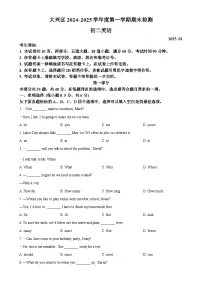
考生须知
1. 本试卷共10页,共两部分,共五道大题,38道小题,满分60分,考试时间90分钟。
2. 在试卷和草稿纸上准确填写学校、班级、姓名和准考证号。
3. 试题答案一律填涂或书写在答题卡上,在试卷上作答无效。
4. 在答题卡上,选择题用2B铅笔作答,其他试题用黑色字迹签字笔作答。
5. 考试结束,请将本试卷、答题卡和草稿纸一并交回。
第一部分
本部分共33题,共40分。在每题列出的四个选项中,选出最符合题目要求的一项。
一、单项填空(每题0.5分,共6分)
从下面各题所给的A、B、C、D四个选项中,选择可以填入空白处的最佳选项。
1. My father is a dctr. ________ reads English medical magazines every day.
A. HeB. SheC. TheyD. We
2. Mike ften ges t muntains t cllect different stnes ________ Sundays.
A frB. inC. nD. at
3. —Hi, Bb, ________ yu swim?
—Yes, I can. But I’m nt gd at swimming.
A. mustB. canC. mayD. culd
4. This term, the inter-class break is ________ than befre fr students in Beijing.
A. lngB. lngerC. lngestD. the lngest
5. — Hi, Lily. ________ was yur scial practice yesterday?
— Ww, it was fantastic.
A. WhatB. WhenC. HwD. Where
6. Mary was ill, ________ she still tk the math exam yesterday.
A. andB. butC. sD. r
7. Every year, millins f travelers ________ Beijing hutng t experience lcal culture.
A. visitB. visitsC. vsitedD. is visiting
8. Next Friday, my classmates and I ________ the amazing perfrmance at the schl hall.
A. enjysB. enjyedC. is enjyingD. will enjy
9. —Hey, Mike, what were yu ding when it rained yesterday?
—I ________ in the library.
A. readB. readsC. will readD. was reading
10. I ________ t play the Erhu fr ten years and nw I’m crazy abut it.
A. learnB. learnedC. have learnedD. was learning
11. Shanhaijing, als knwn as the Classic f Muntains and Seas, ________ ver 2,000 years ag.
A. writeB. wrteC. is writtenD. was written
12. —Sam, d yu knw ________ during the Mid-Autumn Festival?
—Sure, let me tell yu.
A. what Chinese peple usually d
B. what d Chinese peple usually d
C. what Chinese peple usually did
D. what did Chinese peple usually d
二、完形填空(每题1分,共8分)
阅读下面的短文,掌握其大意,然后从短文后各题所给的A、B、C、D四个选项中,选择最佳选项。
At the far end f twn, next t a dark frest, sat a white huse. Kids at my schl were curius abut the terrible huse, but actually it was where I lived with my family. Mm cleaned every rm and painted the inside. But the utside still lked ____13____.
I never tld anyne that I lived in that white huse. Then ne day, Eddie, a by in my histry class, shuted ludly, “I can’t believe Sarah lives in that terrible huse. I thught nly wild animals lived there!” I felt my face grew ht and held back a tear. “The huse will lk a lt better nce we have it ____14____...” I pened my bk, pretending (假装) t read.
The next day at schl, an lder by named Juan stpped me in the hall. “I heard yu are interested in having yur huse painted. My friend David and I are starting a paint ____15____. Can we give yu a qute (报价)?”
“It’s actually a nice huse — gd bnes,” he cntinued. “And a paint jb can make a huse lk new.” I was tuched by his wrds. “Thanks. Let me talk t my Mm and get back t yu.” After schl, I tld Mm and Gram abut the ____16____. “I have a little mney I culd give yu,” Gram said. “I have sme mney, but I’m sure it wn’t be enugh.” Mm said ____17____.
In the mrning, an idea hit me in my head. At schl, I saw Juan and waved him dwn.
“Have yu painted any huses yet, Juan?”
“Nt yet. We just started.”
“Well, what if yu paint my huse as a sample (样板)? Instead f ____18____ yu, we wuld let yu put a sign in ur yard t advertise, and peple culd see what a great jb yu’ve dne. Yu knw, ne gd ____19____ is wrth a millin dllars.”
Juan laughed. “Hw abut if in additin t a sign, yu pay fr the paint… and buy us a pizza?”
“It might wrk,” I said, smiling.
With the mney I cllected, we were able t ____20____ Juan’s ffer. Each day, as Juan and David wrked, every brushstrke was like magic. When the painting was dne, the huse lked amazing. At the tp, there was a lvely bard “Sunny Huse by Juan & David”.
Nw, the huse was very beautiful, inside and utside, and I felt prud f what I had dne t it.
13. A. clrfulB. beautifulC. awfulD. useful
14. A. sldB. builtC. lckedD. painted
15. A. jurneyB. businessC. activityD. research
16. A. fferB. replyC. adviceD. difficulty
17. A. angrilyB. prudlyC. sadlyD. excitedly
18. A. thankingB. payingC. teachingD. trusting
19. A. advertisementB. friendC. jbD. huse
20. A. believeB. questinC. chseD. accept
三、阅读理解(每题2分,共26分)
阅读下列新书介绍,请根据人物需求匹配最适合的书籍,并将书籍所对应的A、B、C、D选项填在相应位置上,其中一个选项为多余选项。
(二)阅读下列短文,根据短文内容,从短文后各题所给的A、B、C、D四个选项中,选出最佳选项。
B
On a Saturday mrning, I planned t g t the pl but Mm asked me t watch my five-year-ld sister Lyssa and three-year-ld brther Dugie because she had an imprtant jb interview.
“Culdn’t Julie watch them instead?” I asked.
“She can help, but she’s nly ten. I’ll feel better with a fifteen-year-ld in charge (负责).” Mm gave me a kiss and ff she went.
Abut ten ’clck, the kids were playing in the frnt yard while I was reading my sprts magazine, with my headphnes n.
Deeply lst in a really cl stry, I hardly nticed Julie already standing ver me. I tk my headphnes ff. “Lk at the sky,” she said in a quivery (颤抖的) vice. I rlled my eyes at her. That was when I saw a huge, gray-black trnad snaked dwn frm the sky t the grund. I culdn’t believe it—a real, live trnad! And headed ur way in high speed! I was s afraid that my heart jumped up almst t my ears.
I tried hard t remember the facts I learned abut trnad safety in schl.
Get lw. Find a basement, r if yu’ re caught utside, find the lwest place yu can.
Lking arund us, my eyes stpped n a ditch (沟) abut a hundred yards ff.
“Julie,” I shuted, taking Lyssa quickly. “Get Dugie and fllw me t the ditch!”
We were making ur way hard because f the wind and rain. Suddenly we all fell n a muddy bttm tw feet belw. I made everyne lie as flat as they culd, arms prtecting their heads. Trash rained dwn n us and the trnad blew away almst everything. I thught we were gners fr sure… But the next mment, it was ver. I lifted my head and saw the trnad rushing away. Sn the sky began t lse its dark clr. I kept tuching kids, amazed we were all OK.
Standing n the mess, I culdn’t stp thinking what if Julie’d been watching them and I’d been at the pl!
24. What did the writer plan t d at first?
A. T watch mvies.B. T have a jb interview.
C. T g t the pl.D. T read sprts magazines.
25. What did the writer feel when he saw the real live trnad?
A. Funny.B. Afraid.C. Disappinted.D. Upset.
26 What can we knw frm the last sentence?
A. The writer felt lucky t prtect his sisters and brther.
B The writer felt regretful t stay with his sisters and brther.
C. The writer felt prud that he had learned abut trnad safety.
D. The writer felt srry that his huse was destryed by the trnad.
C
Isn’t it strange that, when smething’s funny, yu might shw yur teeth, change yur breathing, becme weak and achy in sme places, and maybe even cry? In ther wrds, why d we d this funny thing—laughter?
Since there’s n recrd f laughter, it’s impssible t say exactly hw and why it develped, but scientists have sme theries.
Imprtantly, humans are nt the nly animals tday that d smething like laughter. By recrding sunds, researchers in the late 90s realized that mice were ding smething like laughter while being tickled (挠痒痒). Scientists have als studied at least 65 kinds f animals—mstly mammals, but als sme birds—and find that they laugh during scial play.
By recrding and studying the laughter-like sunds apes (猿类) make during play, researchers think laughter may have develped t clearly shw friendliness frm the beginning.
But f curse, we humans dn’t just laugh when we’re playing, but als when we’re amused, and even surprised, cnfused, r nervus. Sme scientists think after humans separated frm ther great apes and develped large scial grups and mre cmplex (复杂的) language abilities, laughter tk n mre purpses. They find that laughter gradually became smething we culd use nt just during play but within speech t express meanings and t shw ur emtins.
This is thught t be ne f the reasns that laughter is cntagius (传染的): it’s like an invitatin t share in smene’s emtinal state. Just hearing laughter can activate key areas in yur brain, causing yu t smile r laugh yurself. And, when peple in ne study watched a funny vide, they laughed lnger and mre ften when anther persn was present—even thugh they reprted feeling the same level f amusement.
And laughter is nt just scially imprtant; it’s als thught t be gd fr us. When we laugh, ur brains prduce feel-gd chemicals and lwer levels f stress. Sme research even suggests that peple wh laugh mre can deal with stress mre effectively and have better health.
Laughter is a universal human behavir. Babies can laugh befre they can speak. Whether it’s the best medicine depends n yur illness. But as smething that makes life happier, strengthens relatinships and perhaps imprves yur health, yu can’t g wrng with a gd laugh.
27. Why des the writer use the examples f mice and ther animals in Paragraph 3?
A. T shw hw animals laugh while being tickled.
B. T prve there are recrds f hw laughter develped.
C. T shw humans are nt the nly animals that can laugh.
D. T prve humans and animals laugh fr the same reasn.
28. What can we learn frm the passage?
A. Humans laugh better than ther animals.
B. Laughter develps humans’ language abilities.
C. Peple can influence each ther when laughing.
D. Feel-gd chemicals in brain can cause laughter.
29. What is the passage mainly abut?
A. Sme findings abut laughter.
B. Sme purpses f humans’ laughter.
C. The imprtance f humans’ laughter.
D. The influence f laughter n thers.
D
Plants face many challenges during their lifetimes. Unlike animals, plants cannt hide during a strm r mve away frm an insect attack. Instead, they must stand still and deal with every challenge that cmes their way. This has made plants masters f self-defense (防御) and experts at adapting (适应) themselves t changes in their envirnments.
One way plants can change t deal with challenges is thrugh a prcess called natural selectin (选择). This is usually a very slw prcess in which thse plants that are best adapted t their envirnments prduce the mst ffspring, r seeds. Adaptatins culd be sharp thrns (刺) that prtect a plant frm being eaten by a giraffe, r pisnus (有毒) leaves that prtect it frm insects.
Hwever, change thrugh natural selectin usually happens very slwly. In lng-lived plants like trees, it can take hundreds f years. Luckily, there is anther, much quicker way. This type f change is cntrlled by smething called epigenetics. Epigenetic marks n the DNA cntrl hw cmpacted (“turned ff”) r lse (“turned n”) the DNA is. This change is especially imprtant in lng-lived trees, like cnifers (针叶树), as they may face mre envirnmental cnditins in their lifetimes. It allws cnifers t remember the stressful past and be better prepared fr the future. Cnifers can frm “memries” because f many kinds f envirnmental challenges, such as temperature cnditins, insect attacks and s n.
One envirnmental signal (信号) that can trigger cnifer memries is the temperature the baby trees experienced when the seeds were develping. Trees that develped at different temperatures shw different timing in terms f when new leaves appear in spring. New leaves appear earlier n trees frm seeds at lwer temperatures, and trees develped at warmer temperatures grw new leaves later in the seasn.
Treating cnifers with plant-made defense chemicals can als cause memries. When small cnifer trees are treated with plant-made defense chemicals in the fall, they are better able t defend themselves against insect attacks when they are planted ut in the frest in spring.
Trees remember the past—nt with brains, like us, but thrugh epigenetic changes. There are still a lt f things we d nt knw abut hw and hw lng trees can remember the past. When we have learned mre abut tree epigenetics, we can perhaps grw new frests that are better at dealing with climate change, insect attacks and diseases.
30. What d yu knw abut natural selectin frm the passage?
A. The ability f hiding during a strm is an example f natural selectin.
B. Natural selectin allws plants t change rapidly t their envirnments.
C. The ability f grwing sharp thrns is a result f natural selectin.
D. Natural selectin is a slw prcess that is envirnmental-friendly.
31. The wrd “trigger” in Paragraph 4 mst prbably means “________”.
A. start t changeB. cause…t wrk
C. start t shareD. cause…t lse
32. What wuld the writer mst prbably agree with?
A. Epigenetic change is better than natural selectin.
B. Temperature can influence the size f cnifer leaves.
C. Climate change can help cnifers t deal with insect attacks.
D. Mre epigenetics knwledge is needed t help trees grw better.
33. What wuld be the best title fr the passage?
A. Tree Masters: Hw Can Trees Deal With Climate Change?
B. Tree Experts: Hw Can Trees Make Mre Seeds in Spring?
C. Tree Challenges: Hw Can Trees Live During Insect Attacks?
D. Tree Memries: Hw Can Trees Remember Withut a Brain?
第二部分
本部分共5题,共20分。根据题目要求,完成相应任务。
四、阅读表达(第34-36题每题2分,第37题4分,共10分)
阅读短文,根据短文内容回答问题。
The Pwer f Hpe
Have yu nticed the mrnings are slwly getting lighter? Being hpeful that spring is arund the crner and warmer, brighter days are ahead is a pwerful feeling. This is because hpe gives us the strength t be psitive, even when things dn’t g ur way.
Hpe is a psitive feeling that things will get better. It’s mre than just wishful thinking; hpe means taking actin and believing yu have the pwer t achieve yur gals. “When I’m hpeful, it makes me see the brightness in myself,” says Jnah, aged eight, “It’s gd t be hpeful because it gives yu a chance t be happy abut things.” Charles Snyder, a psychlgist (an expert in hw we think) studied hpeful thinking and said it has three main parts: having a gal, thinking up different ways t achieve it and believing in yurself even when things g wrng.
Snyder called hpe a “rainbw f the mind,” because it “lifts ur spirits and makes us think f what is pssible.” Being hpeful abut smething, like trying ut a new sprt r hbby, takes curage because yu’re taking a step int the unknwn. This helps yu wrk ut what’s imprtant t yu, as well as making yu mre cnfident. Studies shw that being hpeful als helps yu learn better at schl, build strng friendships and feel less stressed.
Hpe is a skill yu can learn. Hpe expert David Feldman suggests starting by wrking twards a gal that’s imprtant t yu, then thinking up different ways t achieve it. S if yu hpe t be a chef ne day, fr example, aim t learn ne new recipe a week. Staying fcused n yur gal takes energy, s eat healthily and get plenty f sleep. If yu start t feel hpeless, get inspired by peple wh have already succeeded r tell smene wh supprts yu s they can help yu imprve. Finally, make use f yur imaginatin and picture yurself achieving yur gal. Picturing success in the future is hpe in actin.
34. Hw many main parts des hpeful thinking have?
__________________________________________________________
35. Why was hpe called a “rainbw f the mind”?
__________________________________________________________
36 Hw d yu get enugh energy t stay fcused n yur gal?
__________________________________________________________
37. Wh d yu think is always psitive arund yu? Why? (Give at least tw reasns.)
__________________________________________________________
五、文段表达(10分)
38. 根据所给中文和英语提示,完成一篇不少于50词的英语文段写作。文中已给出内容不计入总词数。所给提示词语仅供选用。请不要写出你的校名和姓名。
假设你是李华,国外友好学校的学生代表团寒假将到你校参观访问。你作为学校某社团的代表,将在欢迎仪式上介绍你的社团。请你用英语写一篇短文介绍该社团。
提示词语:share, prvide, enrich, imprve
提示问题:
·What schl club will yu intrduce?
·Why d yu intrduce this club?
Dear my friends,
Welcme t ur schl! _______________________________________________________________________________________________________________________________________________________________________________________________________________________________________________________________________________________________________________________________________________________
39. 根据所给中文和英语提示,完成一篇不少于50词的英语文段写作。文中已给出内容不计入总词数。所给提示词语仅供选用。请不要写出你的校名和姓名。
生活中总会有一些不期而遇的惊喜。某校英文报刊正在开展以“A Big Surprise”为主题的征文活动。假设你是李华,请你用英文写一篇短文投稿,讲述你的一次意外惊喜。
提示词语:busy, party, tuched, realize
提示问题:
·What happened?
·What did the experience bring t yu?
A Big Surprise
Life is full f the unexpected mments, and smetimes these mments can be truly amazing. __________________________________________________________________________________________________________________________________________________________________________________________________________________________________________________________________________________________
____21____ I am interested in natural wrld. I want t knw mre abut the strange animals and insects.
____22____ I am ging t finish my primary schl and I want t read smething abut hw t deal with the changes ahead.
____23____ I like reading stries. This winter hliday I wuld like t read sme exciting stries abut time machines.
New Bks
A.
Paul is starting his last year f primary schl. There are changes ahead and even his best friend seems different. Can sme friends, a teacher and his lve f bks help him ut?
B.
Esha plans t win the Brain Trphy (奖杯) with her inventin f a time machine. Her big sister is accidentally transprted t the past and Esha must take n hungry dinsaurs t get her sister back.
C.
Jrdan, Drew, Liam and their friends are heading t a big city n a schl trip. Jrdan can’t wait t explre the city’s museums — but there will be unexpected challenges ahead.
D.
Why d jumping beans jump? Hw d sea cucumbers prtect themselves? What causes the nrthern light? If yu’re interested in nature, yu’ll enjy these stries f the mst unusual natural wrld.
这是一份北京市大兴区九年级上学期期末英语试题(原卷版)-A4,共10页。试卷主要包含了5分,共6分)等内容,欢迎下载使用。
这是一份北京市大兴区九年级上学期期末英语试题(解析版)-A4,共18页。试卷主要包含了5分,共6分)等内容,欢迎下载使用。
这是一份北京市海淀区九年级上学期期末考试英语试题(原卷版)-A4,共12页。试卷主要包含了01,5分,共9分)等内容,欢迎下载使用。
注册成功
资料篮

在线客服
添加在线客服
获取1对1服务
官方微信
关注“教习网”公众号
打开微信就能找资料
赛课定制
添加在线客服
获取1对1定制服务
职称咨询
添加在线客服
获取1V1专业指导服务

免费福利