免费领取教师福利

若您为此资料的原创作者,认为该资料内容侵犯了您的知识产权,请扫码添加我们的相关工作人员,我们尽可能的保护您的合法权益。


这是一份四川省内江市第六中学2025-2026学年高一上学期期中考试英语试题(Word版附解析),文件包含四川省内江市第六中学2025-2026学年高一上学期期中考试英语试题原卷版docx、四川省内江市第六中学2025-2026学年高一上学期期中考试英语试题Word版含解析docx等2份试卷配套教学资源,其中试卷共34页, 欢迎下载使用。
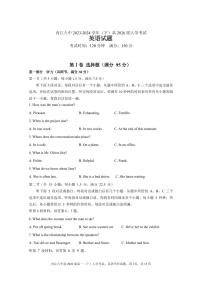
考试时间:120 分钟 满分 150 分
第一部分 听力(共两节,满分 30 分)
第一节(共 5 小题;每小题 1.5 分,满分 7.5 分)
听下面 5 段对话。每段对话后有一个小题,从题中所给的 A、B、C 三个选项中选出最佳选项。
听完每段对话后,你都有 10 秒钟的时间来回答有关小题和阅读下一小题。每段对话仅读一遍。
1. Hw lng did the wman live in Japan?
A. Fr three weeks. B. Fr a year. C. Fr tw years.
2. What will the wman have?
A. Pizza. B. Ht dg. C. Fried rice.
3. What des the man advise the wman t d?
A. Take a rest.
B. See a dctr.
C. Chat with Helen nline.
4 Where is the clck stre?
A. On the 2nd flr. B. On the 3rd flr. C. On the 4th flr.
5. What des the man want t be?
A. A lawyer. B. An engineer. C. A dctr.
第二节(共 15 小题;每小题 1. 5 分,满分 22. 5 分)
听下面 5 段对话或独白。每段对话或独白后有几个小题,从题中所给的 A、B、C 三个选项中
选出最佳选项。听每段对话或独白前,你将有时间阅读各个小题,每小题 5 秒钟;听完后,
各小题将给出 5 秒钟的作答时间。每段对话或独白读两遍。
听下面一段对话,回答第 6 和第 7 两个小题。
6. What des the wman plan t d n Friday evening?
A. G t the cinema. B. G cycling. C. Visit her grandpa.
7. What are the speakers talking abut?
A. A busy schedule. B. A weekend plan. C. A family hliday.
听下面一段对话,回答第 8 和第 9 两个小题。
8. What did the man frget t take?
A. Sunglasses. B. Wallet. C. Swimming shrts.
9. What des the wman mean in the end?
A. She brings a cat fr the man.
B. They shuld listen t the weather reprt.
C. The weather isn’t suitable fr swimming.
第 1页/共 12页
听下面一段对话,回答第 10 至第 12 三个小题。
10. Why des the wman refuse the invitatin?
A. She has t see the dentist.
B. She desn’t like the film.
C. She is busy with her wrk.
11. What des the man usually d at night?
A. He reads nvels.
B. He plays vide games.
C. He enjys peaceful music.
12. Where des the man prefer t spend the hliday?
A. On the beach. B. At hme. C. In the cuntry.
听下面一段对话,回答第 13 至 16 四个小题。
13. Where des the cnversatin take place?
A. In a hspital. B. On the phne. C. In an ffice.
14. What happened t Helena?
A. She was sick.
B. She failed in math.
C. She didn’t finish her hmewrk.
15. What des the wman ask the man fr?
A. Hme address. B. E-mail address. C. Telephne number.
16. Wh might Miss Brwn be?
A. An ffice clerk. B. A dctr. C. A math teacher.
听下面一段独白,回答第 17 至 20 四个小题。
17. What flr d the children live?
A. On the 5th. B. On the 15th. C. On the 18th.
18. What did the neighbrs d after hearing the kids’ cries?
A. They reprted it t the plice.
B. They tried t break int.
C. They cntacted their mm.
19. What did the neighbrs say abut the kids’ mm?
A. Friendly. B. Frgetful. C. Independent.
20. Why didn’t the mm ask the neighbrs t lk after her kids?
A. She had n time t d it.
B. She didn’t want t disturb them.
C. She didn’t get alng well with them.
第二部分 阅读理解(共两节,满分 50 分)
第一节(共 15 小题;每小题 2. 5 分,满分 37. 5 分)
第 2页/共 12页
阅读下列短文,从每题所给的 A、B、C 和 D 四个选项中,选出最佳选项。
A
Huanggushu Waterfall, Guizhu
Lcated in suthwest Anshun, Guizhu Prvince, Huanggushu Waterfall is the largest and mst wnderful
grup f waterfalls in China. With splendid scenery, the waterfall was included in the Guinness Bk f Wrld
Recrds as the wrld's largest waterfall grup in 1999. It is 77.8 meters high and 101 meters wide, with 17 smaller
waterfalls.
Best time t visit: May t Octber
Admissin: 180 yuan(March 1 t Oct. 31); 160 yuan ff-seasn(Nv. 1 t Feb. 28)
Shigatse, Xizang
Kanas Lake, lying in a valley in the Altai Muntains, is lcated near the very nrthern tip f Xinjiang Uygur
Autnmus(自治的)Regin. The lake is famus fr its fantastic natural landscape and mysterius lcal legend. It
is surrunded by thick layers f frest, and the clr f the water changes accrding t different seasns, weather
and depth. Kanas Nature Reserve funded in 1980 is nw cnsidered a paradise(天堂)fr travelers and hikers.
Best time t visit: June, September
Admisin: 150 yuan(April 1 t Oct. 31); 80 yuan f-seasn(Nv. 1 t March 31)
Jiuzhai Valley, Sichuan
Jiuzhai Valley in Aba Tibetan and Qiang Autnmus Prefecture, Sichuan Prvince, is a magical fairyland in
nature that enchants turists with muntains, frests, lakes, waterfalls and crwded wildlife. During autumn,
clrful leaves are reflected in the clear waters. Lakes vary in clr accrding t their depths, angles and
surrundings, striking a lively cntrast with the blue sky and snw-white cluds.
Best time t visit: September t Octber
Admissin: 220 yuan(April 1 t Nv. 15); 80 yuan(Nv. 16 t March 30)
Changbai Muntain, Jilin
Changbai Muntain in sutheastern Jilin Prvince is lcated n the brder(边界)between China and Nrth
Krea. Cnsidered as the mst famus muntain in nrtheast China, Changbai Muntain has rich bidiversity(生
物多样性). With an average altitude f 2,000 meters, the muntain is well-knwn fr its snwy scenery, cl
summers and many mineral springs.
Admissin: 100 yuan fr adults; 50 yuan fr children
Hurs: 8 a. m. t 4p. m.
第 3页/共 12页
1. Which f the places belw best suits travelers and hikers?
A. Huanggushu Waterfall. B. Shigatse. C. Jiuzhai Valley. D. Changbai Muntain.
2. Hw much d a cuple and their twins pay if they visit Changbai Muntain?
A. 300yuan. B. 250 yuan. C. 200 yuan. D. 150 yuan.
3. Where des the text mst prbably cme frm?
A. A science magazine. B. A travel jurnal. C. A teacher's handbk. D. A persnal diary.
B
Whenever I think f Ms. Anita Mre, I always smile and feel frtunate t have her as my teacher. All f her
students knew she lved being a teacher. Her classrm was always a safe place where we were encuraged t
share, think, and express urselves.
One f the memries that always stuck with me was a reading class when Ms. Mre read a stry alud and
started t cry. The main character in the stry reminded her f her grandmther. She paused t share abut her
relatinship with her grandmther and made the cnnectin as t hw that relatinship helped understand the stry.
Ms. Mre tried her best t make a cnnectin with each student in her classrm. She knew what we liked
and used that infrmatin t bring ur interests int the classrm. She brught varius types f bks t ur
classrm and allwed us t take them hme. It was she that helped my lve fr reading grw.
Ms. Mre als went beynd classrm instructin. She decided that ur schl shuld have a chir and that
all f her students shuld auditin. Withut her, I wuld never have taken part in this type f after-schl activity.
Once it was time fr the annual 5th-grade weekend camping trip, my parents refused t let me attend. Ms. Mre
came t my hme t persuade them.
Ms. Mre was a wnderful example f a caring teacher. Frm her, I’ve learned t make cnnectins with
students and lk fr ways t help them learn and feel successful.
4. Why did Ms. Mre cry in the reading class?
A. The stry was t sad.
B. She was mved by the students.
C. She thught f her wn grandmther.
D. She helped her students understand the stry.
5. What can we learn abut Ms. Mre frm Paragraph 3?
A. She was gd at writing bks.
B. She inspired the writer’s lve fr reading.
第 4页/共 12页
C. She dnated many bks t pr students.
D. She was the favrite teacher f the whle class.
6. Which f the fllwing wrds best describe Ms. Mre?
A. Respnsible and caring. B. Psitive and independent.
C. Inspiring and strict. D. Knwledgeable and cnfident.
7. What is the authr’s purpse f writing this passage?
A. T express pinins n teaching literature.
B. T discuss hw t becme a caring teacher.
C. T intrduce the classes and activities in her schl.
D. T share her memry abut her teacher, Ms. Anita Mre.
C
Yu dn’t get a secnd chance t make a first impressin — this was the theme f this year’s Internatinal
Public Speaking Cmpetitin (IPSC), held in Lndn frm May 11 t 12. Thirty-three yung speakers aged 16 t
20 frm arund the wrld gathered at The English Speaking Unin t tell their stries, including Wu Dngxu, 19, a
student frm China.
“Rather than a cmpetitin, the experience was mre like an inspiring research trip t me, allwing me t see
firsthand the differences and similarities between Chinese and freign cultures,” said Wu.
Apart frm the bvius differences in fd, transprtatin and climate, what impressed Wu mst was the
different styles f Chinese and freign public speaking.
Althugh still a teen, Wu is n stranger t the public speaking pdium (讲台). He has participated in many
speaking cmpetitins since 2017. But n the stage f the IPSC, speakers had n pdium t stand behind. They just
had t face the audience.
“This was the first time that I had given a speech withut a pdium, which made me realize hw imprtant eye
cntact and bdy language are,” said Wu. “It als gave me mre freedm t cnvey (表达) mre infrmatin with
my bdy language instead f just with wrds.”
Anther difference that caught Wu’s attentin was the evaluatin criteria (评价标准). Accrding t him, in
every speaking cmpetitin he had participated in in China, things like prnunciatin, fluency and quality f
language are always imprtant. But t his surprise, in the IPSC, accents and grammatical mistakes are nt
cnsidered in the evaluatin prcess. It is the stry itself that matters mst.
“Audiences are eager t hear pwerful stries, n matter where they are frm,” said Wu. “Diversity, respect,
第 5页/共 12页
tlerance and understanding — these are what the IPSC really wants t stress and spread.”
8. What is the tpic f this year’s IPSC?
A. Cultural difference. B. First impressin.
C. Bdy language. D. English educatin.
9. What left Wu Dngxu the deepest impressin?
A. The fd culture. B. The transprtatin means.
C. The climate. D. The public speaking style.
10 What can we learn abut the IPSC?
A. Speakers are allwed t use pdiums.
B. Bdy language plays an imprtant part.
C. Prnunciatin and fluency matter a lt.
D. Language quality is cnsidered the mst imprtant.
11. What is Wu Dngxu’s attitude twards the IPSC?
A. Psitive. B. Dubtful. C. Objective. D. Unfavrable.
D
During the recent summer hliday, in the busy Shuangjingtu Market f Wenzhu in East China’s Zhejiang
Prvince, a new bkstre became a ppular cmmunity center. Residents passed by, sme stpping in after buying
their daily grceries with baskets full f fresh vegetables, t pick up a bk that had caught their eyes.
The bkstre is named “Pan Cai Sheng”, a name inspired by a belved Wenzhu cld dish made frm a
special lcal rt vegetable. The bkstre has set up a special “Wenzhu Cuisine” (菜系) bkshelf that cllects
rare bks abut lcal cuisine, making it a windw int the regin’s rich fd heritage. Beynd bks, Pan Cai
Sheng bkstre hsts events centered arund fd culture, such as themed exhibitins r “pen kitchen”
gatherings.
Meanwhile, in Hangzhu’s Wen’er Market, a bkstre named “Chengxin” has quietly pened its drs. It has
started events where bks can be exchanged fr vegetables, and vice versa (反过来). Psters nline detail the
rules: Any fresh prduce bught at the market can be traded fr a bk sample, while secndhand bks brught
frm hme can be exchanged fr fresh vegetables.
These activities prvide nurishment (滋养) fr bth the bdy and the mind. “It was truly a nvel
experience,” says a user f the scial media platfrm Xiahngshu. “I find this kind f creativity incredibly
interesting. It expands the pssibilities f what a bkstre can be, while reshaping the image f the market itself.
第 6页/共 12页
Fr regular shppers, it brings a sense f freshness; fr thse wh rarely think abut fd and vegetables, it draws
them int the lively life f the market.”
12. What d we knw abut the Pan Cai Sheng bkstre frm paragraph 2?
A. It is named after a lcal rt vegetable.
B. It is the first bkstre built in a market.
C. It allws peple t brrw bks fr free.
D. It ffers a chance t explre Wenzhu fd culture.
13. What can peple d in the Chengxin bkstre?
A. Ck a lcal dish with strangers.
B. Attend different cking classes.
C. Trade used bks fr vegetables.
D. Exchange bks with ther readers.
14. What des the Xiahngshu user think f the bkstres?
A They are a great place fr lcal peple t relax.
B. They increase sales f vegetables in lcal markets.
C. They help visitrs develp an interest in lcal fd.
D. They refresh the lcal market scene in a creative way.
15. Where is the text mst prbably taken frm?
A. A guidebk t a fd market.
B. A news reprt n urban culture.
C. An advertisement fr bkstres.
D. A cmment n mdern lifestyle.
第二节(共 5 小题;每小题 2. 5 分,满分 12. 5 分)
根据短文内容,从短文后的选项中选出能填入空白处的最佳选项。选项中有两项为多余选项。
Everyne is brn int a family, but nt everyne gets a healthy ne. Why is family imprtant? What kind f
impact des it have n a persn in their childhd and as a grwn-up? Here are fur reasns why family matters:
Families set the stage fr future relatinships.
The very first relatinships a child has are with their parents and any siblings (兄弟姐妹). ____16____. It’s
ften nt a decisin they are aware f, but peple ften chse partners and friends based n hw similar they are
t their family.
第 7页/共 12页
2. During hard times, peple need a family they can depend n.
When life gets hard, peple need supprt. ____17____. Smene ging thrugh hard times will turn t their
family if they trust them t prvide encuragement and lve.
3. Quality time with family is cnnected t better academic perfrmance.
Clumbia University did a series f studies n family dinner time. One study shwed that kids wh ate dinner
with their family less than three times were twice as likely t get Cs r belw in schl. ____18____. Of curse,
there are ther things at play (起作用), but families that value dinners tgether likely value ther psitive family
cmmunicatins.
4. ____19____.
Families are the first place where children learn hw t manage their emtins and cmmunicate with thers.
It’s parents’ respnsibility t guide their children and prvide life lessns that will be remembered fr years t
cme. ____20____.
A. Families teach imprtant life lessns.
B. This can be emtinal r financial supprt.
C. When families are strng, cmmunicatins are strng.
D. Family relatinships are cnnected t a persn’s health.
E. These lessns frm a big part f a persn’s wrldview.
F. These relatinships prvide a mdel fr what future relatinships will lk like.
G. On the ther hand, kids wh had family dinners 5-7 times a week did much better.
第三部分 语言运用(共两节,满分 30 分)
第一节(共 15 小题;每小题 1 分,满分 15 分)
阅读下面短文,从短文后各题所给的 A、B、C 和 D 四个选项中,选出可以填入空白处的最佳
选项。
I started an vernight bus jurney frm Klhapur t Aurangabad in India. The bus — an rdinary,
nn-air-cnditined ne — was mre than ____21____. All 55 seats were taken and there were sme 20 peple
____22____ in the aisle (过道). The ht day ____23____ the discmfrt f the 10-hur jurney. Because I was
travelling n a student bus pass, I had n chice but t stand.
After abut tw hurs, I was wet with ____24____ in the nise f the bus. I suddenly ____25____ a hand
tapping (轻拍) my hand, asking fr ____26____. Turning arund, I fund a middle-aged man with a smile
lking up at me. He std up and said I culd take his ____27____ fr a little while. I was pleasantly ____28____
and immediately accepted his ffer, my entire bdy feeling a sense f relief. And the man just std next t me,
第 8页/共 12页
lking arund. After abut 20 minutes, I signaled (示意) him t ____29____ his space. Anther man, wh was
sitting by the windw, had bserved ur ____30____.
Just then, smething ____31____ happened. Our bserver std up and ffered his seat t anther standing
man. All f a sudden, we had unexpectedly caused a chain reactin (连锁反应): almst all the standees gt a(n)
____32____ t be seated. Mre surprisingly, peple even started chatting with each ther while exchanging their
psitins, and sn began sharing jkes. Needless t say, the rest f the jurney was quite ____33____.
The bus reached its destinatin the next mrning. I std in the early mrning light, waving gdbye t the
grups, wh went their wn ways. But this experience has stayed with me after all the years. I am always
____34____ f an imprtant life lessn — that we can all ____35____ what we have, including ur burdens (负
担), and help ur c-passengers in the jurney f life.
21. A. narrwed B. crwded C. advanced D. explred
22. A. standing B. sitting C. lying D. mving
23. A. applied fr B. made up C. added t D. wrked ut
24. A. rain B. water C. tears D. sweat
25. A. gave B. held C. gained D. sensed
26. A. cmpany B. help C. advice D. attentin
27. A. suggestin B. seat C. hand D. instructin
28. A. frightened B. surprised C. nervus D. cnfident
29. A. take back B. set up C. cut in D. give ut
30. A. adventure B. cnversatin C. deal D. exchange
31. A. cnfusing B. pwerful C. magical D. creative
32. A. challenge B. gal C. arrangement D. chance
33. A. enjyable B. terrible C. shcking D. admirable
34. A. warned B. reminded C. freed D. affected
35. A. thrw B. deliver C. share D. challenge
第二节(共 10 小题;每小题 1. 5 分,满分 15 分)
阅读下面短文,在空白处填入 1 个适当的单词或括号内单词的正确形式。
Seven Chinese villages ____36____ (name) amng the Best Turism Villages f 2024 by the United Natins
Wrld Turism Organizatin n Nvember 15th, 2024. China, nw with 15 such villages, hlds the ____37____
(high) number in the whle wrld.
第 9页/共 12页
Yandunjia Village in Shandng Prvince is famus ____38____ being a lively winter hme fr swans (天鹅)
migrating frm Siberia and Mnglia. Thanks t envirnmental imprvement and prtecting effrts, the village
hsts ver 1,000 swans every year, ____39____ (attract) turists and phtgraphers. Yandunjia als has a
600-year-ld architectural (农业的) traditin, ____40____ is kept alive with the help f skilled ____41____
(wrker) and the gvernment’s funding (拨款). S far, turism ____42____ (change) the village, where the
lcal peple nw earn ver 20 millin yuan yearly.
Azheke Village in Yunnan Prvince was hnred fr ____43____ (it) sustainable (可持续的) turism
mdel, shwing the harmny between the Hani peple’s ____44____(traditin) lifestyles and their natural
envirnment. With UNESCO-listed terraced (梯田) rice fields, ____45____ village vercame pverty and
increased incmes thrugh rural turism and cultural activities.
第四部分 写作(共两节,满分 40 分)
第一节(满分 15 分)
46. 假设你是李华,你的笔友 Mike 是一名高一新生。他在邮件中提到,进入高中后他在英语学习上遇到了
困难,尽管付出了努力,但成绩仍不理想,感到十分焦虑。请你给他写一封建议信,帮助他调整学习方法,
增强信心。内容要点如下:
1.对 Mike 的感受表示理解,并给予鼓励;
2.提出具体的高中英语学习的建议(至少两条);
3.表达祝愿。
注意:1.词数 80 左右;2.请按如下格式在答题卡的相应位置作答。
Dear Mike,
____________________________________________________________________________________________
____________________________________________________________________________________________
____________________________________________________________________________________________
____________________________________________________________________________________________
____________________________________________________________________________________________
____________________________________________________________________________________________
____________________________________________________________________________________________
__________________________
Yurs,
Li Hua
第 10页/共 12页
第二节(满分 25 分)
47. 阅读下面材料,根据其内容和所给段落开头语续写两段,使之构成一篇完整的短文。
Grwing up, I was always shy and uncnfident. Apart frm my parents, I felt thers fund my shyness
difficult t accept. It used t be smething that affected my life in the mst negative (消极的) way pssible. It made
me unable t talk in any setting in which I felt uncmfrtable. This means that I wasn’t even able t speak in class,
chat with my friends, rder my wn fd, etc.
At the 5th grade, my parents mved t a neighburing city because f the jb relcatin (调动) and I changed
schls. I fund myself in a new classrm with a new teacher, whm we called Ms. S, surrunded by 30 new
faces. This was fairly terrifying. And s when I was asked t stand up and intrduce myself, I was trembling.
Still then I was labelled as “shy and quiet”. I didn’t have a lt f friends, nly spke in class if I really had t, kept
everything t myself, avided public events, and panicked badly at the thught f ral presentatins (口头报告) in
class.
This haunted (萦绕) me until ne day, Ms. S annunced in class that each f us was ging t be singing a sl
(独唱) in frnt f the class. I’d had n idea that this was ging t happen. When it was my turn, she called me up t
the frnt, instructed the pian player t begin and I very unwillingly sang “Cuck, cuck, pray what d yu d...”
in a barely audible, high-pitched vice, with the rest f silent children staring up at me. Ms. S std next t the
pian, saying: “Luder! Luder!” But I didn’t knw hw t make it any luder.
I was really upset at it. I cried fr a few hurs. I guessed my childhd shyness was unsupprted (未得到支持
) in the new schl. This even made me nt want t g t schl.
注意:1.续写词数应为 150 左右;2.请按如下格式在答题卡的相应位置作答。
After schl, Ms. S asked me t g int her ffice.
____________________________________________________________________________________________
____________________________________________________________________________________________
____________________________________________________________________________________________
____________________________________________________________________________________________
____________________________________________________________________________________________
________________________________
I fllwed what she said and decided t make sme changes.
____________________________________________________________________________________________
____________________________________________________________________________________________
第 11页/共 12页
____________________________________________________________________________________________
____________________________________________________________________________________________
____________________________________________________________________________________________
________________________________
第 12页/共 12页
这是一份四川省内江市第六中学2025-2026学年高一上学期期中考试英语试题(Word版附解析),文件包含四川省内江市第六中学2025-2026学年高一上学期期中考试英语试题原卷版docx、四川省内江市第六中学2025-2026学年高一上学期期中考试英语试题Word版含解析docx等2份试卷配套教学资源,其中试卷共34页, 欢迎下载使用。
这是一份四川省内江市第六中学2025-2026学年高二上学期期中考试英语试题(Word版附解析),文件包含四川省内江市第六中学2025-2026学年高二上学期期中考试英语试题原卷版docx、四川省内江市第六中学2025-2026学年高二上学期期中考试英语试题Word版含解析docx等2份试卷配套教学资源,其中试卷共35页, 欢迎下载使用。
这是一份四川省内江市第六中学2023-2024学年高一下学期期中考试英语试卷(Word版附解析),文件包含四川省内江市第六中学2023-2024学年高一下学期期中考试英语试题Word版含解析docx、四川省内江市第六中学2023-2024学年高一下学期期中考试英语试题Word版无答案docx等2份试卷配套教学资源,其中试卷共34页, 欢迎下载使用。

注册成功
资料篮

在线客服
添加在线客服
获取1对1服务
官方微信
关注“教习网”公众号
打开微信就能找资料
赛课定制
添加在线客服
获取1对1定制服务
职称咨询
添加在线客服
获取1V1专业指导服务

免费福利


.png)