免费领取教师福利


若您为此资料的原创作者,认为该资料内容侵犯了您的知识产权,请扫码添加我们的相关工作人员,我们尽可能的保护您的合法权益。

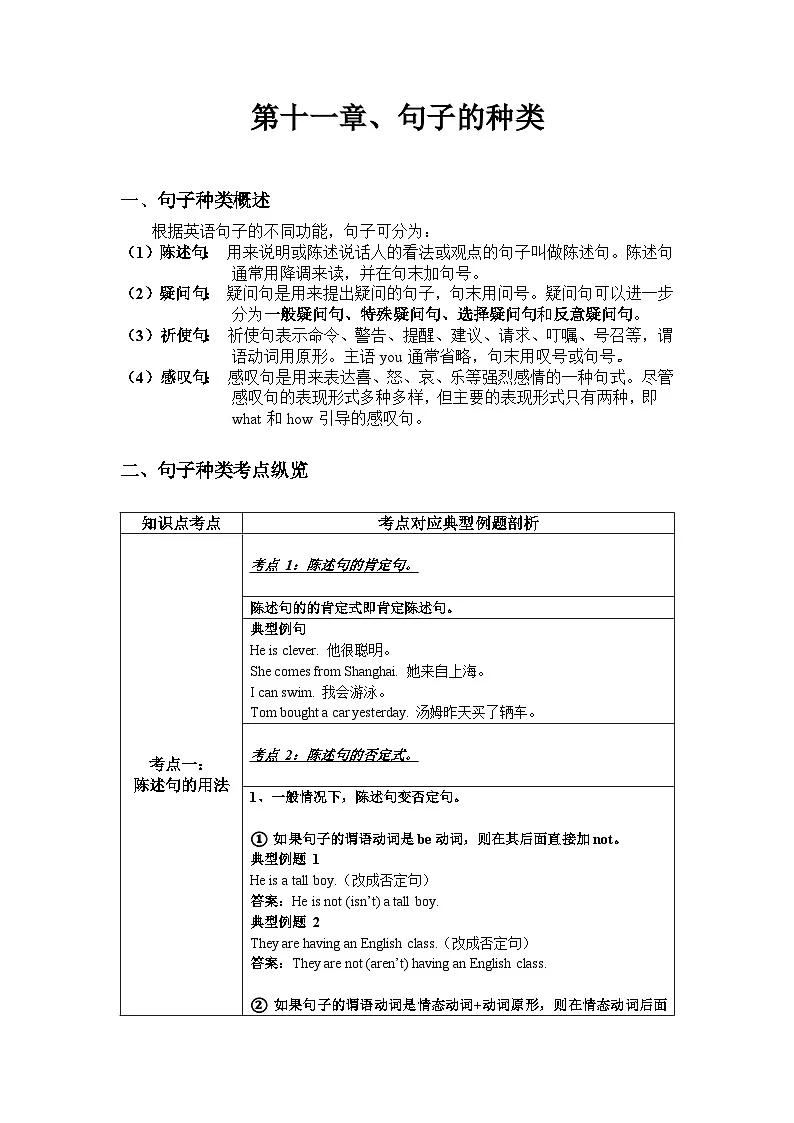
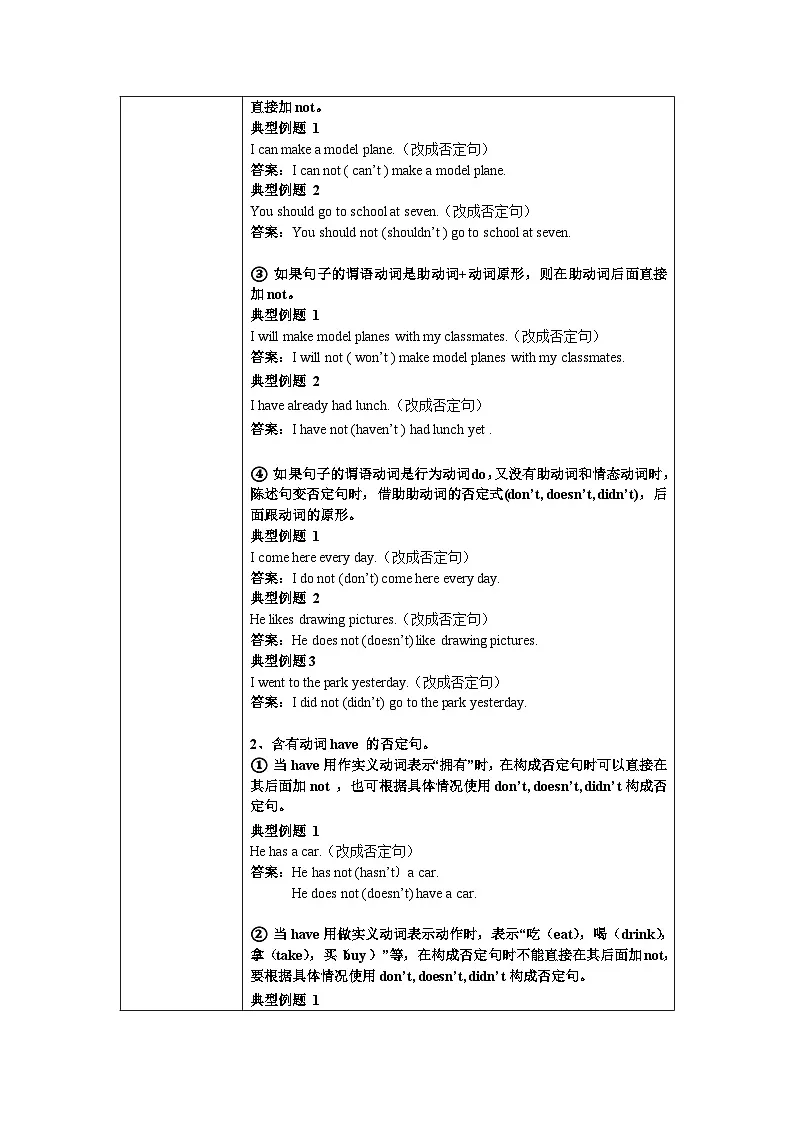
这是一份新人教版7年级英语期末复习语法知识总结(讲解+考点+综合练习):句子的种类,共16页。试卷主要包含了句子种类考点纵览,把下面句子改为否定句等内容,欢迎下载使用。
句子种类概述
根据英语句子的不同功能,句子可分为:
(1)陈述句:用来说明或陈述说话人的看法或观点的句子叫做陈述句。陈述句通常用降调来读,并在句末加句号。
(2)疑问句:疑问句是用来提出疑问的句子,句末用问号。疑问句可以进一步分为一般疑问句、特殊疑问句、选择疑问句和反意疑问句。
(3)祈使句:祈使句表示命令、警告、提醒、建议、请求、叮嘱、号召等,谓语动词用原形。主语yu通常省略,句末用叹号或句号。
(4)感叹句:感叹句是用来表达喜、怒、哀、乐等强烈感情的一种句式。尽管感叹句的表现形式多种多样,但主要的表现形式只有两种,即what和hw引导的感叹句。
二、句子种类考点纵览
综合练习
陈述句部分
一、把下面句子改为否定句。
1. He des well in Maths. (改为否定句)
2. Nancy drew sme pictures yesterday. (改为否定句)
3. The pliceman caught the thief. (改为否定句)
4. I like autumn. (改为否定句)
5. The children have classes tday. (改为否定句)
6. I like cllecting stamps and singing. (改为否定句)
7. He did his hmewrk in the classrm. (改为否定句)
8. Tm jumps as far as Mike. (改为否定句)
9. The by can jump higher than the girl. (改为否定句)
10. Liu Ta needs sme pencils. (改为否定句)
疑问句部分
一、单项选择题
( ) 1. —Excuse me______ is the nearest bkshp ?
—G dwn the street and turn left at the secnd crner?
A. hw B. what C. where D. wh
( ) 2. — ______ is a ticker fr the film Hacker He? —Abut frty yuan .
A. Hw ld B. Hw many C. Hw much D. Hw ften
( ) 3. —______ are yu ging? — I’m ging t the library.
A. Wh B. Which C. What D. Where
( ) 4. is it frm Beijing t Shanghai?
A. Hw much B. Hw sn C. Hw lng D. Hw far
( ) 5. ______? It’s eight.
A. What day is it tday B. What’s five and three
C. Hw ld are yu D. What’s yur telephne number
( ) 6. —______? —I’ve gt a headache and a cugh.
A. What’s the matter with yu B. What’s wrng with it
C. Can I help yu D. Hw are yu
( ) 7. —______ tea did yu have?
A. Hw many B. Hw much C. Hw sn D. Which
( ) 8. —______ shall we meet in the park?
— What abut half past eight?
A. What B. When C. Where D. Which
( ) 9. — ______ des yur schl have sprts meetings? — Twice a year.
A. Hw ften B. Hw sn C. Hw lng D. Hw many times
( ) 10. — ______? —The ne behind the tree.
A. Whse girl is she B. Wh’s that girl
C. Which girl is yur sister D. Where’s the girl
二、就划线部分提问
1.He ften has lunch in the factry.
he ften lunch?
2.They will cme back in a mnth.
will they cme back?
3.He hurt his leg last Sunday.
he his leg?
4.I gt up at six this mrning.
yu up this mrning?
5.They were drawing a hrse when I came in.
they when I came in?
6.I didn’t g t schl because I had a bad cld.
yu g t schl?
He’d better take the N. 3 bus.
bus he better take?
8.He’s feeling well.
he feeling?
9.The girl in a red cat is my sister.
is yur sister?
10.He cmes t China nce a year.
he t China?
祈使句部分
一、单项选择
( )1. _________ the man and yu’ll find his huse.
A. Fllw B. FllwingC. T fllwD. Fllwed
( )2.________ when yu crss the rad.
3 s! Z0 a( S9 g0 2 y# s+ |3 Y6 P. P: ]& }# d: m6 e) i( ]A. Taking care 9 e1 W2 O0 I9 Y' \: m5 K2 yB. Take care ( K" _9 Y, h7 p+ T. @+ E; sC. T take care 0 |" X1 U7 m3 q7 x2 X" mD. Takes care
( )3.________ in bed. It’s bad fr yur eyes.
. V5 ; p% B9 v. q, s7 _! DA. Nt t read * I( G" s- v' b9 M7 q" E( JB. Dn’t read C. Dn’t t read & r: ^& p: c. T) z; {D. Nt read
( )4.________ yur child. We’ll lk after him. B0 I; d- I l
; W9 Y- d y3 \% lA. Nt t wrry abut3 i5 v% {$ z1 z! \ B. Dn’t wrry abut( E3 J! M; @" j
C. Nt wrry fr * K V7 ~4 t/ nD. Dn’t wrry with6 d: ?8
( )5. Dn’t waste yur mney n silly things — _________ it.
A. Save B. T save C. Saving D. Having saved
( )6. T keep fresh, _________ the eggs in the fridge.
A. put B. putting C. t put D. t be putting
( )7. Dn’t sit there watching. _________ and help me!
A. Cme B. Cming C. T cme D. T be cming
( )8. The TV is t lud. Please________.
A. turn it dwn B. t turn it dwn C. turn dwn it D. t turn dwn it
( )9. in the street because it is dangerus.
A. Nt play B. Dn’t play C. Nt t play D. Play nt
( )10. when yu d yur hmewrk.
A. Be careful B. Dn’t be careful C. Are careful D. Carefully
二、用括号内所给动词的适当形式填空。
1. It’s an imprtant meeting. __________(nt, be )late.
2. ____________ (nt, make) nise! Yur mther is sleeping.
3. ____________(nt, speak) with yur muth full f fd and _________ (be) plite.
4. ____________( nt, talk) and ____________ (read) alud.
5. ____________(nt, leave) yur hmewrk fr tmrrw, Larry.
6. ____________(lk) ut! A car is cming.
7. ____________(give) us tw hurs and we will finish the wrk.
8. ____________(nt, let) the baby cry.
9. (wear ) mre clthes r yu will catch a cld.
10. Let’s ___________(nt, say) anything abut it.
感叹句部分
一、单项选择
( ) 1. _________clever girl she is!
A. What a B. What C. Hw a D. Hw
( ) 2. __________interesting stry it is!
A. What an B. What a C. Hw an D. Hw
( ) 3. _______ lvely children they are!
A. What B. What a C. Hw a D. Hw
( ) 4. ____________flwers they are!
A. What beautiful B. What a beautiful
C. Hw beautiful D. Hw a beautiful
( ) 5. ___________ it is tday!
A. Hw cld B. What cld C. Hw a cld D. What a cld
( ) 6. _______bad the weather is!
A. Hw B. What C. What a D. Hw a
( ) 7. _____ gd news it is !
A. Hw B. What a C. Hw a D. What
( ) 8. ______the sunshine is!
A. What a bright B. Hw a bright C. Hw bright D. what bright
( ) 9. _____ he writes.
A. Hw gd B. Hw well C. What gd D. What well
( ) 10. _____ Li Lei runs!
A. What fast by B. What fast C. Hw fast D. Hw a fast
( ) 11._____ hard he wrks!
A. Hw B. WhatC. Hw a D. What a
( ) 12. Which is true?
A. Hw tall the buildings are!
B. What tall the buildings are!
C. Hw tall buildings they are!
D. what a tall buildings they are!
( ) 13. _______ it is raining!
A. Hw heavilyB. What heavy C. Hw heavyD. What a heavy
( ) 14. ____ delicius the dish is!
A. What B. Hw C. What aD. What an
( ) 15. ____ strange clthes he is wearing!
A. What a B. What C. Hw aD. Hw
( ) 16. ____ interesting subject it is!
A. What an B. Hw C. What D. What a
( ) 17. ____ fggy it was yesterday!
A. What B. What a C. HwD. Hw a
( ) 18.____ careless a by yu are!
A. Hw B. What a C. WhatD. Hw a
( ) 19. _________ wnderful time we have had.
A. Hw B. Hw a C. What D. What a
( ) 20. Listen !____wnderful music it is! I really enjy it very much.
A. What B. What a C. Hw D. Hw a
( ) 21.______wnderful music it is! I like Beethven’s better than anybdy else’s.
A. What B. Hw a C. What D. Hw
( ) 22._______weather! I really enjy it very much.
A. Hw fine B. Hw fine a C. What a fine D. What fine
( ) 23._____fun it is t play cmputer games when we’re free.
A. What a B. What C. Hw a D. Hw
( ) 24._____warm weather it is tday! Let’s g climbing.
A. What a B. Hw C. Hw a D. What
( ) 25.---I hear that an ld cuple are traveling arund China by bike.
---Oh, ____lng way n their bicycles! They are s great.
A. what a B. hw C. hw a D. What
参考答案
陈述句部分
一、把下面句子改为否定句。
1. He desn't d well in Maths.
2. Nancy didn't draw any pictures yesterday.
3. The pliceman didn't catch the thief.
4. I dn't like autumn.
5. The children dn't have classes tday.
6. I dn't like cllecting stamps and singing.
7. He didn't d his hmewrk in the classrm.
8. Tm desn't jump as far as Mike.
9. The by can't jump higher than the girl.
10. Liu Ta desn't need any pencils.
疑问句部分
一、单项选择题
1. C 2. C 3. D 4. D 5. B 6. A 7. B 8. B 9. A 10. C
二、就划线部分提问
1. Where des;have
2.Hw sn
3.When did;hurt
4.What time did;get
5.What were;ding
6.Why didn’t
7.Which;had
8.Hw is
9.Which girl
10.Hw ften des cme
祈使句部分
一、单项选择
1.A 2.B 3.B 4.B 5.A 6.A 7.A 8.A 9.B 10.A
二、用括号内所给动词的适当形式填空
1. Dn’t be
2. Dn’t make
3. Dn’t speak; Be
4. Dn’t talk; read
5. Dn’t leave
6. Lk
7. Give
8. Dn’t let
9. Wear
10. nt say
感叹句部分
1.A 2.A 3.A 4.A 5.A 6.A 7.D 8.C 9.B 10.C 11.A 12.A 13.A 14.B 15.B 16.A 17.C 18.A 19.D 20.A 21.A 22.D 23.B 24.D 25.A
知识点考点
考点对应典型例题剖析
考点一:
陈述句的用法
考点 1:陈述句的肯定句。
陈述句的的肯定式即肯定陈述句。
典型例句
He is clever. 他很聪明。
She cmes frm Shanghai. 她来自上海。
I can swim. 我会游泳。
Tm bught a car yesterday. 汤姆昨天买了辆车。
考点 2:陈述句的否定式。
一般情况下,陈述句变否定句。
= 1 \* GB3 \* MERGEFORMAT ① 如果句子的谓语动词是be动词,则在其后面直接加nt。
典型例题 1
He is a tall by.(改成否定句)
答案:He is nt (isn’t) a tall by.
典型例题 2
They are having an English class.(改成否定句)
答案:They are nt (aren’t) having an English class.
= 2 \* GB3 \* MERGEFORMAT ② 如果句子的谓语动词是情态动词+动词原形,则在情态动词后面直接加nt。
典型例题 1
I can make a mdel plane.(改成否定句)
答案:I can nt ( can’t ) make a mdel plane.
典型例题 2
Yu shuld g t schl at seven.(改成否定句)
答案:Yu shuld nt (shuldn’t ) g t schl at seven.
= 3 \* GB3 \* MERGEFORMAT ③ 如果句子的谓语动词是助动词+动词原形,则在助动词后面直接加nt。
典型例题 1
I will make mdel planes with my classmates.(改成否定句)
答案:I will nt ( wn’t ) make mdel planes with my classmates.
典型例题 2
I have already had lunch.(改成否定句)
答案:I have nt (haven’t ) had lunch yet .
= 4 \* GB3 \* MERGEFORMAT ④ 如果句子的谓语动词是行为动词d,又没有助动词和情态动词时,陈述句变否定句时,借助助动词的否定式(dn’t, desn’t, didn’t),后面跟动词的原形。
典型例题 1
I cme here every day.(改成否定句)
答案:I d nt (dn’t) cme here every day.
典型例题 2
He likes drawing pictures.(改成否定句)
答案:He des nt (desn’t) like drawing pictures.
典型例题3
I went t the park yesterday.(改成否定句)
答案:I did nt (didn’t) g t the park yesterday.
含有动词have 的否定句。
= 1 \* GB3 \* MERGEFORMAT ① 当have用作实义动词表示“拥有”时,在构成否定句时可以直接在其后面加nt ,也可根据具体情况使用dn’t, desn’t, didn’t构成否定句。
典型例题 1
He has a car.(改成否定句)
答案:He has nt (hasn’t)a car.
He des nt (desn’t) have a car.
= 2 \* GB3 \* MERGEFORMAT ② 当have用做实义动词表示动作时,表示“吃(eat),喝(drink),拿(take),买(buy)”等,在构成否定句时不能直接在其后面加nt,要根据具体情况使用dn’t, desn’t, didn’t构成否定句。
典型例题 1
My father usually has lunch at hme.(改成否定句)
答案:My father desn’t (des nt) usually have lunch at hme.
典型例题 2
Yu have t g swimming with her.(改成否定句)
答案:Yu dn’t (d nt) have t g swimming with her.
= 3 \* GB3 \* MERGEFORMAT ③ 当have用作助动词构成完成时时,其否定形式只能在其后面加nt。
典型例题 1
I have read the bk.(改成否定句)
答案:I have nt(haven’t)read the bk.
典型例题2
I have gt a brther.(改成否定句)
答案:I have nt (haven’t ) gt a brther.
考点二:
疑问句的用法
考点 1:一般疑问句的用法。
= 1 \* GB3 \* MERGEFORMAT ① 一般疑问句通常需要用yes 或n 来回答,朗读时要用升调。一般疑问句主要有以下几种结构类型:
1、“be + 主语 + 表语”结构
—Are yu sleepy ? 你困了吗?
—Yes, I am. 是的,我困了。
2、“情态动词 + 主语+ 行为动词(或be)”结构
—May/Can I use the telephne? 我能用这部电话吗?
—Yes, yu can. 是的,可以。
3、“助动词(d, des, did)+ 主语 + 行为动词”结构
—D yu like swimming in summer? 你喜欢夏天游泳吗
—N, I dn’t . 不,我不喜欢。
= 2 \* GB3 \* MERGEFORMAT ② 一般疑问句还有否定一般疑问句,表示“难道……?”。
—Aren’t yu sleepy ? 你难道不困吗?
—Yes, I am. 不是的,我困了。 — N, I am nt. 是的,我不困。
— Can’t yu swim befre? 你难道之前不会游泳吗?
— Yes, I can. 不,我会的。——N, I can’t. 是的,我不会。
— Dn’t yu like swimming in summer? 你难道不喜欢夏天游泳吗?
— N, I dn’t. 是的,我不喜欢。——Yes, I d. 不是,我喜欢的。
= 3 \* GB3 \* MERGEFORMAT ③ 将陈述句改成一般疑问句时,将be动词,情态动词,助动词移至句首,将第一人称改为第二人称,句中有sme 时改为any句末改为问号。
典型例题 1
There are sme apples in the blanket.(改成一般疑问句)
答案:Are there any apples in the blanket?
典型例题 2
I can make a mdel plane.(改成一般疑问句)
答案:Can yu make a mdel plane ?
典型例题 3
She lives in Beijing.(改成一般疑问句)
答案:Des she live in Beijing?
The by ate sme apples.(改成一般疑问句)
答案:Did the by eat any apples?
考点 2:特殊疑问句的用法。
以疑问代词 what,wh,whm,whse,which或者疑问副词when,where,hw,why开头进行提问的句子叫特殊疑问句。它的回答要针对问句中的疑问词来回答,不用yes和n来回答,特殊疑问句用降调读。
1、特殊疑问句的结构:特殊疑问词+一般疑问句。
What is this? 这是什么?
Wh are yu waiting fr?你在等谁?
Where did yu lse yur key?你在哪里丢了钥匙?
Which class are yu in?你在几班?
Hw d yu g t schl?你怎么去上学?
When des yur mther get up? 你妈妈什么时候起来?
2、常见的特殊疑问词用法举例。
= 1 \* GB3 \* MERGEFORMAT ① 询问具体的时间用what time,询问星期用 what day,询问日期用what date。
What time is it nw? = What is the time nw? 现在几点了?
What day is it tday? = What is the day tday? 今天星期几?
What date is it tday? = What is the date tday? 今天是几号?
= 2 \* GB3 \* MERGEFORMAT ② 询问天气用what或者hw提问“Hw +be +the weather...?”或“What +be +the weather like...?”
Hw is the weather tday?
= What’s the weather like tday? 今天天气如何?
= 3 \* GB3 \* MERGEFORMAT ③ 对数量提问,疑问词用hw many(可数名词)或hw much (不可数名词)。
Hw many sheep are there n the hill? 山上有多少只绵羊?
Hw much water is there in the bttle? 瓶子里有多少水?
= 4 \* GB3 \* MERGEFORMAT ④ 对价格提问,疑问词用hw much。
Hw much is the cmputer?
= Hw much des the cmputer cst?
= What’s the price f the cmputer? 这台电脑的价格是多少?
= 5 \* GB3 \* MERGEFORMAT ⑤ 对时间长度(一段时间)提问,疑问词用hw lng。
I’ve wrked in that factry fr tw years.(对划线部分提问)
Hw lng have yu wrked in that factry?
= 6 \* GB3 \* MERGEFORMAT ⑥ 对频率nce a year, twice a week等进行提问,疑问词用hw ften。
I visit my grandma nce a mnth.(对划线部分提问)
Hw ften d yu visit yur grandma?
= 7 \* GB3 \* MERGEFORMAT ⑦ 对“in+ 一段时间”进行提问,疑问词用hw sn。
Jane and her brther will finish the wrk in tw hurs.(对划线部分提问)
Hw sn will Jane and her brther finish the wrk?
= 8 \* GB3 \* MERGEFORMAT ⑧ 对距离进行提问,疑问词用hw far。
It's abut tw kilmetres frm my hme t the factry.(对划线部分提问)
Hw far is it frm here t the cuntry?
考点 3:选择疑问句的用法。
提出两种或两种以上的情况,要求对方选择一种情况回答,这种问句叫做选择疑问句,选择疑问句的两种或两种以上的情况用r连接,回答时不能用yes或n,语调一般是第一种选择用升调,最后一种选择用降调。
一般选择疑问句结构:一般疑问句+r供选择的另一部分。
--- Are yu a teacher r a student? 你是个老师还是个学生?
--- I'm a student. 我是个学生。
--- Did yu wrk ut the math prblem in this way r that way?你用这种方法还是用那种方法把这道数学题算出来的?
--- I did it in that way. 我用那种方法算出来的。
特殊选择疑问句:特殊疑问句,选择的一部分+r+选择的另一部分。
--- Which is bigger,Beijing r New Yrk?哪个城市大,北京还是纽约?
--- Beijing. 北京。
--- When will he leave fr Lndn, tday r tmrrw?他何时动身去伦敦,今天还是明天?
--- Tmrrw. 明天。
考点 4:反意疑问句的用法。
反意疑问句又叫附加疑问句,是在陈述句后,对陈述句所叙述的事实提出的疑问。
1、反义疑问的结构:前肯后否,前否后肯
= 1 \* GB3 \* MERGEFORMAT ① 肯定式陈述部分+否定式疑问部分
They wrk hard, dn’t they? 他们工作很认真,是吗?
She was ill yesterday, wasn’t she? 她昨天生病了,是吗?
= 2 \* GB3 \* MERGEFORMAT ② 否定式陈述部分+肯定式疑问部分
Yu didn’t g, did yu? 你没去,是吗?
He can’t ride a bike, can he? 他不会骑自行车,是吗?
2、反意疑问句的构成
陈述句中如果有be动词、助动词、情态动词时,疑问部分就由这些词加上主语人称代词;如果陈述句动词是第三人称单数时,疑问部分就由des/desn’t+人称代词;如果陈述句动词是一般过去式,疑问部分就did/didn’t+人称代词。
典型例句:
Yur brther will g t the library, wn’t he ? 你哥哥将去图书馆,是吗?
Mary is wrking hard, isn’t she ? 玛丽正在努力工作,是吗?
The girl likes English, desn’t she? 这个女孩喜欢英语,是吗?
My father went t the park, didn’t he? 我爸爸去公园了,是吗?
考点三:
祈使句的用法
考点 1:祈使句的肯定形式。
= 1 \* GB3 \* MERGEFORMAT ① 动词原形(省略主语)+其他成分。
第二人称祈使句通常用来向听话者发出命令、提出要求或建议。这种祈使句的主语yu通常不表示出来,而是以动词原形开头。
典型例题 1
_________ ut! A car is cming!
A. Lk
B. Lked
C. Lks
D. Lking
答案:A
典型例题 2
Sandy, ________ t be here at 8 ’clck./ e% F+ p. @8 y V* Y a( w1 ( ?
A. is sure) H2 k' j% O. U0 T1 h' z2
B. is sure that
7 C0 r/ b9 w6 y( l: IC. will be sure6 q+ r* Z9 l" w8 U5 e! g" ^ ~
D. be sure: H# M* X0 ?4 ~,
答案:D
典型题 3
翻译句子:努力学习,你会变得更好。
参考译文:Study harder and yu will be better.
= 2 \* GB3 \* MERGEFORMAT ② let有关的祈使句的肯定形式。
第一、三人称祈使句是以第一人称和第三人称代词或者名词等作为祈使的对象,这类祈使句通常以let为引导词表示建议。
典型例句:
Let us g hme. / Let’s g hme. 让我们回家吧。
Let him be here befre 10 ’clck. 让他在十点之前到这里。
考点 2:祈使句的否定形式。
= 1 \* GB3 \* MERGEFORMAT ① 祈使句的否定结构一般是在谓语动词前加dn't或用never。
典型例题 1
_________ much nise in the library.
A. Dn’t makeB. Nt make
C. Desn’t make D. Wn’t make
答案:A
典型例题 2
翻译句子:别把钥匙丢了!
参考译文:Dn’t lse the key.
典型例题 3
^8 s }Her dctr said,i k% ^% P3 b“________ wrk s hard.”+
/ O5 f" Q D0 p, JA. Stp' W0 A* b9 V. {' g2 |4B. Dn’t8 C; g2 F% _* UC. Can’t1 F0 ?5 Z: A7 H' l: x" ~6 VD. N; K5 Y% U+ v# w0 j/ i
答案:B
= 2 \* GB3 \* MERGEFORMAT ② “let +第一人称代词” 祈使句的否定形式可以为let’s nt/let me(us) nt或Dn’t let’s/ let me(us),但let+第三人称代词或名词祈使句的否定形式为Dn’t let+第三人称代词或名词。
典型例题 1
Let’s ____________ (nt say) anything abut it."
答案:nt say
典型例题 2
____________ (nt let) the baby cry.0 V6 H#
答案:Dn’t let
考点 3:祈使句的其它形式。
= 1 \* GB3 \* MERGEFORMAT ① “N+名词或动名词”结构表示禁止性的祈使,一般用于指示、标牌、布告等。
典型例句:
N smking! 禁止吸烟!
N parking! 禁止停车!
N spitting! 不准随地吐痰!
N littering! 不准乱扔果皮纸屑!
N entry! 不许入内!
N scribbling n the wall! 墙上不准涂写!
N admittance except n business! 非公莫入!
= 2 \* GB3 \* MERGEFORMAT ② 没有动词的祈使句。一般来讲,祈使句都要有动词,但是有些用于口号、告示等的祈使句却是没有动词。主要有:名词短语、介词短语、名词+代词/副词/形容词、形容词+名词/代词、副词+with等。
典型例句:
Help! 救人哟!
Fire! 失火了!
Patience! 要有耐心!
Careful! 小心!
Quickly! 快!
Hands up! 举起手来!
Gd heavens! 天哪!
Yur turn. 轮到您了。
After yu! 您先请!
= 3 \* GB3 \* MERGEFORMAT ③ 祈使句与please连用。为了使祈使句的语气变得委婉,我们可以在祈使句的句首或句末加上please。若加在句首,其后不用逗号;若加在句末,则通常会在please前加一个逗号。
典型例句:
Step this way, please. 请这边走。
Please type yur letter. 请把你的信打出来。
Open the windw, please. 请把窗户打开。
考点四:
感叹句的用法
考点 1:感叹句的种类。
= 1 \* GB3 \* MERGEFORMAT ① what引导的感叹句:what修饰名词或名词短语。
What a lvely dress it is! 多么可爱的裙子啊!
What delicius fd it is! 多么好吃的食物啊!
= 2 \* GB3 \* MERGEFORMAT ② hw引导的感叹句: hw修饰形容词或副词。
Hw clever the by is! 这孩子多么聪明啊!
Hw quickly the player runs! 运动员跑的多么快啊!
考点 2:what引导感叹句。
= 1 \* GB3 \* MERGEFORMAT ① “what + a/an +形容词+可数名词单数+主语+谓语!”,其中“主语+谓语”可以省略。
典型例句:
What a nice present it is! 一件多么好的礼物啊!
What an hnest by he is! 多么诚实的孩子啊!
典型例题 1
________wnderful mvie! We like it very much.
A. What B. What a C. Hw D. Hw a
答案:B
典型题 2
翻译句子:多么有趣的一天!
答案:What an interesting day it is!
= 2 \* GB3 \* MERGEFORMAT ② “what +形容词+可数名词复数+主语+谓语!”,其中“主语+谓语”可以省略。
典型例句:
What beautiful flwers they are! 多么漂亮的花啊!
What expensive bks they are! 多么昂贵的书啊!
典型例题
_______ gd children they are!
A. What B. What aC. hw D. Hw a
答案:A
= 3 \* GB3 \* MERGEFORMAT ③ “what +形容词+不可数名词+主语+谓语!”,其中“主语+谓语”可以省略。
典型例句:
What gd news it is! 多么好的消息啊!
What useful advice it is! 多么有用的建议啊!
典型例题
it is tday!
A. What a gd weather B. What gd weather
C. Hw gd weather D. Hw a gd weather
答案:B
考点 3:hw引导感叹句。
= 1 \* GB3 \* MERGEFORMAT ① “ Hw +形容词 / 副词+主语+谓语!”
典型例句:
Hw ht tday is! 今天多么热啊!
Hw hard he studies! 他学习多么认真啊!
典型例题 1
---Dad, d yu like my picture?
---_____________! It’s the nicest ne I have ever seen.
A. What beautifulB. Hw careful
C. Hw wnderful D. What wnderful
答案:C
典型例题 2
翻译句子:她多么细心啊!
Hw careful she is!
典型例题 3
________hard yu wrk!
A. What B. Hw C. What a D. Hw a
答案:B
= 2 \* GB3 \* MERGEFORMAT ② “ hw +形容词+ a/an +可数名词单数+主语+谓语!”。
典型例句:
Hw strng a man he is! 一个多么强壮的人啊!
Hw interesting a film it is! 多么有趣的一部电影啊!
典型例题 1
下面哪一句是“她是个多么漂亮的姑娘啊!”的正确翻译
A. Hw beautiful a girl she is!B. What beautiful a girl she is!
C. Hw a beautiful girl she is!D. What a girl beautiful she is!
答案:A
典型例题 2
___________ awful a by yu are!
A. Hw B. What a C. What D. Hw an
答案:A
考点 4:感叹句的其它形式。
有时感叹句也可以由一个单词、词组、祈使句、陈述句等构成。
典型例句:
Gd idea! 好主意!
Wnderful! 太精彩了!
Thank gdness!谢天谢地!
Hw time flies! 光阴似箭!
这是一份新人教版7年级英语期末复习语法知识总结(讲解+考点+综合练习):句子的种类,共16页。试卷主要包含了句子种类考点纵览,把下面句子改为否定句等内容,欢迎下载使用。
这是一份新人教版7年级英语期末复习语法知识总结(讲解+考点+综合练习):时 态,共9页。试卷主要包含了时态概述,时态考点纵览,综合练习等内容,欢迎下载使用。
这是一份新人教版7年级英语期末复习语法知识总结(讲解+考点+综合练习):动 词,共16页。试卷主要包含了动词概述,动词考点纵览等内容,欢迎下载使用。
注册成功
资料篮

在线客服
添加在线客服
获取1对1服务
官方微信
关注“教习网”公众号
打开微信就能找资料
赛课定制
添加在线客服
获取1对1定制服务
职称咨询
添加在线客服
获取1V1专业指导服务

免费福利