免费领取教师福利


若您为此资料的原创作者,认为该资料内容侵犯了您的知识产权,请扫码添加我们的相关工作人员,我们尽可能的保护您的合法权益。


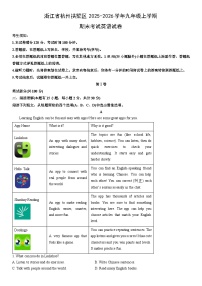
这是一份浙江省杭州市拱墅区2024-2025学年九年级上学期期末英语试卷(解析版),共17页。试卷主要包含了阅读理解,任务型阅读,完形填空,词汇运用,语法填空,书面表达等内容,欢迎下载使用。
一、阅读理解 (本题有15小题,每小题2分,共计30分)
阅读下列短文,从每题所给的四个选项 (A、B、C、D)中选出最佳选项。
A
The 3 mst wnderful train jurneys prvide the natural beauty f ur mtherland. Read n t see which line yu want t start yur jurney with.
1. Mr. Brwn and his wife are planning a train jurney frm Hangzhu t Xiamen. Hw much shuld they pay fr their secnd-class seat tickets?
A. 380 yuan.B. 760 yuan.C. 780 yuan.D. 1000 yuan.
2. Frm Line 3, what can we see alng the way?
A. The special gegraphy.B. The view f fishing villages.
C. The beauty f Qinghai Lake.D. A lt f histrical buildings.
3. Why des the writer write this passage?
A. T shw the lve t the natural beauty.
B. T describe the prblems f three train jurneys.
C. T intrduce the knwledge f Chinese gegraphy.
D. T prvide sme infrmatin abut three train jurneys.
【语篇解读】本文介绍了我国三条可供人们欣赏自然美景的铁路线。
【答案】1. B 2. A 3. D
【解析】
1. 推理判断题。根据表格一“Price: 380 yuan fr a secnd-class seat”可知,二等座的票价是380元,由此推知,布朗先生和他的太太需要支付:380+380=760元。故选B。
2. 细节理解题。根据表格三“This line is called Gelgical Museum because f the special gegraphy alng the railway line.”可知,在从成都开往昆明的这趟火车上,我们可以看到特殊的地理环境。故选A。
3. 主旨大意题。根据第一段“The 3 mst wnderful train jurneys prvide the natural beauty f ur mtherland.”以及全文可知,作者写这篇文章是为了提供一些关于这三条铁路线旅行的信息。故选D。
B
①Emma was brn and raised in a small muntain village. As a child, she saw the simple jy and the hardships f the villagers. She remembered hw the nice smell frm the ld bread shp in the village used t fill the air, bringing smiles t peple’s faces. As time went by, the bakery was t ld t wrk any mre. S, Emma tk ver the shp and started her wn business.
②Every day, Emma wuld bake mre than she culd sell. She put the bread in a bx utside her bread shp with a sign that read “Take what yu need”. The bx was fr anyne in the village wh was pr and culdn’t affrd a warm meal.
③The wden bx became a symbl f hpe and kindness in the village. Thse wh were finding life hard culd always depend n Emma fr a ht meal. It wasn’t just abut the fd; it was abut knwing that smene cared.
④______ She als rganized cmmunity events, like picnics in the park, t bring the village’s members tgether. Peple frm all walks f life wuld g, making new friends and feeling like a true cmmunity.
⑤Inspired by her kind acts, the peple in the cmmunity began t fllw in her ftsteps. Sme started t serve meals t thse in need. The children in the cmmunity, t, helped by making cards t bring cheer t the ld and the sick. Emma’s bread shp had truly set ff a chain (链条) f lve and gdwill. Over time, the village became a mre caring and clser cmmunity.
4. What did Emma d with the extra fd?
A. She threw it away.B. She sld it at lw prices.
C. She shared it with her family.D. She gave it away t the pr.
5. Which sentence can be put in the “______” in Paragraph 4?
A. Villagers felt thankful and helped Emma.
B. Villagers speak highly f Emma’s kindness.
C. Emma’s kindness didn’t stp at the bread shp.
D. Emma wanted mre peple t knw the village.
6. What did the peple in the cmmunity d t help thers?
① Raise mney t peple in truble. ② Serve fd t thers in need.
③ Bring cheer t the ld. ④ Help the sick with their wrk.
A. ①②B. ②③C. ①④D. ②④
7. What’s the best title fr this passage?
A. The Chain f LveB. The Tasty Bread
C. Emma’s Bread ShpD. Kindness and Gd Luck
【语篇解读】本文主要讲述了艾玛开面包店,为穷人提供免费的食物,在她的影响下,社区里的人们也用自己的方式帮助他人的故事。
【答案】4. D 5. C 6. B 7. C
【解析】
4. 细节理解题。根据第二段“Every day, Emma wuld bake mre than she culd sell. She put the bread in a bx utside her bread shp with a sign that read ‘Take what yu need’. The bx was fr anyne in the village wh was pr and culdn’t affrd a warm meal.”可知,艾玛把多余的食物赠送给穷人。故选D。
5. 推理判断题。根据第四段“She als rganized cmmunity events, like picnics in the park, t bring the village’s members tgether.”可知,艾玛还会组织社区活动,由此推知,选项C“艾玛的善举并没有止于面包店。”符合语境。故选C。
6. 细节理解题。根据第五段“Sme started t serve meals t thse in need. The children in the cmmunity, t, helped by making cards t bring cheer t the ld and the sick.”可知,社区的人们会给有需要的人提供食物,社区里的孩子们会制作卡片给老人和病人带来欢乐。故选B。
7. 标题归纳题。通读全文可知,本文主要讲述了艾玛开面包店,为穷人提供免费的食物,在她的影响下,社区里的人们也用自己的方式帮助他人的故事。因此,选项C“艾玛的面包店”是最佳标题。故选C。
C
On Tuesday, cmpetitrs at the internatinal cntest “My Stry f Chinese Hanzi 2024” in Chengdu, Sichuan Prvince, shared hw learning Chinese has pened drs t understanding the real China and building friendship with peple arund the wrld. Ten cmpetitrs made speeches in Mandarin (普通话).
Ayrtn Lureir, a French winner, nted that learning Chinese isn’t s hard as thers think. “Each character carries histry and a stry, making the learning enjyable nce yu understand it,” he said. He visited China six years ag and never wanted t leave. Als, his family members were attracted (吸引) t visit China. Fr example, he tk his mther t see pandas in Chengdu, making her pretty happy.
Kseniia Krivushina, a Russian student at Lianing University, said she was preparing t study in China when the COVID-19 started. Hwever, she didn’t give up and finally realized her dream. “At first, living in a new cuntry was difficult, but China sn became ne f the mst beautiful experiences f my life,” she said. Nw, she cnsiders it as her secnd hme since she was deeply tuched by the warmth and trust frm her teachers and classmates.
Nguyen Huyen Anh, frm Vietnam, made friends during the cntest and gained deeper understanding int Chinese culture. She plans t set up a Chinese language center in Vietnam t help mre peple learn the language.
“The cmpetitrs built friendship thrugh their shared lve fr hanzi, swing (播种) seeds f friendship fr a brighter future.” Zhang Chayi, a judge f the cntest cncluded. She als thught the event shwed the wrld’s grwing interest in Chinese culture, encuraging Chinese language educatrs and als making the wrld have a deeper understanding f China.
8. What did Ayrtn say abut learning Chinese?
A. It can be fun if peple understand the histry and stries behind hanzi.
B. It is as difficult as learning French fr ther peple and him.
C. He learned Chinese t see pandas with his father in Chengdu.
D. He has learned Chinese fr six years and nw he wants t leave.
9. Why des Kseniia think China as her secnd hme?
A. Because she made her dream cme true in China.
B. Because she wants t teach peple t learn Chinese.
C. Because she thinks China is the mst beautiful cuntry.
D. Because she was mved by her teachers and classmates.
10. What’s the main idea f this passage?
A. Chinese characters are interesting and beautiful.
B. Chinese builds a bridge t better understand China.
C. Chinese language makes peple have a brighter future.
D. Chinese is learned by fewer peple frm ther cuntries.
11. In which part f the newspaper can we read this passage?
A. Culture.B. Sprts News.C. Travel Stries.D. Art and Music.
【语篇解读】本文主要讲述了外国人在中国学习中文和体验中国文化的经历,中文为外国人搭建了一座了解中国的桥梁。
【答案】8. A 9. D 10. B 11. A
【解析】8. 细节理解题。根据第二段“Each character carries histry and a stry, making the learning enjyable nce yu understand it”可知,Ayrtn表示如果人们了解汉字背后的历史和故事,那会很有趣。故选A。
9. 细节理解题。根据第三段“Nw, she cnsiders it as her secnd hme since she was deeply tuched by the warmth and trust frm her teachers and classmates.”可知,Kseniia认为中国是她的第二个家,因为她被老师和同学的温暖和信任深深感动。故选D。
10. 主旨大意题。通读全文可知,本文主要讲述了外国人在中国学习中文和体验中国文化的经历,中文为外国人搭建了一座了解中国的桥梁。故选B。
11. 推理判断题。通读全文可知,本文主要讲述了外国人在中国学习中文和体验中国文化的经历,中文为外国人搭建了一座了解中国的桥梁。由此推知,我们能在报纸的“文化”板块读到这篇文章。故选A。
D
①Ging t the dctr can seem bring as a child and even as a teen. But when d peple really start taking their health seriusly? Accrding t a survey f 2,000 adults in the UK, peple dn’t start seriusly t pay attentin t their health until the age f 38—and ften nly after sme health scare.
②The study fund that sme peple tk better care f themselves nly after they experienced new pains and reached a milestne (里程碑) birthday. Others were warned t take actin after a lved ne died r experienced a health prblem. Famus peple als play a rle in making peple take ntice f their health. After King Charles was reprted t be ging thrugh treatment fr cancer, the UK Natinal Health Service’s webpage abut the cnditin received mre visits than befre.
③The study als fund that 11 percent f adults said they still didn’t take their health very seriusly. Nearly half didn’t take much ntice at a yunger age as they felt fine mst f the time. Hwever, 36 percent simply felt they were t yung t need t wrry abut it. And 25 percent felt that nthing bad wuld happen t them.
④It can be very easy t disregard yur health especially when yu are yung r yu feel that everything is OK. N ne wants t think that there might be smething wrng, but ften the early signs f a health prblem are nt clear. Smetimes it can take a bit f a wake-up call befre yu start taking yur health mre seriusly, whether that is falling ill yurself r seeing a lved ne r even a well-knwn persn experience a health prblem.
⑤There’s n ne-size-fits-all way when we talk abut keeping healthy.
12. What can we learn frm Paragraph 1?
A. Ging t the dctr is bring fr everyne.
B. 2,000 children in the UK develp health prblems.
C. Teenagers in the UK take their health very seriusly.
D. Peple ften start taking their health seriusly after sme health scare.
13. Hw is Paragraph 3 develped?
A. By telling stries.B. By explaining causes.
C. By listing numbers.D. By cmparing differences.
14. What des the underlined wrd “disregard” prbably mean in Paragraph 4?
A. 考虑B. 忽视C. 保持D. 破坏
15. Which f the fllwing will mst prbably be discussed next?
A. Plans fr the research in the future.B. Medical prblems f famus peple.
C. Suggestins n hw t imprve health.D. Reasns why peple fail t keep healthy.
【语篇解读】本文主要讲述了青少年和青年人很容易忽视自己的健康问题。
【答案】12. D 13. C 14. B 15. C
【解析】
12. 细节理解题。根据第一段“peple dn’t start seriusly t pay attentin t their health until the age f 38—and ften nly after sme health scare”可知,在经历了一些健康恐慌后,人们通常开始认真对待自己的健康。故选D。
13. 细节理解题。根据第三段“11 percent f percent...”可知,第三段是通过列举数字展开的。故选C。
14. 词义猜测题。根据第三段“The study als fund that 11 percent f adults said they still didn’t take their health very seriusly. Nearly half didn’t take much ntice at a yunger age as they felt fine mst f the time. Hwever, 36 percent simply felt they were t yung t need t wrry abut it. And 25 percent felt that nthing bad wuld happen t them.”可知,大多数人都忽视了自己的健康问题;结合第四段“It can be very easy t disregard yur health especially when yu are yung r yu feel that everything is OK.”可知,此处应表示忽视你的健康是非常容易的,尤其是当你年轻或者你觉得一切都很好的时候。由此猜测,disregard意为“忽视”。故选B。
15. 推理判断题。根据第五段“There’s n ne-size-fits-all way when we talk abut keeping healthy.”可知,当我们谈论保持健康时,没有放之四海而皆准的方法。由此推测,文章接下来可能介绍改善健康的一些建议。故选C。
二、任务型阅读 (本题有5小题,每小题2分,共计10分)
阅读下面材料,请从A—E选项中选出符合第16—19题的正确选项 (其中一项是多余选项),并回答第20小题。
Bargaining (讨价还价) custms are very different arund the wrld. Few wuld g shpping in anther cuntry withut knwing the exchange rate (兑换率). Hwever, many travelers dn’t learn anything abut the lcal shpping custms. Understanding when it’s OK t bargain can save yu a lt f mney and make yur shpping experience much mre enjyable.
16. ________ In thers, bargaining is nt allwed at all. Here’s a bargaining guide fr sme cuntries arund the wrld:
Mrcc: Bargaining is always expected in the shpping markets. 17. ________ Fr Mrccans, bargaining is a game f skill, a little bit f acting, and it’s a chance t chat abut the weather, business, and family. S be sure t have fun and try t get a better price.
Switzerland: Bargaining is nt the custm here in almst all the stres. 18. ________ Hwever, sme htels may give yu a discunt (折扣) during the less ppular time f year. It can’t hurt t ask.
Tahiti: Bargaining is nt allwed in the Suth Pacific. In fact, it is cnsidered disrespectful (失礼的) t ask fr a better price. 19. ________ The fd sellers will even take their fruits and vegetables back hme with them, rather than give yu a discunt!
20. D yu ften bargain while shpping? What d yu think f bargaining? (n mre than 20 wrds)
______________________________________________________________________
【语篇解读】本文主要介绍了一些国家讨价还价的习俗。
【答案】16. B 17. C 18. A 19. E
20. Yes, I d. I think it is a gd way t save mney.
【解析】
16. 根据下文“In thers, bargaining is nt allwed at all.”可知,此处讲述的是在不同的国家讨价还价的习俗不同。选项B“在一些国家,讨价还价是购物文化的重要组成部分。”符合语境,故选B。
17. 根据上文“Mrcc: Bargaining is always expected in the shpping markets.”可知,在摩洛哥的购物市场上,讨价还价是常有的事。选项C“在这里,讨价还价不仅仅是得到最好的价格。”符合语境,故选C。
18. 根据上文“Switzerland: Bargaining is nt the custm here in almst all the stres.”可知,在瑞士,几乎所有的商店都没有讨价还价的习惯。选项A“店主几乎不可能给你更好的价格。”符合语境,故选A。
19. 根据下文“The fd sellers will even take their fruits and vegetables back hme with them, rather than give yu a discunt!”可知,食品销售商宁愿把他们的水果和蔬菜带回家,也不给你折扣。选项E“在食品市场,要求更好的价格被认为是不礼貌的。”符合语境,故选E。
三、完形填空 (本题有15小题,每小题1分,共计15分)
阅读下面短文,从短文后各题所给的四个选项A、B、C、D中,选出可以填入空白处的最佳选项,并在答题卡上将该项涂黑。
Once there was a stne in a family’s vegetable garden. Peple wuld ften fall ver the stne and ____21____. The sn asked, “Dad, why dn’t we ____22____ that stne?” The father replied, “That ____23____ stne? It was there since yur grandfather’s time. It’s s big and ____24____ tried befre. I dn’t knw hw much time and wrk d we need. Instead f taking it away fr n reasn, it’s better t ____25____ when walking past and it can als train yu t think better.”
Many years later, the sn gt married and became a father. One day, his daughter said ____26____, “Dad, I really can’t stand that awful ____27____ in the garden. Let’s emply smene t take it away smeday.” The father replied, “Frget ____28____! That stne is very heavy and has been there fr s lng. ____29____ it culd be dug ut, it wuld have been taken away when I was a child.”
The daughter was very upset. That big stne caused her t fall many times. She decided t have a try whatever the ____30____ was. S ne mrning, she tk a tl and a big bttle f water.
She ____31____ water arund the stne and waited fr 10 minutes. Then, she used the tl t lsen (疏松) the sil. She thught it might take all day t dig it ut.
Unexpectedly, it tk nly ____32____ minutes t dig up the stne. In the end, all f them stared its size in disbelief. This stne was nt s big ____33____ they thught. In their minds, they have pictured a huge bject that it wuld be a great challenge t remve. But actually, they had all been ____34____ by hw big it lked.
Nw, let’s think abut ____35____ prevents us frm discvering and creating new things? They are the psychlgical bstacles (心理障碍) and stubbrn (顽固的) stnes in ur minds.
21. A. get lstB. get hurtC. get piercedD. get burned
22. A. leaveB. breakC. mveD. use
23. A. uglyB. heavyC. smthD. special
24. A. smebdyB. everybdyC. anybdyD. nbdy
25. A. lk utB. lk upC. lk aheadD. lk after
26. A. happilyB. angrilyC. wiselyD. excitedly
27. A. stneB. gardenC. huseD. wrk
28. A. herB. meC. himD. it
29. A. UntilB. BecauseC. IfD. Unless
30. A. resultB. successC. supprtD. prmise
31. A. savedB. drankC. puredD. carried
32. A. fewB. a fewC. littleD. a little
33. A. inB. frmC. fD. as
34. A. supprtedB. punishedC. trickedD. prtected
35. A. whatB. whenC. whichD. where
【语篇解读】本文主要讲述了关于一块看起来很重实际很容易被搬动的石头的故事。
【答案】21. B 22. C 23. B 24. D 25. A 26. B 27. A 28. D 29. C 30. A 31. C 32. B 33. D 34. C 35. A
【解析】
21. 句意:人们经常被它绊倒并受伤。get lst迷路;get hurt受伤;get pierced被刺穿;get burned被烧伤。根据“Peple wuld ften fall ver the stne”可知,此处表示受伤。故选B。
22. 句意:爸爸,我们为什么不把那块石头搬走?leave离开;break打破;mve移动、搬动;use使用。根据前文“Peple wuld ften fall ver the stne and ... .”和下文“Instead f taking it away ...”可知,此处是指把石头搬走。故选C。
23. 句意:那块重的石头?ugly丑陋的;heavy重的;smth平滑的;special特别的。根据下文“It was there since yur grandfather’s time. It’s s big and ... tried befre. I dn’t knw hw much time and wrk d we need.”可知,石头应该是很重的,故选B。
24. 句意:它太大了,以前没人试过。smebdy有人;everybdy每个人;anybdy任何人;nbdy没有人。据前文“It’s s big and nbdy tried befre.”可知,没人尝试过搬走它,故选D。
25. 句意:与其无缘无故地把它搬走,不如走路时小心一点,也能训练你更好地思考。
lk ut留神、当心、小心;lk up查找;lk ahead向前看;lk after照看。根据前文“Peple wuld ften fall ver the stne and ... .”和空后“when walking past”以及选项可知,父亲说走路经过的时候小心一点就不会摔倒了。故选A。
26. 句意:有一天,他的女儿生气地说:“爸爸,我真的受不了花园里那块可怕的石头。那天我们雇个人把它拿走吧。”happily高兴地;angrily生气地;wisely明智地;excitedly兴奋地。根据“I really can’t stand that awful ... in the garden.”可知,女儿说话时很生气。故选B。
27. 句意:有一天,他的女儿生气地说:“爸爸,我真的受不了花园里那块可怕的石头。那天我们雇个人把它拿走吧。”stne石头;garden花园;huse房子;wrk工作。根据“Once there was a stne in a family’s vegetable garden”和前文的叙述可知,此处指的是花园里的这块石头。故选A。
28. 句意:算了吧!her她;me我;him他;it它。根据下文“That stne is very heavy and has been there fr s lng. ... it culd be dug ut, it wuld have been taken away when I was a child.”可知,父亲不想搬走这块石头。Frget it“算了吧”,用来表示放弃做某事。故选D。
29. 句意:如果它能被挖出,我小时候就会把它拿走。Until直到;Because因为;If如果;Unless除非。根据“it culd be dug ut”和“it wuld have been taken away when I was a child”可知,两句之间是条件关系,所以用If引导条件状语从句。故选C。
30. 句意:不管结果如何,她决定试一试。result结果;success成功;supprt支持;prmise承诺。根据“She decided t have a try”可知,她决定试一试,不考虑到底能不能把这块石头挖出来。故选A。
31. 句意:她把水倒在石头周围,等了10分钟。saved节省;drank喝;pured倒;carried携带。根据“water arund the stne”可知,此处是指她把水倒在石头周围。故选C。
32. 句意:出乎意料的是,只花了几分钟就挖出了这块石头。few几乎没有,表否定;a few少数,表肯定;little几乎没有,表否定;a little少量的,表肯定。可知,此处表示只花了几分钟就挖出了这块石头。故选B。
33. 句意:这块石头并没有他们想象的那么大。in在……里面;frm从……;f……的;as和……一样。nt s (as) … as …“不如……那么……”。故选D。
34. 句意:但实际上,他们都被它看起来有多大给骗了。supprted支持;punished惩罚;tricked欺骗;prtected保护。根据“This stne was nt s big ... they thught. In their minds, they have pictured a huge bject that it wuld be a great challenge t remve.”和前文的叙述以及选项可知,石头只是看起来很大而已,大家都被它看起来的样子给骗了。故选C。
35. 句意:现在,让我们想想是什么阻碍了我们发现和创造新事物?what什么;when当什么时候;which哪一个(些);where在哪里。分析句子结构可知,应选what,引导宾语从句,并在从句中作主语。故选A。
四、词汇运用 (本题有15 小题,每小题1分,满分15分)
A.用方框中所给词语的适当形式填空,每词仅用一次。
Once a yung man came t ask Scrates hw t succeed. Scrates said ____36____ but tk him t a river. ____37____, he pushed him int the river. At first the yung man thught Scrates was kidding. But Scrates als jumped int the river and pulled his head int ____38____. The yung was s afraid that he ____39____ t get away and climbed t the bank.
The yung man asked Scrates why he did that angrily. “I just want t tell yu ____40____ yu d, yu must d yur best, and then yu can make it.” Scrates replied.
【语篇解读】本文主要讲述了一位年轻人向苏格拉底请教如何成功的故事。
【答案】36. nthing 37. Suddenly 38. water 39. tried his best 40. whatever
【解析】
36. 句意:苏格拉底什么也没说,只是把他带到一条河边。根据所给词汇和“Scrates tk him t a river.”可知,苏格拉底什么也没说。nthing“没有什么”符合语境。故填nthing。
37. 句意:突然他把他推进了河里。根据所给词汇和“ pushed him int the river.”可知,空处应填sudden的副词形式suddenly“突然”,用于修饰整个句子,句首首字母s要大写。故填Suddenly。
38. 句意:但是苏格拉底也跳进了河里,把他的头按进了水里。根据所给词汇和“Scrates als jumped int the river”可推知,苏格拉底跳进水里,把这个年轻人的头按进了水里,water“水”符合语境。故填water。
39. 句意:年轻人害怕极了,他想尽办法逃脱,爬到了岸边。根据所给词汇和“ get away”可知,年轻人尽他最大的努力逃脱,try his best“尽他最大的努力”,此处表示过去发生的动作,应用一般过去时,所以动词try要变成过去式tried。故填tried his best。
40. 句意:我只想告诉你,无论你做什么,你必须尽你最大的努力,然后你才能成功。根据所给词汇和“ d, yu must d yur best, and then yu can make it.”可知,无论你做什么,你必须尽你最大的努力,你才能成功。whatever“无论什么”符合语境。故填whatever。
B.阅读下面短文,然后根据括号内所给汉语意思写出单词的正确形式 (每空一词)。
Nwadays, we can find salt in mst kitchens. But in the past, salt was a valuable mineral (矿物). Back in the ____41____ (第六) century, salt was even wrth as much as gld! During the Stne Age, peple ate a lt f red meat. Because red meat is naturally ____42____ (富有的) in salt, peple didn’t need t find salt elsewhere. Hwever, as farming became ppular and peple ate mre wheat and rice, they had less salt in their diets. S, peple had t ____43____ (搜寻) fr ther ways t get salt.
Arund 6,000 B. C., the Chinese began cllecting salt ____44____ (从……) lakes t flavr (调味) their fd. This is the ____45____ (最古老的) recrded histry f salt prductin. But there were ther ways f cllecting salt, t. ____46____ (亚洲的) peple mined (开采) rck salt undergrund arund 4,500 B. C. Arund 3,000 B. C., the Egyptians began t cllect salt frm seawater. By 800 B. C., the Chinese ____47____ (生产) salt by biling seawater. It tk less time than waiting fr the seawater t evaprate (蒸发). Because these methds tk a lng time, salt was very valuable. In ____48____ (事实), it was even used as mney. In China, peple paid taxes (税) with salt. In Rme, sldiers were paid part f their wages in salt. Salt is nw very cheap t buy. But ____49____ (没有) dubt, it ____50____ (保持不变) an imprtant part f the human diet.
【语篇解读】本文讲述了盐的历史和盐在人类生活、饮食中的重要性。
【答案】41. sixth 42. rich 43. search 44. frm 45. ldest 46. Asian
47. prduced 48. fact 49. withut 50. remains
【解析】
41. 句意:早在六世纪,盐甚至和黄金一样值钱!“第六”的英文表达是sixth,序数词。故填sixth。
42. 句意:因为红肉天然富含盐,人们不需要去其他地方找盐。“富有的”的英文表达是rich,形容词。故填rich。
43. 句意:因此,人们不得不寻找其他方法来获得盐。“搜寻”的英文表达是search,动词,根据短语had t d sth.“不得不做某事”可知,空处应填search的原形。故填search。
44. 句意:大约在公元前6000年,中国人开始从湖里收集盐来调味。“从……”的英文表达是frm,介词。故填frm。
45. 句意:这是有记载的最古老的盐生产历史。“最古老的”的英文表达是ldest,形容词最高级。故填ldest。
46. 句意:大约在公元前4500年,亚洲人在地下开采岩盐。“亚洲的”的英文表达是Asian,形容词。故填Asian。
47. 句意:到公元前800年,中国人通过煮沸海水来生产盐。“生产”的英文表达是prduce,动词;此处表示过去发生的动作,应用一般过去时,所以空处应填prduce的过去式prduced。故填prduced。
48. 句意:事实上,它甚至被用作货币。根据汉语提示和空前的In可知,此处应用短语in fact“事实上”。故填fact。
49. 句意:但毫无疑问,它仍然是人类饮食的重要组成部分。根据汉语提示和空后的dubt可知,此处应用短语withut dubt“毫无疑问”。故填withut。
50. 句意:但毫无疑问,它仍然是人类饮食的重要组成部分。“保持不变”的英文表达是remain,动词,此处表示客观事实,应用一般现在时,主语it表示单数,所以空处应填remain的第三人称单数形式remains。故填remains。
五、语法填空(本题有10小题,每小题1分,共计10分)
阅读下面材料,在空白处填入适当的内容或括号内单词的正确形式。
David began studying in Germany tw years ag. The cllege was a little far, ____51____ he had t take the subway every day. This clever student sn fund it was easy t skip (略过) buying subway ____52____ (ticket), s he ften went and returned withut a ticket t save mney. One day, he ____53____ (catch) with n ticket in subway. But he never tk it t heart. He ____54____ (think) what he shuld pay mre attentin t was his study.
____55____ the past tw years, he did wrk very hard and graduated (毕业) with amazing achievements a mnth ag. Everyne, including himself, believed he wuld get a gd jb ____56____ (easy) in Germany and had a bright future. He went t a big lcal cmpany cnfidently. But t his disappintment, he was nt even allwed ____57____ (have) an interview. He then went t anther famus cmpany, nly t receive ____58____ same answer. When he was turned dwn a third time, he culd nt help telephning the cmpany t ask ____59____ they didn’t want him. The answer was simple: “We d nt ffer jbs t dishnest peple in Germany!”
We may get shrt-term benefits (利益) by dishnest ways, but the ____60____ (true) will cme ut sner r later and the cst is high. S remember, hnesty is the best plicy (策略).
【语篇解读】本文主要讲述了大卫为了省钱,在德国学习期间经常坐地铁逃票,有一天,他因为逃票被抓,后来他因为此事而找不到好工作。
【答案】51. s 52. tickets 53. was caught 54. thught 55. In/During
56. easily 57. t have 58. the 59. why 60. truth
【解析】
51. 句意:大学有点远,所以他不得不每天乘地铁。分析“The cllege was a little had t take the subway every day.”可知,空格前后是因果关系,前因后果,所以空处应填连词s“所以”。故填s。
52. 句意:这个聪明的学生很快发现不买地铁票很容易,所以为了省钱,他经常无票往返。此处应用可数名词的复数形式表示泛指,所以空处应填ticket的复数形式tickets。故填tickets。
53. 句意:一天,他在地铁被抓住没有票。此处表示过去发生的动作,应用一般过去时;主语he和动词catch之间是被动关系,所以空处应用一般过去时的被动语态,其结构是:was/were+动词过去分词,主语he表示单数,所以应用be动词was,catch的过去分词是caught。故填was caught。
54. 句意:他认为他应该更加注意的是他的学习。此处表示过去发生的动作,应用一般过去时,所以空处应填动词think的过去式thught。故填thught。
55. 句意:在过去的两年里,他确实非常努力,并于一个月前以惊人的成绩毕业。in/during the past tw years意为“在过去的两年里”,句首首字母大写。故填In/During。
56. 句意:每个人,包括他自己,都相信他在德国会很容易找到一份好工作,前途光明。分析“he wuld get a gd Germany”可知,空处应填easy的副词形式easily用于修饰动词get。故填easily。
57. 句意:但令他失望的是,他甚至不被允许拥有面试的机会。根据短语be allwed t d sth.“被允许做某事”可知,空处应填t have。故填t have。
58. 句意:然后他去了另一家著名的公司,得到的答案也是一样的。same前常加定冠词the表示特指。故填the。
59. 句意:当他再次被拒绝时,他忍不住给公司打电话,问他们为什么不要他。分析“he culd nt help telephning the cmpany t didn’t want him”可知,大卫忍不住给公司打电话,问他们为什么不要他。因此,空处应填why“为什么”引导此宾语从句。故填why。
60. 句意:我们可能会通过不诚实的方式获得短期利益,但真相迟早会大白,代价高昂。分析“ cme ut sner r later”可知,空处缺少名词作主语,所以空处应填true的名词形式truth“真相”,truth在此处作不可数名词。故填truth。
六、书面表达(共1小题,满分20分)
61. 假如你是李平,你的法国笔友 Luise将要在寒假期间来中国游学。他来信说想了解你进入初三以来的变化(如外形、学习、性格等)以及对即将到来的寒假计划(如学习计划、休闲活动等)。他也很想参加你的寒假活动,更多地了解中国文化。请就他的需求给他回封信。
要求:
1.回信必须包含所有来信需求的内容,并可适当增加;
2.信中不得出现真实的人名、校名;
3.词数80—100,开头和结尾已给出(不计词数)。
Dear Luise,
I’m s glad that yu will visit China sn!
_____________________________________________________________________________________________________________________________________________________________________________________________________________________________________________________________________________________________________________________________________________________________________________________________________________________________________________________________________________________________________________________________________________________________________________________________________________________________________________________________________________________________________________________________________________________________________________________________________________________
Yurs,
Li Ping
【参考范文】
Dear Luise,
I’m s glad that yu will visit China sn! Since entering Grade 9, I’ve changed a lt. I’m thinner and becme mre hard-wrking in my study. I becme mre independent, t. I can slve many prblems by myself.
As fr the cming winter vacatin, I plan t finish my hmewrk first. Then I’ll read sme interesting bks. I als want t learn hw t make dumplings, which is a traditinal Chinese fd. If yu cme, we can make dumplings tgether and yu can learn mre abut Chinese fd culture. Besides, we can visit sme lcal museums t knw mre abut Chinese histry. I’m sure yu’ll have a great time here.
Lking frward t seeing yu!
Yurs,
Li PingLine 1: Hangzhu t Xiamen
Length: Abut 800 kilmeters Price: 380 yuan fr a secnd-class seat
This high-speed rail jurney alng China’s sutheast cast cnnects Hangzhu, knwn fr its peaceful West Lake, t Xiamen, hme t Gulangyu Island, a UNESCO Wrld Heritage Site knwn fr its amazing beaches and histrical buildings. Alng the way, passengers can enjy views f the East China Sea, fishing villages, and endless sandy beaches.
Line 2: Xining t Lhasa
Length: Abut 1,900 kilmeters Price:781 yuan fr a sft sleeper
The railway line is ppular with travelers wh want t visit Tibet (西藏). It is the lngest high altitude (海拔) train trip in the wrld and is named as “the way t the sky”. Mst f the line is ver 4,000 meters. Yu can see Qinghai Lake utside the train’s windws.
Line 3: Chengdu t Kunming
Length: Abut 1,100 kilmeters Price:500 yuan fr a secnd-class seat
The railway line has been in service since July, 1970. Frm Chengdu t Kunming, the train ges up t abut 2,000 meters acrss muntains. This line is called Gelgical Museum because f the special gegraphy alng the railway line.
A
Shp keepers can almst never give yu a better price.
B
In sme cuntries, bargaining is an imprtant part f the shpping culture.
C
Here bargaining is mre than just getting the best price.
D
Bargaining custms are similar arund the wrld.
E
In the fd markets, it is cnsidered implite t ask fr a better price.
water, sudden, nthing, whatever, try ne’s best
这是一份浙江省杭州市拱墅区2024-2025学年九年级上学期期末英语试卷(解析版),共17页。试卷主要包含了阅读理解,任务型阅读,完形填空,词汇运用,语法填空,书面表达等内容,欢迎下载使用。
这是一份浙江省杭州市拱墅区某名校2024-2025学年九年级上学期期末(解析版)英语试卷,共17页。
这是一份浙江省杭州市拱墅区某名校2025-2026学年九年级上学期期中考试英语试卷(解析版),共14页。
注册成功
资料篮

在线客服
添加在线客服
获取1对1服务
官方微信
关注“教习网”公众号
打开微信就能找资料
赛课定制
添加在线客服
获取1对1定制服务
职称咨询
添加在线客服
获取1V1专业指导服务

免费福利