 免费领取教师福利


若您为此资料的原创作者,认为该资料内容侵犯了您的知识产权,请扫码添加我们的相关工作人员,我们尽可能的保护您的合法权益。

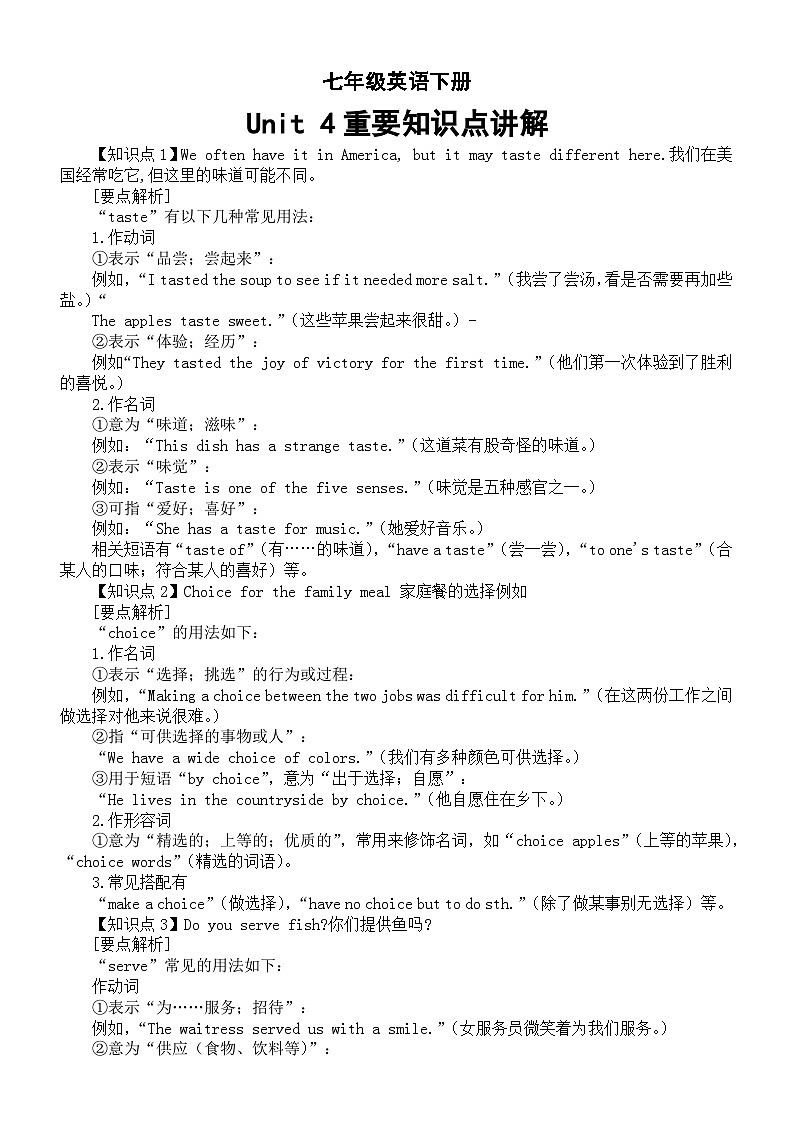
这是一份人教版(2024)七年级下册(2024)Unit 4 Eat Well学案设计,共4页。学案主要包含了知识点1,知识点2,知识点3,知识点4,知识点5,知识点6,知识点7,知识点8等内容,欢迎下载使用。
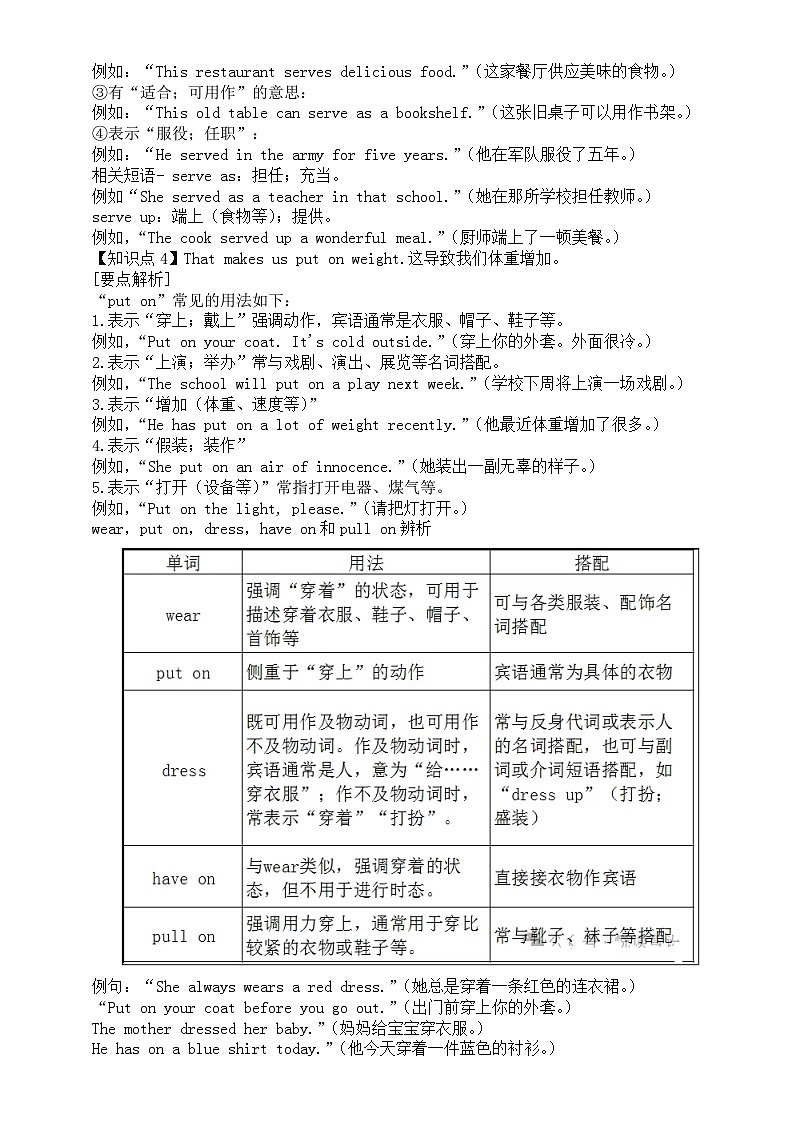
【知识点1】We ften have it in America, but it may taste different here.我们在美国经常吃它,但这里的味道可能不同。
[要点解析]
“taste”有以下几种常见用法:
1.作动词
①表示“品尝;尝起来”:
例如,“I tasted the sup t see if it needed mre salt.”(我尝了尝汤,看是否需要再加些盐。)“
The apples taste sweet.”(这些苹果尝起来很甜。)-
②表示“体验;经历”:
例如“They tasted the jy f victry fr the first time.”(他们第一次体验到了胜利的喜悦。)
2.作名词
①意为“味道;滋味”:
例如:“This dish has a strange taste.”(这道菜有股奇怪的味道。)
②表示“味觉”:
例如:“Taste is ne f the five senses.”(味觉是五种感官之一。)
③可指“爱好;喜好”:
例如:“She has a taste fr music.”(她爱好音乐。)
相关短语有“taste f”(有……的味道),“have a taste”(尝一尝),“t ne's taste”(合某人的口味;符合某人的喜好)等。
【知识点2】Chice fr the family meal 家庭餐的选择例如
[要点解析]
“chice”的用法如下:
1.作名词
①表示“选择;挑选”的行为或过程:
例如,“Making a chice between the tw jbs was difficult fr him.”(在这两份工作之间做选择对他来说很难。)
②指“可供选择的事物或人”:
“We have a wide chice f clrs.”(我们有多种颜色可供选择。)
③用于短语“by chice”,意为“出于选择;自愿”:
“He lives in the cuntryside by chice.”(他自愿住在乡下。)
2.作形容词
①意为“精选的;上等的;优质的”,常用来修饰名词,如“chice apples”(上等的苹果),“chice wrds”(精选的词语)。
3.常见搭配有
“make a chice”(做选择),“have n chice but t d sth.”(除了做某事别无选择)等。
【知识点3】D yu serve fish?你们提供鱼吗?
[要点解析]
“serve”常见的用法如下:
作动词
①表示“为……服务;招待”:
例如,“The waitress served us with a smile.”(女服务员微笑着为我们服务。)
②意为“供应(食物、饮料等)”:
例如:“This restaurant serves delicius fd.”(这家餐厅供应美味的食物。)
③有“适合;可用作”的意思:
例如:“This ld table can serve as a bkshelf.”(这张旧桌子可以用作书架。)
④表示“服役;任职”:
例如:“He served in the army fr five years.”(他在军队服役了五年。)
相关短语- serve as:担任;充当。
例如“She served as a teacher in that schl.”(她在那所学校担任教师。)
serve up:端上(食物等);提供。
例如,“The ck served up a wnderful meal.”(厨师端上了一顿美餐。)
【知识点4】That makes us put n weight.这导致我们体重增加。
[要点解析]
“put n”常见的用法如下:
1.表示“穿上;戴上”强调动作,宾语通常是衣服、帽子、鞋子等。
例如,“Put n yur cat. It's cld utside.”(穿上你的外套。外面很冷。)
2.表示“上演;举办”常与戏剧、演出、展览等名词搭配。
例如,“The schl will put n a play next week.”(学校下周将上演一场戏剧。)
3.表示“增加(体重、速度等)”
例如,“He has put n a lt f weight recently.”(他最近体重增加了很多。)
4.表示“假装;装作”
例如,“She put n an air f inncence.”(她装出一副无辜的样子。)
5.表示“打开(设备等)”常指打开电器、煤气等。
例如,“Put n the light, please.”(请把灯打开。)
wear,put n,dress,have n和pull n辨析
例句:“She always wears a red dress.”(她总是穿着一条红色的连衣裙。)
“Put n yur cat befre yu g ut.”(出门前穿上你的外套。)
The mther dressed her baby.”(妈妈给宝宝穿衣服。)
He has n a blue shirt tday.”(他今天穿着一件蓝色的衬衫。)
“He pulled n his bts and went ut.”(他穿上靴子出去了。)
【知识点5】That makes us put n weight.这导致我们体重增加。
[要点解析]
“weight”的用法如下:
1.作名词
①表示“重量;分量”:
例如,“What's the weight f this bx?”(这个箱子有多重?)-
②指“重物;杠铃片等”:
例如:“He lifted weights at the gym.”(他在健身房举杠铃。)
③表示“重要性;影响力”:
例如:“His pinin carries a lt f weight.”(他的意见很有分量。)
2.作动词
①意为“在……上加重量;使负重”:
例如:“They weighted the bat t keep it stable.”(他们给船加重以保持稳定。)
②表示“权衡;考虑”:
例如:“Yu need t weight the prs and cns befre making a decisin.”(做决定前你需要权衡利弊。)
3.相关短语
“lse weight”(减肥),“gain weight”(增重),“put n weight”(长胖),“carry weight”(有影响力)等。
【知识点6】Maybe they dn't feel hungry in the mrning, r they are t busy t eat anything.也许他们早上不觉得饿,或者他们太忙以至于不能吃东西。
[要点解析]
“”结构用于表示“太……而不能……”,其用法如下:
1.基本结构
“t + 形容词/副词 + t d sth.”。
例如,“The bx is t heavy t carry.”(这个箱子太重了,搬不动。)
2.变体形式
当“t”前面有“nly, but, all”等词修饰时,“”结构不再表示否定意义,而是表示“非常,很”,相当于“very”。
例如,“I'm nly t glad t help yu.”(我非常乐意帮助你。)
3.特殊情况
如果“”结构中的形容词是ready, eager, glad, willing等表示情感或态度的词时,也不表示否定,而是意为“很,非常”。
例如,“He is t eager t knw the result.”(他非常渴望知道结果。)
【知识点7】It is easy t feel sleepy and find it hard t fcus n ur wrk r studies if we dn't eat breakfast.如果不吃早餐,我们很容易感到困倦,并且觉得很难集中精力工作或学习。
[要点解析]
“It is+adj.+( fr sb.) t d sth.”是固定句式,意为“(对某人来说)做
某事怎么样”。该句式中It是形式主语,真正的主语是其后的动词不定
式(短语)。
例如:It's dangerus fr yung children t swim in the river.对于年幼的孩子来说,在河里游泳是很危险的。
【知识点8】After all, an apple a day keeps the dctr away.毕竟,一天一苹果,医生远离我。
[要点解析]
“after all”的用法如下:
1.表示“毕竟;终究;到底” 一般用于句末,强调经过考虑或经历了一些事情后,最终得出的结论或发现。
例如,“I thught I culdn't pass the exam, but I did it after all.”(我原以为我考试不及格,但终究还是通过了。)
2.表示“别忘了” 用于句首或句中,提醒对方注意某个重要的事实或情况,通常用来解释原因或为自己的观点提供依据。
例如,“After all, he is nly a child. Yu can't expect t much frm him.”(别忘了,他只是个孩子。你不能对他期望太高。)
【知识点9】Reasn fr the result该结果的原因。
[要点解析]
“result”的用法如下:
1.作名词
①表示“结果;后果”:常与介词“f”搭配,引出导致结果的原因。
例如,“The result f the experiment was very interesting.”(实验的结果很有趣。)
②意为“成绩;比分”:
例如,“I gt gd results in my exams.”(我考试成绩很好。)
2.作动词
常见搭配 “result in”:表示“导致;造成”,后面接结果。
例如,“His carelessness resulted in the accident.”(他的粗心导致了这场事故。)
“result frm”:意为“由……引起;起因于”,后面接原因。
例如,“The damage resulted frm the fld.”(损失是由洪水造成的。)
这是一份人教版(2024)七年级下册(2024)Unit 4 Eat Well学案设计,共4页。学案主要包含了知识点1,知识点2,知识点3,知识点4,知识点5,知识点6,知识点7,知识点8等内容,欢迎下载使用。
这是一份初中英语人教版(2024)七年级下册(2024)Unit 4 Eat Well学案设计,共5页。学案主要包含了拓展延伸等内容,欢迎下载使用。
这是一份人教版(2024)七年级下册(2024)Unit 4 Eat Well导学案,共8页。
注册成功
资料篮

在线客服
添加在线客服
获取1对1服务
官方微信
关注“教习网”公众号
打开微信就能找资料
赛课定制
添加在线客服
获取1对1定制服务
职称咨询
添加在线客服
获取1V1专业指导服务

免费福利

.png)
.png)
.png)
