免费领取教师福利


若您为此资料的原创作者,认为该资料内容侵犯了您的知识产权,请扫码添加我们的相关工作人员,我们尽可能的保护您的合法权益。





这是一份2025年中考英语复习:16个语法专题讲义,共161页。学案主要包含了备考策略,知识梳理,典例精析,易错疑难,易错易难,备考测略,易难易错, 易错易难等内容,欢迎下载使用。
TOC \ "1-3" \h \z \u \l "_Tc21515568" 专题1 名词 PAGEREF _Tc21515568 \h 2
\l "_Tc21515569" 专题2 代词 PAGEREF _Tc21515569 \h 14
\l "_Tc21515570" 专题3 冠词 PAGEREF _Tc21515570 \h 25
\l "_Tc21515571" 专题4 数词 PAGEREF _Tc21515571 \h 39
\l "_Tc21515572" 专题5 介词 PAGEREF _Tc21515572 \h 50
\l "_Tc21515573" 专题6 形容词 PAGEREF _Tc21515573 \h 63
\l "_Tc21515574" 专题7 副词 PAGEREF _Tc21515574 \h 77
\l "_Tc21515575" 专题8 连词 PAGEREF _Tc21515575 \h 89
\l "_Tc21515576" 专题9 动词 PAGEREF _Tc21515576 \h 100
\l "_Tc21515577" 专题10 动词的时态和语态 PAGEREF _Tc21515577 \h 115
\l "_Tc21515578" 专题11 非谓语动词 PAGEREF _Tc21515578 \h 133
\l "_Tc21515579" 专题12 句子成分 PAGEREF _Tc21515579 \h 148
\l "_Tc21515580" 专题13 句子分类 PAGEREF _Tc21515580 \h 161
\l "_Tc21515581" 专题14 句子结构 PAGEREF _Tc21515581 \h 172
\l "_Tc21515582" 专题15 情景交际 PAGEREF _Tc21515582 \h 184
\l "_Tc21515583" 专题16 主谓一致 PAGEREF _Tc21515583 \h 200
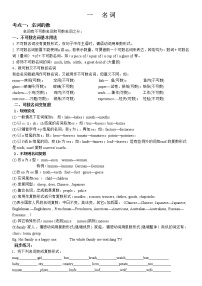
专题1 名词
【备考策略】
中考试题中的名词
名词题往往是中考英语试题的比较重要的一部分内容。综合近几年的中考试题来看,中考对名词的考查一般着眼于常用且易误用的名词,考查的主要形式是单项选择题、完形填空、正确形式填空。分值在6分——10分,需要考生在平时的学习中做好积累,尤其要注意一些常见名词、可数名词与不可数名词。做到有计划、有步骤的复习,重在学生的自主学习,教师多给予方法的指导。
【知识梳理】
■考点一:名词的分类 ►
名词的分类
名词可以分为普通名词和专有名词,专有名词是某个(些)人,地方,机构等专有的名称,如Beijing,China等。普通名词是一类人或东西或是一个抽象概念的名词,如:bk,jy等。
普通名词又可分为下面四类:
1)个体名词(Individual Nuns):表示某类人或东西中的个体,如:dctr, huse, pht。
2)集体名词(Cllective Nuns):表示若干个个体组成的集合体,如:family, class。
3)物质名词(Material Nuns):表示无法分为个体的实物,如:rice, water, air。
4)抽象名词(Abstract Nuns):表示动作、状态、品质、感情等抽象概念,如:health, friendship。
■考点二:名词复数的变化 ►
1.名词复数的规则变化
(1)一般情况加 -s
清辅音后读 /s/;map-maps
浊辅音和元音后读 /z/,bag-bags /z/;car-cars/z/
以s, sh, ch, x等结尾的词 加 -es读 /iz/ bus-buses 、watch-watches
以ce, se, ze, (d)ge等结尾的词 加 -s读 /iz/ license-license
以辅音字母+y结尾的词,变y 为i再加es 读 /z/ baby---babies
但是,以y 结尾的专有名词,或元音字母+y 结尾的名词变复数时,直接加s变复数:
如:mnkey---mnkeys,hliday---hlidays
比较: 楼层:strey ---streys,stry---stries
(5)以 结尾的名词,变复数时:
a. 加s,如: pht---phts pian---pians radi---radis z---zs;
b. 加es,如:ptat--ptates tmat--tmates
c. 均可,如:zer---zers / zeres
(6)以f或fe 结尾的名词变复数时:
a. 加s,如: belief---beliefs, rf---rfs, gulf---gulfs;
b. 去f,fe 加ves,如 knife---knives, thief---thieves, leaf---leaves
wlf---wlves, wife---wives, life---lives
c. 均可,如:handkerchief: handkerchiefs / handkerchieves
2.名词复数的不规则变化
(1)child---children;ft---feet tth---teeth;muse---mice;man---men;wman---wmen
注意:与 man 和 wman构成的合成词,其复数形式也是 -men 和-wmen。
如: an Englishman,tw Englishmen. 但German不是合成词,故复数形式为Germans;,
(2)单复同形 如:deer,sheep,fish,Chinese,Japanese
(3)美元、英镑、法郎等都有复数形式。如: a dllar, tw dllars; a meter, tw meters
(4)集体名词,以单数形式出现,但实为复数。
如: peple plice cattle(牛) 等本身就是复数,不能说 a peple,a plice,a cattle,但可以说a persn,a pliceman,a head f cattle, the English,the British,the French,the Chinese,the Japanese,the Swiss 等名词,表示国民总称时,作复数用。如: The Chinese are industries and brave. 中国人民是勤劳勇敢的。
(5)以s结尾,仍为单数的名词,如: a. maths,plitics,physics等名词,为不可数名词,是单数。
(6)news 是不可数名词。
(7)the United States(美利坚合众国),the United Natins(联合国) 应视为单数。
如:The United Natins was rganized in 1945. 联合国是1945年组建起来的。
(8)以复数形式出现的书名,剧名,报纸,杂志名,也可视为单数。
"The Arabian Nights" is a very interesting stry-bk. 是一本非常有趣的故事书。
(9)表示由两部分构成的东西,如:glasses (眼镜) trusers, clthes
(10)若表达具体数目,要借助数量词 pair(对,双); suit(套); a pair f glasses; tw pairs f trusers
(11)另外还有一些名词,其复数形式有时可表达别的意思,如:gds货物,waters水域,fishes(各种)鱼
3.不可数名词量的变化
物质名词: 结构: 数词+量词(可以是复数形式) + f +不可数名词
例如:a glass f water 一杯水;tw glasses f water
a. 当物质名词转化为个体名词时。
比较:Cake is a kind f fd. 蛋糕是一种食物。 (不可数) These cakes are sweet. 这些蛋糕很好吃。 (可数)
b. 当物质名词表示该物质的种类时,名词可数。
This factry prduces steel. (不可数) We need varius steels. (可数)
c. 当物质名词表示份数时,可数。
Our cuntry is famus fr tea. 我国因茶叶而闻名。
Tw teas, please. 请来两份茶。
■考点三:名词的所有格 ►
名词的所有格
在英语中有些名词可以加’s来表示所有或所属关系,带这种词尾的名词形式称为该名词的所有格,如:a teacher’s bk。名词所有格的规则如下:
名词的所有格的表示方法:
(1)表示有生命的东西(人或动物)的名词所有格一般在名词后加’s。
my father’s study 我父亲的书房
a. 以s或es结尾的复数名词的所有格只在名词后加“ ’ ”。the teachers’ reading rm 教员阅览室
b. 不以s结尾的复数名词的所有格要加 ’s。the peple’s right 人民的权利 the wmen’s dress
c. 如专有名词以s结尾,它的所有格一般只加“ ’ ”,但也有加 ’s 的时候。Burns’ pems 彭斯的诗
d. 复合名词的所有格的词尾 ’s 加在后面的名词之后。her sn-in-law’s pht 她女婿的照片
e. 如果一样东西为两人共有,则只在后一个名词的后面加’s 。如果不是共有的,则两个名词之后都要加’s。
Jane and Helen’s rm 珍妮和海伦的房间(共有)
Bill’s and Tm’s radis 比尔的收音机和汤姆的收音机(不共有)
f. 有些指时间,距离,国家,城镇的无生命名词也可加 ’s 表示所有格。
half an hur’s class 半个小时的课 China’s industry 中国的工业
twenty minutes’ walk 二十分钟的路程
(2)表示无生命东西的名词一般与f构成词组,表示所有关系。
the cver f the bk 书的封面
the cntent f the stry故事的内容
(3) 指有生命的名词有时也可以用f词组表示所有格。
a. 如果名词较长。
the stry f Dr. Nrman Bethune 白求恩的故事
the wrks f Marx, Engels, Lenin and Stalin马,恩,列,斯著作
b. 如果名词的定语较长,就只能用f词组来表示所有关系。
D yu knw the name f the by standing at the gate? 你知道站在大门旁的那个男孩的名字吗?
【典例精析】
■考点一:名词的分类►
◇典例1:( )——Lk,the bss is very angry with Alex.
——Well,he came late again.But that's n______ t shut at him.
A.prblem B.lessn C.excuse D.Reasn
◇典例2:( )As we all knw, Wudang Muntain is the ______ f Shiyan.
A. prud B. pride C. prgress D. purpse
◇典例3:——Michael,hw much d yu knw abut_________?
——Peple usually eat rice dumplings t remember Qu Yuan.
A.the Mid-Autumn Festival
B.the Spring Festival
C.the Dragn Bat Festival
D.the Lantern Festival
◇典例4:——Culd yu take ut the rubbish and d the dishes,Tny?
——Sure,Mm will be mad if she sees this _________,I think.
A.matter B.mess C.truble D.difficulty
◇典例5:——I feel tired. I have s much wrk t d and dn’t have much time fr myself.
——Yu shuld take_____,I think.
A.health B. exercise C. lessn D. time
◇典例6:将下列词组译成英语:
1.一群孩子__________ 2.两箱子苹果__________ 3.十杯牛奶__________
4.多种植物__________ 5.一副眼镜_________ 6.四瓶橘汁__________
7.五杯茶__________ 8.六碗米饭__________ 9.七袋米__________
■考点二:名词复数的变化►
◇典例1:按要求填入单词的适当形式
Tw________ live in this building. (family)
2.Lk at thse _______. (child)
3.I can see a ________ standing near the dr. (pliceman)
4.There are sme ________ n the table. (glass)
5.Wuld yu like sme ________? (bread)
6.I have tw ________. (sister)
7.I like ________. (cat)
8.D yu want sme ________ fr supper? (ptat)
9.He has tw ________. One is ld ,the ther is new .(watch)
In autumn ,yu can see a lt f ________ n the grund. (leaf)
◇典例2:( ) Please remember t give the hrse sme tree___.
A. leafs B. leaves C. leaf D. leave
◇典例3: ——Wuld yu like___ tea?
——N, thanks. I have drunk tw____.
A. any,bttles f range B. sme,bttles f range
C. many,bttles f ranges D. few,bttle f ranges
◇典例4:( )Each cuple in China can have tw_____frm January 1st,2016
A.by B.girl C.children D.child
◇典例5:Yibin is ne f the mst beautiful ____in Si Chuan.( )
A.city B.cities C.citys D.cityes
◇典例6:——It's ht tday.Have sme ________,please.
——N,thanks.I'm nt thirsty at all.
A.water B.ptates C.bread D.cakes
◇典例7:( )——There are many ________ abut this farm.
——Yes, lts f ________ are planted n it.
A. pht; ptat B. phts; ptats C. phts; ptates D. phtes; ptates
◇典例7:( )——What can I d fr yu?
——I want tw ____.
A. bttle f milk B. bttles f milk C. bttles f milks D. bttle f milks
■考点三:名词的所有格 ►
◇典例1:将下列句子翻译成英语
(1)露西和莉莉的父亲都是医生。
◇典例2:( )——Are yu sure this is a pht _______,the famus cmedy actress?
——It surprised yu,didn't it?But she was nce really thin.
A.Jia Ling B.Jia Ling's C.f Jia Ling D.f Jia Ling's
◇典例3:( )Jan is____.
A. Mary's and Jack sister B. Mary and Jack's sister
C. Mary and Jack sister D. Mary's and Jack's sister
◇典例4:用单词的适当形式填空
It takes abut_________walk frm my hme t schl.(五分钟)
◇典例5:( )____ rm is big and nice.
A. Kate´s and Jane´s B. Kate´s and Jane C. Kate and Jane´s
◇典例6:( )It is widely believed that the pull f gravity n a falling raindrp changes rund shape int a teardrp shape.
A. f the drp B. the drp’s C. drp f D. drps the
【易错疑难】
1.对可数名词与不可数名词理解有误
例一:I´d like_________because I am very thirsty.(两杯牛奶)
例二:— Mum, I’m hungry. May I have sme ______?
—Sure. But I dn’t eat t much.
A. hamburgers B. milks C. cake D.banana
例三:There are many websites n the Internet and there ________ a lt f useful ________ n the websites.
A. are; infrmatins B. are; infrmatin
C. is; infrmatin D. is; infrmatin
2.对名词所有格理解有误
例四:三月八号是妇女节。(翻译成英语)
例五:—It’s easy t travel frm Urumqi t Lanzhu by taking high-speed railway.
—Yes. It’s nly _____.
A. eight hurs ride B. eight hur´s ride
C. eight-hurs ride D. eight hurs´ride
例六: It’s abut _________ frm ur schl t my huse.
A. 20 minutes’ walk B. 20 minute’s walk
C. walk f 20 minutes D. 20 minutes’ walks
3.对集合名词“sheep”的理解有误
例七:( )Lk, these_____eating grass n the hill.
A. sheep is B. sheeps is C. sheep are D. sheeps are
4.对相似名词记忆不准确。
例八:——Hw did yu put tgether the mdel plane s perfectly?
——It's easy. I just fllwed the .
A. instructins B. instruments C. interviews D. inventins
专题2 代词
【备考策略】
一、中考试题中的代词
代词题往往是中考英语试题的比较重要的一部分内容。综合近几年的中考试题来看,中考对代词的考查一般着眼于常用且易误用的代词,同时代词占据的比例比较大。考查的主要形式是单项选择题、完形填空正确形式填空。需要考生在平时的学习中做好积累,尤其要注意一些常见指示代词、不定代词与人称代词。做到有计划、有步骤的复习,重在学生的自主学习,教师多给予方法的指导。
【知识梳理】
■考点一:人称代词 ►
1、人称代词
用法口诀: 人称代词分两格,主格宾格来分说;
主格定把主语作,宾格作宾不会错。
(1) I(我)” 不论在什么地方都要大写。
I study English every day.
(2) “she”常常代替国家, 城市, 宠物等,表示一种亲密或爱抚的感情。
I live in China。 She is a great cuntry.
(3) “it” 有时也可指人。(敲门,打电话)
It's me. Open the dr, please.
(4) 人称代词并用时,单数为第二人称,第三人称,第一人称;复数为第一人称,第二人称,第三人称
yu , he and I help us, yu and them
在简短对话中,当人称代词单独使用或在nt 后多用宾格.
——Have mre wine? ——Nt me
——I like English. ——Me t.
■考点二:物主代词 ►
物主代词,表示“……(人)的”,表所属关系。形容词性物主代词是其中的一种,它具有形容词的特性。
(1)形容词性物主代词其后必须跟名词,不能单独使用,后面必接名词,表示所有.
举例: my pen我的钢笔 yur bag你的书包 his bike他的自行车
her desk她的书桌 Is that yur bike? 那是你的自行车吗?
Thse are ur bks. 那些是我们的书。
(2)名词性物主代词可以单独使用,在句子中可以作主语、表语、宾语使用。
举例:my pen=mine My bag is red=Mine is red
总结:形容词性物主代词相当于一个形容词,在句中作定语用。名词性的物主代词相当于一个名词。形容词性物主代词与名词性物主代词之间的关系为:
名词性物主代词=相应的形容词性物主代词+名词
例如:Yur bedrm(=yurs) is big. 你的卧室大。
Mine (=My bedrm) is big, t. 我的卧室也大。
(3)形容词性物主代词
(4)名词性物主代词
用法口诀:物主代词两类型,形容词性、名词性。
形容词性作定语,后面定把名词用。
名词性、独立用,主宾表语它都充。
■考点三:反身代词 ►
(1)反身代词又称为自身代词,表示动作行为反射到行为执行者本身。它还可以在句中起到强调的作用,用以加强语气。
(2)英语中共有八个反身代词,在使用时应注意和它所指的相应的对象在人称、性别、数
上保持一致。其基本形式如下表所示:
(3)反身代词用法口诀: 反身代词表自身,句中可作两成分:表示强调同位语,宾语动作回自身。 反身代词有以下常见搭配:enjy neself, help neself t, teach neself, by neself,
(4)a.可用作宾语,指的是宾语和主语表示同一个或同一些的人或事物。
如:Maria bught herself a scarf. 玛丽亚给自己买了一条围巾。
We must lk after urselves very well. 我们必须好好照顾自己。
b.可用作表语,指的是表语和主语表示同一个或同一些人或事物。
如: She isn’t quite herself tday. 她今天有点不舒服。
c.可用作主语或宾语的同位语,常用来加强语气。
如:She herself will fly t Lndn tmrrw. 明天她自己将要坐飞机去伦敦。
I met the writer himself last week. 我上周见到了那位作家本人。
■考点四:不定代词 ►
(1)不指明代替任何特定名词或形容词的代词叫不定代词。不定代词不仅具有名词和形容词的特征,而且还有可数和不可数之分。不定代词是英语中最重要的一类代词,它不仅数量多、用法复杂,而且也是英语考试中的一个重要的考点。
(2)不定代词主要有:
复合不定代词:
■考点五:疑问代词 ►
主 格 宾格 所有格
指人 wh whm whse
指物 what whse
指人或物 which whse
■考点六:指示代词 ►
单数 复数 用法
this these 近指
that thse 远指
【典例精析】
■考点一:人称代词►
◇典例1:根据句意填空
Culd yu recrd tday's NBA basketball game fr me?I can watch ________ later.
◇典例2:——D yu knw wh taught_____French?
——Nbdy.He learned it by____.
A.his;himself B.him;him
C.him;himself D.his;him
◇典例3:我的妈妈是一个老师。她很容易相处。(翻译成英语)
◇典例4:请向我展示你的图片,汤姆。(翻译成英语)
◇典例5:Tm, Please pass ________ the glasses. I want t read the newspapers.
A. yu B. me C. him D. her
■考点二:物主代词►
◇典例1: _______camera is nt s expensive as _______,but it wrks well,t.
A. My; his B. Mine; him
C. My; him D. Mine; his
◇典例2:I have taken _______ by mistake.(你的钢笔)
■考点三:反身代词 ►
◇典例1:他太年轻而不能照顾他自己。(翻译成英语)
◇典例2:适当形式填空
Hw are yu ging t imprve _______ this term?(yu)
■考点四:不定代词►
◇典例1:——What’s n TV tnight? Is there _________ interesting?
——I’m afraid nt.
A. smething B. anything C. nthing D. everything
◇典例2:Is there smene in the rm?(修改病句)
■考点五:疑问代词►
◇典例1:The new car has been here fr several days. _______ is it?(Whse/Wh)
◇典例2:The yung lady _______ we met yesterday is ur new maths teacher.
A. what B. whse C. whm D. which
■考点六:指示代词►
◇典例1:The pears in my basket are smaller than _______ in Jim's.
A. it B. that C. nes D. thse
◇典例2:——The ppulatin f China is larger than ______ f India.
——Yes,but India's ppulatin is increasing rapidly.
A.it B.ne C.that D.this
【易错疑难】
1.不了解主格与宾格
例一:Miss Smith is very kind.We all like ____.(她)
例二:Gd bks are like wise friends,because______supprt yu t walk frward and help yu understand the wrld.
A.they B.their C.them D.themselves
2.对形容词性物主代词和名词性物主代词理解有误
例一:用物主代词填空
This new cmputer is________,I must lk after_____cmputer.
例二:–Is this new bag______? --N, it´s______.
A. his, his B. his, hers C. yurs, my D. hers, yur
3.对反身代词的理解有误
例一:——Mike,wh helped yu make the paper plane?
——Nbdy!I made it all______.
A.yur B.yurs C.yu D.yurself
例二:翻译成英语
(1)谁教你滑雪?
(2)我自学的。
4.对(a) few, (a) little, many, much理解不透彻
例一:The English nvel is quite easy fr yu. There are ______ new wrds in it.
A. a little B. little C. a few D. few
例二:根据提示完成句子
Paul has _______ friends except me, and smetimes he feels lnely.(a few)
5.混淆nne, n ne, neither的使用条件
例一:All f us were invited, but n ne f us came.(修改病句)
例二:——D yu live by yurself, Mr Wang?
——Yes. I have tw sns. But ______ f them lives with me. They are nw studying in America?
A. neither B. bth C. nne D. either
6.不理解anther, ther, thers, the ther, the thers, else之间的区别
例一:Sme peple like t rest in their free time. ______ like t travel.
A. OtherB. The thersC. OthersD. Anther
例二:适当形式填空
The supermarket is n _____ side f the street.(ther)
7.对由sme-, any-, n-, every-, 与-thing, -bdy, -ne构成的复合不定代词理解有误
例一:你的表有点问题因为它保持错误的时间。(翻译成英语)
例二:—Is there ________ in tday’s newspaper? —Yes, quite a lt.
A. anything interesting B. smething interesting
C. interesting anything D. interesting smething
专题3 冠词
【备考策略】
一、中考试题中的代词
近几年中考对冠词的考查重点是不定冠词a和an的区别,定冠词及零冠词。对冠词的习惯用法的考查是主要考点之一,所以对此类用法一定要熟记在心。另外在学习中,应充分重视对最基本的冠词知识的理解、掌握,同时注意冠词活用的问题。做题时要弄清句子中的单数名词、复数名词或不可数名词及泛指、特指等概念。预计2024年命题趋势仍可能是定冠词与不定冠词的区别和冠词的习惯用法。
【知识梳理】
冠词是一种虚词,不能在句子中作独立成分,要用在名词的前面,帮助说明名词所指的人或事物。它不能离开名词而单独存在,因此,可以说冠词就是名词的一种标志。在英语中,冠词分为不定冠词(a和an)和定冠词(the)两种:不定冠词一般用于单数名词前,表示泛指;定冠词既可修饰可数名词(单复数均可),又可修饰不可数名词,表示特指。
■考点一:不定冠词 ►
1、不定冠词a 和an的用法区别:a用在单词发辅音开首的单词前,an用在单词发元音开首的单词前。如:
a bk, a desk, a pen, a dctr, a huse ,an enemy, an accident, an animal, an egg
但注意:an hur, a useful tl
不定冠词的用法:
表示人、事和物中的某一类或某类中任何一个。
A hrse is a useful tl. A dg runs faster than a gat.
泛指某人或某事物
An ld man is sitting n the chair.
(3)表示ne 或every,但概念上没有它们那样强烈。当表示ne的意思时,一般不用tw, three等相对比。如:Every elephant has a lng nse. Take this medicine three times a day.
(4)用于某些固定词组中。
a few, a bit, a lt f, in a hurry, at a time, all f a sudden, many a, a little, a cuple f, as a matter f fact, in a wrd, have a gd time, d sb. a favr, pay a visit t, in a way, have a wrd with, make a living, take a pride in, take a walk, a great deal f, catch a cld,
(5)用在某些抽象名词前,表示“一种,一类,一场,一阵”等
She was caught in a heavy rain.
It was a wnderful tea.
That is a great disappintment.
3、不定冠词的特殊用法:
(1)与有或没有形容词修饰的抽象名词前,表示具体一个“人或物”。
He received a gd educatin.
Thank yu, Jim. Yu have dne a kindness.
Many peple agreed that a knwledge f English is a must in internatinal trade tday.
The meeting held yesterday was a success.
T advise him is a waste f time.
(2)偶尔与专有名词连用,表示某种特定意思。表示类似的一个或某一个(a certain)
a Mr Black a living Lei Feng
A Mr. Smith wants t see yu.
(3)与形容词最高级连用,表示强调,不表最高级。
The Huanghe River is a lngest river in China.
The stry is a mst interesting ne.
(4)用在有形容词修饰的一日三餐、季节和日期前
Befre I g t wrk every mrning, I’ve a light breakfast.
The traffic accident happened n a Sunday t the end f the July.
(5)用于序数词前,表示“再一,又一”而不表顺序。
Hw imprtant it is t learn a secnd language.
The fisherman cast a third net.
(6)表示类别,有any, per之意,a(n)不必译成汉语,此时a(n)可改为the或不用冠词(但必须用名词复数形式)。
His incme is ne thusand yuan a mnth.
A camel is a useful animal. = Camels are useful animals.
(7)不定冠词用于一些原来是动词的名词前。
Let’s have a lk arund the playgrund after supper.
have a rest / walk / swim / talk … (have = take)
give a shut / whistle / lud laugh …
make a drive / mve …
(8)用在同源宾语中。
Nw we are living a happy life.
Last night I dream a terrible dream.
■考点二:定冠词 ►
冠词the的用法:
1、用于特指(基本用法)。表示某一或某些特定的人或事物。
She stayed at hme and cleaned the huse.
He saw a bk n the table in his rm.
The bys in this schl wear blue shirts.
2、用于双方都知道的名词前。
What d yu think f the film?
Clse the dr, please.
Let’s g and give it t the pliceman.
3、用于世界上独一无二的事物名词前。
Which is farther frm the earth, the sun r the mn?
4、用于第二次提到的事物前。
Mr Wang has a sn and the sn is a driver.
There is a bk n the desk. The bk is Jhn’s.
5、与单数名词连用,表示一类(同a或an)
The panda is very lvely. = A panda is very lvely. = Pandas are very lvely.
6、用于最高级前(与不定冠词不同 = very),以及对两人或事物进行比较时起特定作用的比较级前。
the first / secnd, the tallest, the mst imprtant,
the taller f the tw bys, the mre interesting f the tw bks
7、用于序数词前。
the first by the third student 区别a third student
8、用于有定语修饰的名词前。
the writing desk the man standing there
9、用于乐器名词前。
D yu like playing vilin?
10、用于普通名词构成的专有名词之前,表示国家、当派、团体、组织机构、单位、报刊、条约、朝代、江河湖泊海洋、山川、群岛等。
the United States the Peple’s Republic f China the Yuth League, the Yellw River, the Peple’s Daily, the Tang Dynasty, the Philippines, the Histry Museum, the Children’s Palace, the Taiwan Straits
11、与某些形容词、分词连用表示某一类人。
the rich, the pr, the sick, the wunded
12、用于姓氏复数之前,表示全家或夫妇二人。
the Turners the Wangs the Brwns
13、用于世纪的某年代。 in the 1980s (in the 1980’s)
14、用于方位名词前。
Shanghai is in the east f China.
Japan lies t the east f China.
15、用于发明物的单数名词前。
Wh invented the telephne?
16、用于某些表示国家和民族的形容词前,泛指全体。这些词通常以-sh, -ch, -ese结尾。
the English, the French, the Chinese
17、用于表示数量的名词前。
They sld eggs by the dzen.
They were paid by the hur.
18、用于某些词组和习语中。
in the mrning in the end at the age f
n the ther hand, in the daytime
19、用于句型:主语+ pat (strike/hit/catch/tuch) +sb+介词+the+接触部位
He hit Tm in the face.
The teacher patted the by n the head.
口诀一:
沙漠河流与群山,岛屿海峡与海湾;
阶级当派国家名,组织团体和机关;
方位朝代不一样,会议条约及报刊;
乐器建筑海洋船,定冠词都不能删。
口诀二:
特指双熟悉,上文已提及;
世上独无二,序数最高级;
某些专有名,习语及乐器。
■考点三:零冠词及特例 ►
1、非特指的物质名词和抽象名词前。
paper bravery
Water bils at 1000C.
Knwledge begins with practice.
但,这些词被限定时,要用冠词,当表示个体事物或“一种、一场、一份”等含义时,前面加不定冠词。
The milk in the bttle has gne bad.
D yu want a cffee?
What d yu think f the wrk?
He has a gd knwledge f English.
2、不含有普通名词的专有名词前。
China, Beijing, Mary, Peter
但有限定性、描绘性定语修饰时,用定冠词;当表示“像…那样的人或事物”,“有个名叫……的人”时用不定冠词。
The England f thse years was an England in turmil(动乱).
“Hurry up!” said the anxius Tm.
He wishes t be an Edisn.
A Mr. White came t see yu this mrning.
3、表示语言的名词前。
We are studying English.
4、可数名词前已经有了物主代词、指示代词、不定代词、名词所有格等修饰限定时。
This bk is very cheap.
Is this Mr. Wang’s dictinary?
5、由普通名词构成的专有名词前多要加“the” 但也有的一些不用。
Tian An Men Square Chang An Avenue
Nanjing Rad Bei Hai Park Beijing University
6、在含有“day”节假日前。在中国传统节假日一般有the
New Year Day, May Day,
the Spring Festival the Dragn Bat Festival the Mid-autumn Festival the Duble Ninth Festival the Lantern Festival
7、用作称呼或表示独一无二头衔、职称等做表语、不足语、同位语时以及称呼。
Mr Liu is Chairman f ur club.
G there, by.
What shall I d next, Mther?
In 1860, Lincln was elected President f the United States.
8、表示季节、月份、周日的名词前;但季节等被限定定语修饰时,用定冠词。星期前加不定冠词表示“某一个…”。
In the spring f 2006, a Tuesday in September
9、在球类、棋类、等表运动的名词前和三餐前。
What did yu have fr breakfast? D yu like mathematics? She is fnd f playing basketball.
但在breakfast, lunch, supper前通常有描绘性形容词等修饰时,要加不定冠词。
He had a wnderful supper.
10、复数名词表示一类人或物时。 Hrses are useful animals.
11、当bike, car, taxi, bus, train, bat, ship, plane等与介词by连用时,表示一种交通手段时,不用冠词。
Did yu cme back by plane r by train?
但也可用介词in, n等或与动词搭配。这时名词前要有修饰语。cme in a car take a bus, n the train
还有by water, by land, by sea, by air也可表示交通手段。
12、turn, g 表示“变成”, 其后接名词时。
turn writer = becme a writer g scialist = becme a scialist
13、当两个名词叠用或一对相反(近)的名词连用时。
experiment after experiment hand in hand day and night step by step side by side
day after day husband and wife day by day sul and heart
14、两个名词指同一人时,前一名词有a(n), 而后一名词却没有。
He is a pet and nvelist.
15、在kind f 或kinds f 等结构中,后面的名词一般不用加冠词,但是kind前可根据需要加冠词。
He likes three kinds f bk(s).
然而,有时也可加冠词的情况。如:
What kind f a man is he? ( kind f a …意为“怎样的一个或一种……”)
类似的结构还有:srt(s) f, type(s) f, class(es) f, frm(s) f, variety (varieties) f 它们都表示一种或数种事物,后面的名词都不加冠词。
16、man作“人类”讲时,同human, mankind一样,不用加冠词。
Man has existed fr thusands f years.
17、在以“普通名词(或形容词最高级)+ as / thugh开始的让步状语从句中,前面不用冠词。
Child as he is, he knws a lt. Shrtest thugh he is, he runs fastest in ur class.
在某些独立结构中不用冠词。
He went int the frest, gun in hand. The teacher came int the classrm, ruler under arm.
19、在某些固定搭配中。
g t schl at night by train at first make rm fr
in fact n ft after schl in twn in ink / pen
n purpse in danger / truble / surprise / silence at present
n shw in rder by chance / accident
20、有无冠词意义不同:
(1)不定冠词:
in wrd 口头上 in a wrd 总而言之
f age 成年 f an age 同龄
have wrds with 争吵 have a wrd with 谈话
with child 怀孕 with a child 带着孩子
(2)定冠词:
n earth 究竟 n the earth 在地球上
at table 进餐 at the table 在餐桌旁
at schl 求学 at the schl 在学校
g t schl 去上学 g t the schl 到学校去
in hspital 住院 in the hspital 在医院里
in place f 代替 in the place f 在…..位置上
in ffice 执政 in the ffice 在办公室里
take place 发生 take the place f 取代
in pssessin f 拥有 in the pssessin f 被……拥有
in charge f 负责/掌握 in the charge f 由……负责/被掌握
ut f questin 不成问题 ut f the questin 根本不可能
in frnt f 在……前面 in the frnt f 在……内的前面
口诀一:
一年四季十二月,每周共计七天整;
含有Day的节日前,物质抽象不可数;
头衔称谓词,代词名词的中间;
专有名词极叠词,棋类游戏同球类;
还有体育项目前,用了冠词要不得。
口诀二:
下列情况应免冠,代词限定名词前;
专有名词不可数,球类三餐饭;
复数名词表泛指,两节星期月份前;
颜色语种和国名,称呼习语及头衔。
【典例精析】
■考点一:不定冠词►
◇典例1:填空。
It is generally accepted that____by must learn t stand up and fight like_____man.
◇典例2:填空。
——Jack speaks ________English like a native. I always admire him.
◇典例3:
The freigners here are greatly impressed by the face that the peple frm all walks f life are wrking hard fr the new Tianjin. (修改病句).C()())m]
◇典例4:Mst Schls have banned junk fd and brught ut new menus. “That’s cl!”said Andreas Petru, 11th grader.
A. /; an B. /;the C. the; a D. the; /
◇典例5:Dn’t take it seriusly,Alice.I wasn’t (捉弄你) — it’s nthing but_____ (一个玩笑).
(根据汉语提示填空)
■考点二:定冠词►
◇典例1:——I am s srry t have cme late fr the meeting.
——It is nt yur fault. With ______ rush-hur traffic and ______ heavy rain, it is n wnder yu were late.
A. a; a B. the; the C. /; / D. /; a
◇典例2:——Hw abut ______ (计划) t pen a branch?
——I shuld say it was ______ (失败的事情).(根据汉语提示填空)
◇典例3: That day I saw Mary grab the cat by ______ tail — which was _____ rather stupid thing t d.
A. the; a B. a; a C. a; 不填 D. the; 不填
■考点三:零冠词及特例 ►
◇典例1:If yu g ______(乘火车), yu can have quite a cmfrtable jurney, but make sure yu get a fast ne.(根据汉语提示填空)
◇典例2:My friend asked me t play ____ vlleyball, but I’m tired and I dn’t think I’ve gt ____ energy.
A. a ; / B. the ; the C. / ; / D. / ; the
◇典例3:——My sn seldm has breakfast.
—— It is unhealthy habit.Yu must ask him t change it.
A./ ; an B.the; n C./ ; a D.the; a
◇典例4:The experience f being teased and bullied may stay with the victims fr___ life and cause all kinds f scial prblems at _____later age.
A. a; a B.\; a C. the; \ D.\; the
◇典例5:________(这个世界多么美好啊) it wuld be if all cuntries in the wrld culd (和平相处).
A.a; \ B.the; \ C.a; the D.the; the
【易错疑难】
1.误解不定冠词与定冠词
例一: Zha Wei tk hme Best Actress fr her rle in “Dearest”, ________ mvie abut lking fr her child in China. It was ________ first Hng Kng film award in three tries fr Zha.
A. a ; the B. the ; the C. / ; the D. the; /
例二:I wnder what it feels like t be ne f ______ really rich. The Brwns already have Rlls Ryce and nw they are buying ______ third.
A. the; the B. /; a C. the; a D. /; the
2.对不定冠词与零冠词理解有误
例一:—Excuse me, culd yu tell me the way t the Uncle Jhn’s?
—Srry, we dn’t have Jhn here. (修改病句)
例二:I felt _____sudden urge t tell him all my prblems but I held back because I was afraid that he wuld make ______fun f me.
A.a/ B.the;/ C.a;the D.the;a
3.对定冠词与零冠词的理解有误
例一:Is this______first time yu’ve flwn n_______British Airways?
A. the;不填 B. the; a C. a; the D. 不填;a
例二:Tm, a shy by, wh lacks ______ cnfidence, desn’t get ______ attentin he deserves.
A. the; the B. /; the C. the; / D. /; /
例三:All the arrangements are nw in ________ place fr ________ graduatin ceremny that will take place tmrrw.
/;a B./;the C.the;a D.the;the
专题4 数词
【备考策略】
一、中考试题中的数词
数词题往往是中考英语试题的比较重要的一部分内容。综合近几年的中考试题来看,中考对数词的考查一般着眼于常用且易误用的数词,同时数词占据的比例比较大。英语中的数词看似简单,实际上运用时并不简单,有很多需要注意的地方。近几年中考对数词的考查主要集中在基数词和序数词的辨析用法上。日期、时间和分数也是中考考查的考点。数词考查往往与其他知识点考查结合进行,如主谓一致等。正确解答数词有关问题,需要熟记基本词汇,掌握一定解题策略。
【知识梳理】
■考点一:基数词 ►
1、基数词用来表示数目,或者说表示数量的词叫基数词。最基本的基数词如下表所示。
说明:
(1)13—19是由个位数加后缀-teen构成。注意其中13、15的拼写是thirteen和fifteen。
(2)20—90由个位数加后缀-ty构成,注意其中20—50的拼写分别是twenty, thirty, frty 和fifty;80的拼写是eighty。
(3)其它非整十的两位数21—99是由整十位数加连字符“-”,再加个位数构成。如: 81 eighty-ne。
(4)101—999的基数词先写百位数,后加and再写十位数和个位数。如: 691 six hundred and ninety-ne。
(5)1000以上的基数词先写千位数,后写百位数,再加and,最后写十位数和个位数。
如:5893 five thusand eight hundred and ninety-three。 在基数词中只有表示“百”、“千”的单位词,没有单独表示“万”、“亿”的单位词,而是用thusand(千)和millin(百万)来表达,其换算关系为:1万=10 thusand;1亿=100 millin; 10亿=a thusand millin=a billin。
(6)多位数的读法:
a.1000以上的多位数,要使用计数间隔或逗号“,”。即从个位起,每隔三位加一个间隔或逗号。第一个间隔或逗号前是thusand(千),第二个间隔或逗号前是millin(百万),第三个间隔或逗号前是a thusand millin或a billin(十亿)。
b.每隔三位分段以后就都成了101—999。读的时候十位数(或个位数)的前面一般要加and。如:
888,000,000读作:eight hundred and eighty-eight millin。
2、基数词的用法:
(1)基数词在句中的作用
基数词的作用相当于名词和形容词,在句中可作定语、主语、宾语(介宾)、表语、同位语等。
例如:
Three and five is eight. 3+5=8 (作表语)
Hw many ranges d yu want?你要多少桔子?
I want eight. 我要八个。 (作宾语)
There are eight bats in the lake. 湖里有八条小船。(作定语)
(2)Hundred, thusand, millin, dzen, scre这些词前面如有表示具体数字的词,它们不能加 “s”,反之则须加 “s”, 并要与f短语连用。例如:
three hundred peple, five thusand years;
thusands f peple, hundreds f students, thusands f trees
■考点二:序数词 ►
1、表示顺序的词,叫序数词。序数词用来表示数词顺序。除特殊情况外,序数词一般都由相应的基数词加后缀-th构成。
请见下表:
说明(基数词变序数词口诀)
一、二、三,单独记;八去t,九除e,ve要用f替,整十基数变序数,先把ty变成tie;要是遇到两位数,十位基数个位序,th最后加上去.
解析口诀:ne→first,tw→secnd,three→third这三个词变化特殊,要单独记;eight→eighth,nine→ninth,八去t,九去e后再加-th; five→fifth,twelve→twelfth,五、十二把ve换成f再加-th;twenty→twentieth,thirty→thirtieth整十先把词尾y改为ie再加-th.两位数时则十位数用基数词,个位数用序数词,如:twenty-first.
注意:
1)序数词可缩写为阿拉伯数字加序数词最后两个字母。
例如:
第一:(the) first=1st 第二:(the) secnd=2nd
第三:(the) third=3rd 第五:(the) fifth=5th
第九十七:(the) ninety-seventh=97th
第一百零一:(the) ne hundred (and)first=101st
2)编了号的事物要用基数词表示顺序,但是基数词要后置。
例如: 第一课:Lessn One 第三十二页:Page 32
第305房间:Rm 305 第12路公共汽车:Bas N.12
2、序数词的用法
序数词表顺序,主要作定语,其前面须加上定冠词the,此外,也作主语、宾语、表语和定语等,这时,被它所修饰的名词往往被省略。如:The first ( persn ) t arrive is Kate.
例如:
The first is bigger than the secnd. (作主语)第一个比第二个大。
Give me the first. (作宾语)把第一个给我。
She’s ften the first t g t schl. (作表语)她经常第一个去上
We’re ging t learn the eighth lessn. (作定语)我们将要学习第八课。
■考点三:分数表达法 ►
先写基数词表示分子,后写序数词表示分母,如果分子大于1时,分母用复数。如:ne furth;tw fifths;three tenths
1/2读作:ne half,,a half;1/4读作:ne-furth (furth),ne( a )quarter.
■考点四:小数表达法 ►
小数点前的整数按基数词的规则表示,小数点写作pint, 小数后的数字应按其数字直接表示出来。如:18.38可写成:eighteen pint three eight。
注意:小数在句中常作定语,尤其在比较方式状语从句中被使用。如:This stne is 3.5 times heavier than that ne.
■考点五:倍数表达 ►
1)…几倍大小(长短,数量)=…几倍(或分数)+the size(length, amunt)。
例如:The earth is frty-nine times the size f the mn.
地球是月球的49倍。
2)…比…几倍=…倍数(或分数)+形容词(副词)比较级+than+被比部分。
例如:His huse is three times bigger than mine. 他的房子比我的房子大三倍。
3)…是…倍=…倍数(或分数)+as +形容词+as +被比部分。
例如: This factry is fur times as big as that ne. 这个工厂是那个工厂的四倍。
■考点六:年、月、日和时间的表达法 ►
1、年份用基数词表达,分两位一读,年份前用介词in。例如:
1999 nineteen ninety-nine 2000 tw thusand 2001 tw thusand and ne
2、月份的第一个字母要大写,有些月份名称有缩写形式。例如:
一月January(Jan.), 二月February(Feb.), 三月March(Mar.), 四月(Apr.),五月May, 六月June, 七月July, 八月August(Aug.),九月September(Sep.), 十月Octber(Oct.), 十一月Nvember(Nv.), 十二月December(Dec.)。
3、日期的表达要用序数词,读时前面要加定冠词the,介词要使用n。
例如:在6月1日:n June 1st 读作:n June the first.
年、月、日同时表达时,一般应先写月、日、后写年。如:
在2001年5月4日:n May 4 th, 2001。
4、年代用基数词的复数表示。
例如:20世纪90年代:nineteen nineties;21世纪20年代:twenty twenties
5、时间表达法:时间可用顺读法或倒读法两种方式表达。例如: 5:00 five (’clck)
6、18 six eighteen或 eighteen past six 12:15 twelve fifteen 或fifteen (a quarter) past twelve
4:30 fur thirty或 half past fur 6:45 six frty-five a quarter t seven
注意:
(1)表示整点时间,直接用基数词表达,后边可接’clck (也可不加)。表达“几点几分”时,绝不能用’clck。
(2)表达“15分”或“45分”时,常用quarter(刻)。
(3)在倒读法中,如果钟点不过半,须用“分钟数+past+钟点数”的形式;如果钟点过半,则用“差多少分钟数+t+全钟点(下个钟点数)”的形式。
7、两组与数词有关的介词短语:
(1)in+定冠词the+数词的复数形式,表示年代。如:in the 1870s或1870’s
(2)in+物主代词+数词的复数形式,表示某人的年龄。如:in ne’s thirties。有时在物主代词后面可加上形容词early或late使其含义更确切些。如:The yung man is at mst in his early thirties.
注意:带有数词的名词作定语的表达:a seven-year-ld by,a hundred-metre race
【典例精析】
■考点一:基数词►
◇典例1:写出下列基数词
(1)8______;(2)13______;(3)21______;(4)127______;(5)5893______;
◇典例2:数百万的球迷想要去巴西看世界杯。(翻译成英语)
◇典例3:Batman and Spiderman are ______f the mst famus American cartns.
A. tw B. secnd C. the secnd
■考点二:序数词►
◇典例1:Children’s Day(儿童节) is n the________f June(六月)
◇典例2: 根据句意完成句子
______ mnth f the year is May.
◇典例3:August is the ______ mnth f a year.
■考点三:分数表达法 ►
◇典例1:用英语表示分数
(1)1/4 ______________ (2)3/4 ______________ (3)2/7_____________
◇典例2:适当形式填空
Nwadays, f the ld peple in the area used t dancing n the square after supper.(三分之二,be)
◇典例3:——What d yu think f the envirnment here?
——Wnderful! ________ f the land ________ cvered with trees and grass.
A. Tw fifths; is B. Tw fifth; is C. Tw fifths; are D. Tw fifth; are
■考点四:小数表达法 ►
◇典例1:用英语写出下列数字
(1)3.2______ (2)2.06______ (3)0.2______
◇典例2:这把尺子3.5厘米长。(将句子翻译成英语)
■考点五:倍数表达 ►
◇典例1:这个房间是那个房间的3倍大。(翻译成英语)
◇典例2:图书馆比教室5倍大。(翻译成英语)
◇典例3:The huse rent is expensive, I’ve gt abut half the space I had at hme and I’m paying ________ here.
A. as three times much B. as much three times
C. much as three times D. three times as much
◇典例4:It is reprted that the United States uses ________ energy as the whle f Eurpe.
A. as twice B. twice much C. twice much as D. twice as much
■考点六:年、月、日和时间的表达法 ►
◇典例1:用英语写出下列日期
2003年八月21日 (2)1997年六月一日 (3)2000年十月三日
◇典例2:用英语说出下列时间
(1)6:00 (2)7:15 (3)9:45 (4)8:30
◇典例3:Lincln was brn n ________.
A. February 12th, 1809 B. 1809, February 12th C. 1809, 12th February D. February 1809,12th
◇典例4:Elena was a singer in______.
A a 1870 B 1870s C 1870’s D the 1870’s
【易错疑难】
1.不理解确数与约数的使用方法
例一:正确形式填空
Abut six_____peple were invited t the meeting.(hundred)
例二:There are _______ peple in the cinema.
A.tw hundred B .tw hundreds C. tw hundred f D. tw hundreds f
2.不理解序数词和基数词与冠词的关系
例一:(1)他第一次尝试失败了。(2)我的号码是49号。(翻译成英语)
例二:March is ________mnth f a year.
A.a three B.the third C.a third
3.不理解不定冠词与序数词的搭配
例一:The mnkey ate a secnd banana.(翻译成汉语)
例二:我想再喝一杯牛奶。(翻译成英语)
4.混淆了 “数词+mre”与“anther+数词”的用法。
例一:Mr Smith asked me t fetch ____________.(再拿三张光盘)
例二:She wants t buy_______,because she likes them s much.
A.mre tw pens B.tw mre pens C.tw anther pens D.anther tw pen
专题5 介词
【备考策略】
一、中考试题中的介词
介词是一种用来表示词语词之间、词与句之间的关系的词,在句中不能单独做句子成分。介词分为简单介词和短语介词两种。简单介词即单个介词,如in,under,n,fr,after等;短语介词指多个单词构成的介词,如in frnt f,instead f,far frm等。介词短语与短语介词不同。介词短语指由“介词+名词/代词等” 构成的短语,如at schl,by bus,n Sunday等,在句中可以作定语、状语、表语、宾语补足语等。有些单词,既可以作介词,也可以作连词(作连词时,其后接句子),如after,befre等;而有些单词,既可以作介词,也可以作副词,如abve,belw等。
介词是中考试卷中的“常客”,从时间上看,年年都要考;从地点上看,每个地区都要考。考查介词的主要题目有:单项填空、完形填空、短文填空及句子翻译等。
【知识梳理】
■考点一:时间介词►
■考点二:地点、方位介词 ►
注意:at, in, n表示地点的用法:①at表地点时,指空间位置上的某一点,后面常接小地方。如:at the bus stp;②in表地点时,指在某一立体空间范围内,后面接大地方。如:in shanghai;③n表地点时,指某物与另一物表面相接触,或与某地方接壤等。如:n the table等。
in, n, t表示方位的用法:①范围之内用in;②相邻、接壤用n;③不相邻或隔海相望用t。
■考点三:手段、方法介词 ►
■考点四:其他常用介词 ►
■考点五:介词短语 ►
【典例精析】
■考点一:时间介词►
◇典例1:I was brn ______ December 17. This year I’ll hld a birthday party fr it at
hme.
A. nB. atC. inD. by
◇典例2:Fr many Western peple, they drink cld water even ______ winter.
A. n B. fr C. at D. in
◇典例3:——The charity walk begins ______ 9:00. Dn’t be late. ——N prblem.
A. at B. by C. in D. n
◇典例4: The Dragn Bat Festival this year will cme ______ fur days.
A. afterB. frC. duringD. in
◇典例5:首字母填空
He has been away frm hme s________ tw days ag.
■考点二:地点、方位介词 ►
◇典例1:——I like the weather in Kunming. It’s warm all year lng.
——Yes. And the temperature stays ______ zer all the time.
A. at B. belw C. arund D. abve
◇典例2:The bank is ______ the bkstre and the pst ffice.
A. at the frnt fD. amngC. betweenD. in
◇典例3:Yu must be careful when yu swim ______ the lake.
A. acrssB. belwC. verD. thrugh
◇典例4:——Excuse me, where is the bkstre?
——G ______ the bridge. Yu’ll see it n yur left.
A. n B. crss C. acrss D. thrugh
◇典例5:Heilngjiang Prvince is _____ the nrtheast f China.
A. t B. in C. nD. at
■考点三:手段、方法介词 ►
◇典例1:Ma Yun, the Chairpersn f Alibaba Grup, has made much mney _____
the Internet.
A. thrugh B. alng C. acrss D. twards
◇典例2: Mre and mre peple in Shanghai chse t g t wrk ______ undergrund.
A. in B. with C. by D. fr
◇典例3:Gina, what’s this ______ English?
A. byB. frC. inD. with
◇典例4:We can save mney ______ cking ur wn meals instead f eating utside.
A. byB. tC. frD. with
■考点四:其他常用介词 ►
◇典例1:——D yu remember what she lked like when yu first met her?
——Of curse. She was tall and thin ______ lng hair.
A. inB. withC. nD. fr
◇典例2:Jack had t stp wrking thugh it was ______ his wn wishes.
A. nB. frC. againstD. by
◇典例3:Wild animals are ur friends. We shuldn’t kill them ______ fd r clthing.
A. inB. withC. abutD. fr
◇典例4:It is great___us t get s many favurite bks n Internatinal Children’s Bk Day.
A. tB. withC. fD. fr
◇典例5:He lked at me and, ______ a wrd, smiled.
A. inB. withC. withutD. fr
◇典例6:All f us went t the park ______ Bb. He had t lk after his sister.
A. beside B. withC. exceptD. besides
■考点五:介词短语 ►
◇典例1:My mther says my friend is similar ______ me, but I think she is different
______ me.
A. as; frmB. t; frmC. t; tD. as; t
◇典例2:They hpe it can prtect them ______ terrible air.
A. inB. frmC. frD. at
◇典例3:When the king saw that she as playing his ld harp, he was filled ______ jy.
A. inB. fC. byD. with
◇典例4:Mr. Yang’s daughter is pretty gd ___ drawing pictures and wn many prizes.
A. with B. fr C. in D. at
【易错疑难】
1.将besides,except,but意义混淆
例一:除了汤姆以外,我们还需要三个男同学(翻译成英语)
2.对between,amng理解有误
例一:将下列句子翻译成英语
(1)床头柜在床和扶手椅之间。
(2)这部电影是现代影片中最好的。
例二:将下列句子翻译成英语
(1)王涛坐在李明和我之间。
(2)群山之中有一个村子。
3.对thrugh,acrss,acrss frm的理解有误
例一:将下列句子翻译成英语
(1)他穿过大厅走到门口。
(2)他们正在修建一条隧道,它将穿过这座山。
(3)鞋店在银行对面。
4.混淆in frnt f与in the frnt f的使用
例一:将下列句子翻译成英语
(1)房子前面有一棵大树。
(2)那位老师坐在教室的前面。
5.对句型it´s+形容词+fr sb t d sth与it´s+形容词+f sb t d sth的理解有误
例一:将下列句子翻译成英语
(1)对我们来说学好英语很重要。
(2)帮助我们,你太善良了。
专题6 形容词
【备考策略】
一、中考试题中的形容词
形容词是用于描写或修饰名词或代词的词,它可以表示人或事物的性质、特征、状态和属性,在句中可用作定语、表语、补语、状语等。
中考试题对形容词的考查涉及形容词原级、比较级和最高级的各种句型,形容词作定语的位置,易混淆的形容词用法辨析等。从考查形式看,一般有单项选择、完形填空、词语运用等。需要考生在平时的学习中做好积累,做到有计划、有步骤的复习,重在学生的自主学习,教师多给予方法的指导。
【知识梳理】
■考点一:形容词的句法功能►
(1)作表语,放在系动词之后。常见的系动词有be, becme, get(变), turn(变), feel, lk(看起来), seem, smell, sund, taste。
如: He lks happy tday. Silk feels sft. 绸子摸起来很软。
Milk is able t turn bad easily in summer.牛奶在夏天很容易变坏。
Her parents are very ld.她的父母很老了。
Everyne was happy.人人都很快活。
(2)作定语,放在名词前, smething, anything, nthing, everything等复合不定代词之后;形容词修饰疑问代词时,也须放在其后。
如:It’s a cld day. Wuld yu like smething ht t drink?天冷,你想喝点什么?
What else can yu see? 你还能看见其它什么东西?
(3)作宾补,放在宾语之后
keep/find/make/think+宾语+形容词(作宾补)
例如:We are making ur cuntry strng.我们正使我们的国家强壮。
The news made her sad.这消息使她很伤心。
We fund the rm empty.我们发现房间是空的。
【说明】这类句型若变为被动语态,形容词则为主语补足语:
She was made sad by the news.这消息使她很伤心。
(4)作状语
形容词用作状语的三种类型
1)类型一:说明性状语
形容词的主要功能是用作定语和表语,但有时也可用作状语(有人也称之为主语补足语,因为它们是补充说明主语的)。如:
He lay in bed, awake. 他躺在床上,没有睡着。(表伴随)
He arrived hme, hungry and tired. 他回到家里,又饿又累。(表结果)
Unable t affrd the time, I had t give up the plan. 由于抽不出时间,我不得不放弃这个计划。(表原因)
形容词用作状语的特点是,该形容词的逻辑主语就是句子主语,并且通常可以用并列句或主从复合句来改写。如以上各句可改写为:
He lay in bed and he was awake.
He arrived hme and he was hungry and tired.
Because I was unable t affrd the time, I had t give up the plan.
2)类型二:程度状语
有少数形容词,如red, biling, freezing, icy, bitter等,它们在某些搭配中可以起副词,用作状语,表示程度,意为“很”“非常”等。如:
The stve was red ht. 火炉是炽热的。
It’s biling ht. 它是滚烫的。
His face was bright red. 他的脸是鲜红的。
The weather is freezing [icy, bitter] cld. 天气冷极了。
但这样的用法非常有限,并往往只用于某些特定搭配中,如可说 bitter cld(冰冷),bitter wind(寒风)等,但习惯上却不说 bitter ht(炽热),bitter busy(极忙)等。
3)类型三:承上启下性状语
有些形容词在某些固定结构中可用作独立成分,起承上启下的作用(也可视为一种状语)。如:
Sure enugh, she was there. 果然她在那里。
Strange t say, he did pass his exam after all. 说也奇怪,考试他竟然通过了。
He may be late. Wrse still, he may nt cme at all. 他可能会迟到。更糟的是,他可能根本不来。
Mre imprtant, he’s gt a steady jb. 更重要的是他得到了一个稳定的工作。
Mst remarkable f all, he never suffers frm nerves n the stage. 最了不起的是他从不怯场。
■考点二:形容词位置 ►
1.前置与后置
(1)形容词用作定语一般应前置(即置于被修饰的名词前):
a beautiful girl美丽的女孩an interesting stry有趣的故事
cheap clthes便宜的衣服difficult prblems难题
(2)以下情况形容词作定语可以后置或必须后置:
①表语形容词若用作定语,必须后置:
Wh is the greatest pet alive?谁是当今世界上最伟大的诗人?
②修饰smething,anything,everything,nthing,everyne,anybdy等复合不定代词的形容词,必须后置:
There must be smething wrng with it.它一定出了什么问题。
Keep everything useful.保存好所有有用的东西。
③在“数词+名词+ld(lng,high,deep,tall等)”结构中,形容词总是后置:
The by is nly five years ld.这男孩只有5岁。
The tree is abut 20 meters tall.这棵树大约20米高。
【说明】形容词heavy不用于该结构,如回答Hw heavy is the bx?时,不能用It's 10 kils heavy.(应去掉heavy)
(3)形容词enugh修饰名词时可前置:
D yu have enugh mney?你有足够的钱吗?
We have enugh time.我们有足够的时间。
2.前置形容词的排列顺序
当名词的修饰语不只一个时,我们就得考虑它们的排列顺序问题。在通常情况下,它们的顺序为遵循以下原则:描绘形容词—大小(长短高低)形容词—形状形容词—年龄(新旧)形容词—颜色形容词—国籍形容词—材料形容词—用途(类别)形容词—名词(动名词):
(口诀:美小圆旧黄,法国木书房)
It was a small yellw wden table.那是一张黄色的小木桌。
He bught a nice(好看的)small(小小的)rund(圆形的)new(新的)brwn(褐色的)French(法国产的)ak(橡木做的)writing desk(写字台).
■考点三:-ed形容词与-ing形容词 ►
顾名思义,-ed形容词即指由过去分词转化而来且以-ed结尾的形容词,-ing形容词则指以现在分词转化而来且以-ing结尾的形容词。
关于两者的用法区别,有的同学认为-ed形容词只用于人,-ing形容词只用于物,此说法尽管对初学者来说记忆方便,而且在许多情况下也是可行的,但由于说得太绝对,在许多情况下却是不可靠的。如-ing形容词用于人的情况就比比皆是:若你的老师说话幽默、讲课生动,那么不仅他的课非常interesting,而且你会说他是一个interesting man(有趣的人)。比较以下句子:
I'm interested in interesting peple.我对有趣的人感兴趣。
He was wrried abut his wrrying sn.他为他令人担忧的儿子感到担忧。
■考点四:形容词比较级 ►
1.比较等级的构成
(1)单音节和部分双音节形容词通过加后缀–er和-est构成比较级和最高级:
原级比较级最高级
tall(高的)taller tallest
quiet(安静的)quieter quietest
【说明】①若原级以字母e结尾,则只加-r和-st,如fine—finer—finest。
②若原级以“辅音字母+y”结尾,则应将y改为i,再加-er和-est构成比较级和最高级,如:dry—drier—dries,early—earlier—earliest。但是有一个例外,即shy(害羞的)—shyer—shyest。
③若原级为重读闭音节结尾,且末尾只有一个辅音字母,则双写这个辅音字母后加词尾-er和-est构成比较级和最高级,如:big—bigger—biggest。
(2)多音节和部分双音节形容词通过在其前加mre和mst构成比较级和最高级:
原级比较级最高级
difficult(困难的)mre difficult mst difficult
dangerus(危险的)mre dangerus mst dangerus
如clever,cmmn,gentle,handsme,happy,narrw,plite,quiet,shallw,simple,stupid)可以有两种方式构成比较级和最高级:clever—cleverer/mre clever—cleverest/mst clever等。
2.形容词比较等级的不规则变化
原级比较级最高级
gd(好的)better best
well(好,健康的)better best
bad(坏的)wrse wrst
ill(有病的)wrse wrst
much(多)mre mst
many(多)mre mst
little(少)less least
far(远)farther/further farthest/furthest
3.farther,further与farthest,furthest的用法区别
(1)表示距离时,四个词都可用:
Which twn is farther[further]frm this city?哪个城镇离这座城市更远?
What's the farthest[furthest]distance yu've ever run?你跑过最远的距离是多少?
(2)若用于引申义,表示“更进一步”、“此外”等义,则只能用further:
Are there any further questins?还有问题吗?
4.elder,eldest与lder,ldest的用法区别
(1)ld通常的比较级和最高级分别是lder,ldest。可用于人或物,可用作表语或定语,可与than连用:
He is lder than me.他比我年纪大。
I'm tw years lder than he.我比他大两岁。
The church is the ldest building in the city.这座教堂是城里最古老的建筑。
(2)elder与eldest主要用于家人之间表明长幼关系。通常只用于人而不用于物,只用作定语而不用作表语,也不与than连用:
Wh is the eldest sister?谁是大姐?
He is my elder brther.他是我哥哥。
【说明】在美国英语中也可用lder,ldest表示长幼关系。elder与eldest的区别是:前者指两者中年纪较大的,而后者指三者或三者以上的年纪最大的。如:
ne's elder sn指两个儿子中年纪较大的一个
ne's eldest sn指三个或三个以上的儿子中年纪最大的一个
另外,elder和eldest作为形容词,通常只能用作定语,不用作表语;但若不是用作形容词(即其后不接名词)而是用作名词,则可以用作表语(此时通常有冠词或物主代词修饰):
I'm the eldest in the family.我是全家年纪最大的。
He was the elder f the tw sns.他是两个儿子中较大的。
5.使用比较等级的基本原则
不作比较用原级,两者比较用比较级,多者比较用最高级:
He is very tall.他很高。(尽管“很高”,但没有比较,故用原级)
He is very shrt,but taller than me.他很矮,但比我高。
Amng the three shrt girls,Mary is the tallest.在这三个矮姑娘中,玛丽是最高的。
6.不能使用双重比较等级
即构成比较级时不能既加词尾-er,又在其前加mre;构成最高级时不能既在词尾加-est,又在其前加mst:
误:His English is mre better than mine.
正:His English is much better than mine.他的英语比我的英语好多了。
【说明】虽不能说mre better,mst earliest之类的,但可用“比较级+and+比较级”这样的形式:
It’s getting warmer and warmer.天气越来越暖和了。
The city is becming mre and mre beautiful.这个城市变得越来越美丽了。
7.使用比较等级要合乎逻辑
请看下面两道题:
(1)Her music is mre beautiful than ______.
A.me B.yu C.us D.his
此题应选D,其中的his=his music。因为从逻辑上说,应该是her music与his music作比较,而不是her music与me,yu,us比较。
(2)China is larger than ______ cuntry in Asia.
A.any B.ther C.any ther D.any thers
此题应选C,因为China也在Asia范围内,所以应在any后加上ther,以排除自己比自己大的不合理逻辑。
8.比较级前冠词使用规律
比较级前通常不用冠词,但有时也用,这主要见于以下情形:
(1)当比较级后接名词时,比较级前可能用冠词,此时的冠词不是修饰比较级,而是修饰其后的名词:
This watch is t expensive.Wuld yu shw me a cheaper ne?这块表太贵了,你能给我看一个便宜一点的吗?
(2)当要特指两者中“较(更)…”时,比较级前通常要带定冠词,此时可视为比较级后省略了有关的名词或代词ne,即定冠词实为修饰被省略的名词或代词ne:
Of the tw brthers,the yunger is mre clever.在这两兄弟中,年轻的这个更聪明。
(3)用于“the+比较级,the+比较级”,表示“越来越…”:
The sner,the better.越快越好。
The mre a man has,the mre he wants.人越有越想要。
9.最高级前冠词使用规律
(1)在形容词最高级前通常应有the:
He is the tallest by in the class.他是这个班最高的。
This cmputer is mst expensive in this shp.这种电脑是这家商店里最贵的。
(2)当最高级形容词用作表语且不带比较范围时,有时可以不用the:
This rm is(the)best.这个房间最好。
但是,当处于表语位置的最高级带有比较范围或限定性修饰语时,其前的the通常不能省去:
This rm is the best in this htel.这个房间是这家宾馆最好的。
(3)如果是对同一个人或事物在不同情况下进行对比,那么处于表语位置的最高级形容词前不能用the。比较:
He’s busiest n Sunday.他星期天最忙。(他与自己平时比,不用the)
He’s the busiest f all the peple.在所有人当中他最忙。(他与别人比,故用the)
10.比较级和最高级的常见修饰语
(1)比较级的修饰语有far,even,still,a great deal,a bit,rather,three times,any,n,very much等:
This is very much cheaper.这个便宜得多。
D yu feel any better tday?你今天感觉好点儿了吗?
This ne is even mre expensive.这个更贵些。
(2)最高级的常见修饰语有(by)far,much,nearly,almst,nt quite,secnd等:
He is far mre careful than I am.他比我仔细得多。
He is almst the tallest here.他差不多是这儿最高的。
This is much the wrst bk f all.这是所有书中最最糟糕的一本。
【说明】very不能修饰比较级,却可修饰最高级,但它与一般的修饰最高级的副词有所不同,即它要放在最高级前的定冠词之后,而不是之前:
This is the very best ne.这是最最好的。
另外,secnd,third等也要放在定冠词之后:
The Yellw River is the secnd lngest river in China.黄河是中国第二长河流。
11.as…as结构
该结构的意思是“与…一样”,其间应接形容词原级,不能用比较级或最高级:
He is as tall as his father.他与他父亲一样高。
He is as busy as befre.他还是像以前那样忙。
在否定句中第一个as也可换成s,其意为“不如”:
He is nt as[s]tall as his father.他不如他父亲高。
He is nt as[s]busy as befre.他不像以前那样忙。
12.mre than与less than
两者均可用于表示数量,mre than指“比…多”或“多于”,less than指“比…少”或“不到”:
He is mre than 50 years ld.他有50多岁了。
Tw eyes can see mre than ne.两只眼睛比一只眼睛看得真。
It's less than a mile t the statin.去车站不到一英里。
She eats less than she shuld.她吃得比她应该吃的少。
【说明】mre than除以上用法外,还可表示“不只是”、“非常”等:
He is mre than a father t her.他待她胜过父亲。
They were mre than glad t help.他们非常乐于帮忙。
【典例精析】
■考点一:形容词的句法功能►
◇典例1:The dress lks______n yu.
A. beautiful B. beautifullyC. mre beautiful D.the mst beautiful
◇典例2:It’s a cld day. Wuld yu like________ t drink?
A. ht smething B. anything ht C. ht anything D. smething ht
◇典例3:It is very ht.Yu shuld keep the dr______.
pen B. pens C. pening D. pened
◇典例4:他躺在床上,没有睡着。(翻译成英语)
■考点二:形容词位置 ►
◇典例1:She brught__________yesterday
A. dress a beautiful B. a dress beautiful C.beautiful a dress D. a beautiful dress
◇典例2:——Hw ld is the by?——The by is nly_________.
A. ld five years D.five ld years C. five years ldD. five years
◇典例3:我有一张黄色的小木桌。(翻译成英语)
■考点三:-ed形容词与-ing形容词 ►
◇典例1:The____shw n Zhejiang TV, Running Men, makes lts f peple_____.
A.interesting; relaxing B. interesting; relaxed C. interested; relaxed
■考点四:形容词比较级 ►
◇典例1: —We shuld g t schl by bus instead f by car.
—Yeah, _____cars the use, _____pllutin there will be.
A. fewer, less B. less, fewer C. the less, the fewer D. the fewer, the less
◇典例2: The _____ kids learn t be independent, the ____it is fr their future.
A. early; gd B. early; better C. earlier; better D. earlier; gd
◇典例3: I hpe my schl life f senir high will be ________ than that f junir high.
A. mre exciting B. very exciting C. as exciting as D. the mst exciting
◇典例4:—D yu enjy yurself at the cncert?
—Yes. I have never been t_____ne befre.
A. a better B. the best C. a wrse D. the wrst
◇典例5:——Have yu seen the mvie Ztpia(疯狂动物城)?
——Of curse. I think it’s _____ cartn I have ever seen.
A. funny B. the funniest C. funnier
【易错疑难】
1.对常见的系动词becme, get(变), turn(变), feel, lk(看起来), seem, smell, sund, taste理解有误
例一:这种水果尝起来很美味。(翻译成英语)
例二:这件连衣裙感觉很丝滑。(翻译成英语)
2.形容词与不定代词搭配时,对形容词的位置理解错误
例一:你能给我一些有用的东西吗?(翻译成英语)
3.对多个形容词修饰名词时,形容词位置混淆
例一:他买了一个小的,圆形的,新的,黄色的,法国的,橡木的写字台。(翻译成英语)
对-ed形容词与-ing形容词理解有误
例一:I lve swimming in summer. Nthing culd be_____ than that!
A. much interesting B. mre interested C. mre interesting D. much mre interested
5.对同级比较理解有误,表示双方在程度、性质、特征等某方面相等时,用“as+原级形容词/副词+as”的结构;表示前者不如后者时,用“nt s(as) +原级形容词/副词+as”的结构。
例一:It is just amng cuntries t hst the Olympics as t win an Olympic medal.
A. s fierce a cmpetitin B. as fierce a cmpetitin
C. such a fierce cmpetitin D. t fierce a cmpetitin
6.不了解能够修饰比较级的修饰语
例一:This is______by far mvie that I have ever seen.
A. an inspiring B. a much inspiring C. the mst inspiring D. the mre inspiring
7.对倍数的表达方式不清楚。
例一:Its said that the pwer plant is nw CD#5 large as what it was.
A. twice as B. as twice C. twice much D. much twice
例二:The farmers plan t prduce three times_______ in the year befre last t meet the increasing need f peple.
A. f crp as much this year as B. as much crp this year as
C. as mre crp this year as D. much crp this year than
专题7 副词
【备考策略】
一、中考试题中的副词
和形容词一样,副词在句中也属于修饰范畴。形容词主要修饰名词,而副词则主要用于修饰动词、形容词、其他副词以及全句,以表示程度、方式、时间、地点以及对话语的态度等。
中考试题对副词的考查涉及副词的原级、比较级和最高级的各种句型,易混淆的形容词用法辨析等。从考查形式看,一般有单项选择、完形填空、词语运用等。需要考生在平时的学习中做好积累,做到有计划、有步骤的复习,重在学生的自主学习,教师多给予方法的指导。
【知识梳理】
■考点一:副词的句法功能►
1.作状语
副词作状语,修饰动词、形容词、副词、介词短语或句子
①修饰动词 It’s raining heavily.天正下着大雨。
He speaks English well. 他英语说得非常好。
②修饰形容词 I am quite busy nw.我现在相当忙。
③修饰其他副词 Dn’t drive t fast.别骑得太快。
④修饰介词短语, —Where is the bk?书在哪儿? —Just n the desk.. 就在桌子上。
⑤修饰句子 Luckily , I passed the final exam. 幸运的是,我通过了期末考试。
2.作表语
副词作表语主要指主语的方位、方向、动作或状态.
如:in. ut. n. back. dwn. up. ff. away. upstairs等
My father is ut this mrning, but he will be in this afternn.
I'll be back in five minutes. 我五分钟后就回来。
【山西3】— Jack, I have t have a talk with yur father tday.
— Srry, Mrs King. He is ging n business and wn’t be ___ until next week.
ut B. away C. back
3.作定语
有些地点副词和时间副词可以作定语,放在所修饰的名词或代词之后。
The peple there were very friendly.那儿的人很友好。
4.作宾语补足语
副词可以作主语或宾语的补足语,说明主语或宾语的状态。
Mr. King was seen upstairs. 有人看见金先生在楼上。(作主语补足语)
Bring him in. 把他带进来 (作宾语补足语)
【拓展1】一般副词的位置
(1)通常放在被修饰的动词后面,如果动词有宾语,则要位于宾语之后(副修动后)
(2)副词修饰形容词或副词时,通常放在形容词或副词的前面,(副修形前)只有enugh例外,需要后置。
These flwers are quite beautiful. (在形容词前) 这些花相当漂亮。
He wrks very hard. (在副词前)他工作很努力。
This girl is nt ld enugh t g t schl. 这个女孩还没有到上学的年龄。
副词用法:行为动词+副词。
He writes carefully.他写地很认真。
【拓展2】enugh 修饰adj./adv时,放其后。
She is ld enugh t g t schl.她年龄足够大去上
【拓展3】常见的副词词组:
(1)Hw ld问年龄、年代。
Hw ld is the bridge? 这座桥有多少年代了?
(2)Hw many问可数名词数量。常将可数名词复数紧随其后。
Hw many pictures are there n the wall? 墙上有多少幅画?
(3)Hw much询问不可数名词的数量、物品的价格。
Hw much mney is there in the purse? 钱包里有多少钱?
Hw much is the cat?这个大衣多少钱?
(4)Hw lng提问物体的长度、时间的长短。
Hw lng des it take yu t d yur hmewrk every day?
你每天花多长时间做作业?
(5)Hw sn 对 “in+一段时间 ”提问, 表示“多久之后”。
Hw sn will yu be back? 你多久后回来?
(6)Hw ften对表示频率的副词或短语提问。
Hw ften des Mrs. Green g shpping? 格林夫人多久去购一次物?
(7)Hw far 问两地间的距离Hw tall问人(树)的高度;hw heavy问重量;hw wide问宽度;hw high可以询问建筑物、山峰高度。
Hw far is it frm the earth t the mn? 从地球到月球有多远?
■考点二:副词的分类 ►
(1)时间副词的位置及分类
(2)地点副词的位置及分类
(3)频度副词的位置及分类
(4)程度副词的位置及分类
(5)疑问副词的位置及分类
(6)关系副词的位置及分类
(7)其他常见副词
(8)易混淆的副词
■考点三:副词的构成 ►
(1)形容词——副词:形容词加-ly变副词
beautiful—beautifully bright—brightly careful—carefully
clear—clearly crrect—crrectly deep—deeply
different—differently final—finally plite—plitely
usual—usually wide—widely slw—slwly
recent—recently regular—regularly quick—quickly
safe—safely
(2)以y结尾的变y为i加-ly
easy—easily happy—happily heavy—heavily
lucky—luckily unlucky—unluckily nisy —nisily
(3)以e结尾去e加-y
pssible—pssibly prbable—prbably simple—simply
■考点四:副词的比较级与最高级 ►
副词的比较级和最高级的构成与形容词的比较级、最高级的构成类似,有规划变化和不规则变化。
(1)规则变化
①单音节词和少数双音节词在词尾加-er/est
② 大多数副词都在词前加mre 或mst 构成比较级和最高级
(2) 不规则变化
【典例精析】
■考点一:副词的句法功能►
◇典例1:I carried the bwl with bth hands___, s that I wuldn’t break it.
A. carefully B. happily C. quickly D. carelessly
◇典例2:她现在相当忙。(翻译成英语)
◇典例3:他走的太快了。(翻译成英语)
◇典例4:——As we knw it’s difficult t live in a freign cuntry.
——_______ if yu can’t understand the language there.
A. Exactly B. Naturally C. Usually D. Especially
◇典例5:It’s dark. I can’t see the wrds n the blackbard _______.
A. carefully B. clearly C. silently D. patiently
◇典例6:(1)我们需要多少袋大米?
(2)这个连衣裙多少钱?
(3)她来自哪里?
■考点二:副词的分类 ►
◇典例1:昨天他回家了。(翻译成英语)
◇典例2:最近他去了巴黎。(翻译成英语)
◇典例3:(1)他刚刚去学校。(2)我已经做完了工作。(翻译成英语)
◇典例4:你能帮忙把桌子搬到楼上去吗?(翻译成英语)
◇典例5:Sandy used t eat fast fd. But nw she _______ eats them. S she is becming much healthier.
A. usually B. ften C. seldm D. always
◇典例6:我差点忘记带钥匙。(翻译成英语)
◇典例7:你为什么迟到了?(翻译成英语)
◇典例8:你知道哪家商店我能找到凉鞋吗?(翻译成英语)
■考点三:副词的构成 ►
◇典例1:( ) Elephants eat________, but they can mve ________ when necessary.
A.nisy; silent B.nisily; silently C.nisily; silence D.nisy; silence
■考点四:副词的比较级与最高级 ►
◇典例1: Peter speaks Chinese well indeed, but f curse nt ______ a lcal speaker in China.
A. s fluently as B. mre fluent than C. as fluent as D. much fluently than
◇典例2:I knw yu are shrter than yur brthers,but yu run _________.
A. mre faster B. fastest C. mre fast D. fast
◇典例3:I'm srry I'm late. I shuld get here 10 minutes________.
A. early B. earlier C. the earlier D. the earliest
【
◇典例4:——Our schl bus will leave at 8 ’clck tmrrw. Dn’t be late.
——OK. I will be there ten minutes __________.
A. sner B. slwer C. faster D. earlier
◇典例5:——Dad. Wuld yu please drive ________?
——N hurry. We have enugh time befre the plane takes ff.
A. faster B. mre slwly C. mre carefully
【易错疑难】
1.对t、als、either理解有误
例一:选词填空(t、als、either)。
(1)Yu are a student, I am a student,_____.
(2)They are____students.
(3)I dn’t like the film,____.
2.混淆t much与much t
例一:选词填空(t much、much t)
(1)I have______ hmewrk t d.
(2)The skirt is______dear.
3.对hw lng/hw sn/hw ften/hw far理解不准确
例一:——Hw ften d yu chat with yur friends nline?
——_________ I'm busy with my study.
A. Only ne mnth. B. Abut twice a mnth.
C. Almst every day. D. Maybe in tw weeks.
例二:——It’s very imprtant fr everyne t exercise.________d yu exercise?
——Three r fur times a week.
A. Hw lng B. Hw far C. Hw sn D. Hw ften
4.对t/enugh/s的理解有误
例一:将下列句子翻译成汉语。
(1)The man is t ld t lk after himself.
(2)The by runs fast enugh t win the game.
(3)The camera is s expensive that I can’t affrd it.
5.对sme time /smetime/sme times/smetimes理解有误
例一:——Hw ften d yu g skating?
——________.I can’t skate at all.
A. Always B. Smetimes C. Seldm D. Never
专题8 连词
【备考策略】
(一)连词的概念: 连词是一种虚词,不能担任一个句子成分。连词在句中主要起连接词与词、短语与短语及句子和句子的作用。它主要是包括并列连词和从属连词。
并列连词和从属连词的基本含义
(2)连词在宾语从句和状语从句中的使用
(1)本专题以单项选择、句子翻译的考查为主
【知识梳理】
一、摘要
■考点一、并列连词的分类:
表示意思转折的连词 But, yet, hwever
表示因果关系的连词 Fr, s, therefre
其他并列连词 And, r, either„r, neither„nr nt nly„but als, bth„and, as well as
例句:Slw but sure. 要慢而稳。
She’ll be back either this week r next week. 她将在这周或下周回来。
I went and she went als. 我去了,她也去了。
■考点二、并列连词的用法:
并列连词and和r:
①and 和r 是用得最多的并列连词,可以连接:
两个并列的动词: We were singing and dancing all evening. 整个晚上我们都在唱歌跳舞。
b. 名词、形容词等:
This apple is big and red.
Wuld yu like fish r beef?
c. 两个并列的分句(句子):
I said it and I meant it. 我说话算数。
②and 可连接两个分句,表示递进关系。
Give him an inch and he will take a mile. 他会得寸进尺。
③r可连接分句,表示“否则”: Dn’t drive s fast r yu’ll have an accident. 别开这么快,不然你会出车祸。
表示意思转折的连词:but, yet:
①but和yet的用法:
The weather will be sunny but cld. 天气会晴朗但很冷。
It is strange, yet true. 这很奇怪,却是真的。
②hwever, still 等为副词,但可起连接作用,表示意思的转折---“但是”或“然而”。
hwever: His first respnse was t say n. Later, hwever, he changed his mind. 他的第一反应是不行,但后来他改变了主意。 b. still: It’s raining; still I’d like t g. 天在下雨,但我还是要去。
③词组all the same: She is naughty, all the same we have t laugh at her jkes. 她很调皮,但对她的恶作剧我们还是要发笑。
表示因果的连词:
① fr可以表示“因为”,但引导的不是从句,而是并列分句,对前面情况加以解释,常用逗号把它和前面的分句分开,这在书面语中比较多见。
The days were shrt, fr it was nw December. 白天很短,因为现在已经是十二月。
She must have gne ut early, fr she had nt cme fr breakfast. 她肯定一早出去了,因为她没来吃早饭。
② s 表示结果,可译为“因此”、“所以”。 Our cases were heavy, s we tk a taxi. 我们的箱子很重,因此我们坐了出租车
③ therefre 为副词,也表示同样的意思---“因此”,可放句前: He had gne; she therefre gave the mney t me.他走了,于是她把钱给了我。
bth and 的用法
A man shuld have bth curage and perseverance.一个人既要有勇气又要 有毅力。
难点:
一、就近原则:
1)neither nr
Neither Lucy nr Lily is a League member.
nt nlybut als
Nt nly yu but als he likes ftball.
3)eitherr
Either Jim r Peter is right.
ntbut.
Nt Jim but Peter brke the cup.
从属连词:
分类: 从句种类 主要从属连词
时间从句 when, while, as, befre, after, until, till, whenever
条件从句 if, unless
目的从句 in rder that, s that
结果从句 s„that, such„that, s that, s
原因从句 because, as, since
让步从句 althugh, thugh, even thugh(if),
while 方式从句 as if, as thugh
地点从句 where, wherever
比较从句 than, as
[说明]that, whether, if 等从属连词可引导名词从句,在句中担任主 语、宾语等。
引导时间状语从句的连词(重点):
when: Dn’t get excited when yu talk. 讲话时别激动。
while: We must strike while the irn is ht. 我们要趁热打铁。
as: He smiled as he passed. 他经过时笑了笑。
befre: It will be five years befre we meet again. 要五年后咱们才能再相见。 after:
I’ll tell them after yu leave. 我将在你走后告诉他们。
until, till:
I prpse waiting till the plice get here. 我建议等警察来了再说。
since:Hw lng is it since yu came t Lndn? 你到伦敦有多久了?
whenever: Whenever it is pssible, they play utside. 一有机会他们就到外面玩耍。
引导条件状语从句的连词(重点):
条件状语从句主要由if, unless, suppsing(suppse)引导:
if: If it rains tmrrw , we will have t stay at hme.
unless: I wn’t write unless he writes first. 我不写信,除非他先给我写。
条件状语从句还有其他形式:
(难点) Yu will always have a hme as lng as I have anything. 只要我有家产,你就永远会有一个家。
引导目的状语从句的连词:
(重点) in rder that: I lent him 500 yuan in rder that he can g fr a hliday. 我借给他50英镑,使他能去度假。
s that: Ask her t hurry up with the letters s that I can sign them. 让她快点把信打好,以便我能签字。
引导结果状语从句的连词:
结果状语从句主要由s…that和such…that 引导:
s…that: He was s fat that he culdn’t get thugh the dr. 他胖得连门都过不去了。
such…that: Jim made such a nise that his sister tld him t be quiet. 吉姆吵成那样,他姐姐让他安静点。 [He shut the windw with such frce that the glass brke.
引导原因状语从句的连词:
because: Because it rained he tk a taxi. 由于下雨他叫了一辆出租 车。
as: As yu’re srry, I’ll frgive yu. 既然你悔悟了,我就原谅你。
Since: Since yu will g there, I will g t.
7 .让步状语从句的连词:
althugh / thugh: Thugh / Althugh it is nt large, the rm was light . 房间虽然不大,采光却很好。 [来源even if: They’ll stand by yu even if yu dn’t succeed. 即使你不成功,他们也会支持你。
引导方式状语从句的连词
as: Yu ught t d as I tell yu. 你应当照我说的做。
like: She can’t draw like her sister can. 她不能像她姐姐那样画画。
as if / as thugh: He lked abut as if lking fr smething. 他四处看了看,仿佛在找什么似的。
引导地点状语从句的连词:(难点) where: I’ll drive yu where yu’re ging. 你到哪儿我都可以开车送你去。
wherever: We’ll g wherever yu say. 你说哪里我们就到哪里。 everywhere: Everywhere he went, he was intrduced as the current US champin. 不管他到哪里,人们都介绍他是当前的美国冠军。
n matter where: Keep yur mbile phne with yu n matter where yu are. 不管在哪里你都要带着手机。
引导比较状语从句的连词:
than: Yu sing better than I d. 你的歌唱的比我好。
as: That’s nt s simple as it sunds. 那事并不像听起来那么简单。
引导其他从句的连词:
引导主语从句和宾语的连词有that和whether, if 可以引导宾语从句: that: She always cmplains that he is dwn n her. 她老是抱怨他看不起她。
whether: I dn’t knw whether yu like flwers. 我不知道你喜不喜欢花。
that和whether 还可以引导表语从句:
that: The fact is that he desn’t really try. 事实是他没有真正去努力。
whether: The pint is whether we ught t recmmend him. 问题是我们是否应当推荐他。
二、主要考查方式
单项选择题
三、主要题型
1.Ging t the mvies is gd, ______ I really nly like listening t music.
A. andB. butC. sD. r
2.I have nly tw tickets fr TF Bys’ cncert. ______ yu _____ he can g n with me.
A.Either r B. Neither nr C. Bth and D. Nt nly als
3. —Did yu catch the first subway this mrning?
—N, I didn’t. It had started mving __________ I culd get n it.
A. befre B. since C. after D. as sn as
4.—It is raining hard, _______the farmers are still wrking in the field.
—S they are.
A. and B. but C. s
5.Be quick, _____ we’ll be late fr schl.
A. andB. butC. rD. s
6.—Excuse me, may I cme in?
— Nt yet. Please wait n yur chair _____ yur name is called.
A. andB. untilC. afterD. since
【典例精析】
常用连词的用法辨析
while, when, as 这三个连词都可引导时间状语从句,但用法有所不同。
1)当某事正在进行的时候,又发生了另一件事。While, when, as 都可用来引导表示“背景”的时间状语从句。例如: As/When/While I was walking dwn the street I nticed a plice car.
例: —Lk at the stne bridge! D yu knw it was built?
--In the1860s. It’s quite ld.
A. whenB. hwC. whereD. why
2)当两个长动作同时进行的时候,
最常用的是while。例如: While mther was cking lunch, I was ding my hmewrk.
例: I gt hme, my sister was ding her hmewrk.
A. WhenB. BecauseC. IfD. Thugh
3)当两个动作都表示发展变化的情况时,
最常用的是as。例如: As children get lder, they becme mre and mre interested in things arund them.
— I think everyne shuld play a part in saving ur envirnment.
— I agree. Fr example, there will be less air pllutin ________ we drive less.
A. if B. s C. thugh
4)当两个短动作同时发生时,或表示“一边……一边……”时,最常用as。例如: Just as he caught the fly, he gave a lud cry. She lked behind frm time t time as she went
例:______ Tny ______ Frank likes the CD. They think the music is t nisy.
A. Nt nly; but als B. Either; r C. Neither; nr D. Bth; and
当从句的动作先于主句的动作时,通常用when。例如: When he finished his wrk, he tk a shrt rest.
例:—What d yu think f yur junir middle schl life?
—I think it is clurful. ______ I am always busy.
A. thugh B. if C. while D. until
当从句是瞬间动作,主句是延续性动作时,通常用when。例如: When Jhn arrived I was cking lunch.
例:Ztpia, the cartn, is ppular ______ there are many lvely animals in it.
A. thugh B. because C. if D. because f
【易错易难】
]
■考点一、 althugh/thugh均意为“尽管;虽然”,用来引导让步状语从句,可换用,只是 althugh 比 thugh 更为正式。但是althugh/thugh引导的从句不能与but,hwever连用,但可与yet,still,nevertheless 等副词连用。
例如:他虽然年纪很大了,但还很强壮。
(正)Althugh he is very ld,(yet) he is quite strng.
(误)Althugh he is very ld,but he is quite strng.
【拓展】thugh可以放在句末,表示“但是”,althugh却不能。
例如:They said they wuld cme;they did nt,thugh.
■考点二、有时用于主句之后,起补充说明的作用,相当于 hwever,but。
例如:He is well cntented-althugh he is pr.他很穷,然而却能知足常乐。
■考点三、若主从句主语相同,且从句谓语含有动词be,可将从句主语和动词 be 省略。
例如:Althugh (he is) quite yung,he knws a lt.
【拓展】even thugh 即使 as thugh= as if 好像
【拓展】类似用法的连词还有because与s。即同一句子中because和s不能同时使用。
一、表示选择关系的连词,连接的双方只取其一。常用连词有r, eitherr, therwise
例如:
1)Yu can g t Beijing either tday r tmrrw
2)Yu must get up early r yu wn't catch the early bus.
二、表示转折关系,连接的双方构成对比,意义上有转折。常用连词有but, hwever, while, nly
例如:
1) His brther is fnd f ftball while he likes basketball.
2) Yu can watch TV, but yu must finish yur hmewrk first.
三、表示联合关系,联合的双方是对等的,意义上趋向一致。常用连词有:and, bthand, neithernr, nt nlybut als, as well as, tgether with
例如:
1) T study English well, we need bth diligence and careful.
2) That hrse is nt nly the yungest amng the five, but als runs the fastest.
四、表示因果关系,连接的双方,互为因果,或者前因后果,或者前果后因。常用的连词有:fr, s, therefre
例如:
1) It must have rained, fr the grund is wet.
2) Yu are in the right, therefre they shuld supprt
历年中考中常考并列连词and,but,neither… nr;从属连词nw that,thugh,when。所以了解状语从句和宾语从句的真正意义有助于正确使用从属连词。
五、 易混连词
1. when,while,as
三者均可译为“在时候”。when引导的从句,动词既可以是延续性的,也可以是终止性的。一般来说,当主句的动作正在进行时,when引导的从句的动作才发生;while引导的从句中,动词只能是延续性的,一般来说,当while引导的从句的动作正在进行时,主句的动作才发生;as表示随着短暂动作的发生,另一行为伴随发生。
He was riding t schl when he was hit by a car this mrning.
Yu'd better turn ff the water while yu brush yur teeth.
She sang as she walked.
2.sthat,suchthat
s+形容词+a/an+可数名词的单数+that从句;
s+many/much/few/little+名词+that从句;
such+a/an+形容词+可数名词单数+that从句;
such+形容词+不可数名词/可数名词复数+that从句。
She is s beautiful a girl that we all like her.
She is such a gd girl that we all like her.
There are s many students n the playgrund.
专题9 动词
【备考策略】
动词,就是用来形容或表示各类动作的词汇。基本上每个完整的子句都有一个动词,要表示第二个动作时可使用不定词、动名词、对等连接词、从属连接词或增加子句等方法连结。
动词的分类:
1 实义动词
2 助动词
3 系动词
4 情态动词[来源:+网]
5 动词短语
【知识梳理】
一、摘要
■考点一、实义动词
实义动词意义完整,能独立用作谓语。实义动词有及物动词和不及物动词之分(及物动词是指后面要跟宾语的动词;不及物动词指后面不需要跟宾语的动词)。
1.及物动词后面必须跟宾语意义才完整。常用结构:
(1)主语+及物动词+宾语。
如:She missed a lt f lessns.
她耽误了很多课程。
主语+及物动词+宾语+宾语补足语。
如:He ften makes his parents angry.
他经常使他的父母生气。
(3)主语+及物动词+间接宾语+直接宾语。
如:He gave me an interesting bk.
他给了我一本有趣的书。
不及物动词本身意义完整,后面不需跟宾语。
常用结构:主语+不及物动词+(状语)。
如:LiHua wrks very hard.
李华工作很努力。
■考点二、助动词
协助主要动词构成谓语动词的词叫助动词。助动词是语法功能词,自身没有词义,不可单独使用。
1.帮助构成疑问句或否定句句式的助动词有d,des,did及其否定形式。
如:Did yu g hme last week?上周你回家了吗?
帮助构成时态的助动词有be,have,shall,will等。如:We are playing an interesting game.我们正在玩一个有趣的游戏。
■考点三、系动词
系动词亦称连系动词。本身有词义,但不能单独用作谓语,后面必须跟表语,构成“系表结构”。
常用结构:主语+系动词+表语。具体分类及用法如下:
1.状态系动词。状态系动词一般指be动词。
如:They are always very happy.他们总是很高兴。
持续系动词。持续系动词表示主语继续或保持一种状况或态度,主要有keep,remain,stay,rest,lie,stand。
如:I hpe yu'll keep fit.我希望你能保持健康。
3.表象系动词。表象系动词表示“看起来好像”,主要有seem,appear,lk等。
如:My mther seems very satisfied with my prgress.妈妈对我的进步似乎很满意。
感官系动词。感官系动词表示“……起来”,主要有feel(摸起来,感觉),smell(闻起来),sund(听起来),taste(尝起来,吃起来)等。
如:This kind f clth feels very sft.这种布摸起来很柔软。
变化系动词。变化系动词表示“主语变成什么样”,主要有becme,grw,turn,fall,get,g,cme,run等。
如:The small twn is becming busier and busier.小镇变得越来越繁忙。
终止系动词。终止系动词主要有prve,turnut(结果是,证明是)等。
如:My plan turned ut a success.我的计划成功了。
[提醒]有些系动词也是实义动词,可单独作谓语。
如:He fell ill yesterday.他昨天病了。
■考点四、情态动词
情态动词表示说话人的语气、看法,无人称和数的变化。情态动词有自己的词汇意思,但不能独立作谓语,后须跟动词原形。使用频率较高的情态动词有can(culd),may(might),must,need,shall(shuld),will(wuld)及半情态动词have t,had better。
1.can和culd
(1)can(culd)表示说话人能、可以、同意、准许,以及客观条件许可做某事。culd为can的过去式。表示请求时,culd比can更委婉。如:专题8 动词分类及动词短语Culd I brrw yur pen?我可以借你的钢笔吗?
(2)can意为“能,会”时,相当于“be able t”(适用于各种时态),can和culd只能用于现在时和过去时。
如:A few mnths later,I'll be able t swim alne.几个月后,我将能单独游泳。
(3)can't表示否定推测。
如:That can't be has gne t Beijing.那不可能是王老师。他已经去北京了。
may和might
may和might意为“可以”,表示说话人同意、许可或请求对方许可。may也可表示祝愿。might是may的过去式,表示可能性更小、语气更加委婉。
如:May I take sme phts here?我可以在这儿拍些照片吗?
May yu be happy.祝你开心。
must和have t
(1)must意为“必须,一定,准是”,表示说话人认为有必要做某事,或命令、要求别人做某事以及对事物的推测。但mustn't表示“禁止,不允许”。
如:He must be wrking in his ffice.他一定正在办公室工作。[来源:Z*X*X*K]
Yu mustn't smke here.你不准在这儿吸烟。
must和have t的区别:must表示说话人的主观意愿;have t表示客观需要。
如: I must d my hme wrk first.我必须首先做家庭作业。
It is raining hard utside.I have t stay at hme.外面雨下得很大,我不得不待在家里。
need的用法
need表示“需要,必要”,主要用于否定句和疑问句,否定形式为needn't,表示“没有必要,不必”;回答need引导的问句时,肯定回答用must,否定回答用needn't。此外,need还可以作实义动词。
如:—Need we d sme cleaning nw?—N,yu needn't.“我们必须现在大扫除吗?”“不,你们不必。”
I need t see the dctr nw.我现在需要看医生。
5.shall和will
shall主要用于第一人称,表示提建议或请求;will主要用于第二、三人称,表示征求意见或提建议。
如:Shall we g ut fr a walk after supper?我们晚饭后出去散散步好吗?
Will yu g shpping with us?你要不要和我们一起去购物呢?
shuld和wuld
shuld可用于各种人称的句子,强调义务或责任;wuld是will的过去式,与动词原形构成过去将来时,可用于多种人称,表示意愿。
如:Yu shuld study harder.你应该更加努力学习。
He said he wuld visit the Great Wall the next year.他说他明年将游览长城。
Had better
had better意为“最好”,没有人称的变化,后接不带t的不定式。
如:Yu had better exercise mre.你最好多锻炼。
■考点五、动词短语
词短语在意义上相当于一个实义动词。动词短语辨析是近年来各省市中考常考点。动词短语的词义辨析题旨在通过题干或微型语境考查考生对上下文的理解、动词短语的不同搭配识别、记忆及动词短语词义的辨析并恰当运用动词短语的能力。
1)动词+away构成的短语有:
thrw away扔掉;put away把……收拾好;give away捐赠,分发;carry away运走;run away潜逃,跑开;g away走开
2)动词+fr构成的短语有:
answer fr负责;prvide fr供养;call fr提倡,要求;plan fr打算,为……计划;hpe fr希望,期待;ask fr请求,寻找;需要;send fr派人去请;g fr努力获取;pay fr偿还,赔偿;wait fr等待;lk fr寻找
3)动词+n构成的短语有:
try n试穿,试验;put n穿上,上演;have n穿着,戴着;pull n穿,戴;hld n不挂断,停止;carry n继续开展,坚持;keep n继续;g n继续;get n上(车、船);cme n赶快
4)动词+ver构成的短语有:
cme ver过来;hand ver移交;g ver仔细检查,复习;get ver克服,恢复;lk ver检查;think ver仔细考虑;take ver接受,接管;turn ver翻转
5)动词+up构成的短语有:
bring up抚育,培养;call up召唤,打电话给;cme up走进,上来;cut up切碎;fix up修理;give up放弃;g up上升,增长;grw up长大;lk up尊敬,向上看,查寻;make up虚构,弥补,组成;put up举起,搭建;pick up捡起,(开车)接某人,偶然得到;set up建立,创(纪录);send up发射;shw up揭露,露面;turn up出现,把……调高一点;take up占据,开始从事
6)动词+ut构成的短语有:
g ut出去,熄灭;lk ut留神,当心;walk ut走出;set ut出发,开始;put ut扑灭,生产;give ut发出,发表;hand ut分发;pick ut挑选;find ut找出,发现;speak ut大声地说出;turn ut生产,打扫;get ut出去,离开;wrk ut计算出,解决,锻炼;carry ut实现,执行;bring ut出版;start ut出发,动身
■考点六、同一个动词+不同介词/副词。
1)break+介词/副词的短语有:
break dwn击败,摧毁,发生故障,(身体)垮掉;break ut爆发;break thrugh突破,突围;break ff中断,突然停止;break up打碎,分解,驱散;break in打断;break int破门而人;break away突然离开,逃脱,脱离
2)bring+介词的短语有:
bring abut使发生;bring back拿回来,使恢复;bring dwn打倒,降低;bring in引进;bring ut出版,生产;bring up培养,养育;bring ver使相信,征服
3)call+介词/副词的短语有:
call after以……的名字命名;call back叫回,召回,使回忆起;call up征召入伍,给某人打电话,使想起;call n号召,拜访某人;call in召集;call ff取消
4)cme+介词/副词的短语有:
cme in进来;cme frm来自于……;cme abut产生;cme ver过来;cme ut出来,出现;cme by从旁经过;cme up上来,走进;cme acrss偶遇;cme alng发生,进步;cme after跟着……来;cme back回来;cme arund恢复知觉,回来;cme dwn下来,倒塌
5)cut+介词的短语有:
cut in插嘴,插入;cut acrss抄近路;cut back减少;cut ff切断;cut up切碎;cut away砍掉;cut dwn砍倒,削减;cut ut切掉,裁剪出,停止;cut thrugh通过,穿过
6)get+介词/副词的短语有:
get abut传播,走动;get thrugh到达,做完,通过,度过,打通(电话);get in进入,陷入;get n上车,进展,融洽相处;get ff下车,下来;get acrss通过,被理解;get alng进展,融洽相处;get away离开,脱身
7)give+介词/副词的短语有:
give up放弃;give in屈服;give away赠送,捐赠,泄漏;give ver移交,交出,give ff放出,发出,排出;give ut分发,散发,放出(光,热);give back归还
8)g+介词/副词的短语有:
g ahead着手,开始(做),进行;g alng 进展,前进;g arund到处走动,顺便访问;g away离去;g beynd超过;g by过去,流逝;g dwn下降;g up上升;g fr喜欢;g ff离开,停止;g ver复习,温习;g thrugh经历,穿过
9)1k+介词/副词的短语有:
lk after照顾,照料;lk away把目光移开;1k arund环顾;lk at看;lk dwn朝下看;lk fr寻找;lk int调查;lk ut当心;lk thrugh浏览
10)take+介词/副词的短语有:
take ff脱下,起飞; take away带走,拿走;take ut取出,拿出;take dwn写下
11)turn+介词/副词的短有:
turn abut/rund(使)向后转,回头,转身;turn against(使)反对(某人);turn away转过脸去,拒绝;turn back往回走;turn dwn调低,关小,拒绝;turn in上缴,上交;turn int(使)变成;turn ff关掉;turn n打开;rum ut熄灭,生产;turn t求助于,转向;turn up调高,到达,出现
12)put+介词/副词的短语有:
put aside把……放在一边,积蓄;put back把……放回原处;put dwn放下,镇压;put frward提出,建议;put in放进;put ff迟,拖延;put n穿上,戴上,增加,上演;put ut生产出,出版;put up举起,张贴
13)be/get/becme+过去分词/形容词+介词的短语有:
be dressed in穿着;be fnd f爱好,喜爱;be lst in沉溺于;be lcated in位于;be addicted t沉溺于;be used t习惯于;be curius abut对……好奇;be engaged in忙于……,be glad t乐意……;be cnvinced f确信,认识到;be aware f意识到;be wrried abut担心
14)动词+副词+介词的短语有:
add up t合计达;break away frm从……脱离开;cme up with想出;catch up with赶上;get dwn t开始认真地做某事;g in fr参加,追求;keep away frm远离;keep up with跟上;date back t追溯到;put up with忍受,容忍;run ut f用完;watch ut fr当心;lk dwn upn瞧不起;g ahead with开始,着手;g alng with一起去,同意;hld n t坚持。
主要考查方式
单项选择题
三、主要题型
1.— Has Jane dne the washing yet?
— Yu cannt her t d such a thing.
A. wantB. hpeC. expectD. wish
2. The running water makes the stnes ______ very smth.
A. sundB. tasteC. smellD. feel
—Mum, shall we g t the beach tmrrw?
— It ______ the weather.
A.carries n B.lives n C.depends n D.hlds n
4.—What d yu think f the dish I cked fr yu?
—I haven’t had it yet. Hwever, it gd.
A. tastes B. smells C. sunds D. feels
5.I’ll pick yu up at the stp sign where 50 meters ahead the tw rads ______.
A. fitB. meet C. face D. reach
6.Fr ur wn safety, it’s imprtant t the traffic rules n the way t schl.
A. fllwB. changeC. makeD. break
7.-3-D printing culd be used t build a huse in less than 24 hurs.
-It ______ amazing. It's my first time t get t knw this.
A. sunds B. smells C. tastes
8.— Tm, let’s hang ut after schl.
— Srry. I have ________ Frank t wrk n the bilgy reprt with him.
A. advised B. expected C. prmised
9.My grandfather _____ live in the cuntryside, but nw he ______ living in the city.
A. used t ; used t B. gt used t ; gets used t C. used t ; gets used t
10.When the by heard the wrds, his face ______ red.
A. gt B. turned C. changed
10.— Why des the earth lk blue in space?
— Because mst f the earth’s surface ______ by water.
A.cvers B.is cvered C.cver D.are cvered
【典例精析】
■考点一、连系动词考点例析
由于英语连系动词用法灵活,用途广泛,在很多情况下只有连接作用而没有具体的意义,因此,导致很多学生往往无法正确选择合适而又正确的连系动词来构建句子,说出或写出错句。因此,连系动词成为很多地方中考英语单项选择题中不可缺少的考查点。
试看下列考例: 1.Many scientists believe that rbts ______ able t talk like humans in 50 years.
A.were B.are C.will be D.have been
2.This museum ______ here fr ver 80 years. It ______ ne f the ldest buildings in this city.
A.is; was B.had been; is C.was; has been D.has been; is
■考点二、情态动词考点例析
初中英语中在主要的情态动词有can. must, may, needn’t, will, wuld, shall, shuld等。情态动词的最大特点,在于它的意义灵活性:说话人可根据自己表达意思的需要,选择不同的情态动词来表达自己对某件事发生的可能性或必然性的态度。我们知道,can常用来表示能力或请求,用于否定陈述句中则表示否定推测;may表示请求与许可;must表示必须做某事,在肯定句中与连系动词be连用时,表示肯定推测;needn’t常用于对含must一般疑问句作否定回答。情态动词的用法有别于我们汉语的表达方式,因此,考生容易离开考题所设情景,而主观地选择情态动词,从而造成错误。
试看下列考例:
例—Have yu seen Jack? His mther is lking fr him all the afternn.
—N, I haven’t. I am sure his mther________be very wrried.
A. must B. may
C. need D. Shuld
【易错易难】
used t d sth.;be used t ding sth.和be used t d sth.的区别
辨析:①used t d sth.表示过去常常做某事. e.g. I used t get up at six in the mrnin
②be used t ding.表示习惯做某事,t 后的动词用-ing形式e.g. I'm used t getting up early.
③be used t d sth. 指被用来做什么。 e.g. Pens are used t write.
2.arrive, get 和reach的区别
辨析:arrive in +大地点,arrive at+小地点,get t+地点名词,reach是及物动词,后面直接跟地点名词。
e.g. When did yu arrive in Beijing?
We arrived at the village at five in the afternn。
3.brrw , lend和keep的区别
brrw"借",为终止性动词,表示主语"借入"某物,常用短语brrw sth. frm sb.
lend"借",为终止性动词,表示主语"借出"某物,
常用短语lend sth. t sb. keep "保存,借",为持续性动词,表示"长时间地借"
e.g. I brrwed a bk frm the schl library yesterday.
Culd yu lend yur pen t me? Hw lng can we keep the bk?
4.dress, put n, 和wear的区别
dress sb.给某人穿衣服;dress sb.up打扮某人 ;
put n 穿上,戴上,表动作;
wear 穿着,戴着,表状态;与"be in"同义
e.g. The by dressed himself quickly.
The lady dressed herself up and went t the party.
Jim put n his cat and went ut.
Lily is wearing a red skirt tday.
5.see, lk, watch, read
see 看见,表结果; lk看,表动作,不及物动词,后面需加介词at才可能跟宾语。 watch 看(比赛,电视);read 看书,报,表示阅读
e.g. I can see an apple n the table.
Lk, there is a kite flying in the sky.
Watching TV t much is bad fr yur health.
Dn't read bks in the sun.
6.bring, take, carry
bring意为"拿来,带来",表示"拿到靠说话人近的地方"; take意为"拿走,带走",表示"拿到远离说话人远的地方"; carry 意为"扛,搬",用力移动,没有方向性,
e.g. Please take the bks t the classrm.
Remember t bring yur hme wrk t schl tmrrw.
The bag is very heavy, please carry it t my ffice.
7.die, dead, death,和dying的区别
Die 意为"死",是不及物动词,非延续性动词;Dead 意为"死的",是形容词,表状态; Death 意为"死",是名词;Dying意为"垂死的,要死的",是形容词。
e.g. Her grandfather died last year.
Her grandfather has been dead fr tw years.
His death was a great lss t China. The pr ld man was dying.
speak, say, talk 和tell 的区别
speak 作为及物动词表示语言的名词或只在会议上发言;say 常跟直接引语或间接引语,并且表示说的内容; talk 是不及物动词,常跟介词 t 或with,意为"同某人谈话",也表示具有说话的能力; tell 意为"告诉"并常与stry连用,意为"讲故事"
9.spend,take,pay,cst这几个词都有“花费”意思,从主语来看,take,cst的主语是物; 而pay,spend主语是人。 Spend 只花费时间或金钱,后接n sth.或(in)ding sth.;Cst 物做主语,意为"值多少钱"
Take 可用固定句型表示花费时间、金钱,其结构为:It +takes+时间/金钱+t d sth, Pay 与介词fr 连用
10.Lk fr,find,find ut
Lk fr,find两个词都有找的意思。Lk fr强调寻找的过程,find强调寻找的结果。find ut的意思是“弄清楚,查明”,多指通过观察,探索而发现原因事实等。
例: I am lking fr my pen,but I can’t find it. G and find ut where the train leaves.
11.lse,frget,leave
Lse意为"丢失,失去";Frget"忘记"后可跟不定式和动名词
Leave sth. +地点"把某物落在某处"He left his schlbag in the schl bus this mring.
12.think f, think abut, think ver
Think f "想到…";Think abut "考虑"宾语it或them置后 Think ver "仔细考虑",宾语it或them放在中间,一般指考虑问题。
13.Jin,take part in,attend
三个词都表示"参加"Jin 一般指加入"党派"或组织, 如参军,入党等 Take part in 只参加聚会活动;Attend 一般指出席会议
14.happen ,take place
1). take place 表示―发生、举行、举办‖,一般指非偶然性事件的―发生‖,即这种事件的发生一定有某种原因或事先的安排,
例如: Great changes have taken place in ur hmetwn during the past ten years.
The Olympic Games f 2008 will take place in Beijing.
.happen作―发生、碰巧‖解,一般用于偶然或突发性事件,例如: What happened t yu? (一般不说:What did yu happen?) I happened t see him n my way hme. = It happened that I saw him n my way hme.
Hear 与 Listen―听者‖两不同
hear 是瞬间行为动词,指听见某人说话或者做事发出的声音,即听的结果(指已听见了)。 Listen 指有意识的去听,即听的过程,是延续性不及物动词,常用Listen t(ding) sth.。比较: I listened hard, but culd hear nthing.我努力听,但什么也没听见。
提示: hear f, hear abut, hear frm, hear that
1 .hear f(=hear abut)指 (间接地)听说、听到,宾语可用名词、代词、动名词及what从句。如:I heard f (abut)the news.我听说过此消息。
hear frm 指收到……来信。(=get 或receive a letter frm…)如: I hear frm him every mnth. 我每月都收到他的信。
wish和hpe的区别
wish 有 sb. wish t d sth./wish sb. t d/wish+ that 从句 而hpe:hpe t d sth./hpe+that 从句/没有hpe sb. t d sth.(这个常考的) hpe用作动词时,后面可接不定式或that从句,但不能接―宾语+不定式‖。
如: ①We hpe t see yu again.(= We hpe we can see yu again.)
②I hpe yu can help me with my maths. (不能说 I hpe yu t help me with my maths.)
注意:I wish I culd fly like a bird. 但愿我能象鸟一样飞。(从句中的culd表示其动作不可能实现,不能用can。) wish可表示良好的―祝愿‖,后面接―宾语+宾补(形容词或名词)。而hpe不能这样用。如: ①I wish yu happy.祝你幸福。(不用hpe) ②I wish yu a pleasant jurney.祝你旅途愉快。(不用hpe)
解题技能:
中考近年主要考查连系动词be,feel,lk,taste,smell等用法;及物动词和不及物动词的用法;助动词 d/des/did和have/has的用法;情态动词的用法。
纵观全国各地中考英语试题中的单项选择题中的动词类考题,可以分为以下几个大的方面:
连系动词、情态动词的用法;
第二,动词的时态;
第三,动词的语态;
第四,动词非谓语形式的用法;
第五,近义词的辨析与句义选词。
专题10 动词的时态和语态
【备考策略】
动词的时态[来源:Z&X&X&K]
动词是谓语动所表示的动作或情况发生时间的各种形式。英语动词有16种时态,但是常用的只有9种:一般现在时、一般过去时、一般将来时、现在进行时、过去进行时、现在完成时、过去完成时、过去将来时、现在完成进行时。
【知识梳理】
一、摘要
■ 考点一、一般现在时的基本用法
经常性或习惯性的动作,常与表示频度的时间状语连用。
时间状语: every…, smetimes, at…, n Sunday
I leave hme fr schl at 7 every mrning.
客观真理,客观存在,科学事实。
The earth mves arund the sun. Shanghai lies in the east f China.
表示格言或警句中。
Pride ges befre a fall.
【注意】此用法如果出现在宾语从句中,即使主句是过去时,从句谓语也要用一般现在时。 例:Clumbus prved that the earth is rund..
现在时刻的状态、能力、性格、个性。 I dn't want s much.
5) 某些动词如 cme, g, mve, stp, leave, arrive, be, finish, cntinue, start 等,在一般现在时句中可用来表示将来肯定会发生的动作。
The train cmes at 3 'clck.
在时间状语从句或条件状语从句中,一般现在时代替一般将来时。
I'll help yu as sn as yu have prblem. Tell Xia Li abut it if yu meet him.
判断标志:always=all the time,ften,usually, every day(week, mnth, year, spring,Saturday…) smetimes=at times= frm time t time, at seven(six),seldm, never, in the mrning( afternn、 evening,) n Sunday(Mnday,Tuesday) nce a year(mnth,week) three times a day twice a day, all the year arund=all ver the year, all day and all night, in the day=in the day time, at night …
■考点二、一般过去时的用法:
表示过去某一时刻或某一段时间内所发生的动作或情况,通常一般过去式带有表示动作时间状语的词,词组或从句,如 yesterday, the day befre last, last week, tw days ag 等,上下文清楚时可以不带时间状语。
I wrked in that factry last year.
【注意】 1) 过去经常反复发生的动作,也可用used t或wuld加动词原形来表达,例 如: I used t g fishing n Sundays.
“used t”也可用于表示过去曾经存在过的状态。例如:This river used t be clean.
判断标志: 过去时间状语或过去经常性的时间状语.如:yesterday, the day befre yesterday, last night(week, mnth, year, spring…) an hur /three years ag, nce, nce upn a time=lng, lng ag, 5 days later, the ther day、 in 1988、 befre liberatin, just nw, 以及由when, befre, after, until等引导的状语从句表示过去的时间状语。
■考点三、一般将来时的用法
表示将来的动作或状态。例如:I shall attend the meeting tmrrw.
表示将来反复发生的动作或存在的状态。例如: He will g t see his mther every Saturdays.
表示将来的意愿,决心,许诺, 命令等时常用will,征求对方意见,主语 是第一人称时,常用shall。
I will d my best t catch up with them. Shall I pen the dr?
be + ging + 动词不定式。也是一种将来时句型,表示打算,计划,最近 或将来要作的某事。
I am ging t Beijing next week.
be + 动词不定式(t d…)。表示有职责,义务,可能,约定,意图等。
There is t be a meeting this afternn. We are t meet the guests at the statin.
be abut + 动词不定式(t d…),表示即将作某事。
They are abut t leave. 判断标志:将来的时间状语如tmrrw, next week(mnth, year,spring, summer, autumn, winter, Mnday…), the day after tmrrw, in the future, sn, sme day=ne day等。
■考点四、现在进行时的用法
构成:助动词 am/is /are +现在分词.
1) 现在进行时的用法表示说话者说话时正在发生或者进行的动作, 它注重 现在正在进行的动作,而不管动作从什么时间开始,到什么时间结束。
What are yu ding nw? I am lking fr my key.
现在进行时表示目前一段时间内正在进行的动作(但说话时这个动作不一 定在进行)。
The students are preparing fr the examinatin.
某些动词的现在进行时可以表示即将发生的动作,这些动词有 arrive, cme, leave, start等。
They are ging t Hng Kng tmrrw.
【注意】有些动词一般不可以用于进行时态
①表示状态的动词,尤其是静态动词,如:be, have
②表示认识、知觉和情感的动词,如:knw, think, hear, find, see, like, want, wish, prefer等。 判断标志:常与nw, these days,at the mment, It’s 7:11 nw. 连用或通过上下文如: lk, listen, 等词来暗示
■考点五、现在完成时的用法
构成:have (has)+ 过去分词.
现在完成时表示在说话之前已经完成或刚完成的动作。
I have bught a ten-speed bicycle.
They have cleaned the classrm.
现在完成时表示动作从过去开始持续到现在,或者还有可能持续下去的动 作或状态。 现在完成时常与fr 和 since 引导的短语或从句连用。
We have lived here since 1976.
They have waited fr mre than tw hurs.
【注意】 一般过去时与现在完成时的区别 过去时表示过去某时发生的动作或单纯叙述过去的事情,强调动作;现在完成时为过去发生的,强调过去的事情对现在的影响,强调的是影响;一般过去时常与具体的时间状语连用。
试比较: I saw this film yesterday.(强调看的动作发生过了,不涉及现在)
have seen this film. (强调对现在的影响,电影的内容已经知道了。)
判断标志:these days., already, yet., ever, never, in the past \last few years, in the past 20 years, s far = up till nw, nce, many times, recently, fr +时间段, s ince+时间点, …befre, hw lng连用。不能与过去的时间连用。
■考点六、过去进行时的用法
构成:助动词was, (were)+现在分词。 表示过去某个时刻正在进行的状态或动作。
例如: I was watching TV when she came t see me.
【注意】 过去进行时和一般过去时都是过去发生的事情,但过去进行时侧重表示过去某一时刻正在进行的动作或所处的状态,强调动作的连续进行,而一般过去时则表示单纯的过去事实,例如: They were building a huse last mnth. (上个月正在建造,建造好与否不知)
They built a new huse last mnth. (上个月建造好了,动作已经完成)
判断标志:(常与表示过去某一时刻的时间状语连用,如:this time yesterday. at seven yesterday evening.或由when while等引起的状语从句。
■考点七、过去完成时的用法
构成:助动词had+ 过去分词. 过去完成时表示过去某一时刻或某一动作之前完成的动作或所处的状态,过去完成时常和 by , befre 等词组成的短语和从句连用。
We had already learned tw thusands wrds by the end f last year.
When we arrived at the statin, they had waited fr mre than twenty minutes.
判断标志:by the end f last mnth, by the end f last year, by nine ’clck,等时间
■考点八、过去将来时的用法
由wuld +动原构成或was(were) ging t+动原 构成。过去将来时表示从过去某个时间看将要发生的动作或存在地状态,过去将来时较多地被运用在宾语从句中。 例如: They were ging t have a meeting. I tld him that I wuld see him ff at the statin. 判断标志:the next week, the next year连用
语态有两种:主动语态和被动语态。主语是动作的发出者为主动语态;主语是动作的接受者为被动语态。 [
动词的语态
初中英语需要掌握的8种时态:一般现在时、一般过去时、现在进行时、过去进行时、现在完成时、过去完成时一般将来时和过去将来时。
【知识梳理】
xx|k.Cm]被动语态
1) 被动语态最基本的句型结构是: be +及物动词过去分词
被动语态中的谓语动词一定要是及物动词 因为被动句中的主语是动作的承受者,某些短语动词如lk after, think f, take care f, wrk ut, laugh at等,也可用于被动语态。 The children were taken gd care f by her.
【注意】 短语动词中的介词或副词变成被动语态时不可遗漏。
主动语态变为被动语态要加“t”的情况 若宾语补足语是不带t 的不定式,变为被动语态时,该不定式前要加"t"。此类动词为感官动词,如:feel, hear, help, listen t, lk at, make, bserve, see, ntice, watch等。例如: The teacher made me g ut f the classrm. I was made t g ut f the classrm (by the teacher).
主动形式表示被动意义 如wash, clean, lk, cut, sell, read, wear, feel, draw, write, sell等动词虽然用做主动形式却表示被动的意义。例如: The fd tastes gd.
■考点一.被动语态的构成:
助动词be + 及物动词的过去分词。
助动词be有人称、数和时态的变化。
(1)一般现在时的被动语态:
am(is ,are) + 动词过去分词
Rice is grwn in China .中国出产大米。
(2)一般过去时的被动语态:
Was(were) + 动词过去分词
These phts were taken last year .这些照片是去年照的。
(3)含有情态动词的被动语态:
情态动词 + be + 动词过去分词
This car can be mended in an hur .这辆小汽车一小时就能修好。
■考点二、主动语态变被动语态的方法:
(1)把主动语态的宾语提前变为被动语态的主语。
(2)把主动语态的谓语动词变为被动结构。但时态应保持一致,但人称和数的形式取决于被动语态的主语。
(3)把主动结构的主语变为介词by的宾语,组成介词短语,有时可以省略。
■考点三、
(1)被动语态的用法(即何时用被动语态)。
(2)主动语态变被动语态的方法(怎样变)。
■考点三、
(1)一般现在时的被动语态。
(2)一般过去时的被动语态。
(3)含有情态动词的被动语态。
(4)将主动语态的句子变为被动语态。有关动词的语态在历年各地中考题中约占3分左右。
■考点四、主动语态改成被动语态方法
把主动语态改为被动语态非常简单,可以遵循以下几个步骤:
1. 将主动语态的宾语作被动语态的主语;
2. 谓语动词变为"be+及物动词的过去分词",并通过be的变化来表达出 不同的时态;
3主动语态的主语变为介词by的宾语,组成介词短语放在被动结构中的谓语动词之后。(有时by的短语可以省略);
例:1. Bruce writes a letter every week. →A letter is written by Bruce every week .
■考点五、被动语态的用法:
1. 一般现在时的被动语态构成:is / am / are + 及物动词的过去分词 Our classrm is cleaned everyday.
2. 一般过去时的被动语态构成:was / were + 及物动词的过去分词 A new shp was built last year.
3. 现在完成时的被动语态构成:has / have + been + 及物动词的过去分词 This bk has been translated int many languages.
4. 一般将来时的被动语态构成:will+ be + 及物动词的过去分词 Many mre trees will be planted next year.
5. 含有情态动词的被动语态构成:情态动词+ be + 及物动词的过去分词 Yung trees must be watered ften.
6. 现在进行时的被动语态构成:am / is / are + being + 及物动词的过去分词 Uncle Wang is mending my bike nw.→ My bike is being repaired by Tm nw.
7. 不定式的被动语态:t + be + 及物动词的过去分词 There are tw bks t be read. → There are twenty mre trees t be planted.
■考点六、使用被动语态应注意的几个问题:
1. 不及物动词无被动语态。 What will happen in 100 years. The dinsaurs disappeared abut 65 millin years ag.
2. 有些动词用主动形式表示被动意义。This pen writes well. This new bk sells well.
3. 感官动词或使役动词使用省 略t的动词不定式,主动语态中不带t,但变为被动语态时,须加上t。
例:make smebdy d smething→smebdy+ be +made t d smething
see smebdy d s mething→smebdy +be +seen t d smething
The bss made the little by d heavy wrk.→The li ttle by was made t d heavy wrk by the bss.
如果是接双宾语的动词改为被动语态时,直接宾语(物)作主语,那么动词后要用介词,这个介词是由与其搭配的动词决定。
He gave me a bk.→A bk was given t me by him.
He shwed me a ticket.→A ticket was shwn t me by him.
一些动词短语用于被动语态时,动词短语应当看作一个整体,而不能丢掉其中的介词或副词。
We can't laugh at him. →He can't be laughed at by us.
主要考查方式
单项选择题
三、主要题型
1.—Have yu ever been t Xiamen?
—Yes. I _ there in 2013.
A. g B. went C.have gne[来源:Z_X_X_K]
2.—Ben, why are yu watching TV at this time? Hw abut yur hmewrk?
— I_______ all f it, Mrn. I want t have a rest.
A. finish B. am finishing C. have finished
3.I _______ with my parents when he rang me up yesterday afternn.
A. am shppingB. am shpingC. was shppingD. was shping
4. If it , we will g hiking at Cl City Park.
A. nt rain B. dn’t rain C. wn’t rain D. desn’t rain
5.T ur surprise, the walls f the new bkstre ____bks.
A. are lined with B. is lined with C. have lined with
6.— Lts f trees and flwers ________ in Zhangzhu every year.
— Yu're right. That makes ur city mre and mre beautiful.
A. are planted B. were planted C will be planted
7.Nw it’s much easier t shp nline when yur rder is ready, the things yu want t buy
t yu sn.
A. send B. were sent C. are sending D. will be sent
8. I wnder when Subway Ⅱ in Harbin . When the day cmes, I' ll spend less time ging t schl every day.
A. is finish B. will be finished C. was finished
9.Yu can’t wear shes inside this place.It_____.
A.desn’t allw B.isn’t allwed[来源:Z,X,X,K]
C.hasn’t allwed D.wasn’t allwed
10.Last week the ld bks ______ t raise mney fr Free the Children.
A. sld B. are sld C. were sld
【典例精析】
动词时态
动词的基本形式:英语动词有四种基本形式:动词原形,过去式,过去分词和现在分词。这四种动词形式和助动词一起构成动词的时态,语态和语气。
动词的原形。就是词典中所给的形式。例如:be, have, buy, sit.
例:The shp in Wanda Square ________ fr six years, but I ________ there s far.
A. has pened; haven’t gne B. has been pen; haven’t been
C. has been pen; haven’t gne D. has pened; haven’t been
2.动词过去式和过去分词的构成有规则的和不规则的两种形式。
规则动词的过去式和过去分词,由在原形动词的后面加词尾 -ed 构成。例如:wrk - wrked - wrked. 不规则动词的过去式和过去分词的形式是不规则的,须要一一记忆。 例如:g - went - gne, d - did - dne.
例— Where did yu g last weekend?
—I t the Great Wall.
A. gB. wentC. will gD. have gne
3.动词的现在分词由动词原形加 -ing 构成。构成方法如下:
a)一般情况在动词原形后加 -ing 。例如:g---ging stand---standing
b)以
不发音的 e 结尾的动词,去掉 e ,再加 -ing. 动词是闭音节的单音节词,或是以重读闭音节结尾的多音节词,而末尾只有一辅音字母时,这个辅音字母须双写,然后再加 ing。例如:arrive- arriving get- getting.
c)少数几个以 -ie 结尾的动词,须将 ie 变成 y ,再加 ing. 例如:die--dying lie--lying。
例: I saw Sam and David in the playgrund yesterday afternn. They games with their classmates then.
A. playB. will playC. are playingD. were playing
4. 动词的时态
英语动词的时态是一种动词的形式。不同的动词时态用以表示不同的时间和方式。共有十六种时态。
一般时 进行时 完成时 完成进行时
一般现在时 现在进行时 现在完成时 现在完成进行时
一般过去时 过去进行时 过去完成时 过去完成进行时
一般将来时 将来进行时 将来完成时 将来完成进行时
一般过去将来时 过去将来进行时 过去将来完成时 过去将来完成进行时
十六种时态的谓语形式
一般时态 进行时态 完成时态 完成进行时态
现在 d/des am/is/are ding have/has dne have/has been ding
过去 did was/were ding had dne had been ding
将来 shall/will d shall/will be ding shall/will have dne shall/will have been ding
过去将来 shuld/wuld d shuld/wuld be ding shuld/wuld have dne shuld/wuld have been ding
例— These days, teenagers ften have t d what they ________ t.
— It’s nt gd fr their independence. They need t think n their wn.
A. tell B. are telling C. are tld D. is tld
动词语态
对于语态考查,多以单选、词语运用的形式考查学生在具体语境中灵活运用被动语态的能力。一般情况下,会综合考查时态和语态,这时,要根据语境和动作发生的时间来确定时态,然后再确定语态。
典型例题:Paper first abut 2000 years ag in China.
A. is; creatingB. is; createdC. has; createdD. was; created
【易错易难】
(动词时态)
■考点一、表时刻表的情况下,一般现在时代替将来时态用;
The plane takes ff at 10p.m.
■考点二、 主将从现 符合的原则是:if条件句,时间状语从句,方式状语从句和让步状语从句。如:
If he cmes, I'll let yu knw.
He will be happy when I tell him.
Next time I'll d as yu say.
Even if it rains tmrrw, the sprts meet will take place.
■考点三、be t d 表示有责任、有义务做某事
be abut t d 表示正要做某事
I was abut t leave when the telephne rang.
be ging t d 表示有计划性、准备做某事
will d 一般情况下使用
■考点四、现在进行时注意以下情况:
1) 和always, cnstantly, frever, cntinually连用表示说话人的感情色彩,责备,埋怨等;
He is always thinking f thers.
He is always making the same mistake.
2) 强调情况的暂时性;
He is walking t schl because his bike is being repaired.
■考点五、 一般将来时注意以下三点。
1) 表倾向,习惯性动作。意为"会,不能,没法";
We will die sner r later. The medicine wn't help.
2) 表推测
The man in the middle will be visiting president.
3) 表容量
The hall will seat 500 peple.
■考点六、现在完成时的适用范围。
1) 过去动作对现在的影响和结果;
I've already finished my hmewrk, s I can leave nw.
2) 过去开始持续到现在;
Great changes have taken place in China in the past five years.
■考点七、 过去完成时注意两点。
1) 它是和一般过去时对应存在的,没有一般过去时,就不存在过去完成时。
His family hadn't heard frm him fr six mnths until he came hme.
2) 用在n sner…than, scarcely…when, hardly…when,等句型中。
N sner had I seen him than I tld him.
■考点八、下列 that从句用完成时:(注意:主句用is,从句用have/has+过去分词 ;主句用was 从句用had+过去分词)
1.It/This/That is the first/secnd/last time that… 如:
This is the first time that I have been in Beijing.
2.It/This/That is the nly…that… 如:
That is the nly bk that I have really enjyed in my life.
3.It/This/That is the + 最高级…that…
It is ne f the mst interesting bk that I have ever read.
4.It is/ has been…since
It is/ has been 10 years since I last saw him.(从我上次见到他以来已经10年了。
(动词语态)
使用被动语态应注意的几个问题:
■考点一、不及物动词无被动语态。
What will happen in 100 years.
The dinsaurs disappeared abut 65 millin years ag.
■考点二、有些动词用主动形式表示被动意义。
This pen writes well.
This new bk sells well.
■考点三、感官动词或使役动词使用省略t的动词不定式,主动语态中不带t ,但变为被动语态时,须加上t 。
例:make smebdy d smething→smebdy+ be +made t d smething
see smebdy d smething→smebdy +be +seen t d smething
A girl saw my wallet drp when she passed by.→My wallet was seen t drp by a girl when she passed by.
The bss made the little by d heavy wrk.→The little by was made t d heavy wrk by the bss.
■考点四、如果是接双宾语的动词改为被动语态时,直接宾语(物)作主语,那么动词后要用介词,这个介词是由与其搭配的动词决定。
He gave me a bk.→A bk was given t me by him.
He shwed me a ticket.→A ticket was shwn t me by him.
My father bught me a new bike. →A new bike was bught fr me by my father.
■考点五、一些动词短语用于被动语态时,动词短语应当看作一个整体,而不能丢掉其中的介词或副词。
We can’t laugh him. →He can’t be laugh by us.
He listens t the radi every day. →The radi is listened t by him every day.
The nurse is taking care f the sick man. →The sick man is being taken care f by the nurse
一些特殊的被动结构
■考点六、主动形式表示被动意义的词。
常见的有:
①动词want, need, require, deserve后用动名词的主动形式,这时,动名词同句中主语有动宾关系。
This pint deserves mentining.
The windw want / requires repairing.
The children need lking after.
②有些及物动词后须加副词(如well, easily等),形成不及物动词短语,没有被动语态。 (有些可不加)如:act, clean, cut, draw, lck, pen, read, strike, write, break, build, burn, drive, eat, play, prve, sell, shut, wash, write等动词。
如:This knife cuts well.这把刀很好用。
This bk sells well.这书卖得很好。
The play wn’t act.这戏不宜上演。
The dr wn’t shut.这门关不上。
The clth washes/sells well.这布很经洗(畅销)。
③形容词wrth后直接加动名词时。
The bk is wrth reading twice.
④某些作表语的形容词后,用不定式主动形式表示被动意义。
The fish is nt fit t eat.
⑤某些感官动词和系动词(如feel, lk, prve, smell, sund, taste, wear等)与形容词连用时。 The dish tastes delicius.
The water feels very cld.
■考点七、以下动词构成的句子不能改为被动句:
①动词leave, enter, reach等的宾语是表示处所、地点(国家、团体、组织、军队)等。 ②表示状态的动词,如becme, benefit, cst, cntain, equal, fit, fail, have, lack, last, mean, lk like等
③下列不及物动词及短语动词:appear, belng t, break ut, die, happen, lie, ccurs, rise, take place, agree with, belng t, cnsist f, have n, keep up with及一些固定词组,如keep wrds, lse hearts, make a face等。
④宾语是反身代词、相互代词、同源宾语、不定式、动名词。
(7)Let 开头的祈使句的被动式为:Let + 宾语 + be dne。
Dn’t let yur duties be frgtten.
(8)“据报道”句型It was reprted that… 中的reprt可用believe, cnsider, declare, except, feel, knw, say, see, suppse, think, understand等词替换。
It is expected that he’ll cme tmrrw.
= He is expected t cme tmrrw.
It is said that…据说
It is reprted that…据报道
It is believed that…大家相信
It is hped that…大家希望
It is well knwn that…众所周知
It is thught that…大家认为
It is suggested that…据建议
It is taken granted that…被视为当然
It has been decided that…大家决定
It must be remembered that…务必记住的是
■考点八、必须牢记的固定句式里面的时态要求:
1.This is the first time I have dne sth.
2.It has been tw years since he went abard.
3.I was abut t g ut when the telephne rang.
4.Hardly had I gt hme when the telephne rang.
5.N sner had I gt hme than the telephne rang.
6.It wn’t be lng befre he cmes back.
专题11 非谓语动词
【备考测略】
非谓语动词主要包括不定式、动名词和现在分词。为了区分这三种不同的非谓语动词的用法和含义,我们将分别从三种非谓语动词在句子中做主语、宾语、宾语补足语、定语、状语、表语以及一些特殊结构句型等角度来区分其用法和细微含义。
【知识梳理】
一、摘要
■考点一、只能接t + d的动词有:
decide, agree, hpe, want, refuse, plan, need, wish + t d
①.有些动词加 t d 作宾语补足语,常见的有: ask, tell, want, teach + sb. + t d + sth. 加 t + d 的重点句型有:
① It takes sb. sme time/mney t d sth. 做某事花费某人多少时间/金钱
② It is + adj. + fr/f sb. t d sth. 做某事怎样
③ Wuld yu like t…?
■考点二、后接省略t的动词不定式的动词有:
一感(feel)二听(hear, listen t)三让(have, make, let)四看(watch, see, lk at, ntice)半个帮助(help可以带t,也可以省略)改为被动语态时,t要还原
例如:This little by is made t clean his bedrm every week.
省略t 的情况有:
① 情态动词后
② why nt/why dn’t yu…
③ wuld rather… than… ding (否定式——nt ding)
■考点三、加 ding做非谓语的动词常考的有:
enjy,finish,mind,suggest,miss,admit, deny, keep, imagine,practice + ding sth.
加ding的情况有:
介词后 + ding 例如:give up ding sth.,be interested in ding sth.等
feel like + ding (喜欢做某事)/ prefer ding sth. t ding sth.(更喜欢……)
t作介词时的几个常用短语: lk frward t/be used t/ pay attentin t + ding
既可加t d 也可以加ding,并意思相近的动词有: begin,start, like, lve, hate
既可加t d 也可以加ding,但意思不同的动词有:
frget t d 忘记去做某事(事情还没有做)
frget ding 忘记做过某事(事情已经做了,但是忘了)
remember t d 记得去做某事(事情还没有做)
remember ding 记得做过某事 (事情已经做了)
regret t d (对将要做的事)遗憾
regret ding (对已经做过的事)遗憾
stp t d 停下来去做某事(去做另外一件事情)
stp ding 停止做某事 (停止正在做的事情)
动词不定式在句中的作用
■考点一、不定式和动名词作主语的区别
动名词作主语通常表示抽象动作;而不定式作主语表示具体动作。
Smking is prhibited(禁止)here.这里禁止抽烟。(抽象)
It is nt very gd fr yu t smke s much.你抽这么多烟对你身体很不好。(具体)
动名词作主语时,通常用以表示一件已知的事或经验。 不定式短语通常用来表示一件未完成的事或目的。 Climbing muntains is interesting.爬山很有趣。(经验)
Driving a car during the rush hur is tiring.在高峰时刻开车令人厌烦。(经验)
不定式做主语,一般用it当形式主语,把作主语的不定式短语后置。 It tk me nly five minutes t finish the jb.
■考点二、不定式、动名词和分词作表语的区别
一、不定式作表语
不定式作表语一般表示具体动作,特别是表示将来的动作。
T d tw things at a time is t d neither.--次做两件事等于未做。
What I wuld suggest is t start wrk at nce.我的建议是立刻开始干。
如果主语是不定式(表示条件),表语也是不定式(表示结果)。
T see is t believe.百闻不如一见。 T wrk means t earn a living.工作就是为了生活。
如果主语是以aim, duty, hpe, idea, happiness, jb, plan, prblem, purpse, thing, wish等为中心的名词,或以what引导的名词性从句,不定式作表语是对主语起补充说明作用。
His wish is t buy a luxurius car in the near future.他的希望是在不远的将来买一辆豪华轿车。
The functin f Luis Sullivan's architecture was t prvide large uninterrupted flr areas and t allw ample light int the interir. The mst imprtant thing is t negtiate with them abut the future f the plant.
二、动名词作表语:动名词作表语,表示抽象的一般性的行为。
Our wrk is serving the peple.我们的工作是为人民服务。
His hbby is cllecting stamps.他的爱好是集邮。
(注)动名词作表语时与进行时态中的现在分词形式相同,但其所属结构迥异,进行时态说明动作是由主语完成的。动名词做表语,说明主语的性质或情况。 Peple cannt but feel puzzled, fr they simply cannt understand hw he culd have made such a stupid mistake. His victry in the final was n mre cnvincing than I had expected.
三、分词作表语 分词做表语有两种情况,一种是现在分词做表语,一种是过去分词做表语,这两者区别是考试中经常考到的地方。一般来说,表示心理状态的动词如excite, interest等都是及物动词,汉语意思不是“激动”,“高兴”,而是“使激动”、“使高兴”,因而现在分词应该是“令人激动的”、“令人高兴的”,过去分词则是“感到激动的”和“感到高兴的”。所以,凡表示“令人……的”都是-ing形式,凡是表示“感到……”都用-ed形式。换句话说,若人对……感兴趣,就是smebdy is interested in,若人/物本身有兴趣时,就是说sb./sth. is interesting.
这类词常见的有: interesting使人感到高兴--interested感到高兴的
exciting令人激动的--excited感到激动的
delighting令人高兴的--delighted感到高兴的
disappinting令人失望的--disappinted感到失望的
encuraging令人鼓舞的--encuraged感到鼓舞的
pleasing令人愉快的--pleased感到愉快的
puzzling令人费解的--puzzled感到费解的
satisfying令人满意的---satisfied感到满意的
surprising令人惊异的--surprised感到惊异的
wrrying令人担心的--wrried感到担心的
非谓语动词中的有关句型
(1)动名词作主语的句型
1)Ding+ v. Reading is an art.阅读是门艺术。Seeing is believing.眼见为实。
2) It is + n use, n gd (fun, a great pleasure, a waste f time, a bre)等名词+ding sth.
It is n use crying.哭没有用。It is n gd bjecting.反对也没有用。 It is a great fun playing ftball.打篮球很有趣。 It is a waste f time trying t explain.设法解释是浪费时间。
It is + useless (nice, gd,interesting, expensive等形容词)+ ding sth.
It is useless speaking.光说没用。 It is nice seeing yu again.真高兴又遇到了你。 It is gd Playing chess after supper.晚饭后弈棋挺好。 It is expensive running this car.开这种小车是浪费。
中考中出现频率较高的知识点:
1.stp t d sth. 和stp ding sth.
"stp t d sth." 表示停止做其它事情而去做"t d sth."所表示的事情,可以将"t d sth."理解成"stp"的目的状语;"stp ding sth."表示不做"ding sth."所表示的事情。
例如: "Stp talking. Let's begin ur class." said the teacher. 老师说:"别说话了,让我们开始上课。
We have kept ding ur hmewrk fr a lng time. Let's stp t listen t music. 我们做家庭作业很长时间了,让我们停下来听听音乐。
2.frget t d sth.和frget ding sth. (remember t d sth. 和remember ding sth.)
"frget t d sth."表示将来不要忘记做某事,谈的是未来的事情;"frget ding sth."表示忘记过去应该做的事情。
例如: "Dn't frget t d yur hmewrk." said the teacher befre the class was ver.
老师在下课前说:"不要忘记做家庭作业。"
"I'm srry. I frgt ding my hmewrk. May I hand it in this afternn, Mr. Chen?" said Li Ming.
李明说:"对不起,我忘记做家庭作业了。我今天下午交好吗,陈老师?" [来源:Z。X。X。K]
3.have sth. dne.(过去分词)(让别人)做某事
例如:I had my hair cut yesterday afternn. 我昨天下午理了发。
My cmputer can nt wrk nw. I must have it repaired. 我的电脑有故障了,我必须让人修好它。
4. 感官动词后接不带t的不定式或者现在分词的区别
例如:see sb. d sth.看见某人(经常)做某事 和see sb. ding sth.看见某人(正在)做某事
I ften see him d exercise in the mrning. 我经常在早晨看见他锻炼身体。
When I was walking in the park, I saw him drawing a picture there. 当我在公园散步的时候,我看见他正在那里画画。
5. 在主动语态中,感官动词(see, hear, feel, watch等)和使役动词(make, have, let等)要求接不带t的不定式做宾语补足语,而在被动语态里,不定式要带上t。
例如:The bss ften made the wrkers wrk 10 hurs a day.
The wrkers were made t wrk 10 hurs a day.
She was heard t use strng language. 听说她骂人了。
6.常用的几个和不定式有关的句型:
Why nt d sth? 为什么不做某事?
It takes/tk sb. sme time t d sth. 做某事花了某人多长时间。
It is/was +形容词+(fr sb.) +t d sth. 做某事(对某人来说)怎么样。
7. 介词后面一般接动名词。同学们要特别注意介词t和不定式符号t的区别,例如下面的词组一定要记清:
prefer ding sth. t ding sth. 喜欢做……不喜欢做……
lk frward t ding sth. 期待/盼望做某事
make a cntributin t ding sth. 为……做出贡献
8. 现在分词和过去分词做定语的区别
A. 现在分词含有正在进行的意思,而过去分词含有被动或者已经完成的意思,如:
a develping cuntry 发展中国家 a develped cuntry 发达国家
biling water 正在沸腾的水(一般情况下水温为100℃) biled water 开水(已经烧开的水,水温可以依然很高,也可以是凉白开)
a by named Jim 一个叫Jim的男孩
B. 有些动词的现在分词和过去分词都具有形容词特征,但是它们的意思有区别。它们的-ing形式往往用来说明事物的特征;他们的-ed形式表示被动的意思,用来说明人的情况。
I am interested in this interesting stry. 我对这个有趣的故事感兴趣。
I am mved at the mving sight. 我被这动人的情景感动了。
They were amazed at the amazing facts. 他们对那些令人惊异的事实感到惊奇。
一些常见的固定表达:
和t d 连用的固定搭配
ask sb. t d sth. 请求某人做某事
be pleased /be glad t d sth.很高兴做某事
can't wait t d sth. 迫不及待地做某事
can't affrd t d sth. 不能担负起干某事
decide t d sth. 决定做某事
d/try ne's best t d sth.尽全力做某事
d nthing t d sth. 对……无能为力
deserve t d sth. 值得干某事
形容词/副词+enugh t d sth. 足以做某事
encurage sb. t d sth. 鼓励某人做某事
find + it + 形容词 +t d sth. 发现做某事……
get ready t d sth. 准备做某事
g n t d sth. 继续做某事
hpe t d sth. 希望做某事
imprve sth. t d sth. 改善/提高某物来干某事
invite sb. t d sth. 邀请某人干某事
It's better t d sth. 干某事比较好
It's time t d sth. 到该做某事的时间了。
like t d sth. 喜欢做某事……
like sb. t d sth. 喜欢某人做某事
lve t d sth. 爱做某事
learn t d sth. 学会做某事
make ne's mind t d sth. 下决心做某事
make a list f five ways t d sth. 列出干某事的五种方式的清单
need t d sth. 需要做某事
plan t d sth. 计划干某事
prefer t d sth.+ rather than d sth. 喜欢……不喜欢……
refuse t d sth. 拒绝干某事
remember t d 记得要去做某事
The best time t d sth. is 干某事的最佳时间是……
stp t d sth. 停下来去做另一件事
start/begin t d sth. 开始做某事
seem t d sth. 似乎要做某事
set ne's mind t d sth. 一心要做某事
tell sb. t d sth. 告诉某人做某事
tt d sth. 太……以致于不能……
try t d sth. 努力/试着去做……
think it necessary fr sb. t d sth. 认为某人有必要干某事
There's n time t d sth. 没时间做某事
teach sb. (hw) t d sth. 教某人干某事
used t d sth. 过去常常干某事 wish sb. t d sth. 希望某人做某事
wuld lve t d sth. 很愿意做某事
wuld like (sb.) t d sth. 想让某人做某事
want t d sth. 想做某事
和ding 连用的固定搭配
watch sb. ding sth. 观看某人正在做……
stp ding sth. 停止做某事
remember ding sth. 记得已做过某事
try ding sth. 努力/试着去做……
like ding sth. 喜欢做某事
frget ding sth. 忘记已做过某事
g n ding sth. 继续做某事
be busy ding sth. 忙于做某事
be wrth ding sth. 某事值得一做
carry n ding sth. 继续做某事
culdn't help ding sth. 忍不住做某事
enjy ding sth. 喜欢做某事 feel sb. ding sth. 感觉某人正在做某事
finish ding sth. 完成某事
feel like ding sth. 想做某事
g hiking 远足
give up ding sth. 放弃做某事
have fun ding sth. 感到做某事很有乐趣
have prblems ding sth. 做某事遇到了很多问题
hear sb. ding sth. 听见某人正在做某事
hate ding sth. 不喜欢做某事
It is +形容词 +ding sth. 做某事……
keep n ding sth. /keep ding sth. 持续做某事
mind ding sth. 介意做某事
make it pssible by ding sth. 使做某事成为可能
prevent sb. frm ding sth. 阻止某人干某事
practise ding sth. 练习做某事
prefer ding sth. t ding sth. 宁愿做……也不做……
喜欢做……不喜欢做……
stp sb.frm ding sth. 阻止某人干某事
see sb. ding sth. 看见某人正在干某事
There be sb./sth. ding sth. 某地有某人或某物正在做某事
Thank sb. fr ding sth. 谢谢某人做了某事
take an active part in ding sth. 积极参加做某事
use sth. fr ding sth. 用某物做某事 (be used t d sth.)
What abut ding sth.? 做某事怎么样?
withut ding sth. 没有干某事
wrk all night ding sth. 工作整晚做某事
和 d 连用的固定搭配
hear sb. d sth. 听见某人做过做某事 (sb. be heard t d sth.)
watch sb. d sth. 观看某人做了……
feel sb. d sth. 感觉某人做了某事
have sb. d sth. 使得某人做某事
had better + (nt) d sth. 最好做(不做)某事
let sb. d sth. 让某人做某事
make sb. d sth. 使某人做某事 (sb. be made t d sth.)
Why nt d sth? 为何不做某事?
主要考察方式
单项选择题
主要题型
1. It’s necessary fr us _________ t ur parents when we have prblems.
A. t talk B. talking C. talk
2.We are t tired. Let’s stp ______ a rest.
A. t have B.have C.having
3.I will try my best t stp my sn frm _____ the same mistake.
A. makeB. madeC. makesD. making
4.The cuple will be away fr a while and they need smene the baby.
A.lk after B.lking after C.lkied after D.t lk after
5.She said she hped her daughter.
A. t see B. yu t see C. seeing
6.Our cuntry encurages mre students ftball. Nw many ftball clubs have been set up in schls.
A. play B. playing C. t play D. will play
【典例精析】
■考点一、介词+现在分词,构成介宾结构。
spend…in ding… 花费……做……
lk frwrd t ding… 盼望……
be/get used t ding… 习惯于做……
be used fr ding … 被用来做……
keep n ding … 继续做……
g n ding … 继续做……
stp…frm ding… 阻止…….做…… prevent…frm ding…. keep…frm ding…
be fnd f ding… 喜爱做……
9)succeed in ding…. 成功做……
10)be successful in ding… 成功做……
11)make a cntributin t ding…. 为……做贡献
12)thanks fr ding… 谢谢你做……
13)prefer (ding) …t ding…
例:David said that the glass was brken and warned me __________ it.
A. dn’t tuch B. t nt tuch C. nt t tuch D. n tuching
■考点二、动词+ 现在分词,构成动宾结构。
1)finish ding sth. 做完某事
2)enjy ding sth. 享受做某事的乐趣
3)mind ding sth. 介意做某事
4)be wrth ding sth . 值得做某事
5)be busy ding sth. 忙于做某事
6)practice ding sth . 练习做某事
7)have fun ding sth . 做某事很开心
8)try ding sth. 尝试做某事
例:The nvel is great. It's well wrth _______.
A. read B. reads C. reading
■考点三、动词+名词 /代词+现在分词,构成动词+宾语+宾语补足语结构。
1) keep sb. ding sth . 使某人做什么
2) hear sb./sth . ding sth. 听见某人/某物正在做某事
3) have n truble ding sth .做某事没有困难
4) have n prblem ding sth . 做某事没有问题
5) have (n) difficulty ding sth . 做某事(没)有困难
例:“My father used t drive t wrk, but he is used t ______ nw.
A. walking B. walked C. walks D. walk
■考点四、动词+名词 /代词+不定式,构成动词+宾语+宾语补足语(不定式作宾语补足语)结构.
1)wish sb. t d sth .希望某人去做某事
2)want sb . (nt) t d sth.想要某人(不要)去做某事
3)ask/tell/rder sb. (nt) t d sth.. 要求/告诉/命令某人(不要)去做某事
4)allw sb. t d sth. 允许某人去做某事
5)wuld like sb. t d sth. 想要某人去做某事
6) encurage sb. t d sth. 鼓励某人去做某事
7)call sb. t d sth. 叫某人去做某事
■考点五、动词+名词 /代词+不定式,(动词不定式省略t)构成动宾补结构.
1)feel sb. d sth. 感觉某人做某事 2)hear sb. d sth. 听见某人做某事
3)listen t sb. d sth. 听见某人做某事
let sb. d sth. 让某人做某事
make sb. d sth. 使某人做某事
lk at sb. d sth.看某人做某事
see sb. d sth. 看见某人做某事
■考点六、动词+不定式,不定式做宾语。
aim t d sth. 目的是做什么
prmise t d sth. 答应做某事
d ne’s best t d sth. 尽某人最大努力去做某事
try t d sth. 尽力做某事
hpe t d sth. 希望去做某事
stp t d sth. 停止去做某事
like t d sth. 喜欢去做某事
cntinue t d sth. 继续去做某事
agree t d sth. 同意去做某事
10)remember t d sth. 记住去做某事
11)frget t d sth. 忘记去做某事
【易错易难】
■考点一、动词作谓语和非谓语分辨不清。
(1) It is very difficult fr yu finish the wrk.
〔解析〕本题是考查动词不定式作主语的用法。finish在句子中不是谓语,而是谈论的主题,是真正的主语,而it是形式主语,应该用不定式,所以把finish改为t finish。
例:James, I’m t tired. Let’s stp ____ a rest.
A. having B. have C. t having D. t have
(2) Eat a lt f vegetables is gd fr yur health.
〔解析〕本题考查动名词的用法,动词原形在句子中不能作主语,所以用动词不定式或者动名词作主语,所以把Eat改为Eating。
(3) We have a lt f hmewrk d tday.
〔解析〕本题是考查动词不定式作定语的用法,动词原形不能修饰名词hmewrk,动词不定式可以在句子中作定语,表示“要做”,所以把d改为t d。
(4) We have already seen the film direct by Zhang Yimu.
〔解析〕本题是考查动词的过去分词的用法。direct不是句子的谓语,因为和前面的名词是被动关系,所以用过去分词在句子中作定语,修饰前面的名词。所以把direct改为directed。
(5) The machines are made wrk at full speed.
〔解析〕本题考查动词不定式作补足语的用法。make sb. d sth.变成被动句后要把不定式符号t加上。因此应该把wrk改成t wrk。
(6) Thank yu fr help me.
〔解析〕本题考查动名词作介词宾语的用法。介词后要接动词的ing形式,此处即动名词。所以应该把help改成helping。
■考点二、不定式和动名词作宾语的误用。
(1) I remember t put dwn his telephne number. Oh, lk! It’s here.
〔解析〕本题考查动名词作宾语的用法。remember t d意思是“记住要做……”,而从第二句中看出是记下了他的电话号码,所以要把t put改为putting。
例:He used the mney he first made _____ a used bike fr himself.
A. buying B. buy C. t buy D. bught
(2) Wuld yu like cming my hme fr dinner?
〔解析〕本题考查不定式的用法。wuld like 后要接不定式,不能接动名词。因此要把cming 改成 cme。
例:— D yu prefer________ the film with me?
— N, I’d rather________ at hme and listen t music.
A. see, stay B. t see, t stay C. t see, stay D. see, t stay
专题12 句子成分
【备考测略】
一、摘要
句子是构成文章的墓本单位,而每个句子又是由词或短语组成,这些词或短语便是句子的成分。不同的内容运用不同类型的句式结构,这些句式结构构成了英语中不同的句子种类。对于句子成分的考查体现出了多样性,单选、完形填空、书面表达等题型都会有所涉及,在学习过程中,正确分析词或短语所充当的句子成分是很重要的。
【知识梳理】
组成句子的各个部分叫句子成分,句子成分主要有主语、谓语、宾语、表语、定语、状语、宾语补足语和同位语等。
■考点一、主语
■考点二、谓语
■考点三、表语
■考点四、宾语
■考点五、定语
■考点六、状语
■考点七、宾语补足语
■考点八、同位语
主要考查方式
单项选择题
主要题型
1.—________des she study English?
— _______wrking with a grup.
A. Hw, By B. Hw, In C. Hw ften, Fr D. What, At
2.— We can use this special pen t recrd r take pictures?
— Really? Will yu please shw me it?
A.hw t use B. what t use C. why t use D. where t use
3.—_________d yu study fr a test? —By_________t tapes.
A. What; listen B. What; listening C. Hw; listen D. Hw;listening
4. — _____________ des yur cat weigh?
— Abut 5 kilgrams.
A. What B. Hw much C. Hw many D. Hw
5.Why cme and play basketball with us?
A. dn’t B. nt yu C. nt D.nt t
6.--Where ______ yu ______lunch?---At hme.There was n schl lunch.
A.did,have B.are ,having C. will,have D.d,have
【典例精析】
■考点一、主语和谓语通常是在语法形式上取得一致,即主语是单数形式时,谓语动词也采用单数形式;主语是复数形式时,谓语动词也采用复数形式。
(1)由and或bth … and … 连接两个或三个名词作主语时,谓语动词用复数形式(若连接的是不可数名词,谓语动词也用复数形式)。如:
Tm and Mike are gd friends. 汤姆和迈克是好朋友。
(2)用ne,every ne,each ne,any ne,each,either,neither等+f+复数名词作主语时,谓语动词用单数形式。如:
Every ne f the students is studying hard.
每个学生都在用功读书。
(3)不定代词either,neither,each ne,the ther,anther,anybdy,anyne,anything,smene,smebdy,smething,everyne,everybdy,everything,nbdy,n ne,nthing等在句中作主语时,谓语动词用单数。如:
Is there anything wrng with yur bike?
你的自行车有什么毛病吗?
(4)不定式、动名词作主语时,谓语动词一般用单数形式。如:
T teach is t learn. 教学相长。
(5)在下列结构中,谓语动词的形式和前面的A部分保持一致。
A+with/besides/but/except/as well as/including/rather than/like+B+谓语动词+……,如:
The by with his parents ges t the museum nce a week.
那个男孩同他的父母每周去一次博物馆。
(6)由“sme(f),plenty f,a lt f,lts f,mst(f),the rest(f),all(f),half(f),分数或百分数+f+名词”等短语作主语时,谓语动词常与f后的名词保持数的一致。如果所修饰的是可数名词的复数,则谓语动词用复数;如果所修饰的是不可数名词或可数名词的单数,则谓语动词用单数。如:
Mst f the students in ur class were fr the plan.
我们班多数学生赞成这个计划。
(7) “a number f+名词复数”作主语时,谓语动词用复数;“the number f+名词复数”作主语时,谓语动词用单数。如:
A number f trees are cut dwn. 许多树木被砍伐了。
The number f students in ur class is 32.
我们班的学生人数是32。
(8)nne作主语指代不可数名词时,谓语动词用单数形式;指代可数名词时,谓语动词可用单数形式,也可用复数形式。如:
—Is there any milk in the cup? 杯子里有牛奶吗?
—N,there is nne. 没有,一点也没有。
Nne f them has/have arrived. 他们当中还没有人到达。
(9)表示成双成套的名词,如:trusers,shes,glasses,cmpasses等作主语时,谓语动词用复数。如:
My glasses were brken. 我的眼镜坏了。
注意:如果这类词被a pair/tw pairs修饰,谓语要和pair的形式保持一致。如:
This pair f cmpasses is made in Beijing. 这副圆规是北京制造的。
Five pairs f shes have been sld ut in the mrning. 早晨卖出去了5双鞋。
(10)由“a kind f,this kind f,many kinds f”或“名词+f this kind”,以及由与kind意义相似的type,srt等词构成的类似短语作主语时,谓语动词与f前的名词保持数的一致。如:
A kind f birds has been discvered by them.他们发现了一种鸟。
■考点二、意义一致原则 (★★☆)
(1)表示时间、价格、距离、重量等复数名词作主语,表达一个整体概念时,谓语用单数。如:
Tw years is quite a lng time.
两年是相当长的一段时间。
(2)集体名词作主语时,若作为一个整体来看待,谓语动词用单数;若强调整体中的每一个成员时,谓语动词用复数。通常有这几个名词:family,class,team,grup等。
His family isn’t very large. 他家成员不多。
(3)表示的、以s结尾的名词如:physics,plitics,maths或不可数名词news作主语时,谓语动词用单数。如:
The news makes us happy. 这消息让我们很高兴。
(4)疑问代词wh,which,what和不定代词all,mre,mst,sme,any,nne等作主语时,谓语根据情况来决定单、复数形式。如:
Mst f the water is plluted. 大部分水被污染了。
(5)plice等表示“总称”的名词作主语时,是复数概念,谓语动词用复数,常见的有:peple,plice,cattle等。
The plice are running after a thief.
警察正在追赶一个小偷。
(6)“the+形容词”作主语,表示“一类人”时动词用复数;表示“一类事物”时动词用单数。如:
The pr were nt able t buy it. 穷人买不起这个。
The beautiful is nt the useful. 好看的不一定实用。
■考点三、就近原则 (★★★)
(1)由r,nt,either … r,neither … nr,nt nly … but als连接的并列结构作主语,随后的动词形式通常按照“就近原则”处理。如:
Either Tina r Carl is sure t knw the answer.
蒂娜或卡罗尔肯定知道答案。
Nt nly my father but als their fathers are cming.
不但我的父亲会来,而且他们的父亲也会来。
Neither Jane nr I am ging. 简和我都不去。
(2)there be+并列主语结构中,谓语动词与邻近的主语保持一致。如:
There is an apple and tw ranges n the table.
桌子上有一只苹果和两个橙子。
【易难易错】
考点1、考察句子主语
1.—Is that car Mrs. Black's?
—N, _______ is a white ne.
A. she B. her C. hers D. his
2.This wrk needs clse teamwrk.________ will be achieved unless we wrk well tgether.
A. Nthing B.Anything C. Smething D. Everything
考点2 、考查句子谓语
3.My brther_______ t mve the heavy bx, but I didn't give up.
A. reminded B. refused C. agreed D. cnsidered
4.一Are yu ging t Brazil t watch 2022 FIFA Wrld Cup(2022年世界杯足球赛) this summer?
一I’m nt sure. It _______ time.
A. depends n B. cares abut C. agrees t D. finds ut
考点3、考查句子表语
5.—Excuse me, Mr Li, where is the Fishing Island?
—Let me shw yu n the map. It's ________the east f China.
A. in B. n C. t D.fr
6.—Mum,I want t buy an iPhne 5s 30 fr a change.
—Well, I think there is n______ . It's almst the same as an iPhne 4s.
A. reasn B.need C. answer D.way
考点4、考查句子宾语
7.I’m lking fr a bank,but I can’t find______.
A. it B.ne C. this D.that
8.—Which f the tw pairs f shes will yu take?
—I’ll take______. They are t small fr me.
A.bth B. all C. either D. neither
考点5、考查句子定语
9. When yu mve smewhere new,the first thing fr yu is t find a place______·
A. t live B. living in C. t live in D.lives in
10.—What can I d fr yu ?
—I hpe I have a nice huse ________ a nice garden.
A. f B. with C. frm D. abut
考点6、考查句子状语
11.Cambridge is a small city______ the east f England.
A. between B. with C. in D. under
考点7、考查句子宾语补足语
12. I saw sme by students ________basketball when I passed the playgrund.
A. played B. plays C. playing D. t play
专题13 句子分类
【备考策略】
一、摘要
句子分类:简单句、并列句、复合句
1.简单句:
①:S+Vi (此时动词为不及物动词,后面不能带宾语)
②: S+Vt+O (此时动词为及物动词,后面要带宾语)
③: S+Vt+O+OC (此时宾语不完整,需要一个不足语来补充说明宾语)
④: S+link verb+P (此时句子中没有具体的动作,只有状态)
⑤: S+Vt+InO+O (此时句子中有两个宾语即表示人的间接宾语与表示物的直接宾语)
2.并列句: 简单句+并列连词(and, r, but, s)+简单句
3.复合句:①:主句+连接词+宾语从句
②:主句+连接词+定语从句
③:主句+连接词+状语从句
【知识梳理】
■考点一、五大基本句型结构
主语加系动词加表语
The bike is new.这辆自行车是新的。
The hat lks nice n yu!(系动词还有feel,taste,smell,sund) 你戴这顶帽子真好看。
主语加不及物动词 He swims in the river every summer.他每年夏天都在这条河里游泳。
主语加及物动词+宾语 Children ften sing this sng.孩子们经常唱这首歌。
主语加及物动词加间接宾语加直接宾语
She shwed her friends all her pictures. 等于She shwed all her pictures t her friends.她向她的朋友们展示了她所有的图画。
主语加及物动词加宾语加宾语补足语
We keep ur classrm clean and tidy.我们保持教室干净整洁。
■考点二、疑问句
分类及用法见下表: 分类概念形式一 般 疑 问 句用yes和n来回答的疑问句叫做一般疑问句be加主语加其他? 情态动词加主语加动词原形加其他? 助动词加主语加动词原形/过去分词加其他?
如: —Is she frm England? 她来自英格兰吗? —Yes, she is. 是的,她是。
—Must I finish the reprt tday? 我必须今天完成报告吗? —Yes, yu must. 是的,你必须。
Did she like t dance when she was yung? 她小时候喜欢跳舞吗?
Have yu been t Tibet? 你去过西藏吗?
分类概念形式特 殊 疑 问 句以疑问词开头的疑问句叫做特殊疑问句wh询问身份which询问特定的人或物what询问职业或身份when询问时间where询问地点、位置why询问原因hw询问方式如: Wh is the girl ver there? 那边的女孩是谁?
Which clr wuld yu prefer, red r yellw? 你更喜欢哪种颜色,红色还是黄色?
What are yu ging t be when yu grw up?你长大了将从事什么工作?
When did yu g t Shanghai last time? 你上次去上海是什么时候?
Where can I get the ticket fr the shw? 我在哪儿可以买到这场表演的票?
Why are yu late fr the meeting? 你为什么开会迟到了?
Hw d yu get t schl every day? 你每天怎样去上
中考常考的hw疑问词组用法辨析: 疑问词含义用法hw many多少提问数量,后跟可数名词复数hw much多少提问数量,后跟不可数名词;提问价格,动词随主语而变hw ften多久一次提问频率hw lng多长提问持续的时间,答语用“fr加一段时间”或“since加过去时间点”hw sn多久提问将来时间,答语用“in加一段时间”hw far多远提问距离hw ld多大提问年龄注:
■考点三、感叹句
含义:表示强烈的感情或情绪的句子叫作感叹句。这种句子一般用what或hw来引导,what修饰名词,hw修饰形容词和副词,都用陈述句语序,句尾用感叹号。
分类及用法:
①what引导的感叹句主要有以下两种结构:
结构例句What+a/an+形容词加单数可数名词加主语加谓语!
What a beautiful present it is! 多漂亮的礼物啊!What加形容词加可数名词复数/不可数名词加主语加谓语!What interesting bks they are! 多有趣的书啊!
What nice music it is! 多美妙的音乐啊!
②hw引导的感叹句主要有以下两种结构:
结构例句Hw加形容词/副词加 主语加谓语!
Hw fine the weather is! 多好的天气啊!Hw加形容词加a/an加单数名词!
Hw beautiful a present! 多漂亮的礼物啊!
如何判断用what还是用hw来引导感叹句
方法一:名词前有a,an修饰的,多用what; 方法二:形容词直接加名词的,多用what。
■考点四、祈使句
祈使句句式肯定形式否定形式(Please) 加动词原形加其他 Please listen t me carefully.请 认真听我讲。
Please d nt read in the sun. 不要在太阳下读书。
Put away yur things. 把你的东西收起来。
D nt pen the windw. 不要打开窗子。Let加宾语加动词原形加其他
Letus have anther try. 让我们再试试。
D nt let him g there alne.不要让他独自去那儿。
N加名词/动名词NO PHOTOS! 禁止照相! NO PARKING!禁止停车!
回答祈使句时要用将来时。
如: —Please remember t take the dg ut fr a walk every day. 请记住每天带着狗散步。 —Yes, I will. 好的,我会的。
—D nt take yur mbile phne t schl. 不要把手机带到学校来! —Srry, I will nt. 对不起,我不会了。
2.掌握“祈使句加and/r加结果状语”结构。如:
Wrk harder, and yu will get gd grades. 努力吧,你就会取得好成绩。
Hurry up, r yu will be late fr class. 快点啊,要不然上课就迟到了。
主要考查方式
单项选择题
主要题型
1. _is a dg, a cat and three birds in the rm.
A.There B.These C.This D.That
2. kind and helpful t the peple arund us, and we will make the wrld a nicer place t live in.
A. Be B. Being C. T be D. Been
3. Ding eye exercises ne f the useful ways t prtect ur eyes.
A. is B. are C. were[来
4.—________ angry Kangkang lks!What happened?
—He fund his mther reading his diary when he returned hme yesterday.
A.Hw B.What C.What an D.Hw an
5.________ Jane ________ Peter is warm-hearted. They're ppular with ur class.
A. Bth, and B. Nt nly, but als C. Neither, nr D.either, r
6.______ there any rice in the bag?
A. Has B. Is C. Are D. Have
7.—It’s said that Lin Shuha, a famus NBA basketball star, will cme t ur schl next week.
—Ww! ______! We’ll give him a warm welcme then.
A. What an excited news B. Hw exciting the news is
C. What an exciting news D. Hw excited the news is
8.Let’s g t Disneyland in Shanghai in August, ______ ?
A. shall we B. will yu C. wn’t yu D.can yu
9.As we all knw, life is shrt but amazing. ______ it!
A. Enjy B. T enjy C. Enjying D. Enjyed
[
【典例精析】
■考点一、按使用目的可分为陈述句、疑问句、祈使句和感叹句。[来源:Z&X&X&K]
1) 陈述句(Declarative Sentences):说明一个事实或陈述一种看法。
Light travels faster than sund. 光比声速度快。(说明事实)
The film is rather bring. 这部电影很乏味。(说明看法)
2) 疑问句(Interrgative Sentences):提出问题。有以下四种:
a. 一般疑问句(General Questins):
Can yu finish the wrk in time?
你能按时完成工作吗?
b. 特殊疑问句(W Questins; H Questins):
Where d yu live? 你住那儿?
Hw d yu knw that? 你怎么知道那件事?
c. 选择疑问句(Alternative Questins):
D yu want tea r cffee?
你是要茶还是要咖啡?
d. 反意疑问句(Tag-Questins):
He desn't knw her, des he?
他不认识她,对不对?
3) 祈使句(Imperative Sentences):提出请求,建议或发出命令,例如:
Sit dwn, please. 请坐。
Dn't be nervus! 别紧张!
4) 感叹句(Exclamatry Sentences):表示说话人惊奇、喜悦、愤怒等情绪,例如:
What gd news it is! 多好的消息啊![来源:Z。X。X。K]
■考点二、句子按其结构可以分为以下三类:
1) 简单句(Simple Sentences):只包含一个主谓结构句子叫简单句,例如:
She is fnd f cllecting stamps. 她喜欢集邮。
(主) (谓)
2) 并列句(Cmpund Sentences):包含两个或两个以上主谓结构的句子叫并列句,句与句之间通常用并列连词或分号来连接,例如:
The fd was gd, but he had little appetite。
(主) (谓) (主)(谓)
食物很精美,但他却没什么胃口。
3) 复合句(Cmplex Sentences):包含一个主句从句和一个或几个从句的句子叫复合句,从句由从属连词引导,例如:
The film had begun when we gt t the cinema。
主句 从句
我们到达电影院的时候,电影已经开演了。
■考点三、基本句型(Basic Sentence Patterns):英语中千变万化的句子归根结底都是由以下五种基本句型组合、扩展、变化而来的:
1)主 + 动(SV)例如:
I wrk. 我工作。
2)主 + 动 + 表(SVP)例如:
Jhn is busy. 约翰忙。
3)主 + 动 + 宾(SVO)例如:
She studies English. 她学英语。
4)主 + 动 + 宾 + 补(SVOC)例如:
Time wuld prve me right. 时间会证明我是对的。
5)主 + 动 + 间宾 + 直宾(SVOiOd)例如:
My mther made me a new dress. 我母亲给我做了一件新衣裳。
句型重点
■考点一、There be 句型
①:There is / are + sth + prep phrase . (改句型用于现在某处有某物)
②:There used t be + sth + prep phrase. (改句型用于过去某处有某物)
③:There will be + sth + prep phrase. (改句型用于将来某处有某物)
例:—______ fun time we had at the party yesterday!
—Yeah. It was such an exciting party ____I wuld never frget it.
A. What a; thatB. What; asC. Hw; thatD. Hw; as
■考点二、形式主语句型
形式主语即:我们常说的无主语句。
①:It’s +adj fr / f sb t d sth
②:It’s ne’s duty t d sth
③:It’s time (fr sb ) t d sth
例:—It’s said that we will take an extra half-day ff each week in the near future.
— exciting news it is!
WhatB. What aC. What anD. Hw
■考点三、宾语补足语
定义:有些及物动词接宾语时其意义不完整,为了补充和说明宾语。在宾语后接一个词或短语来补充说明宾语,这样的词或短语被称之为宾语补足语。
宾补可以是名词、形容词、副词、介词短语、分词、动词不定式等。
①:常见的接名词作宾补的动词有:call, name, make, cnsider等
②:常见的接形容词作宾补的动词有:keep, find, get, make, cnsider, wish, regard等
③:常见的接副词作宾补的动词有:keep, find, leave, make等
④:常见的接t +v作宾补的动词有:ask, allw, tell, teach, get, rder, advice, wish等
⑤:常见的接v-ing或v-ed作宾补的动词有:have, make, hear, watch, see, ntice, find等
⑥:在动词hear, see, watch, ntice, make, have, let等词之后用v作宾补,但在被动语态中要用t v(即要补出省略的t)
例: __ Kunming is a really cmfrtable city t live in.
__ _________ . The weather is pleasant.
A.S it is. B.S is it. C.S it des. D.S des it.
【 易错易难】
宾补与双宾语。 宾语与宾补是一种逻辑上的主谓关系,双宾语则没有
疑问句中我们只讲一讲难掌握的反意疑问句和特殊疑问句.
反意疑问句: 在陈述句之后附上一个简短问句,对陈述句所叙述的事实提出相反的疑问,这种疑问句叫做反意疑问句. 如前面陈述句部分是肯定式,后面问句部分一般用是否定式;如前一部分是否定式,后一部分一般用肯定式.前后两部分在人称,数及时态上通常保持一致. 如:Yu are a student,aren't yu?(你是学生,对吗?)
在祈使句后面用反意疑问句,要注意人称的变化。 如:G t the cinema,will yu?
在省略的感叹句后面,要注意主语的单复数。 如:What fine weather,isn't it?
陈述句部分的主语如是I,疑问部分要用 aren't I. 如: I'm as tall as yur sister,aren't I?
陈述部分用never,hardly,few,nthing,nbdy,few,seldm,hardly,little 等否定含义的词时,疑问部分用肯定含义. 如: He seldm came here,did he?
陈述句部分的谓语是used t时,疑问部分用didn't+主语或usedn't +主语. 如: He used t g t schl at seven, didn't he? / usedn't he?
陈述部分有had better + v. 疑问句部分用hadn't yu? 如: Yu'd better read it by yurself, hadn't yu?
陈述部分有Yu'd like t +v.疑问部分用wuldn't+主语. 如:Yu'd like t g with me, wuldn't yu?
主语是everyne, smene,anyne,n ne等不定代词时,多用they 指代. 如:Everyne is here,aren't they?(所有的人都来了吗?)
主语是everything,smething,anthing,nthing时,用it 指代。省去主语的祈使句的反意疑问句,疑问部分用will yu。如: Dn't d that again, will yu? 注意 Let's 开头的祈使句,后用shall we? Let us 开头的祈使句,后用will yu?
陈述部分是"there be"结构的,疑问部分用there省略主语代词。如: There is smething wrng with yur watch, isn't there?
特殊疑问句: 注意疑问词 hw many hw much , hw ften , hw ld, hw lng, what, what time, what day , what clur, which , when , wh, whse等疑问词的用法。
专题14 句子结构
【备考策略】
英语句子根据结构可分为简单句、并列句、复合句。其中,复合句又分为多种从句结构,句式最为复杂。关于句子结构的题目是中考的考查重点。其考查的范圈广、涵盖的题型多。并列连同、宾语从句、状语从句、定语从句的引导词皆为高频专点。在学习过程中,要引起足够的重视,多做针对性训练,掌握句型分析技巧。
【知识梳理】
一、摘要
■考点一、简单句
由一个主语(或并列主语)和一个谓语(或并列谓语)所组成的句子是简单句。
■考点二、并列句
■考点三、复合句
由一个主句和一个或多个从句构成的句子叫做复合句。主句是复合句的主干部分,从句用于修饰主句或主句的某个成分。根据在复合句中所起的作用,从句可分为六类:主语从句、宾语从句、表语从句、同位语从句、定语从句、状语从句。
1.主语从句
2.宾语从句
3.表语从句
4.同位语从句
主要考查方式
单项选择题
主要题型
1.—Can yu tell me_________ ?
—In three days.
A. when will they g t the Science Museum
B. hw lng they have been in New Yrk
C. hw sn they will g t see the children left at hme
D. what time will they attend the meeting
2.—The interviewer wants t knw_______ in yur hme.
—Well,never let yesterday use up t much f tday.
A. hw yur family traditin is B. why yu have family traditin
C. when yu have family traditin D. what family traditin yu have
3.—Excuse me, culd yu please tell me_________ ?
—Sure. It's abut ten minutes' walk.
A. hw lng it takes t g t the z
B. hw far it is frm here t the z
C. hw far is it frm here t the
lngr it is frm here t the
【典例精析】
一. 句子的种类
(一) 根据结构划分:
① 简单句:(5种基本句型)
S+Vi(主+谓)
S+V系+ P (主+谓+表)
S+Vt+O(主+谓+宾)
S+Vt+IO+DO(主+谓+间宾+直宾)
S+Vt+O+OC(主+谓+宾+宾补)
②并列句 and, but, r
③复合句:名词从句(宾,主,表,同)
副词从句(状语从句)
形容词从句(定语从句)
例:— Li Ming, d yu knw _______ this year?
— It’s n June 20th.
A. when is the Dragn Bat FestivalB. when is the Mid-autumn Festival
C. when the Mid-autumn Festival isD. when the Dragn Bat Festival is
(二) 根据功能划分:陈述句, 祈使句, 感叹句,疑问句(一般疑问句,特殊疑问句,
选择疑问句,反意疑问句等)
例:Tny ate the big cake I made this mrning.
A. what B. that C.wh
【易错易难】
1. 基本句型 一:S +Vi (主+不及物动词)
主语:可以作主语的成分有名词,主格代词,动词不定式,动名词等等。主语一般
在句首。
谓语:谓语由动词构成,是英语时态、语态变化的主角,一般在主语之后。
不及物动词(vi.)没有宾语,形成主谓结构,
如:1. We │cme.
2. The sun│rse. 此句型的句子有一个共同特点:即句子的谓语动词都能表达完整的意思。这类动词叫做不及物动词,后面可以跟副词、介词短语、状语从句等。
不及物动词: sleep睡觉 walk步行 swim 游泳 happen发生 cme来 wrk 工作 laugh 笑
1. He runs in the park. 主语 谓语 地点状语
注意
有些不及物动词后面加上介词就可把它看成一个及物动词,后面就可以加宾语了。 Yu must listen t me.
例:—Lily, what kind f museums d yu like?
—I like museums ____ can prvide visitrs with free WiFi.
A. what B. that C. wh
2. 基本句型 二: S + V系 + P (主+系+表)
此句型的句子有一个共同的特点:句子谓语动词都不能表达一个完整的意思,必须加上一个表明主语身份或状态的表语构成复合谓语,才能表达完整的意思。这类动词叫做连系动词。
如:1. This │is │an English-Chinese dictinary.
2. The dinner │smells │gd.
3. He ││tall and strng.
系动词主要是起到连系主语和表语的作用。
可分四类:1. 表 “是 ” 如:be“是”(am, is, are, was, were)
2.表 “感觉” 如:lk看起来feel感到,sund听起来,smell闻起来,seem似乎
3. 表 “变” 如:get变得, turn变得, grw变得,g变得, cme变得, becme成为
4. 表 “保持” 如:keep保持, stay保持
常用连系动词的用法:
① 变成,变得:becme, cme, fall, get, g, grw, run, turn
口诀:好是cme,坏是g; 天气、外貌慢慢grw; 流水、金钱缓缓run;
颜色、天气大不同turn;get / becme口语化,如果要说就用它.
② 保持某种状态: keep, lie, remain, stand , stay.
③ 看起来,好像:appear, lk, seem.
④ 感官动词:feel, smell, sund, taste.
注意:There be 结构: There be 表示‘存在有’。这里的there没有实际意义,不可与
副词“there那里”混淆。此结构后跟名词,表示“(存在)有某事物”。
试比较:There is a by there.(那儿有一个男孩。)
前一个there无实义,后一个there为副词‘那里’。
例:Tny ate the big cake I made this mrning.
A. what B. that C.wh
3. 基本句型 三: S + Vt + O (主+及物+宾)
此句型句子的共同特点是: 谓语动词都具有实义,都是主语产生的动作,
但不能表达完整的意思,必须跟有一个宾语, 即动作的承受者,才能使意思完整。 这类动词叫做及物动词。
如:1. Wh │knws │the answer?
2. He │admits │that he was mistaken
例:The red skirt ________ my mther bught fr me is made f cttn.[来源:Z|X|X|K]
A. that B. whenC. wh D. Whse
4. 基本句型 四: S + Vt + IO + DO (主+及物+间宾+直宾)
有些及物动词可以有两个宾语,
(间接宾语);人
(直接宾语)。物
eg:give / pass / bring / shw
Give me a cup f tea please./ Pass ur English teacher the bk./
Bring it t me, please. / Shw this huse t Mr. Smith.
1.She │rdered │herself │a new dress.
2. He │brught │yu │a dictinary.
A:动词后加t
give 给 shw给……看 send寄,打电报 bring带…… read读……
pass递给…… lend借给…… leave留给…… hand交给…… tell告诉……
return把……还给… write给……写信 thrw扔…… prmise答应…… refuse 拒绝
B:动词后加fr
make生产,制造…… buy买 d做 get得到 play演奏 rder命令 sing唱歌
例:My deskmate asked me ___________.
A. when wuld I g t the z B. whm I wuld play tennis with
C. hw did I get hme that evening D. whether I have been t Singapre
5. 基本句型 五:S + Vt + O + OC(主+及物+宾+宾补)
完整的意思,必须加上一个补充成分来补足宾语,才能使意思完整。
宾语补足语:位于宾语之后对宾语作出说明的成分。可以用作宾语补足语的有:
名词,形容词,不定式,动名词,分词,介词短语等。
专题15 情景交际
【备考策略】
交际用语是英语教学中的重点内容,也是各地中考的热点之一。其目的是考查考生在具体情景中的交际能力和语言应用能力。情景交际试题的特点是试题情景化、语言交际化和有声语言文字化。考查交际用语的题型有听力题、口语考试中的情景反映,单项选择题等形式。解答此类试题要根据对话的情景和上下文句意,并结合中西方文化的差异来有效地答题。现以单项选择题为例,就情景交际用语的常见考点进行归纳。
【知识梳理】
摘要
■考点一、建议、劝告及应答
建议: Why nt d sth.?/ Let's d sth./ Shall I / we d sth.?/ Will / Wuld yu like d
sth.?/ Will / Wuld yu like sth … ?/ Hw / What abut ding sth?
劝告:Yu'd better d sth./ Yu're suppsed t / shuld d sth./ Yu need (t) d sth.
接受: Gd idea./ That / It sunds great. That / It wuld be very nice./ With pleasure. /I'd
lve / like t./ I'll be glad t./ Yes, please. Certainly / Of curse / Sure./ N prblem.
/I agree. /I think s.
拒绝:I'm afraid/ I can't / I'm afraid nt./ I disagree./ I dn't think s./ N, thanks./ I'd lve /
like t, but …/ Thank yu, but …
■考点二、问候、介绍和告别
问候: Gd mrning./afternn/evening./ Hell/Hi./ Hw d yu d./Nice t meet yu./ Hw are yu?
介绍: This is …/ My name is …
告别: Gd bye./ Bye-bye. /See yu (later)./ Gd night.
■考点三、打电话
请……听电话:Hell. May I speake t …, please? / Is that …speaking?
接电话: Hld n, please. He/ She isn't in. Can I take a message, please?/ Speaking.
电话中介绍自己: This is …
询问对方是谁: Wh is that?
■考点四、感谢、祝愿与同情遗憾
当别人帮了你或赞扬了你, 你应该表示感谢:
Thank yu vey much./ Thanks a lt./Many thanks./ Thanks fr …
当别人要去做一件事时或有喜事时,你应该表示祝愿:
Gd luck. /Best wishes./ Have a nice time.
当别人发生不幸的事情,应该表示同情与遗憾:
What a pity!/ I am srry t hear that.
■考点五、就医、就餐与购物
⑴ 就医:
医生说的话: What's wrng with yu?/What's the matter with yu?/ Hw lng have yu been like this? /Take this medicine three times a day./ Nthing serius. 等
病人说的话:I've gt a headache/ fever/cld./ I dn't feel well/ I am nt feeling well./ There is smething wrng with …fr …days等。
⑵ 就餐:
服务员说的话: Can I help yu?/ What can I d fr yu?/ What wuld yu like fr supper? / Wuld yu like smething t drink?/ What else wuld yu like?
顾客说的话: I'd like sme …/ Give me sme …, please. 等
⑶ 购物:
导购员说的话:Can I help yu?/ What can I d fr yu?/ What clr d yu like?/ What size d yu want?/ What else wuld yu like等。
顾客说的话: I'd like sme …/Give me sme …, please./ Hw much is it/ are they? /I'll take it./ I'll think abut it.等。
■考点六、天气、请求帮助
⑴天气: What's the weather like …?/ Hw is the weather …?/ It's sunny/rainy/cludy/snwy ….
⑵ 请求帮助: Excuse me, wuld yu mind ding sth/ Wuld yu please d sth?
■考点七、问路、禁止、警告与常见标志
⑴ 问路:
Excuse me, culd yu please tell me the way t …/which is the way t …/if there is a …near here等。
G alng the rad./ Take the secnd turning n the right/left./ G dwn the rad t the end. /Yu wn't miss it.等
⑵ 禁止或警告别人:Yu can't d./ Yu mustn't./ Yu are nt allwed t …/If yu …, yu will./ Be careful./ Take care./ Lk ut.
⑶ 常见标志和说明:EXIT(出口)./ NO SMOKING(禁止吸烟)./ENTRANCE(入口)./NO PARKING.(不准停车)./NO PHOTOS(不准照相) ./ DANGER(危险)./ BUSINESS HOURS(营业时间)等
主要考查方式
单项选择题
主要题型
1.—_________is it frm here t the train statin?
—It’s abut 10 minutes’bus ride.
A.Hw far B.Hw lng C.Hw sn D.Hw many
2.—Yu cme t schl early every day.__________ is it frm yur hme t schl?
—It’s nly abut ne kilmeter.( )
A.Hw lng B.Hw much C.Hw many D.Hw far
3. —Our mther's birthday is cming. D yu want t buy a wallet r a scarf fr her?
— . She just gt a beautiful scarf last week.
A. Yes, I d B. N, I dn't C. A scarf D. A wallet
4.—Hw was yur last weekend?
—It rained all the weekend. I had t stay at hme.
A. Pretty gd B. Terrible C. Nt bad D. Great
【典例精析】
►考点一、问候
1. A: Hell/Hi. B: Hell/Hi.
2. A: Hell. Hw are yu?
B: I'm fine, thank yu. Hw are yu?
A: Very well, thank yu.
3. A: Gd mrning/afternn/evening.
B: Gd mrning/afternn/evening.
4. A: Hi,Jim!
B: Hi, Bb. Nice t see yu again!
5. Please say hell t yur parents.
Please give my best wishes t yur parents.
►考点二、介绍
1. 自我介绍:
(1)A: My name is Cindy. Glad t meet yu.
B: Nice t meet yu. My name is Frank.
(2)A: Excuse me. What's yur (full) name, please?
B: My name is Rbert Thmas Brwn.
A: May I call yu Rbert?
B: Certainly./Of curse.
2. 介绍他人:
(1)A: This is Ms. Brwn.
B: Hw d yu d?/Nice t meet yu.
C: My name is Alan. Hw d yu d?/Nice t meet yu,
t.
(2)A: This is Mr. Smith.
B: Nice t meet yu.
C: Glad t meet yu.
注:在交际场合里,介绍常常伴随着问候,可参见问候用语。
►考点三、告别
1. 告别前,客方表示要离开的常用语:
(1) I'm afraid I must be ging nw./I'm afraid I must g nw.
(2) I think it's time fr me t leave nw./I think it's time fr
us t g nw.
2. 双方相互道别时的常用语:
(1) Gdbye!/Byebye!/Bye!
(2) See yu later./See yu tmrrw./See yu.
(3) Gd night.
►考点四、感谢和应答
1. 感谢某人:
(1) Thank yu./Thank yu very much./Thanks./Thanks a lt.
(2) Thank yu fr yur help.
(3) It's very kind/nice f yu.
(4) Thank yu anyway/all the same.
2. 回答感谢时的答语:
It's a pleasure./My pleasure./That's OK./
That's all right./Yu're welcme./Nt at all.
►考点五、道歉和应答
1. 当要麻烦别人时:
(1) Excuse me. (2) I beg yur pardn.
2. 当做错某事时:
(1)Srry. (2) I'm srry fr(3) I'm srry that
3. 回答道歉时的答语:
That's all right./That's OK./Never mind./It's nthing./It desn't matter.
►考点六、邀请和应答
1. 表示邀请的用语:
(1) Will yu cme t my party?
(2) Wuld yu like t g fr a walk?
(3) Hw/What abut ging fr a walk?
2. 接受邀请时的答语:
(1) Yes, I'd like/lve t.
(2) Yes. It's very kind f yu.
(3) That wuld be nice.
3. 拒绝邀请时的答语:
(1) N, thank yu.
(2) I'd lve /like t, but
►考点七、请求和应答
1. 表请求用语:
(1) May I ?
(2) Can/Culd I ?
(3) Wuld yu mind if?
2. 表肯定的答语:
(1) Sure./Certainly. (2) Yes, d please.
(3) That's all right. (4) Of curse,yu can.
3. 表否定的答语:
(1) I'm afraid nt.
(2) I'm srry, but yu mustn't/can't.
(3) Yu'd better nt.
►考点八、祝愿、祝贺和应答
1. 祝贺用语:
(1) Have a gd day/time!
(2) Have a gd jurney/trip!
(3) Gd luck!
(4) Enjy yurself!
(5) Best wishes t yu!
(6) Happy New Year!
(7) Merry Christmas!
(8) Happy birthday!
(9) Cngratulatins!
(10) Well dne!
2. 应答用语:
(1) Thank yu.
(2) Yu, t.
(3) The same t yu.
►考点九、提供帮助和应答
1. 提供帮助:
(1) Can I help yu?
(2)Wuld yu like me t help yu?
(3) What can I d fr yu?
(4) Let me help yu.
2. 肯定答语:
(1) Yes, please./Yes, thanks.
(2) Thank yu (fr yur help).
(3) That wuld be nice.
3. 否定答语:
(1) N,thanks/thank yu.
(2) That's very kind/nice f yu, but I can manage it myself.
►考点十、约会
1. 约会前询问对方有无空闲时间:
Are yu free this afternn/evening/Sunday?
2. 常用答语:
(1) Yes,I'll be free then.
(2) N, I wn't be free then. But I'll be free tmrrw.
3. 提出约会时间、地点以征求对方意见的常用语:
(1) Hw abut tmrrw mrning?
(2) Shall we meet at 3:00 p. m. at the schl gate?
4. 常用答语:
Yes,that's all right./All right, see yu then.
►考点十一、打电话
1. 打电话人常用语:
(1) Hell! May/Can/Culd I speak t, please?
(2) Is thatspeaking?(注意:不能用Are yu?或Wh are yu?)
(3) Can I leave a message?
(4) I'll call back later/again.
(5) I'll ring him/her up again.
►考点十二、就餐
1. 主人常用语:
(1) What wuld yu like t have?
(2) Wuld yu like smething t drink?
(3) Help yurself t sme chicken.
(4) Wuld yu like sme mre rice?
2. 客人常用语:
(1) Yes, I'd like a drink.
(2) I'd like rice and chicken.
(3) Just a little, please.
(4) Can I have sme mre sup?
(5) It's s delicius. Thank yu.
(6) N, thank yu. I've had enugh.
(7) I'm full, thank yu.
►考点十四、看病
1. 医生诊断常用语:
(1) What's the matter?/What's wrng with yu?
(2) What seems t be the truble?
(3) D yu have a fever?
(4) Hw lng have yu felt like this?
(5) It's nthing serius.
(6) Take this medicine three times a day.
(7) Yu'll be all right/well sn.
2. 病人叙述病情常用语:
(1) I feel terrible/bad.
(2) I dn't feel well.
(3) I've gt a cugh/headache.
(4) I've gt a pain here.
(5) There's smething wrng with my eyes.
(6) It hurts here.
(7) I can't sleep well.
►考点十五、购物
1. 售货员常用语:
(1) Can/May I help yu?
(2) What can I d fr yu?
(3) Hw many/much wuld yu like?
(4) What clr/size/kind d yu like/want?
(5) What abut this ne?
(6) Here's yur change.
2. 顾客常用语:
(1) I want/I'd like t buy(fr).
(2) Hw much is it/are they?
(3) May I try it n?
(4) It's t big/small.
(5) Srry,it's t expensive.
(6) D yu have any ther clrs/sizes/kinds?
(7) Tw and a half kils/punds,please.
(8) That's fine. I'll take it.
(9) Just have a lk.
(10) Well, I'll think abut it.
►考点十六、问路和应答
1. 问路用语:
(1) Excuse me, where is the nearest pst ffice?
(2) Excuse me, can yu tell me the way t the pst ffice?
(3) Excuse me, hw can I get t the nearest pst ffice?
(4) Hw far is it?
(5) Which bus can I take?
2. 应答:
(1) It's ver there.
(2) It's next t the/in frnt f the/behind the
/betweenand
(3) It's abut 500 meters frm here.
(4) G dwn this street until yu see the tall red building.
(5) Turn right/left at the first/secnd crssing/crner.
(6) Yu can't miss it.
(7) Yu can take bus N.103.
(8) Yu'd better take a taxi.
(9) Srry,I dn't knw. I'm a stranger here.
(10) It's abut 15 minutes' walk.
►考点十七、谈论天气
1. 询问天气情况:
(1) What's the weather like tday?
(2) Hw's the weather in Beijing?
2. 陈述天气情况:
(1) What a cld/ht day tday!
(2) It's a nice/fine/beautiful/hrrible day tday.
(3) It's sunny/cludy/windy/rainy/snwy/fggy.
(4) It's getting cl/cld/warm/ht.
►考点十八、语言交际困难
Pardn?/I beg yur pardn.
Srry,I can't fllw yu.
Culd yu speak again/mre slwly?
Hw d yu sayin English?
I dn't knw hw t say that in English.
I dn't knw the wrd in English.
Hw d yu spell it, please?
I'm srry I nly knw a little English.
►考点十九、提醒注意
Dn't frget yur raincat.
Remember t lck the dr.
Mind yur head/step!
N spitting!Wet flr!
Lk ut! Be careful!
Dn't tuch!It's dangerus!
►考点二十、劝告
Yu'd better g t see the dctr.
Yu shuld listen t and read English every day.
Yu need t buy a ChineseEnglish dictinary.
Dn't rush/hurry/push.
Please stand in line.
►考点二十一、建议
Let's g and have a lk.
What/Hw abut a picnic this Sunday?
Why dn't yu buy a cmputer?
Why nt g t a mvie?
Shall we g this afternn?
►考点二十二、态度
1. 同意和不同意:
(1) 表示赞同的常用语:
Certainly./Sure./Of curse./Yes, please./Yes, I think s./All right./OK./That's a gd idea./I agree (with yu).
(2) 表示不同意的常用语:
N, I dn't think s.
I'm afraid nt.
I really can't agree with yu.
(3) 表示不完全赞同的常用语:
Yes, maybe./Yu may be right.
2. 希望和愿望:
I wish t see yu again.
I hpe t becme a dctr.
I hpe it stays fine.
I hpe s.
I hpe nt.
3. 表扬和鼓励:
(1) 表示表扬和鼓励的常用语:
Very gd!/Well dne!/Wnderful!/Excellent!/
Yu speak English very well!/Yur dress is beautiful!/
Cme n!/Keep trying!/Yu can d it!
(2) 应答:
Thank yu.
OK,I'll try it again.
►考点二十三、情感
1. 高兴:
Hw wnderful/nice!
That's lvely/great/wnderful!
I'm happy. It's well dne.
I'm pleased t knw that.
2. 满意:
Gd!/Well dne!/Perfect!/That's fine./That's better./That's gd enugh./I'm pleased with yur spken English.
3. 惊奇:
Really?/Oh dear!/Is that s?/What a surprise!/Hw nice t see yu!/Hw surprising!/I'm surprised.
4. 忧虑:
What's wrng?
What's the matter?
Anything wrng?
What shuld we d?
5. 恐惧:
Help!
Hw terrible!
I'm afraid f that dg.
I'm terrified f the lin.
I'm frightened.
6. 安慰:
Dn't be afraid.
Dn't wrry.
It's (quite) all right.
7.遗憾同情:
I'm s srry!
I'm srry t hear that.
What a pity!
What a shame!
That's t bad.
【易错易难】
考点一、忌上词下用
上词下用指的是答句部分沿用了题干句子的重点词、信息词,按表层意思似乎合情合理,但往往为错误的“虚像”,需经进一步分析后才能确定正确选项。
避免“上词下用”误区的方法:
一是确认题目涉及的交际功能项目;二是确认句子上下文语境;三是确认正确的话语方式。
例:—Hw was yur last weekend?
—It rained all the weekend. I had t stay at hme.
A. Pretty gd B. Terrible C. Nt bad D. Great
考点二、 忌中文思维
与上词下用比较,这一误区更具迷惑力,因为无论按题目内容或是按思维方式来考虑,都非常符合中国学生的习惯。显然,掌握英汉两种语言和文化之间的相同和相异之处,对于准确解题至关重要。我们解题失误之一是按汉语的表达方式和结构去套英语、选答案,这属于语言知识的“负迁移”。
例:—Our mther's birthday is cming. D yu want t buy a wallet r a scarf fr her?
— . She just gt a beautiful scarf last week.
A. Yes, I d B. N, I dn't C. A scarf D. A wallet
考点三、 忌直接回绝
这主要是指在对方要求得到帮助,提出请求或邀请时,回答过于直接,不够委婉。尽管从语义角度分析是没毛病的,但不符合英语国家的交际习惯。
“请求”方面的问话有May I…?/Can I…?/I wnder if I culd…/D yu mind if I…?等;“邀请”方面的问话有Will yu…?/Wuld yu like t…?/I’d like t invite yu t…等。在作否定回答时,为了表示礼貌和委婉,通常要用一些委婉词,如But, I’m afraid/I’m srry/Thanks等。
例:—Wuld yu like t g fr a walk with me?
— . But I have t clean the living rm first.
A. Yes, I wuld B. N, I wuldn't C. Srry D. Yes, I'd lve t
应该说答非所问的错误比较容易察觉,如果问话与答话的内容毫无相关性的话,学生可以迅速排除。有时双方的对话内容有所关联,但仔细推敲发现其实答语并不切题。最典型的例子是With pleasure和It’s a pleasure。前者一般在事前回答,表示“没问题;非常愿意”;后者一般在事后回答,表示“不必谢;不用客气”。
—Dn’t eat junk fd. It’s bad fr yu.
—___________.
A. Srry, I wn’tB. Sure, I will
C. Take it easyD. Never mind
专题16 主谓一致
【备考策略】
主谓一致是指谓语动词与主语在人称和数上保持一致。因此,找出句子的真正主语是关键。同时,要遵循三个原则:语法一致、意义一致和就近原则。
【知识梳理】
一、摘要
中考对主谓一致的考查主要包括以下三种情况:
1.名词作主语;表示时间、长度、价格、质量等短语作主语;“the+姓氏名词复数”作主语;一些以s结尾的不可数名词作主语,如news,maths;“不定代词+名词”作主语,如bth f,neither等。
2.主语后带有with,except,like,as well as等介词短语。
3.就近原则,如there be句型,eitherr,neithernr,nt nlybut als等。
■考点一、 语法一致原则
语法一致即主语是单数形式时,谓语动词就用单数形式;主语是复数形式时,谓语动词就用复数形式。
①当and连接两个或多个名词,或bthand连接两个名词作主语时,谓语动词用复数形式。如:
Tm and Mike are gd friends.汤姆和迈克是好朋友。
Bth Lucy and Lily are students.露西和莉莉都是学生。
②不定代词either,neither,anybdy,anyne,anything,smene,smebdy,smething,everyne,everybdy,everything,nbdy,n ne,nthing等作主语时,谓语动词用单数形式。如:
Is there anything wrng with yur bike?你的自行车有什么毛病吗?
Everyne is ready fr the sprts meeting.大家都在为运动会做准备。
③由each,eachand each,everyand every,every作主语时,谓语动词用单数形式。如:
Each by and each girl was given a new bk.每一个男孩和每一个女孩都被给了一本新书。
④主语后有with,alng with,tgether with,as well as,n less than,mre than,including,besides,like,except,but等词或短语时,谓语动词的单复数形式由主语的单复数形式决定。如:
Mr.Green with his wife and tw daughters is cming t Beijing.格林先生将和他的妻子及两个女儿一块儿来北京。
⑤“a number f+名词复数”作主语时,谓语动词用复数形式;“the number f+名词复数”作主语时,谓语动词用单数形式。如:
A number f trees are cut dwn.许多树木被砍倒了。
The number f students in ur class is 32.我们班学生人数为32。⑥“a lt f(lts f,plenty f,a pile f,piles f,mst f)+名词”和“分数或百分数+名词”等作主语时,谓语动词的单复数形式取决于名词,如果是不可数名词,则谓语动词用单数形式;如果是可数名词复数,则谓语动词用复数形式。如:
Lts f peple have been there.很多人去过那儿。
⑦由“a pair(a kind,a series)+f+复数名词”作主语时,谓语动词用单数形式;“pairs(kinds)+f+复数名词”作主语时,谓语动词用复数形式。如:
A pair f sunglasses is lying n the table.一副太阳镜放在桌子上。
Fifteen pairs f shes are made each day.每天能制作十五双鞋。
⑧某些只有复数形式的名词(如clthes,trusers,shrts,pants,shes,glves)作主语时,谓词动词用复数形式。如:
My shes were wrn ut.我的鞋子穿坏了。
⑨不定式或动名词作主语时,谓语动词用单数形式。如:
Reading is learning.读书就是学习。
【例】 —Hw much ________ the pair f shes?
—Twenty dllars ________ enugh.
A.is;is B.is;are C.are;is D.are;are
【例】 There ________ a number f bks in the library and the number f them ________ increasing.
A.has;is B.have;are C.are;is D.is;are
■考点二、 意义一致原则
意义一致又叫概念一致,即谓语动词用单数形式还是复数形式要看主语所表达的概念。
①由and连接的两个名词,如果是指同一概念(即and后面无冠词),则谓语动词用单数形式。如:
The teacher and writer is cming t give us a reprt next week.那位老师兼作家下周要来给我们作报告。
The singer and dancer has been invited t the party.那位歌唱家兼舞蹈家被邀请参加了聚会。
②表示金钱、价格、时间、长度等复数名词及词组作主语时,一般被看作一个整体,谓语动词常用单数形式。如:
Three years is a lng time.三年是一段很长的时间。
③集体名词如family,team,crwd,cmpany,class,grup,gvernment,如果表示整体概念,则谓语动词用单数形式;如果表示集体中的成员,则谓语动词用复数形式。如:
My family is a small ne with three peple.我家是一个有三口人的小家庭。
④peple,plice,cattle等集合名词作主语时,谓语动词用复数形式。如:
The plice are helping a girl find her mther.警察正在帮助一个女孩找妈妈。
⑤算式中,表示加法和乘法时谓语动词可用单数形式,也可用复数形式,但表示减法和除法时谓语动词必须用单数形式。如:
What is/are three times three?3乘以3是多少?
【例】 There ________ frtytw students in ur class last term.
A.is B.are C.was D.were
【例】 ________ Lily ________ Lucy is ging with yu because ne f them must stay at hme.
A.Nt nly;but als B.Neither;nr C.Bth;and D.Either;r
■考点三、 就近原则
有时谓语动词的形式与最靠近它的名词保持一致,这种原则叫做就近原则,又叫做邻近原则。
①由eitherr,neithernr,nt nlybut(als)...,ntbut或r连接两个并列主语时,谓语动词与较近的主语在人称和数上保持一致。如:
Nt nly my parents but als I am lking frward t meeting my uncle.不但我父母而且我也盼望看到我叔叔。
Nt nly Jim but als his parents want t live in China.不仅吉姆而且他的父母也想居住在中国。
He r yu have taken my pen.他或你拿了我的钢笔。
②There be和Here be这两个句式中的be动词常与最近的主语在数上保持一致。如:
There is an apple and tw bananas n the table.桌子上有一个苹果和两根香蕉。
【例】 There ________ sme flwers n the teacher's desk just nw,but nw there ________ nthing n it.
A.have;has B.were;has C.were;is D.has;has
主要考查方式
单项选择题
主要题型
1.The twins fnd f the new idea in the magazine article.
A. be B. amC. is D. are
2. The number f the vlunteer in ur city 2,000. And sixty percent f them teachers and students.
A. is;is B. is;are C. are;isD. are;are
3. Bth Kate and I ready fr the new high schl life.
A. amB. isC. areD. be
4. My sister with my parents dumplings when I gt hme yesterday evening.
A. are making B. is making C. was making D. were making
5. Andy,with his parents, t Hng Kng,and they will stay there fr a week.
A. have gne B. has gne C. have been D. has been
【典例精析】
考点一、 1.意义一致
意义一致就是根据句子主语的意义来确定谓语动词的单复数。
例 The wman behind the girls a famus actress.
A. isB. areC. haveD. has
2. 语法一致
语法一致即单数主语要用单数谓语动词,复数主语要用复数谓语动词。
例 The Greens dinner in the kitchen nw.
A. is havingB. havingC. are having
3. 就近原则
就近原则即当主语被某些连词(短语)连接时,谓语动词的数与离它最近的词保持一致。
例 This is my twin sister,Lucy. Nt nly she but als I gd at drawing.
A. isB. amC. are
考点二、并列结构作主语
由and或bth and连接两个名词、代词作主语,表示不同的人或事物时,句子的谓语用复数。如:
Jhn and Mike are gd friends.
约翰和迈克是好朋友。
Bth bread and milk are gd fr yu.
面包和牛奶对你都有好处。
【注意】and连接的两个名词作主语,在意义上指同一人、同一物或同一概念时,谓语动词用单数。如:
The famus singer and dancer is cming t Chngqing. 那位著名的歌唱家兼舞蹈家要来重庆。
考点三、“名词+介词短语”作主语
名词或代词后接as well as,with,alng with,tgether with,except,but等短语作主语时,谓语动词的形式应和介词短语前的名词或代词的人称和数保持一致。
She as well as ther students likes playing cmputer games. 她和其他学生都喜欢玩电脑游戏。
He with his parents is wrking in the fields.
他正和他的父母在地里干活。
Nbdy but yu and me knws it.
除了你和我,没人知道。
考点四、不定代词作主语
1. 当作主语的名词前有each,neither,either,every修饰或each,neither,either作主语时,谓语动词用单数。
Each student has a bk.
每一个学生都有一本书。
Either answer is crrect.
两个【答案】都是正确的。
Neither parent is with him.
他的父母都没有和他在一起。
Every minute is imprtant t us.
每一分钟对大家都很重要。
2. 当复合不定代词smene,anyne,smebdy,anybdy,nbdy,everybdy,smething,anything,nthing,everything等作主语时,谓语动词用单数。
Smebdy is waiting fr yu utside.
有人在外面等你。
Is everybdy here tday? 今天大家都到了吗?
Smething is wrng with my watch.
我的手表出故障了。
Nbdy was away yesterday. 昨天没有人离开。
例 Nw the students each an English-Chinese dictinary.
A. hasB. have C. is havingD. are having
考点五、There be和Here be的就近原则
There be和Here be 结构后面接并列名词时,谓语动词be均应与最近的名词在数上保持一致。如:
There is a pen,a pencil,a knife and three bks n the desk. 书桌上有一支钢笔,一支铅笔,一把刀和三本书。
Here are sme flwers and a card.
这里有一些花和一张卡片。
例 —Why are yu in such a hurry,Mike?
—There an NBA basketball game in ten minutes.
A. will haveB. will be C. is ging t haveD. are ging t be
考点六、特殊名词作主语
1. 国名、人名、书名、报刊名、组织机构等专有名词作主语时,即使其形式上是复数,谓语动词也要用单数。
The United States lies t the east f China.
美国在中国的东方。(国名)
Engels was gd at learning freign languages.
恩格斯擅长学外语。(人名)
2. “the+形容词”作主语时,表示某类人,谓语动词用复数。
The sick are taken gd care f.
病人得到很好的照顾。
The ld are suppsed t be spken t plitely.
跟老人讲话要有礼貌。
3. 以-s结尾的名词,如maths,physics,plitics等和以-s结尾的抽象名词,如news,plastics等作主语时,谓语动词要用单数。
Physics is very difficult fr me t learn.
物理对我来讲很难
The news was very exciting.
这条新闻十分激动人心。
4. 单复数形式相同的名词,如Chinese,Japanese,sheep,deer等作主语时,谓语动词的单复数由名词前的修饰语来确定。
A Chinese wants t see yu. 一个中国人想见你。
Ten sheep are eating grass there.
那边有10只绵羊在吃草。
【注意】Chinese,Japanese,English等前加the表示一国人,作主语时,谓语动词用复数。如:
The Chinese speak Chinese. 中国人说汉语。
例 Physics mre interesting than maths,I think.
A. areB. is C. wasD. were
考点七、表数量概念的词或短语作主语
1. 表示时间、金钱、距离、重量等的复数名词作主语时,通常看作一个整体,谓语动词用单数。
Ten years has passed quickly.
10年很快就过去了。
Ten dllars is enugh. 10美元就够了。
100 kilmeters is a lng way.
100千米是一段很长的路。
2. 加减乘除运算中的谓语动词用单数,其中加法与乘法也可用复数。
Tw and tw is/are fur. 2加2等于4。
Six times ne is/are six. 6乘以1等于6。
3. “many a/mre than ne+单数名词”作主语时,谓语动词用单数。
There is mre than ne answer.
有不止一个【答案】。
Many a student has passed the exam.
许多学生通过了考试。
4. “ne and a half+复数名词”作主语时,谓语用单数。
One and a half days is all I can spare.
一天半是我所能支配的全部时间。
One and a half pears is left n the plate.
一个半梨被留在盘子里。
5. the rest f 短语作主语时,如果f后接复数名词,谓语用复数;如果f后接不可数名词,谓语用单数。
The rest f the bikes are n sale.
余下的自行车降价出售。
The rest f the bread is gne.
剩余的面包不见了。
6. “nne f+复数名词”作主语时,谓语动词既可以用单数也可以用复数。
Nne f the dgs was/were there. 那儿没有狗。
7. “a number f+名词复数”表示“许多/大量的……”,其后的谓语动词用复数;“the number f+名词复数”表示“……的数量”,其中心词为number,故谓语动词用单数。
A number f farmers are standing ver there.
许多农民站在那边。
The number f the students in this schl has reached ver 2,000.
这所学校的学生数量已达到2 000多人。
8. “a lt f/lts f/plenty f+名词”作主语,谓语动词由f后的名词来确定。如果f后是不可数名词,谓语动词用单数;如果f后是复数名词,谓语动词用复数。
A lt f time is needed. 需要大量的时间。
Plenty f wrkers are wrking.
许多工人在工作。
例 —What the number f the students in yur schl?
—Abut tw thusand. A number f them frm England.
A. is;areB. is;is C. are;isD. are;are
【答案】:A
解析:第一空处的主语为the number f the students,用is填写;第二空处的主语为a number f them,用are填写。
考点八、动名词、不定式和从句作主语
动名词、不定式或从句作主语时,谓语一般用单数。
Ding mrning exercises is gd fr yur bdy.
做早操对你的身体有益。
T play with fire near a gas statin is very dangerus. 在加油站附近玩火很危险。
What he said at the meeting is very imprtant.
他在会上的发言很重要。
例 T lse themselves in the Net bar n teenagers’ future.
A. have a bad effectB. has a bad effect
C. have a gd effectD. has a gd effect
【易错易难】
考点一、就近原则出现几个主语时,谓语动词的人称单复数须和最近的主语保持一致。
考点二、意义一致原则主语形式是单数,但意义为复数,谓语动词根据意义要用复数;反之主语形式为复数,但意义为单数,谓语动词也用单数。如表示一笔钱,一段时间,一定重量时,这些单位虽是复数形式,但谓语动词是单数形式。
考点三、语法一致一个句子的主语是单数时,谓语动词也应是单数形式,主语是复数,谓语动词也用复数形式。
细则如下:
1. 由并列结构或连词(either…r, neither…nr,nt…but, nt nly…but als, r等)连接的并列主语,谓语动词与较近的那个名词或代词保持一致。
Neither his parents nr Tm_____(be) at hme.
2. 在倒装句和there be句型中,谓语动词与后面的第一个主语保持一致。
There _____(be) a bk and sme pens n the desk.
There ______(cme) the bus.
3. 在定语从句中,关系代词作主语,其谓语动词应与它所指代的先行词保持一致。
I knw the man wh_____(be) talking t my father.
4. 在强调句中,连接代词又在句中作主语,这时它应与被强调的主语保持一致。
It is Mary’s brther wh_____(be) injured in the car accident yesterday.
5. 从句、不定式、动名词等作主语时谓语动词用单数。
When t leave _____(be) nt been decided.
Watching TV t much _____(be) bad fr yur eyes.
When t leave _____(be) nt been decided.
Watching TV t much _____(be) bad fr yur eyes.
注:如果主语是两个(或两个以上)的名词性从句,谓语动词常用复数。
What he said and what he did _____(be) always different last night .
由“what”引导的名词性从句作主语时,谓语动词通常用单数形式。
What I want t say _____(be) just “ Take care!”.
6.“…+ (f) +名词”作主语时,若“f”后的名词为单数(不可数名词),则谓语动词用单数,如果名词为复数,则谓语动词用复数,
如: half f, sme f, any f, a lt f, lts f, plenty f, a quarter f, a third f, 30% f。
Mst f the water here ______(be) clean.
80% cttn ______have) been sent t America.80%
Half f the apples ______(be) red.
7. 词组“a number f”作主语时,谓语动词应用复数;“the number f”作主语时,谓语动词用单数。
A number f ancient buildings _____ (be) destryed in the war.
The number f the visitrs _____ (have) decreased this year.
8. 英语的集体名词(family, public, grup, team, class等词),指代“整体”时为单数;指代“其中的各成员”则为复数。
My family ____(be) very pr when I was a little girl
My family ______(be) all lking frward fr yur cming.
9. every +….and every +…..或each+…and each +…作主语时,谓语动词用单数形式。
Every man and every wman _____(be) busy at wrking.
10. 英语句中的each, either, neither等词,作代词充当主语,修饰名词作主语时,谓语动词用单数。
Neither f us _____(have) been abrad. Neither answer _____(be) wrng .
11. 由sme, any every, n构成的复合词(smebdy,nbdy,everything,anything等)作主语时,谓语动词用单数。
Smebdy ______(be)waiting fr yu at the schl gate.
12. 成双成对出现的复数名词(glasses,shes,trusers,pants,glves等)作主语时,通常谓语动词用复数,但前面有a /the pair f;a /the suit f等词语时,则谓语动词要与量词(pair, suit, piece )在单复数上保持一致。
A pair f scissrs_______(be) useful tl fr a dressmaker.
Tw pieces f paper ______(be ) n the desk .
13. 以复数形式出现,却表示单数意义(maths, physics, news …)谓语用单数。
Maths_____(be) my favrite subject.
14.“the +形容词(ld /yung /rich /pr )”表示“一类人”,作主语时,谓语用复数。
The yung ______(like) listening t ppular sngs .
15.“the +姓氏的复数” 表示“某某夫妇,某某一家人”,作主语时,谓语用复数。
The Greens _______(be)having lunch nw.
16. 当主语与谓语动词之间插入alng with,with,as well as,tgether with, besides,except, but, including等短语时 ,谓语动词与第一个主语保持一致。
I alng with my sister_____(be) ging t Shanghai next mnth.
17. 表示时间、距离、金额、度量等词语作主语时,通常被视作整体,谓语动词用单数。
10 minutes is enugh.
18.加减乘除等数学运算谓语动词通常用单数。
2 and 3 ______5.
19.“the +姓氏名词的复数”表示“一家人、….夫妇”,作主语时,谓语动词用复数形式。
The Blacks ______(enjy) wrking in China.
20.由and连接的两个单数名词作主语时,一般用复数形式,但and所连接的并列主语是同
一个人,事物,或概念时,谓语动词用单数。这两种情况区分如下:a/the+单数名词+and+单数名词,指的是同一个人或物;a/the+单数名词+and+a/the+单数名词,指两个人或物。
The writer and teacher cming. 那位作家兼教师来了。(作家和教师指同一个人)
The writer and the teacher cming. 作家和老师来了。(作家和老师是两个人)
人称
分类
第一人称
第二人称
第三人称
单数
复数
单数
复数
单数
复数
主 格
I
we
yu
yu
she
he
it
they
宾格
me
us
yu
yu
her
him
it
them
人称
分类
第一人称
第二人称
第三人称
单数
my
yur
his
her
its
复数
ur
yur
their
人称
分类
第一人称
第二人称
第三人称
单数
mine
yurs
his
hers
its
复数
urs
yurs
theirs
人称
分类
第一人称
第二人称
第三人称
单数
myself
yurself
himself
herself
itself
复数
urselves
yurselves
themselves
不定代词
意义
不定代词
意义
不定代词
意义
all
全体,全部
each
每个
many
许多
bth
两个都
every
每个
much
许多
either
任意一个
neither
两个都不
nne
没有一个
sme
一些
any
一些,任何
little
几乎没有
anther
另外一个
ther
另外的人或物
few
几乎没有
smene
某人
smebdy
某人
smething
某事
anyne
任何人
anybdy
任何人
anything
任何事
everyne
每人
everybdy
每人
everything
一切
n ne
没有人
nbdy
没有人
nthing
没什么
1 ne
11 eleven
100 a hundred
2 tw
12 twelve
20 twenty
1000 a thusand
3 three
13 thirteen
30 thirty
1,000,000 a millin
4 fur
14 furteen
40 frty
10,000,000 ten millin
5 five
15 fifteen
50 fifty
100,000,000 a hundred millin
6 six
16 sixteen
60 sixty
1,000,000,000 a billin
7 seven
17 seventeen
70 seventy
8 eight
18 eighteen
80 eighty
9 nine
19 nineteen
90 ninety
10 ten
第一到第十
第十一到第十九
第二十以上
first
eleventh
twentieth
secnd
twelfth
thirtieth
third
thirteenth
frtieth
furth
furteenth
fiftieth
fifth
fifteenth
sixtieth
sixth
sixteenth
seventieth
seventh
seventeenth
eightieth [来源:学]
eighth
eighteenth
ninetieth
ninth
nineteenth
hundredth
tenth
thusandth
介词
用 法
例 句 / 常 用 短 语
at
① 表示在某个时刻或是瞬间
② 用在节假日前表示“在……期间”
③ 用于某些固定搭配
I usually get up at half past six.
Bill gt a lt f presents at Christmas.
at nn; at night; at midnight
n
表示在具体的某一天或具体到某一天的早晨、上下午或晚上等
I like visiting friends n Sundays.
The accident happened n a rainy evening.
in
① 用于月份、季节、年、年代、世纪等
② 泛指一天的上午、下午、晚上
③“in+时间段”,表示“在……之后”,常用于一般将来时态
in January; in summer; in the 1990s
in the mrning / afternn / evening
She says that her mther will be back
____________________ (两个小时后) .
during
在……期间
during the summer hlidays
befre
在……之前
He will be back befre suppertime.
after
①“after+具体时刻”,表示“在……之后”
②“after+时间段”不与将来时连用。
after three ’clck / lunch / August
He will arrive ______ (after / in) an hur.
since
后接时间点或过去时的句子,表示
“自从……以来”
He has taught English since 2001.
I haven’t seen him since he left last time.
fr
后接时间段,表示“持续一段时间”
He has lived here fr eight years.
till / until
① 表示持续到某个时候
② nt …until… 意为“直到……才”
It may last till / until next Friday.
We can’t get ff the bus until it stps.
frm
frm … t … 意为“从……到……”
We g t schl frm Mnday t Friday.
by
① 表示“在……之前”、“不迟于”
② 表示“到……为止”
Yu must be here by ten ’clck tmrrw.
by the end f last year / next year; by nw
介 词
图 示
意 义
例 句
1
in
在……之内
The students are reading in the classrm.
学生们在教室里读书。
2
n
在……上面
The bat is n the river.
那条船在河上。
3
beneath
在……下面
(紧贴着表面)
The sun is nw beneath the hrizn.
太阳此刻落到地平线下了。
4
ver
在……(正)上方
There are several bridges ver the river.
河上有好几座桥。
5
under
在……(正)下方
The bat sailed under the bridge.
船在桥下行驶。
6
abve
在……上方
The plane flew abve the cluds.
飞机在云上飞行。
7
belw
在……下方
The sun sinks belw the hrizn.
太阳沉没在地平线下。
8
by / beside
在……旁边
Tm is sitting by / beside the windw.
汤姆坐在窗户的旁边。
9
near
在……附近
I dn’t need a car because I live near the city centre. 我不需要汽车,因为我住在靠近市中心。
介 词
图 示
意 义
例 句
10
next t
紧挨……
My best friend sits next t me in class.
上课时我最好的朋友坐在我的旁边。
11
behind
在……后面
Olive hid behind a tree.
奥列弗藏在一棵树后面。
12
utside
在……外面
He parked his car utside the theater.
他把汽车停在剧场外面。
13
t
到……去
We walked t the fruit shp.
我们步行到水果店。
14
frm
从……来
We traveled t Lndn frm Edinburgh.
我们从爱丁堡旅行到伦敦。
15
(a)rund
围绕……
We all sat arund the table.
我们都围绕着桌子坐。
16
between
在……之间(指二者)
The letter B is between A and C.
字母B在A和C之间。
17
amng
在……之间(指三者或三者以上)
The huse stands amng the trees.
房子在树丛中。
18
acrss
横过、越过
(从表面跨过)
If the rad is busy, dn’t walk acrss it.
如果道路拥挤,就不要横穿马路。
19
thrugh
穿过……
(从内部穿过)
We drve thrugh the tunnel.
我们开车穿过了隧道。
20
past / by
从旁边经过/ 路过……
I went past / by a bakery n my way hme.
我在回家的路上经过了一家面包店。
21
nt
到……上
The men lift the baskets nt the trucks.
人们把篮子运上卡车。
22
int
到……里
They put the apples int the baskets.
他们把苹果放进篮子里。
23
ut f
从……出来
Dn’t lk ut f the windw in class.
上课时不要朝窗外看。
24
alng
沿着
Walk alng this street, then turn left, yu can see the pst ffice.
沿着这条街走,然后向右拐,你就可以看到邮局。
介词
用 法
例 句 / 常 用 短 语
by
① by+交通工具:“乘坐交通工具”
② by ding sth.:“通过某种方式”
He ges t schl by bus every day.
I learn English by listening t the radi.
in
① in+语言类名词:“用某种语言”
② in+工具:“用某种工具或材料”
Can yu say it in English?
Dn’t write it in pencil. Write it in ink.
with
① with+工具:“用某种工具或材料”
② with the help f…:“在……的帮助下”
I ften d my hmewrk with a pen.
With the help f him, I wn the match.
n
通过某个设备
He listens t music n the radi.
介词
用 法
例 句 / 常 用 短 语
abut
① 大约
②“关于”,只表示“和……有关”
There are abut 60 pupils in my class.
I want t tell yu a stry abut animals.
n
“关于”,多表示内容具有专门性,是严肃的和学术性的
It’s a bk n animals. 这是一本论及动物的书。(学术专著)
like
“像……一样”
He talked t me like his father.
as
“作为;以……的身份”,后跟表示职业、职务的名词
As a vlunteer, I must try my best t help yu with yur prblems.
except
“除……之外”,指从整体中除去一部分
We are all here except Li Ming.(李明不在这儿)
besides
“除……之外还有(包括在内)”
We are all here besides Li Ming.(李明在这儿)
with
表示伴随,意为“和……一起”
I went t plant trees with my friends.
withut
表示“没有”,常作状语
He left withut saying a wrd.
fr
① 表示目的,意为“为了”
② 表示原因、理由
He came here fr a cup f tea.
Sanya is famus fr “Tianya Haijia”.
twards
“朝……方向”
A dg is running twards me.
ff
“离开,脱离”
Keep ff the grass. 勿踏草地。
against
靠着;反对
He is sleeping sundly against a tree.
instead f
“代替”
I went swimming instead f watching TV.
because f
“因为……”,表示原因
I didn’t g ut because f the bad weather.
搭配情况
介词
固 定 搭 配
与
名
词
的
搭
配
at
at night / nn; at nce; at first / last; at hme / schl / wrk
after
after schl / class; after breakfast / lunch / supper; after all
by
by the way; by the lake / river; by nw; by chance / accident
in
in class; in time; in twn; in the future; in fact; in a car / taxi
n
n time; n duty; n business; n ft; n a train / ship / plane
fr
fr example; fr a while; fr sure; fr fun; the idea / technlgy fr…
t
the answer t… / the way t… / the key t…
with
have prblem / truble / difficulty / fun with… // make friends with…
与
动
词
的
搭
配
abut
wrry abut; talk abut; think abut; learn / knw abut
at
lk at; laugh at; shut at; pint at; knck at; arrive at; call at swh.
fr
lk fr; ask fr; wait fr; stand fr; leave fr; send fr sb.
frm
hear frm sb.; learn frm sb.; cme frm; be made frm
n
depend n; get n; call n sb.;(put n; try n; turn n)
ff
get ff; fall ff; shw ff;(take ff; see sb. ff)
t
belng t; listen t; get t; write t; help neself t; say hell / hi t…
with
begin with; talk / chat with sb.; agree with sb.; get n / alng with sb.
与
形
容
词
的
搭
配
abut
be sure abut; be srry abut
at
be mad at; be gd / bad at; be surprised at; be talented at
f
be afraid / scared f; be sure / prud / fnd / jealus / full f
with
be busy / strict / angry / ppular / satisfied / cvered / filled with
in
be interested in; be different in size; be strict in sth.
fr
be famus fr; be late fr; be ready fr; be gd / bad fr
t
be plite / rude / cruel t sb.; be gd / friendly / kind / bad t sb.
frm
be away frm; be different frm; be… away frm
hw many/much
多少
hw lng
多长,多久
hw ld
多大年纪
hw far
多远
hw ften
每隔多久
hw sn
多久以后
分类
位置
例词
时间副词
表示动作发生的时间,一般放在句尾
nw现在, then那时, tday今天, tmrrw明天, yesterday昨天, befre前面, ag……之前,sn很快,nce曾经,以前, at first首先, at last最后, just nw刚才, at nce立刻,马上
分类
位置
例词
地点
副词
表示地点或位置关系,一般放在句尾
here这儿, there那儿, upstairs楼上, dwnstairs楼下, abve上边, behind后边, everywhere每个地方, anywhere任何地方
注意 地点副词前省略介词
分类
位置
例词
频度
副词
表示动作发生的频率。
用在行为动词之前或助动词、情态动词及be动词之后
twice两次, daily天天,常常, weekly每周,每周一次, every day每天, every week每周, every mnth每月, always总是,经常, usually经常, ften经常,常常, smetimes有时, ever曾经, never从来不
注意 提问用 hw ften
分类
位置
例词
程度
副词
表示程度,
用在形容词或副词前,情态动词或助动词之后。
quite相当, 完全,十分, rather相当,颇,有点, very非常, much许多, a lt许多, a little一点,一些, a bit少量, enugh足够, hardly几乎不, almst大多数
分类
位置
例词
疑问
副词
用来引导特殊疑问句的副词。
通常置于
句首
疑问副词有when,where,why, hw, hw lng, hw sn, hw ften, hw far等。疑问副词常用来构成特殊疑问句。
分类
位置
例词
关系
副词
关系副词主要用来引导定语从句,放在句中
关系副词有when, where, why, hw等,关系副词常用来引导定语从句。
hwever
然而
besides
此外
instead
然而
exactly
准确地
prbably
可能
mstly
多半
then
然后
therefre
因此
heavily
沉重地
strngly
强大地
easily
容易地
carefully
仔细地,小心地
quickly
快地
simply
简单地
原级
比较级
最高级
hard
harder
hardest
fast
faster
fastest
early
earlier
earliest
原级
比较级
最高级
slwly
mre slwly
mst slwly
quickly
mre quickly
mst quickly
carefully
mre carefully
mst carefully
原级
比较级
最高级
well
better
best
badly
wrse
wrst
much
mre
mst
far
farther/further
farthest/furthest
little
less
least
功能与位置
由……充当
例句
主语是一个句子的主体,表示所说的是谁或是什么。主语一
般放在句首,有时在特殊句型中主语放在句中或句末
名词或名词短语
Sme students dn't like ding hmewrk.一些学生不喜欢做作业
代词
He is a dctr.他是一名医生。
数次
Three and five is eight.三加五等于八。
the+形容词/过去分词
The rich shuld help the pr.富人应该帮助穷人。
动词不定式
T see is t believe.眼见为实。
动名词
Eating mre vegetables is gd fr yur health.多吃蔬菜对你的健康有好处。
从句
What he said is nt true.他说的不是实话。
功能与位置
由….充当
例句
谓语表述主语的行为动作或所处的状态,常位于主语之后,有人称、时态、语态、数的变化
动词
She practices playing the pian every day.她每天练习弹钢琴。
动词短语
When did the Gulf War break ut?海湾战争是何时爆发的?
情态动词+动词原形
Yu shuld cme here in persn tmrrw.明天你应该亲自来。
功能与位置
由….充当
例句
表语说明主语的性质、特征、
状态或身份,位于系动词之后
名词
He is my friend.他是我的朋友。
代词
This bk isn’t mine。这本书不是我的。
数词
He was the first t cme t schl every day.他每天都是第一个到校的。
形容词
The man lk. wrried.那个人看上去很着急。
现在分词
Seeing is believing.眼见为实。
过去分词
He was praised fr his gd marks.他由于成绩优良受到表扬。
动词不定式
His jb is t answer the phne.他的工作是接电话。
介词短语
My huse is between the schl and the pst ffice.我的房子在学校和邮局中间。
从句
This is where I first met her.这就是我第一次见到她的地方。
功能与位置
由….充当
例句
宾语表示及物动词或及物动词短语的对象或内容,是动作的承受者,一般放在及物动词或介词后面
名词或名词短语
I ride a bike t schl.我骑车上
代词
Yu shuld take care f him.你应该照顾他。
数词
-Hw many pens d yu have?你有几支钢笔?
-I have six.我有六支。
the+形容词/过去分词
They are ready t help the pr.他们愿意帮助穷人。
不定式或不定式短语
Des anyne else want t cme?还有人想来吗?
“疑问词+不定式”
Culd yu tell me hw t use the dictinary?你能告诉我怎么使用字典吗?
动名词
He enjys playing basketball.他喜欢打篮球。
从句
I think he is right.我想他是对的。
【知识拓展]
1.双宾语:指的是“动词十间接宾语(往往指人)+直接宾语(往往指物)”。例如:
Culd yu lend me yur bicycle? (= Culd yu lend yur bicycle t me?)你能把你的自行车借给我吗?
He bught his mther a handbag. (=He bught a hand bag fr his mther. )他给他妈妈买了一个手提包。
2.复合宾语:指的是“动词十宾语+宾补”(详见下面的“宾语补足语”栏目)
功能与位置
由….充当
例句
定语是修饰名词或代词的句子成分。形容词作定语时,一般放在名词前面;副词或副词短语作定语时,放在名词后面
名词
Jack and Susan wrk in a she stre.杰克和苏珊在一家鞋店工作。
代词
My aunt lives in Canada.我的姑母住在加拿大。
数词
She spent seven days n the beach.她在海滩上度过了七天。
形容词
What a gd idea it is!多好的主意!
副词
Peple there are very friendly.那里的人们很友好。
介词短语
The by under the tree is Jhn.在树下的那个男孩是约翰。
动名词
He has a lt f wrk t d tday.今天他有大量的工作要做。
动词不定式
He has a lt f wrk t d tday.今天他有大量的工作要做。
分词
The sleeping by is nly three years ld.正在睡觉的那个男孩只有三岁。
This university,funded in 1911,is very famus.建于1911年的这所大学很有名。
从句
The man wh is speaking there is his father.正在那儿说话的那个人是他的父亲。
功能与位置
由……充当
例句
状语是修饰动词、形容词、副词等的句子成分,说明时
间、地点、目的、结果、条件、原因、方式、程度等,其位置不固定
介词短语
They have lived in the city fr ten years.他们已在这个城市生活了十年。
副词
Light travels faster than sund.光比声音传播得快。
形容词
They went hme, cld and hungry.他们回家T,饥寒交迫。
动词不定式
He turned his head arund t lk at her.他转过头去看她。
现在分词
Leaving the ffice, I met him.离开办公室时,我遇见了他。
过去分词
Seen frm here,the schl is very beautiful.从这儿看,学校非常漂亮。
从句
Once yu begin, yu must cntinue一旦开始,你就得继续。
功能与位置
由……充当
例句
简称宾补,是对宾语
进行补充说明的成
分,位置一般在宾语
之后
名词
Her father named her Li Yan.她的父亲给她取名李燕。
形容词
They painted their rm range.她们把房间漆成了橙色。
副词
Let the fresh air in.让新鲜的空气进来。
介词短语
He fund everything in gd rder.他发现一切井然有序。
动词不定式
I saw him g int the shp.我看到他走进了商店。(省去t的不定式)
We asked him t cme,but he refused..我我们叫他来,可是他拒绝了。
现在分词
She nticed Tm teaching them patiently.她注意到汤姆正在耐心地教他们。
过去分词
I need t have my car repaired.我需要把我的汽车修理一下。
从句
We will make ur city what yur city is nw. 我们要把我们的城市变成你们城市目前的样子。
功能与位置
由…..充当
例句
对名词或代词进行进一步解释、说明,且与之前的名词或代词在语法上处于同等的地位,位置常在名词或代词之后
名词
The yung man, my brther, wrks in a supermarket.这个年轻人是我的哥哥,他在一家超市工作。
名词短语
They, sme railway wrkers, are busy wrking.他们是一些铁路工人,他们正忙于工作。
数词
D yu three want t begin at nce?你们三个想马上就开始吗?
代词
We each have different needs.我们每个人都有不同的需求。
从句
He desn't knw the news that I will g abrad.他不知道我要出国的消息。
句型
例句
主语+系动词+表语
They are always very busy.他们总是很忙。
She has becme a US citizen.她已成为一名美国公民。
【知识拓展】be和becme是常见的连系动词,后面接表语,表语通常由名词或形容词等来充当。此外,连系动词还有appear(显得), seem(好像), turn(变得+颜色), taste(尝起来),feel(感觉),smell (嗅起来),fall(变+asleep/ill) , keep(保持),g(变+表不好的形容词), get(变得+温度形容词), grw(变+yung /ld),sund(听起来),lk(看起来)等
主语+不及物动词
The plane disappeared in the sky.飞机消失在天空中。
【知识拓展】常见的不及物动词有:cme(来),g(去), happen/take place发生,arrive(到达), die(死亡), rise(升起,提起), laugh(笑), stay(停留), swim游泳,walk(走), wrk(工作)等
主语+及物动词+宾语
He likes swimming and fishing.他喜欢游泳和钓鱼。
He tld his stry as a reprter.他讲述了作为记者的经历。
主语+及物动词+间接宾语 +直接宾语
His mther bught him a set f nvels.他母亲给他买了一套小说。
He gave me a lt f help in the past.在过去他给T我很多帮助。
主语+及物动词+宾语+宾语补足语
She ften keeps the rm clean and tidy.她经常保持房间干净和整洁。
He sn made himself understd.他很快把自己的意思讲明白了。
I易错替示!简单句是由一个主谓结构构成的句子。需要注意的是,主语可以是并列的,而且谓语也可以
【易错警示】简单句是由一个主谓结构构成的句子。需要注意的是,主语可以是并列的,而且谓语也可以是并列的。例如:
My brther and I went t the same schl.(画线部分是并列主语)我和我哥哥上的是同一所学校。
He clsed the bk and went t bed.(画线部分是并列谓语)他合上书,上床睡觉。
【巧学助记】双宾语:间接宾语往往指人,直接宾语往往指物。“及物动词+间接宾语+直接宾语”常可改成“及物动词+直接宾语+介词+间接宾语”的形式。例如:
give sb. sth. = give sth. t sb. ;buy sb. sth. = buy sth. fr sb·其中的介词,有的需要使用t,而有的需要使用fr,可以结合顺口溜来记忆。
用介词t的动词:带来带去让人看( bring, take, shw),传递借阅应归还(pass , lend, read,
return),归功提供留给送(we, ffer , leave, give, send),教你书写得付钱(teach, write, pay) 。
②使用介词fr的动词:匀出节省去拿来(spare , save , fetch),找搞制作又购买(find, get, make, buy),歌唱演奏加烹调(sing, play, ck),挑选用fr要记牢(chse, pick, select) 。
【知识拓展】复合宾语:可以接复合宾语(宾语和宾补)的动词常用的有appint任命,指定;believe相信;catch抓住;call叫;elect选举,选择;feel感觉,认为;find发现;hear听见,听说;keep保持;leave留下,使处于某种状态;make使得;name命名,取名;ntice注意到;prve证明;see看见;warn誉告,提醒; watch观察; 等等。
类型
说明
例句
表示并
列关系
and(和),bth and(……和……,两个都),nt nly but als.‘’(不但……而且), neither. . .nr(既不……也不)
This article is well written and yu'd better read it.这篇文章写得很好,你最好看看。
Nt nly is he himself interested in cmputer but als his sn is beginning t shw an interest in it.不仅他自己对电脑感兴趣,而且他的儿子也开始表现出对电脑的兴趣。
表示转
折关系
but(但是),yet(然而,可是),nevertheless(然而,既然如此,依然),while(然而),hwever(但是)
He tried hard but he was unsuccessful.他尽了力,但是没有成功。
She had failed many times,nevertheless she was cnfident that she wuld succeed in the end.她尽管失败T好几次,然而她对最后的成功充满信心。
表示因
果关系
fr(解释性补充原因),s(因果承接关系),therefre(比s更正式),hence(较正式,多用于说理的文章中)
It must be snwing, fr it's s bright utside.肯定下雪了。外
面这么亮。
It was already rather late,,s we decided t g hme.天已经很晚了,所以我们决定回家。
表示选
择关系
r(或者), either r(或者……或者),nt.二but(不是……而是)
Either yu must imprve yur wrk r we shall dismiss yu·要么你好好干,要么我们就辞退你。
We can g there by bus r by train.我们可以乘汽车或者火车去那里。
定
义
在句中充当主语的从句叫主语从句。主语从句常位于谓语动词之前,有时为了保持句子平衡,会使用it作为形式主语,而把真正的主语从句放在后面。
引
导
词
that引导主语从句:That he will cme t the meeting has excited every ne f us.他要来参加会议使我们每个人都十分激动。
if/whether引导主语从句:Whether the wrk can be cmpleted n time is dubtful.不知道工作能否按时完成。
Wh-类连接词引导主语从句:Whever will be in charge f the prject hasn't been decided yet.谁来负责这项工程还没有决定。
【知识拓展】主语从句的常见句型:
It+be+名词+主语从句例如:
It is cmmn knwledge that the earth is rund.地球是圆的,这是常识。
(2)lt + be+形容词+主语从句例如:
It is likely that there will be a snwstrm tmrrw.可能明天会有暴风雨。
③h + be+过去分询+主语从句例如:
it is said that they have already succeeded.据说他们已经成功了。
定
义
在句中充当宾语的从句叫宾语从句。宾语从句常位于及物动词或介词之后。
引
导
词
that引导宾语从句:He said (that) he wanted t stay at hme.他说他想待在家。( that引导宾语从句,不充当句子成分,可省略)
if/whether引导宾语从句:I want t knw if ( whether) he lives there.我想知道他是否住在那里。(if/whether引导宾语从句,不充当句子成分,不可省略)
wh--类连接词引导主语从句:He asked whse handwriting was the best.他问谁的书法最好。(wh--类连接词引导主语从句,在宾语从句中充当句子成分,不可省略)
时
态
如果主句的时态是一般现在时或将来时,从句时态不受主句影响,可以根据需要使用任何时态。例如:
I dn't think he will be back in a few days.我认为他几天内不会回来。(从句为一般将来时)
I hear he came back a few days ag.我听说几天前他就回来了。(从句为一般过去时)
如果主句的时态是一般过去时,宾语从句只能用相应的过去时态(一般过去时,过去进行时,过去将来时,过去完成时)。例如:
He tld me that he was preparing fr the sprts meeting.他告诉我他正在为运动会做准备。(从句为过去进行时)
如果宾语从句所陈述的是客观真理,其时态常用一般现在时。例如:
ur teacher said that January is the first mnth f the year·我们的老师说一月是一年的第一个月。(客观事实)
语
序
宾语从句必须是陈述语序,即按照“主语+谓语”的顺序,尤其要注意whether, if和wh-疑问词引导的宾语从句的语序。
He asked what I did yesterday afternn.他问我昨天下午做什么。
D yu knw why winter is clder than summer?你知道为什么冬天必夏天冷吗?
【知识拓展】I think, I believe 等后接宾语从句时,如果否定的是后面的从句,一般要将主句的动词改为否定形式,而从句仍用肯定形式,在英语中称此现象为否定前移。例如:
I dn’t think yu like sprts.我认为你不喜欢运动。.
【巧学助记】宾语从句的用法歌诀:宾语从句三注意,时态、语序、引导词。主句要是过去时,主从时态要一致,宾从表达是真理,一般现在时代过去。一般问句表是否,if或whether来引导。特殊问句作宾从,疑问词就能行。还有一点要说明,陈述语序要记清。
定
义
在句中充当表语的从句叫表语从句。表语从句位于系动词之后。
引
导
词
that引导表语从句:The truble is that I have lst his address.问题是我把他的地址丢了。
whether, as,as if/thugh引导表语从句:He lked just as he had lked ten years befre·他看起来与十年前一样·
because, why引导表语从句:That's because he didn't understand me·那是因为他不理解我。( That's because…二强调原因)
That's why he gt angry with me.那正是他对我生气的原因。(That's why…强调结果)
Wh-类连接词引导表语从句:The prblem is wh we can get t replace her.问题是我们能找到谁去替换她。
The questin is hw he did it.问题是他是如何做此事的。
【知识拓展】
1.可接表语从句的连系动词有be, lk, seem, sund , appear, remain等。例如:
The questin remains whether they will be able t help us.问题还是他们能否帮我们。
2.当主句的主语为名词reasn时,表语从句的引导词应使用that,而不使用why或because。例如:
One reasn is that yu can nly speak a little English.一个原因是你只能讲一点儿英语
定
义
在句中充当同位语的从句叫做同位语从句。同位语从句常在名词、代词之后,对名词、代词进行解释说明,即从句是名词、代词的其体内容。
引
导
词
that引导同位语从句:Is there any pssibility that yu culd pick up at the airprt?你你有可能在机场接接我吗?
wh类连接词引导同位语从句(注if, which不能引导同位语从句):I have n idea when he will be back.我不知道他什么时候回来。
【知识拓展】常跟同位语从句的名词有:advice建议;dubt怀疑;fact事实,真相;fear害怕,恐惧;hpe希望;idea想法,主意;infrmatin信息,情报;message消息,信息news消息,新闻;ntice通知; rder命令;pinin看法,见解;pssibility可能,可能性;prblem问题;prmise许诺,诺言,答复; request请求,需要;rule规则,条例;suggestin建议;thught思想; questin问题;reprt报告,; reply回答,; wish希望,心愿; wrd消息
这是一份2022年中考英语语法专题复习学案状语从句,共6页。
这是一份2022年中考英语语法专题复习学案连词,共3页。
这是一份2022年中考英语语法专题复习学案动词的时态,共16页。学案主要包含了写出下列动词的第三人称单数形式,单项选择,用所给词的正确形式填空等内容,欢迎下载使用。
注册成功
资料篮

在线客服
添加在线客服
获取1对1服务
官方微信
关注“教习网”公众号
打开微信就能找资料
赛课定制
添加在线客服
获取1对1定制服务
职称咨询
添加在线客服
获取1V1专业指导服务

免费福利