免费领取教师福利

若您为此资料的原创作者,认为该资料内容侵犯了您的知识产权,请扫码添加我们的相关工作人员,我们尽可能的保护您的合法权益。



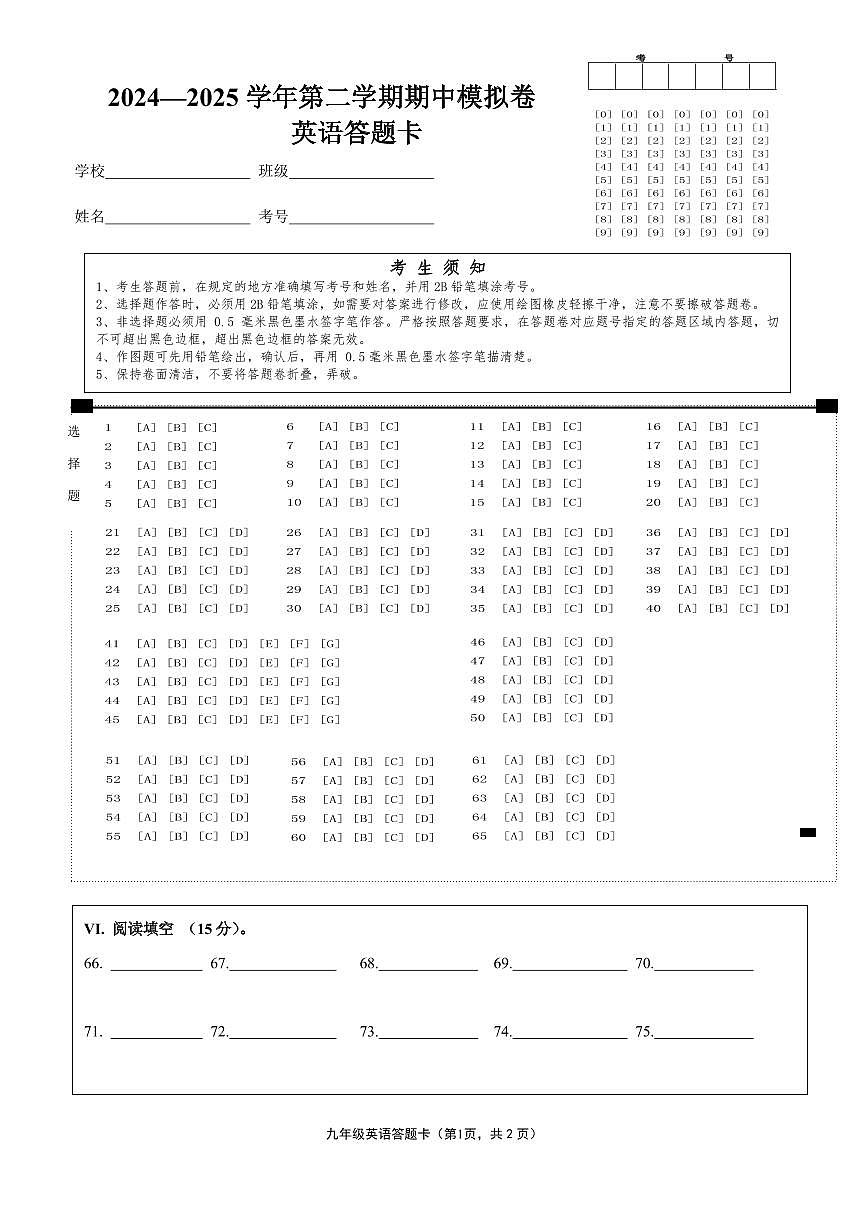
这是一份八年级英语下学期期中模拟卷(山东济南专用)-2024-2025学年八年级英语下学期期中复习查缺补漏冲刺满分(人教版),共36页。试卷主要包含了5分, 满分 7,B.In the sea等内容,欢迎下载使用。
本试题共分为四部分, 满分为150分, 考试用时120分钟。
答题前, 请考生务必将自己的姓名、座号和准考证号填写在答题卡上, 并同时将考点、姓名、准考证号和座号填写在试卷规定的位置。
答题时, 选择题部分每小题选出答案后, 用2B铅笔把答题卡上对应题目的答案标号涂黑; 如需改动, 用橡皮擦干净后, 再选涂其他答案标号。非选择题部分, 用0.5毫米黑色签字笔在答题卡上题号所提示的答题区域作答。直接在试题上作答无效。
考试结束后, 将本试题和答题卡一并交回。
第一部分 听力(共四节, 满分30分)
第一节听录音, 从每组句子中选出一个你所听到的句子。每个句子听一遍。(共5小题, 每小題1.5分, 满分 7.5分)
1.
A.Hw abut ging traveling?B.Hw d yu study it?C.Hw can I read faster?
2.
A.What wuld yu like t d?
B.Where wuld yu like t visit?
C.Wuld yu like t visit smewhere warm?
3.
A.Yu lve here, dn’t yu?
B.Yu dn’t like t live here, d yu?
C.Yu dn’t live here, d yu?
4.
A.Where was he brn?B.When was she brn?C.Where was she brn?
5.
A.What is the secret t learn grammar?
B.What d yu think f this trip?
C.What d yu want t d this vacatin?
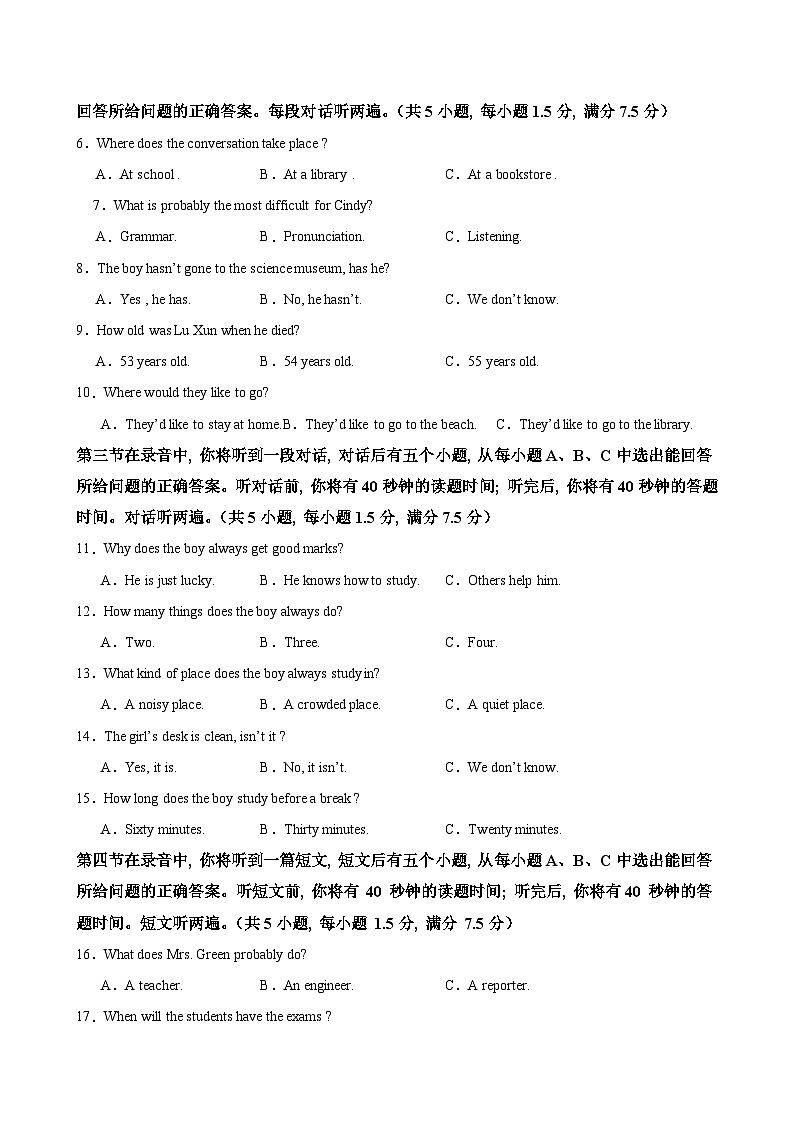
第二节在录音中, 你将听到五段对话, 每段对话后有一个小题, 从每小题A、B、C中选出能回答所给问题的正确答案。每段对话听两遍。(共5小题, 每小题1.5分, 满分7.5分)
6.Where des the cnversatin take place ?
A.At schl .B.At a library .C.At a bkstre .
7.What is prbably the mst difficult fr Cindy?
A.Grammar.B.Prnunciatin.C.Listening.
8.The by hasn’t gne t the science museum, has he?
A.Yes , he has.B.N, he hasn’t.C.We dn’t knw.
9.Hw ld was Lu Xun when he died?
A.53 years ld.B.54 years ld.C.55 years ld.
10.Where wuld they like t g?
A.They’d like t stay at hme.B.They’d like t g t the beach.C.They’d like t g t the library.
第三节在录音中, 你将听到一段对话, 对话后有五个小题, 从每小题A、B、C中选出能回答所给问题的正确答案。听对话前, 你将有40秒钟的读题时间; 听完后, 你将有40秒钟的答题时间。对话听两遍。(共5小题, 每小题1.5分, 满分7.5分)
11.Why des the by always get gd marks?
A.He is just lucky.B.He knws hw t study.C.Others help him.
12.Hw many things des the by always d?
A.Tw.B.Three.C.Fur.
13.What kind f place des the by always study in?
A.A nisy place.B.A crwded place.C.A quiet place.
14.The girl’s desk is clean, isn’t it ?
A.Yes, it is.B.N, it isn’t.C.We dn’t knw.
15.Hw lng des the by study befre a break ?
A.Sixty minutes.B.Thirty minutes.C.Twenty minutes.
第四节在录音中, 你将听到一篇短文, 短文后有五个小题, 从每小题A、B、C中选出能回答所给问题的正确答案。听短文前, 你将有 40 秒钟的读题时间; 听完后, 你将有40 秒钟的答题时间。短文听两遍。(共5小题, 每小题 1.5分, 满分 7.5分)
16.What des Mrs. Green prbably d?
A.A teacher.B.An engineer.C.A reprter.
17.When will the students have the exams ?
A.Next mnth.B.Tmrrw.C.Next week.
18.Accrding t Mrs. Green, what is a gd chice t have while yu are studying ?
A.Candy.B.Fruit.C.Cla.
19.Which f the fllwing is NOT true accrding t Mrs. Green ?
A.Drink sme water.
B.Find a cmfrtable place t study.
C.Try t memrize everything yu have learned befre the exam.
20.Where can the students find past exam papers ?
A.In the library.B.In the classrm.C.In the teachers’ ffice.
第二部分 阅读(共两节, 满分50分)
第一节 阅读理解 阅读下列短文, 从每题A、B、C、D四个选项中, 选出一个能回答所提问题或完成所给句子的最佳答案。(共20小题, 每小题2分, 满分40分)
A
21.Wh gave the reprt?
A.A plice fficer.B.A student.C.A news reprter.D.A driver.
22.When did the event happen?
A.On February 24th, 2023.B.On May 4th, 2023.
C.On Octber 5th, 2023.D.On December 14th, 2023.
23.Where did the plice find the car?
A.In Street 322.B.In the sea.C.In the river.D.In the wds.
24.What did the plice see when they arrived at the scene?
A.Sme passengers were alive.B.The car was n fire.
C.The driver was running away.D.Peple were saving the passengers.
25.We can’t knw ________ frm the reprt.
A.the name f the driverB.the type (类型) f the car
C.the number f the passengersD.the nature f the accident
B
As a vlunteer teacher, I traveled a lng way t a small village schl in Lngzhu, Guangxi. On my way there, I thught abut the village, the schl, and the children there. Hwever, I felt sad when I arrived there. It wasn’t what I expected. It didn’t lk like a schl at all! The schl had nly three rms, ne fr Grades 1, 2, and 3, and anther ne fr Grades 4, 5 and 6. There was a third ne fr me.
The children welcmed me warmly n my first day. They asked me a lt f questins, and I tld them stries abut myself and my life in Shanghai. The next day, I gave them a test t find ut their levels. T my surprise, thugh the test was very easy, ver half f the students failed it, yet they all wanted t learn new things. I knew they needed me.
I was busy preparing lessns and reading test papers every night. I enjyed teaching these lvely and hard-wrking children, and I culd see that they were making prgress with my help.
I have wrked in Lngzhu fr a year nw. I’m very happy, and the experience has been very useful fr me. I lve the small village schl and the children. In fact, I wuld like t cntinue wrking here.
26.Frm the first paragraph, we knw the schl is very ________.
A.beautifulB.smallC.interestingD.big
27.There are ________ grades in the schl.
A.2B.4C.5D.6
28.The writer came frm ________.
A.LngzhuB.GuangxiC.ShanghaiD.Beijing
29.What des the writer think f wrking in the schl?
A.It is very useful.B.It is very interesting.
C.It is very careful.D.It is very exciting.
30.Accrding t the passage, the writer ________.
A.was srry fr the pr schlB.wrked hard t teach the children
C.didn’t want t wrk in the schlD.left the schl in a shrt time
C
If yu ask 10 students which subject he r she hates mst, 9 f them will answer “Math”. N matter which cuntry yu visit, n matter which grade yu are in, yu may nt learn Art, Bilgy, Chemistry r Chinese, but yu always learn Math. Why d s many students hate Math and yet cannt avid learning it at schl?
Jenny Sanders, a high schl student in Califrnia, asks “What gd d we get frm learning Math? We can use cmputers t calculate (计算) numbers and we can use cmputers t stre infrmatin. I think learning Math at schl is a waste f time.”
Hwever, there is much mre t Math than just learning t add and subtract numbers. In fact, Math is nt s much abut calculatin because it is abut learning t think lgically (逻辑地) and wrking ut prblems. Of curse, Jenny was right that we can use cmputers t d calculatins, but if we can’t think lgically, hw culd we knw hw t use the cmputer? In shrt, cmputers are nly tls when slving prblems.
Fr example, imagine yu are a ck and must prepare dinner fr 100 peple. Hw shuld yu divide yur resurces s that yu can get the jb dne fastest and best? T think lgically will help yu wrk ut yur prblems in a better way.
31.Accrding t the passage, which subject d students always learn in different grades at schl?
A.Chinese.B.Math.C.Gegraphy.D.Art.
32.What des Jenny Sanders think f learning Math?
A.Interesting.B.Bring.C.Useless.D.Difficult.
33.What des the underlined wrd “it” in paragraph 3 mean?
A.Number.B.Cmputer.C.Math.D.Subject.
34.Which f the fllwing is TRUE accrding t the passage?
A.90% f the students hate learning Math.
B.Students can learn Math well with cmputers.
C.Math can d calculatins and stre infrmatin.
D.Math helps students learn all the ther subjects well.
35.What des the writer want t tell us?
A.Math is just learning t add and subtract numbers.
B.Math can be gd fr bth ur bdy and ur mind.
C.Math helps us think lgically and slve prblems.
D.Math can help students find a gd jb in the future.
D
When yu hear the wrd “shapeshifting”(变形), yu may think f the rbts in the science fictin mvies instead f the animals. But that’s what animals are ding t deal with (处理) climate change (气候变化).
Animals have their wn ways t deal with climate change. Fr example, a new study shws that sme warm-blded animals are experiencing their bdy changes because f the climate. Sme f them are slwly grwing larger beaks (喙), legs and ears because f the rising temperature, while thers living in clder climates have smaller legs, ears and beaks.
“When we talk abut climate change, we ften ask urselves ‘Can humans cntrl this?’ r ‘What technlgy (科技) can slve this?’ But we shuld knw that just like humans, animals als have t be used t these changes,” said the writer, Sara Ryding.Larger beaks, legs and ears can help them lse heat (热量) mre easily, s they can cl themselves dwn as the earth gets warmer. If animals can’t cntrl their bdy temperature, they can verheat and die.
In ne example, the beaks f sme Australian parrts have grwn 4 t 10 percent larger since 1871. The study says that is because f rising summer temperatures ver the years.There are mre examples—wd mice have lnger tails, and bats have bigger wings in warm climates.
Althugh the changes are still small, Ryding said they culd be mre clear as the days becme htter. “Bdy parts like ears may becme much bigger, s we might have animals like Dumb, a big-eared elephant in Disney cartn, in the near future.”
Althugh animals are changing their bdy shapes, scientists say that it desn’t mean everything is fine. It just means they are trying hard t live. Nt all animals will succeed. “Humans have caused the climate change, which is giving a lt f pressure n animals.” said Ryding.
36.In warmer places, what changes d sme warm-bld animals have frm Paragraph 2?
A.Larger ears.B.Smaller legs.C.Smaller eyes.D.Smaller beaks.
37.Why d animals change their bdy shapes alng with climate change?
A.T shw the imprtance f fd.B.T help cntrl the bdy temperature.
C.T describe the change f the earth.D.T understand the technlgy better.
38.In Paragraph 4, hw des the writer explain the animals’ shapeshifting?
A.By prviding pictures.B.By telling stries.
C.By asking questins.D.By giving examples.
39.Accrding t the text, which f the fllwing is TRUE?
A.Humans have already cntrlled the climate change.
B.Sme animals may be in danger with rising temperatures.
C.Animals’ bdy parts will becme smaller and smaller.
D.Animals are giving humans a lt f pressure abut climate.
40.What can we learn frm the text?
A.We shuld get n well with ur envirnment.B.We shuld care mre abut ur health.
C.We shuld knw mre abut animals’ fd.D.We shuld learn mre abut bdy parts.
第二节 阅读理解七选五 (共5小题, 每小题2分, 满分10分)
根据短文内容,从短文后的选项中选出能填入空白处的最佳选项,选项中有两项为多余选项。
Mst students d nt enjy ding husewrk. 41 Hwever, if yu try the fllwing ways, yu will find that ding husewrk is nt as bring as yu think.
◆ 42
Yu shuld learn t d small things arund the huse. Fr example, yu can d the dishes, sweep the flr r make the bed. Part f grwing up is t be able t take care f yurself. It’s gd t d sme small things arund the huse. 43
◆Share husewrk amng family members.
44 It’s gd t share husewrk amng family members. All the family members can d the husewrk tgether. Sharing husewrk amng all the family members will make everyne’s jb much easier.
◆Make it fun.
Cking is ne part f husewrk. 45 When yu learn hw t ck yur favrite fd, yu will als get a feeling f satisfactin.
A.Learn t d small things.
B.It helps t develp yur independence.
C.Instead, they always eat ut in restaurants.
D.Sme f them think it is bring t d husewrk.
E.If yu put yur heart int it, cking can be great fun.
F.We shuldn’t ask small children t d t much husewrk.
G.In fact, it’s t tiring fr ne persn t d all the husewrk alne.
第三部分 语言运用(共两节, 满分35分)
第一节 补全对话(共5小题, 每小题1分, 满分5分)
阅读对话,从每题 A、B、C、D 四个选项中, 选出一个最佳答案完成对话。
A: Hell, Tny. Ling and I went t La She Teahuse last weekend.
B:
A: It was great! Yu knw, I always wanted t g there.
B:
A: We drank tea and watched an pera.
B:
A: N, it was difficult t understand the wrds. But the actrs and actresses were excellent.
B:
A: We nly planned t watch fr an hur, but in the end, we stayed fr three hurs.
B: Did yu enjy it?
A: Well, it was interesting.
B: S d I. I’m als interested in traditinal Chinese culture.
46.A.Hw was yur trip?
B.When is yur schl trip?
C.Wh is La She?
D.Why did yu g there?
47.A.Did yu d anything interesting?
B.What did yu d in La She Teahuse?
C.Hw abut watching an pera?
D.D yu like drinking tea r cffee?
48.A.What are yu ging t d in the future?
B.Are yu ging t the mvies?
C.What d yu think f the peras?
D.Did yu understand the pera?
49.A.Hw lng did yu stay?
B.Hw ften d yu play sprts?
C.When did yu g there?
D.Hw far is it frm yur hme?
50.A.I had a wnderful time there.
B.Wuld yu like t g there with me?
C.I hpe t see mre peras.
D.I am ging t Shanghai tmrrw.
第二节 完形填空
阅读短文, 从每题A、B、C、D四个选项中, 选出一个能填入文章中相应空白处的最佳答案。(共 15 小题, 每小题 1 分, 满分 15 分)
When Sam was making sme snwballs fr a snwman, Dad was pulling his 3-year-ld sister Becky n the sled like a pny (小马). “Pny! Pny!” Becky called t Dad.
Sam tried and tried, but culdn’t lift (抬起) the snwballs and put them tgether. “Dad, it’s t 51 fr me!” Sam called. “I’m cming,” Dad ran ver t help.
While they were busy, Becky 52 n the snwman. 53 they culd stp her, Becky and the snwman bth fell dwn t the grund.
“Becky!” Sam 54 , “I was wrking n that all afternn!” He gt 55 angry snwball and threw it as hard as he culd, against a tree.
Dad tuched his head gently, “ It’s n big 56 , Sam. Let’s put it back tgether. ”
Minutes later, Sam was 57 the snwman with Dad’s help. While they were wrking, Becky 58 climbed n the snwman’s head. 59 brke int pieces under her and she started crying. Sam gt anther angry snwball and threw it as far as he culd, away acrss the trees.
“It’s time fr Becky t g 60 and warm up. It’s getting dark s I have t ck dinner. ”Dad said, “Sam, I can watch frm the kitchen windw 61 yu want t stay utside a little lnger. ”
S quiet nw. All by himself, Sam began t make mre snwballs. Maybe he culd make a sleeping snwman?
Lking up, he fund Becky watching him frm the windw, with expectatin and excitement in her eyes.
N! He had a 62 plan! A snw pny!
“Sam!” Dad called frm the dr,” Dinner’s ready!” “Almst finished!” Sam called back when he was trying t find smething fr the pny eyes. “Dad, lk! Fr Becky t climb n!”
“Hw fantastic! The snw will get harder and strnger vernight s she can’t break it s 63 . ”
Sam gt a 64 snwball. He threw it as high as he culd, straight up t the sky. “When mrning cmes, she’s ging t 65 it s much!”
When mrning came, she really did.
51.A.ldB.smallC.whiteD.heavy
52.A.cleaned upB.tk dwnC.climbed upD.died dwn
53.A.BecauseB.OrC.BefreD.After
54.A.shutedB.laughedC.cheeredD.ran
55.A.aB.anC.theD./
56.A.cakeB.dealC.ballD.idea
57.A.fixing upB.lking upC.cutting utD.cming ut
58.A.neverB.firstC.everD.again
59.A.ItB.SheC.HeD.They
60.A.stillB.frwardC.utsideD.inside
61.A.ifB.althughC.butD.s
62.A.clderB.betterC.wrseD.sadder
63.A.easilyB.quietlyC.slwlyD.carefully
64.A.angryB.happyC.bringD.funny
65.A.lveB.makeC.dislikeD.miss
第三节 阅读填空 (共10小题, 每小题1.5分, 满分15分)
阅读下面短文,在空白处填入一个适当的单词或括号内单词的正确形式。
There were sme ld garages (车库) acrss the street. Mst f them had cars all year rund, but ne f them 66 (be) empty. The dr culd nt be clsed 67 (cmplete). I thught that’s why nbdy wanted t rent (租) it.
One day, 68 ld man mved in. Every day, he 69 (walk) arund the neighbrhd, picking up glass bttles and paper bxes. At the end f the day, he wuld g t the recycling center t sell 70 (they). Smetimes he helped clean up the street. Hwever, parents ften tld kids 71 (stay) away frm him. They thught the man might be 72 (danger).
Autumn sn arrived and the leaves began t fall. One weekend, the man had a party at the garage. They were drinking, singing, talking and having a gd time.
The man tld his 73 (friend), “N smking! Yu might cause a fire.” At that time, I 74 (play) near the garage. Then I realized that the man wasn’t an irrespnsible (没有责任心的) persn.
When I gt hme, I tld my parents 75 the ld man. My father said, “As the saying ges, ‘Dn’t judge (判定) a bk by its cver.’” Frm then n, every time the ld man held a party, we went t it.
第四部分 书面表达(共两节, 满分 35 分)
第一节 情境运用 (共5小题, 每小题2分, 满分 10 分)
根据所提供的图片,用一个完整的句子提问或应答。
76.
A: What’s the matter with yur sister?
B: .
77.
A: I want t tell peple abut ur City Park Clean-up day. What culd I d?
B: .
78.
A: Jane, ?
B: Sure, Mm. But I want t d my hmewrk first.
79.
A: ?
B: My sister is ding it.
80.
A: What were yu ding when I called yu last night?
B: .
第二节 写作(25分)
81.青少年是祖国的未来,需要提高自身能力,拥有美好的未来。但是现在一些青少年的生活状态不尽如人意,有些青少年不懂得做家务的重要性,不能分家务;有的不能与家人、朋友和睦相处;有的不知道参加哪些志愿者活动帮助他人,等等。为此,我校组织了一场英文演讲比赛,请根据以上提到的青少年的生活现状,完成一篇短文,谈一下青少年的问题并给出建议(每个问题至少2条建议)。
注意:
1.词数100左右。
2.可进行适当发挥。
3.不得出现真实的人名、校名等相关信息。
__________________________________________________________________________________________________________________________________________________________________________________________________________________________________________________________________________________________________________________________________________________________________________
NATURE (性质) OF ACCIDENT: Car Accident ( √ )
Natural Disaster ( )
Crime ( )
Other ( )
Details f Accident
On December 14, 2023, the West Gshen Twnship Plice Statin received a reprt f a car accident near Street 322. When the plice arrived at the scene (现场), they saw a car ff the rad and in the wds. And it was n fire.
The driver and the passengers in the car all died. The driver was identified (鉴别) as Ryan Dunn. The infrmatin f passengers is nt clear yet. Mr. Dunn was driving a 2010 Prsche 911 GT3.
The investigatin (调查) said that speeding (超速行驶) might be the main cause f the accident.
《八年级济南期中2》参考答案
1.C
【原文】略
2.B
【原文】略
3.C
【原文】略
4.A
【原文】略
5.B
【原文】略
6.C
【原文】略
7.C
【原文】M: Cindy, which is mre difficult, grammar r prnunciatin?
W: Oh, I usually make mistakes in listening.
8.A
【原文】略
9.C
【原文】略
10.B
【原文】略
11.B 12.B 13.C 14.B 15.A
【原文】略
16.A 17.C 18.B 19.C 20.A
【原文】略
21.A 22.D 23.D 24.B 25.C
【导语】本文是警察做的一个事故报告,介绍了事故发生的时间,地点以及一些细节。
21.推理判断题。根据“NATURE (性质) OF ACCIDENT:”“Car Accident ( √ ) ”以及报告的内容可知,这是警察做的报告。故选A。
22.细节理解题。根据“On December 14, 2023, the West Gshen Twnship Plice Statin received a reprt f a car accident near Street 322.”可知,这个事件发生在2023年12月14日,故选D。
23.细节理解题。根据“When the plice arrived at the scene (现场), they saw a car ff the rad and in the wds.”可知,警察在树林里找到了那辆汽车,故选D。
24.细节理解题。根据“When the plice arrived at the scene (现场), they saw a car ff the rad and in the wds. And it was n fire.”可知,当警察到达现场时,那辆汽车正在着火,故选B。
25.细节理解题。根据“The infrmatin f passengers is nt clear yet.”可知,乘客的信息不清楚。故选C。
26.B 27.D 28.C 29.A 30.B
【导语】本文主要介绍了作者做教师志愿者的经历,这个经历对于作者来说是非常有意义的。
26.推理判断题。根据“The schl had nly three rms, ne fr Grades 1, 2, and 3, and anther ne fr Grades 4, 5 and 6. There was a third ne fr me.”可知学校只有几个房间,是非常小的。故选B。
27.细节理解题。根据“The schl had nly three rms, ne fr Grades 1, 2, and 3, and anther ne fr Grades 4, 5 and 6. There was a third ne fr me.”可知学校有一、二、三、四、五、六年级。故选D。
28.细节理解题。根据“I tld them stries abut myself and my life in Shanghai.”可知作者来自上海。故选C。
29.细节理解题。根据“I’m very happy, and the experience has been very useful fr me”可知作者认为这段经历很有用。故选A。
30.推理判断题。根据“I was busy preparing lessns and reading test papers every night”可知作者每天晚上都忙于备课和阅读试卷,可见作者很努力。故选B。
31.B 32.C 33.C 34.A 35.C
【导语】本文主要讨论了学生对数学的态度和数学的重要性。尽管许多学生不喜欢数学,但数学在学校的教育中是无法避免的。数学不仅仅是关于计算,更重要的是学习逻辑思考和解决问题的能力。
31.细节理解题。根据“N matter which cuntry yu visit, n matter which grade yu are in, yu may nt learn Art, Bilgy, Chemistry r Chinese, but yu always learn Math.”可知,无论你在哪个国家,无论你在哪个年级,你可能不学艺术、生物、化学或中文,但你总是学习数学。故选B。
32.观点态度题。根据第二段“What gd d we get frm learning Math? We can use cmputers t calculate (计算) numbers and we can use cmputers t stre infrmatin. I think learning Math at schl is a waste f time.”可知,Jenny Sanders认为学习数学是浪费时间的,即无用的。故选C。
33.代词指代题。根据第三段“In fact, Math is nt s much abut calculatin because it is abut learning t think lgically (逻辑地) and wrking ut prblems.”可知,数学不是关于计算,是关于学习逻辑思考和解决问题,it指的是“数学”。故选C。
34.推理判断题。根据“If yu ask 10 students which subject he r she hates mst, 9 f them will answer ‘Math’”可知,10名学生中,有9人会讨厌数学,所以推断90%的学生讨厌学习数学。故选A。
35.推理判断题。根据“T think lgically will help yu wrk ut yur prblems in a better way.”可知,作者想告诉我们数学帮助我们逻辑思考和解决问题。故选C。
36.A 37.B 38.D 39.B 40.A
【导语】本文讲述了气候的变化对动物带来了压力,我们需要采取措施来改变。
36.细节理解题。根据“Fr example, a new study shws that sme warm-blded animals are experiencing their bdy changes because f the climate. Sme f them are slwly grwing larger beaks (喙), legs and ears because f the rising temperature”可知,一些温血动物慢慢长出了更大的喙、更长的腿和更大的耳朵来应对气候变化。故选A。
37.细节理解题。根据第三段“legs and ears can help them lse heat (热量) mre easily, s they can cl themselves dwn as the earth gets warmer. If animals can’t cntrl their bdy temperature, they can verheat and die.”可知,腿和耳朵可以帮助它们更容易地散发热量,因此当地球变暖时它们可以给自己降温。如果动物无法控制体温,它们可能会过热而死亡。之所以动物改变身体的形状,是因为要帮助调节身体温度。故选B。
38.细节理解题。根据第四段“In ne example, the beaks f sme Australian parrts have grwn 4 t 10 percent larger since 1871. ”以及“There are mre examples...”可知,本段通过列举澳大利亚鹦鹉、木鼠、蝙蝠这三种动物来解释动物们的身形变化的。故选D。
39.推理判断题。根据最后一段“It just means they are trying hard t live. Nt all animals will succeed.”可知,动物们正在努力生活,不是所有的动物都会成功。所以推断出随着气温升高,一些动物可能面临危险。故选B。
40.主旨大意题。通读全文,主要讲了因人类引起气候的变化对动物带来了压力,我们需要采取措施来改变,与我们的环境相处好。故选A。
41.D 42.A 43.B 44.G 45.E
【导语】本文是一篇说明文。文章为我们提供了一些让学生喜欢做家务的方法。
41.根据“Mst students d nt enjy ding husewrk”可知此处应是继续陈述大多数学生不喜欢做家务,选项D“他们中的一些认为做家务是无聊的”符合语境,故选D。
42.根据“Yu shuld learn t d small things arund the huse”可知此处方法应是做小事,选项A“学着做一些小事”符合语境,故选A。
43.根据“It’s gd t d sme small things arund the huse”可知此处应是继续阐述做家务的好处,选项B“它帮助培养你的独立性”符合语境,故选B。
44.根据“It’s gd t share husewrk amng family members”可知此处应是阐述在家庭成员之间分担家务的原因,选项G“事实上,由一个人独自做所有的家务是太累人了”符合语境,故选G。
45.根据“Cking is ne part f husewrk”和“Make it fun”可知此处应是说明做饭的乐趣,选项E“如果你用心,做饭可以是相当有趣的”符合语境,故选E。
46.A 47.B 48.D 49.A 50.C
【导语】本文是A和B之间的一则对话。对话主要围绕谈论去老舍茶馆看歌剧展开的。
46.根据下文“It was great!”可知,此处询问对方对老舍茶馆的评价,选项A“你的旅行怎么样?”符合语境。故选A。
47.根据下文“We drank tea and watched an pera.”可知,此处询问对方在老舍茶馆做了什么事情,选项B“你们在老舍茶馆做了什么?”符合语境。故选B。
48.根据下文“N, it was difficult t understand the wrds. But the actrs and actresses were excellent.”可知,此处为一般疑问句,询问对方是否理解歌剧,选项D“你听懂这出歌剧了吗?”符合语境。故选D。
49.根据下文“We nly planned t watch fr an hur, but in the end, we stayed fr three hurs.”可知,此处询问时间长短,选项A“你们待了多久?”符合语境。故选A。
50.根据空前的“Well, it was interesting.”可知,歌剧很有趣,所以希望看更多的歌剧,选项C“我希望能看更多的歌剧。”符合语境。故选C。
51.D 52.C 53.C 54.A 55.B 56.B 57.A 58.D 59.A 60.D 61.A 62.B 63.A 64.B 65.A
【导语】本文主要讲述了山姆在父亲的帮助下堆雪人的故事。他的妹妹贝基不断捣乱,两次弄塌雪人,让山姆很生气。但最后,山姆改变主意,决定为贝基做一个雪马。他充满期待地完成雪马,期待贝基会喜欢。第二天,贝基果然对雪马爱不释手。
51.句意:“爸爸,这对我来说太重了!”
ld老的;small小的;white白的;heavy重的。根据“Sam tried and tried, but culdn’t lift the snwballs and put them tgether.”可知是太重了。故选D。
52.句意:当他们忙的时候,贝基爬上了雪人。
cleaned up清理; tk dwn取下,记下;climbed up爬上;died dwn逐渐减弱或消失。根据“While they were busy, the snwman.”可知贝基爬上了雪人。故选C。
53.句意:他们还没来得及阻止她,贝基和雪人都倒在了地上。
Because因为;Or或者;Befre在……之前;After在……之后。根据“ culd stp her, Becky and the snwman bth fell dwn t the grund.”可知在他们阻止她之前,贝基和雪人都倒在了地上。故选C。
54.句意:“贝基!”山姆喊道:“我整个下午都在做这个!”
shuted喊;laughed笑;cheered欢呼;ran跑。根据“He snwball and threw it as hard as he culd, against a tree.”可知山姆应是生气的喊。故选A。
55.句意:他拿起一个愤怒的雪球,用尽全力朝一棵树扔去。
a一个,用在以辅音音素开头的字母前;an一个,用在以元音音素开头的字母前;the定冠词,表特指。由“angry”以元音音素开头,可知用“an”。故选B。
56.句意:爸爸轻轻地摸了摸他的头,“没什么大不了的,山姆。让我们把它重新组装起来。”
cake蛋糕;deal处理;ball球;idea观点。根据“It’s n big...”可知此处应是表示“没什么大不了的”,应用“nt a big deal”。故选B。
57.句意:几分钟后,山姆在爸爸的帮助下修理雪人。
fixing up修理;lking up查阅;cutting ut删除;cming ut出版。根据“Let’s put it back tgether.”可知是修理雪人。故选A。
58.句意:他们干活的时候,贝基又爬到了雪人的头上。
never从不;first第一;ever曾经;again再次。根据“While they were wrking, n the snwman’s head.”可知贝基又爬到了雪人的头上。故选D。
59.句意:它在她身下碎成了碎片,她哭了起来。
It它;She她;He他;They他们。根据“While they were wrking, n the snwman’s head.”可知贝基又爬到了雪人的头上,雪人成了碎片。故选A。
60.句意:贝基该进屋暖和暖和了。
still仍然;frward向前;utside在外面;inside在里面。根据“warm up”可知是该去里面了。故选D。
61.句意:爸爸说:“山姆,如果你想在外面多待一会儿,我可以从厨房的窗户看着你。”
if如果;althugh尽管;but但是;s所以。根据“I can watch frm the kitchen want t stay utside a little lnger. ”可知应是如果山姆想在外面多待一会儿,爸爸可以从厨房的窗户看着他。故选A。
62.句意:他有更好的计划!
clder更冷的;better更好的;wrse更差的;sadder更伤心的。根据“A snw pny!”可知是有一个更好的计划。故选B。
63.句意:雪会在一夜之间变得越来越硬,所以她不能那么容易地打破它。
easily轻易地;quietly安静地slwly缓慢地;carefully仔细地。根据“The snw will get harder and strnger vernight s she can’t break it s...”可知她不能那么容易地打破它。故选A。
64.句意:山姆拿了一个快乐的雪球。
angry生气的;happy高兴的;bring无聊的;funny滑稽的。根据“He threw it as high as he culd, straight up t the sky.”可知是拿了一个快乐的雪球。故选B。
65.句意:当早晨到来的时候,她会非常喜欢的!
lve喜爱;make制造;dislike不喜欢;miss错过,想念。根据“When mrning cmes, she’s ging s much!”可知,当早晨到来的时候,她会非常喜欢的。故选A。
66.was 67.cmpletely 68.an 69.walked 70.them 71.t stay 72.dangerus 73.friends 74.was playing 75.abut
【导语】本文作者通过自己经历的故事告诉我们不要以貌取人。
66.句意:他们大多数人一年四季都有车,但有一辆车是空的。根据“Mst f them had cars all year rund”可知,时态为一般过去时;主语是“ne f them”,所以be动词用was。故填was。
67.句意:门不能完全关上。此处应用副词cmpletely“完全地”修饰动词clse“关上”。故填cmpletely。
68.句意:一天,一位老人搬进来了。此处泛指一位老人,且ld是以元音音素开头的单词,应填不定冠词an。故填an。
69.句意:每天,他都在附近走来走去,捡玻璃瓶和纸箱子。根据上文“mved in”可知,时态为一般过时,动词walk“走”应用过去式walked。故填walked。
70.句意:一天结束时,他会去回收中心卖掉它们。此处应用人称代词宾格them“它们”作宾语。故填them。
71.句意:然而,父母经常告诉孩子们远离他。tell sb. t d sth.“告诉某人做某事”。故填t stay。
72.句意:他们认为这个人可能很危险。此处应用形容词dangerus“危险的”作表语。故填dangerus。
73.句意:你们可能会引起火灾。friend“朋友”,此处应用名词复数形式表泛指。故填friends。
74.句意:那时,我正在车库附近玩。根据“At that time”可知,时态为过去进行时“was/were+ding”,主语是I,be动词应用was。故填was playing。
75.句意:回家后,我把老人的情况告诉了父母。根据“I tld my ld man”可知,作者把此事告诉了父母,tell sb. abut sth.“告诉某人某事”,固定短语。故填abut。
76.She/My sister has a tthache 77.Yu culd put up signs 78.culd yu please take the dg fr a walk/walk the dg 79.Wh is sweeping the flr 80.I was flding my clthes
【分析】76.根据图片和“What’s the matter with yur sister?”可知,此处应回答“她牙疼”,句子时态是一般现在时,have a tthache牙疼,主语是第三人称单数,谓语动词用三单形式。故填She/My sister has a tthache。
77.根据图片和“What culd I d?”可知,应回答“你可以张贴标语”,句子时态是一般现在时,put up signs“张贴标语”,情态动词culd后跟动词原形。故填Yu culd put up signs。
78.根据图片和“Sure, Mm. But I want t d my hmewrk.”可知,应问“你能去遛狗吗”,Culd yu please d sth.“你能做某事吗”;take the dg fr a walk/walk the dg“遛狗”。故填culd yu please take the dg fr a walk/walk the dg。
79.根据图片和“My sister is ding it.”可知,应问“谁在扫地”,句子是现在进行时,sweep the flr“扫地”,wh“谁”,其后be动词用is。故填Wh is sweeping the flr。
80.根据图片和“What were yu ding when I called yu last night?”可知,应回答“我在叠衣服”,时态是过去进行时,结构为was/were+ding,主语是I,be动词用was,fld my clthes“叠衣服”,谓语动词用现在分词形式。故填I was flding my clthes。
81.例文
Teenagers are the future f ur cuntry. They need t imprve their abilities and have a bright future. But nw sme teenagers have unsatisfactry living cnditins.
Sme teenagers d nt understand the imprtance f ding husewrk and cannt share the burden. I think they shuld actively help their parents with husewrk and maintain the cleanliness f ur rms. They als shuld learn t thank fr what parents d fr them. Sme cannt get alng with family and friends. They need t cmmunicate with family and friends. If they have time, they can d smething interesting tgether. Sme d nt knw which vlunteer activities t take part in t help thers. They can search fr sme vlunteer infrmatin n the Internet. And they can clean the city park.
All in all, they shuld make an effrt t prepare themselves fr the future.
【详解】[总体分析]
①题材:本文是一篇演讲稿;
②时态:时态为一般现在时;
③提示:根据提示内容介绍青少年的一些问题,并给出相应的建议,适当增加细节。
[写作步骤]
第一步,引出话题;
第二步,介绍青少年的一些问题,并给出相应的建议;
第三步,书写结语。
[亮点词汇]
①get alng with和某人相处得好
②take part in参加
③all in all总的来说
④make an effrt t d sth.努力做某事
[高分句型]
①They als shuld learn t thank fr what parents d fr them. (what引导的宾语从句)
②If they have time, they can d smething interesting tgether. (if引导的条件状语从句)
题号
1
2
3
4
5
6
7
8
9
10
答案
C
B
C
A
B
C
C
A
C
B
题号
11
12
13
14
15
16
17
18
19
20
答案
B
B
C
B
A
A
C
B
C
A
题号
21
22
23
24
25
26
27
28
29
30
答案
A
D
D
B
C
B
D
C
A
B
题号
31
32
33
34
35
36
37
38
39
40
答案
B
C
C
A
C
A
B
D
B
A
题号
41
42
43
44
45
51
52
53
54
55
答案
D
A
B
G
E
D
C
C
A
B
题号
56
57
58
59
60
61
62
63
64
65
答案
B
A
D
A
D
A
B
A
B
A
这是一份八年级英语下学期期中模拟卷(山东济南专用)-2024-2025学年八年级英语下学期期中复习查缺补漏冲刺满分(人教版),共36页。试卷主要包含了5分, 满分 7,B.In the sea等内容,欢迎下载使用。
这是一份八年级英语下学期期中模拟卷(人教版专用)-2024-2025学年八年级英语下学期期中复习查缺补漏冲刺满分(人教版),共36页。试卷主要包含了单项选择,完型填空,阅读单选,词汇应用,完成句子,语法填空,材料作文等内容,欢迎下载使用。
这是一份八年级英语下学期期中考试(山东济南专用)-2023-2024学年八年级英语下学期期中复习查缺补漏冲刺满分(人教版),文件包含八年级下学期期中考试山东济南卷docx、答题卡docx、听力mp3等3份试卷配套教学资源,其中试卷共24页, 欢迎下载使用。
注册成功
资料篮

在线客服
添加在线客服
获取1对1服务
官方微信
关注“教习网”公众号
打开微信就能找资料
赛课定制
添加在线客服
获取1对1定制服务
职称咨询
添加在线客服
获取1V1专业指导服务

免费福利


(1).png)