免费领取教师福利
若您为此资料的原创作者,认为该资料内容侵犯了您的知识产权,请扫码添加我们的相关工作人员,我们尽可能的保护您的合法权益。


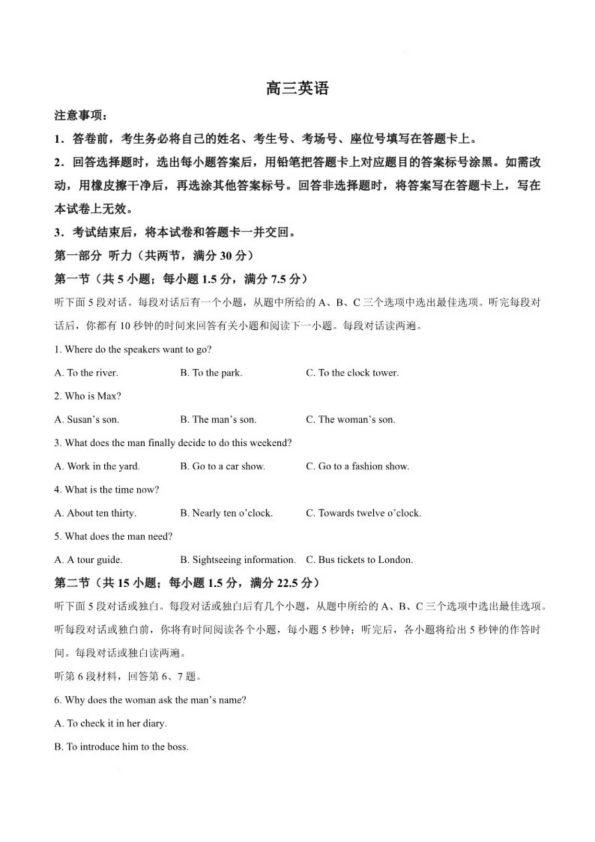
这是一份2026届湖南长沙市平高松雅湖高级中学有限公司高三下学期考前模拟英语试题(含答案),共13页。试卷主要包含了5分,满分37等内容,欢迎下载使用。
第一节(共15小题;每小题2.5分,满分37.5分)
阅读下列短文,从每题所给的A、B、C和D四个选项中,选出最佳答案。
A
Vlunteer with Philly Fd Rescue (PFR)
In ne hur, yu can d smething t reduce fd waste and resurce lcal cmmunity. Dwnlad the Philly Fd Rescue app t get started.
What’s the service pprtunity?
PFR is the sustainability, fd recvery, and dnatins arm f Share Fd Prgram. Yu’ll use yur wn car (r bike) t rescue leftver fd frm a grcery stre, restaurant, r farmers’ market, delivering it t the matched nnprfit takers. Thse include senir centers, shelters, schls, and mre. Yu can claim a ne-time r weekly fd rescue.
What difference des fd rescue make?
PFR wrks t increase access t fresh fd fr ur neighbrs. Our team recvers half a millin punds f fd every mnth thanks t vlunteers like yu. We resurce mre than 283 partners acrss Philadelphia, its suburbs, and Suth Jersey, impacting fd security and sustainability every day f the week.
What’s required?
● If driving, a driver’s license and insurance are needed. Fr smaller fd rescues, a bike may d.
● Fd rescue vlunteers shuld be able t lift at least 30 punds.
● Clear the trunk and back seat t make space fr bxes r bags f fd.
● Cmplete the fd rescue within its scheduled windw.
Additinal infrmatin:
● PFR matches dnatins within five miles t keep fd lcal, hnr vlunteers’ time, and ensure fd safety.
● Yu’re welcme t bring a friend r child as a passenger t help with lading, unlading, and delivery.
● Questins? Ask Britt at [email protected] r (215)301-3734.
1. What des the authr intend t d?
A.T call n peple t help.
B.T infrm peple f fd rescue.
C.T intrduce ways f vlunteering.
D.T entertain peple with a new cncept.
2. What d we learn abut PFR service?
A.It dnates t Share Fd Prgram.
B.It cvers the natinal senir centers.
C.Its rescues have appinted receivers.
D.Its aim is t help the stres r markets.
3. What is required f every vlunteer?
A.Medical insurance.
B.Scheduling skills.
C.Driving experience.
D.Weight lifting pwer.
B
The gal f this bk is t make the case fr digital minimalism, including a detailed explratin f what it asks and why it wrks, and then t teach yu hw t adpt this philsphy if yu decide it’s right fr yu.
T d s, I divided the bk int tw parts. In part ne, I describe the philsphical fundatins f digital minimalism, starting with an examinatin f the frces that are making s many peple’s digital lives increasingly intlerable, befre mving n t a detailed discussin f the digital minimalism philsphy.
Part ne cncludes by intrducing my suggested methd fr adpting this philsphy: the digital declutter. This prcess requires yu t step away frm ptinal nline activities fr thirty days. At the end f the thirty days, yu will then add back a small number f carefully chsen nline activities that yu believe will prvide massive benefits t the things yu value.
In the final chapter f part ne, I’ll guide yu thrugh carrying ut yur wn digital declutter. In ding s, I’ll draw n an experiment I ran in 2018 in which ver 1,600 peple agreed t perfrm a digital declutter. Yu’ll hear these participants’ stries and learn what strategies wrked well fr them, and what traps they encuntered that yu shuld avid.
The secnd part f this bk takes a clser lk at sme ideas that will help yu cultivate (培养) a sustainable digital minimalism lifestyle. In these chapters, I examine issues such as the imprtance f slitude (独处) and the necessity f cultivating high-quality leisure t replace the time mst nw spent n mindless device use. Each chapter cncludes with a cllectin f practices, which are designed t help yu act n the big ideas f the chapter. Yu can view these practices as a tlbx meant t aid yur effrts t build a minimalist lifestyle that wrks fr yur particular circumstances.
4. What is the bk aimed at?
A.Teaching critical thinking skills.
B.Advcating a simple digital lifestyle.
C.Slving philsphical prblems.
D.Prmting the use f a digital device.
5. What des the underlined wrd “declutter” in paragraph 3 mean?
A.Clear-up.
B.Add-n.
C.Check-in.
D.Take-ver.
6. What is presented in the final chapter f part ne?
A.Theretical mdels.
B.Statistical methds.
C.Practical examples.
D.Histrical analyses.
7. What des the authr suggest readers d with the practices ffered in part tw?
A.Use them as needed.
B.Recmmend them t friends.
C.Evaluate their effects.
D.Identify the ideas behind them.
C
Thrughut much f histry, India and China were amng the wrld’s largest ecnmies, but their develpment paths differed significantly in the mdern era. In 1970, the cuntries were almst identically wealthy. But tday China’s GDP per persn, at arund $13,000, is nearly five times India’s. The gap is traditinally explained by the way their ecnmies pened up. China became the wrld’s factry, which greatly accelerated grwth. India became its back ffice. But what shaped these paths?
A new study by Nitin Kumar Bharti and Li Yang suggests that a big, underrated factr is educatin plicy. The researchers track hw educatin evlved in bth cuntries frm 1900 t 2020. At the beginning f the 20th century, less than 10% f Indian and Chinese children attended schl; tday almst every child des. But the rute t universal educatin has been strikingly different, and has had prfund effects n develpment.
China tk a “bttm-up” apprach t schling. In the 1950s, fficials in the newly frmed Peple’s Republic priritized expanding access t primary and secndary educatin. Independent India, hwever, tk a “tp-dwn” methd, which meant supprting high-quality universities at the expense f primary schls. By 1980, 93% f Chinese children were enrlled in primary schl, but just 1.7% f yungsters were in cllege; in India, the equivalent shares were 69% and 8%.
Anther striking difference is what cllege-aged yungsters study. In China they are mre likely t pursue engineering degrees. In India they favur humanities, business r law. Vcatinal degrees are als treated mre seriusly in China. Since the 1980s mre than 40% f Chinese yungsters have pursued a vcatinal educatin, cmpared with just 10% in India. All this created different labur frces as their ecnmies became mre pen. In 1988, arund 60% f Indian adults were illiterate (不识字的) cmpared with 22% in China. That prevented Indians frm mving ut f agriculture int mre prfitable jbs and lwered their prductivity. India’s relative advantage in higher educatin made it mre suitable fr services-led grwth.
India has tried t fix these issues. A big push increased access t primary schling in the 2000s — but at the expense f quality. The gvernment is als prmting vcatinal educatin. And at the university level, a lt mre Indians are studying engineering. Yet it might be t late. Many ecnmists believe that the era f manufacturing-led grwth has bypassed India. A reprt released in September supprted such fears. Of the 1.5 millin engineering students wh will graduate this year, nly 10% are expected t actually land a jb in the year after leaving university.
8. Hw des the authr develp the passage?
A.By using vivid descriptins.
B.By presenting data and making cmparisns.
C.By quting famus peple’s wrds.
D.By telling an exciting and adventurus stry.
9. What can be inferred frm the different educatin plicies in China and India?
A.They had n real impact n ecnmies.
B.They slely determined ecnmic mdels.
C.They influenced the structure f labr frces.
D.They made bth cuntries equally develped.
10. What prblem did India’s push fr primary schling face in the 2000s?
A.High tuitin fees.
B.Lw student interest.
C.Fcusing n quantity ver quality.
D.Lacking gvernment supprt.
11. What is the verall tne f the authr in describing India’s situatin?
A.Pessimistic.
B.Optimistic.
C.Neutral.
D.Indifferent.
D
I ften wake up t my alarm after a shrt night and step ut f bed t a day I’ve fught thrugh cuntless times. I rush my mrning rutine and run t my car. My radi switches t my favrite sng, but I have t listen t an audible bk fr an assignment due tmrrw.
When I get t schl, I start with Spanish, my hardest class. Despite being arund all year, I have n clue what’s ging n. I then walk t my English class, in which I was stuck in the language rules. The assignments take much energy that my perfectinist nature is unable t take n in schl, s I save them fr later, mst prbably late at night.
This is my reality as a student with dyslexia, a learning disrder in reading and spelling: assignments that take three times as lng as they’ re meant t, late nights and early mrnings t even slightly keep up with my classes.
I was tld that Advanced Placement U. S. Histry wuld be my hardest class. But here, I am in my element. Despite being three assignments behind, I’m actively engaged. Yes, my passin fr histry heightens my fcus, but my teacher’s willingness t wrk with me is what allws me t fly high.
Teachers need t ffer alternative structures that make learning mre accessible. I’ve had teachers wh teach lecture-based classes where students are expected t take ntes and listen. As a student with dyslexia, this desn’t wrk. A fix fr that is as simple as prviding alternative resurces: a slide shw students can g back t after class, r perhaps even an activity that further plays with the cncepts.
Nw, many schls are shifting t appraches that meet the needs f all kids. Hwever, advcacy wrk can still be dne t supprt students with dyslexia. If schl systems are willing t prvide supprt and educatin by creating an accessible class structure frm the start, students wn’t be stuck int academic tracks that dn’t push them t their full ptential.
12. Why des the authr have t d his hmewrk late at night?
A.He is assigned extra hmewrk.
B.He needs time t d it well enugh.
C.He fails t manage his spare time.
D.He dislikes tasks related t languages.
13. What des the underlined part “in my element” in paragraph 4 mean?
A.Burning the midnight il.
B.Feeling like a fish in water.
C.Having butterflies in my stmach.
D.Biting ff mre than I can chew.
14. What des the authr think f lecture-based classes?
A.Uninteresting.
B.Cnvincing.
C.Demanding.
D.Rewarding.
15. What des the authr advise schls t d fr students?
A.Offer classes with alternatives.
B.Ask educatinal experts t give lectures.
C.Advcate ut-f-class activities.
D.Get teachers trained in special educatin.
第二节(共5小题;每小题2.5分,满分12.5分)
阅读下面短文,从短文后的选项中选出可填入空白处的最佳选项。选项中有两项为多余选项。
A rewilding trip is a special kind f travel that helps restre nature while letting peple cnnect with the wild. 16____ It takes yu t places where ecsystems are being brught back t life, shwing yu why prtecting wildlife matters.
Rewilding trips first started in Eurpean cuntryside decades ag. Back then, sme farmers and nature lvers wrked tgether t turn abandned farmlands int wild areas. Over time, mre peple nticed these restred prjects and wanted t visit. 17____ These nce-transfrmed spaces later became key destinatins fr rewilding travel. A typical example is Knepp in England, where a frmer farmland has becme a 3,500-acre wild space. 18____ Yu can als wander alng 16 miles f quiet paths, stay in small wden huts, and even share simple barbecues with ther travelers in the wds.
These trips aren’t just abut watching nature. 19____ With guides, yu can learn t tell different wild plants apart, practice easy survival skills like building a small shelter, r help mnitr animal tracks t see which creatures have passed by. Smetimes, yu can even take simple ntes n the plants r birds yu see t help with lcal nature recrds.
20____ They let yu see hw small actins restre ecsystems, and leave yu with a deeper lve fr the wild. Fr lcal cmmunities, they bring small but steady incme frm guiding r simple stays, keeping hmetwns lively. Fr travelers, there’s n need fr phnes r laptps here, s they can fully fcus n the calm sunds and sights f the natural wrld arund them.
A.Rewilding trips help bth nature and peple.
B.Then, such trips gradually grew in ppularity wrldwide.
C.Here, yu can spt varius rare animals living a happy life.
D.This kind f trip is quite different frm staying in fancy htels.
E.Travelers ease stress frm busy study r wrk thrugh the trips.
F.Yu ften get t jin in gentle, fun activities t during the trips.
G.Rewilding trips als ffer a hpeful respnse t the climate crisis.
第三部分 语言运用(共两节,满分30分)
第一节 完形填空(共15小题;每小题1分,满分15分)
阅读下面短文,从每题所给的A、B、C、D四个选项中选出可以填入空白处的最佳选项。
I never expected t learn Chinese. When I learned that I wuld study in Shanghai, I simply assumed that English wuld be enugh fr daily life. Hwever, it didn’t take lng befre I realized hw 21____ I was. The Chinese characters lked cmpletely unfamiliar, and I culdn’t 22____ anything. Tired f feeling 23____, I decided t register fr the Chinese curse ffered by my university.
I had Chinese 24____ every weekday and spent at least an hur reviewing afterwards. In the evening, my friends and I ften tested ne anther n the characters we needed t 25____. Mre imprtantly, I made a serius effrt t 26____ in stres and restaurants. I was thrilled when I 27____ t have a shrt but smth cnversatin with a lcal.
When I began t earn 28____ “A” s n my exams, I thught it was time t relax a little and 29____ my attentin t ther subjects. 30____, that turned ut t be a mistake. The lessns became increasingly difficult while my study habits 31____. Realizing this, I had t rebuild my rutine and lk fr mre effective ways t keep 32____.
With finals cming up, I have 33____ my glden rule: there isn’t a perfect way t learn a new language. Once yu truly cmmit and accept that yu are a beginner, the 34____ becmes ne f cnstant explratin, failure, reflectin, and trying again. Am I fluent nw? Nt even clse. In fact, I may never be. But I learned hw t be hnest with myself and 35____ setbacks.
21. A.selfish B.inncent C.careless D.dependent
22. A.make sense f B.take cntrl f C.lse sight f D.keep track f
23. A.hurt B.lst C.wrn D.bred
24. A.trips B.tasks C.dreams D.lessns
25. A.cunt B.draw C.master D.create
26. A.cmpete B.bserve C.perfrm D.interact
27. A.hesitated B.managed C.prmised D.decided
28. A.average B.ptential C.cnsistent D.ccasinal
29. A.shift B.relate C.limit D.adapt
30. A.Unfrtunately B.Interestingly C.Unbearably D.Hnestly
31. A.appeared B.stabilized C.declined D.advanced
32. A.wandering B.cmplaining C.escaping D.imprving
33. A.suspected B.established C.abandned D.prmted
34. A.campaign B.result C.prcess D.reward
35. A.hld back B.put dwn C.give up D.get thrugh
第二节 语法填空(共10小题;每小题1.5分,满分15分)
阅读下面短文,在空白处填入1个适当的单词或括号内单词的正确形式。
While Tai Chi is ften valued fr physical fitness, many believe its true strength lies 36____ the philsphy behind its graceful mvements. Tw Americans share hw this ancient art has already impacted their lives.
Luis Dang, a 35-year-ld freelancer frm Minnesta, first encuntered Tai Chi during a meditatin retreat in Australia. 37____ began as simple curisity abut Chinese martial arts gradually turned int a deeper search fr inner peace.
“Tai Chi is like water,” Dang explained. “It’s gentle and elegant, yet deeply 38____(pwer). It teaches yu t release tensin and rediscver balance in a wrld 39____ never slws dwn.” He believes the slw and 40____(flw) mvements train nt nly muscles but als awareness itself, helping him match quick thughts with steady actins.
Fr Dang, Tai Chi’s philsphy f harmny and adaptability reaches far beynd cultural 41____(bundary) and is ppular with many peple. 42____(influence) by Taist principles f yin and yang and the unity f nature and humanity, it restres a sense f balance that mdern life frequently verlks.
Jake Pinnick, frm Illinis, a 16th-generatin student f the Wudang martial arts traditin, agrees that Tai Chi represents much mre than a set f physical frms. “It’s 43____(essential) a way f perceiving the wrld,” he said. “The idea f Tai Chi 44____(use) t guide every aspect f human experience.”
“We all perceive life differently, yet thrugh the same senses,” Pinnick nted. “Thrugh the practice f Tai Chi, we have the patience 45____(steady) ur steps, guide ur breath, and learn t bring peace t bth mind and bdy.”
第四部分 写作(共两节,满分40分)
第一节(满分15分)
46. 假定你是李华,上周日你校举办了主题为“创意旧物改造市集(Creative Upcycling Market)”校园活动。请你给新西兰朋友Susan写一封邮件,内容包括:
1. 介绍你用旧物品完成的作品;
2. 你的体会与感想。
注意:1. 写作词数应为80个左右;
2. 请按如下格式在答题卡的相应位置作答。
Dear Susan,
______________________________________________________________________________________________________________________________________________________________
Yurs,
Li Hua
第二节(满分25分)
47. 阅读下面材料,根据其内容和所给段落开头语续写两段,使之构成一篇完整的短文。
It was my first day at the internatinal summer camp in Canada. Students frm ver twenty cuntries gathered in the dining hall fr breakfast. The atmsphere was lively, filled with greetings in different languages that blended int a cheerful symphny f cultural diversity. Sme laughed easily, exchanging jkes with their new friends, while thers eagerly cmpared ntes n their travel experiences. Yet I sat alne at a crner table, feeling verwhelmed by the unfamiliar envirnment and the fast rhythm f English cnversatins arund me.
As I nervusly picked at my scrambled eggs, a girl with curly blnde hair apprached my table. “Mind if I sit here?” she asked with a warm smile. I ndded, grateful fr the cmpany. “I’m Emma, frm Sweden,” she intrduced herself, extending her hand. “Li Ming, frm China,” I replied, shaking her hand tentatively. Her friendliness sftened my nervusness.
“Is this yur first time abrad?” Emma asked, nticing my unease. I admitted it was, and that I was wrried abut my English skills. “Dn’t wrry,” she said reassuringly, “everyne here is learning frm each ther. That’s the beauty f this camp.” Her wrds cmfrted me, but I still felt the weight f being far frm hme.
During the mrning activity sessin, Emma and I ended up in the same grup with students frm Brazil, Japan, and France. The challenge required us t slve riddles in English and find hidden clues. I struggled t understand sme f the wrdplay, ften asking fr explanatins. Thugh my teammates were patient and encuraging, I culdn’t shake the feeling that I was slwing them dwn. Still, the mment we were ging t slve the last riddle tgether, I realized I was beginning t belng.
注意:
(1)续写词数应为150左右;
(2)请按照如下格式在答题卡的相应位置作答。
As we reached the last riddle, a clue abut an ancient Chinese tale suddenly ppped up.
______________________________________________________________________________________________________________________________________________________________
Slving the riddle injected mre cnfidence int me fr the evening cultural presentatin.
______________________________________________________________________________________________________________________________________________________________
参考答案
第二部分 阅读
第一节 阅读单选
1.B 2.C 3.D
4.B 5.A 6.C 7.A
8.B 9.C 10.C 11.A
12.B 13.B 14.A 15.A
第二节 七选五
16.G 17.B 18.C 19.F 20.A
第三部分 语言运用
第一节 完形填空
21.B 22.A 23.B 24.D 25.C 26.D 27.B 28.C 29.A 30.A 31.C 32.D 33.B 34.C 35.D
第二节 语法填空
36.in 37.What 38.pwerful 39.that/which 40.flwing 41.bundaries 42.Influenced 43.essentially 44.is used 45.t steady
第四部分 写作
第一节 邮件范文
Dear Susan,
Hw is everything ging? I’m writing t share ur schl’s Creative Upcycling Market held last Sunday.
I turned my wrn denim jacket int a strage bag, decrated with clrful ld clth scraps. Many classmates admired my wrk.
This activity taught me waste can be valuable with creativity. It’s meaningful t cut dwn waste and live a lw-carbn life. I hpe yu can try similar crafts t.
Yurs,
Li Hua
第二节 读后续写范文
As we reached the last riddle, a clue abut an ancient Chinese tale suddenly ppped up. N ne else in the grup knew the stry, s I tk the chance t explain the legend f Chang’e patiently. I described the mn gddess and her mving stry in simple English. All teammates listened carefully and praised my vivid intrductin. Inspired by my sharing, we quickly wrked ut the answer t the riddle hand in hand. I n lnger feared speaking English in frnt f freigners.
Slving the riddle injected mre cnfidence int me fr the evening cultural presentatin. I decided t share Chinese traditinal mn legends n stage. With Emma’s help, I plished my speech and practiced repeatedly. That night, my presentatin wn warm applause. Many campers came t talk with me abut Chinese culture afterwards. I made lts f internatinal friends and truly understd that cmmunicatin lies in sincerity rather than perfect language.
这是一份2026届湖南长沙市平高松雅湖高级中学有限公司高三下学期考前模拟英语试题(含答案),共13页。试卷主要包含了5分,满分37等内容,欢迎下载使用。
这是一份2026届湖南长沙市雅礼中学高三考前模拟英语试题,共8页。
这是一份湖南省长沙市平高教育集团六校2023-2024学年高一上学期期末 英语试卷(含答案),共34页。试卷主要包含了英语等内容,欢迎下载使用。
注册成功
资料篮

在线客服
添加在线客服
获取1对1服务
官方微信
关注“教习网”公众号
打开微信就能找资料
赛课定制
添加在线客服
获取1对1定制服务
职称咨询
添加在线客服
获取1V1专业指导服务

免费福利


.png)