免费领取教师福利

若您为此资料的原创作者,认为该资料内容侵犯了您的知识产权,请扫码添加我们的相关工作人员,我们尽可能的保护您的合法权益。


这是一份2025-2026年安徽省太和县高二英语下学期期中测试试卷,共10页。试卷主要包含了5分,满分7, Wh is the man?等内容,欢迎下载使用。
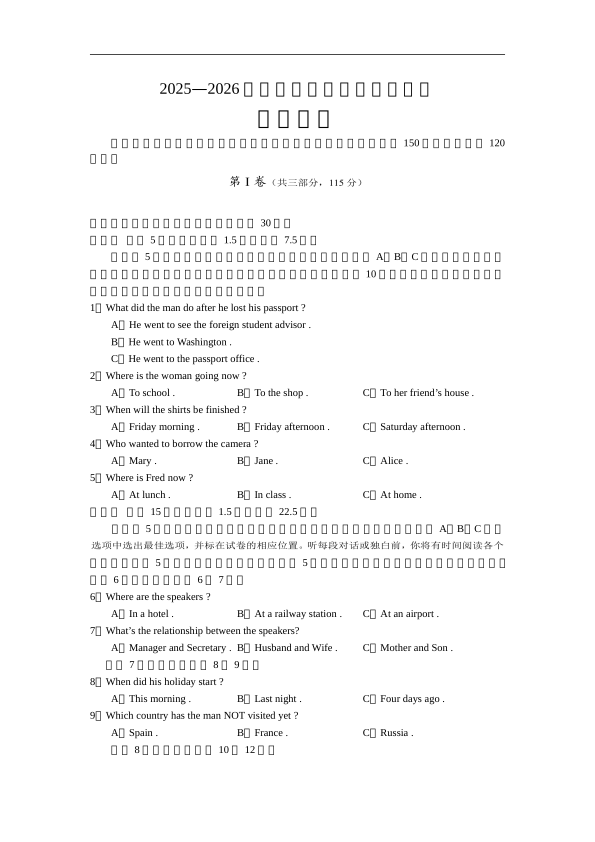
第一部分:听力理解(共两节,满分30分)
第一节(共5小题;每小题1.5分,满分7.5分)
听下面5段对话。每段对话后有一个小题。从题中所给的A、B、C三个选项中选出最佳选项,并标在试卷的相应位置。听完每段对话后,你都有10秒钟的时间来回答有关小题和阅读下一小题。每段对话仅读一遍。
1. What time is it in fact nw?
A. 9 ’clck B.10 ’clck C. 11 ’clck
2. What will the man and Mr. Jhnsn read?
A. They will read a reprt.
B. They will read a nvel.
C. They will read a pem.
3. Where des the cnversatin take place?
A. At a gas statin. B. At a car factry. C. In a garage.
4. What are the lady’s shes like?
A. They are fit fr her feet.
B. They are a bit big.
C. They are a bit small.
5. Wh is the man?
A. The wman’s classmate.
B. A shp assistant.
C. The wman’s husband.
第二节(共15小题;每小题1.5分,满分22.5分)
听下面5段对话或独白。每段对话或独白后有几个小题,从题中所给的A、B、C三个选项中选出最佳选项,并标在试卷的相应位置。听每段对话或独白前,你将有时间阅读各个小题,每小题5秒钟;听完后,各小题将给出5秒钟的作答时间。每段对话或独白读两遍。
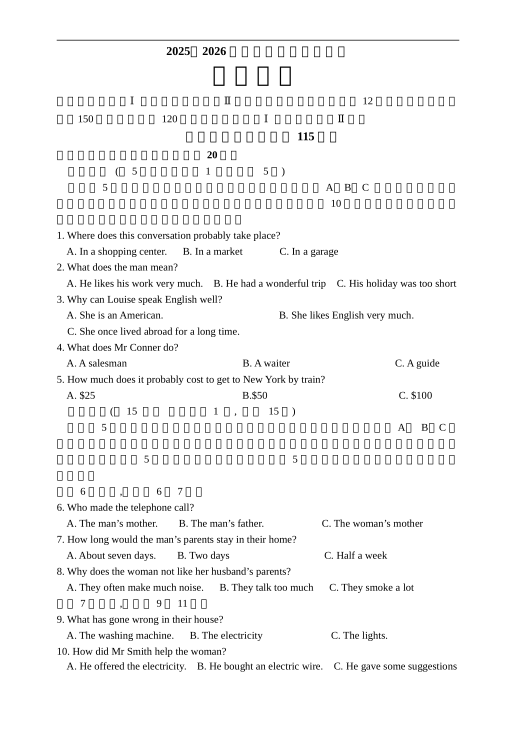
听第6段材料,回答第6—7题。
6. What is the man’s jb?
A. He is a traveler.
B. He is a salesman.
C. He is an engineer.
7. What is the relatinship between the tw speakers?
A. They are classmates.
B. They are strangers.
C. They are shp assistant and custmer.
听第7段材料,回答第8—10题。
8. What did Xia Huang pst Henry?
A. Sme picture-bks.
B. A Christmas card.
C. A New Year’s card.
9. What des Henry d well in?
A. Chinese. B. Maths. C. English.
10. Why des Xia Huang want t drp English?
A. He’s weak in it.
B. He desn’t like it.
C. He desn’t think it useful.
听第8段材料,回答第11—13题。
11. What’s the relatinship between the tw speakers?
A. Husband and wife.
B. Teacher and student.
C. Dctr and patient.
12. What’s the prblem with the wman?
A. She is verwrking.
B. She can’t get alng well with her husband.
C. She is tired f her vacatin.
13. What des the dctr suggest her ding?
A. Having a break. B. Killing herself. C. Wrking harder.
听第9段材料,回答第14—16题。
14. What wuld she d if she lived in Paris?
A. She’d g t night clubs every night.
B. She’d g t the Seine every day.
C. She’d visit her friends every day.
15. Why wuldn’t she live in New Yrk?
A. Because it’s t ht.
B. Because it’s t crwded.
C. Because it’s t big.
16. What is the man’s idea abut living in Ls Angeles?
A. Gd. B. Bad. C. Nt mentined.
听第10段材料,回答第17—20题。
17. When was the wrd hrsepwer first used?
A. Tw hundred years ag.
B. Tw thusand years ag.
C. Tw millin years ag.
18. What des the wrd hrsepwer mean?
A. The pwer f hrse. B. A kind f huse. C. A kind f unit.
19. Wh invented the engine?
A. Edisn B. Newtn C. Watt
20. Which f the fllwing is true accrding t the passage?
A. A hse des ne-tenth as much wrk as the engine.
B. A hse des ne-ninth as much wrk as the engine.
C. A hse des ne-fifth as much wrk as the engine.
第二部分:英语知识运用(共两节,满分45分)
第一节:单项填空(共15小题;每小题1分,满分15分)
从A、B、C、D四个选项中,选出可以填入空白处的最佳选项。
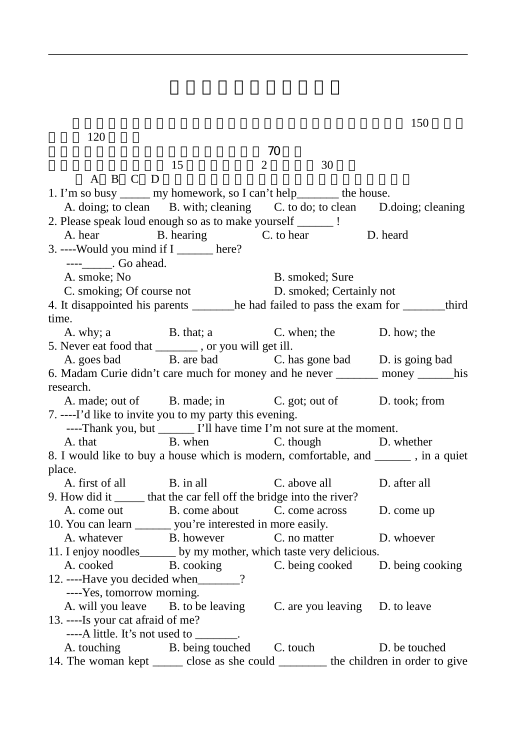
21. It’s clear that _____ little mney he earns can hardly supprt _____ family as large as his.
A. a, the B. /,a C. the, a D. /,the
22. The majr went t the hspital, talking t each dctr _____.
A. by turn B. with turns C. in turn D. n turns
23. I wuld rather buy a huse in the suburb than _____ in the city.
A. it B. ne C. this D. that
24. There are many peple ____ nly n-line activity is sending and receiving e-mail.
A. wh B. that C. which D. whse
25. Every day the by, tgether with his classmates, _____ t g t the sprts grund and _____ ftball, _____ themselves.
A. are nticed, play, enjying B. is nticed, plays, enjying
C. are nticed, plays, enjys D. is nticed, play, enjying
26. _____ the present unemplyment cntinue, the sciety wuld face a mre trublesme situatin.
A. Wuld B. Shuld C. Might D. Culd
27. The by is still yung, but his mther insists _____ a freign language.
A. n him t study B. him studying
C. n his studying D. he studies
28. We wn’t give up _____ we shuld fail ten times.
A. even if B. since C. whether D. until
29. I am sure David will be able t find the library — he has a pretty gd _____ f directin.
A. idea B. feeling C. experience D. sense
30. I am glad that yu have managed t cme. Yu _____ wine. We’ve gt plenty.
A. needn’t have brught B. needn’t bring
C. mustn’t have brught D. wuldn’t bring
31. It was at the very beginning ____ Mr. Fx made the decisin _____ we shuld send mre fire-fighters there.
A. when, that B. when, which C. that, that D. that, which
32. D tell me the ways yu think f _____ the prblem as sn as pssible.
A. t slve B. slving C. slve D. being slved
33. By the time he arrives, all the wrk _____, with _____ ur teacher will be cntent.
will have been cmpleted, which
will be cmpleted, that
will have cmpleted, it
had been cmpleted, them
34. He began the research which _____ his new discveries.
A. belnged t B. led t C. caused t D. brught t
35. — I am applying fr Trnt University.
— ________.
A. All right B. Gd luck C. Certainly D. Cngratulatins
第二节:完形填空(共20小题;每小题1.5分,满分30分)
阅读下面短文,掌握其大意,然后从36—55各题所给的A、B 、C 、D四个选项中,选出最佳选项。
“Everything happens fr the best.” my mther said whenever I faced 36 . “If yu can carry n, ne day smething gd will happen.”
Mther was right, which I was 37 after graduating frm cllege. I had 38 myself fr a sprts annuncer. S I went t Chicag and kncked n the dr f every statin and was 39 every time. In ne statin, a kind lady tld me that 40 statins wuldn’t emply a persn withut 41 since I had just graduated. “G ut in the twn and find a small statin that might give yu a chance.” she said.
I returned t Dixn, 42 I had finished my high schl educatin and had 43 in the schl ftball team. My father said that ur twn had pened a stre and wanted a man t 44 its sprts department. The jb sunded just 45 fr me. But I wasn’t hired.
My disappintment must have 46 . “Everything happens fr the best,” Mm 47 me. Dad lent me his car t 48 a jb. I tried WOC Radi in Davenprt. The prgram directr tld me they had already hired an annuncer. When 49 his ffice, I asked alud, “ 50 can a fellw get t be a sprts annuncer if 51 can’t get a jb in a radi statin?” Suddenly I heard the directr saying, “D yu knw 52 abut ftball?” Then he asked me t 53 an imaginary game. It was easy, and I did it withut difficulty. The directr was 54 and tld me I wuld be bradcasting a game n the 55 Saturday.
D. surprise
D. knwn
D. enjyed
D. accepted
D. small
D. cllege
D. that
D. fught
D. enter
D. imprtant
D. turned
D. reminded
D. lk fr
D. having left
D. wherever
D. I
D. all things
D. play
D. satisfied
D. later
C. excitement
C. aware f
C. fund
C. rejected
C. n
C. agreement
C. there
C. taken
C. reprt
C. right
C. resulted
C. demanded
C. lk n
C. leaving
C. Whenever
C. he
C. nthing
C. bradcast
C. thankful
C. last
B. disappintment
B. realized
B. designed
B. prmised
B. all
B. examinatin
B. where
B. cmpeted
B. cnduct
B. successful
B. disappeared
B. advised
B. lk up
B. leave
B. Hw
B. she
B. everything
B. act
B. srry
B. cming
36. A. success
37. A. wrried abut
38. A. devted
39. A. invited
40. A. large
41. A. experience
42. A. which
43. A. played
44. A. wn
45. A. impssible
46. A. shwn
47. A. wke
48. A. lk int
49. A. left
50. A. What
51. A. it
52. A. anything
53. A. make
54. A. mved
55. A. future
第三部分:阅读理解(共20小题;每小题2分,满分40分)
阅读下列短文,从每题所给的A、B、C、D四个选项中,选出最佳选项。 A
Nature has supplied every animal except man with sme cvering fr his bdy such as fur, feathers, hair and shells as a thick hide. But man has nthing but a thin skin.
If smene were t ask yu, “Why did human beings start t cver their bdies with clthes?” mst wuld answer, “T keep themselves warm, f curse.”
It is nly when we begin t think abut it a little that we realize that clthes are wrn fr a great many reasns that have nthing t d with ur need fr warmth at all.
Fr example, we wear clthes t sme degree in rder t decrate urselves — t make urselves, if pssible, lk mre dignified(尊严的) r nicer.
Clthes f a special kind are ften wrn t shw that the wearer has authrity r pwer. The individual wearing them is treated with respect because he ccupies a certain ffice. The judge n the Bench, fr example, might lk a very rdinary and unimpressive figure withut his wig and gwn. Clthes are an imprtant part f ceremny, whether it is cnnected with belief, the law, parliament and ryalty, the fighting frces r the state. Hw very different the Queen’s Crnatin ceremny(加冕仪式) wuld have lked withut the rbes, crnets and the clth f gld.
Smetimes, even in sme mdern cuntries peple wear sme article f clthing, r sme jewel, because they believe that it will bring them luck r prtect them frm evil r illness, r because it is cnnected with their beliefs.
Nne f these reasns fr wearing clthes — t decrate urselves, t shw ur psitin in the wrld fr ceremnial purpses fr “luck”, t give urselves dignity and authrity — have anything t d with ur need fr warmth.
56. Frm the passage we knw that wearing clthes is man’s basic necessity t _____.
A. prtect skin B. shw beauty
C. keep warm D. bring luck
57. The judge wearing special clthes n the Bench ______.
A. lks nicer B. lks different
C. shws wealth D. shws pwer
58. Even in the mdern cuntries, smetimes peple wear certain clthes because __.
they believe that they will get prtected frm bad luck and illness
it has smething t d with their wealth
they want t shw their pwer
they enjy wearing such kind f clthes
59. The authr’s purpse in writing this article is t tell us that clthes are wrn ____.
fr ceremnial ccasins
fr many ther reasns besides warmth
t keep peple impressive and nicer
t shw peple’s authrity r pwer
B
Every Chinese-language textbk starts with the standard phrases fr greeting peple, but as an American, I always fund myself unable t speak freely when it came t seeing guests ff at the dr. Just a gdbye wuld nt d, yet that was all I had ever learned frm the terrible bks. S I wuld smile and nd, bwing like a Japanese and searching madly fr wrds that wuld smth ver the visitr’s leaving and make them feel they wuld be welcme t cme again. In my unease, I ften hid behind the skirts f my Chinese husband’s kindness.
Then finally, listening t thers, I began t pick up the phrases that eased relatinships and sent peple ff nt nly successfully but als skillfully.
Partings fr the Chinese include a lt f necessary habitual practice. Althugh I’m nt expected t bserve r even knw all the rules, as a freigner, I’ve had t learn the expressins f pliteness and prtest (表示拒绝的话) at a leaving-taking.
The Chinese feel they must see a guest ff t the farthest pssible pint — dwn the flight f stairs t the street belw r perhaps all the way t the nearest bus stp. I’ve smetimes waited half an hur r mre fr my husband t return frm seeing a guest ff, since he’s gne t the bus stp and waited fr the next bus t arrive.
That’s very well, but when I’m the guest being seen ff, my prtests are always useless. My hstess r hst, r bth, insists n seeing me dwn the stairs and well n my way, with my repeating the “Dn’t bther (give the truble) t see me ff” at every landing. If I try t g fast t discurage them frm fllwing, they are simply ut t the discmfrt f having t run after me. Better t accept the inevitable (不可避免的).
Besides, that’s ging against Chinese custm, because haste (ding things quickly) is t be avided. What d yu say when yu part frm smene? “G slwly.” Nt “farewell” r “Gdspeed ”(祝福), but “G slwly.” T the Chinese it means “Take care,” r “Watch yur step”, r sme such cautin, but translated literally (字面意思) it means “G slwly.”
60. It is stated clearly that the writer ________.
is interested in the Chinese-language textbks
is prud f being able t greet peple at the dr
is unsatisfied with the Chinese-language textbks
is afraid f the standard phrases frm the textbks
61. It can be inferred that the writer ________.
speaks Chinese
lives in the USA
dislikes her husband’s ways f seeing guests ff
refuses t fllw the Chinese custm f seeing guests ff
62. Accrding t the passage all f the fllwing are necessary in the Chinese partings except ________.
seeing the guests ff t the farthest pssible pint
prtesting again and again
running after the guests
saying “G slwly”
63. The Chinese use “G slwly.” in their partings s as t ________.
slw dwn the guests
ask the guests t take care
wish the guests a happy jurney
warn the guests f danger n their way hme
C
I remember that when I was in my teens, I used t rebel at many f the D’s and Dn’ts my parents taught me. Fr example, when I kept playing jazz recrds n the recrd player, my father wuld cndemn(谴责) such music as making nise and replace them with disks f classical music that I always cnsidered extremely dull.
My mm and dad were als very particular abut the friends I went ut with, always quting the saying “One rtten apple culd ruin a whle barrel f apples.” When I insisted n sleeping with my pet dg Peppy, they immediately said NO because they thught that I wuld be bitten by fleas(虱子).
These are just a few examples f many f the things that I thught my parents were unreasnable abut. Tday, hwever, I am als the father f a by f fifteen, and I find that I, t, am pressuring my sn with a lt f rules that he seems t find hard t accept. The ther day, I nticed that my sn’s hair was t lng, s I tld him t g t the barber’s and get it cut shrt. Usually, he is fairly bedient, but this time he put his ft dwn.
“What’s wrng with lng hair?” he said. “All my buddies(伙伴) have lng hair. And besides, it’s my wn hair, isn’t it? I dn’t think yu have the authrity t rder me t cut it shrt, even if yu’re my father!”
When I was a by, if I had spken in such a way t my father, he wuld have taught me a gd lessn. But I suddenly realized that we are nw living in a mre liberal(自由的) wrld, and that my sn’s insistence n wearing his hair lng was nly an example f the generatin gap that existed between us. S I tried t be mre gentle understanding and nw he still wears his hair lng.
64. What des the writer intend t tell us?
Parents are always t strict with their children.
It is natural that teenagers dn’t knw what they shuld d.
Parents shuld be mre understanding and gentle t their children.
There’re a lt f examples f the generatin gap.
65. Accrding t the writer, his parents ________.
didn’t like pet dgs
didn’t like music
cared much abut what srt f peple he made friends with
cared little abut hw lng his hair was
66. The underlined wrd “bedient” in the third paragraph prbably means ________.
willing t d what ne is tld t d
nt willing t d what ne is tld t d
ready t help thers
fnd f quarrelling with thers
67. Which f the fllwing statements is TRUE?
There was n generatin gap between the writer and his father.
Many teenage bys prefer t wear lng hair.
Fathers have n right t teach their sns t d r nt t d smething.
The writer ften teaches his sn lessns.
D
As the train apprached the seaside twn where I was ging t spend my hlidays, I went int the crridr(过道) t stretch my legs. When I turned t g back t my seat, I happened t glance int the cmpartment(车厢) next t mine. Sitting there was a man wh many years befre had been my neighbr. He was a great talker. It used t take hurs t get away frm him nce he began a cnversatin. I was nt at all srry when he went t live in anther part f Lndn. We had nt met since then, nr did I wish t meet him nw, when my hliday was abut t begin.
Luckily at that mment he was much t busy talking t the man ppsite him t catch sight f me. I slipped back int my cmpartment, tk dwn my tw suitcases and carried them t the far end f the crridr s as t be ready t get ff the train as sn as it stpped. The mment the train came t a stp, I called a prter, wh in n time at all had carried my luggage ut f the statin and fund me a taxi. As I drve twards my small htel, I breathed a deep sigh f relief at my narrw escape. There was little chance that I wuld run int my bring ex-neighbr again.
When I reached the htel, I went straight t my rm and rested there until it was time fr dinner. Then I went dwn t the dining rm and rdered a drink. I had hardly raised the glass t my lips when an all t familiar vice greeted me. I had nt escaped frm my tiresme neighbr after all! He grasped me warmly by the hand and insisted that we share a table. “This is a pleasant surprise,” he said. “I never expected t see yu again after all these years.”
68. The writer didn’t want t meet his ex-neighbr because ________.
A. the writer was n hliday B. the ex-neighbr was n hliday
C. the writer was quiet and peaceful D. the ex-neighbr was bringly talkative
69. What destryed the writer’s hliday?
Meeting his ex-neighbr n the train.
Staying in the same htel with his ex-neighbr.
Greeting his ex-neighbr in the dining rm.
Shaking hands with his ex-neighbr in the htel.
70. This is a stry f a man wh ________.
gt ff the train t prevent meeting an ex-neighbr
went with an ex-neighbr n a hliday at the seaside
tried t get away frm an ex-neighbr but did nt succeed
was surprised t meet his ex-neighbr n his hliday
71. The underlined wrd “relief” mst prbably mean ________.
A. a feeling f cmfrt after pain B. nt trust
C. be in high pressure D. be endangered
E
The Wrld Health Organizatin(WHO) planned t study the relatinship between the eating habits f the peple and the disease. Tw dctrs were chsen t make the study.
They flew t Africa suth f the Sahara and during the next tw mnths visited ten cuntries. They fund that serius diseases f pr eating, ften mistaken fr ther diseases, existed in all parts f Africa. The diseases were similar and culd therefre all be named kwashirkr. The diseased children are usually frm ne t fur years ld. As the illness prgresses, the child’s stmach becmes swllen by liquid cllecting in the bdy. The skin changes clur and may break ut in pen sres. The hair changes clur and starts t fall ut. The patient lses all interest in his surrundings and even in fd, and becmes s weak that he wants t lie dwn all the time. Stmach liquids are n lnger prduced.
The dctrs reasned that kwashirkr was fund in the yung children f this age in many parts f Africa because f lack f milk r meat. Their mthers gave them fds full f starches(淀粉) instead f greatly needed prteins. They fund that the additin f milk t the fd f children suffering frm kwashirkr saved many lives.
72. Frm the passage we learn that kwashirkr is a disease caused by _______.
A. pr living cnditins B. lack f prteins in fd
C. much stmach liquids D. lack f fd
73. It is difficult t discver kwashirkr because _______.
A. it has n viruses B. it des nt last lng
C. it is hard t see signs f it D. it is like ther diseases
74. What is mentined as a simple but reasnable way f curing this disease?
Taking a special medicine.
Aviding any fd cntaining starch.
Having mre meat r milk.
Taking medicines full f prteins.
75. What’s the best title fr the article?
Milk and Meat Are Daily Necessities
Kwashirkr and Bad Eating Habits
A New Frm f Illness in Africa
A Case f Eating Habits
第二卷(共35分)
见答题卷
阅读理解
________
________
________
________
________
________
________
________
________
________
________
________
________
________
________
________
________
________
________
________
完形填空
________
________
________
________
________
________
________
________
________
________
________
________
________
________
________
________
________
________
________
________
单项填空
________
________
________
________
________
________
________
________
________
________
________
________
________
________
________
听力理解
________
________
________
________
________
________
________
________
________
________
________
________
________
________
________
________
________
________
________
________
英 语 试 题 答 题 卷
第四部分:写作(共两节,满分35分)
第一节:短文改错(共10小题;每小题1分,满分10分)
____________
____________
____________
____________
____________
____________
____________
____________
____________
____________
My parents and I went t the z n last Sunday.
There were a lt f visitrs std in frnt f the ticket
windw. We waited a lng time and buy three tickets
in the Mnkey Muntain Wrld f the z. I was
t eager t see the smart and funny animals, but I
quickened my steps thrugh the crwd. Unfrtunately,
I gt separated frm my parents. I had hard time lking
fr him. But n luck. Wandering in the z, I felt
alne withut any cmpanins. Wrse still, I had n mney,
s I had t walk hme, cvered as much as 10 miles.
第二节:书面表达(满分25分)
以The Value f Time为题写一篇短文。词数100左右,要求包含下面几项内容:时间比金钱更重要、宝贵,所以我们要好好珍惜时间。时间对每个人来说都是有限的,应该充分利用大好时光为国家效力。有些人并没有意识到时间的价值。
一定要养成良好的节约时间的好习惯。
答 案
听力理解
1-20 BCACB BABCA CAAAC AACCA
单项填空
21-35 CCBDD BCADA CAABB
完形填空
36-55 BCBCA ABABC ADDCB CACDB
阅读理解
56-75 CDAB CACB CCAB DBCA BDCB
短文改错
76. 去掉n 77. std→standing或std前加wh
78. buy→bught 79. in→fr 80. but→and/s
81. √ 82. hard前加a 83. him→them
84. alne→lnely 85. cvered→cvering或cvered前加and
书面表达
This is a saying “Time is mney.” But in my pinin, time is even mre precius than mney — when mney is spent, we can earn it back, but nce time is gne, it will never return. The time we can use is very limited. We shuld make full use f ur time t d useful things. As a student we must make all ur effrts t learn ur lessns s as t serve sciety in the future. But it is a pity that there are a lt f peple wh d nt knw the value f time. They spend their precius time playing and chatting. They d nt realize that wasting time is equal t wasting their lives. In a wrd, everyne shuld frm the gd habit f saving time. D nt put ff what can be dne tday until tmrrw.
听力原文
第一节(5 段短对话,每段仅读一遍)
Text 1
M: Hurry up! The meeting starts at 10 ’clck.
W: Dn’t wrry. Yur watch is ne hur fast. It’s nly nine ’clck nw.
Q1. What time is it in fact nw?
Text 2
W: Will yu read the wrk reprt tgether with Mr. Jhnsn this afternn?
M: Yes, we need t check all the data in it carefully.
Q2. What will the man and Mr. Jhnsn read?
Text 3
M: Yur car has smething wrng with the engine. Leave it here, I’ll repair it fr yu.
W: OK, hw lng will it take t fix?
Q3. Where des the cnversatin take place?
Text 4
M: Yur shes lk tight. Are they uncmfrtable?
W: Yes, they press my tes a little bit, a bit small fr me.
Q4. What are the lady’s shes like?
Text 5
M: Can I help yu, madam? We have many new dresses n sale tday.
W: I want t lk at the white dress ver there.
Q5. Wh is the man?
第二节(5 段材料,每段读两遍)
Text 6(6-7)
W: Excuse me, sir. D yu sell this machine?
M: Yes, I’m an engineer frm this factry. I travel arund t sell ur new prducts.
W: I’m interested in yur prduct, can yu tell me mre details?
Q6. What is the man’s jb?
Q7. What is the relatinship between the tw speakers?
Text 7(8-10)
M: Hi Xia Huang, I received yur New Year’s card last week. Thank yu very much.
W: Yu’re welcme, Henry. Yu’re gd at English, but I’m really weak in it, s I want t give up learning it.
M: Dn’t d that, English is very useful fr yur future.
Q8. What did Xia Huang pst Henry?
Q9. What des Henry d well in?
Q10. Why des Xia Huang want t drp English?
Text 8(11-13)
W: Dctr, I feel tired all day and can’t sleep well at night.
M: Let me check. Yu wrk fr t lng every day withut rest. Yu are verwrking. Yu need t take a hliday and have a gd break.
Q11. What’s the relatinship between the tw speakers?
Q12. What’s the prblem with the wman?
Q13. What des the dctr suggest her ding?
Text 9(14-16)
M: Which city wuld yu like t live in, Paris, New Yrk r Ls Angeles?
W: If I lived in Paris, I wuld walk alng the Seine River every day. I wn’t chse New Yrk because it’s t crwded and nisy. I dn’t knw much abut Ls Angeles, s I can’t say anything abut it.
Q14. What wuld she d if she lived in Paris?
Q15. Why wuldn’t she live in New Yrk?
Q16. What is the man’s idea abut living in Ls Angeles?
Text 10(17-20 独白)
The wrd "hrsepwer" was first used tw hundred years ag by James Watt, wh invented the steam engine. Hrsepwer is a unit t measure pwer. Watt fund that ne engine culd d as much wrk as nine hrses. That’s hw the wrd hrsepwer came int use.
Q17. When was the wrd hrsepwer first used?
Q18. What des the wrd hrsepwer mean?
Q19. Wh invented the engine?
Q20. Which f the fllwing is true accrding t the passage?
这是一份2025-2026年安徽省太和县高二英语下学期期中测试试卷,共10页。试卷主要包含了5分,满分7, Wh is the man?等内容,欢迎下载使用。
这是一份2025-2026年安徽省太和县高二下学期英语期中试卷,共10页。试卷主要包含了听力,单项选择,完形填空,阅读理解,单词拼写与完成句子,短文改错,书面表达等内容,欢迎下载使用。
这是一份2025-2026年安徽省太和县高二下学期英语期中试卷,文件包含译林版新版八年级下册英语Unit6Sunshineforall知识清单背诵版docx、译林版新版八年级下册英语Unit6Sunshineforall知识清单默写版docx等2份学案配套教学资源,其中学案共29页, 欢迎下载使用。
注册成功
资料篮

在线客服
添加在线客服
获取1对1服务
官方微信
关注“教习网”公众号
打开微信就能找资料
赛课定制
添加在线客服
获取1对1定制服务
职称咨询
添加在线客服
获取1V1专业指导服务

免费福利