 免费领取教师福利

若您为此资料的原创作者,认为该资料内容侵犯了您的知识产权,请扫码添加我们的相关工作人员,我们尽可能的保护您的合法权益。


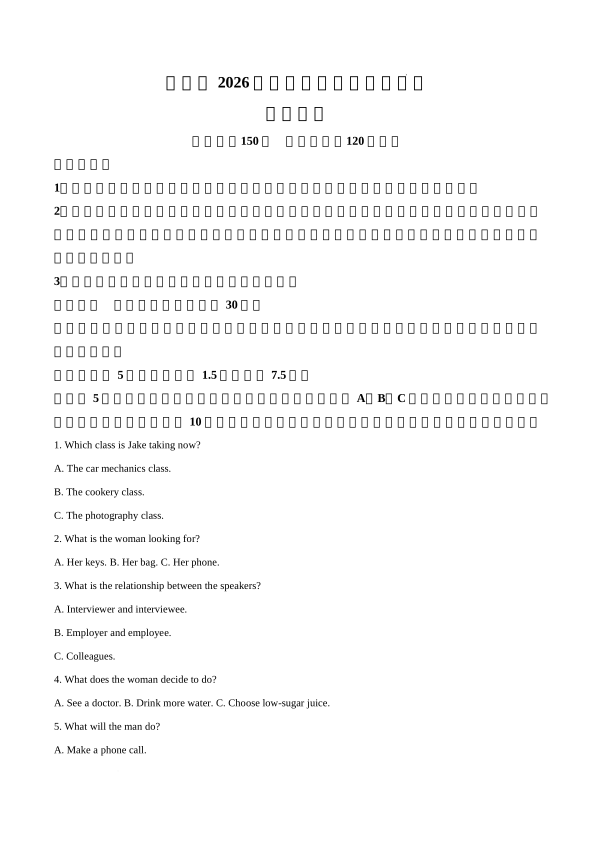
这是一份福建省南平市2026届高三下学期第二次适应性练习英语试卷(Word版附解析),共7页。
本练习卷共 12 页。满分 150 分。
注意事项:
1.答题前,考生务必在练习卷、答题卡规定的地方填写自己的准考证号、姓名。考生要认真
核对答题卡上粘贴的条形码的“准考证号、姓名”与考生本人准考证号、姓名是否一致。
2.回答选择题时,选出每小题答案后,用铅笔把答题卡上对应题目的答案标号涂黑。如需改
动,用橡皮擦干净后,再选涂其他答案标号。回答非选择题时,将答案写在答题卡上。写在
本练习卷上无效。
3.考试结束,将本练习卷和答题卡一并交回。
第一部分 听力(共两节,满分 30 分)
做题时,先将答案标在试卷上。录音内容结束后,你将有两分钟的时间将试卷上的答案转涂
到答题卡上。
第一节(共 5 小题;每小题 1.5 分,满分 7.5 分)
听下面 5 段录音。每段录音后有一个小题,从题中所给的 A、B、C 三个选项中选出最佳选项。
听完每段录音后,你都有 10 秒钟的时间来回答有关小题和阅读下一小题。每段录音播放两遍。
1. Why did Jenny g t Lndn?
A. T have a vacatin.
B. T wrk in a hspital.
C. T accmpany her family.
2. What are the speakers prbably ding?
A. Making a statue.
B. Visiting an art center.
C. Watching a chess game.
3. Which sprt des the man like best?
A. Cycling. B. Hiking. C. Swimming.
4. What d we knw abut Watsn?
A. He is seeing a dentist.
B. He is ut fr cntests.
第 1页/共 14页
C. He ften takes days ff.
5. What will the man d?
A. Use Ze’s umbrella.
B. Return the raincat.
C. Buy a chair.
第二节(共 15 小题;每小题 1.5 分,满分 22.5 分)
听下面 5 段录音。每段录音后有几个小题,从题中所给的 A、B、C 三个选项中选出最佳选项。
听每段录音前,你将有时间阅读各个小题,每小题 5 秒钟。听完后,各小题都有 5 秒钟的作
答时间。每段录音播放两遍。
听第 6 段录音,回答第 6、7 题。
6. What des the grandpa ask Nancy t d?
A. Be patient.
B. Lsen the sil.
C. Water flwers in time.
7. What des Nancy think f gardening?
A. It’s easy. B. It’s tiresme. C. It’s meaningful.
听第 7 段录音,回答第 8 至 10 题。
8. What will arrive in abut tw weeks?
A. New furniture. B. Cmpany samples. C. Sea prducts.
9. What is the prbable relatinship between the speakers?
A. A cuple. B. Neighbrs. C. Clleagues.
10. What is the man ging t d next?
A. Sell the bks. B. Empty the bkshelf. C. Message his buyer.
听第 8 段录音,回答第 11 至 13 题。
11. What is the presentatin mainly abut?
A. Csts f campus recycling.
B. Art prjects using waste materials.
C. Recycling prgrams in tw schls.
12. What materials des Maplewd use?
A. Old paper. B. Plastic bttles. C. Recycled glass.
第 2页/共 14页
13. What des the man suggest Lily d?
A. Handle visuals herself.
B. Avid t many keywrds.
C. Rerganize the presentatin.
听第 9 段录音,回答第 14 至 16 题。
14. Where is Linda nw?
A. At the airprt.
B. In the htel rm.
C. At the security center.
15. When is Linda’s flight?
A. At 9:00 a.m. B. At 12:30 p.m. C. At 3:00 p.m.
16. Hw will Linda get her cat?
A. By herself.
B. By a taxi driver.
C. By a bus passenger.
听第 10 段录音,回答第 17 至 20 题。
17. What des the speaker d?
A. A full-time student.
B. A prfessinal singer.
C. A best-selling authr.
18. When did the speaker nrmally wake up ne mnth ag?
A. At 5:30 a.m. B. At 6:00 a.m. C. At 6:30 a.m.
19. What des the speaker d first after waking up?
A. He drinks water.
B. He reviews the plan.
C. He ntes dwn ideas.
20. Why des the speaker give the talk?
A. T share his daily life.
B. T recmmend a self-help bk.
C. T explain his scheduling methd.
第 3页/共 14页
第二部分 阅读(共两节,满分 50 分)
第一节(共 15 小题;每小题 2.5 分,满分 37.5 分)
阅读下列短文,从每题所给的 A、B、C、D 四个选项中选出最佳选项。
A
The Intrducing Future Leaders t Opprtunities in Water (InFLOW) schlarship prgram aims t lk fr the
next generatin f leaders in the clean water industry. It partners with cmmunity grups t engage prmising
talent, slidify their interest in the water field, raise their awareness f career pprtunities, and enhance their
lng-term career prspects.
Current students r yung prfessinals can chse t apply fr ne f the tw paths: STEMPATH and
CAREERTECH.
REQUIREMENTS
Prir experience in water-related fields is nt required, but a clear interest in the water industry is encuraged.
T participate in the prgram, individuals must:
Be a full-time undergraduate r graduate student majring in a STEM field STEMPATH
(Science, Technlgy, Engineering, r Mathematics).
Be a student attending any adult educatin classes related t
science/technlgy, r a prfessinal lking t engage a career change CAREERTECH
invlving: Operatins, Engineering r Mechanical.
PARTICIPANT BENEFITS
·Membership: Student membership fr 1 year.
·Cnference Attendance: Free Admissin t the 2027 InFLOW Annual Cnference (January 24-27, 2027 in Bstn,
Massachusetts)
·Cmmittee Invlvement: A Water Industry prfessinal will be assigned t guide the participant.
RESPONSIBILITIES
Selected participants are required t take part in nline activities and attend all cnference events. After the
prgram, each participant must cmplete a survey t prvide feedback n their experience and ffer suggestins fr
imprving prgram in the future.
1. What is the InFLOW prgram aimed at?
第 4页/共 14页
A. Offering free curses.
B. Develping industry leaders.
C. Prviding jbs fr yuth.
D. Selecting cnference participants.
2. Wh can apply fr the CAREERTECH?
A. Graduates with membership.
B. Students majring in mathematics.
C. Adults with related certificates.
D. Prfessinals seeking a career shift.
3. What are the selected members expected t d?
A. Address the annual cnference.
B. Design a survey t cllect data.
C. Participate in the related activities.
D. Wrk full-time fr the prgram.
B
When Lila Martinez mved t Maple Street, she was struck by a marked cntrast. The huses were well-kept,
with flwers blming in mst yards, but at the crner f her blck sat a 1,200-square-ft parking lt — a
dumping grund fr ld tires, brken furniture, and vergrwn weeds. T Lila, it lked like a “wund” that the
neighbrhd had simply learned t ignre.
Instead f cmplaining, the 17-year-ld decided t take actin. She began kncking n drs, a clipbard in
hand, asking her neighbrs, “What wuld yu d with that lt if yu culd?”
Mrs. Hendersn, an 82-year-ld resident living alne, teared up as she said, “I used t have a garden, but I can’
t bend dwn anymre. I’d lve t smell fresh flwers again.” Mr. Trres, the wner f the lcal grcery stre,
ffered t dnate tls and sil. Even the teenagers were interested, suggesting a place t play basketball.
Lila realized the prject was bigger than just cleaning up rubbish. She named it the “Maple Cmmunity
Garden” and launched a crwdfunding campaign. With the raised mney, she hired a lcal cnstructin cmpany t
level the grund. The first Saturday was backbreaking. Lila and twenty vlunteers filled 40 garbage bags with
rubbish. As the weeks passed, the lt began t breathe again. Sunflwers twered ver the fence, attracting bees
and butterflies. Tmates ripened n the vine.
Mre imprtantly, the peple began t blm. The teens wh helped build the basketball curt started
第 5页/共 14页
assisting Mrs. Hendersn t carry her grceries. Mr. Trres began hsting weekly barbecues using vegetables frm
the garden. Neighbrs wh had lived next t each ther fr decades but never spken were nw exchanging recipes
and gardening tips.
Lila said, “I thught I was just building a garden, but what I really built was a bridge. That empty lt used t
divide us; nw it cnnects us.”
4. Why did Lila view the lt as a “wund”?
A. It ruined the street’s beauty.
B. It tk up much space.
C. It caused cnflicts in neighbrs.
D. It reminded her f an injury.
5. Which f the fllwing best describes the residents’ respnse?
A. Surprised. B. Supprtive.
C. Cautius. D. Emtinal.
6. What did Lila d fr the cmmunity prject?
A. She ffered tls and sil.
B. She raised mney dr t dr.
C. She secured supprt t transfrm the lt.
D. She encuraged neighbrs t grw vegetables.
7. What is the best title fr the text?
A. Ways t Build a Better Blck
B. The Garden that Heals a Neighbrhd
C. Cares fr the Old in the Cmmunity
D. A Teenager’s Dream f a Lvely Garden
C
It is n surprise that getting enugh sleep, exercising and eating well are crucial t a lng life. But it was
unknwn hw very small lifestyle changes affect ur lifespan, and healthspan, which is the number f years spent
in gd health.
T fill this gap in ur knwledge, Nichlas Kemel and his clleagues at the University f Sydney first
analyzed sleep, dietary and physical activity data frm nearly 60,000 adults, aged between 40 and 69, frm the UK
Bibank prject. In that prject, the participants cmpleted surveys that asked them t recall their diets ver the
第 6页/共 14页
past year. Then, they wre mvement trackers n their wrist fr a week t measure their exercise and sleeping
habits, and their mrtality (死亡率) and health recrds were tracked ver a subsequent fllw-up perid f eight
years.
After an in-depth analysis, the researchers Nichlas’ team used a statistical mdel t estimate that, cmpared
with the bttm 5 percent f participants with the least healthy lifestyles, thse wh slept fr abut 5 minutes mre
each day, engaged in exercise fr abut 2 minutes lnger and ate an extra half serving f vegetables daily lived fr
a year lnger, n average.
This cmbinatin f small lifestyle changes had the same effect as making larger shifts in nly ne aspect f
lifestyle-fr instance, sleeping fr 25 minutes lnger withut adjusting exercise r diet. “When we package lifestyle
changes tgether, we get mre bang fr ur buck and we reduce the verall requirement frm any ne behaviur,”
says Kemel.
Hwever, Alan Chenat frm Clumbia University was nt n the same page. “Dietary recall surveys may
cntain sme errrs because peple frget what they have eaten, and it is impssible t knw whether a week f
physical activity r sleep data is really representative f smene’s general habits ver lnger perids,” he said.
8. What des Nichlas Kemel’s study fcus n?
A. Effects f small lifestyle shifts.
B. Secrets t a balanced life.
C. Ways t imprve living quality.
D. Benefits f healthy rutines.
9. Hw was the study carried ut?
A. By using a data mdel.
B. By mnitring wrist trackers.
C. By ding health surveys.
D. By gathering fllw-up recrds.
10. Which best explains “we get mre bang fr ur buck” underlined in paragraph 4?
A. Rme wasn’t built in a day.
B. Slw and steady wins the race.
C. Never judge a bk by its cver.
D. A little effrt yields great results.
11. What can be inferred frm Alan Chenat’s wrds?
第 7页/共 14页
A. The survey lacks public infrmatin.
B. Participants takes the research casually.
C. The study may still have sme limitatins.
D. A week’s recrds can mirrr persnal habits.
D
The Dunning-Kruger effect, named after the psychlgists wh first studied it, means peple wh aren’t very
gd at a given task are vercnfident while peple with high ability tend t underestimate their skills. Hwever,
recent research by Aalt University scientists reveals that using artificial intelligence (AI) all but remves this
effect — in fact, it almst reverses (逆转) it.
In their study invlving 500 participants, researchers administered lgical reasning tasks frm the Law
Schl Admissin Test. Half the grup used ChatGPT, while the ther half wrked independently. Bth grups
were later quizzed n their AI literacy and hw well they thught they perfrmed. Surprisingly, their research
shwed that AI usage nearly changed the Dunning-Kruger effect: high-skill AI users shwed the greatest
verestimatin f their perfrmance. “Our findings reveal a significant inability t assess ne’s perfrmance
accurately when using AI,” nted c-authr Rbin Welsch.
This phenmenn springs frm “cgnitive fflading” (认知卸载) — users accept AI-generated answers
withut critical cnfirmatin. Less engagement in ur wn reasning reduces ur ability t evaluate ur
perfrmance accurately. Interestingly, AI assistance narrws the gap between high and lw-skill users because
large language mdels imprve everyne’s perfrmance t sme degree.
The researchers warn f a ptential cnsequence. As peple rely mre n results withut questining them, a
dangerus incnsistency emerges: imprved perfrmance paired with reduced self-assessment capability. Withut
accurate errr-checking and reflectin, critical thinking skills may becme wrse ver time.
Furthermre, the flattening f ability differences means widespread vercnfidence in AI-assisted tasks,
particularly amng the mst experienced users, leading t an increased climate f miscalculated decisin-making
and a gradual destructin f skills. One methd the team suggests t arrest such decline is t have AI itself
encurage further questining in users, with develpers adjusting respnses t encurage reflectin, asking
questins like “hw cnfident are yu in this answer?”, r therwise prmting further interactin thrugh
measures like cnfidence scres.
12. Why is “the Dunning-Kruger effect” mentined?
A. T supprt an idea.
第 8页/共 14页
B. T highlight a dilemma.
C. T explain a cncept.
D. T intrduce a phenmenn.
13. What is the finding f the study?
A. Lw-skill users utperfrm high-skill nes.
B. Users verestimate abilities when using AI.
C. AI learning imprves self-assessment accuracy.
D. Cgnitive fflading enhances ne’s perfrmance.
14. What incnsistency des the use f AI create?
A. Higher cnfidence but wrse skills.
B. Mre effrt but lwer scres.
C. Better results but prer awareness.
D. Slwer speed but better accuracy.
15. What des the team suggest t address the prblem identified?
A. Remving cnfidence scres.
B. Adjusting interactin schedules.
C. Limiting AI access fr develpers.
D. Prgramming reflective reminders.
第二节(共 5 小题;每小题 2.5 分,满分 12.5 分)
阅读下面短文,从短文后的选项中选出可以填入空白处的最佳选项。选项中有两项为多余选项。
Divergent (发散性) thinking is an ability t generate multiple appraches t slving a prblem. The divergent
thinkers typically answer simple questins like “What are the uses fr a flwer pt?” in many ways. ____16____ A
genius f divergent thinking wuld cme up with a hundred pssible answers, and they d this by changing the
cncepts f already existing thinking.
Research shws that divergent thinking is mstly fund amng peple wh knw hw t ask questins.
Divergent thinking is nt s much abut finding answers as it is abut asking the questin t get t thse
answers. ____17____ The mre yu ask clear questins that explre the differences, the better yur chance f
succeeding.
____18____ This technique is a tl that builds upn ideas. Allw everyne t think mre freely in the grup
atmsphere. Dn’t pursue a practical slutin. Instead, gather ideas relevant t the prblem itself. Besides
第 9页/共 14页
brainstrming, yu can als keep a jurnal. Using a jurnal enables yu t capture and recrd varius ideas that
peple can have during unusual times and places. ____19____
Anther effective way is t create a subject r mind-mapping visual. ____20____ And make sure the visuals
shw the relatinships amng these ideas. Take “Start a Charity” fr example. Cme up with necessary subtpics,
and use lines and circles t visualize the tpic. After generating ideas in these ways, yu can arrange yur ideas in
an innvative manner.
A. This methd is used t exchange ideas.
B. It helps find the answers t the questins.
C. Put the related ideas in the frm f a chart r a picture.
D. Asking the right questins will get what yu are seeking.
E. Brainstrming is ne way t imprve yur divergent thinking.
F. An average persn wuld have 10 t 15 answers t this questin.
G. Later, it can becme a surce bk f ideas t develp and rganize.
第三部分 语言运用(共两节,满分 30 分)
第一节(共 15 小题;每小题 1 分,满分 15 分)
阅读下列短文,从每题所给的 A、B、C、D 四个选项中选出最佳选项。
Every New Year’s Eve, ur family hlds a special gift exchange. Instead f ____21____ frm wish lists, we
each print a picture f what we want, and the ____22____ n the picture can be handmade. Arund mid-December,
we gather, put ur flded pages int a bwl and pass it arund, each f us ____23____ ne.
This year, I picked Mm’s. ____24____, her gift wasn’t difficult t make. I fund a ____25____ and rdinary
bx at a discunt stre, decrated it carefully and then asked everyne in the family t write dwn
their ____26____ memry t put inside.
“Laughing n the beach at Cape Cd,” wrte my sister-in-law.
“I gt my driver’s license!” was my nephew’s ____27____.
I ____28____ my answer. While I was ding the husewrk, memries ____29____ — visiting my sn at
his cllege, singing tgether n the way t the z… Which memry ____30____ a place inside the bx? The mre
I ____31____, the mre the year unflded int days laced with ____32____, beauty and lve. In the end, I chse
ur family reunin in the Catskills, where we’d spent the night ____33____, laughing and being tgether.
On New Year’s Day, when my mm pened the bx, her face lit up. Everyne grew quiet as she read
each ____34____ alud. Lking arund the rm, I realized the true gift wasn’t the bx at all, but the way
第 10页/共 14页
ur ____35____ hld us clse.
21. A. cpying B. shpping C. benefiting D. learning
22. A. antique B. chart C. item D. device
23. A. feeling B. cutting C. thrwing D. drawing
24. A. Frtunately B. Hpefully C. Eventually D. Accrdingly
25. A. plain B. fancy C. valuable D. distinctive
26. A. early B. instant C. favrite D. painful
27. A. cmment B. request C. suggestin D. cntributin
28. A. wrked ut B. wrte dwn C. handed in D. struggled with
29. A. surfaced B. changed C. disappeared D. remained
30. A. ccupied B. needed C. deserved D. claimed
31. A. imagined B. reflected C. dubted D. anticipated
32. A. pride B. wisdm C. laughter D. creativity
33. A. shuting B. chatting C. arguing D. debating
34. A. pst B. slip C. list D. file
35. A. memries B. thughts C. blessings D. pinins
第二节(共 10 小题;每小题 1.5 分,满分 15 分)
阅读下面短文,在空白处填入 1 个适当的单词或括号内单词的正确形式。
Recent archaelgical (考古的) discveries have revealed the Chinese bayberry, r yangmei, ____36____ is a
summer treat in suthern China, was ppular amng the ancient peple f China as well — in fact, fr much
lnger than ____37____ (initial) believed.
Tw branches, measuring 2 and 2.2 meters in length, respectively, ____38____ (discver) n the suthwest
side f the Shi’a site in Zhejiang prvince. Carbn dating f samples ____39____ (take) frm the wd and
studies f the tree rings shwed that they were abut 4,500 years ld.
____40____ (prve) that the tw branches were indeed yangmei ancestrs, researchers used a series f
high-tech methds, such as gas chrmatgraphy and mass spectrmetry, ____41____ fund that the ancient tree
remains were almst identical t living Chinese bayberry trees in the regin: ut f the ttal f 13 majr
____42____ (chemistry) substances identified in the ancient wd, 12 can be fund in tday’s living trees as well.
This research is thus a breakthrugh in using ____43____ scientific apprach t slve archaelgical puzzles.
“The finding prvides key references ____44____ a cmprehensive understanding f the ecnmic activities and
第 11页/共 14页
dietary ____45____ (cmpse) in the ancient time,” said Zha Zhijun, an archaelgy prfessr at Shandng
University.
第四部分 写作(共两节,满分 40 分)
第一节(满分 15 分)
46. 假定你是李华,你的英国朋友 Chris 对中国书法很感兴趣,请你结合图文信息,向他推荐适合练习书法
基础笔画的汉字“永”,内容包括:
(1)字形结构;
(2)文字内涵。
注意:
(1)写作词数应为 80 个左右;
(2)请按如下格式在答题卡的相应位置作答。
参考词汇:笔画 strke
Dear Chris,
____________________________________________________________________________________________
____________________________________________________________________________________________
____________________________________________________________________________________________
____________________________________________________________________________________________
____________________________________________________________________
Yurs,
Li Hua
第二节(满分 25 分)
47. 阅读下面材料,根据其内容和所给段落开头语续写两段,使之构成一篇完整的短文。
I was the “Queen Bee” at schl. Every mrning, as sn as I walked thrugh the schl gates, my friends
wuld rush ver t greet me. Smene wuld carry my bag, while thers wuld sit beside me r share their stries
with me. I was always the center f attentin, and I lved that feeling. In my mind, nthing at schl culd ever
change my place.
第 12页/共 14页
But nt tday — the first day f the new schl year. As I walked tward my classrm, I fund everyne
gathered arund a bike, talking excitedly and laughing tgether.
“Whse is this?” I asked.
“It’s mine,” a vice replied. I turned and saw a girl with bright eyes and a sweet smile. “I’m the new
girl-Clette Durand. I designed the decratins n the bike myself.” The bike was cvered with clrful ribbns
(丝带) and small handmade decratins, and everyne seemed deeply impressed. Sme f my friends even bent
dwn t take a clser lk, asking her questins.
I hated her instantly. She had shwn up and taken all my friends n my very first day back.
The bell rang and I dashed inside. I headed straight fr my usual seat at the frnt, expecting my friends t
crwd arund and sit next t me as usual. But t my surprise, my clsest friends Jill and Mlly sat beside Clette.
Sn the three f them were deep in cnversatin.
Mrs Melville came in, welcming us back t schl, and the first thing she did after that was t intrduce
Clette. Clette turned arund and waved at us all, smiling cnfidently.
Then lunch-time came. Yes, tday, nbdy was interested in what my lunchbx was.
“Everything OK, Kellie?” Mrs Melville asked me when I was sitting by myself. “I dn’t ften see yu n yur
wn.” “I’m fine! I just fancied a bit f peace and quiet.” I frced a smile. Mrs Melville ndded, lking
uncnvinced, thugh. It was the lngest lunch-break ever.
注意:
(1)续写词数应为 150 个左右;
(2)请按如下格式在答题卡的相应位置作答。
Later in the hands-n design class, Mrs Melville annunced a seat rearrangement.
____________________________________________________________________________________________
____________________________________________________________________________________________
____________________________________________________________________________________________
____________________________________________________________________________________________
____________________________________________________________________
As we wrked tgether fr a paper lantern, I began t see Clette in a different light.
____________________________________________________________________________________________
____________________________________________________________________________________________
____________________________________________________________________________________________
第 13页/共 14页
____________________________________________________________________________________________
____________________________________________________________________
第 14页/共 14页
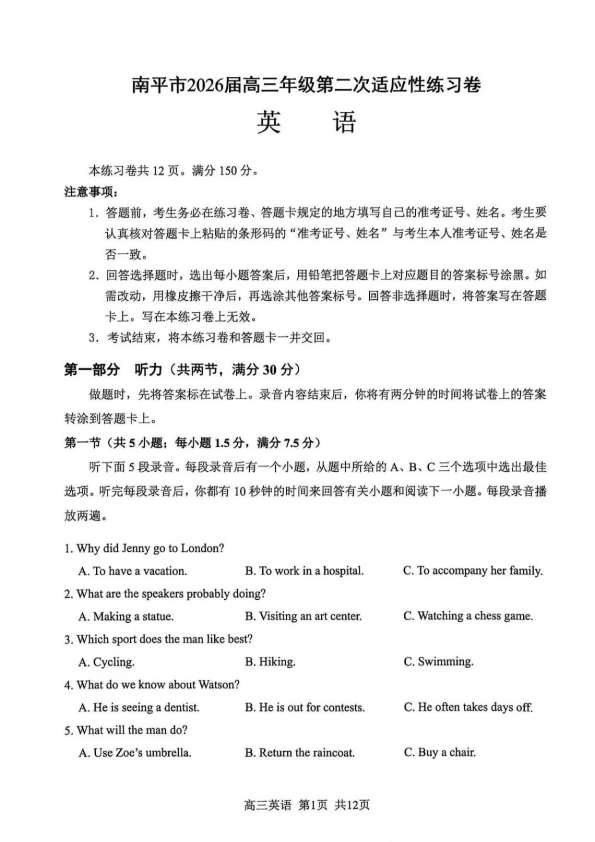
这是一份福建省南平市2026届高三下学期第二次适应性练习英语试卷(Word版附解析),共7页。
这是一份福建南平市2026届下学期高三年级第二次适应性练习卷英语试题(含解析)高考模拟,共8页。
这是一份福建省莆田市2026届高三下学期适应性练习英语试卷(Word版附解析),文件包含2026年高中人教版地理必修1第4章检测卷docx、2026年高中人教版地理必修1第4章检测卷标准答案docx等2份试卷配套教学资源,其中试卷共9页, 欢迎下载使用。
注册成功
资料篮

在线客服
添加在线客服
获取1对1服务
官方微信
关注“教习网”公众号
打开微信就能找资料
赛课定制
添加在线客服
获取1对1定制服务
职称咨询
添加在线客服
获取1V1专业指导服务

免费福利

.png)

.png)
