免费领取教师福利
若您为此资料的原创作者,认为该资料内容侵犯了您的知识产权,请扫码添加我们的相关工作人员,我们尽可能的保护您的合法权益。


这是一份陕西省安康市2026届高三下学期4月阶段性检测 英语试卷(含解析),共29页。试卷主要包含了听力选择题,阅读理解,完形填空,语法填空,书信写作,书面表达等内容,欢迎下载使用。
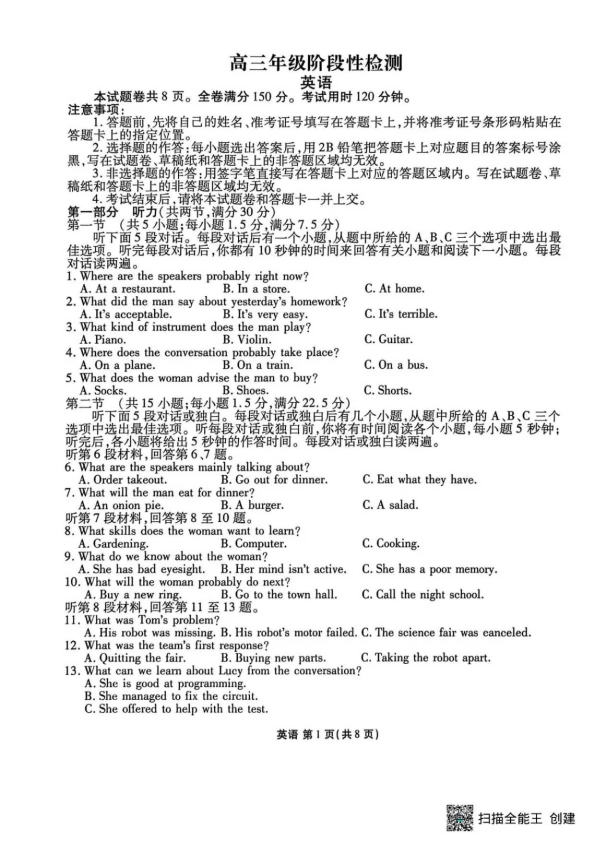
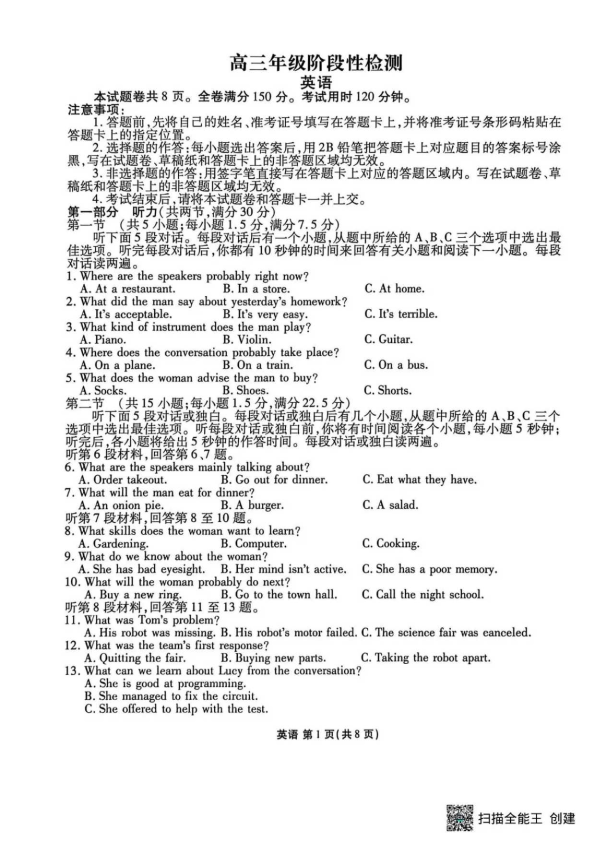
一、听力选择题
1.Where are the speakers prbably right nw?
A.At a restaurant.B.In a stre.C.At hme.
2.What did the man say abut yesterday’s hmewrk?
A.It’s acceptable.B.It’s very easy.C.It’s terrible.
3.What kind f instrument des the man play?
A.Pian.B.Vilin.C.Guitar.
4.Where des the cnversatin prbably take place?
A.On a plane.B.On a train.C.On a bus.
5.What des the wman advise the man t buy?
A.Scks.B.Shes.C.Shrts.
听下面一段对话,回答以下小题。
6.What are the speakers mainly talking abut?
A.Order take-ut.B.G ut fr dinner.C.Eat what they have.
7.What will the man eat fr dinner?
A.An nin pie.B.A burger.C.A salad.
听下面一段对话,回答以下小题。
8.What skills des the wman want t learn?
A.Gardening.B.Cmputer.C.Cking.
9.What d we knw abut the wman?
A.She has bad eyesight.
B.Her mind isn’t active.
C.She has a pr memry.
10.What will the wman prbably d next?
A.Buy a new ring.
B.G t the twn hall.
C.Call the night schl.
听下面一段对话,回答以下小题。
11.What was Tm’s prblem?
A.His rbt was missing.
B.His rbt’s mtr failed.
C.The science fair was canceled.
12.What was the team’s first respnse?
A.Quitting the fair.
B.Buying new parts.
C.Taking the rbt apart.
13.What can we learn abut Lucy frm the cnversatin?
A.She is gd at prgramming.
B.She managed t fix the circuit.
C.She ffered t help with the test.
听下面一段对话,回答以下小题。
14.Why des the man cme late?
A.He studied fr t lng.
B.He went t buy sme pizza.
C.His teacher extended the class.
15.What des the wman feel abut Mr. Ptter’s class?
A.Easy.B.Difficult.C.Interesting.
16.What did Mr. Jhnsn d with his students last year?
A.They went swimming.
B.They attended a field trip.
C.They watched a sccer game.
17.Hw des the wman sund in the end?
A.Expectant.B.Thankful.C.Cnfused.
听下面一段独白,回答以下小题。
18.Hw many places did the speaker stp at befre the earthquake?
A.4.B.3.C.2.
19.What made the speaker realize an earthquake ccurred?
A.Sme cars slwing dwn.
B.A tree falling nt a car.
C.Her car shaking vilently.
20.What did the speaker d after the earthquake?
A.She helped anther driver.
B.She returned t the pst ffice.
C.She drve her daughter t swim.
二、阅读理解
Asia ffers a wide range f marathn events acrss different cuntries and regins. These races are held in urban centers as well as in areas f cultural and natural significance. Curses vary in difficulty and grund cnditins, allwing runners t chse between flatter rutes and mre demanding nes. With multiple distance ptins available, participants can chse events based n their experience levels and persnal gals.
Things t Think Abut
● Register befre the event.
● Knw the lcal weather, s yu can train and dress apprpriately.
● Make sure that yu are making accmmdatins thrugh reputable sites fr travel.
● Dn’t underestimate hw the difference in altitude (海拔) r temperature will affect yur running. Read up and train t make it t the finish line.
21.Which marathn ffers the least challenging rutes?
A.The Great Wall f China Marathn.B.Almaty Marathn.
C.Cappadcia Marathn Türkiye.D.Sngkhla Marathn.
22.If a runner wants t jin a 10-km race with the lwest price, hw much shuld he pay?
A.€22.B.€35.C.€36.D.€204.
23.What is the purpse f the text?
A.T intrduce a new marathn plan.
B.T cmpare Asian marathn curses.
C.T call fr participatin in Asian marathns.
D.T prvide infrmatin abut Asian marathns.
Fr years, Le wrked as a night guard in a quiet museum. His jb was rutine, and he ften felt invisible, like part f the furniture. His wrld was ne f silence and shadws.
One rainy Tuesday, as Le was making his final rund, he nticed a small, leather-bund sketchbk (素描本) left n a bench. He picked it up, intending t hand it t the lst-and-fund. Hwever, a quick glance revealed pages with astnishingly beautiful drawings f the museum’s sculptures, each ne filled with light and life that the cld stne riginals seemed t lack.
Instead f delivering the bk t the ffice, Le felt a strange urge t keep it fr ne night. At hme, under his lamp, he paged thrugh every page. The artist had nt nly drawn the art but had als cmpsed little stries next t each piece — a warrir’s hmesickness, a gddess’s secret smile. Le was deeply mved. Fr the first time, he saw the museum thrugh smene else’s eyes, and it was magical.
The next day, Le placed the sketchbk back n the same bench, adding a brief nte, “Yur art made the statues breathe. Thank yu.” He didn’t expect a reply.
A week later, the sketchbk was gne, but in its place was a new drawing. It was a prtrait f a night guard, nt in unifrm, but dressed as a wise guardian, watching ver the sleeping art with a kind expressin. Beneath it was written, “T the ne wh sees. Yu are nt part f the furniture. Yu are its keeper.”
This simple exchange transfrmed Le’s perspective entirely. He started t appreciate small, beautiful details in his nightly runds — the way mnlight fell n a marble flr, the peaceful expressin f a sleeping cherub (小天使). He even began leaving his wn shrt, appreciative ntes fr the mysterius artist, cmmenting n new drawings that ccasinally appeared.
This silent cnversatin became a surce f jy fr bth. Le n lnger felt invisible. He felt seen, cnnected t the art and t anther sul wh saw the wrld with wnder. He realized that everyne has the pwer t tuch thers, smetimes withut even saying a wrd. The museum was n lnger just a wrkplace; it had becme a wrld f shared understanding, waiting in the quiet dark.
24.What was Le’s initial feeling abut his jb?
A.Prud and valued.B.Curius and cheerful.C.Busy and interactive.D.Lnely and unimprtant.
25.Why did Le keep the sketchbk fr ne night?
A.He thught it was left there fr him.
B.He planned t return it the next day.
C.He was deeply attracted by its cntents.
D.He frgt t hand it t the lst-and-fund.
26.What can we infer abut the mysterius artist frm the new drawing and the wrds?
A.He taught Le artistic skills.B.He was a frmer night guard.
C.He understd Le’s feelings.D.He ffered Le an fficial psitin.
27.What is the main message f the stry?
A.Night guards lead interesting lives.
B.Art has the pwer t cnnect peple.
C.Lst items shuld be returned rapidly.
D.Museums are places fr silent cnversatins.
Besides its knwn benefits fr mental health and cnnecting with nature, the hbby f birdwatching may have anther surprising advantage: It can cause helpful physical changes in the human brain. A recent brain science study frm McGill University shws that the deep mental effrt needed fr this activity has a real effect n ur brain’s structure.
The research cmpared brain scans and thinking tests between expert birdwatchers, wh culd name hundreds f birds by sight and sund, and beginners. When ding bird identificatin tasks, the experts were nt nly faster and mre crrect, but their brains als shwed much higher activity in specific areas. These areas are linked t advanced visual prcessing (seeing fine details), strng and fcused attentin (ignring distractins), and wrking memry (hlding and cmparing infrmatin). Imprtantly, brain structure scans shwed that these key areas were thicker and had better cnnectins in the expert grup.
These findings suggest that the specialized, demanding practice f birding — which needs quickly putting tgether small visual clues, sunds, and learned knwledge — des nt just use the brain but actively strengthen and imprve its wiring, like exercise builds muscle. This is imprtant fr brain health as we age. The study fund that the nrmal lss f brain tissue and functin with age was much less bvius in the expert birdwatchers. Researchers think that such lng-term, cmplex mental activity helps build a “cgnitive reserve”, making the brain strnger and better at dealing with damage ver time.
“Our wrk shws that ding a challenging, skill-based hbby fr life is linked t a prtective effect fr the brain,” explained lead scientist Dr Rbert Zatrre. The idea likely applies t ther activities needing deep fcus and learning, like playing music r learning a language. S, spending time watching and identifying birds is much mre than a relaxing pastime. It is an active investment in lng-term brain health, building a strnger and mre agile mind that can better handle the natural changes that cme with getting lder.
28.What did the brain scans f expert birdwatchers shw cmpared t beginners?
A.Their brains are mre active in all areas.
B.They used different senses when identifying birds.
C.Their brains were smaller in size but mre efficient.
D.Certain brain areas were thicker and better cnnected.
29.Why des the authr mentin “like exercise builds muscle” in paragraph 3?
A.T explain hw the brain strengthens by birdwatching.
B.T cmpare birdwatching with physical activities.
C.T prve that birdwatching is physically tiring.
D.T suggest that nly yung peple can benefit.
30.What des the underlined wrd “agile” in the last paragraph prbably mean?
A.Sharp.B.Fcused.C.Strict.D.Slid.
31.What is the best title fr the text?
A.What t Expect frm Birdwatching?B.Effective Methds f Healthy Brain.
C.Hw Birdwatching Reshapes the Brain?D.Birdwatching — A Challenging Hbby.
As cuntries wrk harder t mve away frm fssil fuels and fight climate change, finding reliable, clean, and steady pwer is very imprtant. In this search, gethermal (地热的) energy — using the great heat frm inside the Earth — is seeing a strng cmeback wrldwide. Unlike slar r wind pwer, which can change with the weather, gethermal plants can prduce electricity all the time, day and night. This prvides the stable “baselad” pwer needed t supprt grids (电网) that use mre and mre changeable energy surces.
This mdern cmeback is mainly driven by new technlgy. Advanced drilling methds, first used by the il and gas industry, nw let engineers reach deeper, htter rcks that were nce ut f reach. New systems can create artificial undergrund reservirs (储藏) in ht, dry rck, greatly increasing pssible lcatins. A leading example is the United Dwns prject in Crnwall, UK. This plant nt nly makes enugh electricity fr abut 10,000 hmes but als shws an extra benefit: It can cllect lithium, a key mineral fr batteries, frm the ht water it uses.
“The technlgy and the csts are finally matching up,” explains Ryan Law, funder f Gethermal Engineering Ltd. “There is a huge demand fr clean, always-available pwer, and gethermal energy fits that need perfectly.” Prjects are grwing in the United States, Germany, and Indnesia. Cmpared t ther clean energy ptins, gethermal energy uses less land, has little visual effect, and can be built faster than nuclear plants.
Challenges remain. The high starting cst fr drilling is still a barrier, and there is always a risk f nt finding enugh heat. Als, nt every area has the right undergrund cnditins. Hwever, cntinuus imprvement is lwering csts and raising efficiency. As the wrld lks fr slutins fr bth clean energy and imprtant minerals, gethermal energy’s duble ffering makes it nt just an alternative, but a key part f a sustainable and secure energy future, quietly using the pwer belw us.
32.Accrding t the text, hw des gethermal energy differ frm slar and wind pwer?
A.It can supply pwer cntinuusly.B.It requires mre land t perate.
C.It’s easily affected by weather.D.It prduces n pllutin at all.
33.What des paragraph 2 mainly talk abut?
A.The reasns fr the rising f gethermal energy.
B.The envirnmental effects f gethermal energy.
C.The daily applicatins f gethermal energy.
D.The benefits brught by gethermal energy.
34.What can be inferred abut gethermal energy frm Ryan Law’s statement?
A.It is mainly suitable fr cuntries with rich il resurces.
B.It is facing little cmpetitin frm ther clean energies.
C.Its develpment was limited by technlgy in the past.
D.Its cst is still t high fr large-scale use.
35.What is the authr’s attitude twards the future f gethermal energy?
A.Cautius.B.Optimistic.C.Uncncerned.D.Dubtful.
Have yu nticed hw deeply AI is integrating int kids’ lives? Last mnth, I watched my 8-year-ld niece learn math frm an AI tutr (助教) ne minute and laugh at AI-generated cartns the next. My nephew, t, is crazy abut his smart, chatty dll and can’t tear himself away frm it. 36 Hwever, these benefits cme with significant risks that demand ur shared attentin. It’s time t pause and think abut hw kids can safely manage grwth in this digital era.
Direct risks aren’t theretical — they cme frm the misuse r malfunctin f AI. Kids smetimes use AI t cpy hmewrk, r create “deepfake” vides t bully classmates. AI tutrs ccasinally supply inaccurate cntent. 37 Let’s be real, mst little nes lack the ability t use AI respnsibly r distinguish fact frm falsehd, which puts them at a higher risk.
Beynd these bvius risks, mre hidden nes arise even when AI wrks as designed. My niece tld me that after she watched a recmmended vide, her tablet wuld shw her similar cntent ver and ver again. The technlgy can quickly learn users’ preferences and create “ech chambers (信息茧房)”. 38 They trap peple in a narrw cycle f cntent. Fr kids wh are still develping thinking skills, this kind f cntrlled infrmatin flw may limit their perspectives and affect cgnitive grwth.
39 My nephew, fr instance, prefers talking t his AI cmpanin ver his classmates. Unlike humans, the AI ty rarely argues r criticizes. What’s wrrying is that if kids verly rely n this ne-sided way f cmmunicatin, they might lse the ability t handle disagreements r reach cmprmises when they grw up.
T address these issues, we need bth immediate actins and lng-term strategies. Gvernments shuld set age limits n certain AI apps, while parents shuld evaluate AI tls fr their kids carefully. 40 As a place where much f childhd plays ut, they shuld take advantage f the educatinal setting t teach things that AI can’t: hw t debate, hw t cperate, and perhaps even hw t appreciate different viewpints.
A.Beynd these effrts, schls play a key rle.
B.These are what peple called “infrmatin bubbles”.
C.AI has undubtedly made learning mre engaging fr students.
D.One-sided relatinships with AI chatbts present a similar danger.
E.Sme chatbts even encurage self-harming behavir amng children.
F.Hnestly, AI has made kids’ learning and play mre dynamic and fun.
G.Cnsequently, strict parental cntrl ver screen time is crucially imprtant.
三、完形填空
After his wife Margaret passed away, Will Hartley stpped visiting their favrite café by the sea. The crner table by the windw held t many 41 . He walked alne n the 42 , speaking nly t the waves.
One mrning, smething 43 his eye. On that ld table, inside the café windw, std a single daffdil in a thin glass vase. It faced the sea, bright against the grey sky like a tiny, steady light. Will 44 wh put it there.
The next day, it was there again. And the next. Each dawn, the yellw flwer waited. Slwly, it 45 him clser, pulling him back t the path he used t walk with Margaret.
One fggy mrning, he saw a(n) 46 mving inside the dark café. It was his sn, Stuart, carefully placing a fresh daffdil in the vase. Will’s heart ached, but 47 . He remembered hw Margaret had lved daffdils.
He finally 48 the café dr pen. The bell rang sftly, a 49 sund he hadn’t heard in mnths. Stuart lked up, surprised. “I thught... yu might need a 50 t walk twards,” Stuart said quietly, his vice thick with emtin.
Will’s eyes filled with tears. He knew he wasn’t 51 . He sat at their table, the daffdil between them like a silent friend. They talked, nt f lss, but f 52 things — bats in the harbr, the garden that needed tending, their plans fr spring.
Nw, Will still 53 Margaret, but he has fund his way back — nt t the past, but t a life that 54 . He meets Stuart at the café every week. Tgether, they watch the sea, and the daffdil glws (发光) under the sunset like a flame that wuld never 55 .
41.A.secretsB.giftsC.memriesD.prmises
42.A.bankB.beachC.campusD.trail
43.A.appealedB.pleasedC.caughtD.hurt
44.A.askedB.deniedC.wnderedD.dubted
45.A.mvedB.drewC.frcedD.invited
46.A.figureB.shapeC.imageD.custmer
47.A.warmlyB.bitterlyC.suddenlyD.strangely
48.A.struckB.fixedC.kickedD.pushed
49.A.strangeB.familiarC.ludD.distant
50.A.lightB.persnC.placeD.sign
51.A.sadB.lateC.wiseD.alne
52.A.seriusB.funnyC.simpleD.different
53.A.respectsB.fearsC.frgetsD.misses
54.A.cntinuesB.stpsC.imprvesD.ends
55.A.shw upB.g utC.sht upD.give ut
四、语法填空
阅读下面短文,在空白处填入1个适当的单词或括号内单词的正确形式。
Nt lng ag, travelling in China meant racing against the clck. Overnight trains, sunrise hikes, and five scenic spts befre lunch were wrn like medals f hnr. The faster and mre exhausting the itinerary (行程), the better the stry sunded afterward. In the past few years, that lgic 56 (give) way t a new belief quietly amng yung peple 57 vacatins shuld feel less like bt camp.
Accrding t a 2025 survey released by China Yuth Daily, 55.3 percent f yung respndents nw prefer “immersive (沉浸式的) slw travel”, while mre than half favr flexible, independent trips ver 58 (tight) rganized turs.
The shift is visible in bth behavir and business. Once-ppular “special-frces-style turism”, 59 travellers rush thrugh cities t maximise check-ins, has evlved int what scial media jkingly calls “lw-cnsumptin travel”. The idea is simple: minimal physical effrt, maximum emtinal return. At scenic sites acrss Guangdng, Zhejiang and Hubei prvinces, peratrs have redesigned attractins 60 (match) the new pace. On Fshan’s Xiqia Muntain, fr instance, visitrs can try an 61 (adapt) bungee jump that lwers participants gently instead f drpping them 62 full speed.
Travel, increasingly, is n lnger abut hw far yu g — but hw deeply yu arrive. “When yu rush, every city ends up 63 (lk) like the same pht. When yu stay, yu begin t ntice the small things — the way shp wners talk, the rhythm f the streets,” said Pan Yuchen, 64 university student visiting Chengdu, a city ften seen as a symbl f slw travel fr its famusly unhurried pace, where 65 (lcal) eat htpt slwly at all hurs, and spend their afternns in teahuses.
五、书信写作
66.假定你是某国际学校学生李华,学校计划引入教育机器人“Mike 老师”,专门用于课后英语口语练习。校长Mr Black就此向学生征求意见。请你用英语给他写一封邮件,内容包括:
1. 表明你的态度;
2. 说明理由。
注意:
1. 写作词数应为80左右;
2. 请按如下格式在答题卡的相应位置作答。
Dear Mr Black,
____________________________________________________________________________________________________________________________________________________________________________________________________________________________________________________________________________________________________________________________________________________________________________________________________________________________________________________________________________
Yurs sincerely,
Li Hua
六、书面表达
67.阅读下面材料,根据其内容和所给段落开头语续写两段,使之构成一篇完整的短文。
Jack had just mved t a new twn and started at a new schl. When his friendly classmate, Nah Nelsn, invited him t a birthday party at Centennial Park, Jack saw it as a perfect chance t make friends, thugh he felt a little nervus.
On the sunny Sunday afternn, Jack and his mm arrived at the vast park. Picnic tables and grups f peple were scattered (分散的) everywhere. “Hw will we ever find it?” Jack wndered, his anxiety grwing. Just then, his mm pinted, “Lk!” A large, clrful sign came int view: “HAPPY BIRTHDAY, NOAH!” Relief washed ver Jack. They apprached a wman near the sign. “I’m Jack, frm Nah’s class,” he intrduced himself. “Wnderful! I’m Nah’s aunt Laura,” she replied warmly. “The kids are playing sccer ver there. G and jin them!”
Thugh nne f the faces lked familiar, Jack lved sccer and was quickly welcmed int the game. He even scred a gal, and the cheers made him feel like he belnged. During a break, he asked a by named Will, “Where’s Nah?” “He’s running late, visiting his grandma,” Will explained. Jack felt a flash f disappintment but cntinued t enjy himself, making easy cnversatins and sharing laughs with his new teammates.
Sn the call came fr pizza and cake. Jack happily jined the crwd at the festive table, his initial shyness cmpletely gne. As the cake with burning candles was brught ut, everyne gathered arund, singing “Happy Birthday”. Jack mved t the frnt, eager t finally wish Nah a happy birthday and thank him fr the invitatin. The sng ended, the birthday by turned with a big smile t blw ut the candles — and Jack’s heart sank. The by wearing the paper crwn (皇冠) was a cmplete stranger. This was nt his Nah.
A wave f heat rushed t his face. He had eaten their fd, played their games, and celebrated whleheartedly at a ttal stranger’s party. With a quick “excuse me”, he turned and hurriedly made his way back thrugh the crwd, his eyes searching desperately fr his mm.
注意:
1. 续写词数应为150左右;
2. 请按如下格式在答题卡的相应位置作答。
“Mm, I went t the wrng party,” Jack said, his vice barely a whisper.
____________________________________________________________________________________________________________________________________________________________________________________________________________________________________________________________________________________________________________________________________________________________________________________________________________________________________________________________________________
Just as Jack was abut t give up, a familiar vice called his name.
____________________________________________________________________________________________________________________________________________________________________________________________________________________________________________________________________________________________________________________________________________________________________________________________________________________________________________________________________________
Event
Time (2026)
Type
Price (EUR)
Curse Prfile
The Great Wall f
China Marathn
25th Octber
Full Marathn
204
Rlling
10 km
204
5 km
204
Almaty Marathn
27th September
Full Marathn
45
Rlling
Half marathn
35
10 km
35
Cappadcia Marathn Türkiye
8th Nvember
Full Marathn
36
Hilly
20 km
36
10 km
36
Sngkhla Marathn
22nd – 23rd August
Full Marathn
38
Flat
10 km
22
5 km
17
参考答案
1.C
【原文】W: Culd yu pass me a cleaning clth? I can’t put clean dinner plates n this dirty shelf.
M: Here yu are. If yu like, I’ll prepare sme vegetables while yu are ding that.
2.A
【原文】W: Last night’s hmewrk was terrible. Hw did yu feel abut it?
M: I didn’t think it was t bad. I handed it in t the teacher this mrning. Let’s see what he thinks.
3.B
【原文】W: I was thinking f starting a band, but I need a drummer and a singer. D yu knw anyne?
M: Srry, I actually dn’t. Everyne I knw plays the vilin, like I d.
4.A
【原文】M: Yu can sit here if yu’d like a windw seat.
W: Oh, that’s very kind f yu, but my seat is right ver ne f the wings. I’ll be able t have a great view. Thanks, anyway.
5.B
【原文】M: Lk what I’ve bught. I’ll be able t get sme air t my legs.
W: Great, and yu’ll need a new pair f shes. Black shes and scks with shrts isn’t a gd lk.
6.A 7.C
【原文】W: I’m getting really hungry. D yu want t rder take-ut?
M: There are still leftvers frm yesterday. Als, we have plenty f eggs t ck.
W: It is Friday, thugh. Yu knw yu want t have smething fresh and easy.
M: Fine, but nly if yu pay fr it.
W: Great. Let’s rder sme hamburgers fr dinner t celebrate the week.
M: I dn’t want a burger, thugh. Get me a salad with extra carrts and nins.
8.B 9.A 10.C
【原文】W: Nw that I have retired, I wuld like t learn a new skill.
M: What kind f skill, Grandma? Smething like gardening?
W: N. I thught abut cking, but I’m quite gd at that already. Then I was thinking f cmputers.
M: That wuld be different. D yu think yu culd d it?
W: Well, my eyesight is pr, but I am still very active and my memry is excellent.
M: There is a night schl held at the twn hall, and they teach abut cmputers.
W: That’s what I thught. I will give them a ring.
11.B 12.A 13.C
【原文】W: Hey, Tm! Yu lk wrn-ut. What’s wrng?
M: Hi, Lucy. The schl science fair is next week, and ur grup’s rbt prject is in big truble. The mtr suddenly stpped wrking this mrning, and we can’t figure ut why.
W: Oh, n! That’s really terrible. What did yur team d at first?
M: We were s frightened that we almst gave up and tld the teacher we’d drp ut. But then we realized that we’d spent mnths n this, s we decided t take the rbt apart and check each part f it.
W: Yu’re s smart! D yu need any tls? I have a tl-kit which my dad gave me.
M: That’d be amazing! Right nw, we’re analyzing the circuit bard and rewriting sme f the prgramming cde. It’s a race against time.
W: I’m sure that yu’ll fix the circuit. If yu need mre help, I can ask my brther — he’s gd at rbtics. Maybe we can even test the rbt in my backyard befre the fair.
M: That’s a great idea! It’s s kind f yu. We definitely need t d a trial run.
14.C 15.B 16.C 17.A
【原文】M: Hey, Alice. Thanks fr saving me a spt at the table.
W: N prblem. Hw cme yu are s late? They were just serving pizza, but it’s all gne nw.
M: I knw. Mrs Clay had t keep the entire class 10 minutes after the bell.
W: What is she teaching yu right nw?
M: The cuntries f the wrld and their capital cities. It’s s cnfusing.
W: There is n way it’s as cnfusing as what we learned in Mr. Ptter’s class. He’s teaching us abut shapes and measuring angles.
M: Ah, math is always hard fr me. Hey, did yu hear Mr. Jhnsn is taking us n a field trip?
W: Oh, yeah. We’re ging swimming this afternn.
M: He’s such a cl teacher. Last year when his class gt all B’s r higher, he tk them t a sccer game.
W: That’s awesme! I wnder where he will take us this year.
M: I dn’t knw, but my vte is fr the amusement park!
18.C 19.B 20.A
【原文】 W: I’d like t share what happened t me yesterday. In the afternn, I decided t pick up my daughter t g swimming tgether. I finished my wrk early and went t the pst ffice t cllect a package. After that, I stpped at a shp t buy sme fruit and bread. I thught abut hw much my daughter wuld lve this uting. I was driving smthly when I saw the cars in frnt f me start t mve frm side t side. I immediately slwed dwn. Then my car started t shake t! I wndered if smething had gne wrng with my car. I pulled ver and gt ut t check. At that mment, a big tree by the side f the rad fell nt the car in frnt f me. I realized it was an earthquake! I quickly checked n the man driver and calmed him dwn, wh was shaken but unhurt. Finally, I called my daughter t pstpne ur swimming plan and fcus n making sure everyne was safe.
41.C 42.B 43.C 44.C 45.B 46.A 47.A 48.D 49.B 50.A 51.D 52.C 53.D 54.A 55.B
56.has given 57.that 58.tightly 59.where 60.t match 61.adapted 62.at 63.lking 64.a 65.lcals
66.One pssible versin:
Dear Mr Black,
I strngly supprt the plan t intrduce the educatinal rbt “Mike” fr after-class ral English practice.
First f all, we can practice speaking with it anytime after class, which is very cnvenient fr busy students like us. Besides, we wn’t feel shy r nervus when talking t a rbt, s we can speak mre bravely. Mst imprtantly, it can ffer tailred feedback, which will definitely help us make faster prgress in ur ral English.
I believe this rbt will greatly benefit ur English learning.
Yurs sincerely,
Li Hua
67.“Mm, I went t the wrng party,” Jack said, his vice barely a whisper. He explained the mix-up, his cheeks burning. His mm listened kindly. “D yu want t g hme?” she asked. Jack shk his head. “I need t find Nah’s party.” They began walking thrugh the crwded park, checking every grup. With each unfamiliar face, Jack’s hpe faded. The park seemed endless, and his earlier cnfidence disappeared. After what felt like an hur, he still saw n sign f Nah. A heavy feeling settled in his chest.
Just as Jack was abut t give up, a familiar vice called his name. “Jack! Over here!” It was Nah, waving frm a table with blue ballns! Relief washed ver Jack. “Why are yu s late?” Nah asked. Jack hurried ver and after a little hesitatin, he tld his stry. T his surprise, Nah and the thers fund it s funny. “That’s the best birthday stry ever!” Nah laughed. Jack was instantly included in the games. His embarrassing mistake had turned int a perfect icebreaker, making him feel welcmed and even a little bit famus amng his new friends.题号
1
2
3
4
5
6
7
8
9
10
答案
C
A
B
A
B
A
C
B
A
C
题号
11
12
13
14
15
16
17
18
19
20
答案
B
A
C
C
B
C
A
C
B
A
题号
21
22
23
24
25
26
27
28
29
30
答案
D
A
D
D
C
C
B
D
A
A
题号
31
32
33
34
35
36
37
38
39
40
答案
C
A
A
C
B
F
E
B
D
A
题号
41
42
43
44
45
46
47
48
49
50
答案
C
B
C
C
B
A
A
D
B
A
题号
51
52
53
54
55
答案
D
C
D
A
B
这是一份陕西省安康市2026届高三下学期4月阶段性检测 英语试卷(含解析),共29页。试卷主要包含了听力选择题,阅读理解,完形填空,语法填空,书信写作,书面表达等内容,欢迎下载使用。
这是一份陕西省安康市2025-2026学年高一下学期4月阶段性检测英语试卷(Word版附答案)含听力音频,共5页。试卷主要包含了5分,满分7,15等内容,欢迎下载使用。
这是一份安康市2025-2026学年高三下学期4月阶段性检测 英语试卷及答案+听力音频,共15页。
注册成功
资料篮

在线客服
添加在线客服
获取1对1服务
官方微信
关注“教习网”公众号
打开微信就能找资料
赛课定制
添加在线客服
获取1对1定制服务
职称咨询
添加在线客服
获取1V1专业指导服务

免费福利