免费领取教师福利

若您为此资料的原创作者,认为该资料内容侵犯了您的知识产权,请扫码添加我们的相关工作人员,我们尽可能的保护您的合法权益。


这是一份广东省广州市2026届高三下学期二模英语试卷(Word版附解析)试卷主要包含了考生必须保持答题卡的整洁等内容,欢迎下载使用。
2026 年广州市普通高中毕业班综合测试(二)
英 语
本试卷共 10 页,满分 120 分。考试用时 120 分钟。
注意事项:
1.答卷前,考生务必将自己的姓名、考生号、试室号和座位号填写在答题卡上。用 2B 铅笔将
试卷类型(B)填涂在答题卡相应位置上。并在答题卡相应位置上填涂考生号。因笔试不考听
力,试卷从第二部分开始,试题序号从”21”开始。
2.作答选择题时,选出每小题答案后,用 2B 铅笔把答题卡对应题目选项的答案信息点涂黑;
如需改动,用橡皮擦干净后,再选涂其他答案。答案不能答在试卷上。
3.非选择题必须用黑色字迹的钢笔或签字笔作答,答案必须写在答题卡各题目指定区域内相应
位置上;如需改动,先划掉原来的答案,然后再写上新答案;不准使用铅笔和涂改液。不按
以上要求作答无效。
4.考生必须保持答题卡的整洁。考试结束后,将试卷和答题卡一并交回。
第二部分阅读(共两节,满分 50 分)
第一节(共 15 小题;每小题 2.5 分,满分 37.5 分)
阅读下列短文,从每题所给的 A、B、C、D 四个选项中选出最佳选项。
A
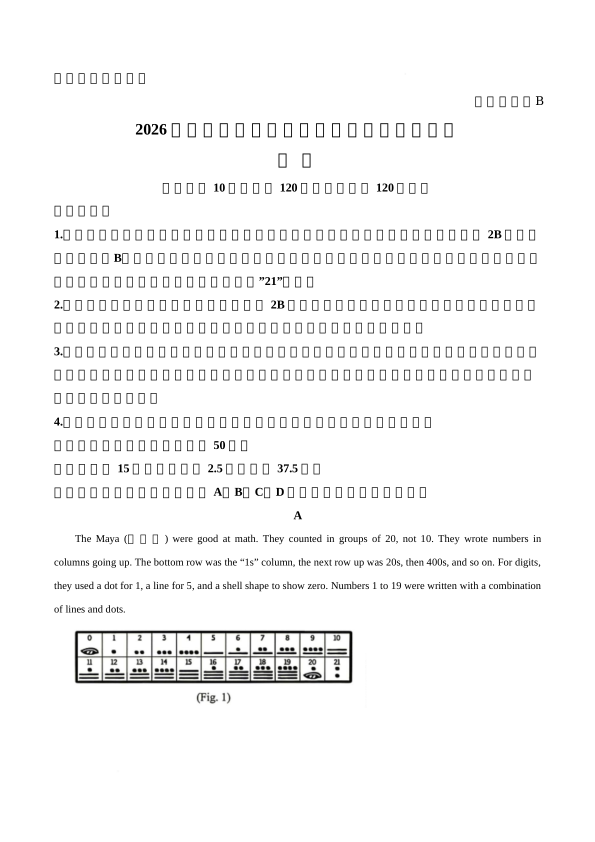
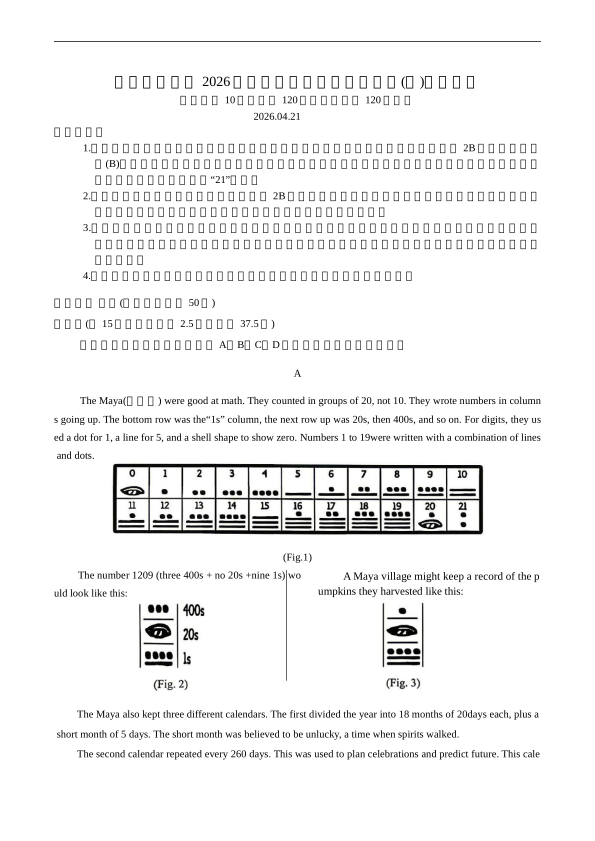
The Maya (玛 雅 人 ) were gd at math. They cunted in grups f 20, nt 10. They wrte numbers in
clumns ging up. The bttm rw was the “1s” clumn, the next rw up was 20s, then 400s, and s n. Fr digits,
they used a dt fr 1, a line fr 5, and a shell shape t shw zer. Numbers 1 t 19 were written with a cmbinatin
f lines and dts.
第 1页/共 10页
The number 1209 (three 400s + n 20s + A Maya village might keep a recrd f
nine 1s) wuld lk like this: the pumpkins they harvested like this:
The Maya als kept three different calendars. The first divided the year int 18 mnths f 20 days each, plus a
shrt mnth f 5 days. The shrt mnth was believed t be unlucky, a time when spirits walked.
The secnd calendar repeated every 260 days. This was used t plan celebratins and predict future. This
calendar cunted 13 mnths f 20 days each. Each date had its wn set f 3 symbls (day, mnth, and year).
When talking abut events lng ag, they used a calendar called the “lng cunt.” This cvered abut 5,125
years. Year 1 n this calendar was 3114 BCE n ur calendar.
Each city and village had a calendar keeper, wh was in charge f saying when t celebrate hlidays and when
t expect rain r plant crps. But farmers culd prbably als tell the time f the year frm the sun and stars.
1. Hw many pumpkins did the Maya village harvest accrding t Figure 3?
A. 114. B. 409. C. 414. D. 439.
2. What culd the “lng cunt” calendar be used fr?
A. Marking the unlucky days. B. Recrding ancient events.
C. Dividing the year int 18 mnths. D. Predicting and making future plans.
3. Which learning prject wuld this text be mst suitable fr?
A. Design a travel plan t the Maya ruins
B. Write a reprt n the Maya agriculture
C. Give a presentatin n Maya artistic symbls
D. Make a pster f Maya scientific achievements
B
When Mia Wds retired at 61, she knew she needed a plan. “I was wrried abut lsing my identity as a
prfessinal. What else can I be?” she thught.
The year befre, she had been tld she had a mild memry prblem. “I was trying t shw myself that I culd
still think and be creative,” she says. S she decided t d — rather than be — smething new: bake a pie every
第 2页/共 10页
day fr a year and give each pie away. “It made me reach ut every day t smebdy, s I wuldn’t be alne. And
it gave me a rutine,” she says.
She baked her first pie and gave it t her 88-year-ld aunt, Carl. As a teenager, Mia had mved in with her
aunt’s family when her mther became ill. “They gave me stability... It was the perfect first pie,” she says. She
went n giving pies t frmer clleagues, grcery clerks, even a hmeless man. As wrd spread, she gt knwn as
“the pie lady”.
Fr mre than 30 years, Mia had wrked as a city planner. “I’m a planner by nature, training and prfessin.
What I really liked abut it was that planning takes time, chas, many different cmpnents, puts them all tgether
and makes them int smething manageable.” She sees the same in baking pies: “Yu take a bunch f ingredients
and create smething ut f them.”
Twelve years n, Mia has cntinued t invent new prjects, including writing a letter a day, and painting
pictures f her lcal sky. She is writing a bk abut the pie experience. But she has learned mre than baking.
“What really came ut f it was the understanding that I was smene wh culd d new things,” she reflects.
“And my prfessinal identity wasn’t critical t wh I am.”
“Even nw, after I have an encunter with smebdy, I think: ‘There’s a persn I wish I culd give a pie t.’”
says Mia.
4. What was Mia’s wrry when she retired?
A. Her serius mental prblem. B. Her being cut ff frm thers.
C. Having n identity beynd career. D. Having t change her daily rutine.
5. Why did Mia give her first pie t her aunt?
A. She had given Mia a hme.
B. She had cared fr Mia’s mum.
C. She was the ldest in the family.
D. She had built Mia’s stable character.
6. What d city planning and baking pies have in cmmn accrding t Mia?
A. Bth require prfessinal training. B. Bth make sense f mixed elements.
C. Bth create smething ut f nthing. D. Bth cnnect peple with ne anther.
7. What is Mia’s reflectin n her experience?
A. Everyne in the wrld deserves a pie.
B. New challenges redefine wh we are.
第 3页/共 10页
C. Opening up t changes takes curage.
D. Simple acts can bring peple tgether.
C
Peple might nt realize that ne basic life necessity has slipped frm their cntrl: meals. With the rise f
nline platfrms, peple enjy the freedm t get anything quickly and at a reasnable price. Hwever, fd writer
Chen Yuhui argues in her bk Wh Decides What t Eat that this cnvenience has rbbed peple f their
autnmy ver fd, reflecting a greater lss f cmmunity life in a result-driven sciety that priritizes efficiency.
“Many peple dn’t realize hw ften their dining chices are made fr them,” Chen says. Fr instance, a bss’
s request fr vertime changes their dinner plans; r a restaurant discunt ffer influences where they eat. These,
she explains, are passive chices.
Chen cites anther cmmn cmplaint: tmates that taste plain cmpared t childhd memries. This
reveals a deeper lss — cmmercially dminant, hard-skinned varieties are “mre fitting fr lng-distance
transprtatin,” sacrificing flavr and the cmmunity life nce built arund fresh markets.
Chen als wrries abut the decline f peple’s ability t chse fd wisely. Yung peple buy ingredients
nline withut market experience and may think plain fd is just hw it’s suppsed t be. Chen further ntes that
nline fd images are “zmbie-like” — they shw lifeless fd, unlike the fresh prduce in markets, and this
limits peple’s imaginatin abut fd. Hwever, when she shares tips n selecting fresh prduce in markets, she
ften gets requests fr shpping links instead.
Chen cnnects these attitudes t a brader mindset: “Buying grceries and cking invlve a certain level f
acceptance f mistakes. Yet many tday seem t have little patience with them.” The fcus n results makes
delivery appealing, as peple believe it guarantees a better utcme.
Beynd the lss f autnmy, Chen sees smething deeper in fd — it’s a micrcsm fr understanding the
wrld. “If yu lve tmates but find them plain, d yu cmplain r invest effrt t find flavrful nes? Searching
fr the right variety shws different prblem-slving abilities, which is what I mean by fd being the smallest unit
fr understanding the wrld,” she cncludes.
8. What des the first paragraph mainly intrduce?
A. Advances in fd technlgy. B. The hidden cst f fd cnvenience.
C. Changing habits f dining ut. D. The ppularity f nline fd shpping.
9. What des Chen mean by describing nline fd images as “zmbie-like”?
A. They lk t perfect t be real.
第 4页/共 10页
B. They discurage interest in cking.
C. They push peple t rder takeut.
D. They fail t shw real and lively fd.
10. What des peple’s preference fr delivery reveal?
A. Their desire t avid uncertainty.
B. Their ver-reliance n technlgy.
C. Their view f cking as a burden.
D. Their separatin frm fd surces.
11. What message des the text want t cnvey?
A. Returning t markets can restre fd autnmy.
B. The lss f fd flavr is unavidable nwadays.
C. Online platfrms have changed peple’s lifestyle.
D. Our relatinship with fd mirrrs ur wrld view.
D
Chinese scientists have develped a new refrigeratin methd that slves a lng-standing challenge in cling
technlgy. Published in Nature, the study respnds t rising energy demands in applicatins ranging frm fd
preservatin t data center cling.
Traditinal vapr-cmpressin systems cnsume vast amunts f electricity and rely n harmful refrigerants.
In China, refrigeratin accunts fr nearly 20% f the natin’s electricity use and 7.8% f its carbn emissins (碳
排放). While slid-state cling avids harmful gases, it suffers frm pr heat transfer, limiting its real-wrld
applicatin.
Led by Prfessr Li Bing frm the Chinese Academy f Sciences, the research team vercame this by
cmbining slid cling effects with liquid flw. They used a cmmn, nn-txic salt whse disslutin (溶解) in
water absrbs large amunts f heat. Cnversely, applying pressure causes the salt t cme ut and release heat.
Cycling this pressure achieves cntinuus cling.
“Unlike traditinal slid methds, where heat mves slwly, ur system integrates the refrigerant and
heat-transfer medium int a single liquid,” Li said. “This slves the ‘impssible triangle’ — achieving lw
pllutin, strng cling, and fast heat transfer all at nce.”
Lab tests shwed a temperature drp f nearly 30°C in just 20 secnds at rm temperature, and up t 54°C at
higher temperatures — significantly utperfrming existing slid clers. A prttype cycle achieved a cling
第 5页/共 10页
capacity f 67 jules per gram with nearly 77% efficiency. The system als prved stable, reversible, and instantly
respnsive t pressure changes.
“This technlgy mves beynd traditinal refrigeratin principles,” Li added. “By turning the clant int a
fluid, it pens the dr t high-perfrmance, zer-emissin cling fr hmes and industry.”
He nted the methd’s strng high-temperature perfrmance makes it an ideal candidate fr heat management
in next-generatin AI cmputing facilities. While engineering challenges remain, especially in achieving rapidly
switchable pressure cycles, the principle culd be adapted t ther materials fr diverse cling needs.
12. What is the main prblem with traditinal slid-state cling systems?
A. They transfer heat prly. B. They prduce harmful gases.
C. They fail at high temperature. D. They use t much electricity.
13. What is the key innvatin f the new cling methd?
A. Using salt instead f chemical refrigerants.
B. Increasing pressure inside traditinal systems.
C. Replacing pressure cycles with cntinuus flw.
D. Cmbining slid cling with liquid heat transfer.
14. Why des the authr mentin the “impssible triangle” in the text?
A. T highlight the value f the new system.
B. T illustrate the design f the new system.
C. T explain why ld systems are still in use.
D. T shw the limitatins f previus systems.
15. What des Li Bing see as a prmising applicatin f the new technlgy?
A. Preserving fd in supply chains. B. Replacing traditinal hme refrigeratrs.
C. Cling future AI data centers. D. Achieving rapidly switchable pressure cycles.
第二节(共 5 小题;每小题 2.5 分,满分 12.5 分)
阅读下面短文,从短文后的选项中选出可以填入空白处的最佳选项。选项中有两项为多余选项。
Cnfidence is infectius. Smene wh speaks with ttal certainty is mre likely t inspire than smene wh
is hesitant. ____16____ It fund that mre cnfident letters were assciated with mre successful cmmercial
c-peratins.
Cnfidence — even vercnfidence — can als lead t higher status. In a 2012 study, MBA students were
asked t take an nline survey. The questinnaire asked them if they knew certain names, events and wrks f art.
第 6页/共 10页
____17____ At the end f the term, classmates rated the verly cnfident students — thse wh had picked the
mst fictinal entries — as the mst influential.
____18____ One study fund that vercnfident bsses were mre likely t buy ther cmpanies. These
purchases were als mre likely t fail. Anther paper lked at the link between CEOs’ cnfidence and their
earning frecasts. Researchers fund that bsses with t much self-belief were slwer t adjust their frecasts
when they were wrng. ____19____
This leads t tw brad suggestins fr managers t reflect n. First, vercnfident peple need clear rules. A
newspaper fund that puffed-up bsses at high-tech firms had a better recrd f making breakthrugh innvatins
if they were watched by pwerful and expert bards. Secnd, self-dubters need encuragement t fulfil their
ptential. ____20____ Studies shwed that when peple were reminded f their wn pwer, they perfrmed better
in interviews and presentatins. Cnfidence can be natural. It can als be stimulated.
A. They didn’t knw that sme f the chices were made up.
B. A study analysed the language used in letters frm investrs.
C. Simply put, vercnfident bsses stayed wrng fr a lnger time.
D. Overcnfident peple tend t be prmted t leadership psitins.
E. As much as cnfidence brings rewards, hwever, it als brings danger.
F. Therefre, experts suggest creating a mre relaxing wrk envirnment.
G. This supprt can cme frm managers, advisrs, r even frm themselves.
第三部分 语言运用(共两节,满分 30 分)
第一节(共 15 小题;每小题 1 分,满分 15 分)
阅读下面短文,从每题所给的 A、B、C、D 四个选项中选出可以填入空白处的最佳选项。
Despite my successful career, perfrmance anxiety has been my cnstant cmpanin. It first struck during an
exam at university. Fr thirty minutes, my mind went cmpletely blank, unable t ____21____ a single wrd frm
the paper. Althugh I ____22____ recvered and achieved a decent result, the regret remained: what if I hadn’t
____23____?
Years later, as a prfessinal, I frequently gave ____24____. Usually, a few deep breaths wuld calm my nerves.
Hwever, ne day, while heading t address students n hw t imprve learning efficiency, I ____25____ the
subway exit. The mistake ____26____ me precius time, and I rushed int the hall just five minutes befre the start.
Seeing the audience already ____27____, I felt a wave f terrr washing ver me. This time, the breathing
technique ____28____. When I finally began t speak, my vice shk uncntrllably. In that ____29____
第 7页/共 10页
mment, I made a sudden decisin. I admitted my fear t the students. Immediately, their eyes filled with
____30____ instead f judgment.
Fr the next ten minutes, I shared my stry, explaining that everyne has weaknesses that may never be fully
____31____. I tld them that n ne is perfect, but ____32____ urselves can make us better. The tw-hur sessin
ended with unexpected warmth. Later, a friend mentined hw ____33____ the students were t try the methds I
shared. I explained that the success lay in my ____34____ interactin. Smetimes, what truly tuches hearts is nt
a perfect speech, but the ____35____ t share ur real selves.
21. A. take in B. bring up C. lk fr D. send ut
22. A. actually B. eventually C. quickly D. suddenly
23. A. passed B. recvered C. panicked D. finished
24. A. advice B. feedback C. lectures D. perfrmances
25. A. frgt B. fund C. changed D. misjudged
26. A. cst B. wn C. bught D. spared
27. A. bred B. seated C. chatting D. leaving
28. A. helped B. mattered C. respnded D. failed
29. A. surprising B. desperate C. magical D. unfrgettable
30. A. anger B. dubt C. curisity D. sympathy
31. A. vercme B. frgiven C. understd D. neglected
32. A. behaving B. describing C. accepting D. lving
33. A. eager B. hesitant C. prud D. cnfused
34. A. meaningful B. inspiring C. casual D. hnest
35. A. mtivatin B. curage C. technique D. determinatin
第二节(共 10 小题;每小题 1.5 分,满分 15 分)
阅读下面短文,在空白处填入 1 个适当的单词或括号内单词的正确形式。
Every spring, the 356-year-ld kapk tree (木棉树) in Sun Yat-sen Memrial Hall flwers, capturing the hearts
f lcals. Knwn as ____36____ “Kapk King,” it is a miracle f nature, as these trees rarely survive ____37____
a century in the wild. Its lng life is due t the cnstant care and attentin frm an expert team.
Led by Wang Yngyue, the team emplys advanced technlgies ____38____ (mnitr) the tree’s health. They
use CT scans t map rts up t seven r eight meters deep. “We als strike nails in the wd t create sund
waves,” Wang explains. “If the wd ____39____ (be) hllw r decayed (腐烂的) inside, the speed f the sund
第 8页/共 10页
changes. This helps us strengthen the tree ____40____ it’s t late.”
Since 2009, Wang has verseen quarterly check-ups, with a critical fcus n managing harmful insects. Rather
than relying n strng ____41____ (chemical), the team practices bilgical cntrl. Bi Keke, a lab expert,
describes releasing ____42____ (nature) enemies t hunt them. “It is a stry f ne ____43____ (beat) anther in
nature,” he ntes, highlighting hw this apprach maintains ____44____ (eclgy) balance.
T the citizens f Guangzhu, this tree is mre than a plant; it is a belved family member _____45_____
well-being cnnects the city’s past and future.
第四部分 写作(共两节,满分 40 分)
第一节(满分 15 分)
46. 假定你是李华。你的外国笔友 Mark 在邮件中说,学校摄影比赛中有幅作品因使用 AI 技术生成而被取
消参评资格。请你回复邮件谈谈你对这一事件的看法及理由。
注意:
1.写作词数应为 80 个左右;
2.请按如下格式在答题卡的相应位置作答。
Dear Mark,
Thanks fr sharing the disqualified pht case with me.
____________________________________________________________________________________________
____________________________________________________________________________________________
____________________________________________________________________________________________
________________________________________
Best wishes,
Li Hua
第二节(满分 25 分)
47. 阅读下面材料,根据其内容和所给段落开头语续写两段,使之构成一篇完整的短文。
Last summer, we mved int a beautiful huse where sunlight flded the kitchen every mrning. The nly
dwnside was the backyard: behind tall, messy bushes lay an ld pnd, dry and smelly. “Let’s bring it back t life!”
I suggested. My parents smiled and agreed.
It became ur family’s summer prject. We cleaned ut the mud and lined the edge with pretty stnes. At the
garden shp, I chse cattails and water lilies. “They flat like little umbrellas,” Mum said. “Yes,” I replied prudly,
“and they keep the water cl and clean.” Then came the best part: tw tiny gldfish — Sptty and Sparkly.
第 9页/共 10页
I als asked abut a pnd heater. I’d read that if the pnd frze slid in winter, the fish wuld run ut f xygen.
They needed a small hle in the ice t breathe, which a heater culd keep pen. But they were sld ut. As we left,
I nticed a pster listing clever ideas t prevent ice frm sealing (封住) the pnd — fr example, keeping the
water mving, since flwing water desn’t freeze easily. I thught we’d get a heater lng befre winter, s I didn’t
think much f them.
Sn, baby fish appeared! Frgs and butterflies ften visited t. Our pnd felt like a living ecsystem.
Then ne evening, the weather reprt warned f an early freeze — clder and sner than usual. My stmach
drpped. We still didn’t have a heater! Dad immediately rdered ne nline. “It’ll arrive befre the ice frms,” he
prmised.
Early the next mrning, I wke t a wrld cvered in white. I threw n my cat and ran t the pnd. It was
frzen with clear ice — n pen water! Yet I culd still see the fish mving slwly beneath.
I rushed back inside. Dad had already called the delivery cmpany, but they said it wuldn’t arrive tday because
f the icy rads. “The fish can nly last half a day withut fresh air!” I cried.
“Let’s think f smething nw,” Mum said.
注意:
1.续写词数应为 150 个左右;
2.请按如下格式在答题卡的相应位置作答。
S we started brainstrming ideas tgether.
____________________________________________________________________________________________
____________________________________________________________________________________________
____________________________________________________________________________________________
____________________
By nine ’clck, we had built a simple device t keep a hle pen in the ice.
____________________________________________________________________________________________
____________________________________________________________________________________________
____________________________________________________________________________________________
____________________
这是一份广东省广州市2026届高三下学期二模英语试卷(Word版附解析),文件包含2026年石家庄高三质检二化学试题pdf、2026年石家庄高三质检二化学参考答案pdf等2份试卷配套教学资源,其中试卷共11页, 欢迎下载使用。
这是一份广东省广州市2026届高三下学期4月二模英语试卷(Word版附解析),共35页。试卷主要包含了考生必须保持答题卡的整洁等内容,欢迎下载使用。
这是一份广东广州市2026届高三下学期一模英语试卷(Word版附解析),文件包含新部编版八年级语文下册第六单元教学目标测评卷PPT参考答案课件pptx、新部编版八年级语文下册第六单元教学目标测评卷A3原卷版doc、新部编版八年级语文下册第六单元教学目标测评卷A3解析版doc等3份课件配套教学资源,其中PPT共28页, 欢迎下载使用。
注册成功
资料篮

在线客服
添加在线客服
获取1对1服务
官方微信
关注“教习网”公众号
打开微信就能找资料
赛课定制
添加在线客服
获取1对1定制服务
职称咨询
添加在线客服
获取1V1专业指导服务

免费福利


.png)