 免费领取教师福利


若您为此资料的原创作者,认为该资料内容侵犯了您的知识产权,请扫码添加我们的相关工作人员,我们尽可能的保护您的合法权益。

这是一份26年英语中考复习专题第13讲 进行时(学生版不带答案)练习,共17页。试卷主要包含了进行时的特殊疑问句,进行时的基本用法,不用于进行时的动词,Let’s g ut等内容,欢迎下载使用。
第 份
第13章 动词的进行时
动词的进行时表示动作在“某时”正在进行中。“某时”如果是指现在,则用现在进行时;“某时”如果是指过去,则用过去进行时。进行时的构成是:主语+be动词+现在分词。本章将从进行时的肯定句、进行时的否定句和进行时的疑问句来详细讲解进行时在不同句式中的构成。当然,进行时的各种基本用法也是本章的讲解重点。
典型例句:1.He plays tennis every day.(他每天都打网球。)(现在时)
典型例句:2.He is playing tennis nw.(他现在正在打网球。)(现在进行时)
典型例句:3.He was playing tennis at ten yesterday mrning.
(昨天上午10点,他正在打网球。)(过去进行时)
说明:典型例句1是现在时,表示习惯性动作。典型例句2是现在正进行某动作,表示他现在正在打网球。典型例句3是过去某时刻在进行某动作,表示他昨天上午10点在打网球。
1.进行时的肯定句
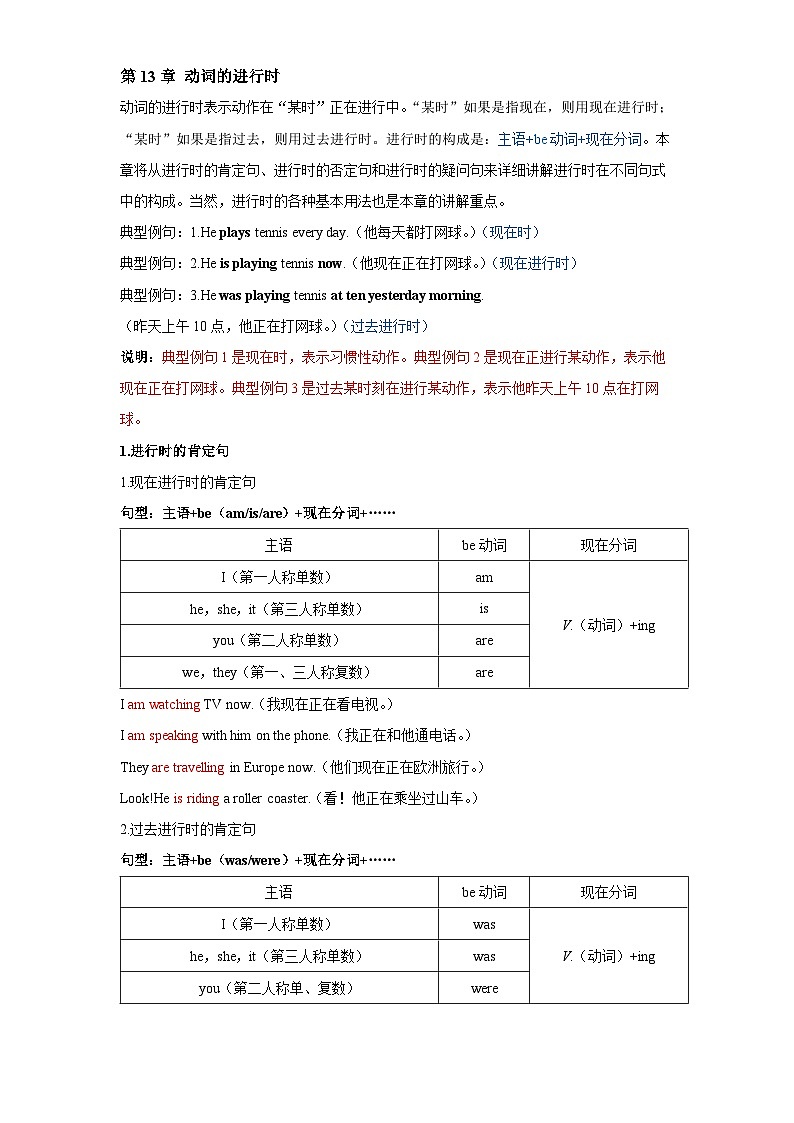
1.现在进行时的肯定句
句型:主语+be(am/is/are)+现在分词+……
I am watching TV nw.(我现在正在看电视。)
I am speaking with him n the phne.(我正在和他通电话。)
They are travelling in Eurpe nw.(他们现在正在欧洲旅行。)
Lk!He is riding a rller caster.(看!他正在乘坐过山车。)
2.过去进行时的肯定句
句型:主语+be(was/were)+现在分词+……
He was strlling arund the park at this time yesterday.(昨天这个时候,他正在公园散步。)
I was watching TV then.(那时我正在看电视。)
She was playing the pian when the bell rang.(当铃声响时,她正在弹钢琴。)
When I came hme,they were cking in the kitchen.(当我回家时,他们正在厨房做饭。)
2.进行时的否定句
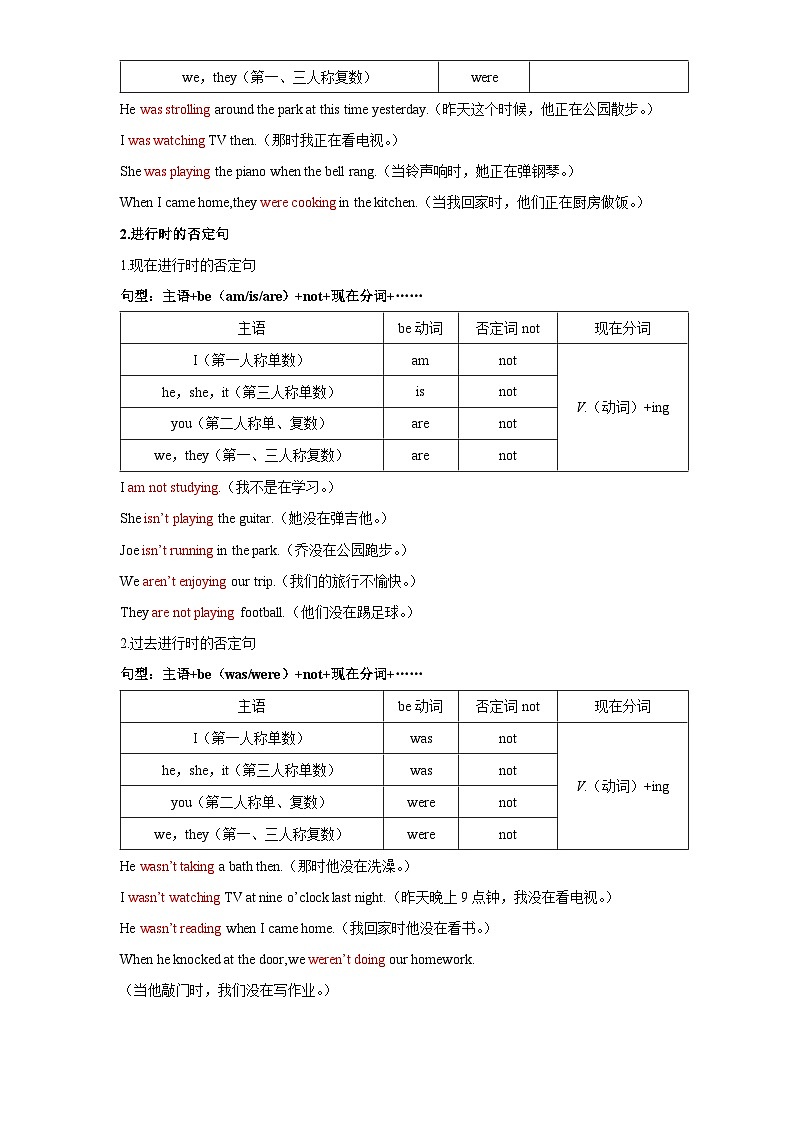
1.现在进行时的否定句
句型:主语+be(am/is/are)+nt+现在分词+……
I am nt studying.(我不是在学习。)
She isn’t playing the guitar.(她没在弹吉他。)
Je isn’t running in the park.(乔没在公园跑步。)
We aren’t enjying ur trip.(我们的旅行不愉快。)
They are nt playing ftball.(他们没在踢足球。)
2.过去进行时的否定句
句型:主语+be(was/were)+nt+现在分词+……
He wasn’t taking a bath then.(那时他没在洗澡。)
I wasn’t watching TV at nine ’clck last night.(昨天晚上9点钟,我没在看电视。)
He wasn’t reading when I came hme.(我回家时他没在看书。)
When he kncked at the dr,we weren’t ding ur hmewrk.
(当他敲门时,我们没在写作业。)
They weren’t having supper then.(那时他们没在吃晚饭。)
补充:“be动词+nt”常用缩略式:
3.进行时的一般疑问句
1.现在进行时的一般疑问句
句型:Be(Is/Are)+主语+现在分词+……?
Are they playing tennis nw?(现在他们正在打网球吗?)
A:Is she still studying abrad?(她还在国外读书吗?)
B:Yes,she is.(是的。)/N,she isn’t.(不,她不在国外读书了。)
A:Lk!Is a bird flying in the sky?(看,天空中有只鸟在飞吗?)
B:Yes,it is.(是的。)/N,it isn’t.(不,没有鸟在飞。)
2.过去进行时的一般疑问句
句型:Be(Was/Were)+主语+现在分词+……?
Were yu cking at that time?(那时,你在做饭吗?)
A:Was he singing then?(那时他正在唱歌吗?)
B:Yes,he was.(是的。)/N,he wasn’t.(不,他那时没在唱歌。)
A:Were yu listening t music last night?(昨天晚上你在听音乐吗?)
B:Yes,I was.(是的。)/N,I wasn’t.(不,我没有在听音乐。)
4.进行时的特殊疑问句
1.现在进行时的特殊疑问句
句型:疑问词+be(is/are)+主语+现在分词+……?
What are yu reading nw?(你现在读什么书呢?)
A:What are yu ding nw?(你现在正在做什么?)
B:I’m bserving the structure f the plane.(我在观察飞机的构造。)
A:What curse are yu taking at weekends?(周末你在学什么课程?)
B:I’m taking a tae kwn d curse.(我在学跆拳道。)
2.过去进行时的特殊疑问句
句型:疑问词+be(was/were)+主语+现在分词+……?
What was he ding when I called yu?(我给你打电话时他在做什么?)
A:What was he ding at the time f the fire yesterday?(昨天起火时,他在做什么呢?)
B:He was studying at the library then?(那时他正在图书馆学习。)
A:When were yu dancing yesterday?(你(们)昨天什么时候在跳舞?)
B:I was/We were dancing at ten last night.(昨天晚上10点钟我(们)在跳舞。)
注意:对主语提问的特殊疑问句
Nancy is singing.(南希在唱歌。)→Wh(主语)is singing?(谁在唱歌?)回答:Nancy is.
5.进行时的基本用法
1.现在进行时的基本用法
(1)表示说话时正在进行的动作
现在进行时表示说话时正在进行的动作,常和nw连用。有时也会用一个动词如lk(看),listen(听)等来表示nw(现在)这一时间概念。
Lk!A train is cming.(看!火车来了。)
Listen!He is playing the pian.(听!他在弹钢琴。)
(2)表示现阶段正在进行的动作
现在进行时表示的动作不一定是说话时正在进行的,也可以是现阶段正在进行的,此时,常和at present(目前),this week(本周),these days(这几天)等时间状语连用。
Which lessn are yu studying this week?(你们这周学哪一课了?)(说话时并不在学)
He is attending an internatinal cnference in Beijing these days.
(这几天他正在北京出席一个国际会议。)(说话时不一定在开会)
补充:如果没有表示将来时间的状语,此类句子就可能指现在或现阶段的动作。
Where are yu ging?(你现在去哪儿?)
有next week(下周)等表示将来的时间状语时,用现在进行时表示将来时。
Where are yu ging next week?(下周你计划去哪儿?)
(3)表示最近按计划或安排要进行的动作
现在进行时有时可表示一个在最近按计划或安排要进行的动作,也就是说可以用来代替将来时,但此时,一般要与表示将来的时间状语连用,而且仅限于下列少数动词。
g去;cme来;leave离开;start开始;arrive到达;return返回;sleep睡觉
Are yu ging t Tianjin tmrrw?(你明天要去天津吗?)
Hw many f yu are cming t the party next week?(下周你们有多少人要来参加聚会?)
(4)be ging t+动词原形
这一句型表示即将发生的事或打算(准备)做的事,我们把它归在了将来时里。
(参见(第14章 动词的将来时))
She isn’t ging t speak at the class meeting.(她不打算在班会上发言。)
We are ging t sing this sng tgether.(我们打算一起唱这首歌。)
重要:1.I’m ging t the park.(我正在去公园。)(为进行时,进行时的t之后须加名词)
2.I’m ging t g t the park.(我打算去公园。)(为将来时,将来时的t须加动词原形)
(5)现在进行时和一般现在时的区别
一般现在时表示经常性的动作;而现在进行时表示暂时性的动作。
He walks t wrk.(他步行上班。)(表示习惯、经常性的动作)
He’s walking t wrk because his bike is being repaired.
(他现在走着去上班,因为他的自行车正在修理。)(只是暂时的情况)
Where des he live?(他住在哪儿?)(询问一般的情况)
Where is he living/staying?(他(现在暂时)住在哪儿?)(询问暂时一段时间的情况)
(6)现在进行时代替一般现在时的情况
现在进行时有时可用来代替一般现在时,表达说话人的某种感情,使句子有强烈的感情色彩。常与always(总是),frever(永远)等词连用。
Yu are always frgetting the imprtant thing.(你总是把重要的事情忘掉。)
(表达出不满的情绪)
Mary is ding pretty well at schl.(玛丽在学校表现很不错。)
(比Mary des pretty well at schl.更富有赞许的意思)
2.过去进行时的基本用法
(1)表示过去某个时刻或某一阶段正在进行的动作
A.过去进行时表示在过去某个确定的时间点或某一段时间里正在发生的动作。因此,原则上,常和表示过去时间的状语连用。
then那时,当时;at this/that time在这时/那时;yesterday昨天;last night昨晚
What were yu ding at nine last night?(昨晚9点的时候,你在做什么?)
I was playing vlleyball with my friends yesterday afternn.(我昨天下午在和朋友们打排球。)
B.有些情况下,句子中没有明确表示时间的状语,但从句子的上下文中可以得知这是在过去某一时间内正在进行的动作。
We didn’t g shpping as it was raining heavily.(我们没去购物,因为雨下的很大。)
It was a very cld night and a terrible wind was blwing.
(那是个寒冷的夜晚,而且还刮着猛烈的大风。)
(2)与表示过去的时间状语从句连用
A.当两个持续性动作在过去某个时间同时发生时,且存在并列或对比关系,则这两个持续性动作都可用过去进行时表达。
When I was cleaning the windws,my brther was sweeping the flr.
(当我在擦窗户的时候,我弟弟在扫地。)
Sme students were playing ftball,while thers were running rund the track.
(一些学生在踢足球,同时别的学生正在沿着跑到跑步。)
B.当持续性和短暂性的两个动作在过去某个时间同时发生时,用过去进行时表示持续性动作。过去进行时可用于主句中,也可用于从句中。
It was raining hard when I left my ffice.(当我离开办公室时,雨下得正大。)
When yu called,I was having my lunch.(你打电话时,我正在吃午饭。)
We were walking alng the river when (suddenly) it rained.
(我们沿着河边散步,突然下起雨来。)
They were watching TV when the lights went ut.(他们正在看电视,突然停电了。)
说明:此时的when是连词,与上面几例不同,只能用于句子中间。
(3)表示过去将要发生的动作
现在进行时可以表示将来的动作,同样,过去进行时也可以表示从过去某时间看来将要发生的动作,常用在间接引语中。
She went t see David.He was leaving early the next mrning.
(她去看戴维。他第二天一早就要离开此地了。)
She asked him whether he was cming back fr lunch.(她问他是否准备回来吃午饭。)
(4)过去进行时和一般过去时的区别
一般过去时只表示一个完成的动作,而过去进行时表示过去某时正在进行的动作。也就是说,用一般过去时只是表示有过这件事;用过去进行时则强调了动作的连续性。
The children watched TV yesterday evening.(昨天晚上孩子们看电视了。)
The children were watching TV yesterday evening.(昨晚孩子们整晚都在看电视。)
比较:第一句用了一般过去时,只说明了昨晚孩子们看过电视,但至于看电视看了多长时间并不知道。
第二句用了过去进行时,则不仅是陈述昨晚孩子们看电视这一事实,更强调他们看电视的时间贯穿昨晚整个时间段。
Li Ming washed the dishes last Sunday.(上周日李明洗过盘子了。)
Li Ming was washing the dishes when his mther came hme.
(当他妈妈回来时,李明正在洗盘子。)
I read a cmic bk this mrning.(今天上午我看了一本漫画书。)(已经看完了)
I was reading a cmic bk this mrning.(今天上午我在看漫画书。)(可能没看完)
必背:常用动词的现在分词
6.不用于进行时的动词
表示状态、思想、感情和感觉的动词不能表示正在进行的动作,因此,这类动词一般不能用于进行时态。这样的词包括:
(1)表示感觉的感官动词
(⚪)I hear the sund.(我听见了声音。)
(×)I am hearing the sund.
(⚪)D yu hear the nise f a plane?(你听到飞机的声音了吗?)
(×)Are yu hearing the nise f a plane?
They are hearing an English lecture.(他们在听一个英语讲座。)
说明:如果hear不表示“听见”而表示“听”的意思时,可用进行时。
(2)表示态度、感情或心理状态等意思的动词
(⚪)I hate smking.(我讨厌吸烟。)
(×)I’m hating smking.
(⚪)I believe him t be hnest.(我认为他是诚实的。)
(×)I’m believing him t be hnest.
注意:现代英语中,为了使语气更加婉转、客气,want,hpe,expect往往用于进行时。
I hpe yu will g with us.(我希望你和我们一起去。)
I’m hping yu will g with us.(语气更客气,口气更婉转)
(3)表示存在状态或持续的动词
(⚪)He lks tired.(他看上去很疲倦。)
(×)He is lking tired.
(⚪)The battle cntinued fr a week.(这场战斗持续了一个星期。)
(×)The battle was cntinuing fr a week.
(4)表示占有的动词
(⚪)I have a lt f bks.(我有许多本书。)
补充:如果have/has表示“吃饭、开会、玩得愉快”等意思时,可用进行时。
I was having dinner when yu called me up.(你打电话来时我正在吃晚饭。)
(×)I’m having a lt f bks.
Cmmn Mistakes(注意!失分陷阱!)
陷阱例题①
A:It’s nice t see yu again.Have yu changed jbs?
B:N,__________ my cusin here.【盐城中考】
句意提示:A:很高兴再次见到你。你换工作了吗?B:不,我来这儿探望我的堂兄。
陷阱追击:现在进行时表示某种状态,强调情况的暂时性。如忽视上下文语境则容易误选。
正确解析:A项是一般将来时,C项是一般过去时,D项是过去完成时。只有B项符合语境。正确答案为B。
陷阱例题②
A:Did yu see a by in white pass by just nw?
B:N,sir.I __________ music.【黄石中考】
句意提示:A:你刚才看见一个穿白衣服的男孩经过吗?
B:没有,先生。当时我正在听音乐。
陷阱追击:本题考查根据情景判断时态。此类题目应仔细揣摩上下文语境,否则容易误选。
正确解析:问句用一般过去时提问,则答语应该用过去进行时表达当时正在做某事。正确答案为A。
陷阱例题③
I first met Lisa three years ag when we __________ at a radi statin tgether.【兰州中考】
句意提示:三年前我第一次见到莉萨是我们一起在电台工作的时候。
陷阱追击:如果没有掌握好when引导的时间状语从句的时态运用,则容易误选。
正确解析:when引导的时间状语从句中,主句用一般过去时,从句要用过去进行时表示当时正在发生的事。正确答案为C。
陷阱例题④
When I gt there,he __________ them t dance.【宁夏中考】
句意提示:当我到达那里时,他正在教他们跳舞。
陷阱追击:本题如分辨不清上下文语境所传达的时态信息,则容易误选。
正确解析:时间状语从句中用一般过去时,主句用过去进行时表示当时正在发生的事。正确答案为C。
Final Check(实力测验)
1.用括号中动词的适当形式填空
1.Tm and his father __________ (swim) nw.
2.Lk!They __________ (run) alng the street.
3.We __________ (practice) hard these days because we will have a big match next mnth.
4.What __________ he __________ (d) at nine ’clck last night?
5.They __________ (listen) t the music at that time.
6.When the headmaster came in,the students __________ (read) the text.
7.We __________ (watch) TV when suddenly the telephne rang.
8.She __________ (make) the paper flwers the whle night.
9.A:__________ yu __________ (study) English? B:Yes,I am.
10.Let’s g ut.It __________ (nt rain) nw.
11.Hurry up!Everybdy __________ (wait) fr yu.
12.A:__________ (yu,listen) t the radi? B:N.Yu can turn it ff.
13.I __________ (watch) TV at seven ’clck yesterday evening.
14.A:What __________ (yu,lk) fr?
B:I __________ (lk) fr my wallet.There is smething imprtant in it.
__________ (rain) hard.We’ll get wet if we g ut.
16.What __________ (he,d) at this time last night?
17.The student __________ (run) n the playgrund when suddenly a ball hit him.
18.Please be quiet.The students __________ (have) an exam.
19.While we __________ (have) a drink,a by drpped his glass.
20.I __________ (read) a newspaper while I was waiting fr the bus.
2.按要求变换句型
1.Lk!He is dancing.→(一般疑问句)
_______________________________________________________________________________
2.The farmers weren’t wrking last year.→(肯定句)
_______________________________________________________________________________
3.The teachers are having a meeting.→(对划线部分提问)
_______________________________________________________________________________
4.The bys are cleaning their rm.→(对划线部分提问)
_______________________________________________________________________________
5.The singer is singing sme famus sngs.→(否定句)
_______________________________________________________________________________
6.I am studying English,t.→(否定句)
_______________________________________________________________________________
3.改错
1.Mary’s mther is wrks in a factry.
_______________________________________________________________________________
2.Are yu driveing nw?
_______________________________________________________________________________
3.Listen!Li Ming playing the pian there.
_______________________________________________________________________________
4.Lk,yur classmates play ftball n the grund.Why dn’t yu jin them?
_______________________________________________________________________________
5.We are liking music very much.
_______________________________________________________________________________
6.We are nt deciding it nw.
_______________________________________________________________________________
7.I was finishing my wrk and went hme.
_______________________________________________________________________________
8.The wman wre a blue cat at that time.
_______________________________________________________________________________
9.I was ding my hmewrk when suddenly I was hearing smene call my name.
_______________________________________________________________________________
10.All f us cpied the sentences n the blackbard when suddenly the lights went ut.
_______________________________________________________________________________
4.汉译英
1.我正在发电子邮件给我在北京的朋友。
_______________________________________________________________________________
2.当时你在做什么呢?
_______________________________________________________________________________
3.昨晚你打电话给我时,我正在看电视。
_______________________________________________________________________________
4.上周日上午从9点到11点你一直在玩电脑游戏,是吗?
_______________________________________________________________________________
5.听,有人在喊“救命”。
_______________________________________________________________________________
【课后作业】
一.单项填空
( )1.What ________ Jim and Mike ding nw?
A. am B. is C. are D. /
( )2.2016·永州—What are yu ding nw? —I ________ t the music.
A.is listening B.am listening C.was listening
( )3.—Wh's yur friend________? —Her mther.
A.talk B.talk t with C.talking D.talking with
( )4.Listen! A girl________ an English sng.
A.sings B.is singing C.sing D.t sing
( )5.—Is he________ a mvie n TV? —N,he's ________ an email.
A.reading; writing B.seeing; writing C.seeing; watching D.lking; reading
( )6.—What________ he________ nw? —He's reading.
A.des; d B.is; ding C.has; t d D.was; d
( )7.—What is he ding? —He ________ his MP4.
A.is listening B.is listening t C.listening D.listening t
( )8.Lk at the pht. The by ________.
A.swimming B.desn't swim C.swims D.is swimming
( )9.It's seven 'clck. My father is ________ a newspaper.
A.reading B.lking C.reads D.lks
( )10. —Is David playing cmputer games? —________.
A.Yes, he is B.N, he is C.Yes, he des D.N, he desn't
( )11.What are yur parents talking________?
A.t B.at C.abut D.with
( )12.Wang Bin is ________ a bk. Li Ta is ________ the blackbard.
A.reading; seeing B.reading; lking at C.seeing; seeing D.seeing; lking at
( )13.Mike and his classmates________ ver there.
A.is play B.is playing C.are playing D.are play
( )14.Lk! She is ________ a bk under the tree.
A.lking B.watching C.seeing D.reading
( )15.Bill is talking ________ the phne nw.
A.n B.in C.at D.t
( )16.I want ________ this nvel nw.
A.reading B.t reading C.read D.t read
( )17.The by isn't________ the teacher in class.
A.listen B.listens C.listening D.listening t
( )18.It's 8 'clck. Jim's family ________ TV.
A.is watching B.are watching C.watch D.t watch
( )19.Let me ________ these bks int the bx.
A.puts B.put C.t put D.putting
( )20.—________ yu ________ the windw? —Yes, I am.
A.D; clean B.Is; cleaning C.Are; cleaning D.D; cleaning
( )21. My grandma isn't here nw. She is ________ a strybk in her rm.
A. lking B. reading C. seeing D. watching
( )22.—Where is Rse? —She ________ at the mall.
A.shpping B.is shpping C.shps D.are shpping
( )23.There is a ________ pl near here. I ften g there________.
A.swim; swim B.swimming; swim C.swimming; t swim D.swimming; swimming
( )24.—Let's g swimming. —________. I like swimming very much.
A.Sunds gd B.Sure, I'd lve t C.Srry D.N
( )25.—Keep quiet, children. Dad ________ in the bedrm. —OK, Mm.
A.sleep B.sleeps C.is sleeping D.is sleeps
( )26. Listen! My sister ________ n the phne.
A. talks B. t talk C. is talking D. talk
( )27.________ the first pht, I ________ at the mall.
A.On; d shp B.On; shpping C.In; am d shp D.In; am shpping
( )28. The girl wishes ________ icecream, but her mther desn't want her ________ it.
A. eating; t eat B. t eat; eating C. eating; eating D. t eat; t eat
( )29.Danny is living ________ his grandmther.
A.fr B.t C.with D.in
( )30.Mary is playing with her cat and her brther ________ at the pl.
A.is swimming B.swims C.swim D.t swim
( )31.—What ________ Mary and Sara ________? —They are playing the guitar.
A.d; d B.are; d C.are; ding D.des; d
( )32.Here ________ tw ________ f my family.
A.is; pht B.are; phts C.are; phts D.is; phts
( )33.2016·昆明Each cuple in China can have tw ________ frm January 1st, 2016.
A.by B.girl C.children D.child
( )34.My parents are ________ races n TV in the living rm.
A.watching B.seeing C.reading D.lking at
( )35. Her ________ are watching TV nw.
A. huse B. hme C. family D. schl
( )36.2015·菏泽—Hi, Wang Ning! Hw's the weather in Heze nw? —It is terrible. It ________ all the mrning.
A.rains B.is raining C.rained
( )37.2015·安徽 —Cathy, can yu answer the dr? I ________ the rm. —I'm cming, Mm.
A.clean B.cleaned C.have cleaned D.am cleaning
( )38.2015·威海 Listen! Smene ________ the vilin in the music rm.
A.plays B.played C.is playing
( )93.Mm, smene ________. Please pick up the phne.
A.has called B.is calling C.will call D.was calling
( )40.2015·苏州—Where is Jan? —She ________ a nvel in her study.
A.has read B.reads C.will read D.is reading
( )41.Lk! Simn ________ in the playgrund.
A.run B.runs C.is running D.running
( )42. —Hell, Betty! What are yu ding nw? —I ________ n the Great Wall f China. I'll send them t yu later.
A. will take pictures B. am taking pictures C. was taking pictures D. take pictures
( )43. —________English every mrning? —Yes, but nw I ________ Chinese.
A.Are yu reading; read B.D yu read; read C.D yu read; is reading D.D yu read; am reading
( )44.Lk! That's my yunger brther, Mike. He ________ with his dg.
A.plays B.play C.is playing D.t play
( )45.Lk! Jack and his mnkey ________ in the garden.
A.is playing B.playing C.are playing D.play
( )46.My father is ________ a newspaper under a tree.
A.reading B.watching C.lking D.seeing
( )47.Wh is talking ________ Mr. Green?
A.t B.at C.fr D.n
( )48.Tday Wang Meimei is ________ a beautiful skirt.
A.putting n B.wear C.wearing D.wears
( )49.Yu can't use the bathrm nw. Rbbie ________ a shwer.
A.take B.will take C.is taking D.are taking
( )50.Tm ________ a big family. Nw his family ________ at hme.
A.has; are eating B.has; is eating C.have; are eating D.have; is eating
( )51.—________ they playing games ver there? —Yes, they ________.
A.D; d B.Are; are C.D; are D.Are; d
( )52. Listen! The bird ________ in the tree.
A. sing B. sings C. singing D. is singing
( )53.He is studying ________ a test.
A.with B.fr C.n D.f
( )54.—________ are they ding? —They are talking abut a new film(电影).
A.Where B.What C.Why D.Wh
( )55.—Where is yur mther? —She ________ zngzi fr us in the kitchen.
A. makes B. make C. t make D. is making
( )56. Lk! It ________ utside.
A. rains B. rain C. is raining D. t rain
( )57.—________ it ging? —Very gd.
A.What's B.What des C.Where's D.Hw's
( )58.Mary is studying ________ her friend's hme.
A.with B.fr C.t D.at
( )59.My mther ften tells me ________ at schl.
A. nt fight B. nt fighting C. t fight D. nt t fight
( )60.
( )61.Li Ming ________ music in the living rm nw.
A.listening B.listen C.listens t D.is listening t
( )62.I'm watching TV in the living rm and my mther is ________ in the kitchen.
A.shpping B.cking C.sleeping D.exercising
( )63.What are yu ding ________?
A.again B.right nw C.right D.sn
( )64.It's ten 'clck. The students ________ a Chinese class.
A.have B.having C.is having D.are having
( )65. Everyne in my class ________ a gd time.
A. are having B. have C. is having D. t have
( )66.It's ________. Let's play vlleyball.
A.windy B.clud C.sunny D.rainy
( )67.—Hi, Mary ________. —Hell, ________ Steve.
A.speaks; this is B.speaking; this is C.speaking; I'm D.am speaking; I'm
( )68.—Where's Linda? —She ________ in the classrm.
A.studying B.studies C.study D.is studying
( )69.Sme peple ________ in the river nw.
A.swim B.swam C.is swimming D.are swimming
初中语法讲义
进行时
年 月 日
主语
be动词
现在分词
I(第一人称单数)
am
V.(动词)+ing
he,she,it(第三人称单数)
is
yu(第二人称单数)
are
we,they(第一、三人称复数)
are
主语
be动词
现在分词
I(第一人称单数)
was
V.(动词)+ing
he,she,it(第三人称单数)
was
yu(第二人称单、复数)
were
we,they(第一、三人称复数)
were
主语
be动词
否定词nt
现在分词
I(第一人称单数)
am
nt
V.(动词)+ing
he,she,it(第三人称单数)
is
nt
yu(第二人称单、复数)
are
nt
we,they(第一、三人称复数)
are
nt
主语
be动词
否定词nt
现在分词
I(第一人称单数)
was
nt
V.(动词)+ing
he,she,it(第三人称单数)
was
nt
yu(第二人称单、复数)
were
nt
we,they(第一、三人称复数)
were
nt
isn’t=is nt
wasn’t=was nt
aren’t=are nt
weren’t=were nt
arrive(到达)→arriving
cme(来)→cming
ck(烹调)→cking
cut(砍)→cutting
drive(驾驶)→driving
live(住)→living
make(做)→making
lk(看)→lking
mve(移动)→mving
play(玩)→playing
run(跑)→running
sit(坐)→sitting
speak(说)→speaking
study(学习)→studying
swim(游泳)→swimming
stp(停止)→stpping
take(取)→taking
write(写)→writing
感官动词
hear,see,ntice,feel,taste等
表示态度、感情的动词
like,lve,hate,desire,wish,mind,appreciate,fear,envy等
表示心理状态的动词
knw,realize,understand,recgnize,believe,feel,suppse,want,expect,prefer等
表示存在状态和持续的动词
seem,lk,appear,cst,we,weigh,be,exist,cntinue等
表示占有的动词
belng t,wn,pssess,have等
A.I’m ging t visit
B.I’m visiting
C.I visited
D.I had visited
A.was listening t
B.listened t
C.am listening t
D.wuld listen t
A.have wrked
B.had been wrking
C.were wrking
D.had wrked
A.is teaching
B.teaches
C.was teaching
D.taught
这是一份26年英语中考复习专题第13讲 进行时(学生版不带答案)练习,共17页。试卷主要包含了进行时的特殊疑问句,进行时的基本用法,不用于进行时的动词,Let’s g ut等内容,欢迎下载使用。
这是一份26年英语中考复习专题第13讲 进行时(教师版带答案)练习,共19页。试卷主要包含了进行时的特殊疑问句,进行时的基本用法,不用于进行时的动词,Let’s g ut等内容,欢迎下载使用。
这是一份26年英语中考复习专题第15讲 完成时(学生版不带答案)练习,共18页。试卷主要包含了现在完成时的一般疑问句,现在完成时的特殊疑问句,过去完成时的用法,使用过去完成时需注意事项等内容,欢迎下载使用。
注册成功
资料篮

在线客服
添加在线客服
获取1对1服务
官方微信
关注“教习网”公众号
打开微信就能找资料
赛课定制
添加在线客服
获取1对1定制服务
职称咨询
添加在线客服
获取1V1专业指导服务

免费福利

.png)
.png)
.png)
