 免费领取教师福利


若您为此资料的原创作者,认为该资料内容侵犯了您的知识产权,请扫码添加我们的相关工作人员,我们尽可能的保护您的合法权益。


这是一份26年英语中考复习专题第11讲 一般现在时(教师版带答案)练习,共20页。试卷主要包含了be动词一般现在时的一般疑问句,be动词一般现在时的特殊疑问句,There be句型等内容,欢迎下载使用。
第 份
第11章 动词的一般现在时
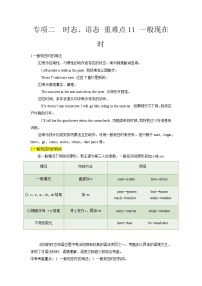
be动词是系动词的一种,表示“……是……”。现在时有am,is,are三种,其原形动词都是be,所以把它们称为be动词。行为动词又称为实义动词,其意义完全,可独立用作谓语,如:g(走),make(做)等。由于be动词和行为动词在构成疑问句和否定句时的句型并不相同,因此我们将详细说明这两者的区别。
典型例句:1.She is my classmate.(她是我的同学。)
典型例句:2.He speaks English.(他说英语。)
1.be动词的一般现在时
be动词常与名词、形容词或其他词类一起表示主语的性质、状态、身份、特点等。be动词的一般现在时有am,is,are三种形式,由主语的人称和数来决定用哪一种。
1.be动词一般现在时的肯定句
句型:主语+be动词的一般现在时(am,is,are)+……
I am thirteen years ld.(我13岁。)
Mary is a student.(玛丽是一名学生。)
We are classmates.(我们是同班同学。)
I am a teacher.(我是一个老师。)(接名词)
Sphia is yung.(索菲娅很年轻。)(接形容词)
Nra is ut.(诺拉不在家。)(接副词)
They are frm China.(他们来自中国。)(接介词短语)
说明:be动词之后可接不同词性的词。
be动词的意义,除了有“……是……”之意,还表示“……在……”。
2.be动词一般现在时的否定句
句型:主语+be动词的一般现在时(am,is,are)+nt+……
肯定句:I am utging.(我性格外向。) 否定句:I am nt utging.(我性格内向。)
缩写式:I’m nt utging.
肯定句:It is a seed.(它是一颗种子。) 否定句:It is nt a seed.(它不是一颗种子。)
缩写式:It isn’t a seed.
肯定句:Yu are smart.(你很聪明。) 否定句:Yu are nt smart.(你不是很聪明。)
缩写式:Yu aren’t smart.
补充:I am nt...,缩写为I’m nt...。I’m读作[aim]。
is nt缩写为isn’t,读作[ˈɪznt]。are nt缩写为aren’t,读作[ɑːnt]。
缩写记号,要放在被省略的词的上方。
3.be动词一般现在时的一般疑问句
Am I right?(我对吗?)
Is she a nurse?(她是一位护士吗?)
Are yu frm America?(你来自美国吗?)
(1)一般疑问句的结构
句型:Be动词的一般现在时(Am/Is/Are)+主语……?
Am I n the guest list?(我在客人名单里吗?)
Is his father an English teacher?(他父亲是一位英语老师吗?)
Are Mrs.Li and Marry in a supermarket?(李太太和玛丽在超市吗?)
(2)一般疑问句的回答
在回答由be动词构成的一般疑问句时,要用Yes或者N,句型如下:
肯定回答:Yes,主语+be动词.
否定回答:N,主语+be动词+nt.
注意:Yes或N的后面一定要有逗号。逗号后所加的主语不能大写,I(我)除外。
A:Is yur key n the table?(你的钥匙在桌子上吗?)
补充:一般疑问句答句中主语需用代词,yur key是第三人称单数,回答时要用it指代。
B:Yes,it is.(是的,它在。)
A:Are yu an Australian?(你是澳大利亚人吗?)
说明:问句中的yu(你),回答时改为I(我),I须用大写。
B:N,I’m nt.(不,我不是。)
4.be动词一般现在时的特殊疑问句
What is the date tday?(今天几月几号?)
Where are yu frm?(你来自哪里?)
(1)特殊疑问句的结构
句型:疑问词+be动词+主语+……?
What is this?(这是什么?)
What are they?(他们是干什么的?)
Wh is he?(他是谁?)
切记:疑问词
(2)特殊疑问句的回答
特殊疑问句不能用yes或n来回答。回答时,be动词要视主语的情况而决定用am,is或are。
A:What is the time nw?(现在几点了?)
B:It is seven ’clck.(7点钟了。)
5.There be句型
There is(引导词)a schl(真正的主语)there.(地点状语)
(那里有一所学校。)
(1)There be句型的用法
There be句型表示“某地(场所)有/存在某物”,它的基本用法见下表:
There is a pineapple there.(那儿有一个菠萝。)
说明:There be中的there不是“那里”的意思。当我们要明确地表达“在那里有……”的意思时,则必须在最后重复使用there。
There is still sme juice in the cup.(杯子里还有一些果汁。)
There are many eggs in the kitchen.(厨房里有很多鸡蛋。)
(2)There be句型的否定句与疑问句
A.There be句型的否定句是在be的后面加nt。
There is nt a cmputer n the desk.(桌子上没有电脑。)
There are nt any students n the playgrund.(操场上没有学生。)
B.There be句型的一般疑问句是将be调到there的前面。
Is there a cmputer n the desk?(桌子上有电脑吗?)
Are there any students n the playgrund?(操场上有学生吗?)
C.There be句型的特殊疑问句是在其一般疑问句前加相应的疑问词。
A:Hw much ink is there in the ink bttle?(墨水瓶里有多少墨水?)
B:There is nly a little.(只有一点儿了。)
A:Hw many peple are there in yur family?(你们家有几口人?)
B:There are five.(有五口人。)
注意:问“……有……”时,都用句型What’或What
A:What’s n the table?(桌子上有什么?)
B:There are sme bxes n it.(桌上有几个盒子。)
2.行为动词的一般现在时
除了be动词(am,is,are)、助动词、情态动词以外的动词全部称为行为动词。在行为动词的句型中,主语为第三人称单数时的动词变化要特别注意(构成参见(第9章 动词概说))。行为动词一般现在时的否定句和一般疑问句要加d/des,这和be动词是不同的。
1.行为动词一般现在时的肯定句
I play baseball every Sunday.(我每个星期日都打棒球。)
She usually des her hmewrk at schl.(她通常在学校做作业。)
(1)主语为第一、二人称或第三人称复数时
主语为第一人称I/we、第二人称yu或第三人称复数时,谓语动词没有形式的变化。
句型:主语(除第三人称单数外)+行为动词(原形)+……
I g t schl every day.(我每天去上学。)
We have three children.(我们有三个孩子。)
Yu sing very well.(你(们)唱得很棒。)
They live far frm schl.(他们住得离学校远。)
(2)主语为第三人称单数时
主语为第三人称单数时,谓语动词的一般现在时形式有变化,变化规律和名词的单数变复数形式相同。
句型:主语(第三人称单数)+行为动词(-s/-es)+……
He always wears (in) black.(他总是穿黑色的衣服。)
She ften gets up at half past six.(她经常六点半起床。)
补充:at ten past six(6:10)在6点10分;at ten t seven(6:50)在6点50分
It grws very well.(它生长得不错。)
Nancy ges t the mvies every weekend.(南希每周末都去看电影。)
2.行为动词一般现在时的否定句
I dn’t watch TV at hme.(我在家不看电视。)
He desn’t study hard.(他不用功学习。)
句型:主语(除第三人称单数外)+d nt+行为动词原形
主语(第三人称单数)+des nt+行为动词原形
I d nt have dinner at schl.(我不在学校吃晚餐。)
We dn’t knw him very well.(我们和他不是很熟。)
She des nt speak Chinese.(她不说汉语。)
Amy desn’t like t eat eggplant.(埃米不喜欢吃茄子。)
说明:d nt的缩写为dn’t;des nt的缩写为desn’t。
d nt和des nt后面的动词必须是原形。
行为动词一般现在时的肯定句和否定句,请参看下列表格:
3.行为动词一般现在时的一般疑问句
D yu g t schl tday?(你今天去上学吗?)
Des she cme frm Australia?(她来自澳大利亚吗?)
(1)一般疑问句的结构
句型:D/Des+主语+动词原形+……?
D yu like rck climbing?(你喜欢攀岩吗?)
Des he walk t schl?(他走路上学吗?)
补充:d和des用于行为动词的否定句和疑问句中,称为助动词。
(2)一般疑问句的回答
肯定回答:Yes,主语+d/des.
否定回答:N,主语+d nt/des nt.
A:D yu live in Dngcheng district?(你住在东城区吗?)
B:Yes,I d.(是的,我是。)
A:Des he play tennis?(他打网球吗?)
B:N,he desn’t.(不,他不打。)
A:Des he g t schl every day?(他每天都去上学吗?)
B:Yes,he des.(是的,他是。)
行为动词一般现在时的一般疑问句,请参看下列表格:
4.行为动词一般现在时的特殊疑问句
When d they have lunch?(他们什么时候吃午饭?)
Hw many pairs f sneakers des she have?(她有多少双运动鞋?)
(1)特殊疑问句的结构
句型:疑问词+一般疑问句?
Where d yu live?(你住在哪儿?)
Hw des he g t schl?(他怎么上学?)
When and where des Li Ming d his hmewrk every day?
(李明每天什么时候在哪里做作业?)
Hw many emails d yu send t yur friends every day?
(你每天给你朋友发多少封电子邮件?)
注意:特殊疑问句一般是将疑问词放在句首,后面用倒装句语序。但如果是对主语提问,则为:疑问词+谓语+其他成分?
Wh(主语)lks after(谓语)the baby?(谁照看这个婴儿?)
(2)特殊疑问句的回答
特殊疑问句不能用yes/n回答。由于在问句中出现d/des,所以动词保持原形,但回答时,动词要视主语而决定是否加-s等。
A:Where des her father wrk?(她父亲在哪儿工作?)
B:He wrks in an irn factry.(他在一家铁制品厂工作。)
3.一般现在时的基本用法
(1)表示经常、习惯性发生的动作或存在的状态
可以和always(总是),usually(通常),ften(经常),smetimes(有时),every day(每天),every week(每周)等表示时间的状语连用。
Helen always smiles at us.(海伦总是对我们微笑。)
I usually d my hmewrk in the evening.(我通常晚上做作业。)
Eric ften drives t travel.(埃里克经常开车去旅行。)
Smetimes they play ftball n the playgrund.(有时他们在操场上踢球。)
He ges t wrk every day.(他每天去上班。)
We g t schl frm Mnday t Friday.(我们周一到周五上学。)
(2)表示普遍真理和特征
由于普遍真理和特征是众所周知的客观事实,所以要用一般现在时陈述,而且一般不用时间状语。
The earth is rund.(地球是圆的。)
Birds fly in the sky.(鸟儿在空中飞翔。)
The sun is bigger than the earth.(太阳比地球大。)
(3)表示知觉、态度、感情等
I want yur help.(我想要你的帮助。)
I dn’t think yu are wrng.(我觉得你没错。)
I suppse everything will be all right.(我料想一切都会好的。)
I lve yu.(我爱你。)
A:We live in difficult times.(我们生活在艰难时世中。)
B:I agree.(我同意。)
切记:常用相关动词
wnder想知道;like喜欢;frget忘记;believe相信;hpe希望;dubt怀疑;remember记住;knw知道;prefer宁愿;更喜欢
(4)在时间、条件状语从句中表示将来的动作
When he gets t Eurpe,he will email me.(他到欧洲后就给我发电子邮件。)
If it desn’t rain tmrrw,we’ll g t the Summer Palace.(如果明天不下雨,我们就去颐和园。)
(5)表示已经预先计划或安排的肯定将要发生的动作
A.主要用于含有cme,g,start,begin,leave,return,stp等终止性动词(又叫点动词)的句子中,且句中常有表示将来时间的状语。
The train leaves at seven and arrives in New Yrk at three tmrrw mrning.
(火车7点出发,将于明天凌晨3点到达纽约。)
Our hlidays begin in a week.(我们的假期一周后开始。)
The plane takes ff at tw this afternn.(飞机将于今天下午2点起飞。)
B.用be abut t d表示马上就要发生的事情。
The plane is at the end f the runway.It’s abut t take ff.
(飞机已经滑行到机场跑道的尽头,它马上就要起飞了。)
Li Ming is nearly reaching the finishing line nw.He is abut t win the race.
(李明差点儿就到终点线了,他马上就要赢得这场比赛了。)
比较:be abut t用于表示将来时的时候,与will,be ging t不同的是,它表示的是最近的将来,且不与表示将来的时间状语连用。
Cmmn Mistakes(注意!失分陷阱!)
陷阱例题①
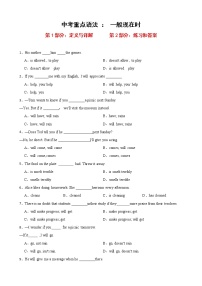
All the students in Class 5 will climb the muntain if it __________ rain tmrrw.【绵阳中考】
句意提示:如果明天不下雨,五班所有的学生都将去爬山。
陷阱追击:本题考查if引导的条件状语从句的时态。如果条件状语从句的主句是一般将来时,从句要用一般现在时代替一般将来时。容易误选A。
正确解析:根据从句的主语it可知,后面要用动词的第三人称单数形式。正确答案为D。
陷阱例题②
Mid-Autumn Day usually __________ in September r Octber every year.【北京中考】
句意提示:中秋节通常在每年的阳历九月份或十月份到来。
陷阱追击:本题考查一般现在时的基本用法。一般现在时表示经常发生的动作或存在的状态,表示普遍真理和特性。容易误选C,D。
正确解析:传统节日在固定的某月份到来,要用一般现在时。正确答案为B。
陷阱例题③
A:I’m srry that Jhn is ut.
B:Please ask him t call me as sn as he __________.【成都中考】
句意提示:A:抱歉,约翰出去了。B:请您让他一回来就给我打电话。
陷阱追击:在时间状语从句和条件状语从句中表示将来的动作,用一般现在时表示将要发生的事情。如不清楚这种用法,就容易误选。
正确解析:as sn as意为“一……就……”,引导时间状语从句。正确答案为B。
陷阱例题④
A:Are yu wrried when yur sn ften plays cmputer games?
B:Yes.I think playing cmputer games __________ n teenagers.【宿迁中考】
句意提示:A:当你的儿子经常玩电脑游戏时你担忧吗?
B:是的,很担忧。我认为玩电脑游戏对少年有不良影响。
陷阱追击:在答语中,“playing cmputer games”作主语。如分辨不清主语就容易误选。
正确解析:由肯定答语可知,回答者认为玩电脑游戏有坏的影响。正确答案为C。
Final Check(实力测验)
1.用括号中适当的词填空
1.I __________ (am,are,is) frm Australia.
2.She __________ (am,are,is) a cllege student.
3.Jane and Tm __________ (am,are,is) my friends.
4.My mther __________ (is,play,plays) tennis well.
5.Ry always __________ (cme,cmes,cming,t cme) t schl at 8:30.
6.A:__________ (Are,Is,D,Des) there a Chinese schl in New Yrk? B:Yes,there is.
7.__________ (Be,Are,D,Des) they speak English in Japan?
2.用括号中动词的适当形式填空
1.There __________ (be) sme glasses n it.
2.He __________ (g) t the park every day.
3.My uncle __________ (live) in Nanjing nw.
4.__________ Lucy and Lily __________ (like) China?
5.Rnald __________ (nt like) t drink range sda.
6.The girl __________ (g) hme at 4:30 in the afternn.
7.A:__________ Kate __________ (speak) French? B:Yes,she des.
8.Jim __________ (nt ride) his bike ften.
9.If he __________ (be) free tmrrw,he __________ (g) with us.
10.As sn as they __________ (get) there next mnth,he __________ (call) me.
11.__________ Li Ming’s father __________ (have) his lunch at hme?
12.Sean __________ (nt d) the mrning exercises ften.
13.I __________ (be) hungry and my sister __________ (be) thirsty.
14.The baby __________ (have) curly hair.
15.Everybdy __________ (have) a chance t win.
16.I __________ (clean) my rm nce a week.
17.Nbdy __________ (tell) them anything.
18.There __________ (be) a lt f chicken n the plate.
__________ (teach) the secnd grade.
20.The by __________ (watch) TV every evening.
21.Karen __________ (play) the vilin quite well.
22.David __________ (study) Chinese and I __________ (study) English.
23.The game __________ (be) interesting.
24.Many children __________ (be) n the playgrund.
25.He __________ (have) a gd time at yur party.
26.I __________ (have) a new bicycle.
3.选择填空
1.What __________ Justin and his mther like?
2.Where __________ yur English teacher frm?
3.Kevin can __________ the pian.
4.Betty __________ Chinese __________ Mnday.
5.The English lessn __________ at 8:00 a.m.
6.__________ yur brther play ftball in the afternn?
7.A:__________ des Alan usually __________ t schl? B:By bike.
8.We __________ TV n Mnday.
9.Hugh usually __________ a kite in the park.
10.A:Yu always __________ yur hmewrk very well. B:Thank yu.
4.选择适当的词并用其正确的形式填空
1.Michael desn’t __________ a T-shirt.
2.Luis __________ his teacher t his birthday party.
3.Mary and her sister __________ emails n the Internet.
4.Kevin likes __________ magic shw n TV.
5.He ften __________ jeans and trainers.
6.Lisa __________ her grandparents at weekends.
7.My parents usually __________ at hme n Sunday.
8.Owen __________ nline in his spare time.
9.Where des he __________ the music frm?
10.What abut __________ games,Harry?
5.按要求变换句型
1.We speak Chinese.→(否定句)We __________ speak Chinese.
2.I am a dctr.→(否定句)__________ a dctr.
3.There is a map n the wall.→(疑问句)__________ a map n the wall?
4.Our teacher has a big dg.→(疑问句)__________ ur teacher __________ a big dg?
5.Are there many flwers in the garden.→(回答问题)Yes,__________.
6.Des yur sister play the pian?→(回答问题)N,__________.
7.What’s yur name?→(回答问题)__________ name __________ Wang Feng.
8.Hw many student d yu have in yur class?
→Hw many students are __________ in yur class?
9.My brther des his hmewrk every day.
→(否定句)My brther __________ his hmewrk every day.
10.In Canada there are a lt f beautiful muntains and lakes.
→Canada __________ a lt f beautiful muntains and lakes.
11.There is a lt f traffic n the rads.→(对划线部分提问)
_______________________________________________________________________________
12.There are many new buildings in the city.→(对划线部分提问)
_______________________________________________________________________________
13.Smetimes yu have a meeting n Sunday.→(变为反意疑问句)
_______________________________________________________________________________
14.The students d mrning exercises during the break.→(对划线部分提问)
_______________________________________________________________________________
15.His father is a dctr.→(对划线部分提问)
_______________________________________________________________________________
6.汉译英
1.我的姐姐是一名护士。
_______________________________________________________________________________
2.我父亲每周末都打网球。
_______________________________________________________________________________
3.我每天早上7点钟离开家去上学。
_______________________________________________________________________________
4.我不想要这么多。
_______________________________________________________________________________
5.克洛伊的英语写作很好,但是口语不好。
_______________________________________________________________________________
6.我知道你的意思。
_______________________________________________________________________________
7.这里所有的学生都来自第一中学。
_______________________________________________________________________________
8.如果你接受我的邀请来参加我们的聚会,我的家人会很高兴。
_______________________________________________________________________________
KEYS:
1.
2.
3.
4.
5.
6.
1.My elder sister is a nurse.
2.My father plays tennis every weekend.
3.I leave hme fr schl at 7 every mrning.
4.I dn’t want s much.
5.Chle writes gd English but des nt speak well.
6.I knw what yu mean.
7.All the students here belng t N.1 Middle Schl.
8.If yu accept my invitatin and cme t ur party,my family will be pleased.
【课后作业】
一、单项选择
( ) 1. There __________ a meeting tmrrw afternn.
A. will be ging t B. will ging t be C. is ging t be D. will g t be
( ) 2. Charlie ________ here next mnth.
A. isn't wrking B. desn't wrking C. isn't ging t wrking D. wn't wrk
( ) 3. He ________ very busy this week, he ________ free next week.
A. will be; is B. is; is C. will be; will be D. is; will be
( ) 4. There ________ a dlphin shw in the z tmrrw evening.
A. was B. is ging t have C. will have D. is ging t be
( ) 5. -_____ yu ______ free tmrrw? - N. I _____ free the day after tmrrw.
A. Are; ging t; will B. Are; ging t be; will C. Are; ging t; will be D. Are; ging t be; will be
( ) 6. Mther ________ me a nice present n my next birthday.
A. will gives B. will give C. gives D. give
( ) 7. - Shall I buy a cup f tea fr yu? -________. (不,不要。)
A. N, yu wn't. B. N, yu aren't. C. N, please dn't. D. N, please.
( ) 8. - Where is the mrning paper? - I ________ if fr yu at nce.
A. get B. am getting C. t get D. will get
( ) 9. ________ a cncert next Saturday? A. There will be B. Will there be C. There can be D. There are
( ) 10. If they cme, we ________ a meeting. A. have B. will have C. had D. wuld have
( ) 11. He ________ her a beautiful hat n her next birthday.
A. gives B. gave C. will giving D. is ging t give
( ) 12. He ________ t us as sn as he gets there. A. writes B. has written C. will write D. wrte
( ) 13. He ________ in three days. A. cming back B. came back C. will cme back D. is ging t cming back
( ) 14. If it ________ tmrrw, we'll g rller-skating.
A. isn't rain B. wn't rain C. desn't rain D. desn't fine
( ) 15. - Will his parents g t see the Terra Ctta Warrirs tmrrw? - N, ________ (不去).
A. they willn't. B. they wn't. C. they aren't. D. they dn't.
( ) 16. Wh ________ we ________ swimming with tmrrw afternn?
A. will; g B. d; g C. will; ging D. shall; g
( ) 17. We ________ the wrk this way next time.
A. d B. will d C. ging t d D. will ding
( ) 18. Tmrrw he ___ a kite in the pen air first, and then ____ bating in the park.
A. will fly; will g B. will fly; ges C. is ging t fly; will ges D. flies; will g
( ) 19. The day after tmrrw they ________ a vlleyball match.
A. will watching B. watches C. is watching D.are ging t watch
( ) 20. There ________ a birthday party this Sunday.
A. shall be B. will be C. shall ging t be D. will ging t be
( ) 21. They ________ an English evening next Sunday.
A. are having B. are ging t have C. will having D. is ging t have
( ) 22. ___ yu ____ free next Sunday?
A. Will; are B. Will; be C. D; be D. Are; be
( ) 23. He ______ there at ten tmrrw mrning.
A. will B. is C. will be D. be
( ) 24. ________ yur brther ________ a magazine frm the library?
A. Are; ging t brrw B. Is; ging t brrw
C. Will; brrws D. Are; ging t brrws
( ) 25. - Shall I cme again tmrrw afternn? -________ (好的).
A. Yes, please B. Yes, yu will. C. N, please. D. N, yu wn't.
( ) 26. It ________ the year f the hrse next year. A. is ging t be B. is ging t C. will be D. will is
( ) 27. ________ pen the windw? A. Will yu please B. Please will yu C. Yu please D. D yu
( ) 28. - Let's g ut t play ftball, shall we? - OK. I ________.
A. will cming B. be ging t cme C. cme D. am cming
( ) 29. It ________ us a lng time t learn English well.
A. takes B. will take C. spends D. will spend
( ) 30. The train ________ at 11.
A. ging t arrive B. will be arrive C. is ging t D. is arriving
二、动词填空
1. I ______________(leave)in a minute. I ____________(finish)all my wrk befre I ______ (leave).
2. -Hw lng ___________ yu _____(study)in ur cuntry?
3. I ______(be)tired. I ____________(g)t bed early tnight.
4. Mary's birthday is next Mnday, her mther ___________(give)her a present.
5. It is very cld these days. It ____________(snw)sn.
6. _____ yu _____(be)here this Saturday? -N. I ____________(visit)my teacher.
7. ______ I ______(get)yu a cpy f tday's newspaper? -Thank yu.
8. I am afraid there ____________(be)a meeting this afternn. I can't jin yu.
9. Mike ____________(believe, nt)this until he ______(see)it with his wn eyes.
10. Mst f us dn't think their team ____________(win).
11、I _____(plan)t be here fr abut ne mre year.
12、I _____(hpe)t visit the ther parts f yur cuntry.
13、What ______ yu ______(d)after yu ______(leave)here?
14、I ____________(return)hme and ______(get)a jb.
参考答案:一、1. C 2. D 3. D 4. D 5. D 6. B 7. C 8. D 9. B 10. B 11. D 12. C 13. C 14. C 15. B 16. D 17. B 18. A 19. D 20. B 21. B 22. B 23. C 24. B 25. A 26. A 27. A 28. D 29. B 30. D
二、1. am leaving ; will finish ; leave 2. will ; study ; 3. am ; will g 4. will give 5. will snw 6. Will, be ; will visit 7. Shall ; get 8. will be 9. wn't believe ; sees 10. will win 11. plan ;12. hpe ;13. will ; d ; leave ; 14.will return ; get
一、单项选择
1、Bth his parents lk sad .Maybe they _________what's happened t him .
A. knew B. have knwn C. must knw D.will knw
2、He has _______ been t Shanghai , has he ?
A. already B.never C.ever D. still
3、Have yu met Mr Li ______?
A. just B. ag C.befre D. a mment ag
4、The famus writer _____ ne new bk in the past tw year
A. is writing B.was writing C.wrte D.has written
5、-Our cuntry ______ a lt s far . -Yes . I hpe it will be even ______ .
A. has changed ; well B. changed ; gd C. has changed ; better D. changed ; better
6、Zha Lan ______already ______in this schl fr tw years .
A. was ; studying B. will ; study C. has ; studied D. are ; studying
7、We ______ Xia Li since she was a little girl .
A. knw B. had knwn C. have knwn D. knew
8、Harry Ptter is a very nice film . I_______ it twice .
A. will see B. have seen C. saw D.see
9、-These farmers have been t the United States . -Really ? When _____ there ?
A. will they g B. did they g C. d they g D. have they gne
10、-______ yu ___ yur hmewrk yet ? -Yes . I _____ it a mment ag .
A. Did ; d ; finished B. Have ; dne ; finished
C. Have ; dne ; have finished D. will ; d ; finish
11、 His father ______ the Party since 1978 .
A. jined B. has jined C. was in D. has been in
12、-D yu knw him well ? - Sure .We _________ friends since ten years ag .
A. were B. have been C. have becme D. have made
13、-Hw lng have yu ____ here ? - Fr abut tw mnths .
A. been B. gne C. cme D. arrived
14、Hurry up! The play __________ fr ten minutes .
A. has begun B. had begun C. has been nD. began
15、 It _____ ten years since he left the army .
A. is B. has C. will D. was
16、 Miss Green isn't in the ffice . she_______ t the library .
A.has gne B. went C.will g D. has been
17、My parents ______ Shandng fr ten years .
A. have been in B. have been t C. have gne t D. have been
18、The students have cleaned the classrm, ________ ?
A. s they B. dn't they C. have they D. haven't they
19、________ has Mr White been a member f Greener China since he______ t China?
A. Hw sn, cmes B. Hw ften, gt C. Hw lng, came D. Hw far, arrived
20、 His uncle ________fr mre than 9 years.
A. has cme here B. has started t wrk C. has lived there D. has left the university
二、句型转换
3、The ld man _____ last year. He _________ fr a year. (die) (动词填空)
4、This factry pened twenty years ag.(同义句转换)
This factry _____ ____ _____fr twenty years.
5、Miss Ga left an hur ag. (同义句转换)
Miss Ga ________ _______ ________ ______ an hur.
6、Her mther has been a Party member fr three years .(同义句)
Her mther _______ the Party three years ________ .
7、The Green Family mved t France tw years ag. (同义句转换)
_______ tw years ________ the Green family mved t France.
8、The bus has arrived here. It arrived ten minutes ag. (把两个句子合并成一个句子)
___________________________________________
三、汉译英。
Jim已经做完了作业。他现在有空了。
__________________________________________________________
他昨天收到了一封信。
__________________________________________________________
我的爸爸以前去过长城。
__________________________________________________________
参考答案:
一、单项选择。
1、B 2、B 3、C 4、D 5、C 6、C 7、C 8、B 9、B 10、B
11、D12、B 13、A 14、C 15、A 16 A 17、A 18、D 19、C 20、C
二、句型转换。
1、has he? 2、Hw lng 3、died, has been dead 4、has been pen 5、has been away fr
6、jined;ag 7、It is, since 8、The bus has been here fr ten minutes.
1、Jim has finished ding his hmewrk already. He is free nw.
2、He received a letter yesterday.
3、My father has been t the Great Wall befre.
初中语法讲义
一般现在时
年 月 日
人称
数
主语
be动词
第一人称
单数
I(我)
am
复数
we(我们)
are
第二人称
单数
yu(你)
are
复数
yu(你们)
are
第三人称
单数
男性
he(他)
is
女性
she(她)
is
其他
it(它)
is
复数
they(他/她/它们)
are
what什么
wh谁
which哪个
where哪里
when何时
why为什么
主语
句型
单数可数名词
There is+单数可数名词+表示场所的词或短语
不可数名词
There is+不可数名词+表示场所的词或短语
复数名词
There are+复数名词+表示场所的词或短语
主语
肯定式
否定式
第一人称单数
I speak English.
I d nt/dn’t speak English.
第二人称单数
Yu speak English.
Yu d nt/dn’t speak English.
第三人称单数
He/She/It speaks English.
He/She/It des nt/desn’t speak English.
所有人称复数
We/Yu/They speak English.
We/Yu/They d nt/dn’t speak English.
主语
疑问式
简略答语
第一人称单数
D I speak English?
Yes,yu d.
N,yu d nt/dn’t.
第二人称单数
D yu speak English?
Yes,I d.
N,I d nt/dn’t.
第三人称单数
Des he/she speak English?
Yes,he/she des.
N,he/she desn’t.
所有人称复数
D we speak English?
Yes,we/yu d.
N,we/yu d nt/dn’t.
D yu speak English?
Yes,we d.
N,we d nt/dn’t.
D they speak English?
Yes,they d.
N,they d nt/dn’t.
A.wn’t
B.dn’t
C.didn’t
D.desn’t
A.cme
B.cmes
C.is cming
D.will cme
A.returned
B.returns
C.will return
A.have a gd effect
B.has a gd effect
C.has a bad effect
D.have a bad effect
A.des
B.d
C.is
D.are
A.des
B.is
C.d
D.are
A.plays
B.playing
C.play
D.t play
A.have;n
B.has;in
C.has;n
D.there is;n
A.start
B.is begin
C.starts
D.is starts
A.D
B.Des
C.Are
D.Is
A.Hw;ges
B.Hw;g
C.What;g
D.What;ges
A.dn’t watch
B.dn’t watches
C.desn’t watch
D.dn’t lk
A.fly
B.flies
C.flys
D.flying
A.d
B.des
C.dn’t
D.did
watch
wear
visit
have
invite
send
play
stay
g
dwnlad
1.am
2.is
3.are
4.plays
5.cmes
6.Is
7.D
1.are
2.ges
3.lives
4.D,like
5.desn’t like
6.ges
7.Des,speak
8.desn’t ride
9.is,will g
10.get,will call
11.Des,have
12.desn’t d
13.am,is
14.has
15.has
16.clean
17.tells
18.is
19.teaches
20.watches
21.plays
22.studies,study
23.is
24.are
25.has
26.have
1.B
2.B
3.C
4.C
5.C
6.B
7.B
8.A
9.B
10.A
1.have
2.invites
3.send
4.watching
5.wears
6.visits
7.stay
8.ges
9.dwnlad
10.playing
1.d nt
2.I’m nt
3.Is there
4.Des,have
5.there are
6.she desn’t
7.My,is
8.there
9.desn’t d
10.has
11.What’s n the rads?
12.What’s in the city?
13.Smetimes yu have a meeting n Sunday,dn’t yu?
14.What d the students d during the break?
15.What’s his father?
这是一份26年英语中考复习专题第11讲 一般现在时(教师版带答案)练习,共20页。试卷主要包含了be动词一般现在时的一般疑问句,be动词一般现在时的特殊疑问句,There be句型等内容,欢迎下载使用。
这是一份26年英语中考复习专题第11讲 一般现在时(学生版不带答案)练习,共19页。试卷主要包含了be动词一般现在时的一般疑问句,be动词一般现在时的特殊疑问句,There be句型等内容,欢迎下载使用。
这是一份26年英语中考复习专题第12讲 一般过去时(教师版带答案)练习,共19页。试卷主要包含了He walks t schl,be动词一般过去时的一般疑问句,be动词一般过去时的特殊疑问句等内容,欢迎下载使用。
注册成功
资料篮

在线客服
添加在线客服
获取1对1服务
官方微信
关注“教习网”公众号
打开微信就能找资料
赛课定制
添加在线客服
获取1对1定制服务
职称咨询
添加在线客服
获取1V1专业指导服务

免费福利

.png)
.png)
.png)
