 免费领取教师福利


若您为此资料的原创作者,认为该资料内容侵犯了您的知识产权,请扫码添加我们的相关工作人员,我们尽可能的保护您的合法权益。

这是一份26年英语中考复习专题第14讲 将来时(教师版带答案)练习,共18页。
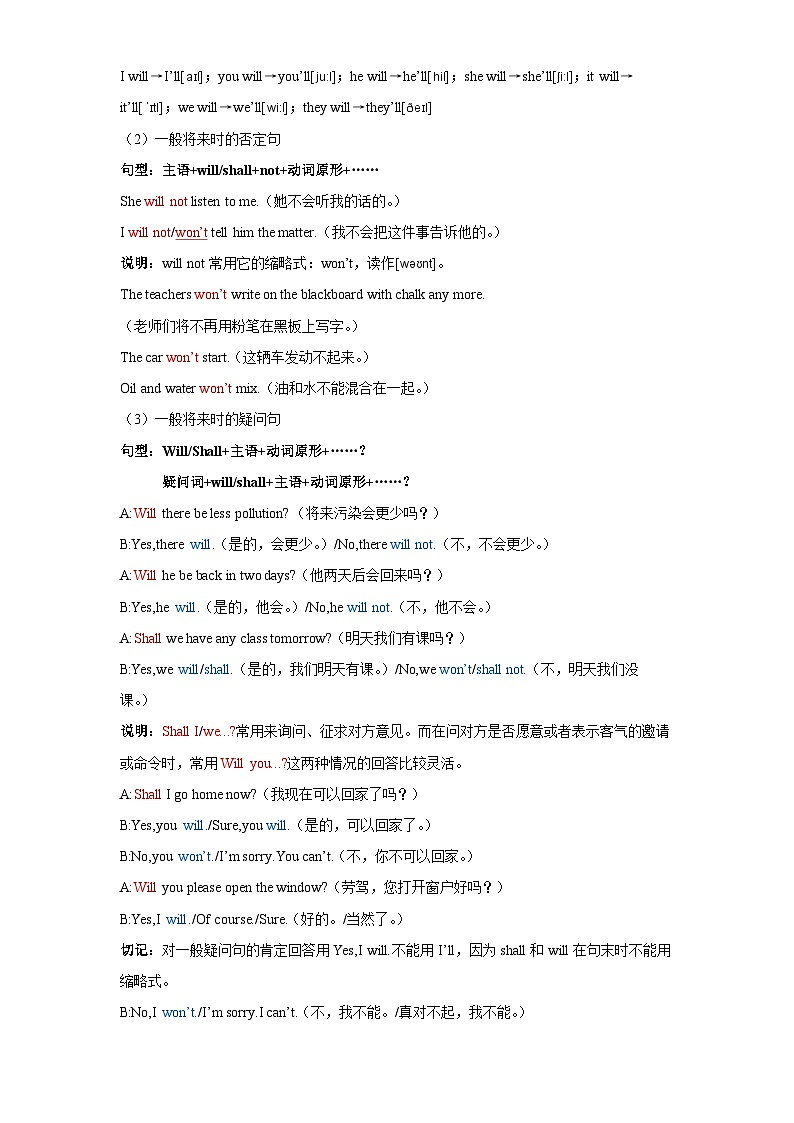
第14章 动词的将来时
动词的将来时包括一般将来时和过去将来时。一般将来时表示将来某个时间要发生的动作或存在的状态,也表示将来经常或重复发生的动作,常与表示将来的时间状语连用,如:tmrrw,next year,sn等。过去将来时表示对过去某一时间而言将要发生的动作或存在的状态。
我们已经学习过一般现在时,它表示目前(现在)习惯或经常性的动作;以现在为基准,叙述过去某时的事情,用过去时;以现在为基准,叙述将来的事情,用将来时。
典型例句:1.I’m ging t study tmrrw.(我打算明天学习。)
典型例句:2.I will/shall study tmrrw.(我明天将要学习。)
典型例句:3.I didn’t knw they were ging t live abrad.(我不知道他们打算在国外生活。)
典型例句:4.I didn’t knw they wuld live abrad.(我不知道他们将要在国外生活。)
1.一般将来时
一般将来时由“助动词will/shall+动词原形”构成,表示将来某个时间要发生的动作或存在的状态,也表示将来经常或者反复发生的动作。一般将来时常与表示将来的时间状语连用,如:tmrrw,next year,in the future等。
1.一般将来时的构成
用助动词will/shall表示的一般将来时,本身没有人称和数的变化。在书面语中,主语是第一人称(I或we)时,常用助动词shall;在口语中,所有的人称都可以用will。如果在疑问句中,主语是第一人称(I或we)时,常用助动词shall。
(1)一般将来时的肯定句
句型:主语+will/shall+动词原形+……
I will/shall arrive in New Yrk tmrrw mrning.(我明天早上到达纽约。)
I will call yu this evening.(今天晚上我会给你打电话。)
We will cme t see yu next week.(下周我们会来看你。)
Yu will carry ut these instructins and reprt back this afternn.
(你要执行这些指示并于今天下午报告执行情况。)
I think it’ll be htter in Beijing next summer.(我想明年夏天北京会更热。)
There will be a cmputer n every student’s desk in the future.
(将来,每位同学的桌子上都会有一台电脑。)
补充:主语+will常用缩略式
I will→I’ll[aɪl];yu will→yu’ll[juːl];he will→he’ll[hil];she will→she’ll[ʃiːl];it will→it’ll[ˈɪtl];we will→we’ll[wi:l];they will→they’ll[ðeɪl]
(2)一般将来时的否定句
句型:主语+will/shall+nt+动词原形+……
She will nt listen t me.(她不会听我的话的。)
I will nt/wn’t tell him the matter.(我不会把这件事告诉他的。)
说明:will nt常用它的缩略式:wn’t,读作[wəʊnt]。
The teachers wn’t write n the blackbard with chalk any mre.
(老师们将不再用粉笔在黑板上写字。)
The car wn’t start.(这辆车发动不起来。)
Oil and water wn’t mix.(油和水不能混合在一起。)
(3)一般将来时的疑问句
句型:Will/Shall+主语+动词原形+……?
疑问词+will/shall+主语+动词原形+……?
A:Will there be less pllutin?(将来污染会更少吗?)
B:Yes,there will.(是的,会更少。)/N,there will nt.(不,不会更少。)
A:Will he be back in tw days?(他两天后会回来吗?)
B:Yes,he will.(是的,他会。)/N,he will nt.(不,他不会。)
A:Shall we have any class tmrrw?(明天我们有课吗?)
B:Yes,we will/shall.(是的,我们明天有课。)/N,we wn’t/shall nt.(不,明天我们没课。)
说明:Shall 常用来询问、征求对方意见。而在问对方是否愿意或者表示客气的邀请或命令时,常用Will 这两种情况的回答比较灵活。
A:Shall I g hme nw?(我现在可以回家了吗?)
B:Yes,yu will./Sure,yu will.(是的,可以回家了。)
B:N,yu wn’t./I’m srry.Yu can’t.(不,你不可以回家。)
A:Will yu please pen the windw?(劳驾,您打开窗户好吗?)
B:Yes,I will./Of curse./Sure.(好的。/当然了。)
切记:对一般疑问句的肯定回答用Yes,I will.不能用I’ll,因为shall和will在句末时不能用缩略式。
B:N,I wn’t./I’m srry.I can’t.(不,我不能。/真对不起,我不能。)
A:When will Mike arrive here tmrrw?(迈克明天什么时候到这儿?)
B:He will arrive here at three ’clck.(他明天3点钟到这儿。)
(简略回答:At three ’clck.3点)
A:Hw many bks will they give us?(他们会给我们多少本书呢?)
B:They will give us thirty bks.(他们会给我们30本书。)
(简略回答:Thirty bks.30本)
必背:和一般将来时连用的时间状语
2.一般将来时的基本用法
(1)表示将来的动作或状态
My mther will spend her hliday in Shanghai in August.(8月份我妈妈将去上海度假。)
In the future,there’ll be a new schl.(将来这儿要建一所新学校。)
(2)用在一些主从复合句中
一般将来时在一些主从复合句的主句中表示将来的动作或状态。
We’ll have a picnic if it desn’t rain tmrrw.(明天如果不下雨我们就去野餐。)
Dick will pass the exam if he studies harder.(如果迪克再努力些,他就会及格的。)
I’ll send a message t yu as sn as/when I get there.(我一到那儿就会给你发信息。)
We’ll help him if he asks us.(如果他请求我们的话,我们愿意帮他。)
注意:在复合句中,尤其要注意在时间状语从句和条件状语从句中的时态搭配,主句用一般将来时表示将来的动作和状态,从句则要用一般将来时,有时可用现在完成时表示。
I’ll write a cmpsitin abut the play after/when/as sn as I have seen it.
(看完了这个剧本后,我将写一篇关于它的文章。)
2.过去将来时
过去将来时由“助动词wuld/shuld+动词原形”构成,表示从过去的某一时间来看将来要发生的动作或存在的状态。过去将来时常用于宾语从句和间接引语中。
1.过去将来时的构成
过去将来时的构成和一般将来时的构成一样,只要把助动词will,shall变为过去式即可。
(1)过去将来时的肯定句
句型:主语+wuld/shuld+动词原形+……
She was sixty-six.After three years she wuld be sixty-nine.(她66岁了。3年后,她将69岁。)
He asked me if I wuld g abrad.(他问我是否会出国。)
I didn’t knw if he wuld cme.=I didn’t knw whether he wuld cme.(我不知道他是否会来。)
(2)过去将来时的否定句
句型:主语+wuld/shuld+nt+动词原形+……
She tld us that she wuld nt g with us if it rained.
(她告诉我们,如果下雨,她就不和我们一起去了。)
There were sme signs that Betty wuld nt g t that party.
(有些迹象表明贝蒂不会去参加那个聚会。)
(3)过去将来时的疑问句
句型:Wuld/Shuld+主语+动词原形+……?
疑问词+wuld/shuld+主语+动词原形+……?
Wuld I dine with him?I thught abut it befre.
(是否跟他一起吃饭呢?我之前考虑过这个问题。)
I didn’t knw hw t d it.What wuld be their ideas?
(我不知如何去做。他们会有什么想法呢?)
2.过去将来时的基本用法
(1)表示过去习惯性的动作或状态
Whenever he had time,he wuld d sme reading.(他一有时间,总是看书。)
This dr wuldn’t pen.(这扇门老是打不开。)
I wuld play with him when I was a child.(当我还是孩童时,总是和他一起玩。)
说明:当表示过去习惯性的动作或状态时,不管什么人称,一律用wuld。
(2)用于间接引语及宾语从句中
He said he wuld wrk fr that bss the next year.(他说下一年他打算为那个老板工作了。)
I thught he wuld accept the invitatin.But he refused it.
(我原以为他会接受邀请,但他拒绝了。)
He didn’t expect that we shuld/wuld all be there.(他没想到我们都在那里。)
3.其他表示将来的结构
(1)be ging t+动词原形+……
对于将要发生的事情,或打算、计划、决定要做的事情,皆可以用“be ging t+动词原形+……”句型来表示。
A.肯定句
句型:主语+be ging t+动词原形+……
重要:be ging t后面的动词一定要用原形。
He is ging t travel arund the wrld.(他计划周游世界。)
They’re ging t have a picnic this weekend.(他们这个周末要去野餐。)
He said he was ging t teach in Beijing next year.(他说明年他将要在北京任教。)
They said they were ging t start ff at nce.(他们说他们将立即出发。)
补充:I’m ging t...;He’s ging t...;We’re ging t...;They’re ging t...
B.否定句
句型:主语+be nt ging t+动词原形+……
此句型含有be动词,所以它的否定句与一般含有be动词的句型相同,只要在be动词后面加上nt即可,其余保持不变。
I’m nt ging t be a teacher.(我不打算当老师。)
It’s nt ging t rain this afternn.(今天下午没有雨。)
We’re nt ging t have any class next week.(下周我们不上课。)
C.一般疑问句
句型:Be+主语+ging t+动词原形+……?
此句型中有be动词,所以它的一般疑问句的构成法也和含有be动词的句型相同,只要把be动词放在句首,就使其成为一般疑问句了。
A:Are yu ging t be a dctr when yu grw up?(你长大了,打算当一名医生吗?)
B:Yes,I am.(是的,我想。)/N,I’m nt.(不,我不想。)
A:Is yur sister ging t bring yu lunch?(你姐姐打算给你带午饭来吗?)
B:Yes,she is.(是的,她会的。)/N,she isn’t.(不,她不会。)
说明:回答be ging t构成的一般疑问句时,只需简略回答如下:
肯定:Yes,主语+be./否定:N,主语+be nt.
D.特殊疑问句
句型:疑问词+be+主语+ging t+动词原形+……?
Where is she ging t have her birthday party?(她打算在哪儿举办生日聚会?)
Hw are they ging t spend their hlidays?(假期他们准备怎么过?)
A:What are yu ging t d next Sunday?(下个星期天你打算做什么?)
B:I’m ging t g fishing.(我打算去钓鱼。)
A:Wh is ging t Hng Kng fr a hliday?(谁打算去香港度假?)
B:I’m ging t Hng Kng fr a hliday.(我打算去香港度假。)(简略回答:I am.)
A:When is she ging t buy a new huse?(她准备什么时候买新房子?)
B:She is ging t buy a new huse in September.(她计划9月份买新房。)
(简略回答:In September.)
比较:wh问句和when问句的区别
wh问句和when问句都是特殊疑问句,但结构不同。
wh问句用疑问词wh对主语进行提问,所以wh就是这个句子的主语,后面不可能再出现主语。
when问句是用疑问词when对句子中的时间状语提问,所以when后面的句子中一定有主语。
E.be ging t和will/shall的区别
对初中阶段来讲,“be ging t+动词原形”和“will/shall+动词原形”一般可以互换使用。但在现代英语中,特别是在口语中,表将来时多用“be ging t+动词原形”这一形式。它们的主要区别在于:“be ging t+动词原形”表示主观上打算、计划或意图;而“will/shall+动词原形”则表示未经事先考虑的意图。但是如果不清楚是否是事先考虑的意图时,两者都可以用。
There is smebdy at the dr.I’ll g and pen it.(门口有人,我去开门。)
(I’ll g and pen it.去开门显然是未经事先考虑的意图,在此,不宜说I’m ging t pen it.)
Mike:I’m srry.I frgt t mail the letter fr yu.(迈克:真对不起,我忘了替你寄信了。)
Tm:Never mind.I’ll mail it tmrrw.(汤姆:没关系。明天我去寄。)
(显然,汤姆说明天我去寄这封信时不能用be ging t mail...,因为这不是事先计划好的)
He is ging t change his jb.(他打算换工作。)
(换工作是事先考虑好的,所以用be ging t)
I wn’t/am nt ging t tell yu my age.(我不会/不准备告诉你我的年龄。)
补充:在有些情况下,will和be ging t句型可以互相转换。此时要注意be动词的变化。
She will visit there next week.→She is ging t visit there next week.(她下周要去那儿参观。)
(2)be t (d)表示将来
当表示安排、计划在近期将发生的事情,或者表示过去曾经计划要做的事时,用be t (d)结构。
There is t be an exhibitin next mnth here.(这儿下个月将有个展览。)
She is t be here at 10:00 a.m. tmrrw.(她将于明天上午10点抵达这里。)
(3)be abut t (d)表示将来
表达事情或动作马上、很快就要发生时,用be abut t (d)结构,一般不用时间状语,但有时也可与when连用。
The bell is abut t ring.(马上就要响铃了。)
Their daughter is abut t get married.(他们的女儿很快将要结婚了。)
We were abut t g t a mvie when Mnica appeared.
(我们正要去看电影,这时莫妮卡来了。)
(4)一般现在时/一般过去时表示将来
按时刻表将要发生的动作或事件往往用一般现在时来代替一般将来时,如:火车发车、到站或飞机起飞、降落等。条件状语从句和时间状语从句中须用一般过去时代替过去将来时。
The plane takes ff at ne ’clck this afternn.(飞机下午1点起飞。)
I didn’t knw when Jerry wuld cme,but when he came I wuld let yu knw.
(我不知道杰瑞什么时候来,但他来了我会告诉你。)
(5)现在进行时/过去进行时表示将来
有些词如g(去),cme(来),leave(离开),start(开始)用现在进行时或者过去进行时表示将来。
When is she cming?(她什么时候来呀?)
I’m leaving tmrrw.(明天我要走了。)
She tld me she was cming t see me.(她告诉我她要来看我。)
Cmmn Mistakes(注意!失分陷阱!)
陷阱例题①
A:Yu’ve left the light n,Tracy.
B:Oh,yes.__________ t turn if ff right nw.【宜昌中考】
句意提示:A:特蕾西,你没有关灯。B:哦,对。我马上去关。
陷阱追击:本题考查根据情景判断时态。如忽视上下文语境所传达的信息,则容易误选。
正确解析:一般将来时常与表示将来的时间状语连用。由答语中所用“right nw”可知正确答案为C。
陷阱例题②
A:I wnder if it __________ tmrrw.
B:Dn’t wrry,if it __________,we’ll stay at hme.【黄冈中考】
句意提示:A:我想知道明天是否下雨。B:别担心,要是下雨,我们就呆在家里。
陷阱追击:由if引导的宾语从句和由if引导的条件状语从句的时态不同,容易误选。
正确解析:第一个句子中由if引导的宾语从句用一般将来时;第二个句子中主句用一般将来时,由if引导的条件状语从句用一般现在时表示将来的情况、动作。正确答案为B。
陷阱例题③
There __________ a ftball game between Italy and Germany tmrrw mrning.【武汉中考】
句意提示:明天上午将有一场意大利对德国的足球赛。
陷阱追击:There is ging t be与There will be这两个句型结构都表示将来。容易受“There will be”句型结构的影响而误选C。
正确解析:对于将要发生的事,或打算、计划、决定要做的事情,用“be ging t+动词原形+……”的句型来表示。正确答案为B。
陷阱例题④
Jane says that she __________ t Beijing next week.【荆州中考】
句意提示:简说她下周要去北京。
陷阱追击:本题考查时态。如忽视了题干中的时间状语“next week”,则容易误选。
正确解析:一般将来时表示将来某个时间要发生的动作或存在的状态。正确答案为B。
Final Check(实力测验)
1.用括号中动词的适当形式填空
1.Befre lng,he __________ (frget) all abut the matter.
2.He __________ (be) back in three hurs.
3.Lk at these cluds.It __________ (rain).
4.They __________ (make) prgress sn.
5.If he isn’t free tmrrw,he __________ (nt take) part in the party.
6.He said if he had time,he __________ (g) t the cinema that night.
7.We wn’t g until yu __________ (cme) sn.
8.A:I dn’t knw if his uncle __________ (cme).
B:I think he __________ (cme) if it desn’t rain.
9.We __________ (send) fr a dctr if yu __________ (be) nt better in the evening.
10.She said she __________ (have) a cncert the next year.
2.选择填空
1.A:Dad,can yu sew n a buttn fr me?
B:I can’t sew.Ask mum.She __________ it fr yu.
2.I think ur teacher __________.
3.A:I’ve lst my passprt. B:Take it easy.I __________ yu lk fr it.
4.A:__________ we g shpping tnight?
B:That sunds a bit bring.Hw abut seeing a film?
5.If yu g there by taxi,it __________ much faster.
6.I have an appintment with my dentist.I __________ t see him this afternn.
7.A:Yu have left the TV n. B:Oh,srry,I __________ and turn it ff.
8.A:Isn’t Jim back yet? B:N,but I think he __________ in half an hur.
3.汉译英
1.明天,我们学校将有场足球赛,我准备去看。
_______________________________________________________________________________
2.我们打算和李明一起复习功课。
_______________________________________________________________________________
3.将来的计算机会是什么样的呢?(be like)
_______________________________________________________________________________
4.李明正在妈妈的帮助下做饭。今天晚上他要把做好的饭带到晚会上去。
_______________________________________________________________________________
5.A:您路过邮局时,帮我把这封信寄了,好吗?
B:好吧,如果我到邮局,我会把信寄出的。
_______________________________________________________________________________
_______________________________________________________________________________
4.英译汉
1.A:What time des yur plane leave tmrrw?
B:Ten ’clck in the mrning.And it arrives in Lndn at five in the afternn.
_______________________________________________________________________________
_______________________________________________________________________________
2.I shuld say gdbye t my uncle.He is abut t leave.
_______________________________________________________________________________
3.Tday is Sunday.Tmrrw is Mnday.
_______________________________________________________________________________
4.I dn’t think he is leaving fr Shanghai next week,is he?
_______________________________________________________________________________
5.The ftball match will be put ff if it rains tmrrw.
_______________________________________________________________________________
6.The sun will rise at five thirty tmrrw mrning,s we’ll get there at five.
_______________________________________________________________________________
7.I dn’t knw when he will cme.As sn as he cmes,I will tell yu.
_______________________________________________________________________________
8.A:Please turn the radi a little dwn.It makes a lt f nise. B:OK.I’ll turn it dwn.
_______________________________________________________________________________
9.A:D yu have any plans fr tmrrw? B:Yes,I’m ging t see a film with my sister.
_______________________________________________________________________________
10.He decided that he wuld spend his hliday the next mnth.
_______________________________________________________________________________
5.改错
1.I dn’t want a cup f tea.I think I am ging t have a cup f cffee.
_______________________________________________________________________________
2.It’s a lvely day.Are we ging fr a walk?
_______________________________________________________________________________
3.I left my ntebk in the ffice.Are yu ging t take it back?
_______________________________________________________________________________
4.If it will be a fine day tmrrw,the children will ride bikes t the Summer Palace.
_______________________________________________________________________________
5.She tld me that she wuld take the final exam next mnth.
_______________________________________________________________________________
6.Shall they swim in the river when the weather changes?
_______________________________________________________________________________
7.There will be drinks at the receptin,but there is nt ging t be any fd.
_______________________________________________________________________________
8.I’m thirsty.I think I have smething t drink.
_______________________________________________________________________________
9.I knw yu are taking a bus at ten.What time is it getting t Lndn?
_______________________________________________________________________________
10.The writer said that if he had time he was abut t translate the bk int Chinese.
_______________________________________________________________________________
KEYS:
1.
2.
3.
1.Tmrrw there will be/is ging t be a ftball match in ur schl.I’m ging t watch it.
2.We are ging t g ver the lessns with Li Ming.
3.What will the cmputer be like in the future?
4.Nw with his mther’s help,Li Ming is cking.He’ll take the fd t the party this evening.
5.A:Will yu please mail the letter fr me when yu pass the pst ffice?
B:OK.If I g there,I’ll pst it.
4.
1.A:你乘坐的飞机明天几点钟起飞?B:早上10点钟。下午5点钟到达伦敦。
2.我该和我的叔叔告别了,他要走了。
3.今天是星期日,明天是星期一。
4.我认为他下周不会去上海,对吗?
5.如果明天下雨,足球赛将延期举行。
6.太阳将在明天早上五点半升起,因此我们将在5点钟到达那里。
7.我不知道他什么时候来。他一来我就会告诉你。
8.A:请把收音机音量调小些,它噪音很大。B:好的,我会关小些的。
9.A:你明天有什么计划吗?B:是的,我要和我姐姐去看电影。
10.他决定下个月去度假。
5.
1.am ging t→will(解说:will和be ging t都属于将来时态,但含义有所不同。be ging t表示的是说话人的打算或想法。句子开头已经有了I think,再说I am ging t就显得累赘了。)
2.Are we ging→Shall we g(解说:这道题的后一句话显然是说话人的一个提议,应该用Shall we...句式。)
3.Are yu ging t→Will yu(解说:这道题的后一句话是说话人的请求,也不可以用be ging t。)
4.it will be→it is(解说:这是一个表示将要做某事的主从复合句,其中的时间状语从句需用现在时表示将来,即所谓的“主将从现”。)
5.next mnth→the next mnth(解说:这道题中的宾语从句是过去将来时,这里的“下个月”指的是从那时算起的下个月,而不是从现在算起的下个月。)
6.Shall→Will(解说:一般将来时的shall只与第一人称I,we连用。)
7.is nt ging t→will nt(解说:在这里只是客观叙述将来的情况,不宜使用be ging t。)
8.I have→I will have(解说:用将来时表示将要发生的动作或要做的事情。)
9.is it getting→des it get(解说:这道题的前一句是用现在进行时表示计划好要做的事情,而后一句询问公共汽车的运行时刻,这是规定好的常规,应该用一般现在时。)
10.was abut t→was ging t(解说:这儿应该用过去将来时,表示主观上打算、计划做某事。be abut t d...的意思是“正要做某事……”。)
【课后作业】
一、用所给动词的一般将来时填空
1. I ______(leave)in a minute. I ______(finish)all my wrk befre I ______ (leave).
2. —Hw lng _____ yu _____(study)in ur cuntry?
—I _____(plan)t be here fr abut ne mre year.
—I _____(hpe)t visit the ther parts f yur cuntry.
—What ______ yu ______(d)after yu ______(leave)here?
—I ______(return)hme and ______(get)a jb.
3. I ______(be)tired. I ______(g)t bed early tnight.
4. Mary’s birthday is next Mnday, her mther _____(give)her a present.
5. It is very cld these days. It ______(snw)sn.
6. —_____ yu _____(be)here this Saturday?
—N. I ______(visit)my teacher.
7. —______ I ______(get)yu a cpy f tday’s newspaper?
—Thank yu.
8. I am afraid there ______(be)a meeting this afternn. I can’t jin yu.
9. Mike ______(believe, nt)this until he ______(see)it with his wn eyes.
10. Mst f us dn’t think their team ______(win).
二、单项选择
1. There __________ a meeting tmrrw afternn.
A. will be ging t B. will ging t be C. is ging t be D. will g t be
2. Charlie ________ here next mnth.
A. isn’t wrking B. desn’t wrking C. isn’t ging t wrking D. wn’t wrk
3. He ________ very busy this week, he ________ free next week.
A. will be; is B. is; is C. will be; will be D. is; will be
4. There ________ a dlphin shw in the z tmrrw evening.
A. was B. is ging t have C. will have D. is ging t be
5. –________ yu ________ free tmrrw?
– N. I ________ free the day after tmrrw.
A. Are; ging t; will B. Are; ging t be; will C. Are; ging t; will be D. Are; ging t be; will be
6. Mther ________ me a nice present n my next birthday.
A. will gives B. will give C. gives D. give
7. – Shall I buy a cup f tea fr yu?
–________. (不,不要。)
A. N, yu wn’t B. N, yu aren’t. C. N, please dn’t D. N, please.
8. – Where is the mrning paper?
– I ________ if fr yu at nce.
A. get B. am getting C. t get D. will get
9. ________ a cncert next Saturday?
A. There will be B. Will there be C. There can be D. There are
10. If they cme, we ________ a meeting.
A. have B. will have C. had D. wuld have
11. He ________ her a beautiful hat n her next birthday.
A. gives B. gave C. will giving D. is ging t giving
12. He ________ t us as sn as he gets there.
A. writes B. has written C. will write D. wrte
13. He ________ in three days.
A. cming back B. came back C. will cme back D. is ging t cming back
14. If it ________ tmrrw, we’ll g rller-skating.
A. isn’t rain B. wn’t rain C. desn’t rain D. desn’t fine
15. – Will his parents g t see the Terra Ctta Warrirs tmrrw?
– N, ________ (不去).
A. they willn’t B. they wn’t. C. they aren’t D. they dn’t.
16. Wh ________ we ________ swimming with tmrrw afternn?
A. will; g B. d; g C. will; ging D. shall; g
17. We ________ the wrk this way next time.
A. d B. will d C. ging t d D. will ding
18. Tmrrw he ________ a kite in the pen air first, and then ________ bating in the park.
A. will fly; will g B. will fly; ges C. is ging t fly; will ges D. flies; will g
19. The day after tmrrw they ________ a vlleyball match.
A. will watching B. watches C. is watching D. is ging t watch
20. There ________ a birthday party this Sunday.
A. shall be B. will be C. shall ging t be D. will ging t be
21. They ________ an English evening next Sunday.
A. are having B. are ging t have C. will having D. is ging t have
22. ________ yu ________ free next Sunday?
A. Will; are B. Will; be C. D; be D. Are; be
23. He ________ there at ten tmrrw mrning.
A. will B. is C. will be D. be
24. ________ yur brther ________ a magazine frm the library?
A. Are; ging t brrw B. Is; ging t brrw C. Will; brrws D. Are; ging t brrws
25. – Shall I cme again tmrrw afternn?
–________ (好的).
A. Yes, please B. Yes, yu will. C. N, please D. N, yu wn’t.
26. It ________ the year f the hrse next year.
A. is ging t be B. is ging t C. will be D. will is
27. ________ pen the windw?
A. Will yu please B. Please will yu C. Yu please D. D yu
28. – Let’s g ut t play ftball, shall we?
– OK. I ________.
A. will cming B. be ging t cme C. cme D. am cming
29. It ________ us a lng time t learn English well.
A. takes B. will take C. spends D. will spend
30. The train ________ at 11.
A. ging t arrive B. will be arrive C. is ging t D. is arriving
三、把下列各句译成英语
1.我叔叔今晚要来。
2.他没有打算住那座小屋。
3.我们要读这本书。
4.—你爸爸要去钓鱼吗?—不,他要去游泳。
参考答案:
一、1. am leaving ; will finish ; leave 2. will ; study ; plan ; hpe ; will ; d ; leave ; will return ; get
3. am ; will 4. will give 5. will snw 6. Will, be ; will visit 7. Shall ; get
8. will be 9. wn’t believe ; sees 10. will win
二、1. C 2. D 3. D 4. D 5. D 6. B 7. C 8. D
9. B 10. B 11. D 12. C 13. C 14. C 15. B 16. D
17. B 18. A 19. D 20. B 21. B 22. B 23. C 24. B
25. A 26. A 27. A 28. D 29. B 30. D
三、1.My uncle will cme tnight.
2.He isn't ging t live in the small huse.
3.We are ging t read this bk.
4.—Will yur father g fishing?—N,he is ging swimming.
初中语法讲义
将来时
年 月 日
sn很快
tmrrw明天
the day after tmrrw后天
this afternn
今天下午
this evening
今天晚上
this year
今年
befre lng
不久,很快
in the (near) future
在(不久)的将来
in tw weeks/days
两周/天以后
sme day
将来的某一天
next week/mnth/year/summer
下一周/下个月/明年/明年夏天
A.I’d t
B.I’ve gne
C.I’ll g
D.I g
A.rains;rains
B.will rain;rains
C.rains;will rain
D.will rain;will rain
A.has
B.is ging t be
C.will have
D.has been
A.has gne
B.will g
C.ges
D.g
A.is ging t d
B.will d
C.shall d
D.sews
A.is late
B.is ging t be late
C.will be late
D.be late
A.help
B.am ging t help
C.will help
D.am abut t help
A.Will
B.D
C.What abut
D.Shall
A.is
B.is ging t be
C.shall be
D.will be
A.will
B.shall
C.wuld
D.am
A.have gne
B.g
C.went
D.will g
A.returned
B.will return
C.has returned
D.returns
1.will frget
2.will be
3.is ging t rain
4.will make
5.wn’t take
6.wuld g
7.cme
8.will cme,will cme
9.will send,are
10.wuld have
1.B
2.C
3.C
4.D
5.D
6.D
7.D
8.B
这是一份26年英语中考复习专题第14讲 将来时(教师版带答案)练习,共18页。
这是一份26年英语中考复习专题第14讲 将来时(学生版不带答案)练习,共16页。
这是一份26年英语中考复习专题第13讲 进行时(教师版带答案)练习,共19页。试卷主要包含了进行时的特殊疑问句,进行时的基本用法,不用于进行时的动词,Let’s g ut等内容,欢迎下载使用。
注册成功
资料篮

在线客服
添加在线客服
获取1对1服务
官方微信
关注“教习网”公众号
打开微信就能找资料
赛课定制
添加在线客服
获取1对1定制服务
职称咨询
添加在线客服
获取1V1专业指导服务

免费福利

.png)
.png)
.png)
