免费领取教师福利


若您为此资料的原创作者,认为该资料内容侵犯了您的知识产权,请扫码添加我们的相关工作人员,我们尽可能的保护您的合法权益。

这是一份初中英语人教版(2024)七年级上册(2024)Unit 1 You and Me Section A教学设计,共7页。
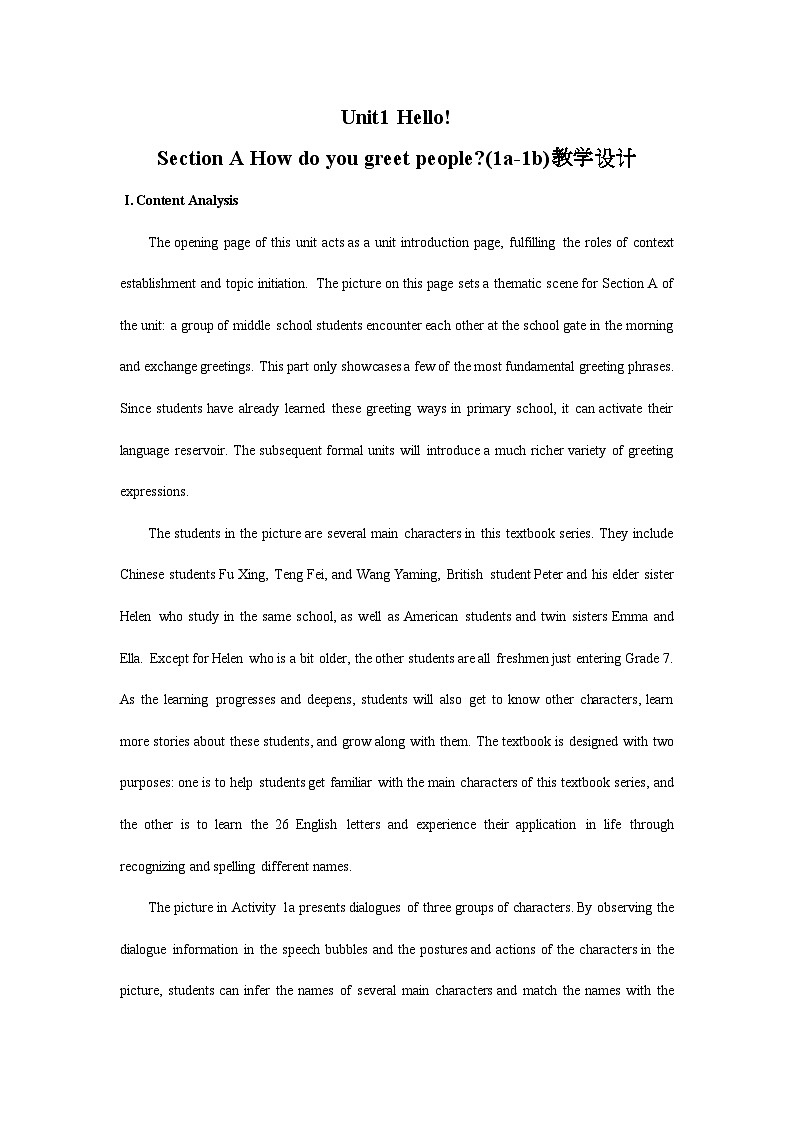
I. Cntent Analysis
The pening page f this unit acts as a unit intrductin page, fulfilling the rles f cntext establishment and tpic initiatin. The picture n this page sets a thematic scene fr Sectin A f the unit: a grup f middle schl students encunter each ther at the schl gate in the mrning and exchange greetings. This part nly shwcases a few f the mst fundamental greeting phrases. Since students have already learned these greeting ways in primary schl, it can activate their language reservir. The subsequent frmal units will intrduce a much richer variety f greeting expressins.
The students in the picture are several main characters in this textbk series. They include Chinese students Fu Xing, Teng Fei, and Wang Yaming, British student Peter and his elder sister Helen wh study in the same schl, as well as American students and twin sisters Emma and Ella. Except fr Helen wh is a bit lder, the ther students are all freshmen just entering Grade 7. As the learning prgresses and deepens, students will als get t knw ther characters, learn mre stries abut these students, and grw alng with them. The textbk is designed with tw purpses: ne is t help students get familiar with the main characters f this textbk series, and the ther is t learn the 26 English letters and experience their applicatin in life thrugh recgnizing and spelling different names.
The picture in Activity 1a presents dialgues f three grups f characters. By bserving the dialgue infrmatin in the speech bubbles and the pstures and actins f the characters in the picture, students can infer the names f several main characters and match the names with the character prtraits. This activity nt nly fcuses n cultivating students' literal reading ability but als trains their ability t btain nn-textual infrmatin frm pictures (Viewing). In additin t presenting the images and names f the main characters, Activity 1a als shws key greeting sentence patterns such as "Hell! / Hi!" and "Gd mrning!", which mainly lay a linguistic fundatin fr the subsequent listening activities. Activity 1b is a language imitatin and utput activity, requiring students t use the greeting expressins in Activity 1a t have cnversatins with their partners, cnslidate the learned language, and enhance their understanding with classmates.
II. Learning Objectives
1. Be able t crrectly read and write the names f these main characters: Teng Fei, Fu Xing, Yaming, Emma, Ella, Peter, and Helen.
2. Be able t identify the image features f the main characters in this bk by bserving pictures.
3. Be able t prficiently use expressins like "Hell", "Hi", and "Gd mrning" t greet thers r respnd t thers' greetings.
4. Be able t understand the cntext f greeting scenaris and apply apprpriate greeting languages in different situatins.
5. Be able t develp the ability t btain infrmatin frm pictures and texts cmprehensively.
III. Teaching Suggestins
1. Ice - breaking Activity
As the first English class fr new students, teachers can achieve ice - breaking thrugh simple and easy - t - understand self - intrductins. Fr example, the teacher can say: "Hell, bys and girls! Nice t meet yu all. My name is [Teacher's Name]. I'm yur English teacher. I lve English very much. I ften watch English mvies and listen t English sngs in my spare time. What abut yu? D yu like English? What's yur hbby?"
Teachers can als narrw the distance with students thrugh vivid self - display with pictures and texts. Fr instance, the teacher can shw sme pictures f themselves using English in daily life, such as reading an English bk, traveling in an English - speaking cuntry, etc., and say: "Lk at these pictures. This is me reading an English strybk. English is very useful and interesting. I hpe we can have a great time learning English tgether." In this way, a natural and harmnius English learning envirnment can be created.
2. Picture Cmprehensin
(1) Tpic Intrductin
Teachers can shw pictures f the schl, such as the schl building, classrm, playgrund, etc., and guide students t say wrds like "schl", "schl gate", "classrm", "student" thrugh questins. Fr example:
- "What's this? Yes, it's a schl. Can yu spell 'schl'? S - C - H - O - O - L, schl."
- "Where d we enter the schl? That's right, the schl gate. 'Schl gate', spell it, please. S - C - H - O - O - L, space, G - A - T - E, schl gate."
- "What's in the schl? There are classrms. 'Classrm', C - L - A - S - S - R - O - O - M, classrm."
- "Wh are in the schl? Students. 'Student', S - T - U - D - E - N - T, student."
After naturally intrducing these wrds, teachers guide students t pay attentin t the scene shwn in the 1a picture, that is, the situatin where students meet at the schl gate in the mrning and exchange greetings. Teachers can ask mre detailed questins:
- "What time f the day d yu think it is in the picture? Why?" Students might answer: "It's mrning because the sun is shining, and the students lk like they are ging t schl."
- "Hw d yu think the students feel when they meet each ther?" Students may say: "They feel happy because they are greeting each ther with smiles."
(2) Cmpleting the 1a Matching Task
Teachers guide students t carefully bserve the three grups f characters in the 1a picture. First, let students describe the characters' appearances, such as: "This by is tall." "That girl has lng hair." Then, read the three grups f dialgues alud tgether with students. Teachers can write the dialgues n the blackbard while reading:
- Grup 1: "Hell!" "Hell!"
- Grup 2: "Hi!" "Hi!"
- Grup 3: "Gd mrning!" "Gd mrning!"
Then, ask students t circle the seven names in the dialgues. After that, guide students t distinguish male and female names accrding t the details in the picture and the cntent f the dialgues. Fr example, "Peter" and "Teng Fei" are male names, "Emma" and "Ella" are female names. After students cmplete the matching task independently, the whle class checks the answers. Teachers can use a prjectr t shw the crrect matching results and explain: "Lk, this is Fu Xing. He is matching with this dialgue."
Teachers can als remind students t pay attentin t the spelling, capitalizatin and spaces f the characters' names. Fr example, "Wang Yaming" has a space between "Wang" and "Yaming", and the first letter f each part f the name is capitalized. Then, guide students t bserve the appearances f Ella and Emma. Ask: "Lk at Ella and Emma. What d they lk like? D they lk the same? S what's their relatinship?" Students may guess: "They are twins."
(3) Familiarizing with the Prnunciatin f Characters' Names
Teachers read the names f the seven characters alud slwly, emphasizing the prnunciatin f each syllable. Fr example:
- "Teng Fei, T - e - n - g, Teng; F - e - i, Fei. Teng Fei."
- "Fu Xing, F - u, Fu; X - i - n - g, Xing. Fu Xing."
Then, teachers can display the character prtraits ne by ne using PPT r cards and let students say the characters' names by raising their hands. T make it mre interesting, teachers can play a game: "Name Bing". Divide students int grups, and when the teacher shws a character prtrait, the first student in each grup t say the crrect name gets a pint. The grup with the mst pints at the end wins a small prize, such as a sticker r a bkmark.
3. Oral Expressin
(1) Fcusing n Greeting Expressins
Teachers guide students t first read the instructins f 1b. Explain the meaning f "greet" by using bdy language, such as waving hands and saying "Hell" t a student. Then let students find the greeting expressins f the three grups f characters in the picture (Hi! / Hell! / Gd mrning!). Write these expressins n the blackbard:
- "Hell!"
- "Hi!"
- "Gd mrning!"
Teachers present the greeting expressins f 1b with curseware, shwing different scenaris where these greetings can be used, such as meeting a friend in the mrning at schl (use "Gd mrning!"), meeting a classmate in the crridr (use "Hell!" r "Hi!"). Then let students read the guiding questin in this part "Hw d yu greet peple?" and explain that the main cntent f Sectin A is t learn t greet peple in different situatins.
(2) Reading Practice
Teachers invite a student t demnstrate reading the dialgue in 1a with themselves. Pay attentin t reminding students t experience the expressins and tnes when greeting. Fr example, when saying "Gd mrning!", use a cheerful tne. Then students practice reading the dialgue in 1a in pairs r grups f three. Walk arund the classrm t listen t students' reading and prvide timely guidance, such as crrecting prnunciatin errrs.
(3) Rle - playing
Teachers invite several grups f students t perfrm the situatinal dialgue in the 1a picture. Befre each perfrmance, let the grup members prepare briefly. After the perfrmance, give apprpriate cmments. Fr example:
- "Yur grup did a great jb! Yu spke clearly and yur greetings were very natural."
- "Try t use a luder vice next time s that everyne can hear yu better."
(4) Greeting Classmates
Teachers ask all students t stand up and allw them t mve freely in the classrm and greet their classmates using the learned greeting expressins. T make this activity mre rganized, teachers can set a time limit, such as 5 minutes. During this activity, walk arund the classrm t encurage students: "Dn't be shy! Just say 'Hell' t yur classmates." "Great! Yu greeted yur friend crrectly."
Teaching Tip
Teachers can ask students t make cards with their names (bth Chinese and English if they have) n clred paper befre class and put them n the desks. Encurage students t greet each ther with English names in class. Teachers can als prepare sme English names in advance, such as Tm, Lily, Jack, Lucy, etc., and make name cards. Fr students wh are willing t chse an English name, help them select ne and let them use the English name in class. This can better create an English learning envirnment. Fr example, when greeting, students can say: "Hell, Tm!" "Gd mrning, Lily!"
这是一份初中英语人教版(2024)七年级上册(2024)Unit 1 You and Me Section A教学设计,共7页。
这是一份七年级上册(2024)Unit 1 You and Me Section A教案,共8页。
这是一份人教版(2024)七年级上册(2024)Unit 1 You and Me Section B教案,共5页。
注册成功
资料篮

在线客服
添加在线客服
获取1对1服务
官方微信
关注“教习网”公众号
打开微信就能找资料
赛课定制
添加在线客服
获取1对1定制服务
职称咨询
添加在线客服
获取1V1专业指导服务

免费福利

.png)
.png)