免费领取教师福利

若您为此资料的原创作者,认为该资料内容侵犯了您的知识产权,请扫码添加我们的相关工作人员,我们尽可能的保护您的合法权益。

这是一份沪教版(2024)七年级下册英语期末复习:全册考点讲义(含答案),共49页。学案主要包含了考点10,考点11,考点12,要点复习,考点13,考点14,考点15,词汇拓展等内容,欢迎下载使用。
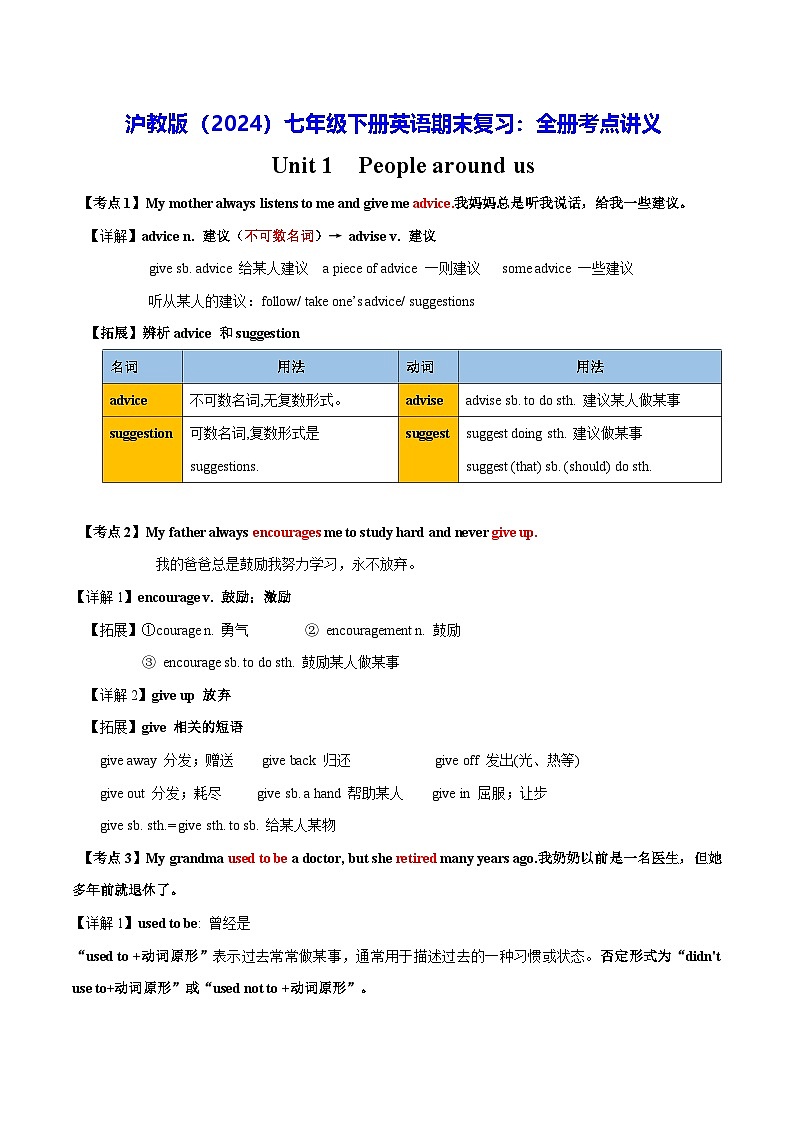
【考点1】My mther always listens t me and give me advice.我妈妈总是听我说话,给我一些建议。
【详解】advice n. 建议(不可数名词)→ advise v. 建议
give sb. advice 给某人建议 a piece f advice 一则建议 sme advice 一些建议
听从某人的建议:fllw/ take ne’s advice/ suggestins
【拓展】辨析advice 和suggestin
【考点2】My father always encurages me t study hard and never give up.
我的爸爸总是鼓励我努力学习,永不放弃。
【详解1】encurage v. 鼓励;激励
【拓展】①curage n. 勇气 ② encuragement n. 鼓励
③ encurage sb. t d sth. 鼓励某人做某事
【详解2】give up 放弃
【拓展】give 相关的短语
give away 分发;赠送 give back 归还 give ff 发出(光、热等)
give ut 分发;耗尽 give sb. a hand 帮助某人 give in 屈服;让步
give sb. sth.= give sth. t sb. 给某人某物
【考点3】My grandma used t be a dctr, but she retired many years ag.我奶奶以前是一名医生,但她多年前就退休了。
【详解1】used t be: 曾经是
“used t +动词原形”表示过去常常做某事,通常用于描述过去的一种习惯或状态。否定形式为“didn't use t+动词原形”或“used nt t +动词原形”。
例句:I used t g t schl by bike. 我过去常常骑自行车上学。
He didn't use t smke. 他过去不抽烟。
【拓展】be / get used t ding 习惯于
I am / get used t getting up early.我习惯早起。
【详解2】retire: v. 退休 →retired adj. 退休的 (同时也是retire的过去式和过去分词)
例句:My father retired last year.我父亲去年退休了。
He is retired nw. 他现在已经退休了。
【考点4】She is kind t everyne and very patient with peple and she is always cheerful.她对每个人都很好,对人也很有耐心,而且她总是很高兴。
【详解1】be kind t : 对友善的= be friendly t
【详解2】cheerful:adj. 欢快的,高兴的。同义词:glad,happy。
【拓展】cheer v. (为)欢呼,加油 短语:cheer sb. up 使某人振奋起来/ 使某人开心
例句:She tld him a funny stry t cheer him up. 她给她讲了一个有趣的故事,让他开心起来。
【详解3】patient:adj. 有耐心的 → impatient 没有耐心的
短语:be patient with sb. v. 对…有耐心
【拓展】patient 还可以作名词,意为“病人”。
例句:The dctr is patient with his patients. 这名医生对他的病人们很有耐心。
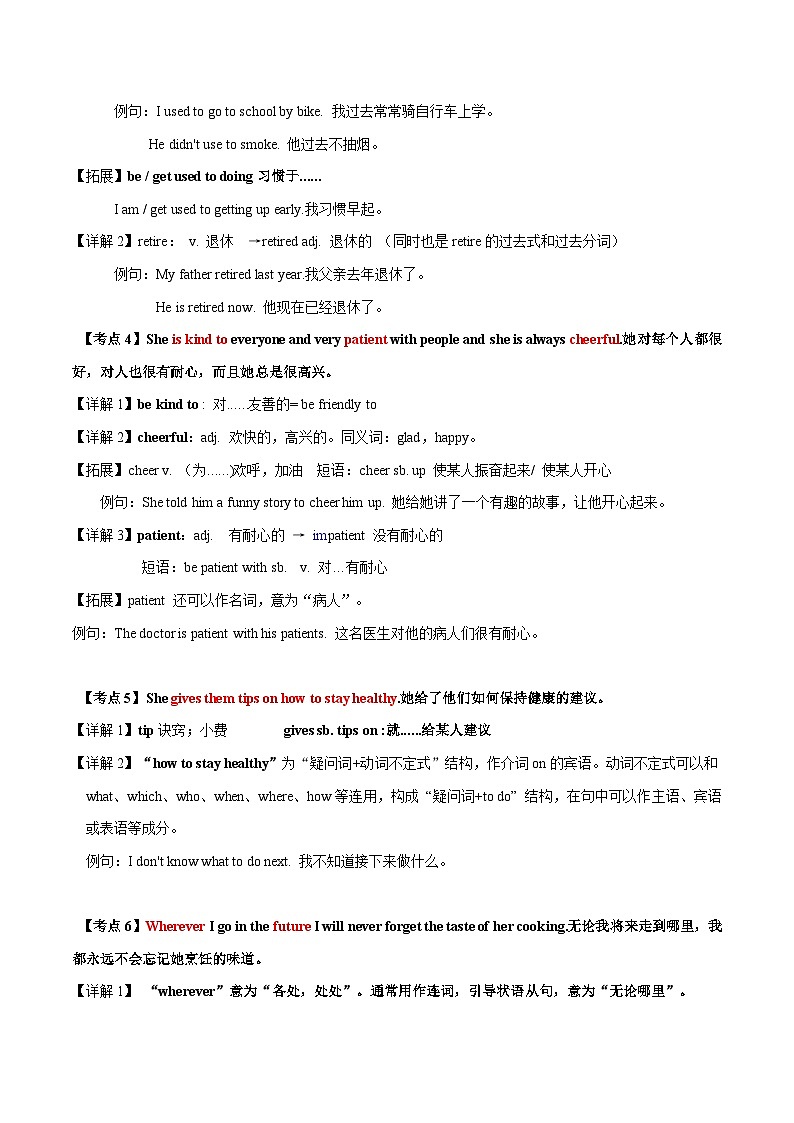
【考点5】She gives them tips n hw t stay healthy.她给了他们如何保持健康的建议。
【详解1】tip 诀窍;小费 gives sb. tips n :就给某人建议
【详解2】“hw t stay healthy”为“疑问词+动词不定式”结构,作介词n的宾语。动词不定式可以和what、which、wh、when、where、hw等连用,构成 “疑问词+t d” 结构,在句中可以作主语、宾语或表语等成分。
例句:I dn't knw what t d next. 我不知道接下来做什么。
【考点6】Wherever I g in the future I will never frget the taste f her cking.无论我将来走到哪里,我都永远不会忘记她烹饪的味道。
【详解1】 “wherever”意为“各处,处处”。通常用作连词,引导状语从句,意为“无论哪里”。
另有whenever,hwever,whichever,whatever等作连词,引导状语从句。
例句:The puppy fllwed the girl wherever she went. 无论小女孩去哪里,小狗都跟着她。
【详解2】future n. 未来;将来。短语“in the future”意为“在将来”,常与一般将来时连用。
例句: He hpes he will be able t fly in the future. 他希望在未来他能够飞起来。
【考点7】She is in hspital nw.We are very wrried and we hpe she gets well sn.她现在在住院。我们很担心,希望她能早日康复。
【详解1】in hspital: 住院 (辨析:in the hspital 在医院里)
【详解2】sn adv. 很快;马上;不久; 作时间状语,通常用于将来时。也可用于其他时态,根据具体语境而定。
I will finish my hmewrk sn.我会很快完成作业。
She is ging t travel t Eurpe sn.她不久将要去欧洲旅行。
I sn realized the mistake.我很快意识到犯了错误。
The aspirins sn take effect.阿司匹林药品很快见效。
【拓展】Hw sn “多久之后;还要多久”针对时间进行提问,与一般将来时连用。通常用“in+时间段”来回答,“in”表示“后”。
--Hw sn will yu get up? 你多久才能起床?
--In an hur. 一个小时以后。
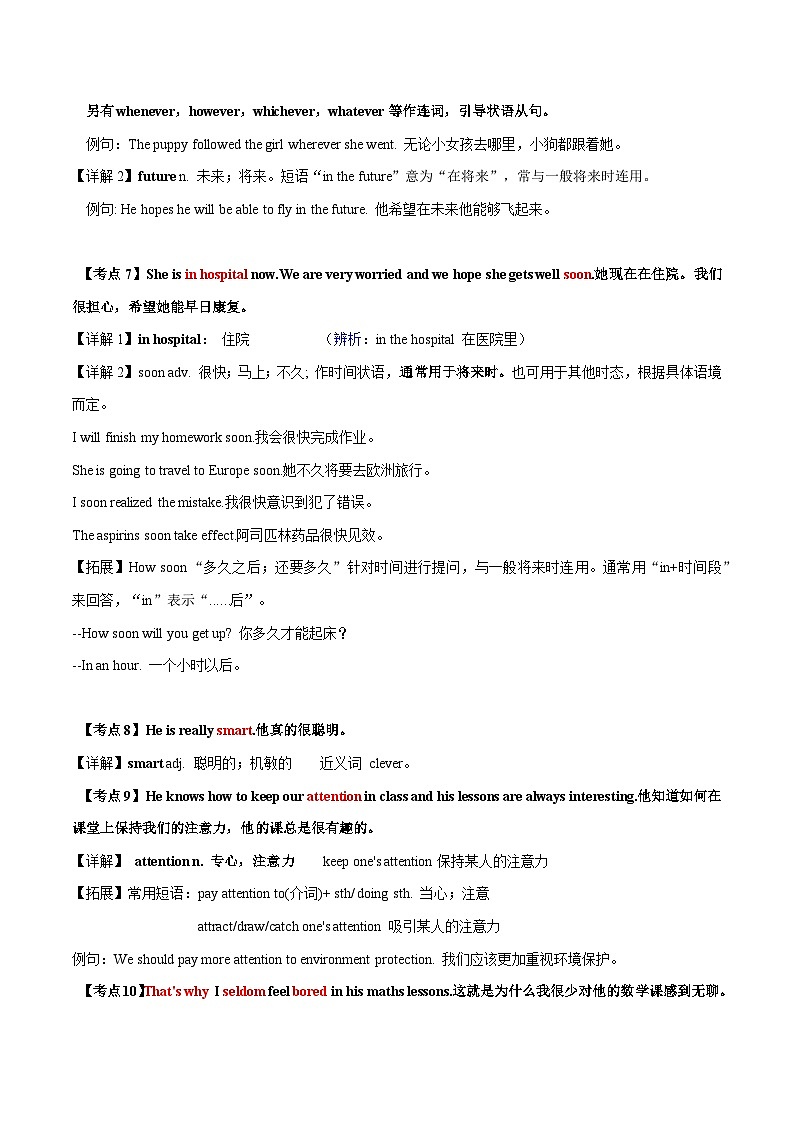
【考点8】He is really smart.他真的很聪明。
【详解】smart adj. 聪明的;机敏的 近义词 clever。
【考点9】He knws hw t keep ur attentin in class and his lessns are always interesting.他知道如何在课堂上保持我们的注意力,他的课总是很有趣的。
【详解】 attentin n. 专心,注意力 keep ne's attentin 保持某人的注意力
【拓展】常用短语:pay attentin t(介词)+ sth/ ding sth. 当心;注意
attract/draw/catch ne's attentin 吸引某人的注意力
例句:We shuld pay mre attentin t envirnment prtectin. 我们应该更加重视环境保护。
【考点10】That's why I seldm feel bred in his maths lessns.这就是为什么我很少对他的数学课感到无聊。
【详解1】“That's why...”意为“这就是为什么;这就是的原因”。
【拓展】辨析that's why 和that's because
【详解2】seldm adv. 不常;很少;难得
【拓展】 频度副词的用法
【详解3】bred:adj. (感到)无聊的
【拓展】辨析bring 和bred
【考点11】Mr Li is strict abut ur schlwrk but he gives us lts f supprt when we need help.李先生对我们的学校作业很严格,但在我们需要帮助时,他给了我们很多支持。
【详解】strict adj.要求严格的;严厉的
【拓展】be strict abut sth:对某事要求严格
例句:She is very strict abut things like hmewrk. 她对家庭作业之类事很严格。
be strict with sb.:对某人要求严格
【考点12】If we cannt wrk ut a difficult maths prblem, he will encurage us t think abut it in a new way.如果我们不能解决一个数学难题,他就会鼓励我们以一种新的方式来思考它。
【详解1】这是由if引导的条件状语从句,主句用一般将来时,从句则用一般现在时,即“主将从现”。
例句: He will help yu if yu ask him. = If yu ask him, he will help yu.如果你问他,他会帮助你。
【要点复习】
1. if意为“如果”,引导条件状语从句,既可放在主句前面,也可放在主句后面。若if条件句放在句首,从句后面要加逗号与主句隔开。
If yu g there , I'll g , t.如果你去那儿,我也会去。
My mther will take me t the park if she is free.我妈妈如果有空,就会带我去公园。
2.时态运用在含有if引导的条件状语从句的主从复合句中,主句有下列情况之一时,从句要用一般现在时表示将来意义。
(1)主句是一般将来时。
(2)主句谓语含有情态动词may/might/can/must/shuld 等。
(3)主句是祈使句
3.句型转换
(1)借助“祈使句+and/r+句子(一般将来时)”这一句型来转换。其中,在句意上 and表示顺承;r 表示转折,意为“否则”。
If yu study hard , yu’ll pass the exam easily.= Study hard and yu’ll pass the exam easily.
努力学习,你将很容易通过考试。
(2)借助 withut 或 with 来转换条件状语从句。
If there is n water , fish will die.= Fish will die withut water.如果没有水,鱼将会死。
If yu help me , I'll finish the wrk sn.= With yur help , I'll finish the wrk sn.
如果你帮助我,我将很快完成工作。
助记:if引导的条件状语从句(if)条件句,放在前,逗号要放主句前;(if)条件句,表条件,主将从现是关键。
【考点13】He's walking n a narrw plank, nt wrried abut the height.他走在一块狭窄的木板上,并不担心这个高度。
【详解1】narrw adj. 狭窄的;窄小的 →(反义词)wide:宽的
短语:a narrw escape 死里逃生 narrw-minded 心胸狭窄的
【拓展】narrw 还可以作动词,意为“使缩小,压缩;使变窄”。
例句:We shuld narrw the gap between rich and pr. 我们应该缩小贫富之间的差距。
【详解2】(be)wrried abut 担心;担忧
例句:Every time the exam is ver, I will be wrried abut the results.
每次考试结束后,我都会担心考试成绩。
【拓展】
① wrry abut 担心;担忧;是动词短语,强调动作。be wrried abut 侧重状态。
② wrried 用于形容人感到担忧的;wrrying 多用于修饰事物,意为“令人担忧的”。
③ wrry 的用法
(1)wrry后面可接宾语从句,意为“担心,担忧”。
如:I always wrried that I culdn't pass the exam.我总是担心我考试不能通过。
(2)wrry作及物动词,还可以跟sb.作宾语,意为“使担心,使发愁”。
如:Nthing wrries me.没有什么让我发愁。
(3) wrry作不及物动词,常单独使用或与abut连用,意为“担心某人或某事物”。
如:Dn't wrry. Everything will be OK. 别担心。一切都会没事的。
I have nthing t wrry abut. 我没什么可担心的。
(4)wrry作不可数名词意为“烦恼,担忧”;作可数名词意为“令人烦恼的人或事物”。
如:He has n wrry at all. 他没有一点烦恼。
She is full f wrries. 她有种种烦恼。
【考点14】Ya Yuan is active in ur cmmunity.姚元在我们的社区很活跃。
【详解】active adj. 忙碌的;活跃的 cmmunity:社区
【拓展】actively adv. 积极地;活跃地 activity: n. 活动
take an active in: 积极参加 be active in: 在中积极参与
【考点15】Ya Yuan als use his time wisely.姚元也合理地利用他的时间。
【详解】wisely adv. 明智地
【词汇拓展】wisely adv.→ wise adj. 明智的(unwise adj. 不明智的)→ wisdm n. 智慧
【常考句型】It’s wise f sb. t d sth. 某人做某事是明智的...
【考点16】What des she d? 她是做什么的?
【详解】询问职业的句型
①What d/ des sb. d? ② What is/ are+主语? ③ What is sb's jb?
Unit 2 Travelling arund the wrld
【考点1】France is ne f the mst visited cuntries in the wrld.法国是世界上游客最多的国家之一。
【详解】“ne f the+ 形容词最高级+名词复数”,表示“最的之一”。
例句:She is ne f the mst ppular teachers. 她是最受欢迎的教师之一。
【拓展】France n. 法国 →French adj. 法国的,法国人的 n. 法语
【考点2】It is in Western Eurpe and it is a beautiful cuntry rich in histry and culture.
它位于西欧,是一个历史和文化丰富的美丽国家。
【详解】rich adj. 丰富多彩的;富有的 → enrich v. 充实;使丰富/富含/富有
(反义词)pr adj. 贫穷的,贫乏的
【拓展1】①be rich in... 富于;在方面丰富 (反义)be pr in... 贫乏; 在…方面差
例句:This area is rich in natural resurces. 这个地区富含自然资源。
He is pr in English. 他的英语水平很差。
②the rich 富人 the pr 穷人
【拓展2】Eurpe /ˈjʊərəp/ n. 欧洲→ Eurpean /ˌjʊərəˈpiːən/adj. 欧洲的 n. 欧洲人 (注意发音)
【考点3】It lies in the nrth f the cuntry and the river Seine runs thrugh its centre.它位于这个国家的北部,塞纳河穿过它的中心。
【详解】lie v. 位于; 躺 (过去式lay-过去分词lain;现在分词lying)
【拓展1】①lie作动词还有“说谎”的意思。(lie→过去式lied→过去分词lied;现在分词lying)
例句:Dn't lie t me. 别对我说谎。
②lie 作名词是“谎言”的意思。例句:She tld a lie t me yesterday.她昨天对我撒谎了。
【拓展2】lie+方位介词(in,n, t)
图解:
【拓展3】辨析thrugh和acrss
【考点4】Here yu will find many places f interest, such as the Eiffel Twer and the Arc de Trimphe.在这里,你会发现很多名胜古迹,比如埃菲尔铁塔和凯旋门。
【详解1】 place f interest 名胜古迹 复数形式:places f interest
【详解2】辨析such as和fr example
(1)such as 用于列举事物,后面一般接名词或者名词词组,可以是多个,不用逗号隔开。
(2)fr example 用于举例说明,后面一般接句子,要用逗号隔开。
例句: ①He has been t many cuntries, such as America, Japan and Germany.
他去过很多国家,比如美国、日本和德国。
②Jim is a kind persn, fr example, he ften helps thers in truble.
吉姆是一个好心人,例如,他经常帮助陷入困境的人。
【考点5】The lcal farmers grw great grapes t make excellent French wine.
当地的农民种植优质的葡萄,酿造出优质的法国葡萄酒。
【详解1】excellent是形容词,意为“极好的,优秀的”。既可形容物,又可形容人。如:
excellent wrk 出色的工作;an excellent student 一个优秀的学生。
Zhang Yining is an excellentping png player. 张怡宁是个出色的乒乓球运动员。
【详解2】 wine n. 葡萄酒(不可数名词)
酿酒: make wine 白葡萄酒:white wine 红葡萄酒:red wine
【考点6】 It lies n France's suth-east cast and is famus fr its wnderful beaches.它位于法国的东南海岸,以其美丽的海滩而闻名。
【详解】cast:n. 海岸;海滨 be famus fr 因而出名
【拓展】
【考点7】It is the perfect place fr a summer hliday.这是一个完美的暑假度假的地方。
【详解】perfect adj. 完美的;十分适合的→ adv. perfectly 完美地
【习语】Nbdy is perfect.人无完人。
【拓展】perfect v. 使完善;使完美
I need mre time t perfect this draft.我需要更多时间来完善这份稿件。
注意:perfect这个词,不存在比较级和最高级。因为它们本身已经代表了某种绝对的含义。
【考点8】If yu want t get a taste f French wine culture, yu shuld visit the Lire Valley.
如果你想体验一下法国葡萄酒文化,你应该参观卢瓦尔河谷。
【详解】①这是一个if引导的条件状语从句。主句含有情态动词can/may/might/must/shuld等,从句用一般现在时。(主情从现)
例:If yu want t be healthy, yu shuld keep a gd diet.如果你想保持健康,你应该保持良好的饮食。
② get a taste f 品尝;体验
【拓展】taste:n. 味道; 体验;鉴赏力 v. 品尝(实义动词); 尝起来(系动词)→ tasty adj.美味的
例句:I dn't like the taste f cffee.我不喜欢咖啡的味道。
He has a gd taste in music.他在音乐方面有很好的鉴赏力。
Wuld yu like t taste the new dish?你想尝尝这道新菜吗?
The sup tastes delicius.这汤尝起来很美味。(系动词+adj.)
【考点9】But if yu prefer t visit France in winter, yu can g skiing in the French Alps.
但如果你喜欢在冬天去法国旅游,你可以去法国的阿尔卑斯山滑雪。
【详解】prefer:v. 偏爱;更喜欢 g skiing 去滑雪
【拓展1】prefer的用法
【拓展2】g+ ding(通常用来进行或从事某项体育或娱乐活动。)
如: g camping 去野营 g swimming 去游泳 g fishing 去钓鱼 g bating 去划船
g shpping 去购物 g hiking 去徒步 g sightseeing 去观光 g walking 去散步
【考点10】France has smething fr everyne, s why nt visit France this year?
法国有适合每个人的东西,所以今年为什么不参观法国呢?
【详解】句型“why nt d sth. ”意为 为什么不…呢?= why dn’t yu d sth ?
例句:Why nt take a few days ff? 为什么不休息几天呢?
Why dn't yu ask him fr his advice? 你为什么不征求他的意见?
【拓展】表示建议的句型:
1.Yu’d better+动原... 你最好……
2.Shall 我们……好吗?
3.Let's... 让我们……吧!
4.Why dn’t yu/Why nt+动原 为什么不……呢?
5.What/Hw abut+ ……怎么样?
6.Will/Wuld/Culd yu 请你……好吗?
【考点11】Gvernments have set up natinal parks t save ur natural heritage,such as unique landscapes and endangered wildlife.政府已经建立了国家公园来保护我们的自然遗产,如独特的景观和濒危的野生动物。
【详解1】set up 建立 (set-set-set)
【拓展】set 相关的短语
set ff 出发,燃放;使...爆炸 set dwn 制定;放下;记下 set ut 出发
set aside 分出;放在一边 set abut 开始;着手 set an example t/fr sb 为某人树立榜样
【详解2】unique adj.独特的;罕见的
常见短语: be unique t...(某地或某人)独具的,特有的
例句:Everyne's fingerprints are unique.每个人的指纹都是独一无二的。
Kangars are unique t Australia. 袋鼠是澳大利亚所独有的。
【详解3】endangered adj. 濒危的
【拓展】构词法 :en+ danger+ ed=endangered
(1) danger n. 危险 in danger 处于危险中 ut f danger 脱离危险
(2) endanger v. 危及;使遭受危险 (3) dangerus adj. 危险的
【考点12】See the playful pandas in the wild all year rund.全年都在野外看顽皮的熊猫。
【详解】in the wild 在自然环境下,在野外 all year rund 全年,一年到头
【拓展】wild adj. 野生的 n. 自然生长;野生状态 → wildly adv. 疯狂地;粗暴地,野蛮地
其他短语:wild animals 野生动物 (be)wild with jy 狂喜
【考点13】This park is hme t ver 1,600 wild giant pandas.这个公园里是1600多只野生大熊猫的家园。
【详解】be hme t:是...的家园/栖息地 giant panda 大熊猫
例句: Zhngguancun is hme t abut 9,000 high tech cmpanies. 中关村拥有约9000家高科技公司。
【考点14】Imagine that yu are visiting yur dream travel destinatin.想象一下,你正在参观你梦想中的旅行目的地。
【详解】 imagine v. 想象 destinatin:n. 目的地
【拓展】 imagine → imaginatin /ɪˌmædʒɪˈneɪʃn/n. 想象力;想象
imagine ding sth. 想象做某事/ imagine sth. 想象某事(物)
imagine +从句
例句:It is difficult t imagine a wrld withut bks.一个没有书的世界是很难想象的。
Yu can't imagine what a great teacher she is!你无法想象她是多么好的一位老师。
【考点15】Discver the pandas' amazing neighburs, such as glden mnkeys and lepards.
发现大熊猫的神奇邻居,如金丝猴和豹子。
【详解】discver v. 了解到;查明;发现 → discvery n. 发现
glden mnkey金丝猴
【拓展】辨析discver,find,find ut,lk fr, invent
1、lk fr意为 “ 寻找” ,强调寻找的过程。同义词组:search fr 。
2、find 意为 “找到(一般事物)”,强调寻找的结果,若后接从句,表示 “发现"。
3、find ut 意为 “查明(事实或事情的真相)”。
4、discver意为 “发现”,指发现本来存在,但以前未为人知或未被发现的事物、真理或情况。
5. invent 意为“发明”。意为“发明,发明之物”指“从无到有”。
【考点16】It is mstly painted by hand. 它大部分是手工绘制的。
【详解】mstly adv. 主要地;大部分;通常 by hand 手工
【拓展1】辨析mst 、mstly和 almst
1.mst 既可以作形容词也可以作副词。
①mst 作形容词时,意为“大部分的,大多数的”,修饰名词,前面不用冠词。与mst f同义,但mst f后的名词前必须加冠词。
如:Mst f the students had left when he came in.=Mst students had left when he came in.
② mst作副词时,修饰形容词或者副词,用来加强语气,表示“极,十分”;也可以用来构成形容词或者副词最高级。
如:It’s mst dangerus fr teenagers t swim in the river alne in summer.
夏天青少年独自在河里游泳是极其危险的。
This is the mst cmfrtable htel in this city.这个旅馆是这座城市里最舒适的。
③at mst, 固定搭配,意为“最多”,与at least相对。
Yu can play chess fr at mst 2 hurs a day.你每天最多可以下棋2个小时。
2.mstly:副词,意为“主要地,多半地”,相当于mainly.
He uses his bike mstly fr ging t schl.他主要用自行车去上学。
3.almst:副词,意为“几乎”,相当于very nearly.
He spent almst his pcket mney buying his favrite stry bks.他几乎花了零用钱去买他最喜欢的故事书。
Unit 3 Trees and us
【考点1】What else d trees d fr us?树木还对我们做什么呢?
【详解】else adv. 另外;其他。通常用于复合不定代词或疑问词后。
例句:I have smething else t tell yu. 我还有别的事要告诉你。
Wh else wants t have a try? 还有谁想尝试一下呢?
【考点2】We share ur wrld with trees.我们与树木共享我们的世界。
【详解】share with 和……分享;共享
share sth. with sb. ...和某人分享某物
例句:Sme f them have t share with ne anther.有些学生不得不和别的同学分享。
I’d like t share my happiness with all f yu.我想和你们大家分享我的快乐
【考点3】In fact, trees are very imprtant fr all living things n earth. 事实上,树木对地球上所有的生物都非常重要。
【详解】in fact 事实上= actually
例句:In fact, everyne can make it.事实上,每个人都能做到。
【拓展】辨析living, live ,alive和lively
(1)alive 意为“活的, 活着的”, 没有比较级和最高级, 可用作表语和后置定语, 指人或动物, 不能用来指
植物。
例句:The fish is still alive. 这条鱼还活着。
(3)living 意为“活着的; 现存的”, 指人或物可用作表语和定语, 作定语时要放在所修饰的名词前。还可作名词,意为“生存之道,生计”;make a living 谋生。
例句:He is regarded as ne f the best living writers at present. 他被认为是当代健在的最好的作家之一。
live 意为“有生命的; 活的; 现场播出的”, 可作定语, 指动物或植物, 不能用来指人。
例句:It wasn’t a recrded shw. It was live. 它不是录制节目, 是实况转播。
(4)lively意为“有生气的; 活泼的”, 可用作定语、表语和宾语补足语, 指人或物。
例句:Jenny is a lively girl. 詹妮是个活泼的女孩。
【考点4】Trees are als gd fr us humans because they take in greenhuse gases like carbn dixide and prduce xygen.树木对我们人类也有好处,因为它们会吸收二氧化碳等温室气体并产生氧气。
【详解】take in 此处意为“吸收;吸入”;take in还有“欺骗”的意思。
【拓展】take相关短语
【考点5】Trees make ur lives mre cnvenient.树木使我们的生活更方便。
【详解】cnvenient adj: 方便的;便利的
【派生词】cnveniently adv. 便利地;合宜地 cnvenience n. 便利;方便;便利设施
incnvenient adj: 不方便的; 不便利的
【拓展】It is cnvenient t d sth. ... 做某事很方便
例句:It is cnvenient t take a bus at the bus stp.在公交车站乘坐公交车非常的方便。
【拓展】make +宾语+adj.(宾补)
We'll d ur best t make yu happy. 我们会尽一切努力使你幸福。
【考点6】A lt f the furniture is made f wd.很多家具都是用木头做成的。
【详解1】furniture是不可数名词。furniture一般用来表示“设备,家具,储藏物”,指室内的可移动的大件物品,是所有家具的总称。没有复数形式。
furniture表示“量”,可用much,little,a little,a lt f,lts f等修饰,但不能用many,few,a few等修饰。若要表示“数”,可用a piece f(article,item)f等修饰。若要表示“一套家具”,可用a suite f修饰。
We will buy sme furniture fr ur new huse。我们得给我们的新房子买些家具。
This ld table is a valuable piece f furniture.这张旧桌子是一件很珍贵的家具。
【详解2】be made f 由...制成(看得出原材料)
【拓展】辨析be made f; be made frm;be made int; be made in;be made by
be made f:短语意为“由... ...(材料)制成”,能看出原材料。
如:The table is made f wd. 这张桌子是木头做的。(看得出原材料)
be made frm:短语意为“由... ...(材料)制成”,不能看出原材料。
如:Paper is made frm wd. 纸是木头做的。(看不出原材料)
be made int:其中介词int有“进入...;到...”之意,故短语意为“被制成...”,后加“成品”,指某物被制作成另一物。如:The fruit can be made int jam. 这种水果可以制成果酱。
be made by:其中介词by有“被”之意,故短语意为“被...(某人)制作”,后加“制造方”。
如:The table in the kitchen was made by a lcal craftsman. 厨房里的桌子是本地一位工匠制作的。
be made in:其中介词in有“在...”之意,故短语意为“被制作于...(某地)”,后加“地点”。
如:My phne is made in China.我的电话是中国制造。
【详解3】wd n. 木材,木头(不可数名词)
【拓展】wds: n. 森林 wden: adj. 木制的
【考点7】Fr example, we can make tea frm the leaves f the tea tree.例如,我们可以用茶树的叶子来泡茶。
【详解】fr example: 例如;譬如。一般只举同类人或物中的一个为例,常用作插入语,可缩写为e.g.。
【拓展】辨析fr example 和 such as
I like fruits very much, such as apples, pears, grapes, strawberries, and s n.
我非常喜欢水果,例如苹果,雪梨,葡萄,草等。
Fr example, air is invisible.例如,空气是看不见的。
He, fr example, is a gd student.例如,他就是个好学生。
【考点8】We can't imagine a wrld withut them.我们无法想象一个没有他们的世界。
【详解】imagine v. 想象;设想
【派生词】imaginatin n. 想象;想象力 imaginative adj: 富有想象力的
【拓展】imagine用法
①imaging (ding) sth.意为“想象(做)某事”。
It is difficult t imagine a wrld withut bks.一个没有书的世界是很难想象的。
She imagined walking int the ffice and handing in her resignatin. 她想象着自己走进办公室,递上辞呈。
② imagine+从句:意为“想象…”。
Yu can't imagine what a great teacher she is!你无法想象她是多么好的一位老师。
Just imagine (that)smene were fllwing us.想象一下要是有人在跟踪我们。
【考点9】Hwever, humans are nt treating trees in a kind way. 然而,人类并没有善待树木。
【详解】treat v. 对待,看待 in a kind way:以一种友好的方式
【拓展】treat... as/like...: 把看作……
例如:Dn't treat me as/like a child.”(不要把我当作小孩子看待。)
treat 作动词还有 “治疗;医治”的意思。
例如:The dctr is treating his illness.(医生正在治疗他的病。)
treat 作动词还有 “请客;款待”的意思。常见表达有 “treat sb. t sth.”。
例如:“He treated us t a big meal.”(他请我们吃了一顿大餐。)
【考点10】We are cutting dwn frests all arund the wrld.我们正在砍伐世界各地的森林。
【详解】cut dwn 意为“砍伐;砍倒”。该短语是“动词+副词”结构,若宾语为代词,代词要放在中间,如cut them dwn.
【拓展】cut相关的动词短语
cut ff 切除;剪下,切断(电,气) cut dwn 砍倒;削减
cut up 切碎 cut in 插嘴;干预
cut in line 插队 cut ut删掉;切除
cut … int pieces / halves 把……切成碎片/切成两半
【考点11】call n peple t stp cutting dwn trees呼吁人们停止砍伐树木
【详解】call n: 动词短语,意为“号召;动员;要求”。
call n sb. t d sth. 号召某人去做某事; 另 call n+sb. 表示“拜访某人”。
【拓展1】call的相关短语
call back 回电话call ff 取消
call n / upn 号召;要求call up 打电话给
make a call 打电话answer a call 接电话
【拓展2】stp的用法
【考点12】We can brrw bks frm the library r share bks with friends r classmates...我们可以从图书馆借书,或者与朋友或同学分享书
【详解】brrw v. 借,借用; 常用短语: 从借(入)
【拓展】辨析brrw,lend 和keep
【考点13】Accrding t a Chinese legend, Shen Nng discvered tea by accident when sme leaves fell frm a tree int his drink. 根据中国的一个传说,神农偶然发现了茶,当时一些树叶从树上掉到他的饮料中。
【详解1】Accrding t:意为“根据”,为复合介词,后接名词或代词。注意以下用法:
(1)主要用来表示“根据”某学说、某书刊、某文件、某人所说等或表示“按照”某法律、某规定、某惯例、某情况等。如:
Everything went ff accrding t plan. 一切都按照计划实现了。
Accrding t my watch it is five ’clck. 照我的表,现在是5点钟。
Each man will be paid accrding t his ability. 每个人将根据他的能力获得报酬。
accrding t 表示“根据”,通常是指根据别人或别处,而不能根据自己,所以其后不能接表示第一人称的代词(如me, us),同时也很少接表示第二人称的代词(yu),但用于第三人称(如 him, her, Jim, Mary, the dctr等)则属正常用法。如:
误:Accrding t me, the film is wnderful.
正:In my pinin, the film is wnderful. 依我看,这部电影很不错。
(3)另外注意,accrding t后也不接view(看法)和pinin(意见)这类词表示看法的词。如:
误:Accrding t my pinin, he did it very well.
正:In my pinin, he did it very well. 在我看来,他干得很不错。
【详解2】accident n. 事故,意外;偶然
短语:by accident= by chance 偶然地;意外地 traffic accidents 交通事故
【考点14】Nt lng after Lu Yu died, tea culture quickly spread acrss the cuntry and he became knwn as the Sage f Tea.陆羽死后不久,茶文化迅速传遍全国,他被称为“茶圣”。
【详解1】 spread v. 传播 → 过去式 spread →过去分词 spread
spread acrss... 遍布,遍及= spread all ver
【拓展】spread 做动词还有“开展;伸开”的意思。
如:The bird slwly spread its wings.这只鸟慢慢地张开了翅膀。
【详解2】be/ becme knwn as = be /becme famus as被认为是;号称;作为...而出名
【拓展】be/ becme knwn fr= be /becme famus fr 因...而出名
be knwn t sb.为 所知
Unit 4 Our animal friends
【考点1】"Gd evening, sir," said the receptinist when Jhn arrived at the htel. “晚上好,先生,”当约翰到达旅馆时,接待员说。
【详解】辨析arrive in(at)/ reach/ get t
【考点2】... but we dn't allw pets here. 但我们不允许宠物进来。
【详解】allw的用法
①allw ding sth. 允许做某事
例:The library desn’t allw talking t lud. 图书馆里不允许大声喧哗。
②allw sb. t d sth. 允许某人做某事
例:D yur parents allw yu g ut t play at midnight?
③be (nt) allwed t d sth. (不)被允许做某事
例:I am allwed t play games by my parents after I finish my hmewrk n weekends.
【考点3】I'm blind, and it's hard fr me t get arund by myself.我是个盲人,一个人很难四处走动。
【详解】①blind adj. 失明的;盲的 → blindly adv. 盲目地;无目的地
②by neself 单独;独自(alne r independently)= n ne's wn
③句型:It is +adj.+fr sb. + t d sth. (做某事对某人来说是的)
例:It is imprtant fr us t g t schl n time. 准时去上学对我们来说是很重要的。
【考点4】The receptinist aplgized and led Jhn and Charlie t their rm.接待员道了歉,把约翰和查理领到他们的房间。
【详解1】aplgize的用法
①aplgize t sb. 向某人道歉= make an aplgy t sb.
Yu shuld aplgize t the ld man.=Yu shuld make an aplgy t the ld man你应该向这位老人道歉。
②aplgize fr sth./ ding sth. 因(做)某事而道歉
He aplgized fr his rude behavir.他为自己的粗鲁行为道歉。
③aplgize t sb. fr sth./ding sth. 因(做)某事向某人道歉
例: I must aplgize t yu fr the delay in replying t yur letter.我必须为没有及时回复你的来信而道歉。
【详解2】的用法 {lead-led(过去式)-led(过去分词)}
①lead sb. t sp.= take sb. t sp. 带某人去某地
例:The guide led us t the Great Wall. 导游把我们带到了长城。
②lead t 导致
例:His carelessness led t the traffic accident.他的粗心大意导致了这次交通事故。
【考点5】He went t bed and sn fell asleep.他上床睡觉,很快就睡着了。
【详解】fall asleep 入睡;睡着 (fall的过去式是__fell__)
【拓展】辨析asleep和sleepy
【拓展】辨析g t bed、g /get t sleep、fall asleep
1、g t bed:表动作,指“去睡觉”。
I g t bed at 11 'clck every day.我每天11点上床睡觉。
2、g /get t sleep:表动作,指进入“睡着”状态。
I was s wrried that I culdn't get t sleep last night.昨晚我担心得无法入睡。
3、fall asleep:表动作,意为“刚刚入睡”,指“刚睡着”这动作。
He fell asleep when there was a lud knck at the dr.他刚睡着,这时有人大声敲门。
【考点6】Jhn wke up and smelt smke.约翰醒来,闻到了烟味。
【详解1】wake up 醒来
wake的过去式是__wke___;含义:醒来(不及物);叫醒(及物)。
【详解2】smell 的过去式是 smelt/smelled, 意为“闻到,闻起来”。还可以作名词,意为“气味;嗅觉”。
例:It smells delicius.它闻起来很好吃。
The smell f cffee filled the rm. 房间里弥漫着咖啡的气味。
【详解3】smke n.烟 v. 吸烟
例:Peple shuld give up smking. 人们应该戒烟。
【考点7】With Charlie’s help, Jhn put sme wet clthes alng the bttm f the dr. 在查理的帮助下,约翰把一些湿衣服放在门缝底部。
【详解】with ne’s help 在某人的帮助下= with the help f sb.需用 宾格(如 me, him, the team)
例:I passed the exam with my teacher’s help.= I passed the exam with the help f my teacher.
【考点8】Then he gt dwn n the flr next t Charlie and waited.然后他趴在查理旁边的地板上等着。
【详解】get dwn 蹲下;趴下
【拓展】get+介词/副词的相关短语
get up 起床 get arund 四处走动 get n 上车 get ff 下车
get thrugh完成(任务);通过(考试);接通电话 get ver 克服
get alng (with)与某人相处融洽
【考点9】Finally, the fireman gt bth Jhn and Charlie ut f the building safely.最后,消防队员把约翰和查理安全救出了大楼。
【详解1】 意为“”两者都,既…又…,用于连接两个并列成分。当连接两个并列成分做主语时,谓语动词用复数形式。
例:She is bth kind and knwledgeable.
She is bth a teacher and a writer.
Bth the teacher and the students were excited abut the trip.
【详解2】get sb. ut f 使某人从...出来,使某人脱离
例:The plice helped them ut f danger. 警察帮助他们摆脱了危险。
【考点10】Yur stry can either be based n a news reprt r a real-life experience.你的故事可以基于新闻报道或真实的经历。
【详解】either…r...的意思是“或者...或者”,它表示:在两个选项中做出选择。用来连接相同类型的事物、短语、从句或单词。
例:He can be cntacted either by phne r by email. 可以通过电话或电子邮件与他联系。
Either yu g by plane t that cuntry r yu get a lt f truble during the jurney.
你要么坐飞机去那个国家,要么在旅途中遇到很多麻烦。
either... r... 位于句首连接两个主语时,谓语动词的单复数要与后面的名词或代词保持一致。
例:Either he r she cks dinner.要么他或她要么做饭。
【拓展】常见的就近原则:there be, , , nt nly... but als...,
例句:1. Neither yu nr she is wrng.你和她都没错。(be动词和she保持一致)
2. There are sme cats and a dg.这里有几只猫和一只狗。(be动词和sme cats保持一致)
3. Nt yu but yur friends are nt friendly.不是你,而是你的朋友不友好。(be动词和yur friends保持一致)
4. Nt nly the teacher but als the students want t see the film.不仅老师,学生也想去看这部电影。(谓语动词want和students保持一致)
【拓展】辨析t, als, as well, either
【考点11】The stry f dmesticatin started smewhere in Asia abut 15,000 t 23,000 years ag.驯化的故事开始于15000到23000年前的亚洲某处。
【详解】smewhere adv. 某处,在某处
【拓展】辨析anywhere, smewhere, everywhere, nwhere
【考点12】Peple in West Asia started t dmesticate aurchs, a kind f wild x, smetime after 8,000 BCE.西亚人在公元前8000年左右的某个时间开始驯养野牛,这是一种野牛。
【详解】smetime adv. 在某时
【拓展】辨析smetime、smetimes、sme time、sme times
Unit 5 Water is life
【考点1】Where can yu find water in yur everyday life?你在日常生活中在哪里可以找到水?
【详解】everyday adj. 日常的;每天的
【拓展】辨析everyday 和 every day
①every day 是副词短语,意思是“每天”,表示频率通常用作句子的时间状语。
例:I g t schl n ft every day.我每天步行去上学。
②everyday 是形容词意思是“日常的,每天的”,同义词为daily。仅用在名词之前作定语,不能单独使用。
例:The Internet has becme part f everyday life.互联网已成为日常生活的一部分。
【考点2】The jurney f a drp f water一滴水的旅程
【详解1】 jurney n. (尤指长途)旅行
【拓展】 辨析trip, jurney, travel和vyage
【详解2】drp n. 滴; 水珠 a drp f... 一滴 (作动词,意为“v. 落下”)
【考点3】The tap was n. 水龙头开着。
【详解】n 此时是副词,意为“开着”。be n表示“已连接、处于工作中的状态”。
类似的还有: The class is ver. 课程结束了。
【考点4】"Turn that tap ff!" said an angry vice suddenly.“关掉那个水龙头!”突然有一个愤怒的声音说。
【详解1】turn ff 意为“关闭(水、电、电器等)”。当宾语为代词时,代词要位于中间。 如:Turn it ff。
【拓展】turn的相关短语辨析
【详解2】vice n. 说话声
【拓展】辨析nise, vice, sund
【考点5】I fell int a river and eventually ended up in a reservir.我掉进了河里,最后掉进了一个水库。
【详解】eventually adv. 最后,终于 。其同义表达有finally,in the end,at last 等。
“fell int”意为“掉入,落入”,fell的动词原形为___fall______.
【拓展】end up 是一个常用的动词短语,表示 “最终处于某种状态” 或 “以某种结果告终”,常用于描述意外或非计划中的结局。详细用法如下:
①end up + 地点/状态
They gt lst and ended up in a small village.(他们迷路了,最终到了一个村庄。)
If yu dn’t study, yu’ll end up failing the exam.(如果你不学习,考试会不及格。)
②end up + ding sth(最终做了某事)
We ended up staying hme because f the rain.(因为下雨,我们最终待在了家里。)
③end up with + 名词(最终有某物/处于某种情况)
He gambled all his mney and ended up with nthing.(他赌光了钱,最后一无所有。)
【考点6】There peple cleaned me and added sme chemicals t me.那里有人给我清洗干净,还给我加了一些化学物质。
【详解】add: v.添加;增加。“” 意为“把...加到...里”。另外 add 还有“加”的意思。
例: I added sme water t the chicken sup just nw. 我刚才在鸡汤里加了一些水。
Add 2 and 3 t get 5. 2加3得5.
【考点7】Because I was a bit dirty. 因为我有点脏了。
【详解】a bit 意为“稍微;有点儿”,具体用如下。
①a bit可用于修饰形容词、副词的原级和比较级,此时可与a little 互换。
例如:I am a bit hungry.=I am a little hungry.我有点饿了。
②a bit若修饰名词,需要加介词f,即“a bit f”作形容词,后面加不可数名词。而 a little可直接修饰不可数名词。
例如:There is a bit f water in the bttle. =There is a little water in the bttle.瓶子里有一点水。
【考点8】 Then I'll g int a river, and after that I'll return int the sea again.然后我就进入一条河里,然后再回到海里去。
【详解】return v. 返回;归还 n. 回来;归还
1. 不及物动词:直接接 t + 地点,表示回到某处。直接接 frm+ 地点,表示从某处回来。也可单独使用(无需加地点)。
She returned t her hmetwn. (她回到了家乡。)
He returned frm wrk at 6 PM. (他6点下班回来。)
2. 及物动词:return + 物品 (t + 人/地点) 归还(物品)给
Please return the bk t the library. (请把书归还图书馆。)
I will return yur call later. (我会稍后回电。)
【拓展】return 还可以作名词,意为“归来;回归”。“in return” 意为“作为回报;作为回应”。
【考点9】 Remember nt t waste r pllute me. I'm valuable.记住不要浪费或污染我。我是很宝贵的。
【详解】remember t d sth. 意为“记得要去做某事”;其否定表达为 remember nt t d sth.
【拓展】辨析remember t d和remember ding sth.
【考点10】 If yu lk at a ppulatin map f any cuntry in the wrld, yu will see that mst peple live clse t water.如果你看一下世界上任何一个国家的人口地图,你会发现大多数人都住在水边。
【详解】ppulatin n. 人口;族群;具体用法如下:
1.ppulatin 常与定冠词the连用,作主语时,谓语动词常用第三人称单数形式。询问人口数量用句型:
A.What is the ppulatin f…? 这是最常见的询问某地人口数量的句型。例如:
What is the ppulatin f China?中国的人口是多少?
B.Hw large / hw big is the ppulatin f…?这个句型也可以用来询问人口数量,其中“hw large”和“hw big”都可以用来形容人口规模的大小。例如:
Hw large is the ppulatin f India? 印度的人口规模有多大?
C.Hw many peple are there in…? 虽然不如前两个句型正式,但这个句型同样可以用来询问某个地方的人口数量。例如:
Hw many peple are there in New Yrk City? 在纽约市有多少人?
2.当主语是表示人口的百分之几、几分之几时,谓语动词用复数形式。
例如:Abut seventy percent f the ppulatin in China are farmers.中国大约有百分之七十的人口是农民
表示人口的“多”或“少”,不用much或little,要用large或small。
China has a large ppulatin. (中国人口众多。)
4.表示“某地/某一范围内有多少人口”时,用have/has a ppulatin f。
例如:The village has a ppulatin f nly 500 peple. (这个村庄仅有500人。)
【考点11】At the end f the 18th century, water played a big rle in the Industrial Revlutin.18世纪末,水在工业革命中发挥了重要作用。
【详解1】rle n. 角色;地位;作用。
“play a big rle in...”意为“在...发挥了重要作用”。同义表达为:play a big part make a big difference t...。
例:Technlgy played a big rle(part) in imprving mdern healthcare.
=Technlgy made a big difference t imprving mdern healthcare.
科技在改善现代医疗中发挥了重要作用。
【详解2】At the end f ... 意为:在…结尾,在…末端
例:At the end f the mvie, everyne clapped.(电影结束时,大家都鼓掌了。)
At the end f the path, there is a small park.(小路的尽头有一个小公园。)
【考点12】As a result, the cities that were clse t water grew much larger.结果,靠近水的城市变得更大了。
【详解】"as a result" 是一个表示因果关系的连接词,意为 "因此,所以,结果",用于连接前后两个具有因果关系的句子。
例:He studied hard. As a result, he passed the exam. 他努力学习。结果,他通过了考试。
【拓展】"as a result f + 名词/动名词"(表原因,意为 "由于...")
例:The event was canceled as a result f bad weather.(由于天气恶劣,活动取消了。)
【考点13】Nearly all f these cities are n the cast r by rivers r lakes.几乎所有这些城市都位于沿海或河畔或湖畔。
【详解】nearly的基本含义:表示 "几乎,差不多",强调接近某个状态或数量,但未完全达到。具体用法:
1. 修饰动词(表示动作或状态接近完成)
位置:通常位于实义动词前(be动词、情态动词或助动词后)。
She nearly fell when she tripped n the stairs.(她在楼梯上绊了一下,差点摔倒。)
I’ve nearly finished reading this bk.(我快读完这本书了。)
2. 修饰形容词或副词(表示程度接近)
位置:位于形容词/副词前。
The bttle is nearly empty.(瓶子几乎空了。)
He ran nearly as fast as an athlete.(他跑得几乎和运动员一样快。)
3. 修饰数量或时间(表示接近具体数值)
位置:直接放在数字或时间前。
Nearly 100 peple attended the meeting.(将近100人参加了会议。)
It’s nearly midnight; we shuld leave nw.(快半夜了,我们该走了。)
【考点14】This is because cities need water fr peple's hmes, industry, business, turism and leisure activities.这是因为城市需要水来满足人们的居住、工业、商业、旅游和休闲活动。
【详解1】“This is because...”意为“这是因为...”。具体用法如下:
【详解2】business 意为“n. 商业,生意;商务”。
【拓展】businessman: n. 商人 n business: 出差 nne f ne's business 与某人无关,不关某人的事
【考点14】It is nw ur duty t make sure we dn't waste water r pllute it.现在我们有责任确保我们不浪费水或污染它。
【详解1】duty:n.责任;义务
【拓展】①n/ff duty(值班/下班)
例:Nurses must stay n duty fr 12 hurs.(护士需连续值班12小时。)
② It is ne’s duty t d sth. 做某事是某人的责任
例:It’s my duty t help him. 帮助他是我的责任。
【详解2】make sure 意为“确保”。具体用法如下:
①. make sure + (that) 从句
用法:确保某动作完成或某状态存在(that 可省略)。
例句:Please make sure (that) the dr is lcked.(请确保门已锁好。)
②. make sure t d sth 确保做某事
用法:提醒或要求某人必须做某事(强调动作本身)。
例句:Make sure t turn ff the lights befre leaving.(离开前务必关灯。)
③. make sure f/abut sth
例句:Yu shuld make sure abut the terms befre signing.(签约前需确认条款细节。)
④. make sure + 疑问词从句(where/when/hw等)
例句:He made sure hw the machine wrks.(他弄清了机器的运作方式。)
【考点15】She wanted t tell her diary abut this at nce. 她想马上把这件事告诉她的日记。
【详解】at nce 意为“立即,马上”,在句中通常做状语,常位于句末,可与right away,immediately或right nw互换。
例:Leave the rm at nce if yu feel uncmfrtable! 如果感到不舒服,请马上离开房间!
Unit 6 Electricity everywhere
【考点1】What d the pictures have in cmmn?这些图片有什么共同之处?
【详解】have smething in cmmn 有相同的特点/特征
【拓展】①have a lt/much in cmmn有很多共同之处
例:We have a lt in cmmn.(我们有很多共同点。)
②have nthing/little in cmmn 没有共同之处
例:They have nthing in cmmn.(他们毫无共同之处。)
③ cmmn adj. 意为:常见的;普遍的 如:cmmn sense 常识
adj.意为:共有的;公共的 如: a cmmn gal一个共同的目标 cmmn grund共同立场
【考点2】 Why d yu think electricity is imprtant? 为什么你认为电对我们很重要?
【详解】 electricity n. 电;电力 save electricity 节约用电
【拓展】辨析electric/electrical/electrnic
快速记忆口诀:Electric:电驱动,直接带电;Electrical:电系统,工程覆盖;Electrnic:电子芯,数字主宰。
【考点3】Then she gave us a special task t try living withut electricity fr a weekend.然后她给了我们一个特别的任务,让我们试着过一个没有电的周末。
【详解1】task n. 任务;活动
【拓展】give sb. a task(t d) 给某人一个(做某事的)任务 a task f ding sth. 一个做...的任务
cmplete/finish a task完成任务
【考点4】 Hwever, it turned ut that it was very hard t live withut electricity.然而,事实证明,没有电是很难生活的。
【详解】turn ut 表示“结果是,原来是”,使用如下:
①turn ut+形容词(例The cake turned ut delicius.)
②turn ut+不定式(例:She turned ut t be a dctr.)
③turn ut+that从句(例It turned ut that they were friends.)
【考点5】Instead, we played vide games fr a while, but then ur tablet ran ut f battery.取而代之的是,我们玩了一会儿电子游戏,但后来我们的平板电脑没电了。
【详解1】while n. 表示“一段时间”,常与介词搭配,如 fr a while(一会儿)、after a while(过了一阵子)。
【详解2】ran ut f 意为“耗尽;用完”。
例: He ran ut f patience.他的耐心耗尽了。
【拓展】辨析run ut f 和 run ut
【详解3】battery n. 电池 → batteries (复数)
【考点6】Since there wasn't any electricity, sme things in the fridge quickly went bad.因为没有电,冰箱里的一些东西很快就坏了。
【详解1】g bad 表示“变质”。g 在这里表示“变得(坏的方面)”,是系动词,不能用副词修饰。
例:g mad 发疯 g wrng 出问题
【详解2】since 在此句中作连词,意为“由于,既然”,引导原因状语从句,语气比because弱。另外,since还可以引导时间状语从句,意为“自从...”。
原因:Since yu knw the answer, tell me.(既然你知道答案,告诉我。)
时间:I’ve lived here since I was brn.(自我出生就住在这里。)
【考点7】switch ff the lights when yu leave hme当你离开家时,请关掉那些灯.
【详解】switch ff:意为“关掉电源或设备”。(英式英语更常用,美式多用 turn ff)。
例:Turn ff / Switch ff the TV if yu’re nt watching it. 如果你不看电视,请关闭/关闭电视。
【拓展】
【考点8】 Read the instructins carefully befre yu use a new electrical appliance.在你使用一个新的电器之前,请仔细阅读用法说明。
【详解】instructin n.用法说明;用法指南 electrical appliance 电器
【拓展】 instruct v. 教导,指导 instructr n. n. 指导者,导师
【考点9】Mre than 2.2 millin hmes and businesses jined in. 超过220万家庭和企业加入了这一行列。
【详解】jin in 动词加介词短语,意为“参加;加入”。通常指参加或加入某个活动、讨论、游戏等。
【拓展】辨析take part in,jin,jin in,attend
【考点10】The same amunt f electricity culd pwer thusands f cmputers r televisin sets fr an hur.同样的电量可以为数千台电脑或电视机供电一小时。
【详解1】 amunt:n. n. 金额;数量(用于不可数名词),the amunt f...意为“的数量”。
【拓展】辨析the amunt f/ the number f; an amunt f/ a number f
【详解2】pwer v. 驱动;推动
【拓展】pwer 作名词,意为“动力;能量;权利”。如:slar pwer 太阳能。
形容词为pwerful,意为“ 有权力的;强有力的;强壮的”。
【考点11】It will be even mre fun if yu ask yur friends, family and classmates t jin as well.如果你邀请你的朋友、家人和同学加入,那会更有趣。
【详解】as well 意为“也”,常用于肯定句句末。
【拓展】辨析t, als, as well, either
【考点12】 We need t make sure that the cables are cnnected crrectly befre we turn n the device.在我们打开设备之前,我们需要确保电缆连接正确。
【详解】cnnect v.(使)连接
【拓展】①cnnect 把...连接到;相连
例句:The USB cable cnnects the camera t the cmputer.
②cnnect 把……与……联系起来
例句:The authr cnnected the stry with real histrical events.
③be cnnected with/ t与……相连/联系
例句:All yur festivals seem t be cnnected with histry.
Unit 7 Rle mdels f ur time
【考点1】 In 1999, he received the "Tw Bmbs and One Satellite" merit award.1999年,他获得了“两弹一星”优秀奖。
【详解】① receive v. 收到;接到;拿到。
例句: She received an award fr her hard wrk. 她因努力工作而获得了奖项。
I received a gift frm my friend。 我收到了朋友送的礼物。
【拓展】辨析receive和accept
② award :既可以作名词,也可以作动词,以下是详细介绍:
A.作名词:意为“奖;奖品;奖金;奖状”。常见搭配有“win an award(获得奖项)”“give an award(颁奖)”“an award ceremny(颁奖典礼)”等。
例:She wn an award fr her excellent perfrmance in the play.(她因在剧中的出色表演而获奖。)
B.作动词:意为“授予;奖励;判给”。常见用法有“award sb. sth.(授予某人某物)”,也可以用“award sth. t sb. ”。
例:In 1939, he was awarded a dctrate in aerspace engineering and mathematics.(P101)
1939年,他被授予航空航天工程和数学博士学位。
The cmmittee awarded him the first prize.(委员会授予他一等奖。)
【考点2】 He studied engineering at Shanghai Jia Tng University and then went t further his educatin in the USA.他在上海交通大学学习工程学,然后去美国深造。
【详解】①engineering n. 工程学 → engineer n. 工程师
② educatin n. 教育→ educate v. 教育→ educatr n.教师;教育家
→educatinal adj. 具有教育意义的
【拓展】further ne’s educatin进一步深造; further 在这里作动词,意为 “增进;促进”。
例句:Lts f students dream f furthering their educatin abrad.许多学生梦想着到国外继续深造。
【典例】1.他选择出国深造。
He chses t g abrad t .
【考点3】After that, he spent many years teaching and ding research at universities in the USA.
在那之后,他在美国的大学里从事了多年的教学和研究工作。
【详解】① spend v. 花费 (spent 过去式;spent 过去分词)
sth. 花(时间)做某事
例:Yesterday I spent an hur ding hmewrk.昨天我花了一个小时做作业。
② d research 做研究(注意:research表示“研究;探索”这一抽象概念时,是不可数的。)
【拓展】四大花费用法辨析(cst、spend、pay、take)
【考点4】Hwever, he decided t return t China when he heard f the funding f the Peple's Republic f China.然而,当他听说中华人民共和国成立时,他决定回国。
【详解1】hear f 听说;得悉 (近义表达:hear abut)
【拓展】 hear frm sb.(收到某人的来信)
【详解2】fund v. 建立 → funded (过去式)→ funded (过去分词)
【拓展】the funding f ... 的建立 be funded 被建立
例句:The Peple's Republic f China was funded in 1949. 中华人民共和国是在1949年建立的。
We are excited abut the funding f the Art Club. 我们对艺术俱乐部的成立感到兴奋。
【考点5】While in the USA, Qian achieved lts f success and he was a well-respected persn in his field.
在美国期间,钱取得了很大的成功,他在他的领域是一个受人尊敬的人。
【详解1】achieve v. 达到;实现 →achievement n. 成就;功绩;实现
【拓展】achieve ne's dream=realize ne’s dream = make ne’s dream cme true 实现某人的梦想
achieved lts f success 获得巨大的成功
【详解2】well-respected adj. 受尊敬的(respected 是respect的过去分词,意为受尊敬的),类似的表达还有 well-dressed (adj. 穿着入时的;穿着考究的);well-knwn(adj.知名的,著名的)等。
【详解3】field:n.领域;还有“田地;运动场;战场”的意思。
【拓展】 in the field f... 在领域 in the field 在田野里;在野外
【考点6】He was eager t bring his knwledge and skills t his hmeland and began planning his return. 他渴望将自己的知识和技能带到祖国,并开始计划回国。
【详解1】eager 是形容词,意为 “渴望的;热切的”;
be eager t d sth. 渴望做某事 be eager fr sth. 渴望某事(物)
例句:Tm is eager t travel arund the wrld. 汤姆渴望环游世界。
【详解2】begin ding sth. =begin t d开始做某事
【考点7】Qian devted himself t his cuntry, and his great wrk brught hnur and success t China.
钱将自己奉献给了祖国,他的伟大事业为中国带来了荣誉和成功。
【详解】devte neself t 致力于;献身于。注意:此时“t”是介词,后面加名词、代词、或v-ing。
【拓展】devte sth. t... 把(时间、金钱、生命等)奉献给
例句:She devted herself t helping the pr. 她致力于帮助穷人。
He decided t devte his life t helping thers. 他决定将一生奉献于帮助他人。
He devted five years t researching the effects f climate change. 他奉献5年时间研究气候变化的影响。
【考点8】Still, Qian lived a simple life and was nt interested in fame r mney. 尽管如此,钱过着简朴的生活,对名利不感兴趣。
【详解1】live a ... life 过着……生活
例如:live a happy/ better/ hard life 过幸福的/ 更好的/ 艰苦的生活
【详解2】 be interested in 对…… 感兴趣
【拓展】interest n. 兴趣 v. 使感兴趣 →①interested adj.感兴趣的 ② interesting adj. 有趣的
一言辨析: He is interested in the interesting stry. 他对这个有趣的故事很感兴趣。
【考点9】If after I die the public feels I have made sme cntributins during my life,that apprval wuld be the highest praise f all. 如果我死后,百姓觉得我在生前做出了一些贡献,这种认可将是最高赞誉。
【详解1】public n. 百姓,民众; adj. 公众的;公共的;公开场合的
【拓展】the public 公众,民众 in public 公开地,当众
注意:“the public”表示“公众,民众”,是集合名词,作主语时谓语动词的形式要根据具体语境来确定:
①把公众看作一个整体,此时谓语动词用单数形式。
The public is cncerned abut the envirnmental issues.(公众关注环境问题。)
②强调公众中的个体成员,此时谓语动词用复数形式。
The public have different pinins n this plicy.(公众对这项政策有不同的看法。)
【详解2】cntributins n. 贡献 → cntribute v. 贡献
【拓展】make a cntributin t/ make cntributins t.. 对做出贡献
cntribute t 有助于,促成;对…贡献
把……贡献给……;为……做贡献
例句:①Every little bit helps. Even a small actin can make a cntributin t saving the planet.
积少成多,即使一个小小的行动也能为拯救地球做出贡献。
②His hard wrk cntributed t the success f the business.他的努力工作促成了生意的成功。
③He decided t cntribute his savings t the charity t help thse in need.
他决定把自己的积蓄捐给慈善机构,以帮助那些有需要的人。
【详解3】praise n./ v. 称赞;赞扬
【拓展】praise sb. fr sth.:因某事赞扬某人。 in praise f:歌颂;为赞扬……
win high praise frm sb. : 获得某人的高度赞扬
例句:The teacher praised him fr his hard wrk. 老师因他努力学习而表扬了他。
He wrte a pem in praise f the natural beauty. 他写了一首诗赞美自然美景。
His bk wn high praise frm the public.他的书赢得了公众的高度赞扬。
【考点10】Once we land, we race t put ut the fire. 我们一着陆,就忙着灭火。
【详解】put ut : 扑灭
【拓展】常考put相关的短语
put away 收拾;放妥;放弃 put ff 推迟;延期;脱掉
put n 上演;穿上,体重增加 put… int 把 放入,表达;翻译
put dwn 放下;写下put up 举起;竖起;张贴
【考点11】We use simple tls t clear away dead leaves and trees t stp fires frm spreading.
我们使用简单的工具清理枯叶和树木,以阻止火势蔓延。
【详解1】dead:形容词,意为“死的;去世的”; leaves是leaf 的复数形式。单词释义
【拓展】die:动词,意为“死;去世;逝世”
death:名词,意为“死;死亡”
例句:He died last year.他去年去世了。
I cried because my pet dg was dead.我哭了,因为我的宠物狗死了。
She was sad abut her grandfather's death.她对她爷爷的去世难过不已。
【详解2】stp sb. (frm)ding sth. 阻止某人做某事= keep sb. frm ding sth. =prevent sb.(frm) ding sth.
例句:The heavy rain stpped us (frm) ging n a picnic.大雨阻止了我们去野餐。
Parents shuld stp children (frm) playing cmputer games fr t lng.
家长应该阻止孩子们长时间玩电脑游戏。
【考点12】Hwever, I am very prud f what I d.然而,我为我的工作感到非常自豪。
【详解】be prud f... 为... 而自豪
【拓展】prud 的名词是“pride”。be prud f... 为... 而自豪= take pride in...,后可加名词、代词、v-ing 或宾语从句。
例句:Yu shuld be prud f helping thers.(你应该为帮助他人而感到自豪。)
I am prud f my cuntry.(我为我的国家感到骄傲。)
Unit 8 Fllw yur interests
【考点1】 My dream jb is t be a phtgrapher. 我梦想的工作是当摄影师。
【详解】句型不定式作表语: 抽象名词+be+t d/ be...
当句子的主语是抽象名词(如 gal, dream, purpse, jb 等)时,常用 不定式(t d) 作表语,说明主语的具体内容或目标。
例如:His gal is t becme a dctr.(他的目标是成为一名医生。)
The purpse f this meeting is t slve the prblem.(这次会议的目的是解决问题。)
【考点2】Lk at the hbbies and suggest pssible jbs frm the list.看看这些爱好并从列表中提出可能的工作.
【详解】pssible adj.可能的 →①impssible adj.不可能的 ② pssibly adv.可能地 ③ pssibility n.可能性
【拓展】常用句型:It’ s pssible / impssible fr sb.+ t d sth. 做某事对某人来说是可能/ 不可能的
例句:It’ pssible fr us t finish the task in ne week.我们有可能在一周内完成这项任务。
常用短语:as+ adj./ adv.+as pssible: 尽可能
如:as sn as pssible 尽快; as much as pssible 尽可能多
例句:We will finish the prject as sn as pssible. 我们将尽快完成这个项目。
【考点3】That was the beginning f my lifetime interest. 那是我一生爱好的开始。
【详解1】 the beginning f 的开始
【拓展】at the beginning f VS. in the beginning
At the beginning f the bk, the authr intrduces the main characters.在书的开头,作者介绍了主要角色。
In the beginning, humans relied n hunting and gathering.起初,人类依靠狩猎和采集为生。
总结:at the beginning f + 具体时间段/事件(强调明确起点)= at the start f
in the beginning(单独使用,泛指“最初阶段”)= at first
【详解2】lifetime interest 终身兴趣
【拓展】interest的用法
①作名词,表示“兴趣;业余爱好”时,可用单数或复数(但含义不同)。常用短语: have n interest in
✅ He has an interest in phtgraphy.他对摄影很感兴趣。(具体兴趣)
✅ She pursued her interests in art and music.她追求自己对艺术和音乐的兴趣。(多种兴趣)
②作动词,意为“使感兴趣,吸引”。
✅ This bk interests me.这本书很吸引我。
③interested:感兴趣的; interesting:有趣的;常用短语: be interested in 对感兴趣
✅ The mvie was interesting. 这部电影很有趣。
✅ Frm that day n,she became really interested in animals. 从那天起,她就对动物产生了浓厚的兴趣。(教材原句)
【考点4】I used t g utside with my mum n clear nights and lk at the sky.我曾经在晴朗的夜晚和妈妈一起出去看天空。
【详解1】used t d/ be 过去常常(做……),曾经
✅ She used t be a shy girl.她过去是个害羞的女孩。
【拓展】辨析used t d sth.;be/get used t ding sth.; be used t d sth.
✅ I used t ride a bike. 我以前经常骑自行车。
✅ I'm used t getting up early. 我习惯早起了。
✅ This knife is used t cut bread. 这把刀子是用来切面包的。
=This knife is used fr cutting bread.
【详解2】n clear nights 在晴朗的夜晚。当表示在具体某一天的上午、下午、晚上等时段时,通常用介词“n”。
如:n sunny mrnings(在晴朗的上午) n rainy afternns(在下雨的下午)
【考点5】It lked like black velvet with a millin diamnds n it.它看起来像黑色天鹅绒,上面镶着一百万颗钻石。
【详解】lk like 看起来像(此时like作介词)
例句:Yu lk like yur mther.(你看起来像你妈妈。)
The mn lks like a big silver plate tnight.(今晚月亮看起来像个大银盘。)
【拓展】lk相关的短语
【考点6】In summer, we saw Vega shine brightly as it gt dark.Smetimes we saw stars shting acrss the sky.在夏天,当夜幕降临时,我们看到织女星发出明亮的光芒。有时我们看到星星划过天空。
【详解1】see sb./sth. d sth. 和see sb./ sth. ding
see sb./sth. d sth.:该结构强调看到动作发生的全过程,或者经常看到某一动作。这里的“d sth.”是不带t的不定式,描述的是一个完整的、已完成的动作。
例句:I ften see him play basketball n the playgrund after schl.我经常看到他放学后在操场上打篮球。
She saw the bird fly away.她看到那只鸟飞走了。
see sb./ sth. ding:侧重于描述看到某人或某物正在处于某个动作的进行当中。
例句:He saw a dg lying under the tree.他看到一只狗正躺在树下。
【详解2】sht acrss: 掠过;划过;飞过
sht v. 冲;奔;飞驰→ sht (过去式)
【考点7】Studying the stars was great fun fr me and I was extremely curius abut the night sky.
研究星星对我来说很有趣,我对夜空非常好奇。
【详解1】单个动名词(ding sth. )做主语,谓语动词用是单数。
例句:Swimming is gd fr health. 游泳对健康有益。
Learning a new language requires patience.学习一门新语言需要耐心。
【详解2】 extremely adv. 极其;极端;非常 (程度副词)
【详解3】 curius adj. 好奇的 → curisity n. 好奇;好奇心
【短语】be curius abut 对...好奇的
例句:She is curius abut different cultures. 她对不同的文化感到好奇。
【考点8】S I read a lt abut the tpic,and my understanding increased as I grew lder.
所以我读了很多关于这个话题的书。随着年龄的增长,我的理解也越来越深。
【详解】increase v. 增加;增长;增多; 也可做名词。
例句:The temperature increases in summer. (夏天温度会上升。)
There was a big increase in his grades. (他的成绩有了很大的提高。)
【拓展】increase by(增加了多少)
用法:表示“增加了某个数量或百分比”,后面接具体数值。
例句:❶ My pcket mney increased by 20 yuan this mnth.(我的零花钱这个月增加了20元。)
❷The price f apples increased by 5%.(苹果的价格上涨了5%。)
increase t(增加到多少)
用法:表示“从原来的数量增加到某个总数”,后面接最终数值。
例句:❶ The temperature increased t 25°C tday.(今天温度上升到了25摄氏度。)
❷ My savings increased t 500 yuan.(我的存款增加到了500元。)
总结:increase by + 数值 → 强调“增加了多少”(差值)。
increase t + 数值 → 强调“最终达到多少”(总数)。
【考点9】 I teach my audience abut the different stars in a lively way.
我以一种生动的方式向观众讲解不同的星星。
【详解1】teach sb. abut sth.
用法:表示“教某人关于某事”,“teach”是及物动词,后面接双宾语,即“sb.”(间接宾语)和“abut sth.”(直接宾语)。
【拓展】teach的主要用法
【详解2】in a lively way:以一种生动有趣的方式 (注意介词的使用)
lively: adj. 充满趣味的;令人兴奋的
例句:He tld a lively stry and it made us laugh. 他讲了一个生动有趣的故事,让我们都笑了。
【拓展】以-ly结尾的形容词:friendly友好的;lvely可爱的、美好的;lnely孤独的、寂寞的;
daily每日的、日常的;weekly每周的;deadly 致命的 等等。
【辨析】 live, living, alive与lively的区别
【考点10】My TV prgramme has lasted mre than 50 years,and I am really prud f that!
我的电视节目已经持续播出 50多年了。
【详解1】last ①v. 持续 ;延续
例句:The meeting nly lasted (fr) a few minutes. 会议只持续了几分钟。
【详解2】be prud f 为……感到骄傲;为……自豪
例句: Her parents are very prud f her.她的父母以她为自豪。
【拓展】拓展
(1) be prud t d sth. 为做某事而感到自豪
She is prud t help the ld peple in the nursing hme.她为能在养老院帮助老人们而感到自豪。
(2) be prud + that从句 为……感到自豪
They are prud that their team has wn the first prize.他们为自己的团队获得一等奖而感到骄傲。
【考点11】Actually,yu t can turn yur interests int yur career. 事实上,你也可以把你的兴趣变成你的事业。
【详解1】actually adv. 事实上= in fact actual adj. 真实的,实际的;真正的
【详解2】turn... int... 把变成...
例句: Water turns int ice at 0℃. 水在0度变成冰。
【考点12】I never feel bred with dancing. 我从来不会对跳舞感到厌烦。
【详解】 feel bred with sth./ ding sth. 对感到厌烦的
例句:I feel bred with this kind f TV shw.我对这类电视节目感到厌烦。
He feels bred with ding the same wrk every day.他对每天做同样的工作感到厌倦。
【拓展】bred: 感到无聊的;感到厌烦的 bring:adj. 令人厌烦的,无聊的
例句:I'm really bred with this bring lecture.我真的对这场无聊的讲座感到厌烦透顶了。
【考点13】When she was a 16-year-ld schlgirl, Jane dreamt f a career studying wild animals in Africa.当她还是个16岁的女学生时,简就梦想着以研究非洲野生动物为职业。
【详解】 16-year-ld:意为“ 16岁的”,是一个合成形容词。主要用于修饰名词,且一般放在被修饰名词之前,起到限定或描述该名词的作用。不能作表语。
例如:He is a five-year-ld by。他是个五岁的男孩。
This is a three-meter-lng rpe. 这是一根三米长的绳子。
【详解】dream n. 梦(想);理想/ v. 做梦;渴望; 梦想 →过去式:dreamt/ dreamed
dream f+ n/ ding sth.: v. 梦想某物/ 梦想做某事...
achieve ne’s dream= make ne’s dream cme true 实现某人的梦想
例如:I dream f a big huse by the sea.我梦想着有一座海边的大房子。
She dreams f becming a famus singer.她梦想着成为一名著名的歌手。
Jane Gdall made her dreams cme true because she never gave up. (教材原句)
简·古道尔让她的梦想成真,因为她从不放弃。
【考点14】Jane gave the chimpanzees human names and cmpared them t humans.简给黑猩猩取了人类的名字,并将它们与人类进行比较。
【详解】cmpare: v.将...比作
【拓展】辨析cmpare... t... VS cmpare... with...
:“把……和……比较”,常强调同类相比。
例句:Please cmpare this bk with that ne and tell me which is mre interesting.
请把这本书和那本比较一下,然后告诉我哪本更有趣。
:有时可与“”互换。表示“把……比作……”时只能用“” 。
例句:We ften cmpare children t the flwers f ur cuntry.我们经常把孩子比作祖国的花朵。
Peple cmpare teachers t candles because they give light t thers.人们把老师比作蜡烛,因为他们照亮别人。
名词
用法
动词
用法
advice
不可数名词,无复数形式。
advise
advise sb. t d sth. 建议某人做某事
suggestin
可数名词,复数形式是suggestins.
suggest
suggest ding sth. 建议做某事
suggest (that) sb. (shuld) d sth.
辨析
用法
例句
that's why...
后接某事产生的结果,含义是“这就是为什么...”。
He was ill. That’s why he was sent t the hspital. 他病了,所以被送到医院来。
that's because...
后接某事发生的原因,含义是“那是...的原因”。
He was sent t the hspital. That’s because he was ill. 他被送到医院,是因为他生病了。
辨析
用法
一言辨析
bring
adj. 主要用于修饰事物的特征。
She feels bred because this film is bring.
她感到很无聊这部电影很无趣。
bred
adj. 主要用于描述人的感受。
辨析
用法
例句
in
表示在某个范围之内
China is in Asia.中国在亚洲。
n
表示两者接壤
Nrth Krea is n the nrtheast f China.朝鲜在中国的东北方。
t
表示在某个范围之外,不接壤
The United States is t the west f China.美国在中国的西边。
辨析
用法
例句
thrugh
介词。强调从物体中间或内部穿过。
The sunlight shne thrugh the windw.
阳光透过窗户照射进来。
acrss
介词。强调横穿,从物体表面穿过。
I walked acrss the rad.我穿过了马路。
crss
动词。crss=g/walk/run/swim acrss
横过/路过/跑过/游过
I crssed the rad.我穿过了马路。
易混词
含义与用法
例句
arrive
不及物动词,后接宾语时要加介词in(大地点)或at(小地点)。arrive也可单独使用。
He arrived at the bus statin.他到达了公交车站。
He arrived in Paris yesterday.他昨天到达了巴黎。
When will he arrive? 他什么时候到?
reach
reach及物动词,后面可以直接加宾语。
Finally we reached the tp f the muntain.
最终我们到达了山顶。
get
与“t”连用,表示达到。相当于arrive in/ at 或reach。
We gt t the schl ne hur ag.
我们一小时前就到了学校。
注意:
注意:当arrive, get后接表示地点的副词,如here, there, hme等时,则不用介词,即arrive/get+地点副词。
词条
含义及用法
asleep
意为“睡着的”,用作表语。 例: fall asleep 入睡
sleepy
意为“昏昏欲睡的;困倦的”,用作表语 例:feel sleepy 犯困的
词条
用法
例句
t
位于肯定句句末,其前通常用逗号隔开。
I like reading, and I like music, t.
我喜欢阅读,也喜欢音乐。
als
位于be动词、助动词之后,行为动词之前。
当位于句首时,其后用逗号与句子的其他部分隔开,修饰整个句子,相当于“同时;还;而且”。
He is a teacher, and he is als a writer.
他是一名老师,也是一名作家。
Als, we shuld check the weather frecast.
另外,我们还应该查看一下天气预报。
as well
位于肯定句句末,其前不用逗号隔开。
She enjys painting, and she lves singing as well.
她喜欢画画,也喜欢唱歌。
either
位于否定句句末,其前用逗号隔开。
I dn’t like cffee, and I dn’t like tea, either.
我不喜欢咖啡,也不喜欢茶。
易混词
含义与用法
例句
smewhere
“在某处”,用于肯定句
It must be smewhere in this rm.
一定在这个房间里的某个地方。
anywhere
“在任何地方”,用于疑、否句中
I can't find it anywhere.我在任何地方都找不到它。
everywhere
“各个地方,各处”
Technlgy is everywhere.科技无处不在。
nwhere
“无处,哪里都不”
My bk is nwhere t be fund.我的书哪里也找不到。
词条
含义及用法
smetime
副词,意思为“在某个时候”,可与将来时连用,也可与过去时连用。
如:He was here smetime last year. 去年某个时候他在此地。
We shall visit the Science Museum smetime next week.
我们将在下周的某个时间去参观科学博物馆。
smetimes
频度副词,意思为“有时,时不时”。
如:Smetimes I g t the library. 有时我会去图书馆。
sme time
名词词组,意为“一段时间”.如:I stayed here fr sme time. 我在这儿待了一段时间。
sme times
名词词组,意为“几次,几倍”。
如:I have warned him f the danger sme times.我已几次警告他危险。
词条
用法
trip
指短期的具有特定目的的旅行。常用短语:take a trip 去旅行
jurney
指稍长的旅途
travel
是最常用的,指旅行或普通出行
vyage
指海上航行
词条
含义
用法
nise
噪音;喧闹声
意为“噪音;喧闹声”, 常指不悦耳、不和谐的嘈杂声。
vice
嗓音;说话声
指人的嗓音或说话、唱歌时发出的声音;或指鸟叫声。
sund
声音
泛指人们听到的各种“声音”, 可以是人或动物的声音, 也可以是大自然的任何声音。
结构
含义区别
例句对比
remember t d
记得要去做(未做)
She remembered t buy milk.(她记得要去买牛奶。)
remember ding
记得做过(已做)
She remembered buying milk.(她记得买过牛奶。)
frget t d
忘记要做(未做)
He frgt t call me.(他忘了打电话给我。)
frget ding
忘记做过(已做但忘记)
He frgt calling me.(他忘记给我打过电话。)
辨析
用法区别
例句
This is because+原因
直接解释前句原因
The ppulatin grew.(结果) This is because healthcare imprved.(原因)人口增长了。这是因为医疗保健状况有所改善。
That's why + 结果
用已知原因引出结果,强调由前文原因导致的后果。
He never checks the weather frecast.(原因)That's why he gt caught in the rain yesterday.(结果)
(他从不看天气预报,这就是为什么他昨天淋雨了。)
口诀总结:"Because" 后跟因,"Why" 后跟果要记清。前因后果用 "why",前果后因 "because" 行。
辨析
核心含义
搭配场景
electric
adj.用电的;由电驱动的。指直接由电驱动或产生电的事物(物理层面的电)。
electric car电动汽车
electric kettles 电水壶
electrical
adj.电力科学的,与电有关的。指与电相关的系统、技术或抽象应用(工程或功能层面)。
electrical system电气系统,
electrical appliance电器设备
electrnic
adj.电子的;电子设备的。依赖电子元件(如电路、芯片)或数字技术。
electrnic device电子设备,
electrnic music电子音乐
短语
核心区别
例句
try t d sth.
努力/试图做某事(强调付出努力,结果可能成功或失败)。
She tried t finish her hmewrk early.
她努力想早点完成作业。
try ding sth.
尝试做某事(强调用某种方法试试看效果,或建议某种解决方案)。
Try adding sugar if the cffee is bitter.
如果咖啡苦,试着加点糖。
try ne’s best t d sth.
尽某人最大努力做某事
I’ll try my best t finish the task n time.
我会尽力按时完成任务的。
词条辨析
主语
结构
例句
run ut f
人
人 + run ut f + 物
I ran ut f mney.(我的钱用完了。)
run ut
物
物 + run ut
The mney ran ut.(钱用完了。)
辨析
含义
例句
switch ff(同turn ff)
关闭(电器)
Switch ff the TV befre bed.(睡前关电视。)
switch n(同turn n)
打开(电器)
Switch n the lights, please.(请开灯。)
词条
含义及用法
take part in
一般指积极地参加大型的集体性的活动、集会等,并发挥一定作用。如:
Hw many cuntries will take part in the Wrld Cup?有多少个国家要参加世界杯?
Are yu ging t take part in the discussin? 你打算参加那个讨论吗?
jin
指加入到某团体、组织或某些人中,并成为其中一员。
如:She jined a health club. 她参加了一个健身俱乐部。
We bth jined the Labr Party. 我们俩都加入了工党。
jin in
意思为“参加”,后面接的宾语一般是表示竞赛、娱乐、游戏等活动的名词或v. -ing. 如:Can I jin in the game?我可以参加这个游戏吗?
They all jin in singing the sng. 他们一起唱这首歌。
attend
一般指参加、出席会议、报告等活动,不强调参加者在活动中所起的作用。
如:Our teacher attended the meeting yesterday. 我们老师昨天参加了那个会议。
I have prmised t attend her wedding. 我已经答应她去参加她的婚礼了。
短语
修饰对象
含义
主谓一致
例句
a number f
可数名词复数
许多(≈ many)
复数动词
A number f students are studying here.
(许多学生在此学习。)
the number f
可数名词复数
...的数量(强调总数)
单数动词
The number f students is increasing.
(学生数量在增加。)
an amunt f
不可数名词
一定量的(≈ sme)
单数动词
An amunt f mney was dnated.
(捐了一笔钱。)
the amunt f
不可数名词
...的总量(强调具体量)
单数动词
The amunt f water is limited.
(水的总量有限。)
词条
用法
例句
t
位于肯定句句末,其前用逗号隔开。
I like reading, and I like music t.
我喜欢阅读,也喜欢音乐。
als:
位于句中。be动词、助动词之后,行为动词之前。
He is a teacher, and he is als a writer.
他是一名老师,也是一名作家。
as well
位于肯定句句末,其前不用逗号隔开。
She enjys painting, and she lves singing as well.
她喜欢画画,也喜欢唱歌。
either
位于否定句句末,其前用逗号隔开。
I dn’t like cffee, and I dn’t like tea ,either.
我不喜欢咖啡,也不喜欢茶。
词条
含义及用法
alive
意为“活的, 活着的”, 没有比较级和最高级, 可用作表语和后置定语。例如:
He was still alive after the accident.(事故之后他还活着。)
Wh is the greatest man alive?(当今最伟大的人是谁?)
living
意为“活着的; 现存的”, 指人或物可用作表语和定语, 作定语时要放在所修饰的名词前。例如:
All living things need water.(所有生物都需要水。)
He is the greatest living writer.(他是在世的最伟大的作家。)
live
意为“活的;直播的;现场直播的”, 可作定语, 指动物或植物, 不能用来指人。例如:
We watched a live ftball match.(我们观看了一场现场直播的足球比赛。)
The cat is playing with a live muse.(猫正在玩一只活老鼠。)
lively
意为“活泼的;充满生气的;生动的” ,可用作定语、表语和宾语补足语,,可用来修饰人、物或氛围等。例如:
She is a lively girl.(她是个活泼的女孩。)
The party was very lively.(聚会很热闹。)
He gave a lively descriptin f the event.(他对事件作了生动的描述。)
这是一份沪教版(2024)七年级下册英语期末复习:全册考点讲义(含答案),共49页。学案主要包含了考点10,考点11,考点12,要点复习,考点13,考点14,考点15,词汇拓展等内容,欢迎下载使用。
这是一份沪教版(2024)七年级下册英语期末复习:全册语法讲义(无答案),共53页。学案主要包含了、用适当的冠词a;an;the,、按要求完成句子,、翻译下列含反身代词的短语等内容,欢迎下载使用。
这是一份沪外教版(2024)七年级上册英语期末复习讲义(含答案),共19页。
注册成功
资料篮

在线客服
添加在线客服
获取1对1服务
官方微信
关注“教习网”公众号
打开微信就能找资料
赛课定制
添加在线客服
获取1对1定制服务
职称咨询
添加在线客服
获取1V1专业指导服务

免费福利